Get in touch with LFADJ Company

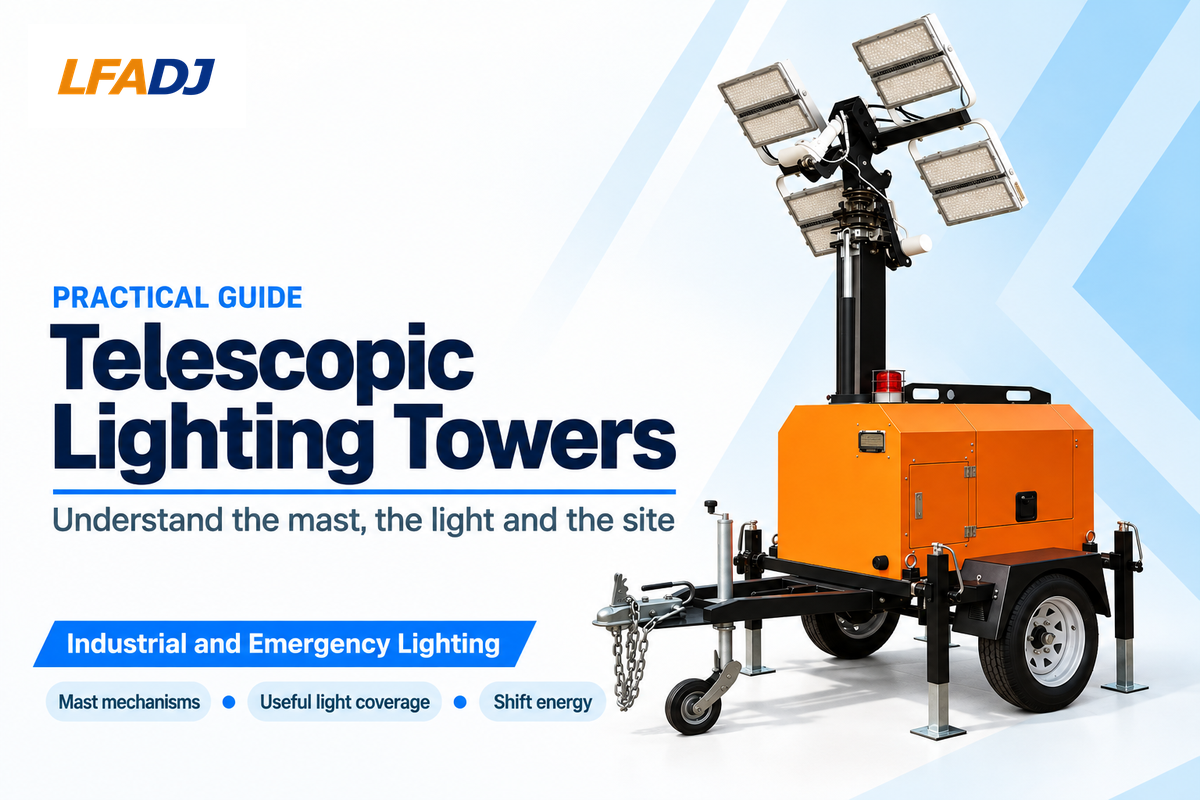
Telescopic Lighting Towers extend a mast to place lamps over temporary work areas. The choice of which one to use depends on the work people need to see, available space for the tower, and energy available over the shift. Just considering the required height of the mast gives an incomplete answer.
A loading yard, a road repair and an indoor shutdown may require different types of temporary lighting. This manual explains different types of equipment, different types of mast mechanisms and power sources, shows how to determine coverage and compare running costs for different models and points out when it’s appropriate to switch to a different model.
What Is a Telescopic Lighting Tower?
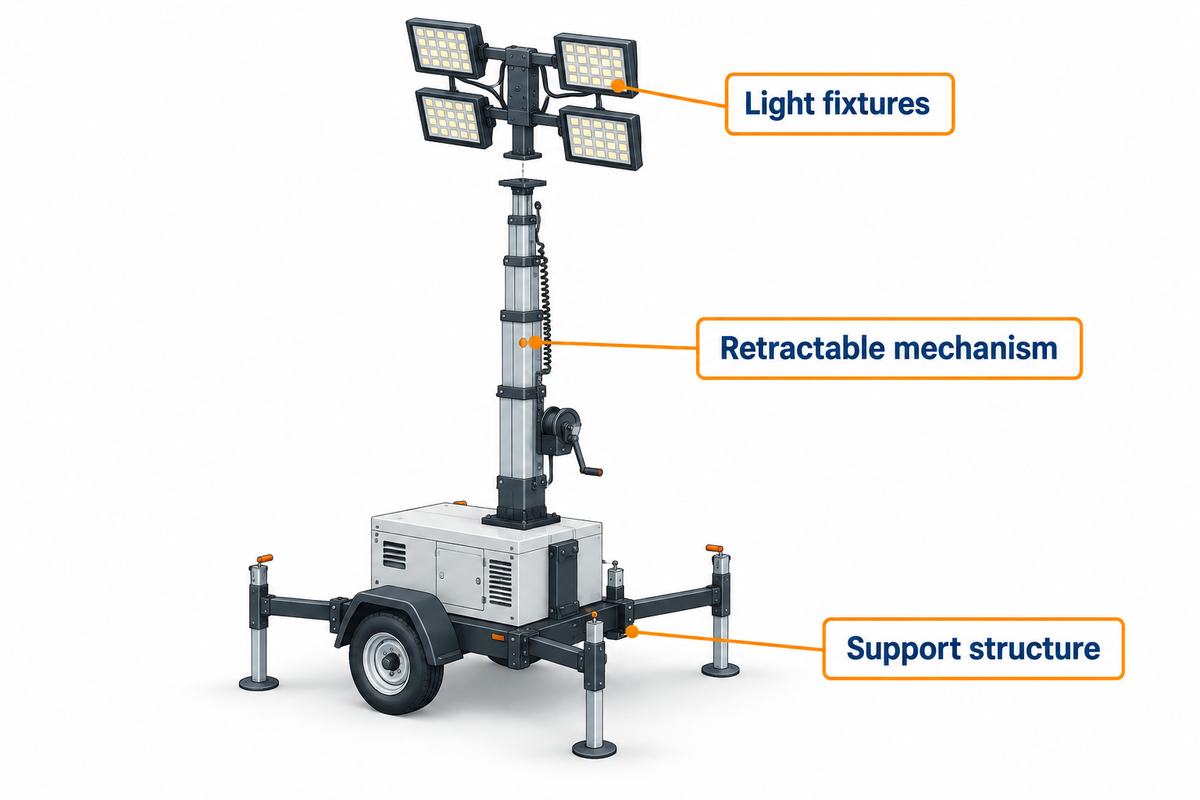
A telescopic lighting tower includes a base, a support structure, light fixtures and a pole-like mast with a retractable mechanism that raises the light head above surrounding obstructions. Retracting the equipment reduces its height for transport or storage. How the equipment is deployed is determined by the layout of the work site.
The light mast is one element of the system. A bare telescopic mast requires an accompanying payload, a means of attachment and a supply. A complete mobile lighting tower adds lamps and controls and sometimes a built-in generating set or battery. Comparing their costs as though they were part of the same purchase creates a misleading budget.
In a standard LED light tower, a driver supplies the LED modules while the mast positions their optics. A lamp or bulb lumen rating describes light output; input watts describe electrical demand. Neither indicates how much light reaches a particular work surface. A head with four LED light fixtures also behaves differently from a single diffused source because each fixture can have its own beam direction.
Consider a maintenance contractor walking between an equipment yard and a service bay. The equipment yard requires light above the vehicles. The service bay may require a compact light placed near the task. A larger tower range provides more alternatives. However, lifting the tallest unit into both the equipment yard and service bay may leave the service bay with glare and obstructed access.
United Rentals specialist Doug Distel’s selection advice treats coverage, height, lamp type, power and transport as separate considerations. This can provide a good starting point for evaluating complete systems.
Mast Types and Power Sources Are Separate Choices
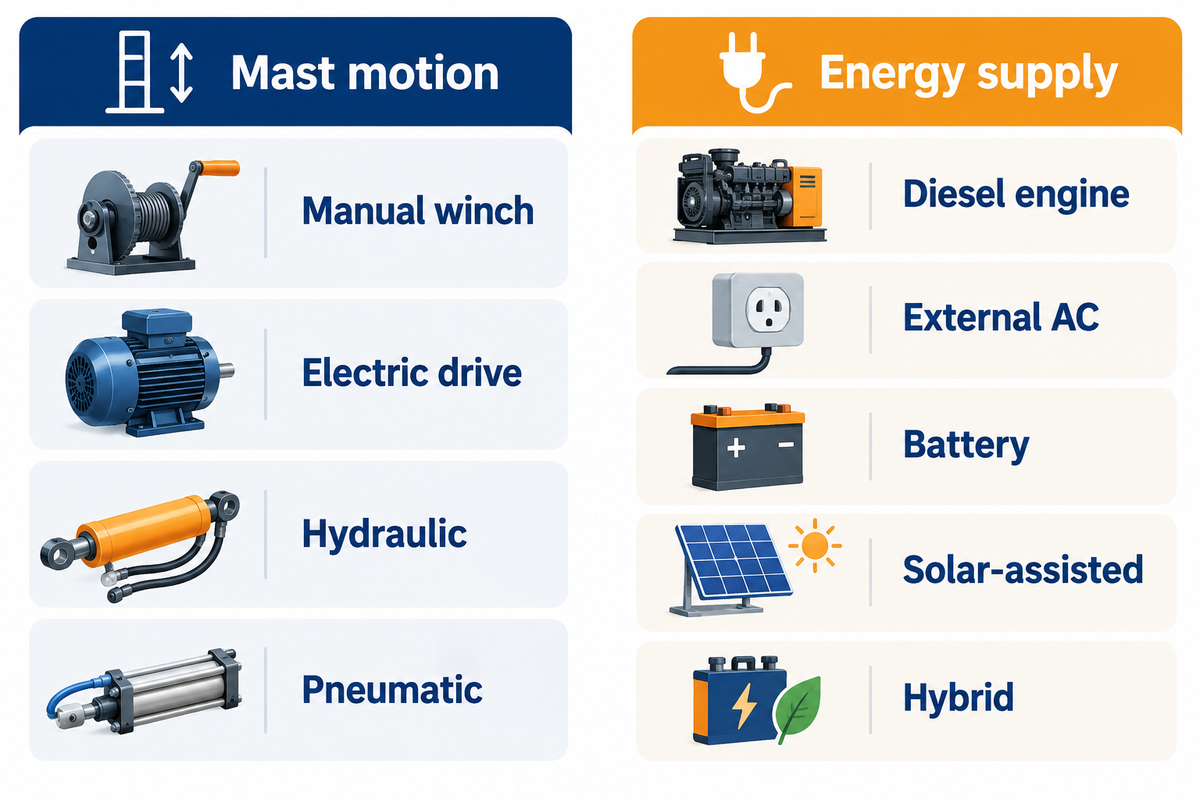
Manual, electric, hydraulic and pneumatic describe a mast’s movement mechanism. Diesel, grid electricity, batteries and solar describe the lighting power source. A manual winch can raise a lamp powered by an engine-driven generator or an external electrical connection. Selecting one axis doesn’t automatically select the other. Every combination may not be compatible.
Related functions include raising the head and holding it in position. Lowering the head is also a separate function. Each requires specific design details. For example, Will-Burt’s pneumatic locking mast design has extensions that are held in position by collars that require no continuous air pressure to hold them. Other pneumatic designs may have different arrangements to hold the extended sections. The term “pneumatic” doesn’t provide an operator with enough information to specify what will happen to the design when there’s no air pressure. Reliability needs to be assessed at the complete system level.
| Axis / type | What it changes | Design question |
|---|---|---|
| Mast: manual winch | Operator turns a handle to drive the lifting arrangement | Handle effort, access and holding mechanism |
| Mast: electric drive | A motor drives the extension mechanism | Control supply and specified recovery method |
| Mast: hydraulic | Pressurized fluid produces movement | Pump, hoses, holding system and service access |
| Mast: pneumatic | Air pressure extends the sections | Locking design and required air supply |
| Energy: diesel engine | An onboard generating set supplies electricity | Fuel tank, refueling, exhaust and service needs |
| Energy: external AC | A suitable site circuit or separate generator supplies electricity | Total input load, cable route and protection |
| Energy: battery | Stored electrical energy supplies the lamps | Usable energy and charging opportunity |
| Energy: solar-assisted | Panels replenish stored energy | Seasonal charging balance and backup supply |
| Energy: hybrid | Two or more energy paths support operation | Which source runs during each part of the shift |
Josh Nickell discusses power sources separately from manual and hydraulic masts in his light tower selection article. Simpler commands can be used on a user-friendly control panel. Operation of the system, however, requires a clear understanding of the actual model being used.
Our manual winch light tower and electric mast light tower buying guides have more detailed information on the lifting options. These guides are more geared toward comparison of different lifting designs.
How Height, Aiming and Light Output Change Coverage
Useful light coverage is the area that receives the illumination required for a task with minimum shadows and glare. Raising a mast alters the beam footprint and its intensity at the ground plane. Lamp output, optical distribution, tilt and site obstructions act together, so that equal lumen ratings can mean different working conditions.
“Different activities require different levels of light.”
Lux measures light that falls on a surface. One foot-candle (fc) is approximately 10.8 lux. Total lumens measure the emitted light, including light that misses the task. Generac’s 2021 light tower Factsheet therefore directs customers to coverage maps at different foot-candle thresholds. It’s useful, in the context of this discussion, to compare the LED equipment currently available.
Coverage Threshold Test
Compare the advertised areas of two candidates for an equivalent task rather than relying on a candidate’s largest advertised area. The comparison fields define a test that the site manager, lighting designer, and procurement team can use to determine what best suits the application. If one candidate’s claim leaves out a field, get that figure before comparing the two.
| Comparison field | Use the same basis | What a mismatch hides |
|---|---|---|
| Task and work plane | Walking route, ground work or raised bench | Light measured on the wrong surface |
| Illuminance threshold | The specified lux or fc value | A larger but dimmer footprint |
| Minimum or average | Both results use the same statistic | Dark spots inside an acceptable average |
| Mast height | The planned deployed height | A beam pattern from another geometry |
| Lamp and optic | Fixture count and beam distribution | Light spilling beyond the work area |
| Head aiming | Tilt and rotation shown on the layout | A bright foreground and weak far edge |
| Obstructions | Vehicles, containers and moving plant | Shadows absent from an empty-site plan |
| Observer position | Worker and approaching driver viewpoints | Glare outside the illuminated task zone |
| Operating setting | Actual dimming level and supply mode | Full-output data applied to reduced output |
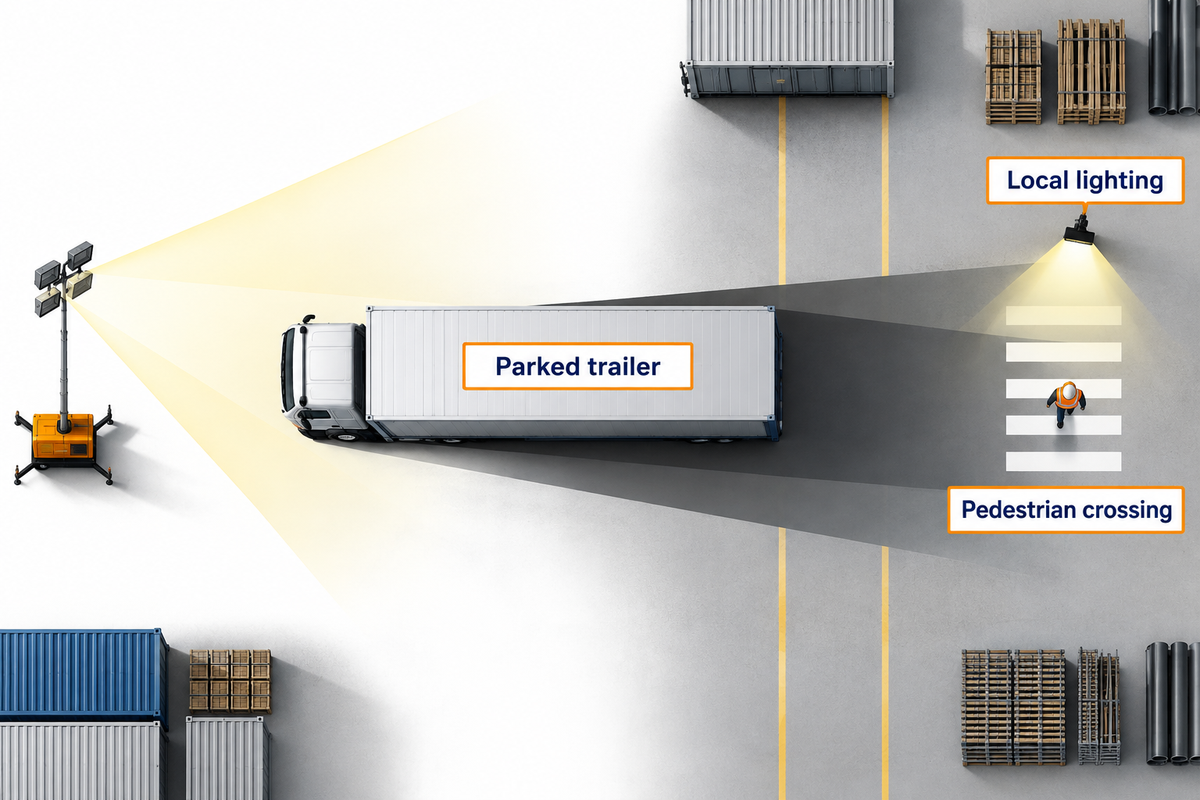
Picture a freight yard where a trailer is parked between the tower and the pedestrian crossing. The empty yard plan may show sufficient light across the crossing, but a parked trailer may create a light shadow where a person is about to step out into the road. Increasing the brightness of the same head may not remove the shadow. A second lighting position or local lighting at the crossing may address the blocked path of light. The comparison concerns lighting in an occupied yard, not the printed nominal square meters for each tower.
An additional viewpoint is provided by roadside work. The abstract of a 2017 Virginia Transportation Research Council study reports that when towers were aimed at drivers, there was reduced driver visual performance even though the measured horizontal illumination was above the recommended levels. Ground-level brightness and driver visibility require further analysis.
For U.S. construction, OSHA 1926.56 lists task-specific minimum illumination levels, including 5 foot-candles for general construction area lighting. The July 2025 rescission document is a proposed rule; the rule remains published in current official materials checked in October 2026. A project lighting plan should apply the rule to the tasks it covers.
Where Telescopic Towers Fit, and Where They Do Not
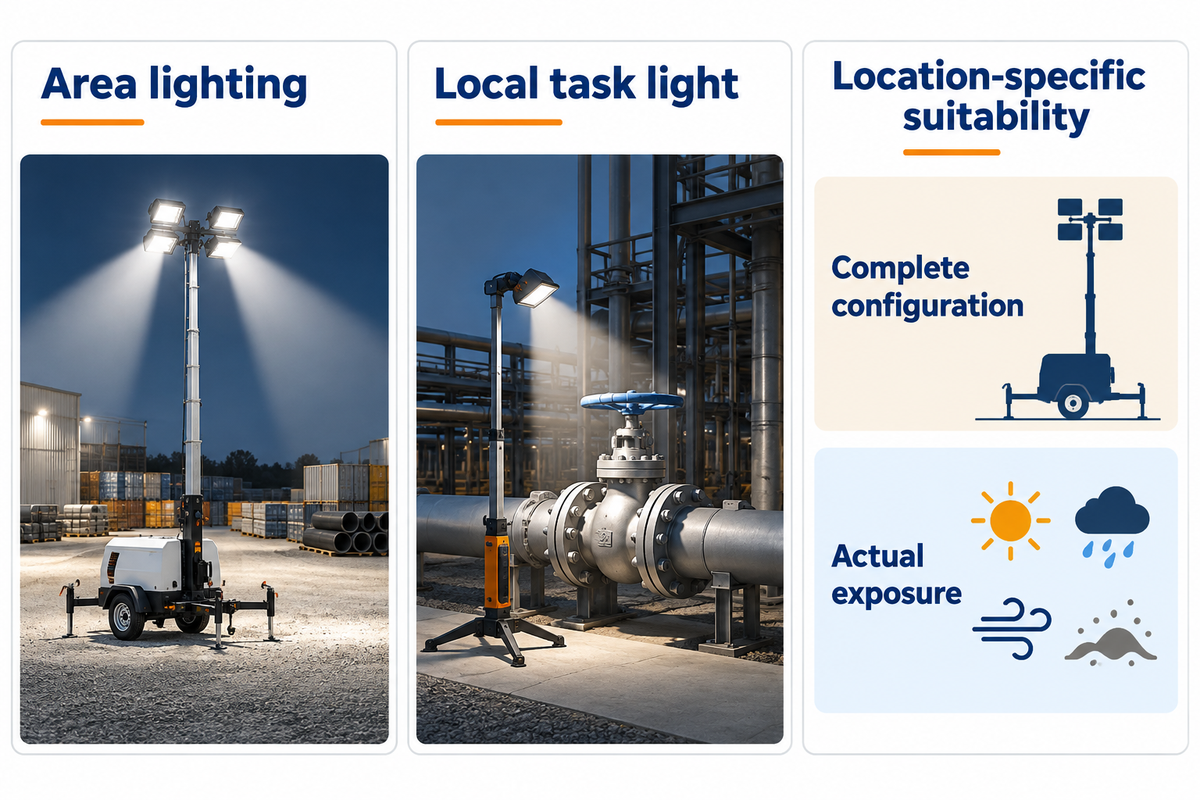
Telescopic towers can place elevated lighting above a work or access area. Other lighting applications include outdoor, industrial maintenance and emergency response work. Scope, clearances and special atmospheric hazards may require a different lighting arrangement or local task lights.
A tripod work light can be positioned more easily near a machine than a larger work light if there’s inadequate floor space for the larger light base. A raised tower can light a surrounding work zone and a rechargeable work light can light a valve or inspection point. More area light doesn’t eliminate the need to see details.
Combustion-powered equipment also changes where the system can work. NIOSH’s guidance on carbon monoxide states that generators can create dangerous carbon monoxide levels in buildings and semi-enclosed spaces, even if there appears to be enough ventilation. An indoor job requires the appropriate electrical lighting arrangement with the external generating equipment controlled by the site exhaust control plan.
Are telescopic lighting towers safe?
Yes, telescopic lighting towers are safe to use when the site is surveyed for overhead powerlines and other hazards before the tower is placed, the base is stable, operators know how that model raises and lowers, and the electrical supply and glare are controlled. Protection from ordinary weather doesn’t render a unit suitable for a hazardous location; that application requires equipment that’s classified for the location.
Mining, petrochemical operations and special events involve different environments. Industry labels don’t always describe the locations within a site. A rugged enclosure, or a “durable” product description, gives little information about an explosive atmosphere. For harsh environments, durability assessments must consider the actual exposure. It’s the complete, approved configuration of a tower that matters, including the light head, controls and energy equipment. Emergency work area illumination has a different purpose from lighting provided for escape routes from a building.
Plan the Full Deployment Cycle
Deployment means putting the tower in position, establishing its support, arranging the supply and aiming the lights. Returning the equipment to transport condition is a large part of this task. Sometimes, the difference in advertised lifting speed may be small, while access and setup time affect productivity across repeated moves.
HSE workplace transport guidance details pedestrian routes, loading areas and movement of vehicles. Outrigger pads, the base, and cable route also need to be considered, in addition to the light beam. Also, consideration needs to be given to a safe delivery route and storage location for towable light towers.
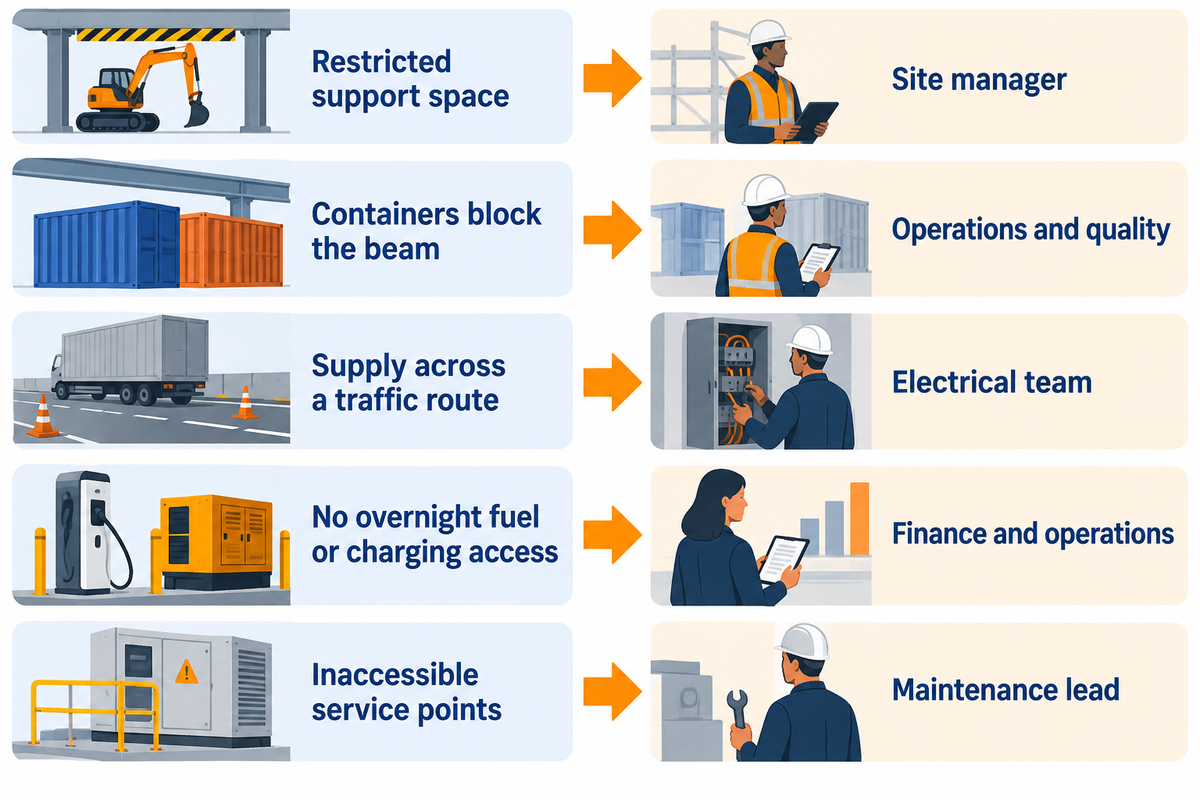
Shift Support Responsibility Map
| Constraint | Decision it changes | Who carries the consequence |
|---|---|---|
| Restricted support space | Base type and tower position before mast height | Site manager: access or setup delay |
| Containers block the beam | More lighting positions or local task lights | Operations and quality: unseen work detail |
| Supply is across a traffic route | Protected routing or a different energy arrangement | Electrical team: distribution work |
| No overnight fuel or charging access | Duty schedule, reserve energy and support cover | Finance and operations: interrupted work |
| Service points are inaccessible | Placement and maintenance access | Maintenance lead: recovery time |
A 2017 New York FACE report documented a death during the light tower take down. The death was attributed to contact with a power line. The event was unwitnessed. The report states that the mast was apparently raised rather than lowered. This document illustrates the importance of knowing and understanding the controls during take-down and setup and the need to develop a plan to address overhead clearances during take-down.
Different plans are needed for safe handling of trailer mounted towers and towers on carts. Using the instructions, crews should be able to safely position, move and store the equipment on the jobsite. An adjustable head or a lock doesn’t create a safe wind speed or overhead clearance.
What Changes Purchase Price and Operating Cost?
A lighting tower’s price includes more than the mast and lights. The price can also be impacted by the base, generating equipment, controls and delivery. During use, maintenance also impacts cost. Comparing towers to the same illuminated task is the best starting point for a meaningful cost comparison.
How much does a portable light tower cost?
As a price anchor, one equipment buyer’s guide lists advertised new towable diesel light towers with 30-ft masts at $10,300 to $25,000 and used towers at $2,700 to $8,750; group complete generator-powered towers, plug-in units and bare masts separately when comparing costs. A useful quote will state the same lighting duty, lifting arrangement and included equipment for each candidate. Delivery, commissioning, taxes and dealer charges will then be shown next to the equipment price, rather than appearing after a quote that looks cheaper.
The U.S. Department of Energy’s life-cycle cost guidance distinguishes acquisition and installation costs from operation and maintenance costs, replacement costs and disposal costs. A tower used occasionally and a fleet unit working every night will distribute these costs over different operating hours.
Night-Shift Energy Budget
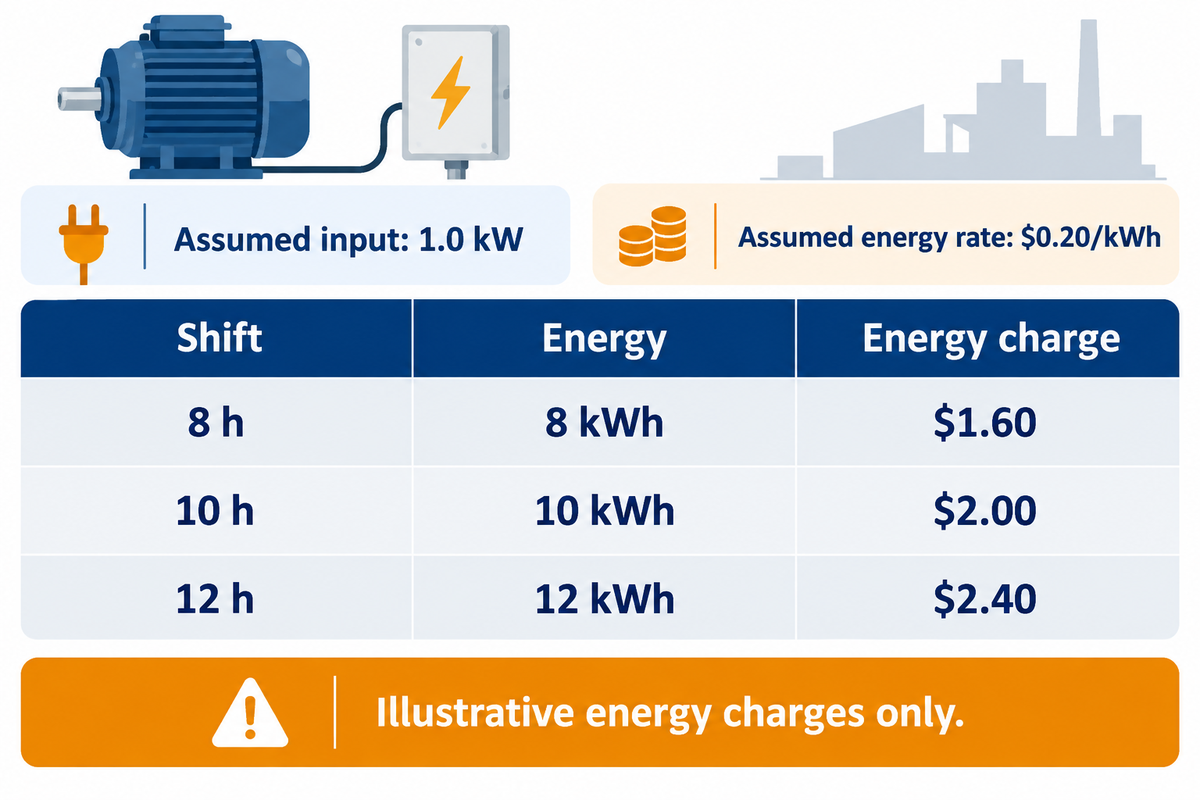
Example: Assume a constant total electrical input of 1.0 kW and an energy cost of $0.20/kWh. The calculation covers electricity consumed during lighting operation and excludes acquisition, labor, maintenance, demand charges and other costs associated with owning or renting the equipment.
Energy (kWh) = input power (kW) x operating time (h) . Multiply that energy by the rate per kWh to determine the energy charge. The U.S. Energy Information Administration’s electricity units explanation defines the relationship between watts, hours, and kilowatthours.
| Shift | Energy at assumed 1.0 kW | Energy charge at assumed $0.20/kWh |
|---|---|---|
| 8 h | 8 kWh | $1.60 |
| 10 h | 10 kWh | $2.00 |
| 12 h | 12 kWh | $2.40 |
Suppose the finance manager budgets 100 nights of 10 h each. At the assumed input and tariff, the energy charge is $200 for 1,000 h. The operations manager still needs a workable supply path and overnight availability. If connecting that supply requires extra distribution equipment or labor, the lowest energy figure may not produce the lowest project expense. Conversely, an available site circuit can remove routine refueling work. Put those project costs beside the energy figure before deciding whether a separate engine is worthwhile.
The DOE’s utility rate guidance differentiates energy, demand and fixed charges. For the actual budget, use the unit’s total input at the intended setting and the site-specific tariff, including all loads on the unit. Lamp watts don’t tell the whole story. Diesel fuel use requires a load-specific consumption figure; battery charging adds charging losses and a charging schedule. Local emission and noise constraints may also alter the feasible energy arrangement.
Inspection, Maintenance and Troubleshooting Boundaries
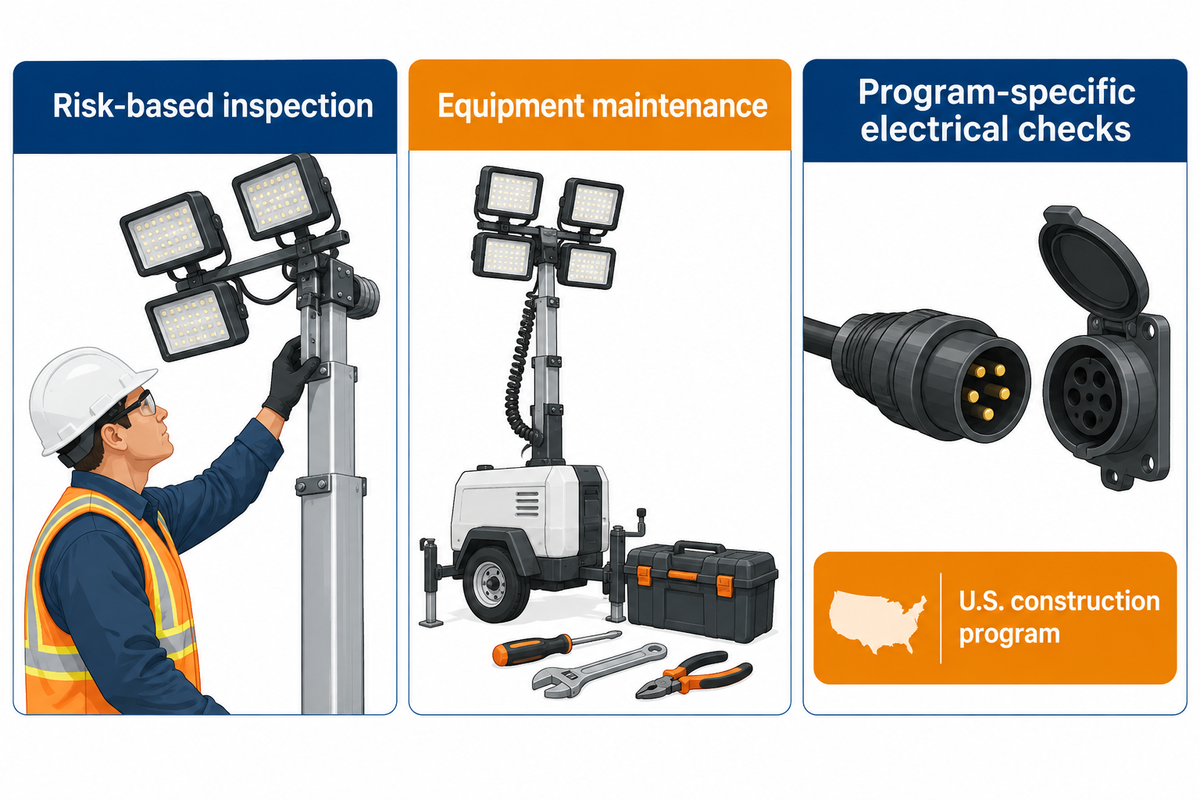
Inspection reveals damage or deterioration that impacts use; maintenance keeps the equipment functioning over time. A tower’s exposure, operating history, and manufacturer’s instructions impact both. Electrical checks can add separate jurisdiction-specific duties; therefore, a monthly service label can’t describe the complete care plan for a lighting tower.
HSE inspection guidance states that the need and frequency of inspections should be based on risk and conditions that cause deterioration. Transport vibration and repeated deployment are different exposures from stationary indoor use. Records help the maintenance team track a recurring fault instead of treating each stoppage as an isolated event.
Certain electrical arrangements can trigger specific inspection requirements. Under the U.S. construction assured equipment grounding conductor program in 1926.404(b)(1)(iii), specified cord-connected equipment requires visual inspection before each day’s use, except fixed cord sets and receptacles not exposed to damage; required grounding tests have separate before-use triggers and maximum periodic intervals of 3 months, extended to 6 months for those protected fixed cord sets and receptacles. These are program-specific electrical duties and are separate from whole-tower servicing.
When a head flickers, record whether it affects one fixture or the whole set, how the system is operating and what the surrounding conditions are. When a mast won’t hold position or stops, remove it from service and get qualified support to figure out what’s wrong. Improper cable repairs or bypassed interlocks may result in a larger incident. Reducing downtime starts with clear fault information and accessible parts, rather than repeated attempts to restart damaged equipment.
Turn Site Requirements into a Tower Selection
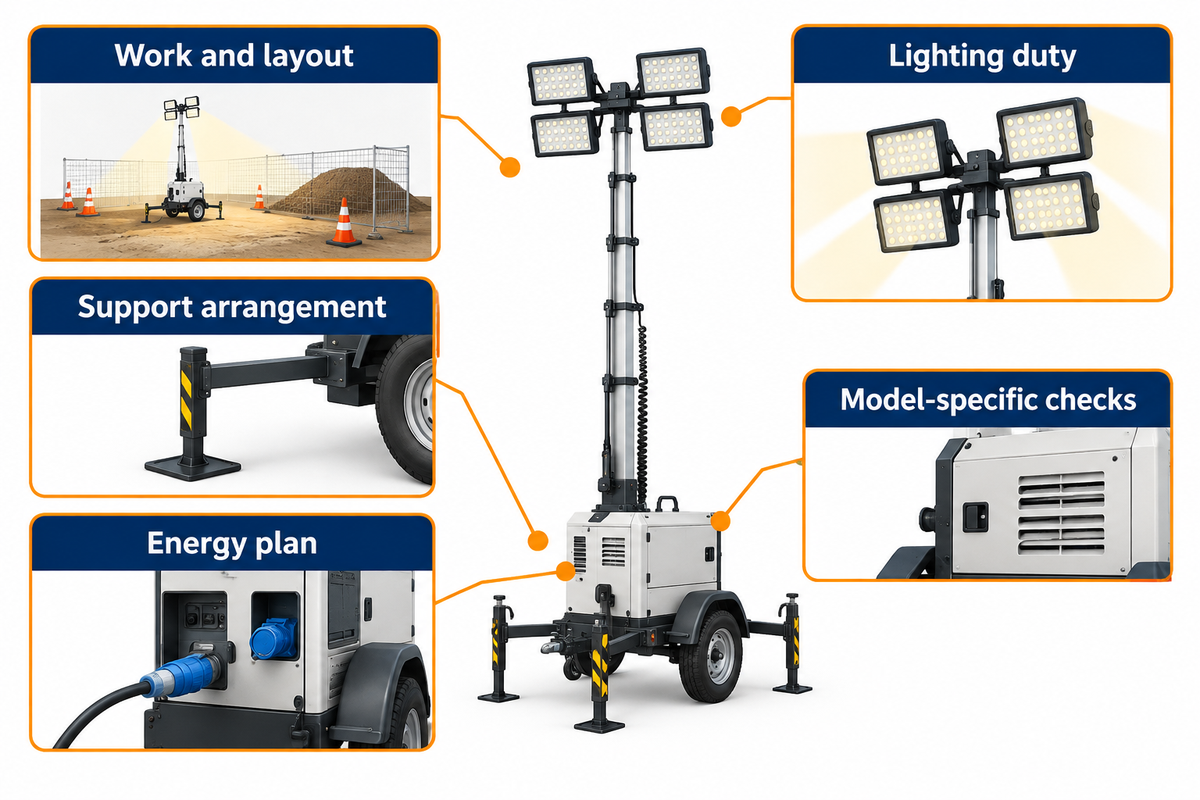
A good tower specification starts by describing the task and the layout. This is then followed by the lighting duty, support arrangement and energy plan. Procurement can compare complete offers once these conditions are satisfied. Where the task can be accomplished with the help of a light tower in an improved aiming position with local supplementary lighting, it may make more sense to spend the money on this instead of getting a taller light tower.
How do you choose the right lighting tower?
Select a tower to fit in the available space and supply the required light during the planned shift. Then select a lifting mechanism based on the support available and movement frequency. An extensive range of accessories provides value only when a particular accessory addresses a real constraint on a job site. A versatile product range still requires that task-by-task comparison.
An example from the City of Sydney’s Joynton Park decision record provides a good example of duty-cycling. In April 2022, the Council installed five solar towers to be tested for six months with lights scheduled from 5pm to 10pm. The five-hour schedule during the evenings differs from that of an all-night industrial shift. Solar run times must be assessed based on the real nightly load and seasonal charging potential, and not based on an example from a different application.
When creating a site brief, include the required illuminance, observer locations, and operating hours. Include the allowed setup area and site obstructions. Include the transport access, frequency of relocation, and environmental conditions. Include voltage and the fuel and charging arrangements, the supply capacity, and service terms in one technical review. Confirm model-specific rotation, tilt, wind limits, corrosion protection, and service terms in one technical review before placing an order.
The 360 degree rotating mast, combined with a diffused lamp head, addresses two different problems. The rotation changes the direction of the head, while the use of diffusion changes how light spreads. A lightweight package would help with handling, but stability, and the complete footprint, would determine the application of the system. The promises of “Superior visibility” and “built for harshest conditions” become meaningful only when related to the project’s actual lighting and environmental requirements.
LFADJ provides mobile and lifting lighting equipment for industrial and emergency tasks. To turn the site brief into a configuration discussion, explore our telescopic lighting towers and worksite solutions. For energy specific layouts, compare our solar mobile lighting systems, diesel fuel and refuelling requirements and hybrid mobile lighting systems with the same operating schedule.
Discuss your worksite lighting requirements
Frequently Asked Questions
What is a light tower called?
A light tower is also called a lighting tower; a mobile version is often called a portable light tower.
The complete equipment includes more than the extending pole. A mast supplied on its own still needs a suitable light head, base and electrical arrangement. For purchasing, the clearest description states whether the offer is for a complete working unit, a vehicle-mounted assembly or a replacement mast. That distinction helps keep accessories and installation work inside the same quotation scope.
Can telescopic lighting towers be mounted on a vehicle?
Yes, vehicle-mounted telescopic lighting systems are available when the mast, mounting and electrical design suit the vehicle.
The installation needs to account for the supported payload, travel envelope and forces applied to the mounting structure. Cable movement and the stowed position matter as much as the extended height. A portable tower intended to stand on its own base cannot simply be bolted onto a vehicle and treated as an approved conversion. Use a vehicle integration designed for that application.
Are telescopic lighting towers worth it?
They are worthwhile when elevated temporary area lighting solves a recurring job that smaller task lights cannot cover efficiently.
Frequency of use is an important part of the decision. Regular night work gives an owner more opportunities to recover acquisition and maintenance expenses through productive use. An occasional short project may favor rental or a simpler portable arrangement. Compare the same lighting task over the expected operating hours, including delivery, setup labor and energy support, before choosing the ownership route.
How are lighting towers manufactured?
Manufacturing combines the mast and support structure with luminaires, controls and the selected energy system.
Production includes metal fabrication, fitting the extension mechanism, electrical assembly and design checks. Materials and protective finishes address the intended exposure. The finished configuration needs applicable product testing; company management-system certification has a different scope from certification of the equipment.
Can a telescopic tower also support a camera?
Yes, a mast can support a camera when that payload and mounting arrangement are part of its approved design.
Adding a camera changes more than the total weight. Its bracket and housing add exposed area, while the viewing task may require less movement than area lighting can tolerate. Power, signal connections and cable travel also need to work through the full mast motion. A lighting head with spare physical space is therefore not an automatic invitation to add equipment. The tower manufacturer or integration designer should evaluate the combined payload, mounting position and intended operating conditions before a mixed lighting-and-camera system enters service. Image stability at the required zoom setting also belongs in the specification, since a visibly steady light source may still move enough to spoil a distant camera view.
References & Sources
- Lighting and human factors Health and Safety Executive.
- Workplace transport: lighting Health and Safety Executive.
- 29 CFR 1926.56, Illumination OSHA.
- Nighttime work-zone lighting, 2017 summary report abstract Virginia Transportation Research Council.
- Mechanic Electrocuted When a Mobile Light Tower Contacted Powerline, Report 12NY018 New York FACE, 2017.
- Inspection of work equipment Health and Safety Executive.
- Measuring electricity U.S. Energy Information Administration.
- Evaluating Your Utility Rate Options U.S. Department of Energy.