Get in touch with LFADJ Company

Industrial Emergency Lighting Systems: Power, Testing and Maintenance Costs

Industrial Emergency Lighting Systems are arrangements that provide light when normal lighting fails. They can help people leave the premises safely, make hazardous conditions safe, or perform a defined response task. One should analyze the tasks and failures first, and address the lighting system later. The focus should be on the required lighting task first, and the type of lamp and battery capacity later.
These systems support an orderly evacuation during power failures. The required illumination levels must be appropriate to the location and safety activity.
For the full facility audit, supplier-input register, bid comparison and commissioning sequence, use the industrial emergency lighting project guide. This article focuses on battery location, test management and the maintenance labor those choices change.
For facility managers, the hard question is rarely about whether a light switches on. It is about whether the correct zone remains useful after a supply, circuit, control or lamp failure, and whether the maintenance team can keep it that way. The following explains the power arrangements, automatic testing and maintenance cost decisions behind that end state.
By CYH · Updated October 2026
What Are Industrial Emergency Lighting Systems?
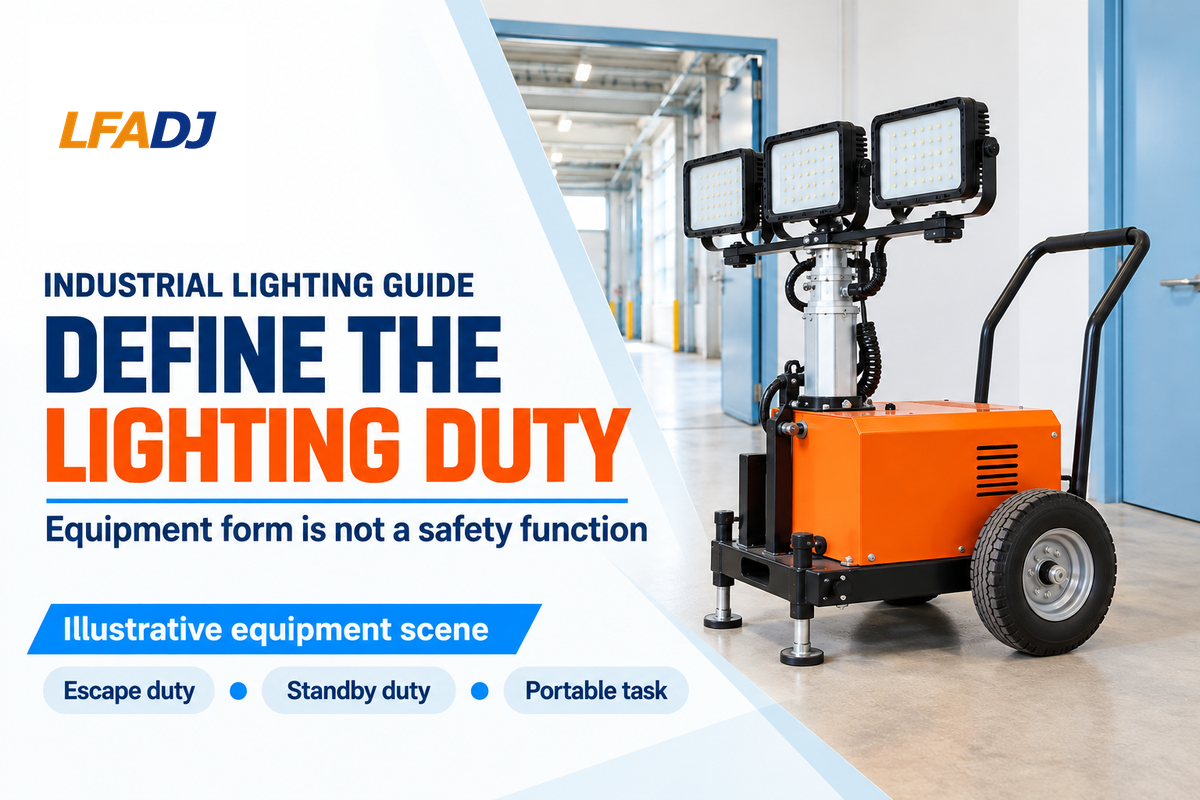
Industrial emergency lighting systems integrate luminaires, a backup power source, controls and maintenance arrangements for a defined lighting duty. Escape lighting supports evacuation, local area lighting supports particular safety activities, and standby lighting permits continuation of normal activities. Portable lighting describes methods of carrying or deploying the equipment, rather than a separate safety function.
The difference is important on the production floor. Following an exit route, reading a shutdown control, and inspecting a damaged pump are different kinds of visual tasks. A building might need several lighting solutions, each with different location, output, response time and operating duration. An illuminated exit sign shows direction; it does not light every obstacle in the way.
Exit and emergency lighting work together to help each occupant safely evacuate. Lighting and exit signs therefore belong in the same layout review. With LED lighting solutions, normal and emergency operating conditions still need separate attention.
The Home Office guidance for England, section 7, distinguishes escape illumination from lighting that allows normal activities to continue. Planning for industry has the same separation: state what people must do before choosing types of emergency lights.
The Blackout-to-Task Selector
Use the following map of illustrative site situations to distinguish an outage scenario from the lighting response required.
| Failure or situation | Lighting duty | Decision to record |
|---|---|---|
| Whole-site main power loss | Reach designated exits | Emergency supply, changeover and complete escape-route coverage |
| Local normal-lighting branch fails | Leave the affected area | How the emergency arrangement responds to that branch failure |
| Normal local control leaves lights off | Keep the required route visible | Emergency override or independently operating lighting arrangement |
| One lighting element fails | Preserve usable coverage | Remaining light distribution and areas vulnerable to total darkness |
| A hazardous process needs shutdown | Read and operate the relevant controls | Task location, response and duration needed to make the process safe |
| People must remain temporarily | Support the specified local safety activity | Who remains, where they stay and what they must see |
| Normal operations must continue | Provide standby illumination | Required working conditions and power capacity for continued use |
| A crew enters a dark shipyard work area | Provide the required portable illumination | Equipment carried, availability and location-specific suitability |
| A duration test discharges batteries | Maintain protection during recovery | Test timing, recharge arrangements and permitted occupancy |
Self-Contained Battery Backups or a Central Power Source?
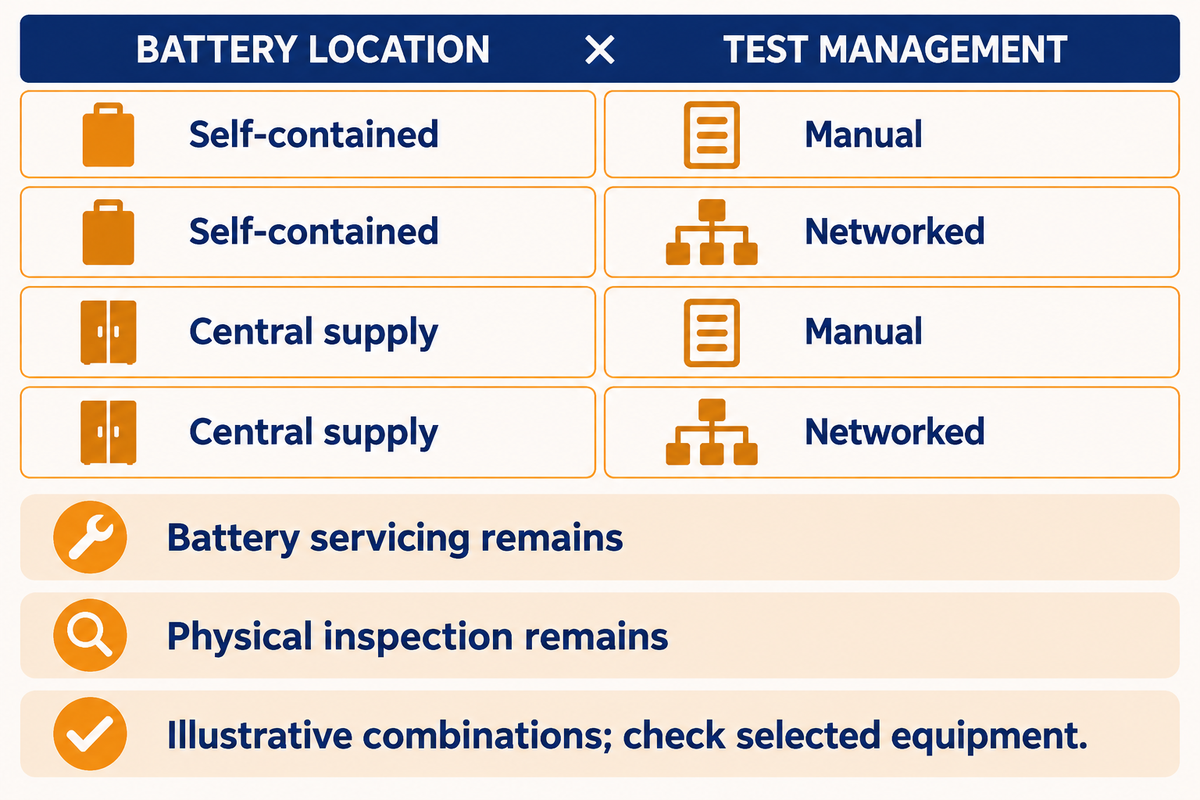
Self-contained battery backups suit installations where local independence and phased changes are key. Reducing the number of battery locations can be achieved by central supplies, while adding distribution and central equipment to the system design. Consider automatic testing of luminaires. Centrally managed and monitored testing of self-contained luminaires can be undertaken.
| Battery location | Test management | Work that remains |
|---|---|---|
| Self-contained | Manual | Local battery servicing, test initiation and recording |
| Self-contained | Networked | Local battery servicing and physical inspection; remote results depend on the selected system |
| Central supply | Manual | Central battery servicing, distribution inspection and test recording |
| Central supply | Networked | Central battery and distribution work, physical inspection and fault resolution |
Not every product supports all four combinations. Check the selected equipment and controls. Battery location determines where batteries are serviced; test management determines how tests are initiated and results collected.
A self-contained emergency light has its battery either within or adjacent to the fitting. A central battery supplies remote luminaires through the distribution system. A remote head connected to a battery unit adds another detail: the load, cable length and allowed arrangement must comply with the unit’s specifications.
Review of commercial buildings also requires review of changing paths of egress. The main power supply arrangement and emergency distribution also need to be in line with the revised layout.
CIBSE’s Lighting in Buildings guidance covers the use of emergency lights and describes dedicated, protected wiring for central supplies and the need for recurring servicing of local battery packs. The cost of the battery system and ease of access may be of equal importance in the decision for high ceiling fittings. If a building is altered in stages it may be easier to add or move local units, than to change a central distribution system.
Does emergency lighting need to be hardwired?
Fixed building emergency lighting normally uses permanently connected components designed for the installation. Other lights, designed to be portable, are used in construction and shipyard work. The difference lies in whether the lighting is automatically available for the task. An emergency lighting system already doing its job is not the same as a stored work light that requires someone to go and fetch it.
A generator can be one supply in a lighting design. A transfer switch, associated circuits and controls, determine what kind of failures the generator covers. Separate normal and emergency circuits may preserve illumination after one circuit fails without starting the generator. A circuit powered by a generator may be controlled locally and be left off.
We consider 29 CFR 1910.308(b) in the United States to address emergency wiring independence with stated exceptions. It provides that an arrangement is made in which the failure of an individual lighting element cannot leave any space in total darkness, where emergency lighting is required.
Design for Illumination at the Exit Route and Work Position
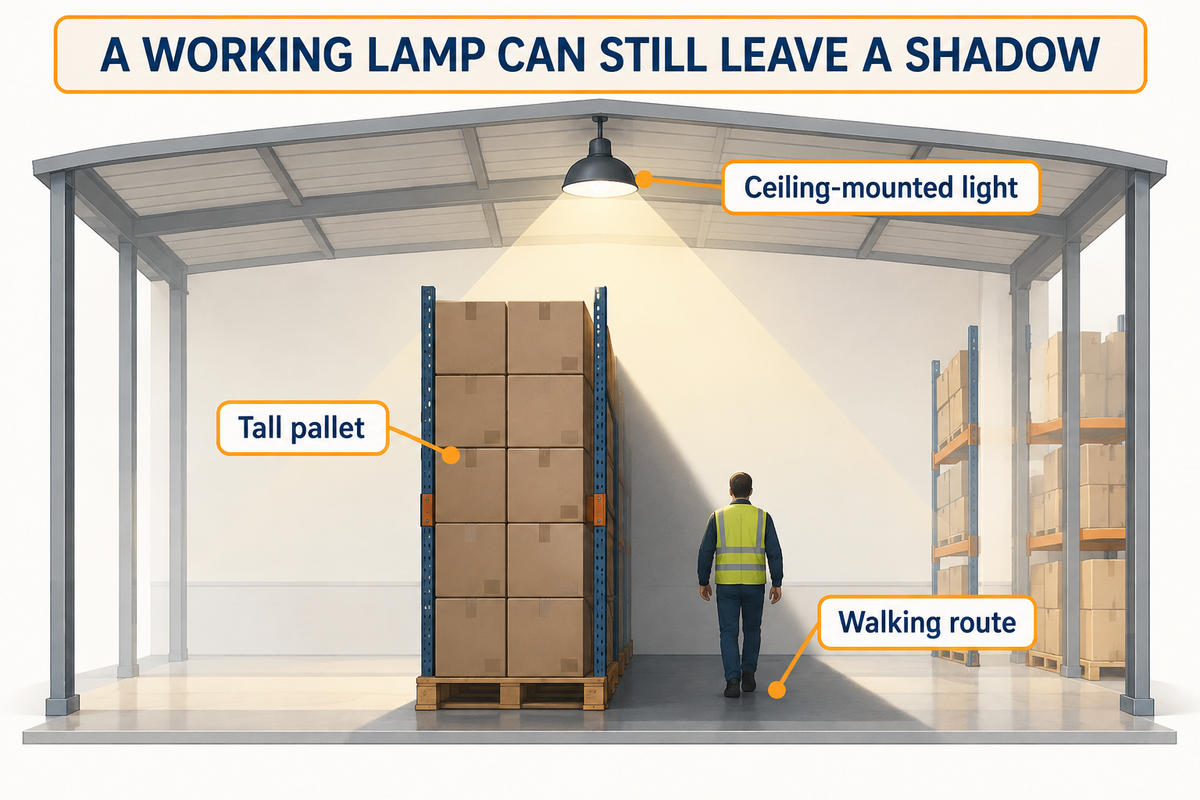
The illumination must reach the actual walking surface or working position for the required task. Normal-mode lumen output describes the light source, and mounting height, optics and aiming affect the delivered light. A well-designed lighting system, therefore, describes route geometry and task, including foreseeable changes in the space.
Where are emergency lights located?
Escape route lights are installed at the safety points or tasks identified in the design. They are usually installed at changes of direction, stairs and relevant equipment. Their arrangement follows the building’s fire strategy. Emergency lights cannot illuminate an entire industrial hall from one fitting next to an exit.
“Each exit route must be adequately lighted so that an employee with normal vision can see along the exit route.”
In calculating emergency lighting, consider LED emergency lighting in the general LED fixtures. Use the emergency operating mode in the lighting calculation. The normal operating mode used in production may result in a different output from emergency battery backup, including for high output fittings. Careful placement of recessed emergency fittings is important; a neat recess cannot compensate for a blocking rack.
Example: a forklift places a tall pallet beneath a ceiling-mounted light near a pedestrian crossing. The fitting still works, yet the pallet shadows the walking route. The HSE workplace transport guidance gives examples on vehicle shadows and driver glare, and changes between bright and dark areas. Applying those to the outage design helps to address people and vehicles together.
What Runtime and Response Does a Power Outage Require?
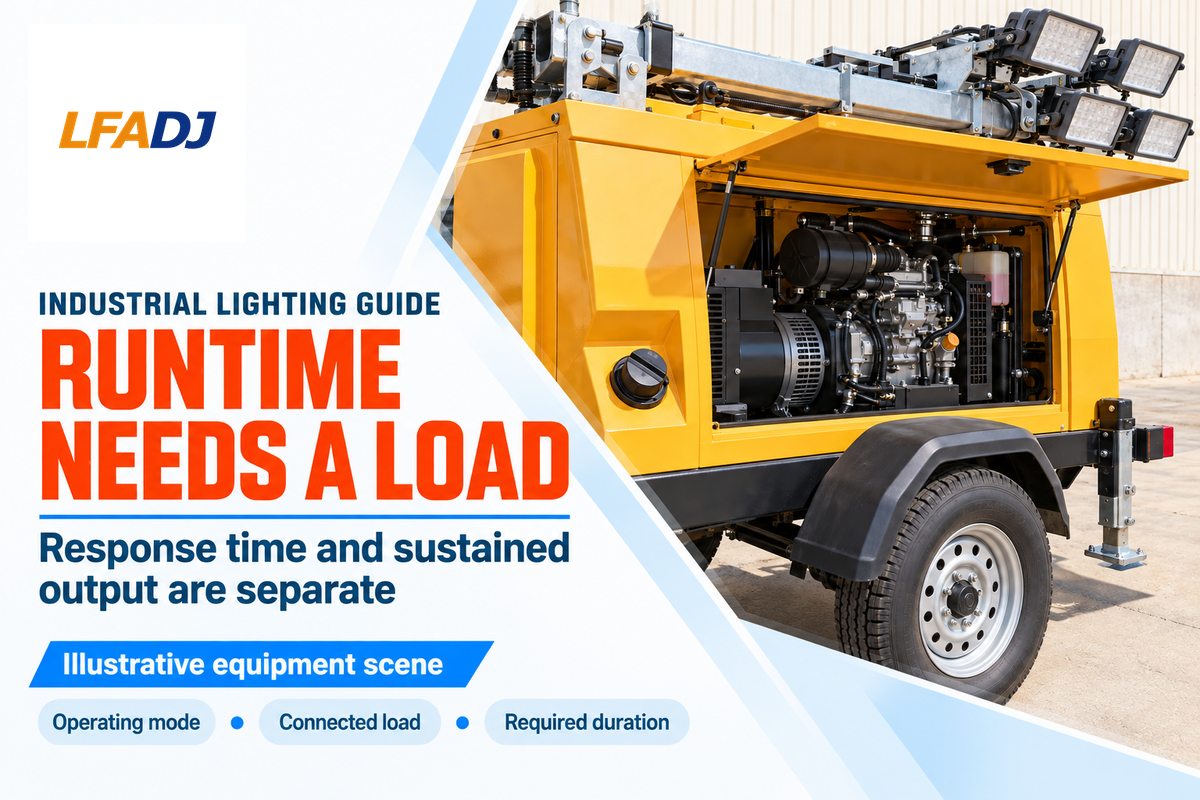
When specifying emergency output, give the backup duration, response time and operating conditions. The required duration is defined in the design and rules. The equipment, however, must be able to provide that lighting duty for that duration. Advertised runtime of a battery is only meaningful in the context of the load and the mode of operation used to arrive at that runtime.
How long should emergency lighting operate during an outage?
Where the NFPA Life Safety Code applies, emergency lighting is designed to illuminate automatically for at least 90 minutes when normal power or the normal lighting circuit fails; other codes use different design periods for their installations and safety functions. The specification should state the governing codes and the required emergency function, rather than saying that one design period is sufficient for all factories, countries, or applications.
A short transfer delay that a person can tolerate while walking may be unsuitable beside machinery needing immediate attention. Separate the time required to achieve usable illumination from the time the illumination has to be sustained. An unsuitable initial response can not be corrected by increasing the battery runtime.
Battery-pack exit signs and emergency lighting in health facilities in North Dakota are required by North Dakota’s health-facility Life Safety Code guidance to perform a 30-second test monthly and a 90-minute test annually. The annual test calls for operation for at least 90 minutes. This is a testing requirement for the specified equipment and situation, rather than a universal practice for industry or runtime specification.
Temperature and the state of the battery and connected load should be evaluated for runtime. A low setting of a portable lamp may have a different output from a rated emergency mode of a fixed luminaire. Record useful illumination for the required period, rather than stating, “still on.”
What Is the Scope of Emergency Lighting Codes and Standards?
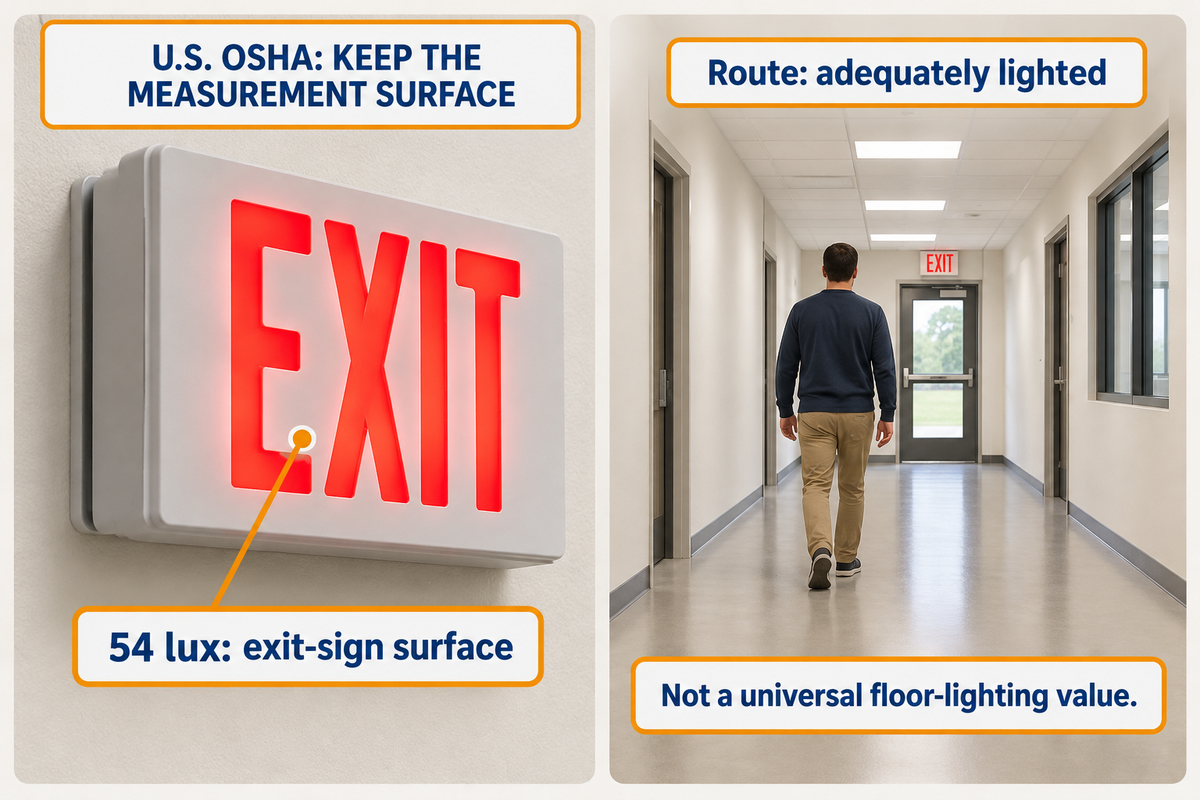
Emergency lighting includes choices of where, how, what and how much. A correct compliant selection combines the applicable jurisdiction, occupancy, lighting function and installation requirements. Combining a duration from one jurisdiction and a lighting level from another creates an unreliable specification.
When changing the layout or intended use of an installation, reassessment is necessary to remain compliant.
The OSHA 1910.37 requirement of five foot-candles, stated as 54 lux, concerns the illuminated surface of an exit sign. The route itself needs adequate lighting. During the selection of emergency lighting, applying 54 lux to the ground along an emergency route based on that adequate-lighting paragraph confuses two different surfaces.
| Reference or evidence | What it addresses | Project information needed |
|---|---|---|
| OSHA 1910.37 | United States workplace exit-route maintenance, lighting and marking | Covered workplace, exit route and sign surface |
| International Building Code and NFPA 101 Life Safety Code | Applicable building and life safety requirements when adopted | Adopted edition, occupancy and local amendments |
| BS 5266-1:2025 | Code of practice for emergency lighting of premises | Applicable UK project requirements and related standards |
| Product listing or test documentation | Named equipment, configuration and evaluated performance | Exact model, operating mode and installation conditions |
“Code compliant” on a catalogue is the beginning of product selection and not the project specification. The markings on safety products need to be tied to the emergency light fixture and its allowed configuration. This also applies to changes in installation. Replacing a fitting with a different optical distribution can change coverage even if the electrical rating is the same.
Which Emergency Light Fixture Suits Industrial Conditions?
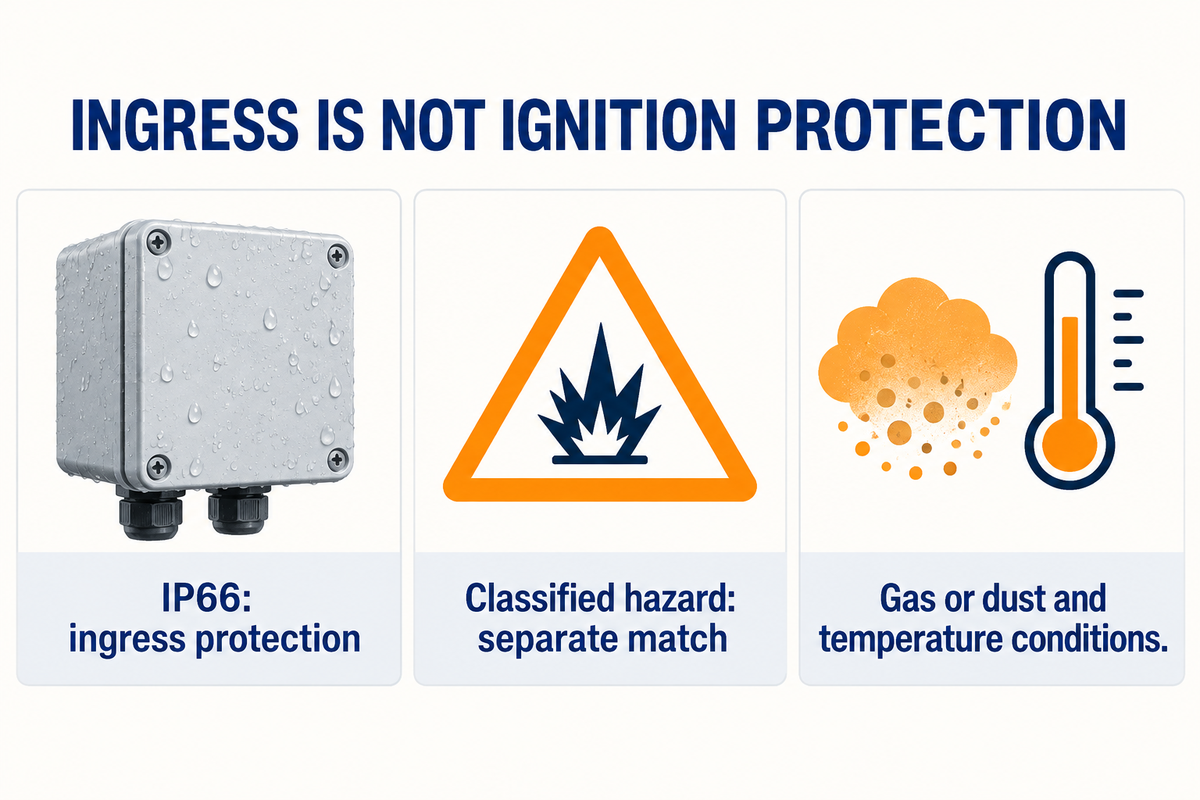
An industrial emergency light fixture needs operating limits and environmental protection aligned to its location. Dust, washing, corrosion, vibration and extreme temperatures affect different parts of the assembly. Wet location suitability addresses exposure to the environment; hazardous location protection requires a different match to the classified hazard.
OSHA 1910.307 includes requirements to consider hazardous locations individually and addresses the class of location, ignitable materials and equipment marking. An IP66 enclosure is not a substitute for a hazardous-location assessment. Gas and dusts, equipment/component temperatures, and the approved protection techniques still apply.
An example would be considering both a washdown area and a solvent handling area as both requiring the use of sealed enclosures. The solvent handling area would create an additional hazard of ignition. If a fitting is selected for washdown conditions without consideration of the hazardous area classification, the distinction is not made. Likewise a battery located in a warm roof space would be subjected to different conditions from those which were measured at the occupied story.
For a classified portable task, the hazardous-area lighting application guidance helps locate and define the intended duty. Keep those inputs separate from the required emergency operating period. Both environmental survival and useful light during an outage are part of the specification.
What Do Lighting Duty Tests and Defect Repairs Include?
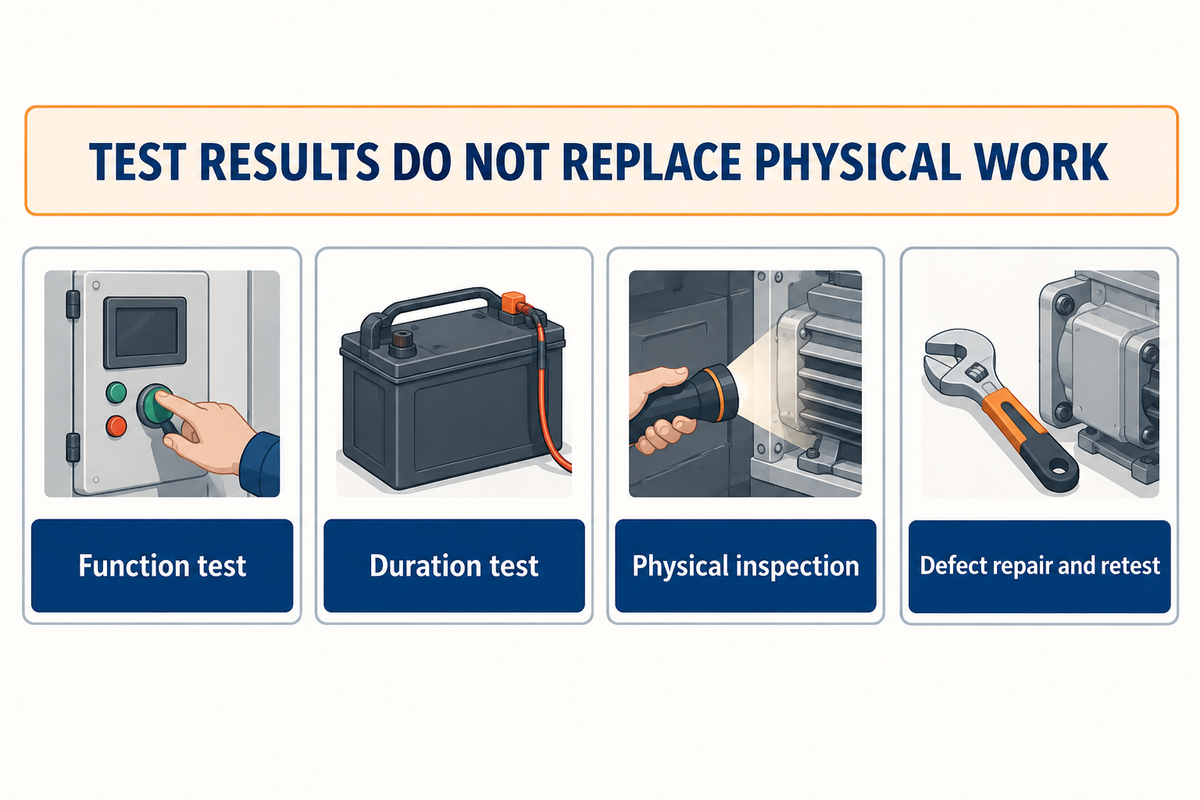
A complete maintenance action tests the emergency operation, corrects defects, and restores the equipment to its operating condition. Function and duration tests serve different purposes. Automated testing can eliminate the need to manually initiate tests and record results. However, a passed function test does not mean there is no blocked exit sign, a damaged housing or a repair awaiting management approval.
Test the emergency and exit lighting according to the specified procedure. Inspect the lights to ensure signs and required routes remain visible as the workplace changes.
The emergency lighting explanation provided by the DALI Alliance outlines a quick function test to check the battery, charging circuit, driver or relay, and lamp, and a duration test to check the full rated period. Thus, self-testing adds useful information and does not reduce all maintenance to one green status indicator.
Record all defects and remedial actions in a log book. Restore controls and track repairs to a successful retest. The IET 2020 emergency lighting webinar states some test-switch arrangements can be left off. Correct replacement batteries and a closed work order are separate from the original fault alert.
Example: a failing battery is reported automatically, saving a test visit. Repair still requires the availability of a suitable access window and hoisting equipment. Facility managers need to track the time from defect detection to a successful retest to prevent reduced maintenance costs from becoming deferred maintenance.
What Drives Installed Cost and Maintenance Work?
Consider the total cost of ownership for both systems for the same lighting duty and compare installed cost to recurring cost. Compare installed and recurring costs only for emergency lighting solutions that meet the same applicable code requirements. Emergency lighting units with different duties are not comparable cost inputs.
Cost comparisons should include luminaires, wiring, controls, commissioning, access, batteries and corrective maintenance. Central supplies and monitored self-contained systems alter different tasks, so the lowest fixture price or an automatic test feature does not identify the lower whole-life cost. CIBSE maintenance guidance calls for effective working order and upkeep advised by the supplier or installer; the task times below are hypothetical.
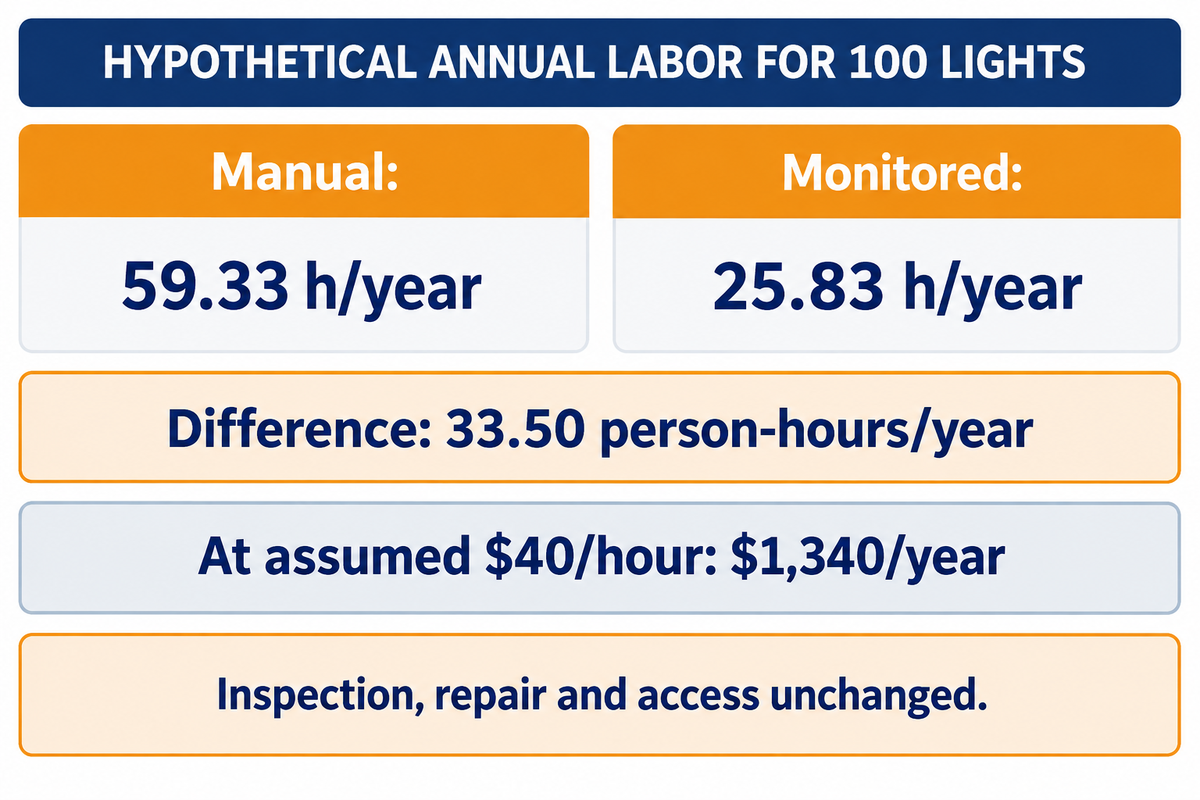
This hypothetical planning example is a comparison of manual and monitored testing for the same 100-light installation. Assumed inputs: 12 routine rounds per year, one annual duration-test result review, eight repairs, ten separate access setups and a loaded labor rate of $40 per person-hour.
| Work item | Manual arrangement | Monitored arrangement |
|---|---|---|
| Routine activation/result work | 100 × 12 × 2 min = 40.00 h | 100 × 12 × 0.5 min = 10.00 h |
| Round-level report administration | 12 × 10 min = 2.00 h | 12 × 5 min = 1.00 h |
| Annual duration-test result review | 100 × 2 min = 3.33 h | 100 × 0.5 min = 0.83 h |
| Separate physical-condition inspection | 100 × 4 min = 6.67 h | 100 × 4 min = 6.67 h |
| Repair and retest work | 8 × 30 min = 4.00 h | 8 × 30 min = 4.00 h |
| Additional access setup | 10 × 20 min = 3.33 h | 10 × 20 min = 3.33 h |
| Total person-hours | 59.33 h/year | 25.83 h/year |
| Labor at $40/person-hour | $2,373.33/year | $1,033.33/year |
| Difference under these inputs | 33.50 person-hours/year × $40 = $1,340/year | |
The saving comes from routine testing and administration. Repair and access time are unchanged. A 90-minute battery discharge is elapsed test time, not automatically 90 minutes of labor for every fitting.
For finance, a hypothetical $3,000 incremental monitoring cost divided by $1,340 annual labor savings, gives a payback period of 2.24 years. Consider actual software costs, commissioning and servicing expenses, before using project figures. If repairs remain open because access is unavailable, a quicker report would help in diagnosis, but would not eliminate the bottleneck. Energy efficiency or a long lifespan of LED lighting should be analyzed separately from test-labor savings.
Where Portable Response Lighting Fits
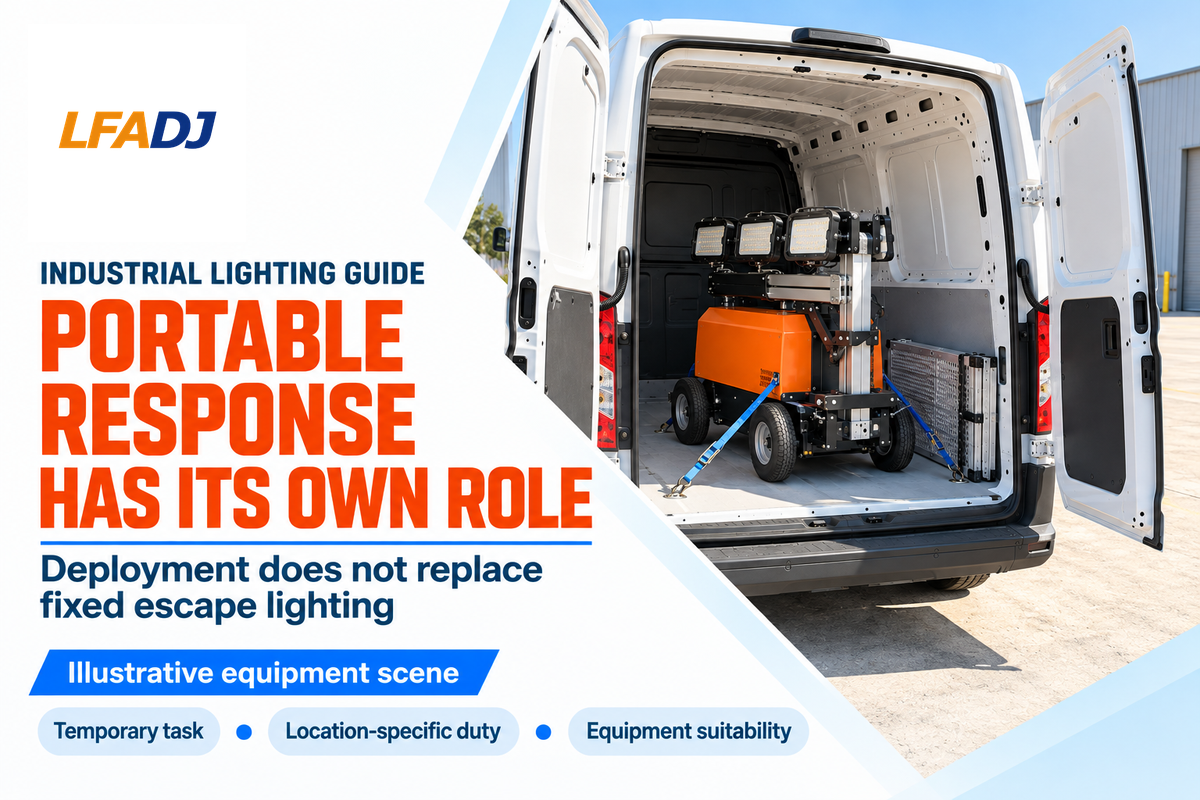
Portable response lighting is used for tasks such as entering a dark work area, inspecting equipment, and illuminating temporary emergency operations. Some industrial rules mandate it. Its use is determined by the job and location, while fixed building escape lighting follows its own installation design and automatic-availability requirements.
For example, 1915.82(c) of OSHA’s Shipyard Lighting Standard requires portable or emergency lights in the specified dark-area and vessel-lighting situations. HSE’s Construction Site Guidance states that torches or similar lights are allowed in the stated situations where automatic lighting cannot be provided. These guidance documents define specific application boundaries, rather than giving blanket permission to replace a building’s installed egress lighting.
LFADJ offers temporary and transportable lighting solutions for industrial site works and emergency operations. The equipment and project selection side is covered in its industrial emergency lighting systems solutions. For a crew’s portable task, discern between a rechargeable work light that is brought to a work position and a mobile system for temporary area lighting that is deployed to illuminate a larger working area.
LFADJ claims a one-hour emergency-battery duration for its LF6133 wheeled telescopic work light, with the output mode to be agreed. Pair that duration to the light output required at the work position to choose the configuration.
Integration and Monitoring Before Purchase
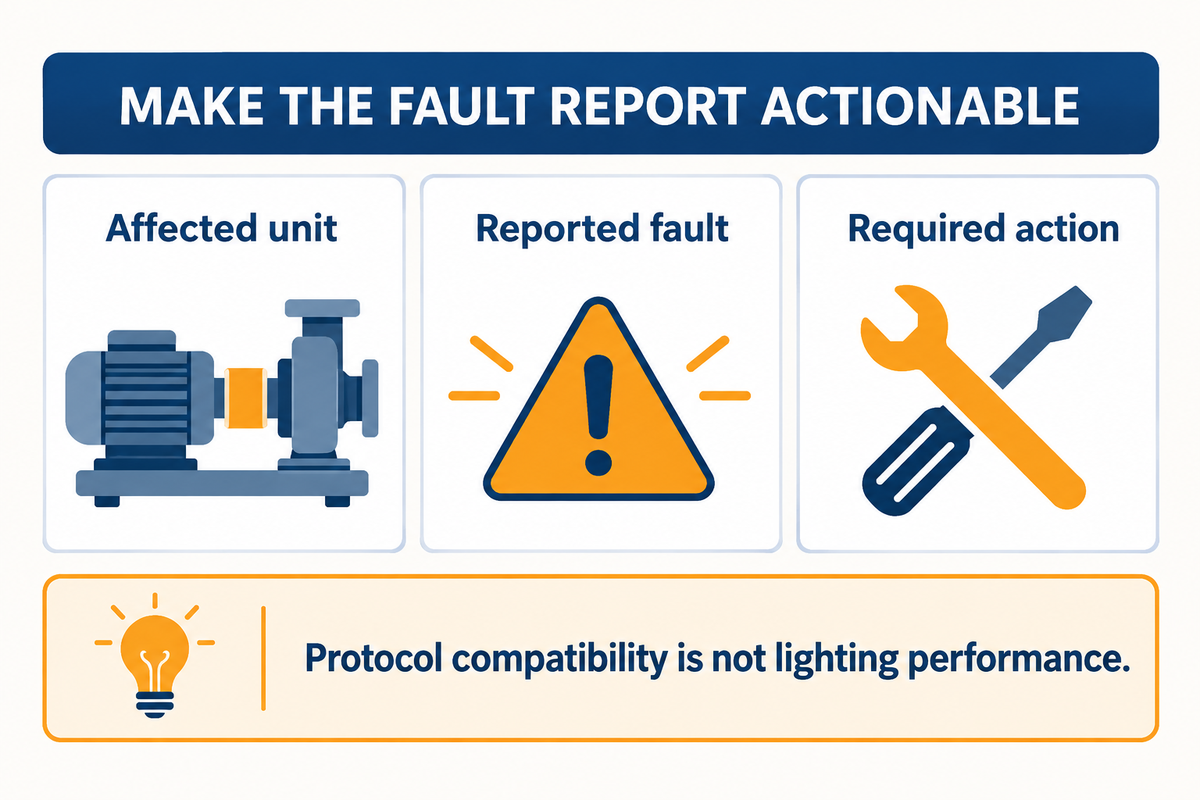
State the lighting duties and acceptance conditions to choose a monitoring interface. Then state how results, faults and work orders are made accessible to the responsible persons to perform actions. Protocol compatibility is useful to assist those tasks. It does not substitute the electrical, photometric or maintenance design.
Emergency lighting must satisfy the required illumination during power loss. Monitoring and maintenance planning in safety solutions work best when the fault report identifies both the affected unit and the action required.
For a UK project, separate evacuation, protection of people who remain and continued operations: they may require different lighting during an outage. BS 5266-1:2025, published on 29 October 2025 as a full revision of the 2016 edition, expands the scope to include local area and standby lighting, as described in the BSI catalogue for BS 5266-1:2025.
DALI-2 Emergency certification was already available in 2021 to provide a defined interoperability and testing framework for self-contained emergency control gear. The commissioning handover should show the configured devices and the results of tests performed on the system.
For temporary deployment, LFADJ can discuss the operating environment and the nature of the task to be performed using their lighting consultancy services.
Discuss a temporary industrial lighting task
Frequently Asked Questions
Are industrial emergency lighting systems required?
Usually yes: where the NFPA Life Safety Code applies, industrial occupancies need emergency lighting, except special-purpose industrial occupancies without routine human habitation and structures occupied only in daylight whose skylights or windows give the required light on all of the means of egress.
The designer identifies the routes and safety activities affected by a lighting failure, then specifies the required coverage, response and operating period under the applicable rules. A factory with hazardous processes may need lighting for safe shutdown as well as escape. Portable response equipment has its own duties alongside the building installation.
What type of emergency lighting is best for large commercial spaces?
Choose an arrangement suited to the layout and maintenance access: central power for concentrated battery servicing, or self-contained fittings for local independence and phased changes.
Central monitoring is available with either battery arrangement. For a high ceiling, access to individual battery packs can dominate servicing work; for a changing layout, local units can simplify phased alterations. Commercial spaces still need emergency-mode photometric design around mounting height and obstacles. Compare the complete installation and recurring work before selecting either arrangement.
Why are high bay emergency lights important in industrial environments?
High bay emergency lights address the challenge of delivering useful light from a high mounting position to the floor or task.
Their optics and emergency output determine how the light reaches walking routes around racks and machinery. A normal-output rating is not the same as the emergency operating condition. Positioning also matters when tall equipment or stored goods create shadows. The layout should preserve the required coverage under the failure conditions included in the design.
Are red or green exit signs better?
Use the sign format and color required by the applicable jurisdiction and approved design.
Keep signage visible, legible and consistent so people can recognize the route and follow it during an evacuation.
How often should emergency lighting be tested and inspected?
Where the NFPA Life Safety Code applies, manually tested battery emergency lights are run monthly for at least 30 seconds and annually for at least 90 minutes, with physical inspections and defect correction on top.
For example, North Dakota’s health-facility guidance specifies monthly 30-second and annual 90-minute tests for battery-pack equipment. Other settings and system types have their own requirements. A useful maintenance record identifies the unit, test date, operating result and any defect, then records the corrective action and retest. Physical inspections cover conditions that an electronic result may miss, such as obstruction, damage or a changed layout. Schedule enough recovery time after a full-duration test to restore the required protection, and coordinate any temporary arrangements with the responsible designer.
Can a generator replace emergency light batteries?
Yes, in a suitable design: an emergency generator with an automatic transfer switch is one of the two primary ways the NFPA Journal describes for powering building emergency lighting, and the generator then needs its own inspection, testing and maintenance under NFPA 110.
The installation must meet the required response, load, circuit and control arrangements. Some designs also use local batteries. Evaluate normal-supply loss and the other relevant failure conditions rather than judging the system from generator capacity alone.
Does IP66 mean an emergency light is explosion-proof?
No. IP66 concerns ingress protection; hazardous-location suitability requires equipment appropriate to the classified hazard.
Match the equipment approval to the gas or dust, location classification and temperature conditions.
References & Sources
- OSHA: 1910.37, exit-route safeguards, lighting and marking.
- OSHA: 1910.308(b), emergency power systems.
- OSHA: 1910.307, hazardous locations.
- Home Office: guide for persons with fire-safety duties in England, section 7.
- CIBSE: Lighting in Buildings, emergency lighting and maintenance.
- DALI Alliance: emergency testing and certification scope.
- BSI: BS 5266-1:2025 public catalogue and revision summary.
- North Dakota Health and Human Services: health-facility Life Safety Code compliance.
Related guidance: construction and roadwork lighting deployment · mobile lighting systems guide for temporary area-and-task layouts.
LFADJ · COMPANY & TECHNICAL CONTEXT
Practical lighting guidance for real project conditions
LFADJ shares product context, application notes, and selection checks to help project teams compare industrial lighting options with the right site details in view.
What LFADJ covers
LFADJ focuses on industrial lighting and tailored lighting solutions for teams planning, specifying, or operating demanding work environments.
- Product context: mobile lighting, light towers, explosion-proof lighting, emergency lighting, and related industrial lighting equipment.
- Project context: application conditions, target illumination, runtime, site constraints, and product configuration questions.
- Decision support: use the information here as a starting point, then confirm final specifications against the actual installation and local requirements.
Industrial lighting
Application guidance
Project enquiries
NEXT STEP
Have a site question?
Send the operating environment, lighting target, expected runtime, and any drawings or photos you have. The existing enquiry form is ready for a focused discussion.
Start an enquiry Or use the LFADJ contact page