
Get in touch with LFADJ Company

By GW · Updated October 2026
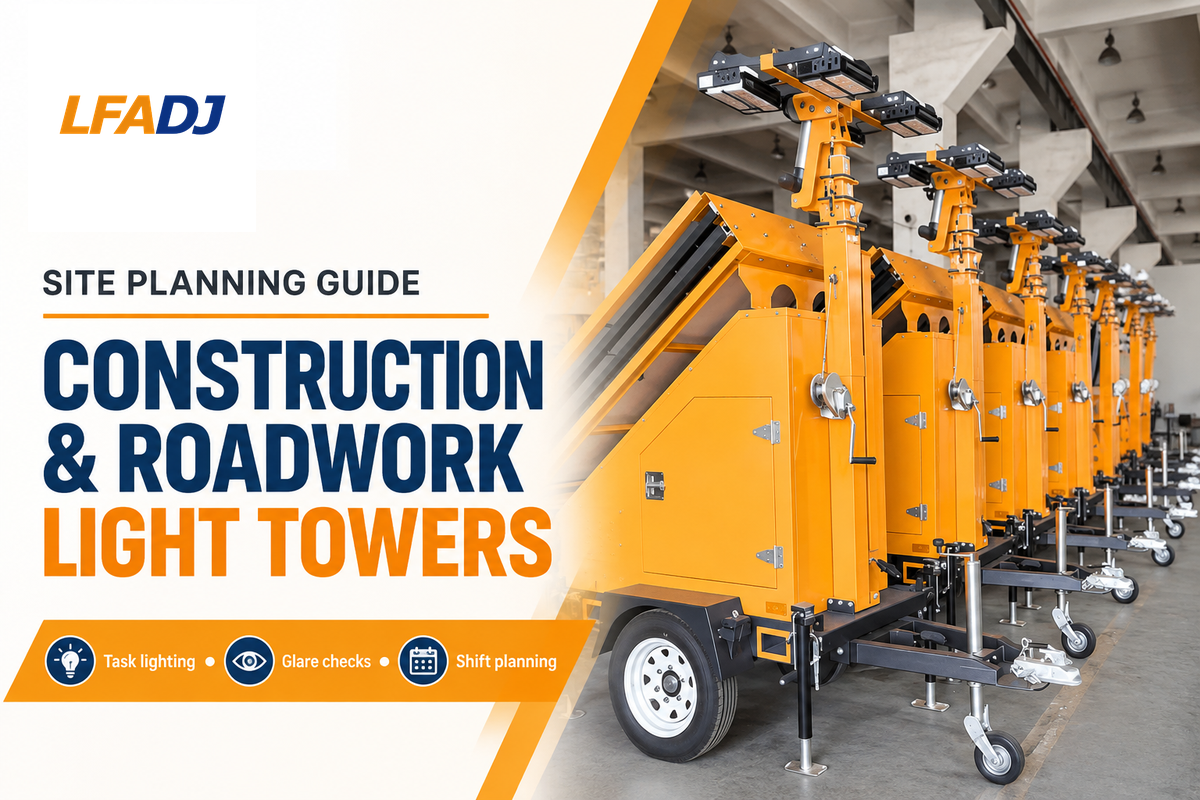
Construction & Roadwork Light Towers are relocatable lighting units used beyond daylight for construction- and roadwork-related activities. Design starts with the task, traffic configuration, and the shift being worked; continues with consideration to lighting distribution and power; and ends with the selection of the best light tower for the job. A bright site can cast a worker’s hands in shadow or reflect glare in an approaching driver’s eyes.
The direct answer
Identify a light tower based on a defined work area, lighting criteria, and a power arrangement for the entire shift. Verify the installed layout from both the worker and the road user perspective.
Planning essentials
- Define the task area and the separate traffic-visibility requirement.
- Read coverage at the stated measurement plane, mast height and aiming angle.
- Separately address optics from power (mains, batteries, hybrids, and solar).
- Assign responsibility for relocation, defects and the next shift’s checks.
Start with the workfront, not fixture wattage

During construction, a light tower should illuminate the work area, including the surfaces and interfaces involved in the task and the routes used by people during the shift. Indicate these areas on a site plan before requesting a proposal. Similar assessment is required to determine the needs of approaching drivers and pedestrians for road construction.
The FHWA’s 2012 lighting handbook distinguishes temporary roadway lighting from construction work-zone task lighting. Treat that distinction as a planning question: who needs to see what, and from which direction? Lighting a paving operation doesn’t automatically cover a diverted pedestrian route.
What Are Mobile Light Towers?
Mobile light towers are relocatable lighting units that raise a lamp above a work area. A towable tower is made of a trailer or base, a mast or support, lighting fixtures, and a power arrangement. Portable light towers provide larger illumination than a handheld work light, and the placement of the unit determines the work area that’s illuminated.
General area illumination and close task lighting have different functions. An excavator, a barrier or a worker’s body can block light from a raised lamp. A portable construction work light near a joint, inspection point or repair task may be necessary, even when the surrounding construction site looks well-lit.
Separately map each crew’s lighting needs. Fixed lighting may cover the access road while mobile units follow the workfront. Enhancing visibility at the task means identifying the cause of poor visibility, whether an obstruction, an unlit approach, or glare from a fixture.
Before comparing construction equipment, give the supplier a marked layout showing the active workfront, access routes and obstructions. A price based only on total site area leaves the lighting duty unresolved.
What lighting levels apply to construction and roadwork?
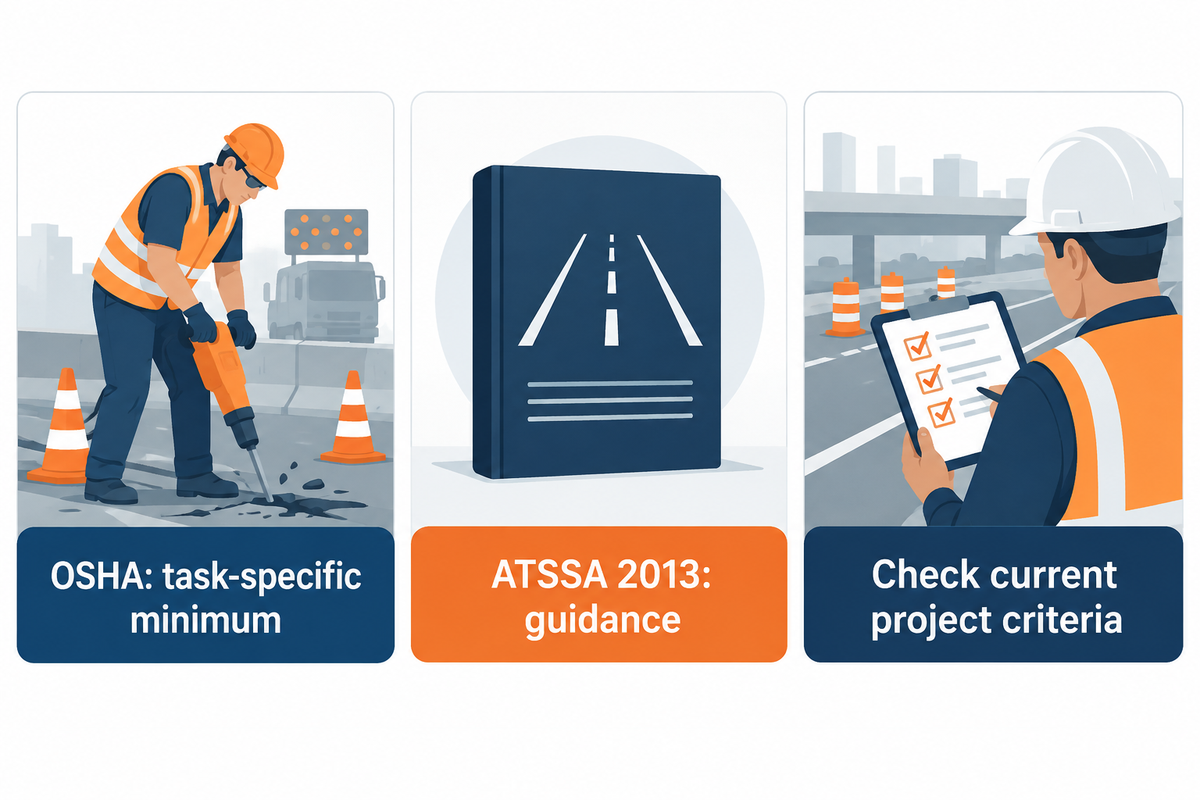
In the US, OSHA’s illumination table for construction sets minimum lighting levels by operation, from 3 foot-candles for areas such as excavation and access ways to 30 for first-aid facilities and offices. Roadwork guidance may instead describe maintained average illuminance for particular activities. Record the applicable source and acceptance before using any figures for purchase specification.
| Source and scope | Level | How to use it |
|---|---|---|
| OSHA: general construction area | 5 foot-candles | Apply the relevant Table D-3 category. |
| OSHA: general construction areas, concrete placement, excavation and waste areas, access ways, active storage, loading, refuelling and field maintenance areas | 3 foot-candles | Preserve the full task scope rather than applying one site-wide figure. |
| OSHA: indoor warehouses, corridors, hallways and exitways | 5 foot-candles | Check the actual operation and location. |
| OSHA: tunnels, shafts and general underground work | 5 foot-candles; specified heading operations require 10 | Read the drilling, mucking and scaling exception in the rule. |
| OSHA: listed construction plant and shop facilities | 10 foot-candles | Consult the listed facilities in the source. |
| OSHA: first-aid facilities, infirmaries and offices | 30 foot-candles | Separate these spaces from the general workfront. |
| ATSSA 2013 guidance: Level I activities | 5 foot-candles / 54 lux | Recommended average minimum maintained illuminance. |
| ATSSA 2013 guidance: Level II activities | 10 foot-candles / 108 lux | Match the activity description before specifying. |
| ATSSA 2013 guidance: Level III activities | 20 foot-candles / 215 lux | Retain the source’s units and rounding. |
Read the complete OSHA 1926.56 rule, including paragraph (b) for operations outside the table. The separate ATSSA Nighttime Lighting Guidelines for Work Zones is April 2013 guidance supported by an FHWA grant. Its recommendations aren’t a replacement for the project’s current agency requirements.
Procurement: Have the project lighting designer state task, units, measurement plane, and if the criterion is for point readings, minimum or average illuminance. A supplier’s single lux number cannot answer all four questions.
Proper lighting gives the inspection team a defined basis for accepting the work area. Similarly, project efficiency relies on completion of the lighting review before the crew arrives. The decision regarding lighting belongs in the setup timeline, together with the other construction activities.
OSHA lists 3 foot-candles for several named construction activities and 5 foot-candles for general construction area lighting. The classification of a task determines the equipment selected. An average illumination target from a work-zone guide has a different basis and needs its own project acceptance method.
Read useful light coverage before comparing towers
Light coverage is the area that receives the required illumination at the relevant task plane in the proposed operating arrangement. Comparing photometric drawings requires the same assumptions. A headline coverage area, lamp wattage or lumens, leaves unanswered where light falls and where shadows are.
Ask for a layout to show fixture placement, height, aiming, output setting, measurement plane and obstructions. The ATSSA guide explains the use of photometric charts in a lighting plan. A drawing based on an unobstructed surface needs another look when heavy equipment blocks the light.
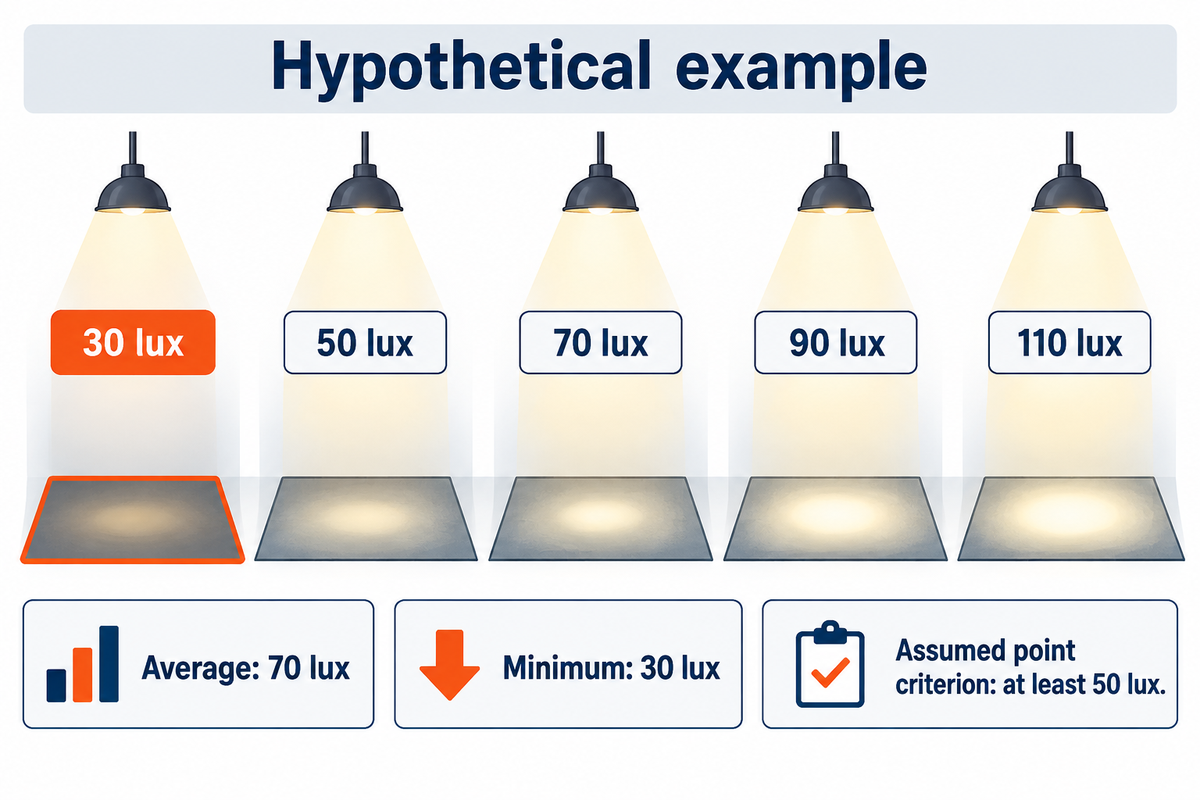
Worked example. Assume a project requires at least 50 lux at each agreed test point on a task surface. Five hypothetical readings are 30, 50, 70, 90 and 110 lux. Their average is (30 + 50 + 70 + 90 + 110) ÷ 5 = 70 lux. The minimum remains 30 lux, so the arrangement fails this assumed point-minimum criterion. Averaging the readings hides the dark location. The 50-lux criterion and five-point sample are example inputs, not a legal threshold or prescribed survey grid. The project must define its measurement procedure. Before adding another tower, check whether obstruction, aiming or the selected optic caused the shortfall; then repeat the agreed measurements.
A published ANSI/IES LM-79-24 summary describes laboratory measurement of solid-state lighting output and electrical characteristics. Ask for the relevant test report and photometric file, then use them in the site design. A laboratory report characterizes a product; site acceptance concerns the installed arrangement.
Reject a comparison of coverage when one offer uses a different illumination criterion or mast height. Put both offers on the same basis before deciding that the larger advertised area needs fewer units.
High output defines an amount of light. Sufficient lighting defines if the task receives what it needs. Make the request for distribution data when a proposal promises brighter illumination across a wide area. The appropriate comparison is the resulting task lighting, in particular, the darker locations.
An assumed five-point set of 30, 50, 70, 90, and 110 lux averages 70 lux, but has a 30 lux minimum. A project requiring 50 lux at every agreed point wouldn’t accept that setup. Comparisons of coverage would require the required level as well as the method used to evaluate it.
How should you position light towers and check glare?
Position light towers to put light on the task while limiting direct glare and deep shadows from the viewpoints people actually use. Start with an approved layout and then verify the operating setup after darkness. Adjustments to height, aim and/or position of the masts need repeat checks of the affected work and traffic areas.
Purdue’s 2022 work-zone lighting research tested 49 arrangements involving balloon lights and conventional towers. In those experiments, height, tilt and rotation changed glare; pointing towers toward approaching traffic increased glare compared with perpendicular or away-facing arrangements. Those findings explain why aiming matters, rather than supplying a universal installation angle.
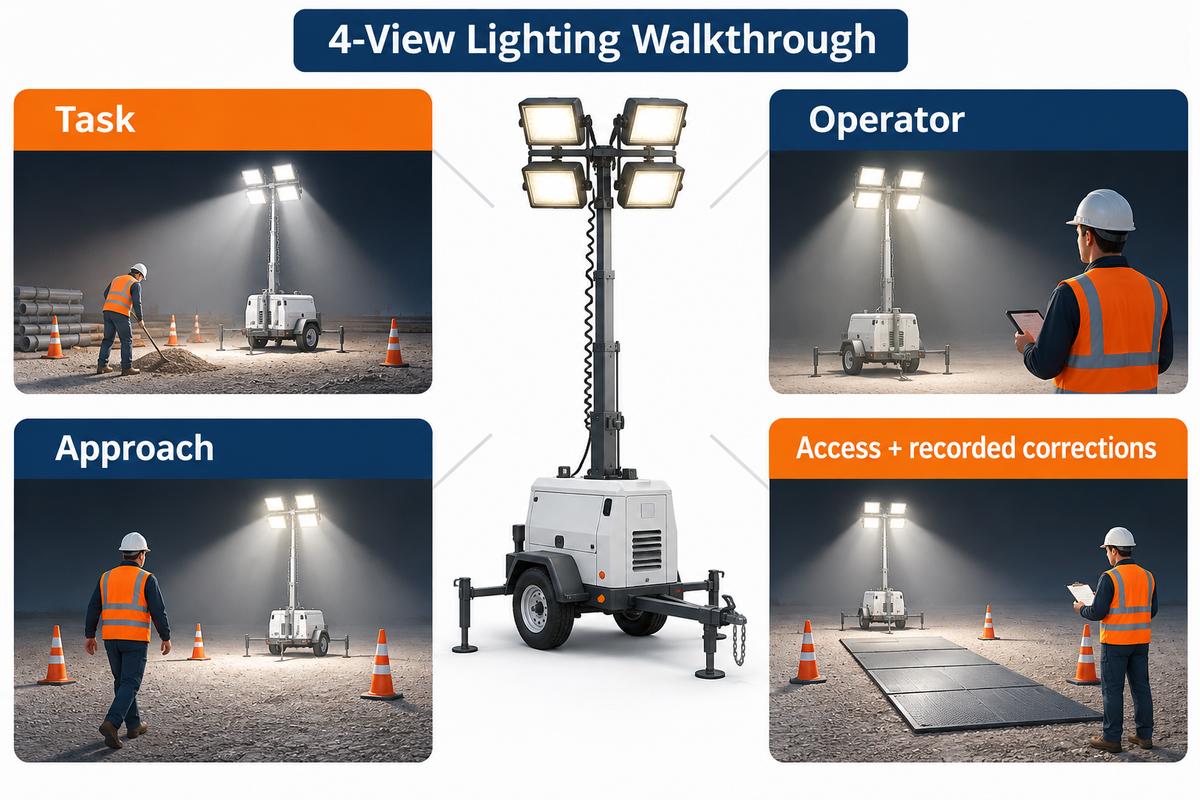
4-View Lighting Walkthrough
The 4-View Lighting Walkthrough is an editorial checklist bridging recorded corrections to the task, operator, traffic-approach and access viewpoints.
- Check the task: inspect the working surface and the shadows cast during the operation.
- Check the operator: assess the view from normal equipment positions without entering an operating machine’s exclusion area.
- Check the approach: have the authorised traffic team assess driver and pedestrian views using the approved traffic-control procedure.
- Check access and record corrections: inspect agreed routes, log defects and repeat the affected checks after adjustment.
Use the walkthrough within the project’s lighting and traffic plans. Traffic viewpoints should be assessed through authorised procedures, never by sending someone into a live lane. The ATSSA guide includes observations from worker and motorist perspectives and recording remedial adjustments.
For the buyer, the unresolved issue is often who will be making the adjustment and who will be accepting it. Include both roles in the quotation scope when a supplier is expected to commission the setup.
Coordinating with the site’s other controls is also necessary for using light towers for safe working. The lighting lead has a critical role in site visibility, but the work-area assessment should also cover moving equipment and the traffic interface.
Purdue tested 49 lighting arrangements and found that glare was affected by the orientation and tilt of the light fittings. As such, a field check should record both the position and the reading. A 70-lux average from the worked example would still leave the driver-view assessment and the 30-lux dark point unresolved.
Which lighting and power arrangement fits the shift?
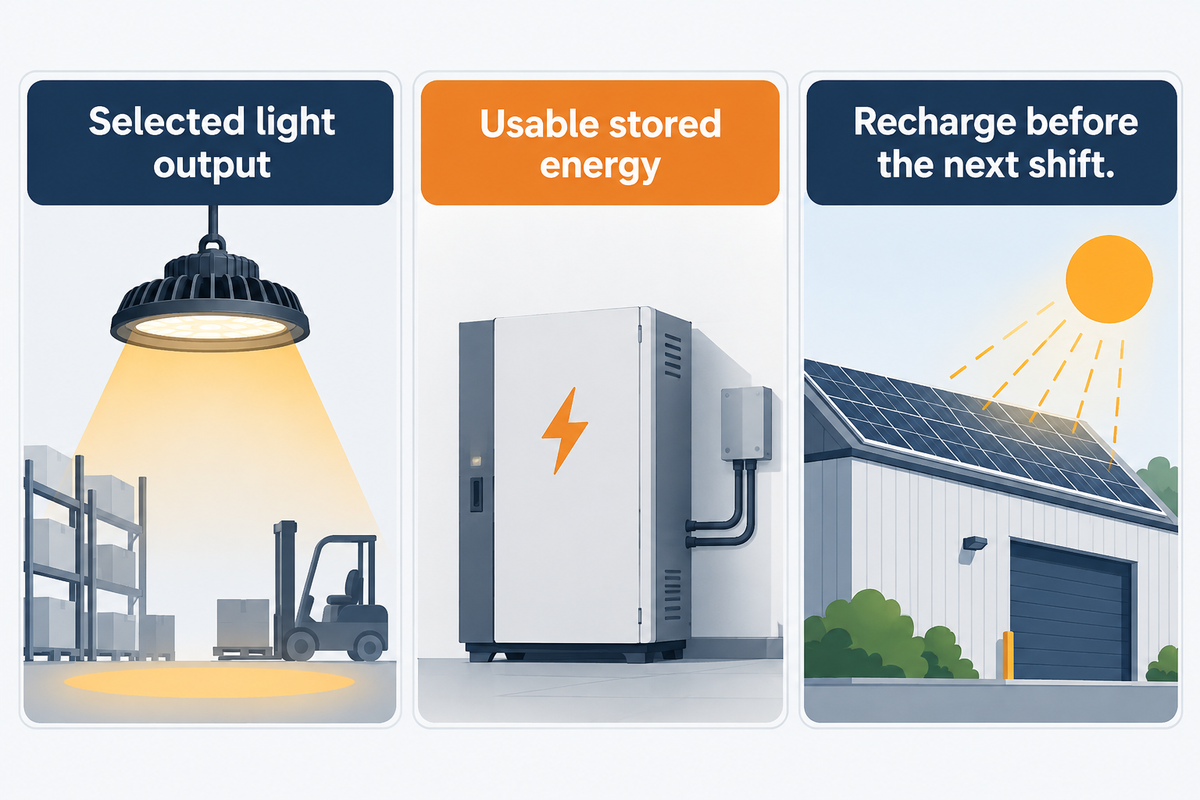
Decide on light distribution separately from energy supply. LED lighting or a diffuse balloon arrangement describes how light is produced or distributed; diesel, mains, battery, hybrid and solar describe the energy supply. The right combination must take into account the access, noise and utility restrictions of the site for the full shift.
Different types of light towers can share the same energy supply yet behave differently in low-light conditions. Select the right lighting distribution before comparing energy demand. An energy-efficient lighting proposal should retain the agreed task performance when it uses less power; reducing output alone changes the comparison.
| Site condition | Arrangement to assess | Hidden bottleneck and evidence to request |
|---|---|---|
| No usable site supply | Self-contained engine or stored energy | Fuel or charging access; request the shift energy plan. |
| Engine operation restricted overnight | Battery or mains during restricted hours | Usable energy at the agreed output and end-of-shift reserve. |
| Several successive night shifts | Recharge, refuelling or swap plan | Recovery time between shifts, not just the first-night runtime. |
| Seasonal shade or limited solar access | Solar with an evidenced energy balance | Worst-period generation and the agreed backup arrangement. |
| Long cable route across operations | Mains-fed or local generation | Electrical design, cable protection and access-route conflicts. |
| Frequent workfront relocation | Towable or relocatable arrangement | Lowering, transport, setup and rechecking time. |
| Low-angle views toward fixtures | Suitable optics, shielding or diffusion | Glare and shadows in the installed layout. |
| Enclosed or semi-enclosed work area | Electrical supply with combustion equipment appropriately outside | Exhaust paths and nearby air intakes require review. |
| Other equipment needs electrical power | Specified auxiliary supply, if available | Confirm rated spare capacity in kW and applicable protection. |
Shift example. An urban crew schedules a 12-hour night shift with a 6-hour engine restriction. A battery-backed arrangement could be an option, only after the supplier confirms useable energy at the selected light output for the 6 hours. Daytime charging needs to also fit the next shift’s schedule. Reducing output to extend runtime may change task illumination, so the revised setting needs to remain within the approved lighting plan. The same question occurs for a solar-powered unit: can the local charging opportunity reenergize the unit? Analyze the permitted operating sequence before analyzing prices. These are assumed scheduling inputs, not a runtime claim for a particular tower.
For a solar light tower, ask who will respond if the expected recharge opportunity is lost. Dependable overnight operation needs an agreed energy reserve and contingency, rather than a first-night demonstration alone.
NIOSH warns about carbon monoxide from combustion equipment, including portable generators, and recommends outdoor placement away from air intakes. Enclosed or semi-enclosed spaces need particular attention. Mains and generator installations also require a competent electrical review: OSHA 1926.404 has conditional ground-fault protection and portable-generator grounding provisions. Follow the applicable rule and model instructions rather than a blanket ground-rod rule.
Staff should understand the differences in their required energy plans during the 12-hour shift with a 6-hour engine restriction. Runtime at one output setting doesn’t carry over to another, so check that the duty-specific energy schedule covers the 6 restricted hours at the agreed output before treating a hybrid power configuration as a workable option.
Plan for a moving roadwork front
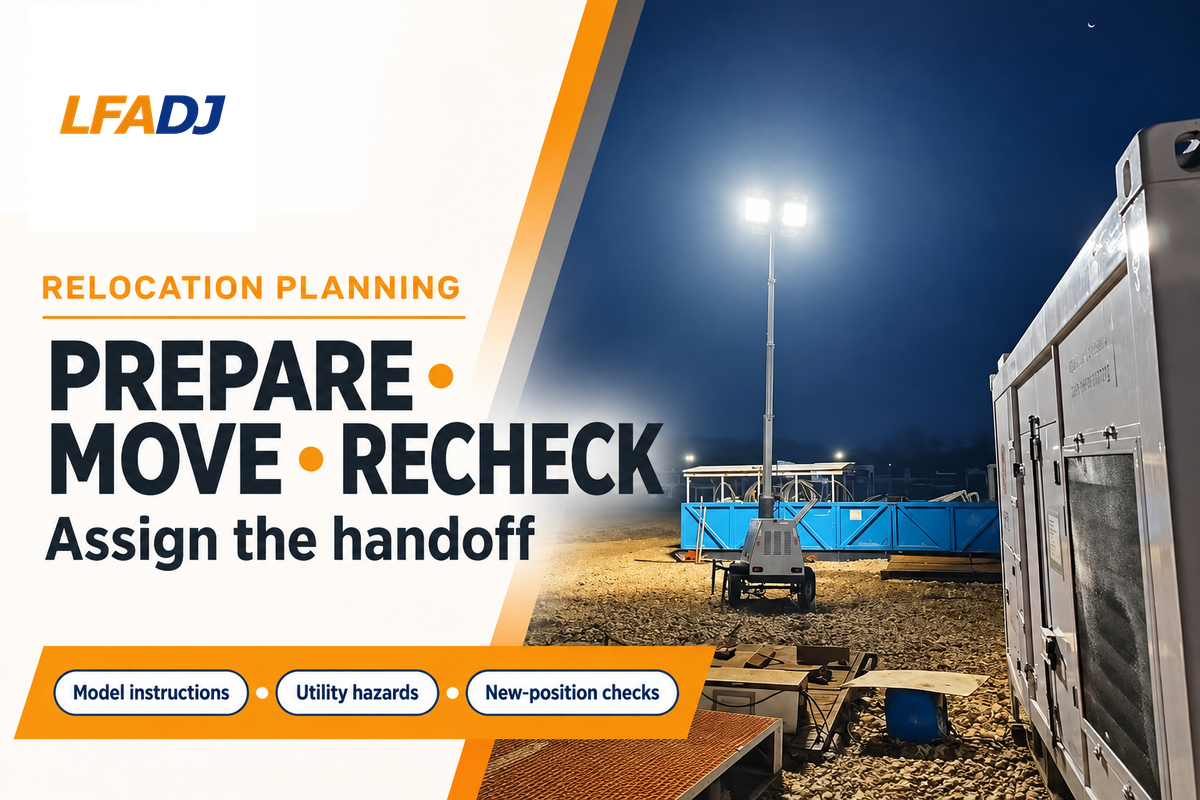
Moving road construction requires careful planning and the ability to keep pace with the work. Assign the move, the transport preparation and the new-position checks before the shift. Access to towers, the position of utility lines and interaction with heavy equipment can impact the positioning of equipment that looks satisfactory on a static drawing.
A New York FACE investigation, Report 12NY018, describes a mechanic electrocuted when a mobile light tower contacted a powerline during equipment removal. The May 2012 incident was unwitnessed; the report says the worker apparently raised the mast for an unknown reason. Include removal and relocation in the utility-hazard assessment, as well as initial installation.
Use the manufacturer’s operating instructions for towing, lowering the mast and equipment supports. Have the responsible site team address overhead-line clearances and controls under the applicable rules. A generic figure for tower height can’t address powerline hazards.
How do portable lighting towers improve productivity in construction?
Portable lighting towers can support productivity by making the planned nighttime work visible and keeping temporary light close to the active task. The outcome depends on equipment and resource coordination, as well as glare and shadows.
View the handoff between paving, inspection, and the next workfront position. Record who moves the tower and who confirms the lighting arrangement. Extending working hours adds little value if a move leaves the next task waiting for suitable light. Agree a contingency for an interruption to the lighting system rather than promising uninterrupted production.
Tight deadlines make the relocation handoff especially easy to overlook. Put productivity and safety responsibilities in the work sequence so the person arranging the next move knows which checks must be done before work can resume.
How do you compare rental and purchase costs fairly?
When comparing rental and purchase offers, evaluate lighting duty and scope of responsibility, and operating hours. The price of the capital equipment is only one input. The total cost of the equipment can be affected by the energy, the terms of the contract, and the timing of off-hire. A lower light-output setting can also make the equipment unsuitable for the work.
“That means buyers should look beyond initial cost, to the total cost of ownership over the product’s lifetime.”
The DOE training uses equal light output to compare lighting costs. Use this principle to compare tower quotes, and take into account current supplier terms for the equipment, market and project in question.
| Input | Put both offers on this basis |
|---|---|
| Lighting duty | Same work area, illumination criterion and output setting. |
| Operating hours | Shift hours, included meter hours and excess-hour charge. |
| Mobilisation | Delivery, collection and transport preparation. |
| Energy | Fuel or electricity at the specified duty. |
| Site labour | Setup, moves, checks and replenishment responsibilities. |
| Maintenance | Who services the unit and what response is contracted. |
| Contingency | Replacement provision and responsibility during interruption. |
| Commercial terms | Insurance, damage, taxes and separately charged items. |
| End of use | Off-hire notice and collection; for ownership, storage and disposal. |
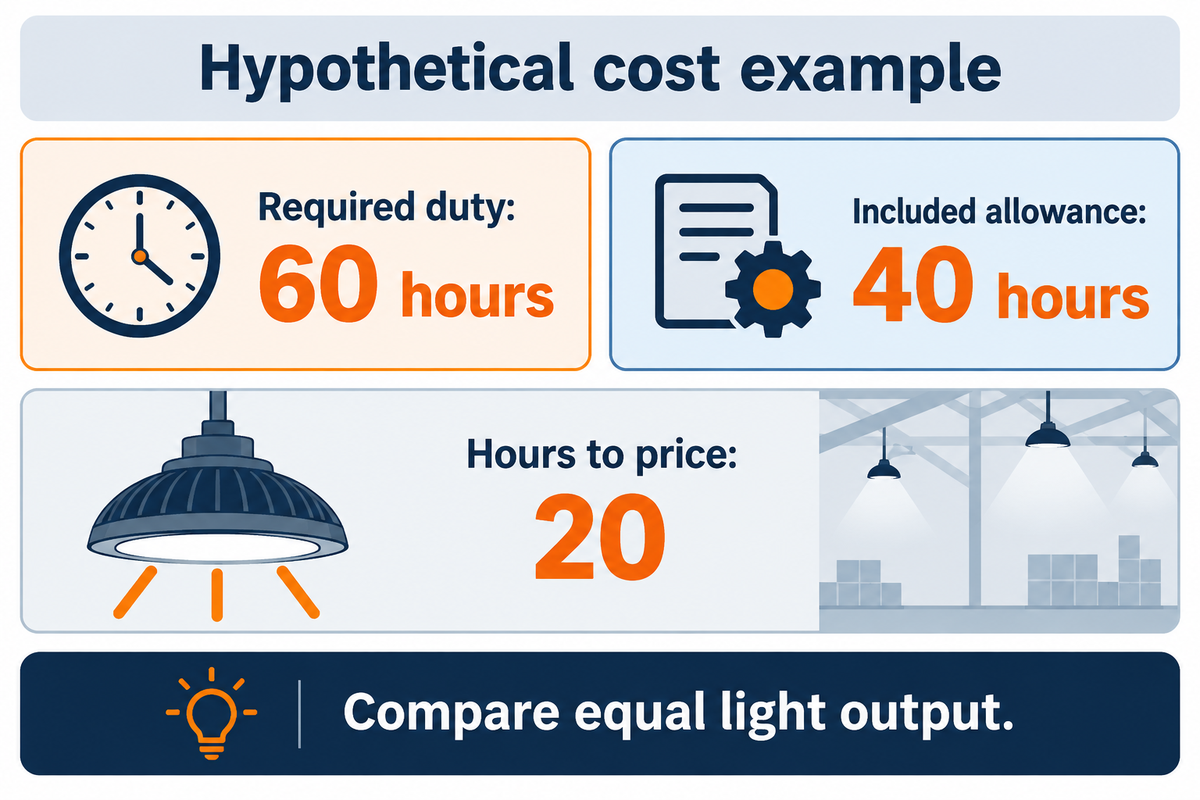
Cost example. Assume a five-night job runs its tower for 12 hours each night: 5 × 12 = 60 operating hours. A hypothetical quotation includes 8 hours per day across those five days, or 40 hours. The remaining 20 hours need a stated charge or a revised allowance. Don’t add an invented hourly rate to close the gap. Ask each bidder to price the same 60-hour duty, including delivery and energy responsibilities. An apparently cheaper rental may then change position, or remain cheaper for a clear reason. For ownership, use expected future utilisation and maintenance inputs rather than treating those 60 hours as a full business case.
Five assumed 12-hour shifts total 60 operating hours. An 8-hour daily allowance over the same five days totals 40 hours, and 20 hours remain to be priced. Normalising that difference exposes a contractual cost before the job starts, without guessing a rental rate or a purchase payback period.
Accept the setup before the shift starts
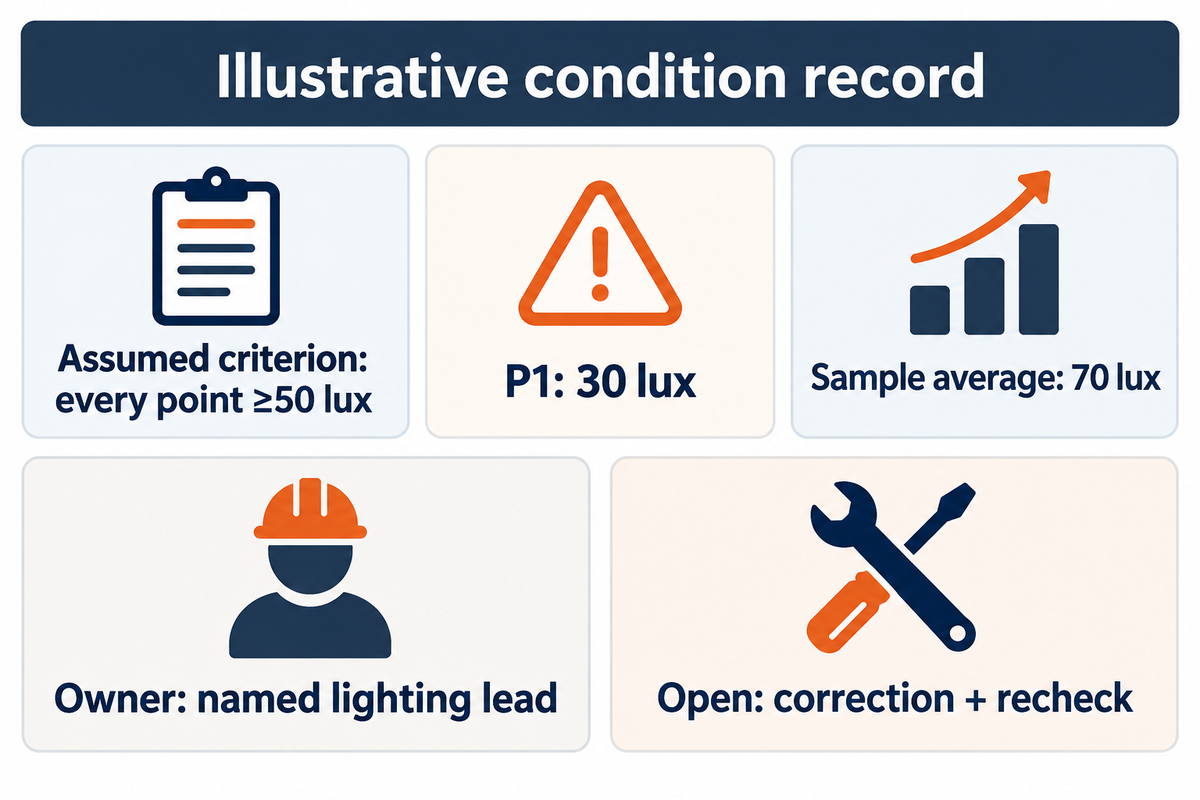
Handover must connect the installed tower arrangement to the project criteria, readings and observations. Record output settings and operating positions and any defects. Close corrective actions through the responsible project roles before releasing the affected work, and define which changes require another check during the shift.
| Record field | Example entry | Decision or next action |
|---|---|---|
| Task and point | Joint inspection, point P1 | Mark the point on the workfront sketch. |
| Task plane | Inspection surface defined in the project method | Keep the measurement plane consistent. |
| Operating arrangement | Tower A, agreed output, recorded mast and aim settings | Save settings with a marked sketch. |
| Criterion source | Assumed project requirement: every agreed point ≥50 lux | Attach the actual requirement on a real job. |
| Measured value | P1: 30 lux; sample average: 70 lux | Resolve the point shortfall before acceptance. |
| Observation | Equipment shadow crosses P1 | Review position or supplementary task lighting. |
| Corrective-action owner | Named lighting lead | Assign the individual and completion time. |
| Recheck trigger | Tower move, changed aim or changed obstruction | Repeat affected readings and viewpoint checks. |
| Handover status | Open: P1 correction and recheck outstanding | Record acceptance only after the issue is resolved. |
The record is an editorial aid created from the guide’s field check approach and isn’t an official record. Adhere to the project’s meter procedure, checking frequency, and authorisation rules. The ATSSA guidance is supportive with regards to checking the layout from relevant viewpoints and recording adjustments.
Keep the model manual and support arrangement, and weather limits, available to the shift lead. If the task requires emergency response lighting after loss of primary power, document that contingency. Leaving a gap in responsibility with an undefined deployment of a spare tower is unacceptable.
The illustrative condition record keeps a 30-lux point failure visible even though the five-point average is 70 lux. Recording the obstruction and specifying the corrective action and recheck owner turns the measurement into an action. The example inputs must be replaced by the actual site criteria and measurement procedures.
What belongs in the supplier brief and handover?

Include the task map, lighting criteria, shift schedule and site constraints, then ask for documents that answer specific approval questions. Keep company documents, model test evidence and site acceptance records separately during the procurement process.
- Lighting design: photometric data and the proposed layout answer whether useful light reaches the task.
- Operating configuration: the exact model manual covers mast, support, transport and operating limits.
- Power interface: the supply design, protection and auxiliary load schedule answer electrical questions.
- Shift support: Written terms of agreements identify responsibilities for replenishment, maintenance and response and replacement.
- Handover: the condition record connects the installed setup to project acceptance.
Use LM-79’s public measurement scope to frame a request for relevant product test information. Keep the scope exact: a lighting measurement report, a company’s management-system certificate and a hazardous-location product approval answer different questions. Hazardous areas require review of the specific model’s suitability and conditions of use under applicable rules.
LFADJ, the brand of Zhejiang LONGFA Lighting Co., Ltd., supplies mobile and industrial lighting and provides product-selection and configuration consultation. Send a marked site brief through the Construction & Roadwork Light Towers solution page to discuss equipment options. Agree warranty, service response and on-site support in the specific contract.
For the procurement team, the issue is whether each offer provides the required evidence and allocates the remaining work. An unassigned design, electrical or commissioning task needs to be assigned before the order is finalized.
A lighting solution for several project sites also requires a clear record of the configuration assigned to each location. Keep that record with the relevant layout; moving the equipment between job sites doesn’t transfer the previous location’s acceptance.
What is changing in nighttime work-zone lighting?
Current work zone initiatives put more focus on glare control and how agencies assess nighttime visibility. Buyers should request this type of lighting evaluation, identify relevant views, understand how the assessing agency evaluates glare, and identify the individuals that can make this determination. More light output doesn’t settle these concerns.
The FHWA’s Advancing Nighttime Work Zone Safety initiative, on a page modified May 22, 2026, promotes anti-glare lighting and agency measurement practices alongside other work-zone safety measures. The page explains that guidance has no binding legal effect except where it cites applicable statutes or regulations. Treat it as a current planning direction, rather than a new universal product requirement.
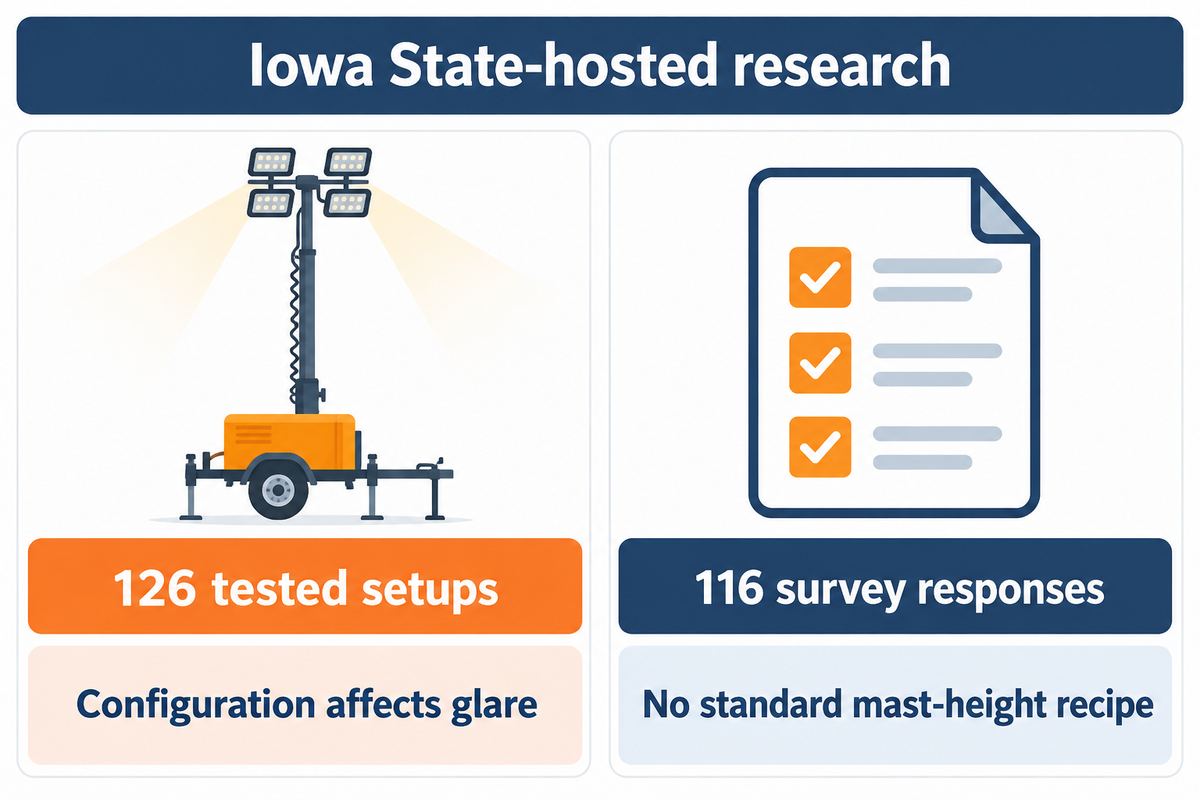
A completed Iowa State-hosted research project combined 116 survey responses with 126 tested LED and halogen setups. It identified configuration as a major influence on glare and uneven coverage. Rotation and mounting height were the greatest factors in the study. Its experimental geometry should inform questions for a site designer, rather than become a standard mast-height recipe.
On a current project, ask the responsible agency or designer what measurement and review practices apply, and include that response in the request for quotation so bidders price the same commissioning scope. A lower-priced supply-only offer and a commissioned lighting arrangement are separate purchases.
Improving safety is a project objective requiring defined assessment. Ask how a proposed lighting change will be checked, who owns any corrective action and how the approved settings will reach the next shift. Ensuring safety requires site controls in addition to adequate lighting; a higher-intensity light source can’t take over control responsibilities.
Iowa State-hosted research examined 126 lighting setups and collected 116 survey responses. Its findings show that configuration and glare are important, in addition to output. A project using 12-hour night shifts still requires its own approved configuration and energy duty; the research doesn’t define that project site’s requirements.
Frequently asked questions
Lighting for construction and road work is typically addressed once the task, location, and operating schedule are defined. The answers that follow address the next specification or commercial input requirement. For US illumination categories, review the complete OSHA table; other jurisdictions and project agencies may set different requirements.
What are the requirements for lighting on construction sites?
In the US, construction lighting requirements start from OSHA’s minimums: 5 foot-candles for general construction area lighting and 3 foot-candles for several named activities; project rules and other jurisdictions can add their own.
For US construction, OSHA 1926.56 lists illumination categories with different minimum levels. Match the operation to the correct row, then check the project’s additional requirements and measurement procedure. Record whether the acceptance criterion concerns a minimum or an average, and at which task plane it applies. Road-user visibility and glare also need attention in roadwork planning.
How much does a portable light tower cost?
A 2026 US rental price guide lists a portable light tower at $60–$200 per day, $192–$720 per week or $510–$1,900 per month; the job price still comes from a dated quote for the specified model, duty and supply scope.
Request the light-output setting, power arrangement and operating hours alongside the equipment price. For rental, confirm meter allowances, excess hours, delivery, collection, energy and off-hire terms. For purchase, add commissioning, maintenance and storage inputs. Comparing those items on the same basis gives a sounder cost decision than applying a generic market rate to an undefined job.
Do Light Towers Work on Construction Projects?
Light towers can support construction work when their installed arrangement provides suitable task illumination within the site’s operating constraints.
Check how the proposed light reaches the active task, including shadows from workers and machinery. Then review glare, power, access and the model’s operating limits. A tower suitable for broad area illumination may still need supplementary close task lighting. Confirm performance against the approved lighting plan after setup and after changes that affect the working arrangement.
Where are construction and roadwork light towers used?
Typical applications include temporary construction areas, road repairs and nighttime equipment maintenance.
Select the arrangement for the individual task and environment. Work sites with enclosed operations, hazardous locations or live-traffic interfaces require their own assessments of safety hazards and applicable equipment conditions.
Should you buy or rent a mobile light tower?
Rent for uncertain or intermittent demand; evaluate ownership when recurring utilisation and maintenance responsibilities support the investment.
Start with expected operating hours across the projects you can reasonably identify. Rental can suit a short programme or changing site requirements, but included hours and availability need checking. Ownership adds storage, transport, maintenance and eventual disposal responsibilities, as well as the equipment purchase. Compare both options using matching illumination duty and energy assumptions. Include the cost of staff time, service arrangements and backup during a failure. Ask how a change in utilisation would affect the decision, especially if future work is uncertain. A tower that fits the current job may not suit the next site’s noise restrictions, charging access or traffic layout. Use dated offers and a documented planning period rather than a universal break-even number of rental months.
Key takeaway
Buy against a defined task and shift: the assumed 70-lux average in this guide still contains a 30-lux point requiring correction before acceptance against the example criterion.
Turn the workfront into a clear equipment brief
Send LFADJ your task layout, shift schedule, power access and project lighting criteria. The team can discuss a potential configuration and the documents required for your project.
Related articles and equipment guides
- Diesel mobile light towers for off-grid work
- Solar mobile light towers and charging considerations
- Hybrid mobile light towers for mixed energy arrangements
- Industrial emergency lighting systems and contingency planning
References & Sources
- OSHA, 29 CFR 1926.56: Illumination.
- ATSSA, Nighttime Lighting Guidelines for Work Zones, April 2013, FHWA-grant-supported guidance.
- Purdue JTRP, Workzone Lighting and Glare on Nighttime Construction and Maintenance Activities, 2022.
- Iowa State SWZDI, The Effect of Nighttime Lighting Systems on Workers’ Visibility and Safety, completed research summary.
- FHWA Lighting Handbook, Related Roadway Systems, 2012, sections 8.3.1–8.3.2.
- FHWA, Advancing Nighttime Work Zone Safety, page modified May 22, 2026.
- ANSI/IES LM-79-24 public abstract, optical and electrical measurements.
- New York FACE, Mechanic Electrocuted When a Mobile Light Tower Contacted Powerline, Report 12NY018, CDC archive.
- NIOSH, Carbon Monoxide Hazards at Work, September 30, 2024.
- OSHA, 29 CFR 1926.404: Wiring design and protection.
- DOE FEMP, Take Five: Life Cycle Costs for Acquisition, December 2, 2024.