Get in touch with LFADJ Company

Updated October 2026
Rechargeable Portable Work Lights should keep their assigned task visible during their assigned duty period and be prepared for the next crew. Choose the physical format first. Then, compare the same settings for brightness, work position and battery configuration. Maximum lumens and the longest advertised runtime typically describe different settings.
Rechargeable Portable Work Lights are battery-powered task or area lights. Select them by work-surface visibility, mode-specific runtime and charging recovery. The comparison records the same task position at the start and end of the required duty.
Quick selection facts
- A runtime label can use an endpoint far below initial brightness. Keep its test definition attached to the number.
- Lumens describe light output; lux describes illumination reaching a surface. Position and shadows affect the result.
- USB charging, USB power output and removable batteries are separate features.
- LFADJ lists LF6128 lamp heads as IP65 and its case as IP54. Keep those component ratings separate.
Choose a Portable Work Light for the Actual Job
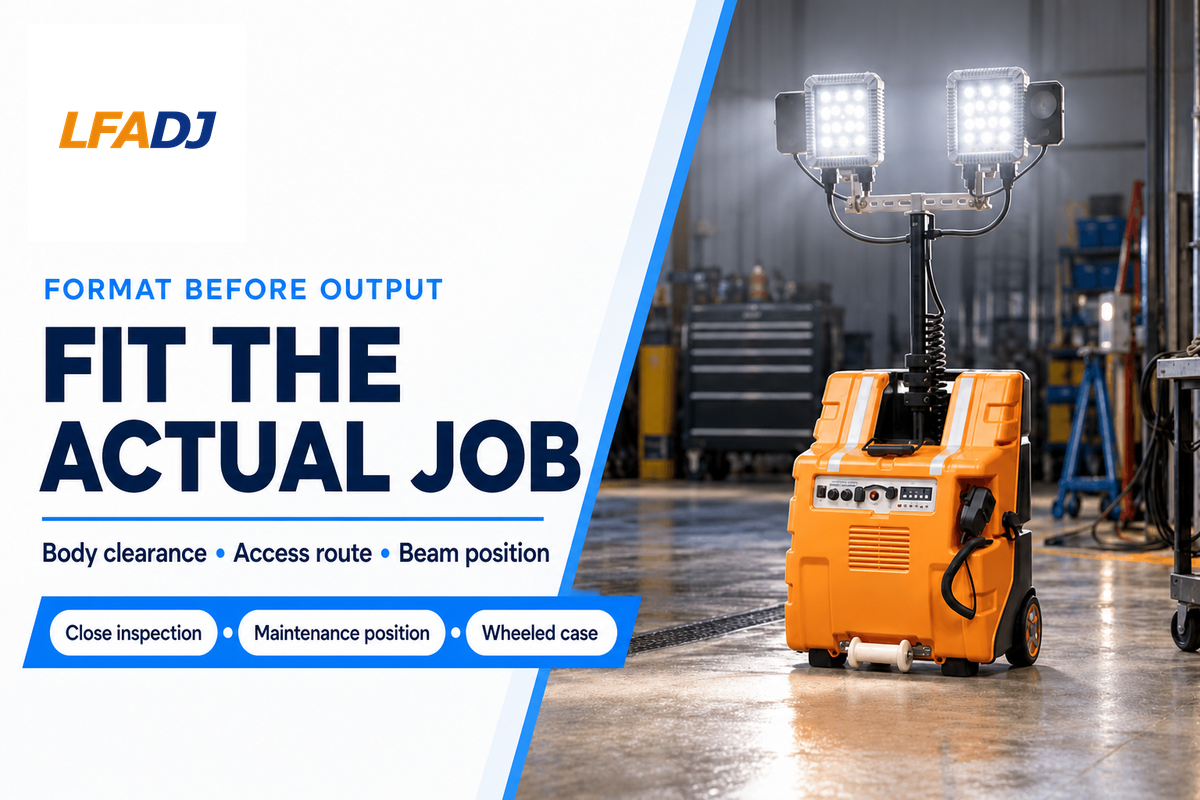
A portable work light fits the job if its body arrives in the work area and its mounting arrangement directs the beam onto the task. Close inspection favors a small handheld work light; a broad maintenance position calls for a floodlight. Larger area lights require a transport and placement plan before their output figures become useful.
Which work-light format fits close inspection?
Close-quarters inspection rewards access rather than a larger housing. For an LED portable work light, check the body’s clearance before comparing beam output. A small opening can exclude a unit that otherwise might fit.
A slim inspection light is a good starting point for accessing a narrow space behind an engine or in a cabinet. A magnetic flashlight leaves one hand free on a suitable steel surface; a narrow LED flashlight reaches a recess. Broad flood lights suit a different job: lighting the space around a worker rather than looking into a small opening.
| Task or location | Format to evaluate | Placement check |
|---|---|---|
| Cabinet inspection | Slim handheld | Body clears the opening |
| Under-hood repair | Clamp or magnetic light | Beam clears hands and hoses |
| Bench assembly | Adjustable task light | Detail remains visible from the working seat |
| Floor-level maintenance | Low stand floodlight | Housing stays outside the access path |
| Room-wide temporary work | Tripod LED work light | Legs fit without blocking movement |
| Repeated field setup | Wheeled case system | Route accommodates the loaded unit |
| Large open work area | Elevated area light | Coverage reaches each assigned position |
| Frequent ladder access | Compact carried light | Handling follows the access procedure |
| Short home repair | Small rechargeable flood | Stable placement near the repair |
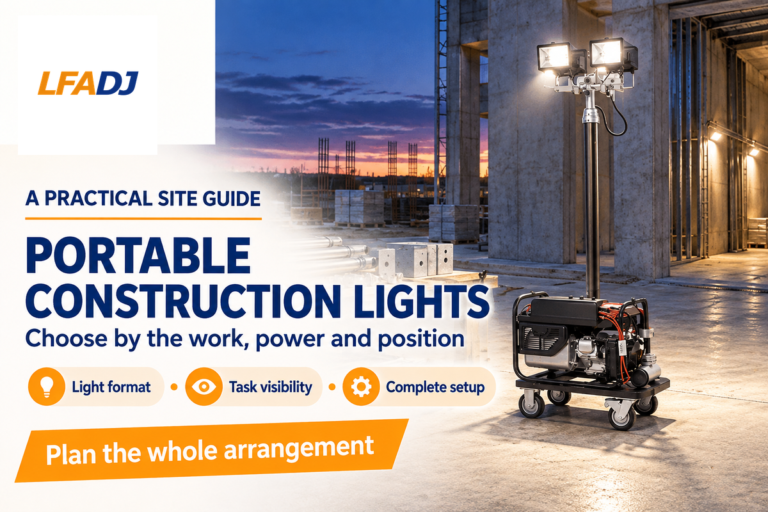
LFADJ’s LF6128 belongs to the wheeled-case category. The LFADJ rechargeable portable work lights page lists two 30 W heads, a 25.2 V, 22 Ah lithium-ion battery and a 15.6 kg unit weight. Those figures describe a movable lighting system, rather than a pocket light. Its USB connection supplies output power to devices.
Consider a maintenance crew moving between a ground-floor pump room and an upper-level valve platform. A wheeled case suits the clear ground-floor route, but the stairs change the handling problem. The crew also needs to see a recessed fastener after an operator leans over the machine. A wide beam, placed next to the pump, and a small inspection light, placed at the recess, perform different jobs. Buying a larger flood light, by itself, leaves the fastener in the same shadow. In this case, a sensible package combines different task positions, rather than replacing all the lights with one high-output model. Assessing routes should be included in the purchase consideration, before the final quantity is determined.
LF6128’s published 15.6 kg weight makes access planning part of selection. Evaluate the loaded route, storage space and carrying arrangements alongside its two 30 W heads. A unit that rolls easily across a clear floor still needs a separate handling plan where the route includes stairs.
Compare Lumen Output at the Work Surface
Useful brightness is the illumination available where the work is performed, with the operator and equipment in their normal positions. A lumen output describes the light source, not the shadow behind the hand. Before paying for higher output, consider the distribution and placement of beams.
A useful lighting comparison ties each output setting to a working position. Descriptions such as super bright provide no information about measurement location or duty duration, therefore, measure performance and evaluate in detail.
Why does a lumen figure not prove task visibility?
A flood beam spreads output across a wider area; a focused beam puts more of it into a smaller area. Changing a light’s position, angle or moving it behind a worker, changes the surfaces that receive the output.
The UK Health and Safety Executive’s lighting guidance mentions task demands, contrast, glare and shadows as design issues. The Canadian Centre for Occupational Health and Safety’s lighting survey guidance supports the assessment of lighting at the task and considers the normal position of the worker. A bright patch on the floor is a poor substitute for seeing a label on a vertical cabinet.
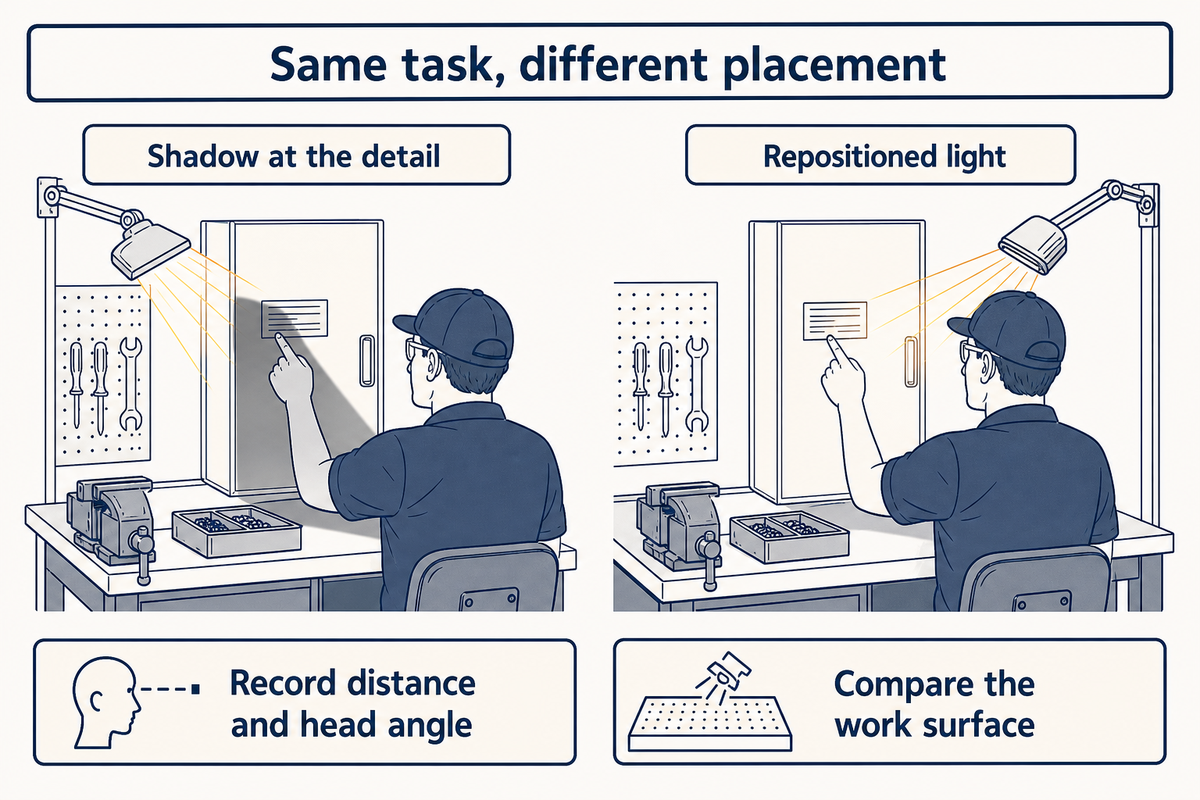
Use the same measurement locations for each sample: the inspection point, surrounding work surface and the edge of the working area. Record distance and head angle. Lux readings should be accompanied by a note describing whether the worker is able to distinguish the required detail without reflected glare. Portable LED flood lights and narrow inspection lights of similar output can be quite different in distribution.
Place two candidate lights in the same mounting positions, and study the label from the normal seat. One broad LED work light brightens the bench well, but the operator’s forearm hides the label during assembly. A second position on the opposite side removes the shadow without changing the product’s output mode. Record both arrangements and their resultant readings. The choice then becomes workable: one repositioned light, a second task light, or another mount. Merely buying high lumens preserves the same geometry. The final choice must also enable the bench to be usable during assembly.
Photometric historical data in the 2018 LED Journal analysis article includes floor plans and elevations. The buying principle is useful to assess the surfaces that people need to see, and its case examples aren’t portable-light tests.
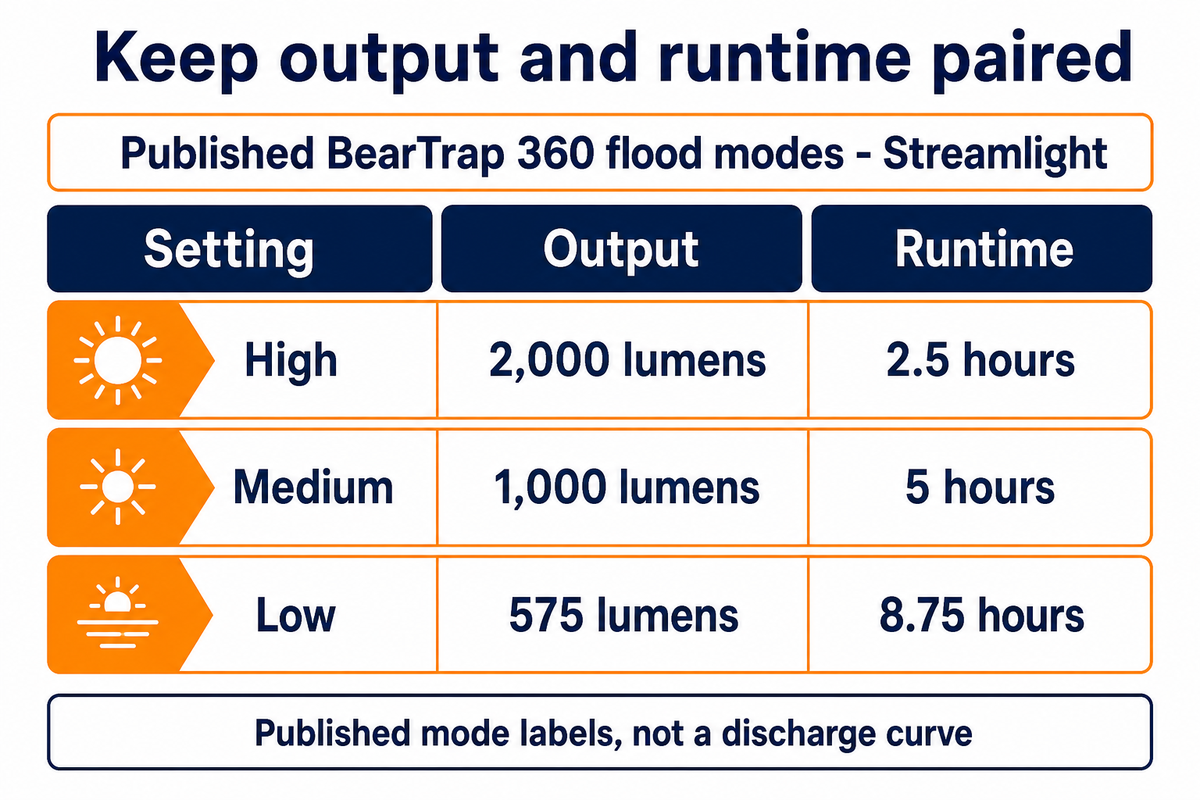
Streamlight publishes 2,000 lumens for BearTrap 360 flood high and 575 lumens for flood low. Any setting still needs a suitable beam position. Record task-surface lux using identical distances and angles, rather than treating either output figure as a universal lighting requirement.
Read Battery Runtime and Recharge Conditions Together
Battery runtime is meaningful when the brightness mode, battery and test endpoint travel together. Long low-mode operation is a different duty from high-output operation. Charging recovery is also important: a light that completes one job but misses the next start needs additional time, reserve equipment or a different plan.
Does a quoted runtime mean full brightness throughout?
No. Quoted runtime describes a test endpoint. PLATO’s FL 1 testing explanation describes ordinary-mode runtime ending when output falls to 10% of its initial measured value. Its short duration, elevated-brightness method uses a different measurement window and endpoint. Keep the mode’s definition with the quote.
The following figures are published by Streamlight for the BearTrap 360. Its May 2024 release also lists the flood high and low pairs. These are mode labels and published durations, not a measured discharge curve for this article.
| Published flood setting | Output | Runtime | Comparison meaning |
|---|---|---|---|
| High | 2,000 lumens | 2.5 hours | High output paired with its duration |
| Medium | 1,000 lumens | 5 hours | Product-page setting |
| Low | 575 lumens | 8.75 hours | Longest flood duration in this table |
Multiplying initial lumens by the advertised hours doesn’t compute the light delivered for the duration of discharge. This requires output over time. Not all long-runtime claims are low settings: different products can have different battery capacities and control schemes. Compare the actual mode pair to the task’s minimum illumination.
Charging-Ready Handover Map
For an LED rechargeable work light, the recovery process begins with the supplied battery and charger. Consider availability of charging as part of the equipment rather than an incidental convenience.
The Charging-Ready Handover Map assigns each light, battery and charger a recovery task before the next crew starts.
| Constraint | Hidden interruption | Handover action | Owner |
|---|---|---|---|
| Selected high mode | Low-mode hours entered in the roster | Plan using the selected mode’s duration | Operations |
| Shared spare battery | Another tool takes the reserved pack | Allocate a compatible spare to the duty | Plant manager |
| Recharge window | Next assignment begins before recovery | Schedule reserve equipment or another release time | Operations |
| Mounting position | Repositioning interrupts the task | Approve the working arrangement before supply | Quality lead |
| Package boundary | Charger or mount arrives as an extra purchase | Compare complete supplied configurations | Procurement and finance |
- USB input recharges a battery through the specified input connection; USB output supplies another device.
- A removable battery needs the right pack, a charged spare and access for the swap.
- Shared tool batteries are available only when another tool hasn’t taken it.
- Dual power and operation while charging are model-specific operating features.
Milwaukee’s 2119-22 utility light provides one clear architecture example: its REDLITHIUM USB battery recharges via Micro USB and can be swapped for another compatible pack. USB therefore doesn’t automatically mean a sealed battery. The specialized utility format is a separate suitability decision.
LFADJ lists at least 8 hours of continuous operation and a recharge time no greater than 6 hours for LF6128. Place the operating mode and charging condition in the purchase record. Device charging and other active functions also belong in that configuration. The existing shift coverage and recharge roster helps construct the handover schedule.
Beartrap 360 flood high is rated at 2.5 hours, and flood low is rated at 8.75 hours. A duty needing the high setting cannot be planned with the low-setting duration. Battery swaps create downtime; a spare pack doesn’t provide continuous illumination.
Check Mounting, Access and Hands-Free Use

Hands-free lighting requires a stable attachment that illuminates the task without obstructing the work. Magnets suit compatible surfaces; clamps need suitable contact geometry. A hanging hook, floor stand or tripod mount changes the available beam positions. Evaluate these with the tools and access route of the worker.
Where will a magnetic base actually hold?
A magnetic base requires a ferromagnetic surface and a secure contact for the lamp’s mounting arrangement. Aluminum panels and plastic covers don’t provide magnetic contact. Obstructed and/or curved steel surfaces also require examination based on the mounting instructions. A light with magnetic attachment still has to point in a useful direction.
In a Garage Journal discussion about rechargeable magnetic lights, the community mentions attachment positions, charging arrangements and various repair tasks. The mechanic light for car repair sticks to bodywork, but it still needs to adjust for clearance around moving workpieces.
Streamlight says a 360° rotation and a 270° pivot, together with other adjustments, help aim the head after clamping for their BearTrap 360. A tripod-mounted light provides a different geometry. Wider mobile lighting system options deserve a separate layout when a local workspace expands into a larger temporary operation.
BearTrap 360’s published 360° rotation and 270° pivot target aiming movement not universal mounting security. Assess contact, adjustment clearance and beam direction in combination. If the desired position is outside the mount’s travel, reposition the unit or find another mounting solution rather than forcing the joint.
Match the Light to Exposure and Operating Conditions
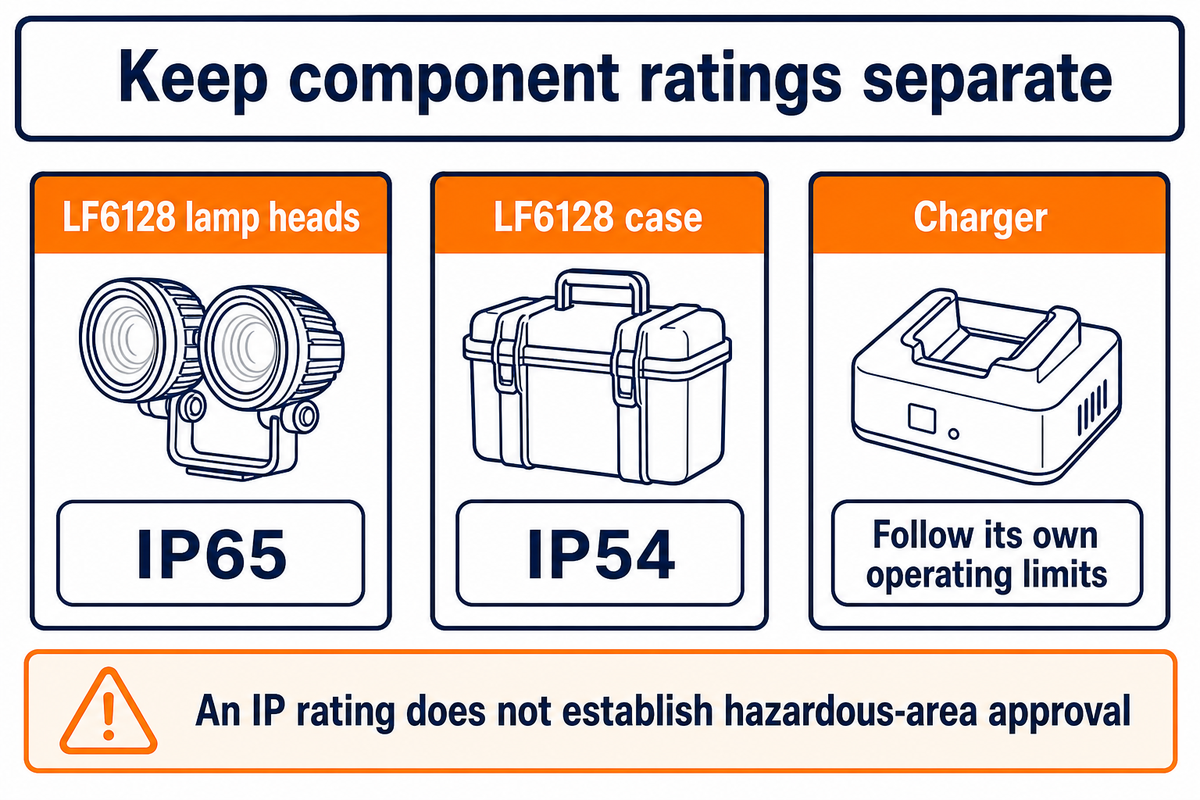
Exposure selection starts with the component and operating condition covered by the rating. Different limits may apply to a lamp head, case and charger. Water resistance doesn’t qualify for a hazardous location. The working environment and the applicable lighting requirements must be taken into consideration, and these must be reflected in the acceptance criteria of the project.
Does an IP rating establish hazardous-area approval?
No. An ingress-protection rating is for enclosure protection; hazardous area approval is concerned with the identified hazardous situations and the approved equipment. LF6128’s listed IP65 lamp heads and IP54 case are separate component ratings. Wet conditions, charging arrangements and explosive atmospheres require separate selection.
Exposure limits of a water-resistant housing still apply to the exact model. Charge equipment with its own operating limits rather than extending the rating of a lamp head to accessories.
OSHA’s US shipyard lighting rule stipulates the portable explosion-proof lights approved for a number of specified hazardous conditions. The note to Table F-1 further states that emergency and portable lights aren’t included in that table’s required illumination levels. That exclusion does not remove other requirements for an adequately lighted workplace.
For construction, separate requirements for area-lighting are found in OSHA 1926.56. When setting acceptance criteria, consider the relevant site and task requirements. A single, universal lumen minimum would over-simplify the judgement of lamp output versus area illumination.
For an outdoor job site, include rain exposure, dust, storage and recharge location in the operating plan. Portable rechargeable equipment does not make every charger suitable outdoors. Use the approved equipment selection for classified locations and the exact model’s instructions for temperature and charging conditions.
LF6128 has IP65 head and IP54 case components. In the package specification, both components should be recorded. Additional labeling should identify charging equipment and any hazardous location approval.
Run a Usable-Light Acceptance Check
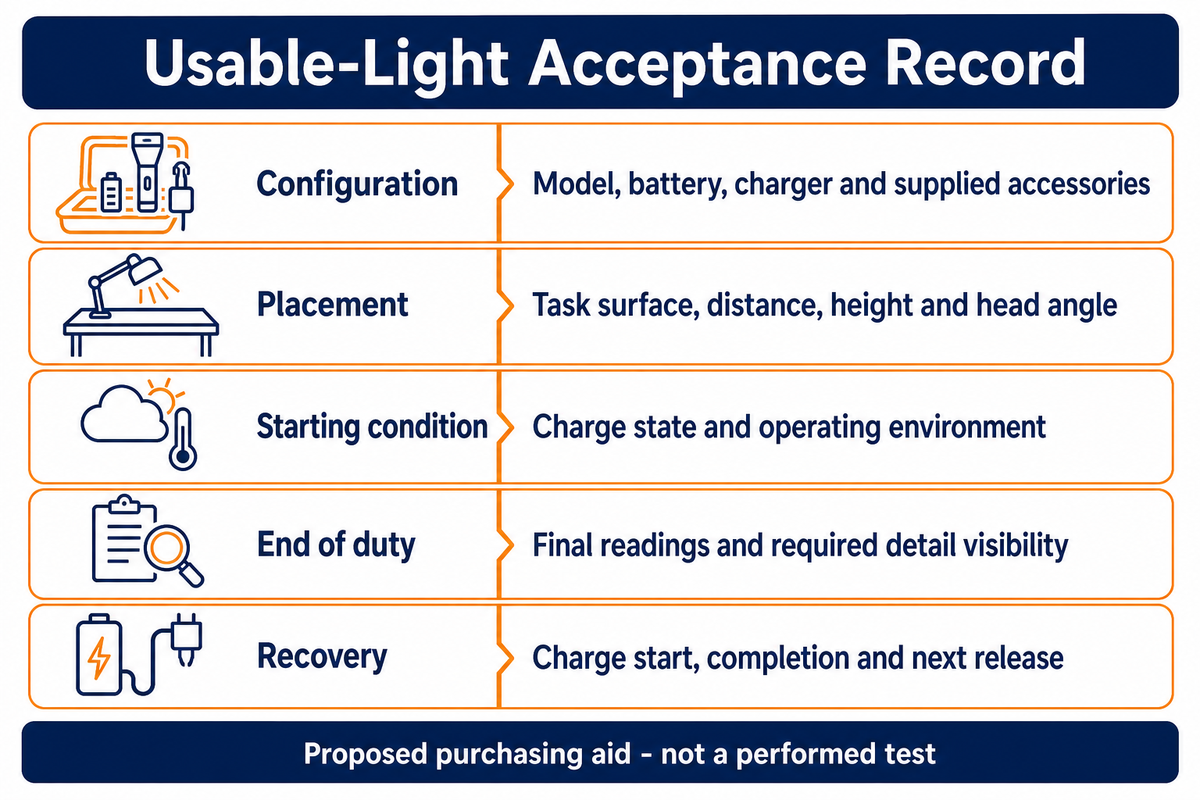
Usable-light evaluation keeps task geometry and configuration steady. Illumination should be measured during the required duty cycle. Other site requirements should also be included in acceptance criteria.
Usable-Light Acceptance Record
A usable-light acceptance check links a fixed task location, selected mode and the end of the duty cycle to an acquisition decision.
| Field | What to record | Decision it supports |
|---|---|---|
| Sample identity | Model, battery, charger and supplied accessories | Match the tested and quoted package |
| Work geometry | Task surface, distance, height and head angle | Repeat the placement |
| Output setting | Named brightness mode and active functions | Compare equivalent operating duty |
| Initial condition | Charge state and operating environment | Make starting conditions comparable |
| Acceptance target | Task visibility and applicable site requirements | Define acceptance before the run |
| Starting illumination | Lux at each fixed measurement position | Document the initial setup |
| Duty observations | Readings, time, shadows and adjustments | Identify loss of useful illumination |
| End-of-duty state | Final readings and required detail visibility | Decide whether duty was completed |
| Dynamic visual suitability | Relevant modulation information and assessment | Address the actual task, including motion |
| Recharge recovery | Charge start, completion and next release | Fit the handover window |
| Disposition | Accept, change arrangement or reject for this duty | Close the sample decision |
What must be recorded at the end of the duty test?
Record the final illumination at the original measurement locations, whether required detail is still apparent, and any changes made during the run. Enter elapsed time, active functions, and battery state. If the operator moved a head or changed a mode, record that event, rather than compare the final illumination reading as though the configuration stayed the same.
Temporal light modulation needs a separate assessment. The US Department of Energy’s flicker research guidance explains that driver loading and dimming affect the waveform, and that one metric can’t predict every application. A video taken on a phone of a moving object or a quick look at machinery isn’t an acceptance method for determining dynamic visual suitability.
Agree on the measurement and assessment method with competent personnel. Don’t operate machinery to show a lighting effect. This Record is a proposed purchasing aid based on lighting guidance; it isn’t a sample test to demonstrate that LFADJ has already performed the described test.
A proposed 4-hour duty needs an observation at the end of the 4 hours under the agreed configuration. A 2.5-hour high-mode label, and an 8.75-hour low-mode label answer different questions. Acceptance follows the required work position and useful output, not the longest duration listed in the catalog.
Compare Quotes on Equivalent Duty
Quotations for equivalent duties include the equipment needed to perform the same task for the same period and recovery schedule. For comparable packages, price per unit should be considered. Items such as batteries, chargers and mounts can affect the total cost of the package; the replacement and availability of the package can affect the total cost of ownership.
What is missing from the cheaper lighting quotation?
What’s missing from the package is usually part of the operating package: a battery, charger or mount and a reserve unit. An a la carte price can be a good deal if the user has the required equipment. If the user doesn’t have that equipment, an a la carte price isn’t a good comparison basis. Check the package against the agreed duty before choosing.
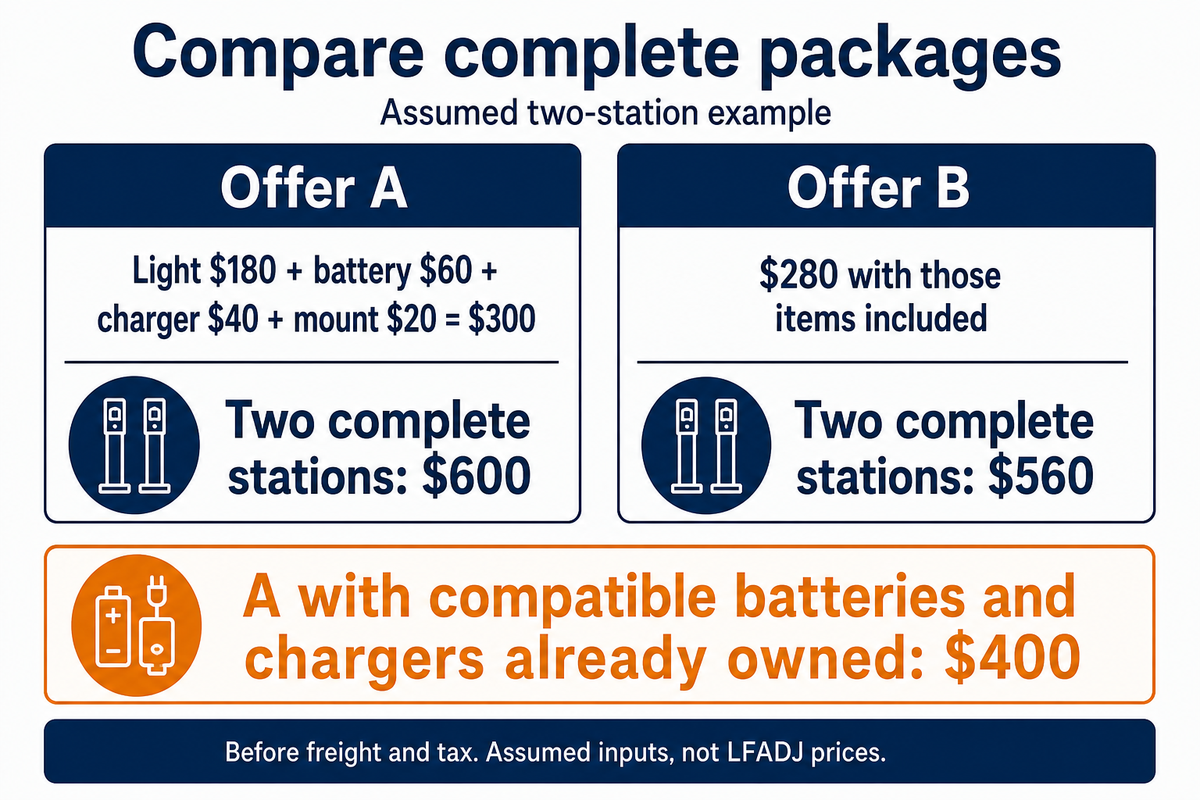
Example: two offers both meet the same four-hour task test. Offer A costs $180 per light, with a $60 battery, $40 charger and $20 mount purchased separately. Its complete total is $180 + $60 + $40 + $20 = $300. Offer B costs $280 with those items included. For two complete stations, A totals $600 and B totals $560, a $40 difference before freight and tax. If the site already owns both compatible batteries and chargers for A, its incremental total falls to $400. The choice changes because the purchasing boundary changes. These assumed inputs demonstrate package arithmetic; subsequent operating and replacement costs require their own common time horizon.
Like DOE’s life-cycle purchasing training, equal light output is also considered with costs beyond the first purchase. Apply this to the battery and charger package. The tool currently available can compare equivalent-duty package quotes without combining various supplied configurations.
RFQ checklist: send one duty description
- Describe the task, access route, measurement positions and lighting needs.
- Specify useful duty duration, selected modes and permitted interruptions.
- Confirm battery identity, supplied chargers, input power and recovery window.
- Ask which component each exposure rating covers and identify applicable approvals.
- Include modulation assessment needs, replacement parts and battery shipping documentation.
- Request the complete package price, quantity, freight basis and agreed support terms.
For LF6128 logistics, the LF6128 unit and transport summary helps keep unit configuration and handling information together.
In the assumed two-station purchase, $600 versus $560 reflects complete packages. With compatible batteries and chargers already owned, Offer A instead totals $400. Record existing equipment; the lowest body price doesn’t always win, nor does the bundled higher price.
What Is Changing in Rechargeable Work Lighting?
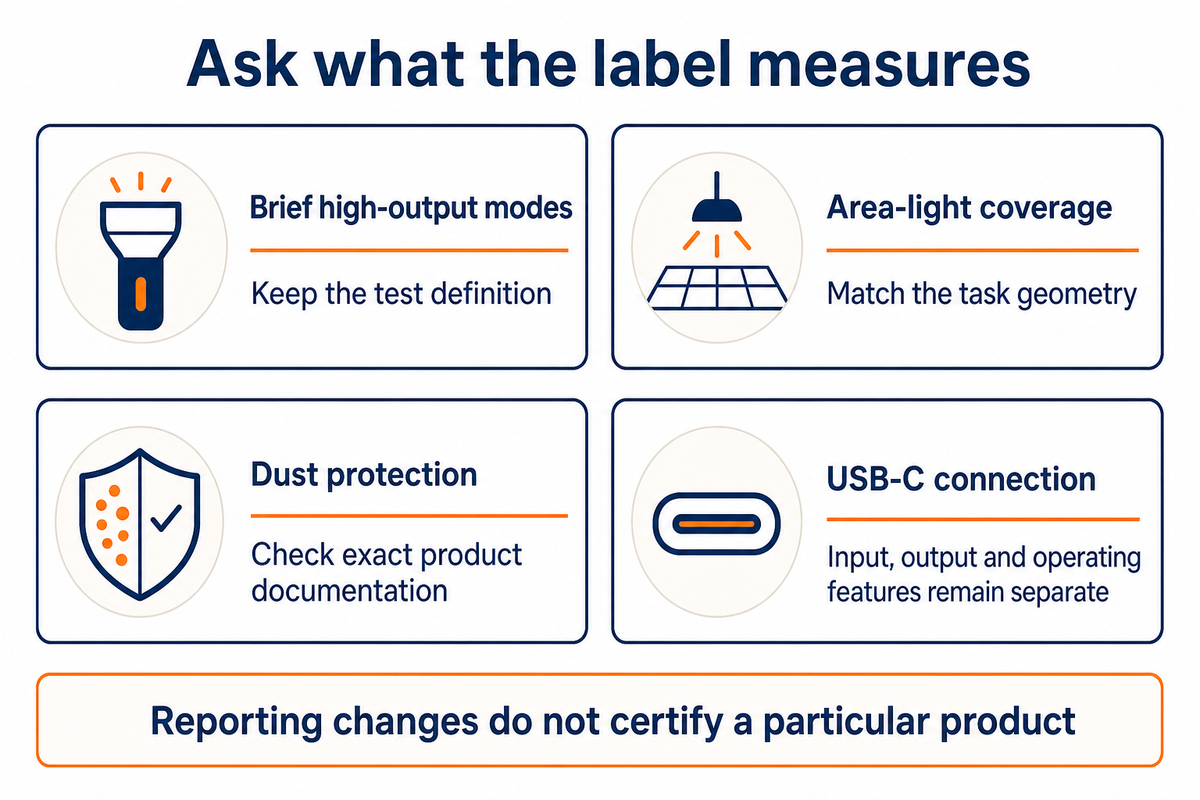
Portable-light performance reporting is becoming more specific about brief high-output modes and enclosure testing. For the buyer, the main change is a clear-cut distinction between a very short peak and a sustainable duty. Standardize the evidence requested with the quotation so a revised label improves comparison instead of adding another headline number.
Electric work lights cover fixed and mobile duties. Tower lights address a wider placement problem than a local inspection lamp; compare lighting solutions at the scale of the assigned work area.
PLATO’s February 2026 announcement published the revised ANSI/PLATO FL 1-2025 standard, which includes brief duration of high brightness testing, an extended scope covering area lights and dust protection rating. A standard publication is a reporting development; acceptance and compliance remain with the exact product and test documentation.
“the industry didn’t have a consistent way to measure or communicate that performance”
Does USB-C tell you how the light can be used?
No. A USB-C connector identifies a connection, while the product’s input, output and operating instructions define its use. Features such as battery replacement, charging a product while in use and use as a power bank are separate features. A rechargeable LED work light with a USB-C connection may have a different battery configuration and recharge schedule compared to a different product.
A cordless work light is preferable to a cord for flexibility in placement. Plug-in shop lights can be used for a fixed workspace with an adequate power supply. Moving from halogen to LED lighting doesn’t rule out placement, exposure and power management issues. A rechargeable work light, whether used by a jobsite team or for infrequent home improvement work, still requires a charging and storage routine.
For the next purchase, retain mode names and test definitions in the equipment register rather than storing only the brightest figure. This allows you to keep track of batteries and chargers when recording. This also allows you to evaluate replacement offers based on the same operating condition, even if marketing labels or connections change.
Frequently Asked Questions
What is the best rechargeable portable work light?
Choose the format that meets your actual task and duty period.
For close inspection, start with a compact light that reaches the detail. For a maintenance position, evaluate a stable floodlight; for wider temporary coverage, consider an elevated or wheeled system. The best choice completes the agreed task test and fits the charging schedule, rather than simply carrying the highest brightness label.
How long do LED rechargeable lights last?
Per charge, one published buying guide puts most compact work lights at 2 to 8 hours of light and higher-capacity ones at 10 hours on a reduced brightness setting; product service life is a separate measure.
Runtime changes with the operating mode, battery and test endpoint. Service life also includes battery replacement, controls, connectors and repair support. Use the exact model’s mode table for a working-period estimate, then review its replacement arrangements for longer ownership. An advertised duration isn’t a promise of unchanged brightness throughout that period.
Is there a rechargeable magnetic work light available?
Yes. Rechargeable lights with magnetic mounting are available.
Streamlight’s BearTrap 360 is one published example with a magnetic base and clamp. Choose the attachment for the actual surface and beam position. Work lights with magnetic mounting need suitable contact and secure placement; aluminium or plastic panels call for another arrangement. Check adjustment clearance as well as the strength of the attachment.
Are rechargeable lamps worth buying?
Yes, when cordless placement and mobility solve the job’s access problem.
Include the battery, charger and reserve plan in the comparison. A fixed bench with suitable power can favor a plug-in arrangement, while a moving maintenance crew gains more from independent placement and a planned recharge routine.
How many lumens do I need for my work light?
Work back from the light the task surface needs: on US construction sites, for example, OSHA’s illumination rule requires at least 10 foot-candles in general construction plant and shops, so choose the lumens and beam that reach that level at your working distance.
A narrow inspection point and a broad work area need different distributions. Measure the intended surfaces at the normal working positions, including the edges and any vertical labels. Establish acceptance targets from the task and applicable site requirements. Compare candidate modes using identical distances and mounting angles. Higher output helps only when the extra light reaches the required detail without unacceptable shadows or glare.
Can I use a portable work light during a home power outage?
Yes, a suitable charged battery light can provide temporary illumination.
Choose a stable position that keeps access routes clear and follow its operating instructions. Rechargeable flashlights can serve local inspection; a lantern offers another distribution. Preserve battery capacity for the duration you need rather than automatically selecting maximum output.
How do I charge my work light?
Use the model’s specified charger or supported charging input.
Start with the instructions and identify the input connection; a USB output socket serves another device. Charge within the stated environmental limits and retain the correct battery-and-charger combination. Operation while charging is available only where the model supports it. Before storage or the next assignment, record whether the battery is fully charged and whether enough recovery time remains. Remove damaged equipment from service under the site’s handling procedure. For shared equipment, assign a charging location and record who releases the light for use. Keep the supplied charger identifiable so another crew can find the correct equipment without guessing from a connector shape.
Conclusion
Choose Rechargeable Portable Work Lights based on a visible task, a usable duty period and a workable recharge plan. Package comparison follows these conditions. Send LFADJ your work position, access route, operating duration, exposure, and quantity to discuss your lighting duty, and build a configuration around your job.
About this guide: CYH created the buyer’s guide with the resources publicly available below and manufacturer-attributed model information reviewed in October 2026. Suggested records and example purchases are editorial aids. No third-party certification of LFADJ or hands-on comparative product test is claimed.
References & Sources
- Lighting and human factors, UK Health and Safety Executive.
- Lighting Survey, Canadian Centre for Occupational Health and Safety.
- LED Match Making: The Value of Photometric Analysis, LED Journal, 2018.
- ANSI/PLATO FL 1-2025: Getting the Testing Right, Portable Lights American Trade Organization.
- 29 CFR 1915.82, Lighting, US Occupational Safety and Health Administration, shipyard employment.
- 29 CFR 1926.56, Illumination, US Occupational Safety and Health Administration, construction.
- Flicker Research, US Department of Energy.
- Take Five: Life Cycle Costs for Acquisition, US Department of Energy, 2024.
- Publication of the Revised FL 1-2025 Standard, Portable Lights American Trade Organization, February 2026.