Get in touch with LFADJ Company

Manual Winch Light Towers: Choosing the Mast and Lighting Package

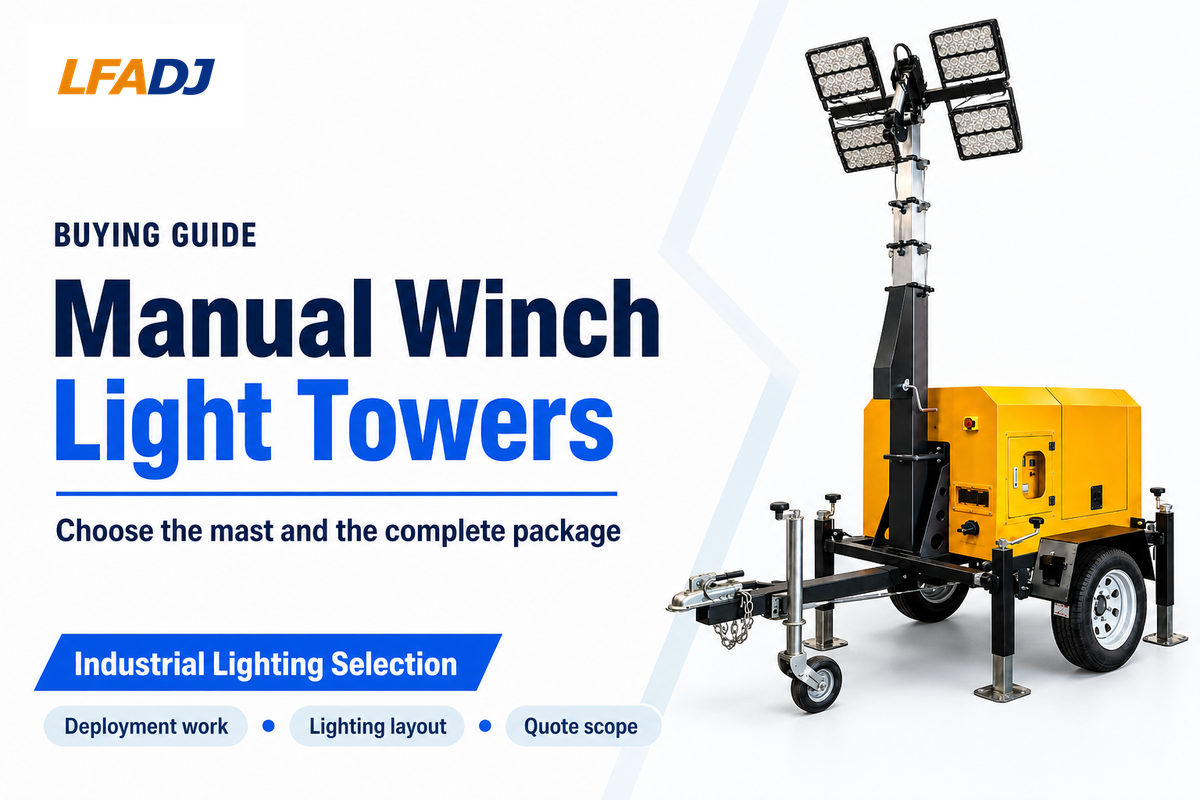
Manual Winch Light Towers suit buyers needing a hand-operated mast with lifting and a lighting package integrated to their work. The decision is not restricted to the crank: factors such as deployment frequency, type of illumination and equipment included in the quotation impact the unit selection.
Equipment that stays beside a maintenance area has a different job from a tower moved repeatedly along a road project. Compare equivalent offers using the eight checks below and decide if powered lifting is justified.
What Manual Winch Light Towers Actually Control
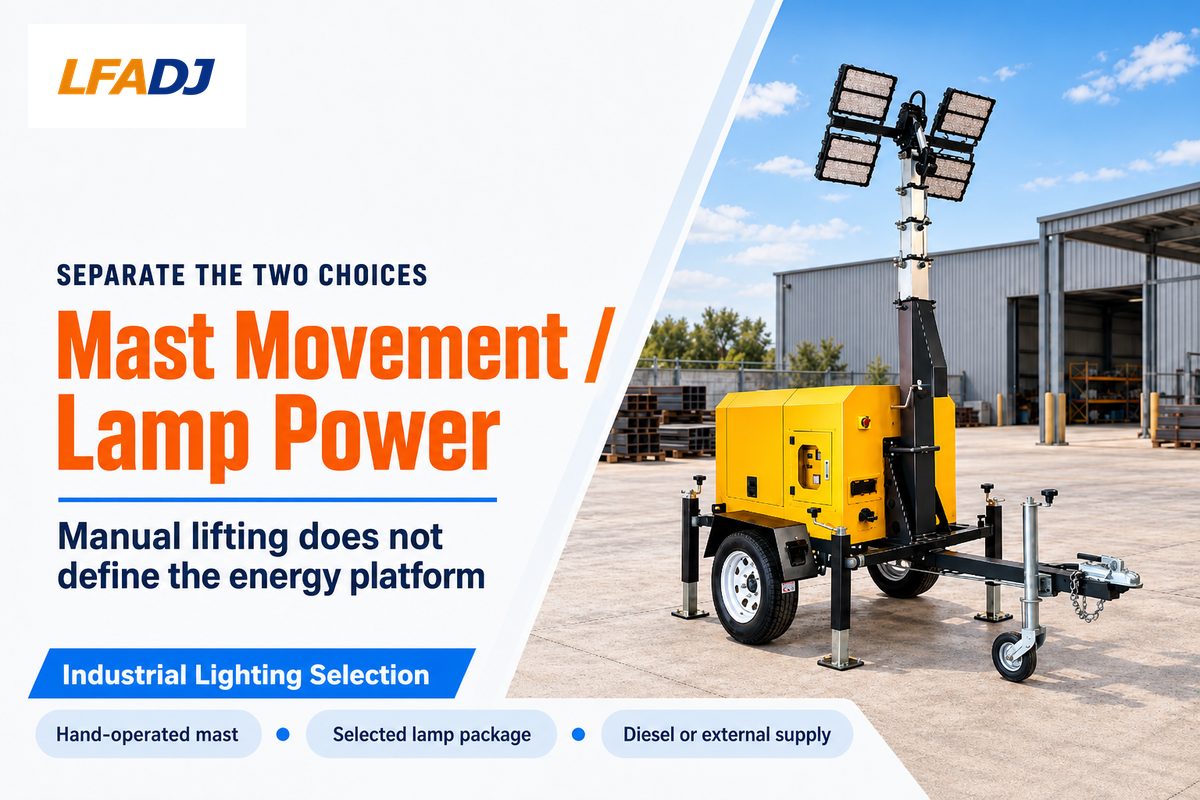
Manual winches control mast movement through a hand operated mechanism. Lamp power is a different consideration. A complete lighting package may use an onboard diesel generator or an external electrical supply. Choose the lifting method round the crew’s work, and then choose the energy platform around the operating hours and the available utilities.
How do manual winch light towers work?
The operator turns a handle to operate the winch and move the mast through its cable and lifting arrangement. The design of the delivered system determines how the sections extend and how the raised assembly is secured. The light fixtures receive power from the tower’s selected energy platform, independently of the operator’s cranking effort.
This is the case at quotation stage. Mains-powered units need a suitable supply at their work location. Diesel packages bring an engine and its servicing requirements. Changing the mast drive alone does not change the fuel or electricity used by the lamps.
For example, Kubota Center calls the Night-Lite E-Series manual-winch unit a plug-in tower. LFADJ’s D951 uses a diesel platform. Both can be correct as the word manual defines the lifting arrangement.
Starting with LFADJ’s current product configuration, consider the D951 manual-winch lighting package. LFADJ lists four 400 W LED lamps, and a Kubota Z482 diesel engine. When comparing alternatives, consider the lamp package and mast operation as separate elements.
Manual vs Hydraulic and Electric Masts
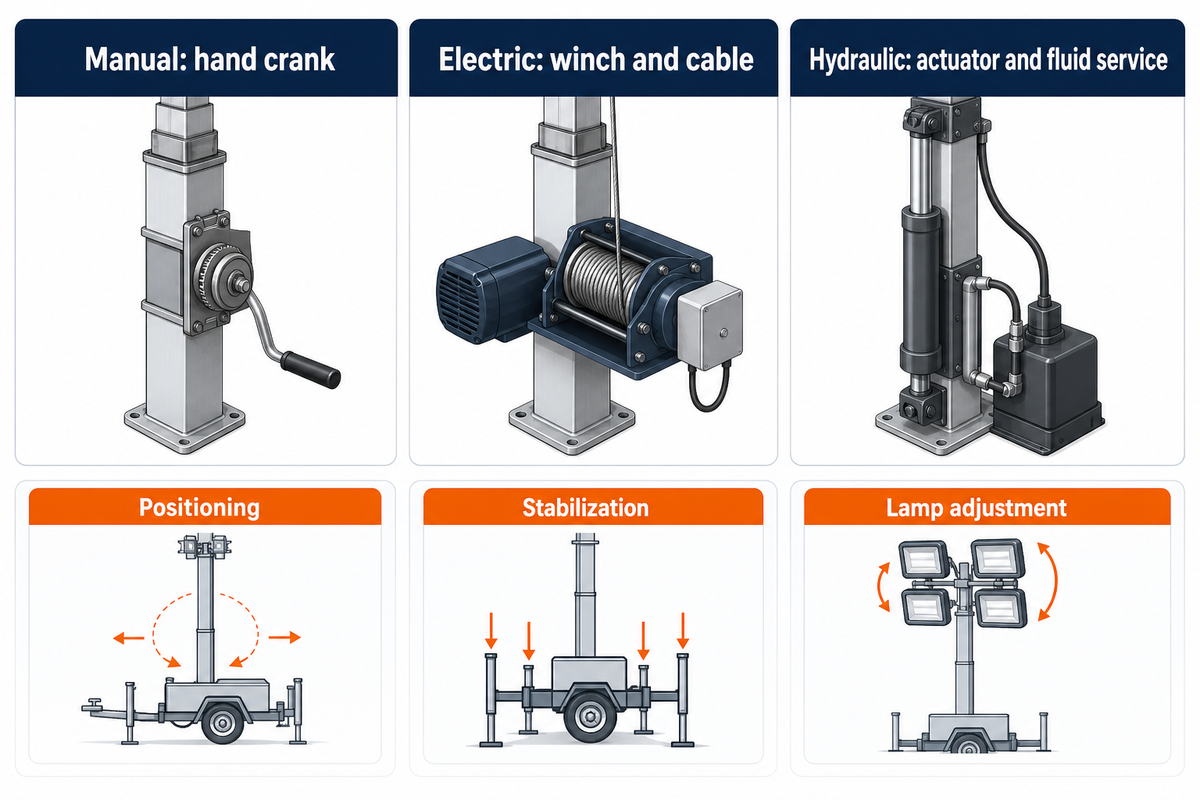
Use manual lifting if the crew can comfortably operate the crank and repeated raising is not a large part of the duty. Compare an electric winch or hydraulic mast when frequent movements make that task costly. Powered movement alters the controls and service components; positioning, stabilization and adjustment of the lamp still belong in the deployment plan.
“Manual masts are raised by winding a handle, then locking the mast into place”
The exact procedure for securing belongs in the model’s operating instructions. Electric light masts can retain a winch and cable arrangement; hydraulic designs introduce their own actuator and fluid-service requirements. Payload, wind and safe-operation limits come from the complete tower’s own ratings, whichever drive it uses.
Use this Deployment Pattern Matrix to determine the constraint to be compared before selecting the drive. These are preference orderings rather than absolute engineering values.
| Duty pattern | First priority | Selection direction |
|---|---|---|
| Long deployment at one location | Lighting and service access | Keep manual lifting on the shortlist |
| Frequent relocation along a work front | Complete-cycle crew time | Compare powered lifting using measured labor |
| Compact maintenance yard | Shadows around stored equipment | Resolve positions and aiming first |
| Remote site with established fuel supply | Fuel access and engine support | Compare suitable diesel packages |
| Event location with electrical supply | Supply capacity and cable routes | Include plug-in packages |
| Roadwork beside live traffic | Driver glare and tower placement | Review the lighting layout with the traffic plan |
| Rental fleet with changing operators | Clear controls and repeatable handover | Evaluate the delivered instructions and training |
| Lighting plus intermittent hand tools | Simultaneous output and starting loads | Compare specified auxiliary capability |
| Mast supplied for an existing platform | Mounting and integration responsibility | Separate the mast offer from a complete tower |
Rental managers can put a convenient control feature ahead of purchase price when it removes a repeated task. Finance needs the size of that saving. Demonstrations of comparable electric mast configurations become relevant if the same crew performs the same complete cycle.
Mast Height, Light Output and the Work Area
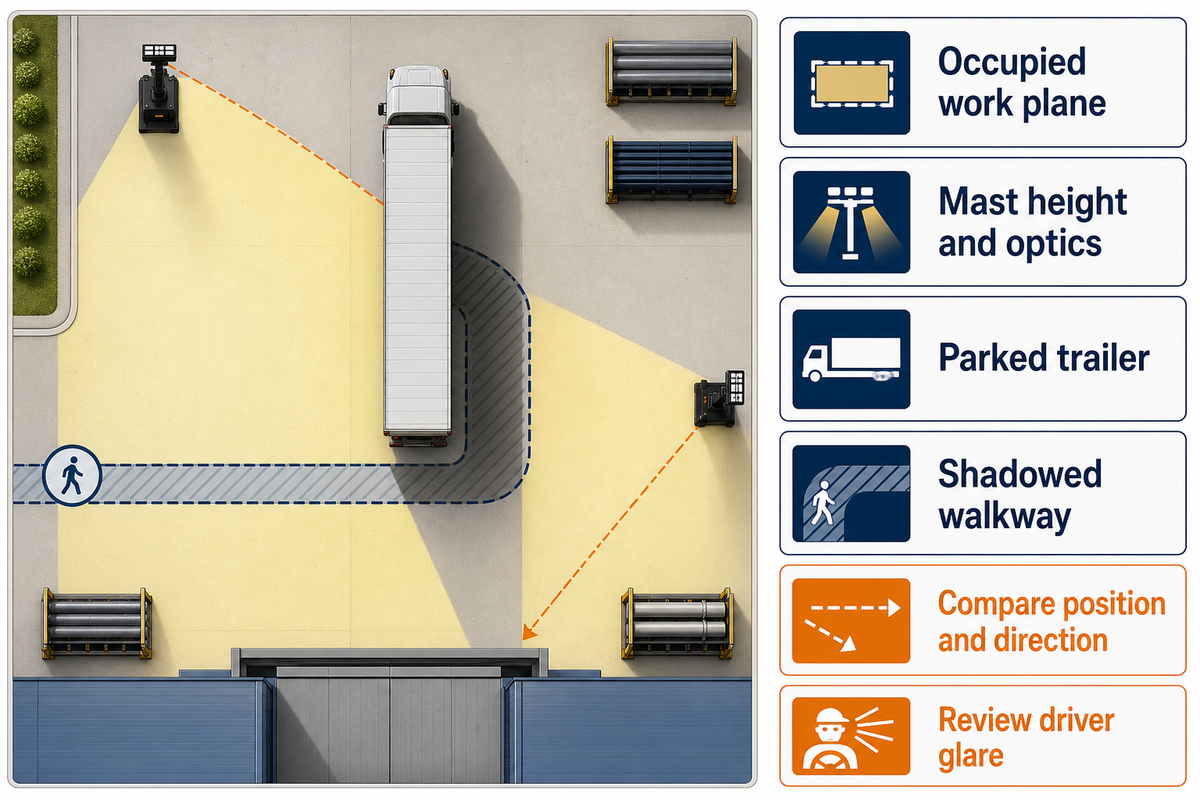
Select illumination for the task and the occupied work area, including paths used between tasks. Mast height, optics and aiming affect where the light lands. Obstacles create shadows and poor direction of fixtures can create glare for employees and approaching drivers. Increasing wattage of a fixture does not address issues of glare and shadows.
The UK Health and Safety Executive’s lighting guidance says that movement through space requires different lighting than detailed work. It also notes that trailers and containers cast shadows that an empty-yard design can miss. Show obstructions on the layout and decide how many towers to buy.
Scenario: a maintenance yard with changing obstructions
Consider a maintenance supervisor who needs to light around a repair bay and the pedestrian route past stored equipment. Lamps light the open ground well, but a parked trailer blocks light from reaching the walkway. Raising the assembly alone may move the shadow without clearing the entire route. The supervisor first marks the occupied work positions and likely parking areas and then checks an alternative tower position and fixture direction. The buyer’s useful deliverable is a lighting layout showing the work plane and obstructions. This makes an alternative position of a unit or a different beam a reasonable choice, as opposed to treating a lamp with a higher wattage as the solution.
Driving provides a different viewpoint. Researchers in a Virginia Tech study of work-zone glare found that positioning height and distance from the roadway impacted visual performance in their test conditions. Keep traffic-facing glare in the review of construction and roadwork lighting.
For US construction work, 29 CFR 1926.56 sets illumination minimums by area or operation in Table D-3, including 5 foot-candles for general construction area lighting and 3 foot-candles for concrete placement, excavation and waste areas, access ways and active storage areas. A 2025 proposed rescission is listed in OSHA’s rulemaking index under proposed rules. Apply the requirements current for the project and jurisdiction.
LFADJ’s listed 4 × 400 W D951 lamp configuration provides procurement with a defined package to compare. The lighting layout supplies the next decision: is that configuration reaching the occupied work plane with appropriate aiming and acceptable glare? Keep those two parts together when evaluating a demonstration.
The Winch and Mast Details Worth Checking
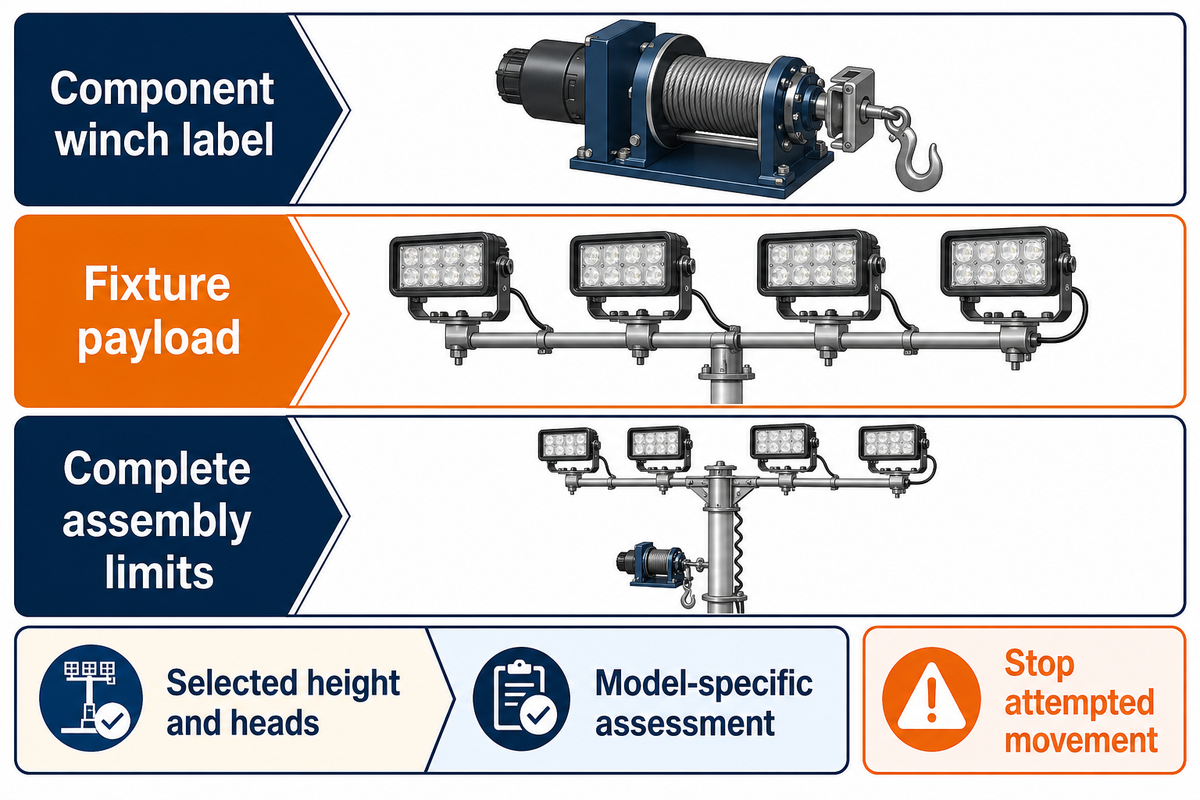
Evaluate the winch as part of the delivered mast assembly. Cable routing and securing arrangements, payload and mounting all influence the application. Component lifting-force labels describe the component; the complete tower needs its own operating limits for the selected height, lighting heads and supporting arrangement.
Larson Electronics’ historical 25-foot mast description illustrates the distinction: it lists two 1,000 lbs winches alongside a 150 lbs fixture payload. These are distinct quantities within one manufacturer’s design. Selecting a replacement winch by the largest number on its label may not fulfill the assembly’s requirements.
Wind limits require their operating conditions. Ratings in mph at a reduced height describe a different configuration from a fully extended mast. The area of the head, the supporting platform, and the means of securing are all part of the same configuration. Claims that a tower can withstand high winds are useful only alongside those conditions.
Why can a light tower mast rise but fail to lower?
The cause can lie in the winch, the cable path, a securing device or the moving sections, and the symptom looks the same for each, so a mast that will not lower needs a model-specific fault assessment. Stop the attempted movement and take the manufacturer’s service route rather than releasing components under load or forcing the handle.
Clearance is important during both retraction and raising. Investigators in a New York FACE report describe a mobile tower contacting an overhead powerline during a 2012 withdrawal operation. The incident was unobserved, and the reason for the possible mast extension was uncertain. Include the full movement path and the operator’s familiarity in the site plan.
For replacement work, keep the assembly identification, winch model and cable arrangement together. A 1,000 lbs component label is not the same as the mast’s fixture-payload limit. The distinction helps maintainers order the correct part without altering the tower configuration.
Deployment Labor and the Price Difference
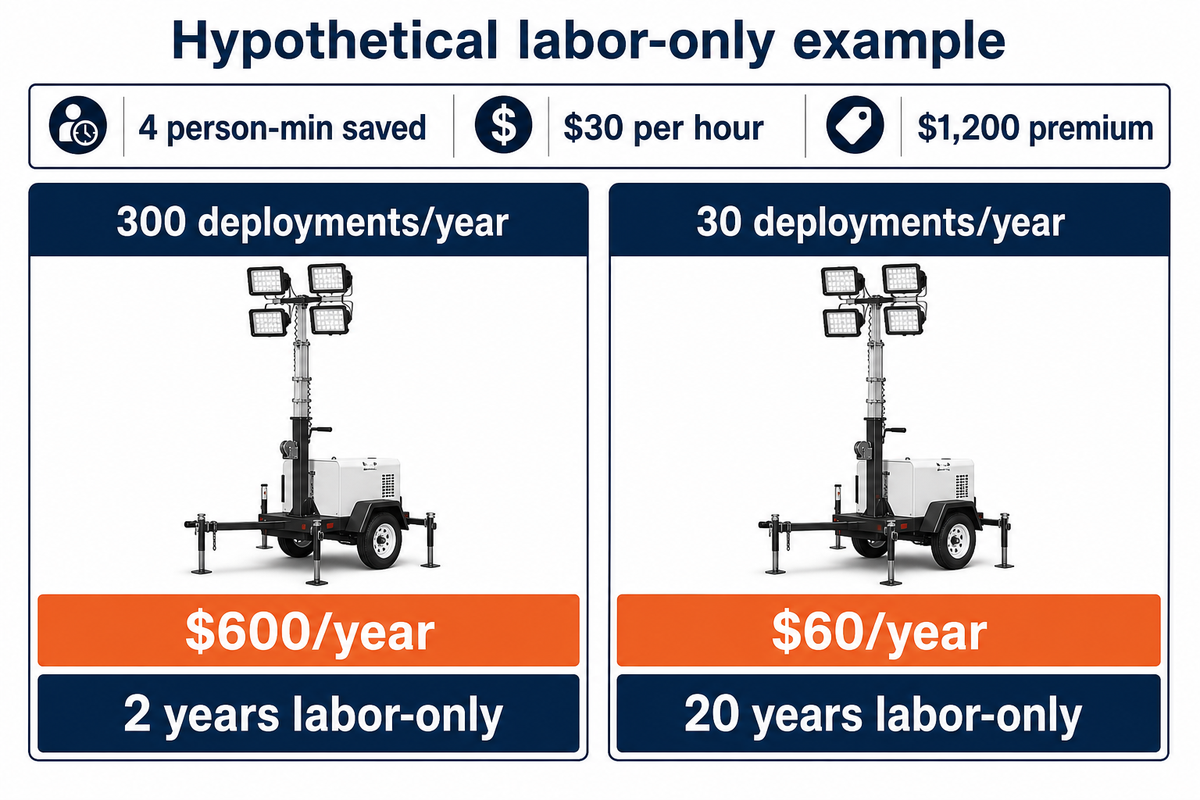
Compare the mast pricing, based on total person-minutes and number of deployments. Person-minutes include the time each crew member spends on the task; elapsed time alone can hide an extra worker. Powered options earn their premium when the value of measured labor savings exceeds the additional ownership cost over the chosen time period.
The useful measurement begins before cranking and ends when the equipment is ready for its next duty. Separate positioning and stabilization from movement of the mast. Record aiming and retraction. The Allmand tower-selection guidance states that these issues should be treated separately. Powered raising leaves the other tasks in the cycle.
Deployments-to-Premium Break-Even
Example: a rental buyer compares two otherwise equivalent packages. The powered option costs $1,200 more. A timed comparison saves 4 person-minutes per deployment, the fleet expects 300 deployments a year, and loaded labor costs $30 per hour. Annual labor value is 4 × 300 ÷ 60 × $30 = $600. The labor-only payback is $1,200 ÷ $600 = 2 years.
With the other inputs the same, at 30 deployments a year the annual labor savings become $60 and the labor only payback becomes 20 years. That buyer has little reason to justify the premium on cranking time alone. Frequent relocation changes the calculation; a long stationary duty may favor spending the same budget on lighting layout or service access. These considerations, along with maintenance, downtime, and funding costs, should be part of an ownership cost comparison before the purchase decision.
| Cycle activity | Effect of powered mast movement | Record in the comparison |
|---|---|---|
| Position the equipment | Still required | Travel and crew time |
| Establish stable support | Still required | Ground and outrigger work |
| Raise or extend the assembly | Drive method changes this task | Operator attendance and elapsed time |
| Aim the fixtures | Depends on the delivered arrangement | Adjustment time |
| Retract and secure | Drive method may change part of the task | Time until transport-ready |
For finance, the difference between $600 and $60 per year is more important than a guess that one drive always saves a fixed percentage. For operations, the same analysis finds the labor input worth measuring. Multiple deployments connect the mast purchase premium to the duty.
Inspection, Maintenance and Parts Planning
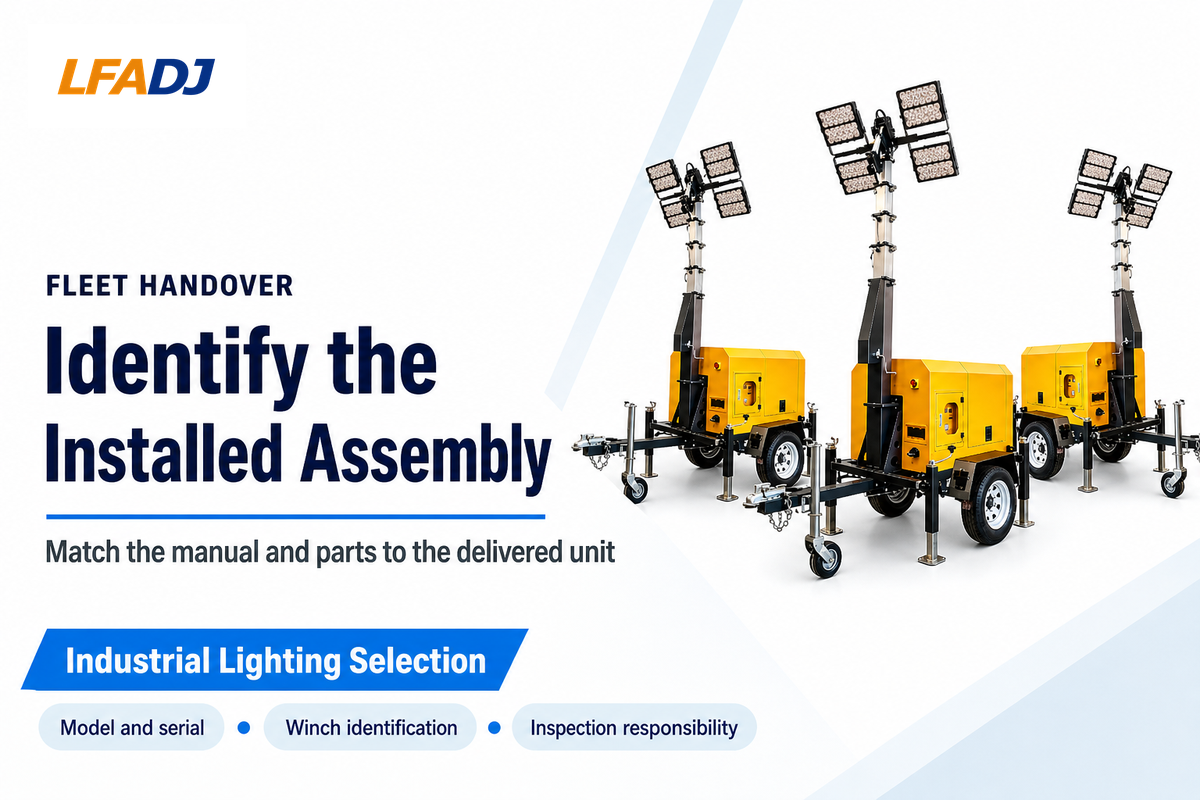
Plan inspections based on the equipment delivered, its exposure, and its service history. Manual masts still require attention to the winch, wire rope, moving parts and securing devices. Diesel lighting packages also include engine related work. Distribute those duties before fleet handover to make sure a simple lifting device does not become a neglected one.
HSE’s equipment inspection guidance outlines the scope of inspections based on risk, and the frequency based on risk assessment, while using the manufacturer’s recommendations as a baseline. Harsh external conditions may shorten the recommended interval. A generic weekly checklist should not displace the delivered manual or the equipment’s actual inspection history.
Scenario: a mixed rental fleet preparing for handover
A fleet manager receives similar-looking units from different production periods. One has a different winch assembly. The service team stores the generator book with the asset, but has no mast parts diagram. The manager groups documents by model and serial number. The manager, also, identifies the winch and assigns responsibility for cable inspection and parts ordering. During handover, the operator is given the instructions for the control of the unit and how to secure it in place. This avoids treating every handle, brake or cable as interchangeable. Planning for spare parts then is done based on the actual assemblies that are installed rather than the appearance of the lighting heads.
Original equipment documentation is often organized this way: Allmand’s manuals index separates operator, parts and schematic documents by model and serial range. The same discipline helps a buyer to specify the support package for lighting equipment used in rental fleets.
Compare Complete Light Towers, Not Loose Winches
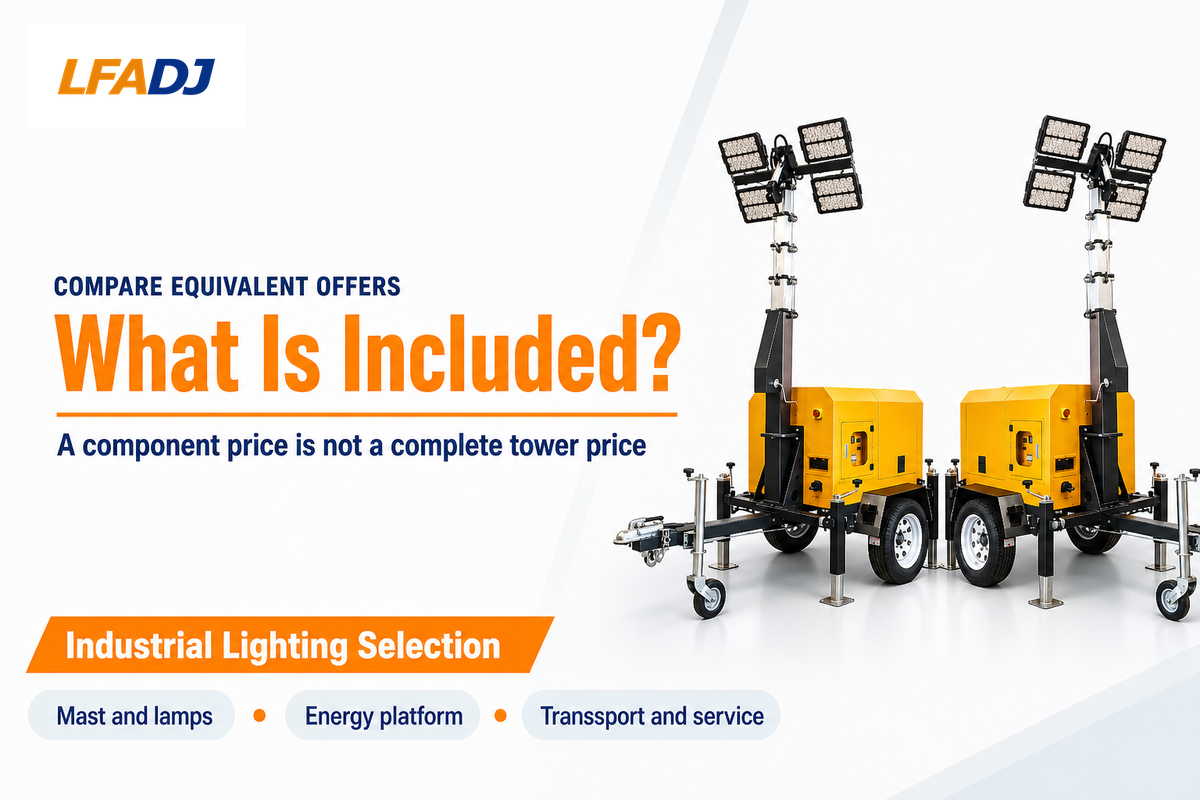
Offers should be compared after all supply scopes have been aligned. Bare masts, mobile towers and replacement winches put different integration work on the buyer. The lowest component price may result in leaving a trailer or mounts and other hardware outside the scope of the purchase. Responsibility should be assigned, along with price, before offers are ranked.
Use this Component-to-Complete-Tower Quote Map as a single enquiry. It provides a description of what will arrive to procurement and maintenance alike.
| Quote line | Required description | Decision it resolves |
|---|---|---|
| Supply boundary | Winch, mast assembly or complete lighting package | Who completes integration |
| Mast movement | Drive, controls and securing arrangement | Operator workflow |
| Working configuration | Operating height and fitted lighting heads | Applicable assembly limits |
| Wind conditions | Limit, mast position and supporting arrangement | Operating restrictions |
| Lamp package | Fixture count, watts per lamp and optics | Lighting-layout comparison |
| Energy platform | Generator, external supply or selected alternative | Fuel and electrical logistics |
| Auxiliary supply | Available output with lamps on, receptacles and load conditions | Tools that can run concurrently |
| Transport and destination | Stowed dimensions, transport scope and destination requirements | Access and delivery planning |
| Service documents | Unit-specific operation, parts and maintenance information | Handover and spare-parts support |
For D951, LFADJ lists a carbon-steel canopy, 340° mast rotation and a transport envelope of 1650 mm long × 1450 mm wide × 2350 mm high. The height here is the stowed transport dimension. Procurement can use those dimensions for access and storage planning while keeping working height on its own quotation line.
The stated production period by LFADJ is 45-60 days. An arrival deadline also needs freight and destination handling in the schedule. A customer comparing diesel light-tower options can use the same scope map across offers without getting confused with the engine brand, lamp configuration and delivery responsibility.
Integration and Utility Requirements
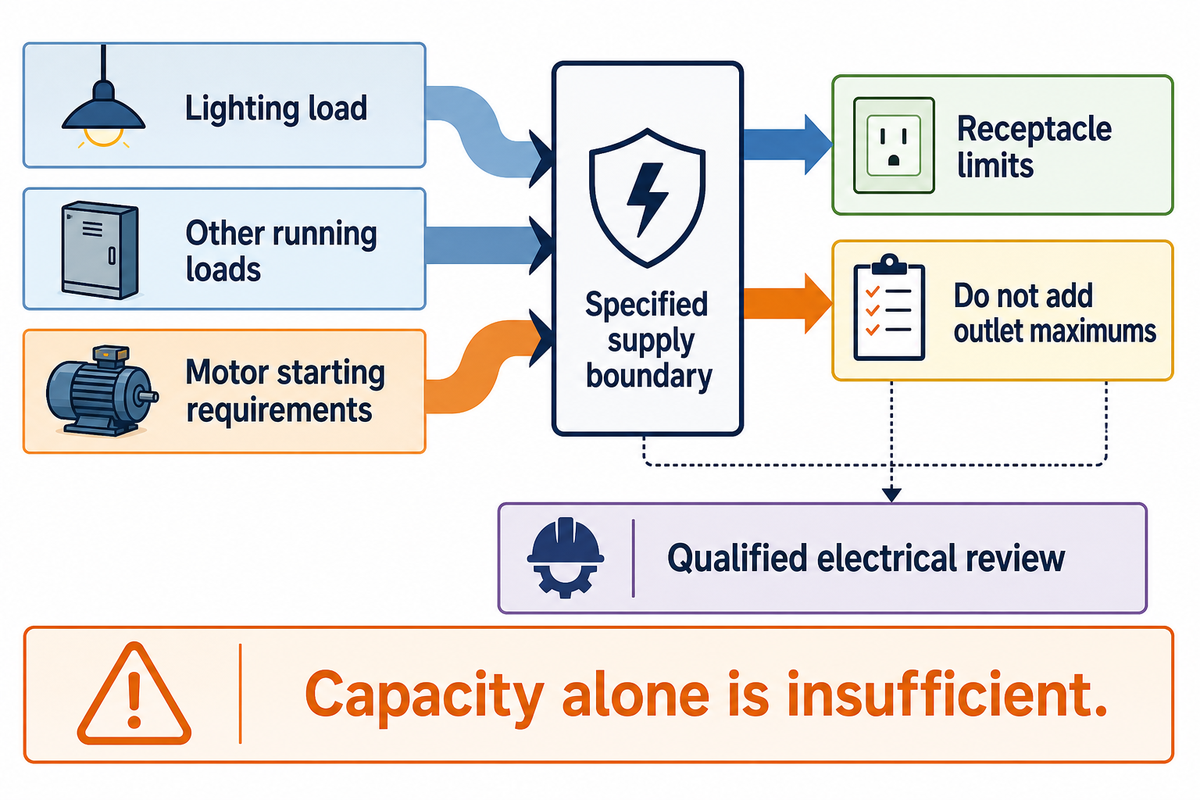
A tower supplying tools as well as lighting needs a simultaneous load specification. The lamps, other running loads and motor starting requirements share the available electrical system. Connection limits and ratings add further restraints. State those requirements together to ensure that the intended dual function of the lighting is also performed.
The American Rental Association guide describes dual-use units that supply a limited amount of power to small equipment alongside lighting. A University of Florida generator-selection guide explains the related distinction between equipment that runs simultaneously and the power needed to start it. Determine power requirements for starting and for continuous operation of the actual tools used in the request.
Connection suitability is another part of that review. In US construction, 1926.404(f)(3) gives conditions for portable-generator grounding and bonding arrangements. A qualified electrical review should match the delivered unit, connected equipment and project rules. Generator capacity alone does not resolve those connections.
Do
- List the lights and tools that operate together.
- Separate running loads from starting requirements.
- Match the documented supply and connection arrangement.
Don’t
- Add separate outlet maximums into a larger generator rating.
- Assume a manual mast defines the energy source.
- Use a replacement-part price as the complete-system budget.
Provide LFADJ the layout of the work area, the type and frequency of deployment, the lamp package required and any simultaneous tool loads. We can review the configuration of D951 and the extent of supply for those requirements. For another lifting approach, compare the wider telescopic lighting-tower range against the same duty.
Key takeaway
Choose the mast around deployment work, the lamps around the occupied work area, and the energy platform around the operating duty. Compare complete packages using the same supply boundary.
Frequently Asked Questions
When are manual winch light towers used?
They are used for temporary work lighting where hand-operated mast movement suits the deployment routine.
Construction work, maintenance areas and rental duties are common examples. The strongest purchasing case is a suitable lighting package that remains in position long enough for hand cranking to be a small part of the job. A frequently moved work front deserves a whole-cycle labor comparison before selecting the mast drive. Fuel access, power availability and the lighting layout remain separate decisions.
What equipment does a manual winch light tower use?
Complete packages combine the mast and hand winch with lighting heads, support arrangements and a selected power source.
The quoted supply may also include a mobile chassis, engine enclosure and electrical equipment. Bare mast offers have a different boundary and can leave those items to the integrator. Procurement should align the listed assemblies before comparing prices, while maintenance needs the identification and documentation for the components actually fitted to the delivered unit.
How are manual winch light towers built?
They combine an extendable mast with a hand-operated lifting arrangement and a lighting package on a supporting structure.
The mast material, section geometry, cable routing and securing devices follow the selected design. Complete diesel packages add the engine and electrical equipment needed for their lighting duty. Buyers should keep fixture payload, mounting and operating limits tied to that assembly. Replacing a component or changing the lighting heads therefore calls for a compatible configuration rather than a visual match alone.
Can a replacement winch fit any light tower?
No. A replacement must match the intended mast and lifting arrangement.
Mounting plate details, cable specification, drum arrangement and the securing method all matter. Order against the equipment identification and the manufacturer’s parts information. A similar handle or a larger lifting-force label is not a basis for swapping a winch into the installed assembly.
How long does D951 production take?
LFADJ lists a D951 production lead time of 45–60 days.
Freight and destination handling sit outside that production period. Include the required arrival date, destination and order configuration in the enquiry so the supply schedule covers those stages. Keeping production completion separate from site arrival helps procurement compare schedules on the same basis. For an order tied to a project mobilization, the useful schedule connects the agreed configuration to production completion, shipment and destination handling. List the lighting package and any auxiliary-load requirement together so the quoted equipment and the delivery plan describe the same order.
Can power tools run while the tower lights are on?
Yes, on a package specified for the simultaneous lighting and auxiliary load.
LFADJ reviews the requested tool load with the lighting package. Include starting requirements, usable output and receptacle limits in that specification, alongside the electrical connection review.
References & Sources
- HSE: lighting, glare and task requirements
- HSE: inspection of work equipment
- OSHA: construction illumination, 1926.56
- NY FACE: mobile light-tower powerline incident, report 12NY018
- Virginia Tech: tower geometry and driver glare
- Josh Nickell, ARA: light-tower selection and deployment
- UF/IFAS: auxiliary generator load selection
LFADJ · COMPANY & TECHNICAL CONTEXT
Practical lighting guidance for real project conditions
LFADJ shares product context, application notes, and selection checks to help project teams compare industrial lighting options with the right site details in view.
What LFADJ covers
LFADJ focuses on industrial lighting and tailored lighting solutions for teams planning, specifying, or operating demanding work environments.
- Product context: mobile lighting, light towers, explosion-proof lighting, emergency lighting, and related industrial lighting equipment.
- Project context: application conditions, target illumination, runtime, site constraints, and product configuration questions.
- Decision support: use the information here as a starting point, then confirm final specifications against the actual installation and local requirements.
Industrial lighting
Application guidance
Project enquiries
NEXT STEP
Have a site question?
Send the operating environment, lighting target, expected runtime, and any drawings or photos you have. The existing enquiry form is ready for a focused discussion.
Start an enquiry Or use the LFADJ contact page