Get in touch with LFADJ Company
Hazardous Location Lighting Selected Around Your Actual Site
For industrial hazardous area lighting, consider classification/division, installation type, and supporting docs before deciding on a configuration.
- Classification-first model review
- Fixed, portable, mobile, and emergency-use discussion
- Certificate and datasheet requirements tied to the quoted model
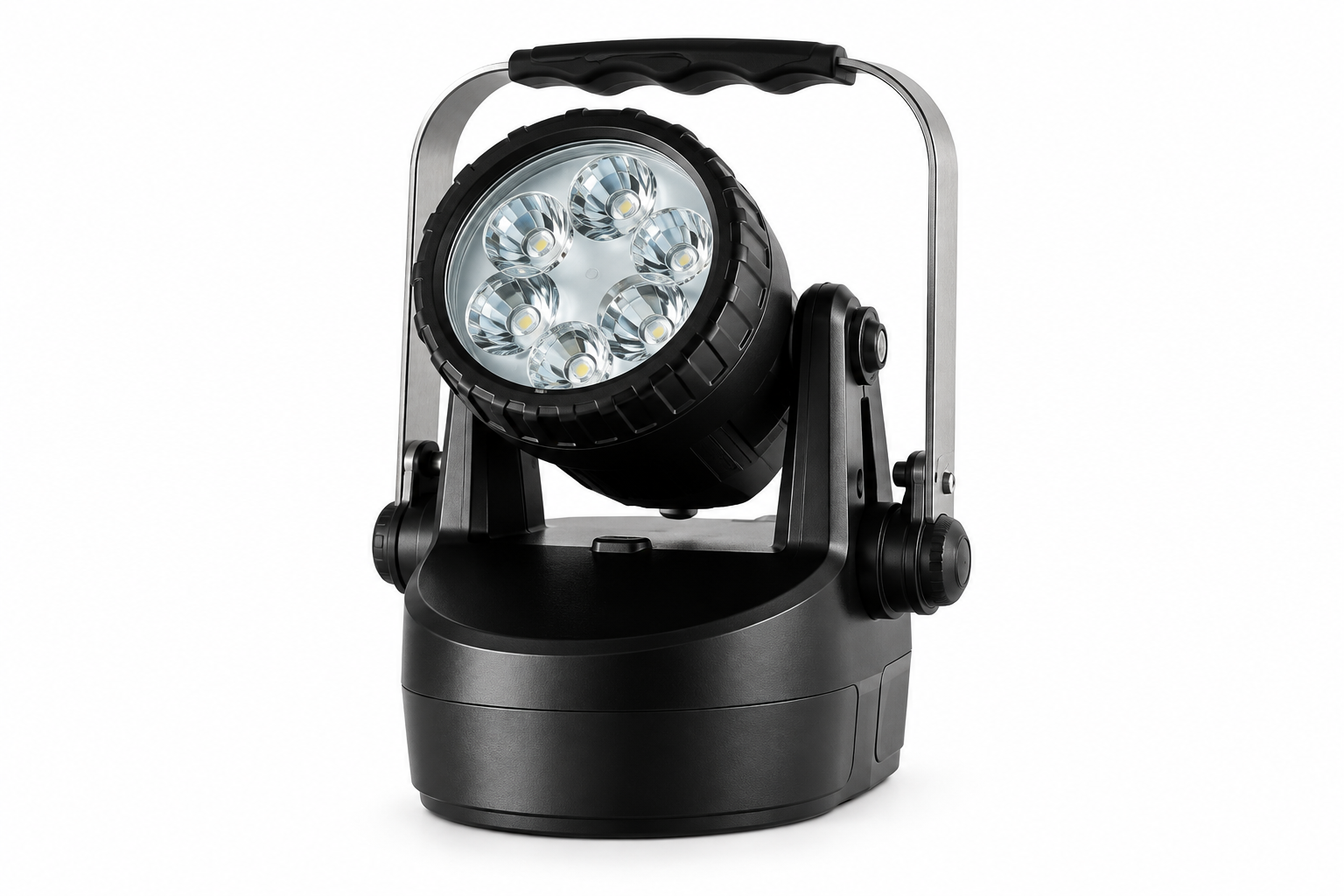
LFADJ hazardous location lighting product range
At a glance
Summary: commercial facts for quote planning
MOQ 1 unit
Single-piece orders are accepted, which is beneficial for project evaluation, replacement orders, and other requirements.
Sample basis
Samples are charged at the same unit basis as finished products.
50% deposit
Payment terms are 50% deposit, with the balance settled before shipment by wire transfer.
What is confirmed with the quotation?
- Exact model and configuration
- Certificate and datasheet package
- Production schedule and shipment scope
- Warranty, maintenance, and on-site support terms.
Start with the classified location, not a generic product label
OSHA 29 CFR 1910.307 requires classified locations to be documented and equipment to be suitable for the specific location. “Explosion proof” should not be considered location classification or equipment suitability.
1. Define the hazard
- Gas, vapor, combustible dust, or fibers
- Class/Division or Zone framework
- Material group and ignition characteristics
2. Define exposure
- Ambient temperature and heat sources
- Water, washdown, dust, corrosion, and chemicals
- Indoor, outdoor, vibration, and maintenance access
3. Define the lighting duty
- Fixed area, inspection, maintenance, or emergency use
- Illuminance target, beam distribution, and mounting height
- Operating schedule, controls, and power arrangement
Class/Division and Zone language should stay in its own framework
Class I Division 1 lighting and Zone 1 lighting may address similar project concerns, but the markings and certification routes may vary; the IECEx Certified Equipment Scheme provides the certificate route for equipment within its scope. Your AHJ determines the accepted framework.
Project input
Values to confirm
Why it matters
-
System
Class/Division or Zone
Sets the classification vocabulary and approval route.
-
Occurrence
Division 1 or 2; Zone 0, 1, or 2
Describes how the hazardous atmosphere may be present.
-
Hazard
Class I gas/vapor; Class II dust; Class III fibers
Changes the equipment and marking requirements.
-
Temperature
Applicable T-code or maximum surface temperature
Must be compatible with the material ignition characteristics.
-
Ambient
Minimum and maximum °C
Approval conditions and thermal behavior can depend on ambient range.
-
Electrical
Voltage, frequency, controls, emergency mode
Prevents electrical configuration mismatch.
-
Mechanical
Mounting height, cable-entry thread, gland, and adapter
Prevents installation-interface rework.
Important boundary
These numbers are classification inputs, and not model rating inputs.
Summary: operating-environment checks
Selection factors for industrial luminaires may include maintenance access, corrosion, washdown, ambient conditions, and compatibility of materials. There is no single material that best suits all chemically corrosive situations.
- Ingress and washdown exposure
- Salt, solvents, acids, alkalis, or other corrosives
- Outdoor UV, wind, impact, and vibration
- Dust accumulation and cleaning method
- Access for inspection and maintenance
- Glove-friendly handling for portable work
- Replacement and spare-part strategy
- Permitted power, charging, and accessory locations
Summary: application form factors
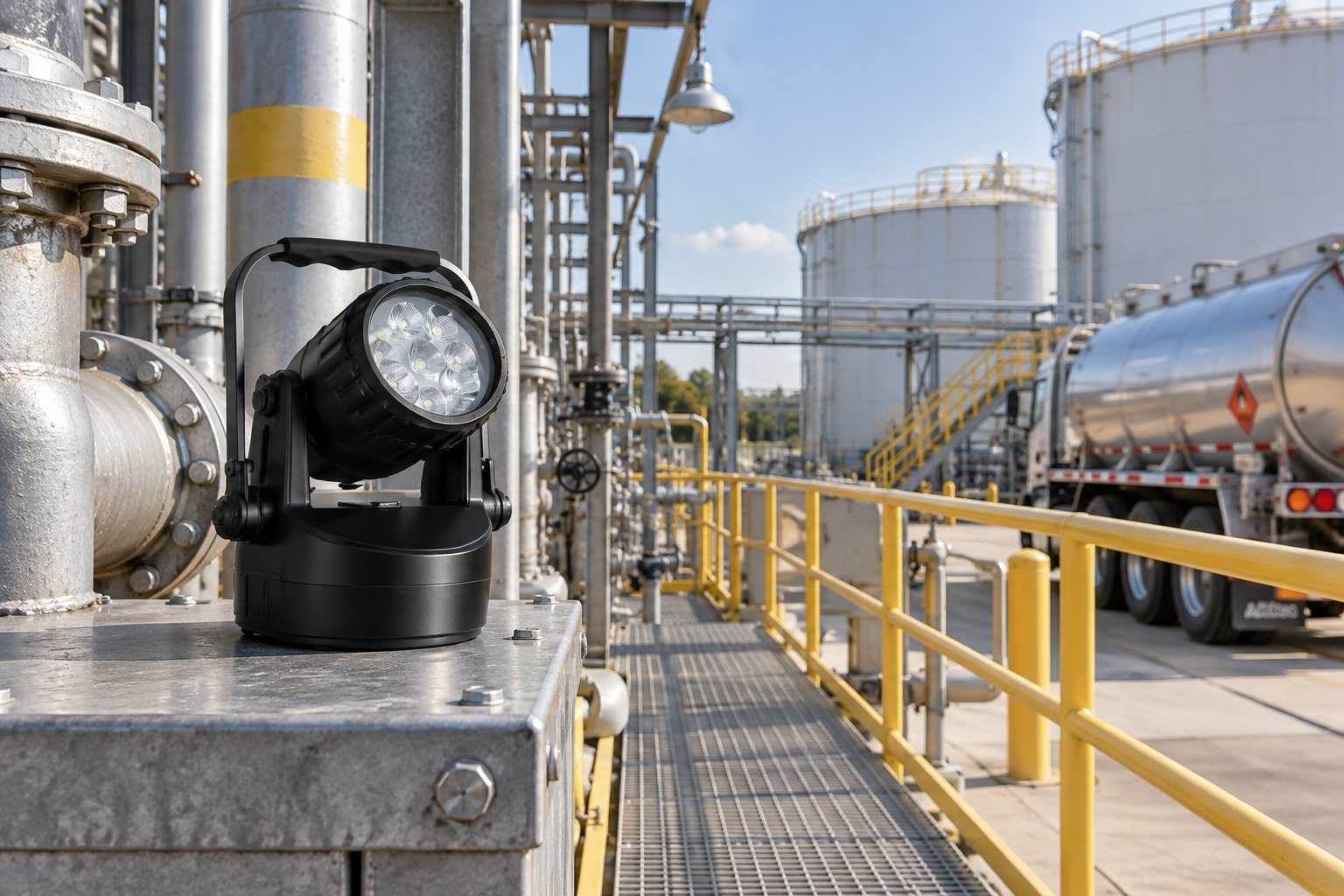
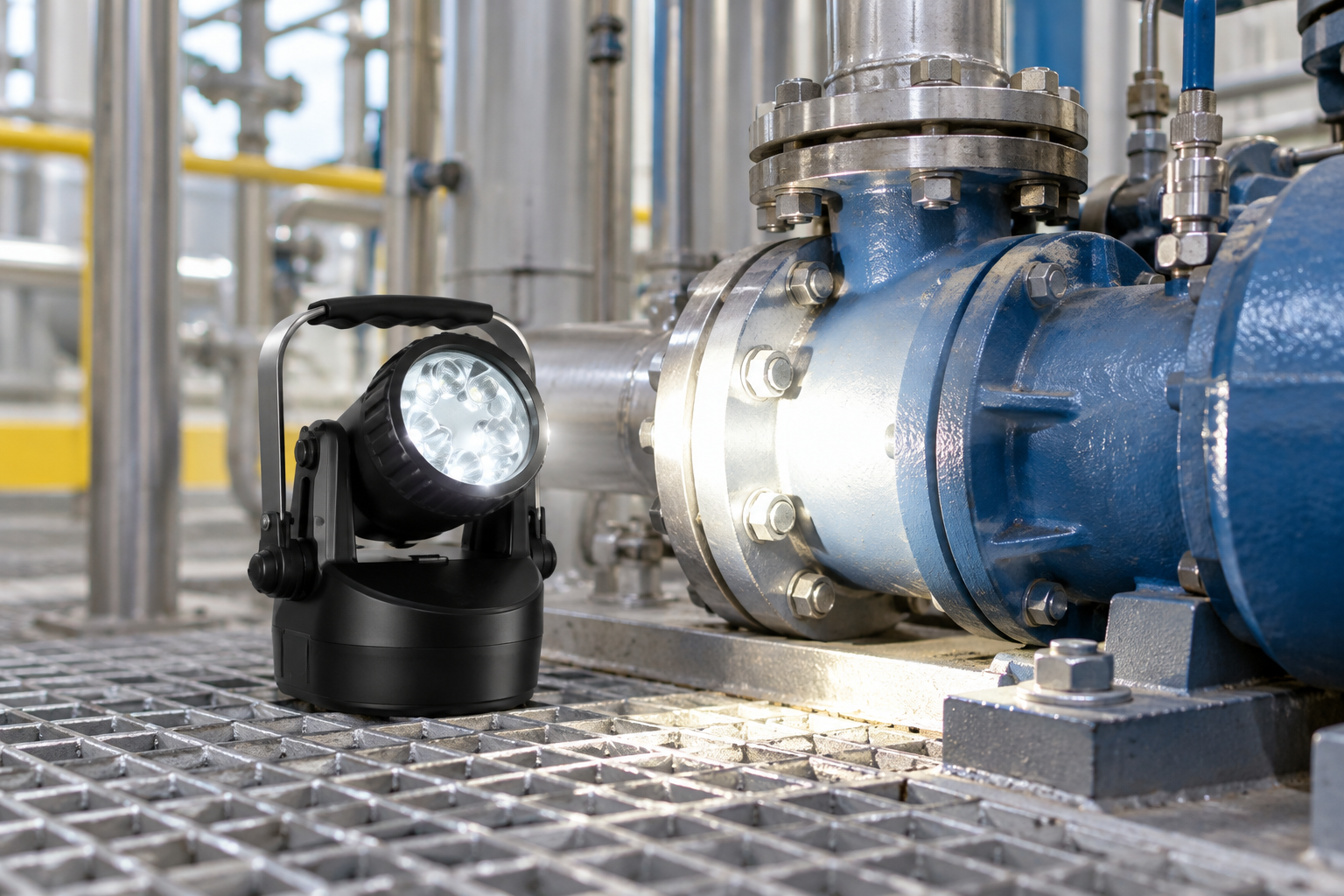
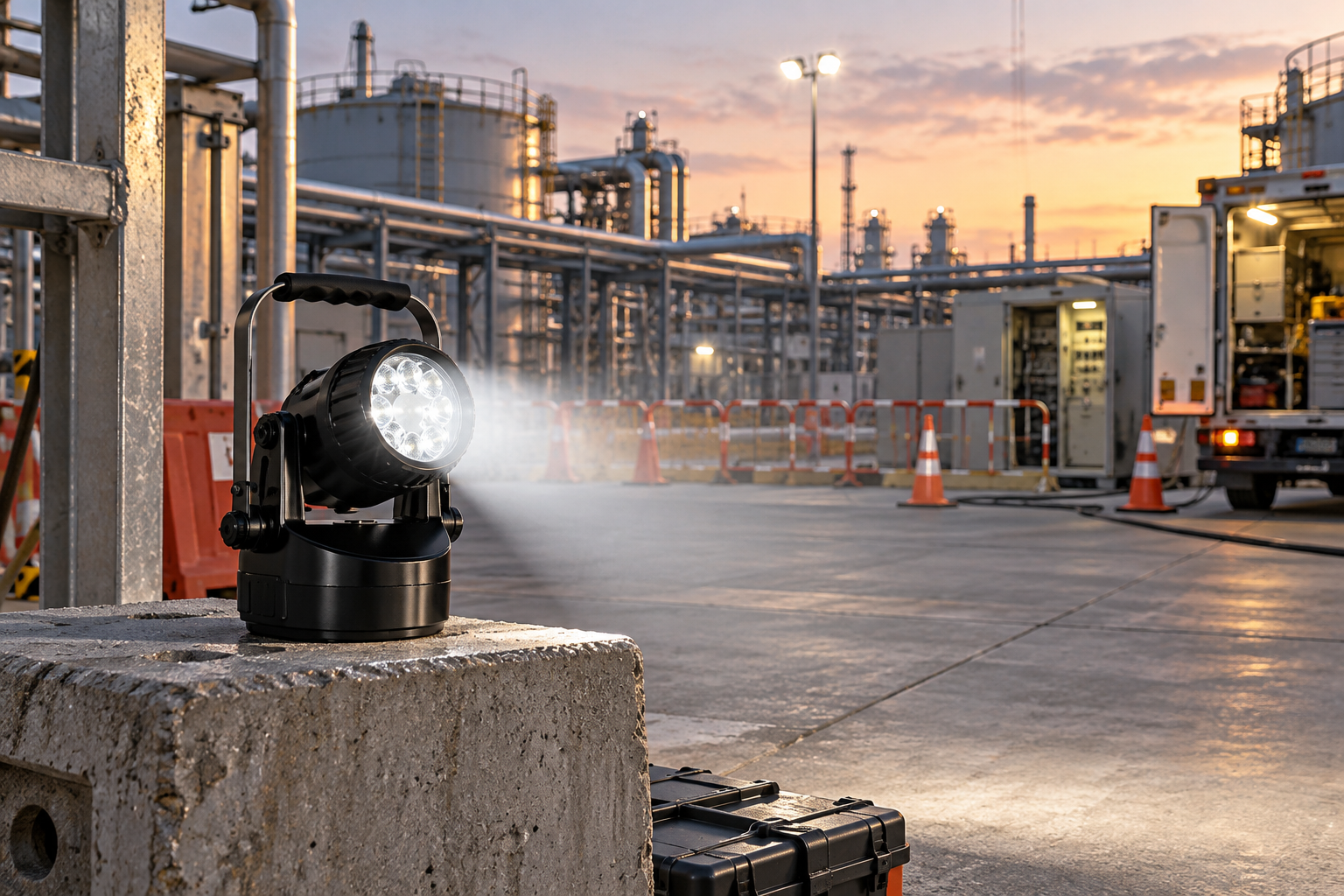
Fixed area lighting
For fixed installation, access ways, loading areas, and equipment location.
- Confirm mounting geometry
- Provide target illuminance or task details
- Review controls and maintenance access
Portable and inspection lighting
For up-close inspection, equipment maintenance, patrols, and temporary work where allowed and power is available.
- Describe working distance and beam need
- Confirm battery, cable, or charger boundaries
- Check size, positioning, and runtime duty
Mobile and emergency lighting
Temporary installations, outage response, emergency situations, and large-area illumination.
- Define deployment and lifting needs
- Confirm area coverage and operating duration
- Review weather, stability, and power source
From site inputs to a quote-ready configuration
| 01 | Classification is reviewed. | The review starts with the Class/Division or Zone basis and information of the gas, vapor, dust, or fiber. |
| 02 | Operating conditions are defined by project inputs. | A form is completed to capture project inputs for ambient temperature, corrosion, water, dust, vibration, and other environmental factors as well as the need for cleaning. |
| 03 | Project defines lighting task. | The discussion is based on dimensions of the area to be lighted, mounting of the light, distance of the light from working point, duration of operation, beam control and other requirements. |
| 04 | Installation Interfaces are checked during technical review. | The order record or the shop ticket verifies interfaces such as, voltage and frequency, threaded inlets, glands, adapters, wiring and method, and accessories. |
| 05 | LFADJ Shortlists Products. | Options are limited to inputs available for fixed, portable and mobile equipment, explosion proof equipment and emergency lighting equipment. |
| 06 | Document review aligns Evidence package. | The quotation is reviewed for the absence of required product data, certification, instruction, and other project documents. |
| 07 | Commercial review aligns scope. | The quotation indicates terms of sale, payment, and delivery, quantity, sampling basis, production schedule, and shipping scope. |
| 08 | LFADJ supports scope. | The project team integrates the technology to facilitate communication among the various project groups involved in product configuration and ordering. |
| 09 | ANSWERS USE QUESTIONS | There’s product-use guidance to assist with guidance and handle after-sales issues through the service network. |
| 10 | The project supports by contract. | The agreement confirms warranty, response time, maintenance, and on-site support. |
Industrial lighting support from a dedicated manufacturer
Zhejiang LONGFA Lighting Co., Ltd. was established in 2013 in Yueqing, Zhejiang. Under the LFADJ brand, the company focuses on industrial, mobile, explosion-proof, and emergency lighting for sectors including energy, petrochemical, power, metallurgy, rail, shipping, aerospace, venues, public security, and fire response; for independent certification context, see UL Solutions' hazardous-locations overview.
Product scope
- Mobile lighting systems
- Lifting lighting devices
- Explosion-proof panoramic lighting
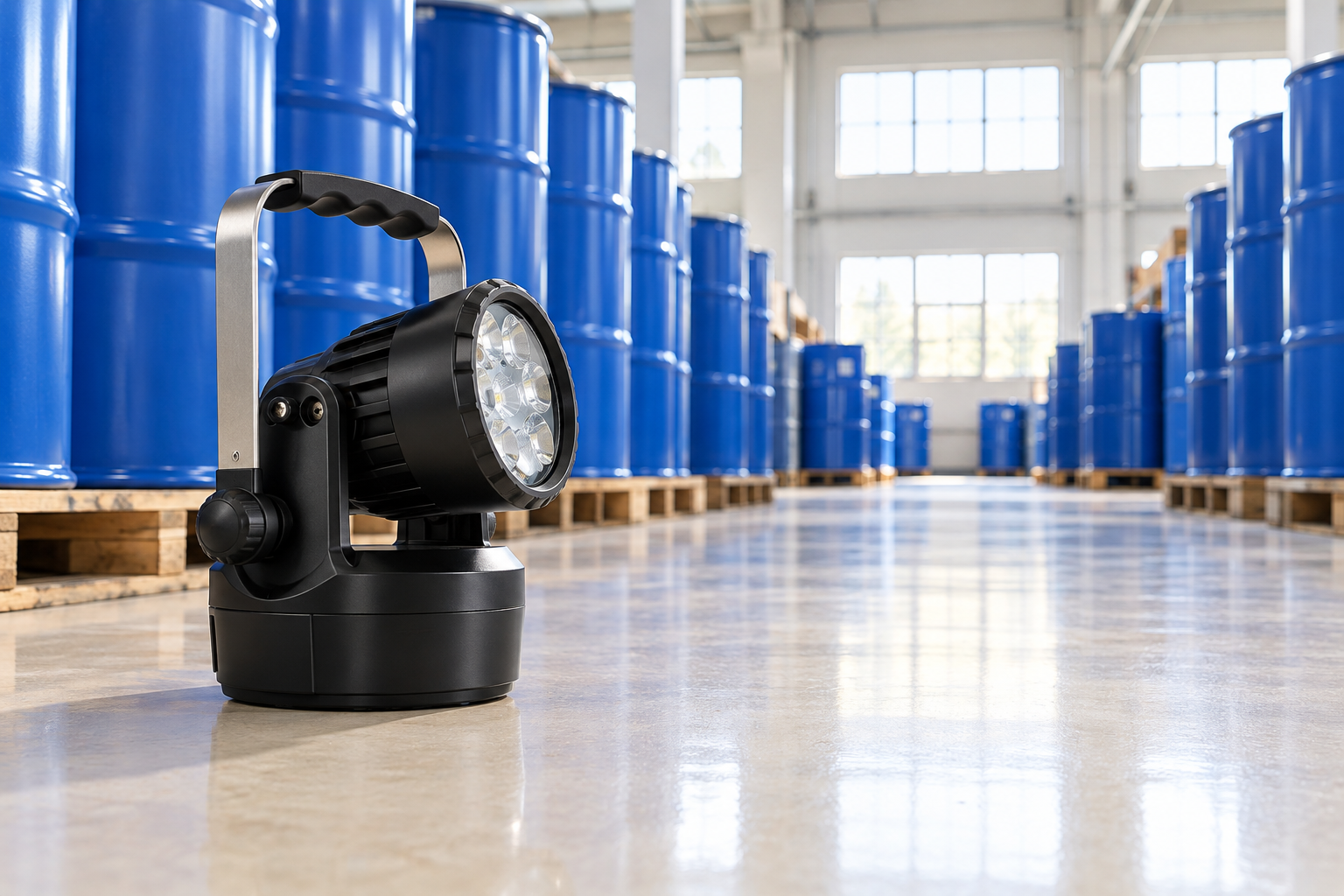
- Portable work lights
- Emergency lighting equipment
Documented experience
Client materials include product test reports across mobile, lifting, explosion-proof, portable LED, and emergency-lighting categories.
The applicable report and certificate for a purchase must be confirmed against the exact model.
Service scope
- Pre-sale consultation and selection
- Lighting-solution discussion
- Configuration and technical communication
- Supply coordination
- After-sales issue handling
Stop conditions
Summary: stop conditions before selection
Pause the purchase if
- The classified area has not been documented
- The gas, dust, group, or temperature basis is unknown
- The certificate does not identify the quoted model
- Ambient or corrosion exposure is outside the reviewed conditions.
- The cable-entry, gland, adapter, or wiring method is unresolved
Do not assume that
- Vapor-tight means hazardous-location approved
- A retrofit lamp preserves the original fixture approval
- A Zone marking automatically satisfies a Division specification
- A company ISO certificate proves product approval
- One “explosion-proof” product is adequate for gas, dust, fixed and portable duties.
Hazardous-Location Lighting Tools
Hazardous-Location Lighting RFQ Checker
Explosion-Proof Lighting · Hazardous Location · RFQ Process
https://lfadjlight.com/explosion-proof-lighting/hazardous-location/hazardous-location-lighting-rfq-checker/Certificate Package Checker
Explosion-Proof Lighting · Hazardous Location · Certificate Resources
https://lfadjlight.com/explosion-proof-lighting/hazardous-location/certificate-package-checker/Explosion-Proof Lighting Application Route
Explosion-Proof Lighting · Application Route & Specifications
https://lfadjlight.com/explosion-proof-lighting/application-route/FAQ
Hazardous location lighting questions
No. Suitability depends on documented classification, material group, temperature, environmental conditions and exact model approval.
They cover different conditions to define a hazardous atmosphere. Use project classification and accepted equipment marking, rather than broader Class I definitions.
Not automatically. The accepted classification, certification route, marking and local authority must align with the project.
No. Environmental enclosure ratings and hazardous location approvals are for different considerations, although both may be required for the same installation.
Provide site classification, gas or dust info, ambient conditions, voltage, mounting, cable entry, quantity, lighting duty, and required certificates or datasheets.
Yes. LFADJ’s stated MOQ is 1 unit, and samples are charged at the same unit basis as finished products.
Timing is confirmed in the quotation after LFADJ reviews the quantity, configuration, certificate scope, documents, and shipping requirements.
LFADJ handles product-use consultation and after-sales issues. Warranty, response time, maintenance, and on-site support are governed by the specific contract.