Get in touch with LFADJ Company

By GW · Updated October 2026
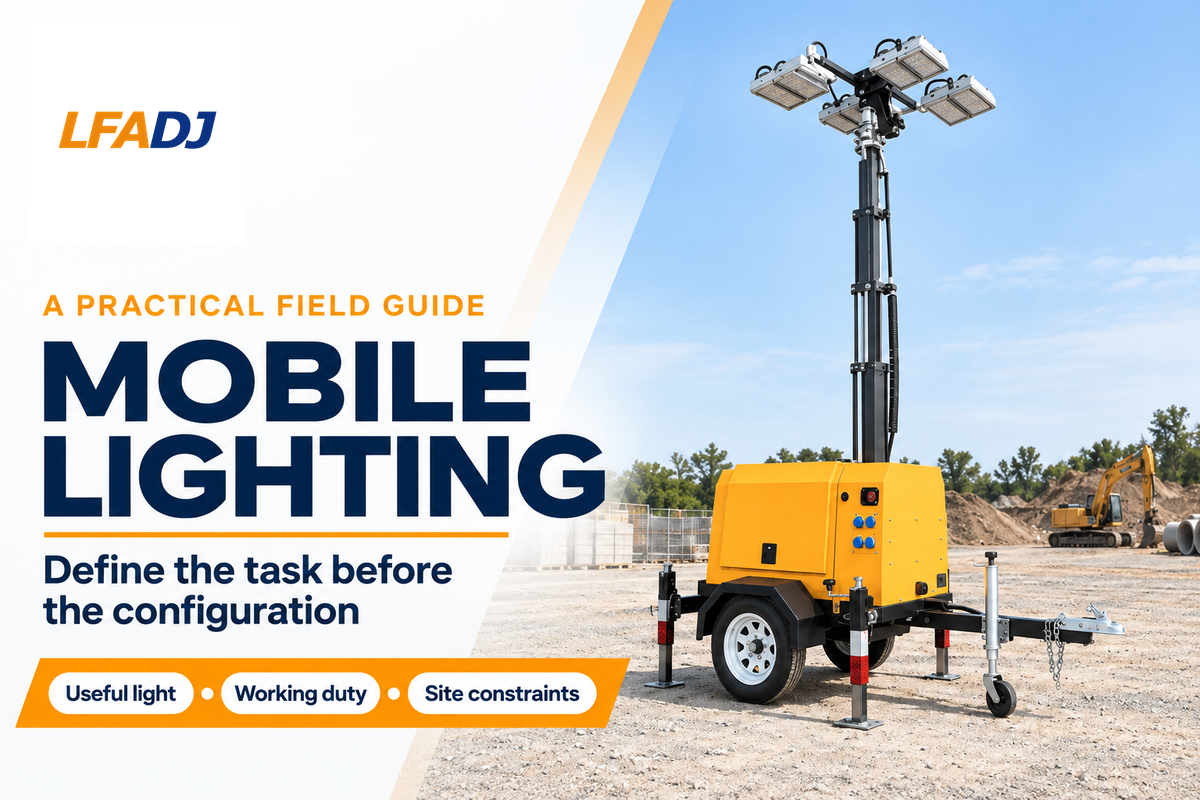
Mobile Lighting Systems integrate movable luminaires, supports, power and controls to illuminate temporary tasks. Select them based on what employees need to see, where they’re positioned and how the site varies, not on lamp output alone.
A bright yard can still leave a valve label unreadable. A portable light can reach the workpiece, but puts a stand in an access route. Job site lighting requires a lighting solution for the actual viewing task. This handbook teaches identification of the task, evaluating lighting evidence and comparing defined working duties prior to requesting a configuration.
Key points: combine area and task lighting where necessary; compare coverage with matching thresholds and conditions; include recharge or refuelling between shifts; reassess the layout when machinery moves.
What Is a Mobile Lighting System?
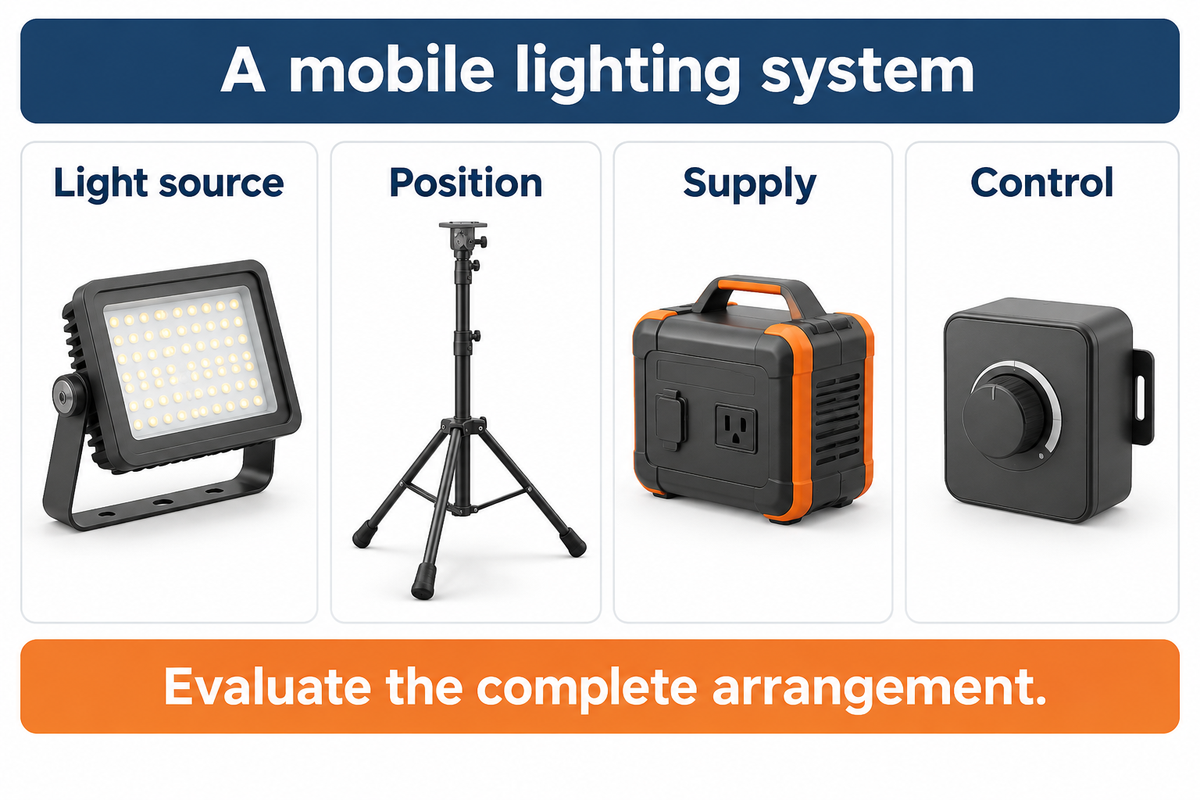
Mobile Lighting Systems integrate a movable arrangement of luminaires, support or base, power supply and operating controls. Its purpose is to provide temporary useful illumination. The supply and support may be integrated or separate, and the support may be handheld, mounted locally, carried on a tripod or elevated on a tower.
Think in four connected parts: light source → position → supply → control. Changing the lamp without checking its position can leave the same shadow. Changing the battery without checking the light setting can leave the same shift unfinished. Light tower solutions also need the accessories that make the proposed arrangement usable. For LED lighting solutions, the same system boundary applies beyond the diode and housing.
What mobile lighting systems are available?
Available arrangements include portable work lights, tripod-mounted lamps, elevated light towers and diffused area lights. CCOHS distinguishes general, localized and task lighting: they serve a wider space, a smaller area and a specific activity respectively. These functions can overlap within one worksite, so a tower and a close task light may solve different parts of the same job.
A telescopic mast trailer has a different deployment pattern from a battery-powered LED source, such as a rechargeable portable LED lamp. Begin with that movement and the viewing task rather than a preferred fuel or chassis.
Which Types of Mobile Lighting Fit Different Tasks?
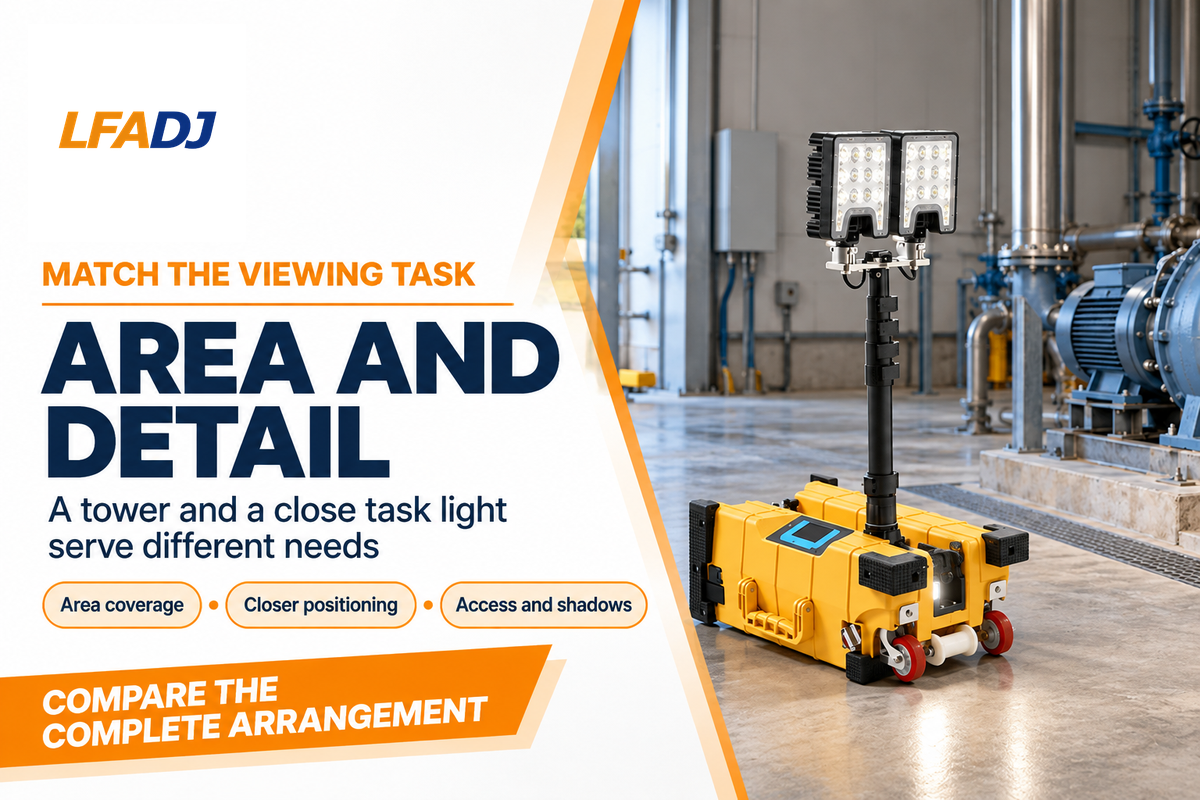
Equipment choice should be based on the area to be inspected, the means of access and what’s likely to obstruct it. Portable LED light towers serve area lighting. Tripod lights allow closer repositioning. Diffused sources can change the glare problem. Compact task lights may be used to light details behind plant. Generally, a big source doesn’t always replace a smaller, better positioned source.
| Family | Useful starting point | What can limit the choice? |
|---|---|---|
| Mobile light tower | Large areas with room for an elevated source | Support footprint, overhead restrictions and shadows behind equipment |
| Tripod work light | A changing work face within a smaller zone | Projecting legs, cable route and exposure to impact |
| Diffused or balloon lighting | Tasks where direct glare needs attention | Distribution at the task and the model’s installation limits |
| Handheld or locally supported task light | Labels, recesses and closer inspection | Aim retention, mounting position and the worker’s own shadow |
Think about the light after the operator starts work. In a Practical Machinist discussion, a respondent described a lamp drooping at its connection. Keeping the beam aimed was as important as the initial brightness. A different discussion about tripods described projecting legs and the heat and breakage of an existing halogen setup. Individual cases can help generate fruitful questions for inspection. They don’t set failure rates for an equipment family. HSE’s task-lighting guidance is the basis for matching light to the work.
For a blocked workpiece or inspection point, consider portable work lights for closer tasks alongside the area source. Compare how each arrangement stays aimed during the task. Ease of use includes repositioning and access, not simply carrying weight. A durable LED housing can’t correct a poorly supported lamp.
How Do You Compare Brightness and Light Quality?
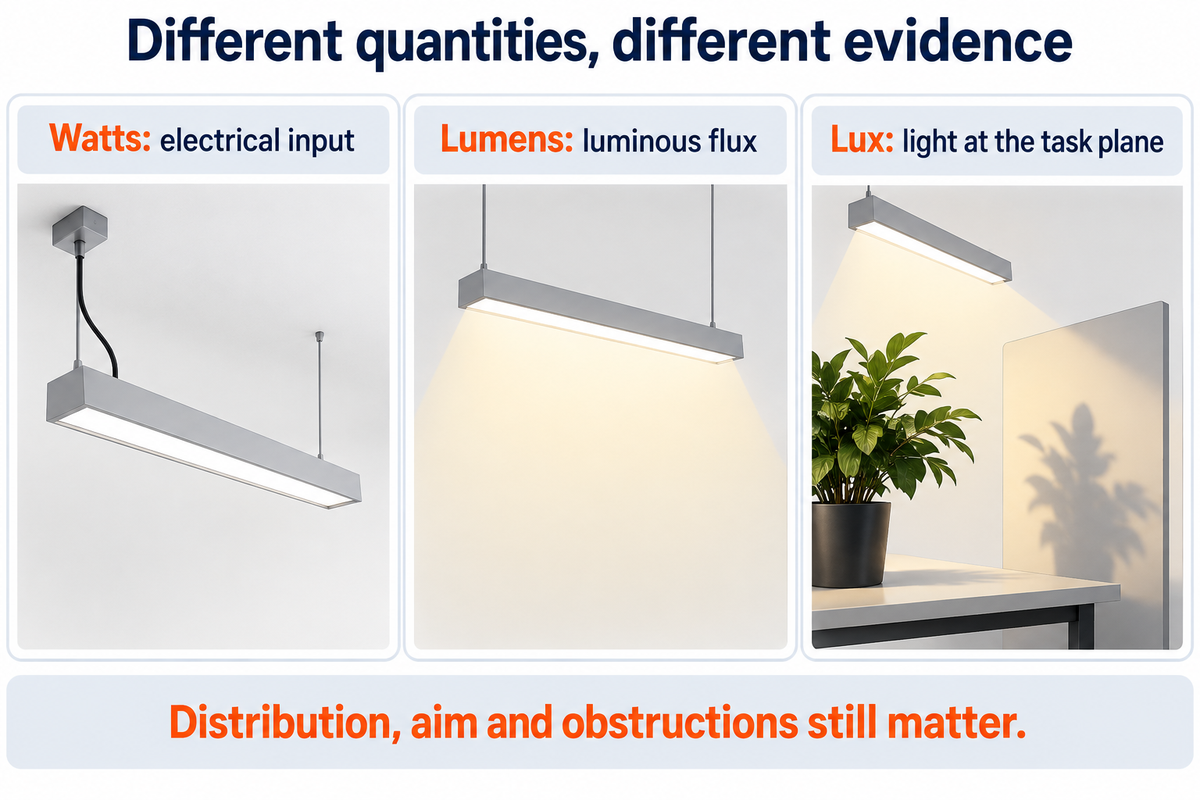
Consider the light reaching the task, the distribution and the conditions of the task. Lumens describe luminous flux; lux describes incident light per unit area. Useful information is provided only with a stated threshold, measurement plane, mounting height, aiming and output setting. Undesirable glare and shadows can ruin an otherwise well-lit average.
One lux is equal to one incident lumen per square metre. Dividing the advertised lumen output of a luminaire by the desired lux level doesn’t determine actual coverage. It fails to consider where the beam goes. Photometric distribution and site geometry matter. When using industrial lighting with leds equipment compared to metal halide equipment, look at the delivered task conditions instead of treating the electrical watts as a measurement of brightness. Replacing a bulb or head also needs to be aligned with equipment, rather than just targeting the output.
“that requirement varies based on the work being done”
Coverage-reading example: Wanco publishes 26,510 square feet at a minimum of 0.5 foot-candle for its WLTS-M-1600H, with the lamps 24 feet high, at 100% brightness and aimed 15 degrees down from vertical. Those conditions belong together. The number doesn’t describe coverage at 5 foot-candles, a different mounting height or a dimmed setting. A buyer comparing another tower needs the same threshold and measurement basis before concluding that either coverage figure is larger. The next step is to review a matching distribution plot and check task points, not to multiply or divide the area covered to predict coverage.
For a jurisdiction-specific example, U.S. OSHA construction Table D-3 lists 5 foot-candles for general construction area lighting and 30 for first-aid stations, infirmaries and offices. Other listed activities have different entries. These are U.S. construction requirements, not one worldwide target for mining, events or every industrial operation.
Evidence: task criterion, distribution plot with stated conditions, readings where workers need to see. A bright patch near the mast cannot stand in for the rest of the work area.
How Do Power Supply and Runtime Fit Together?
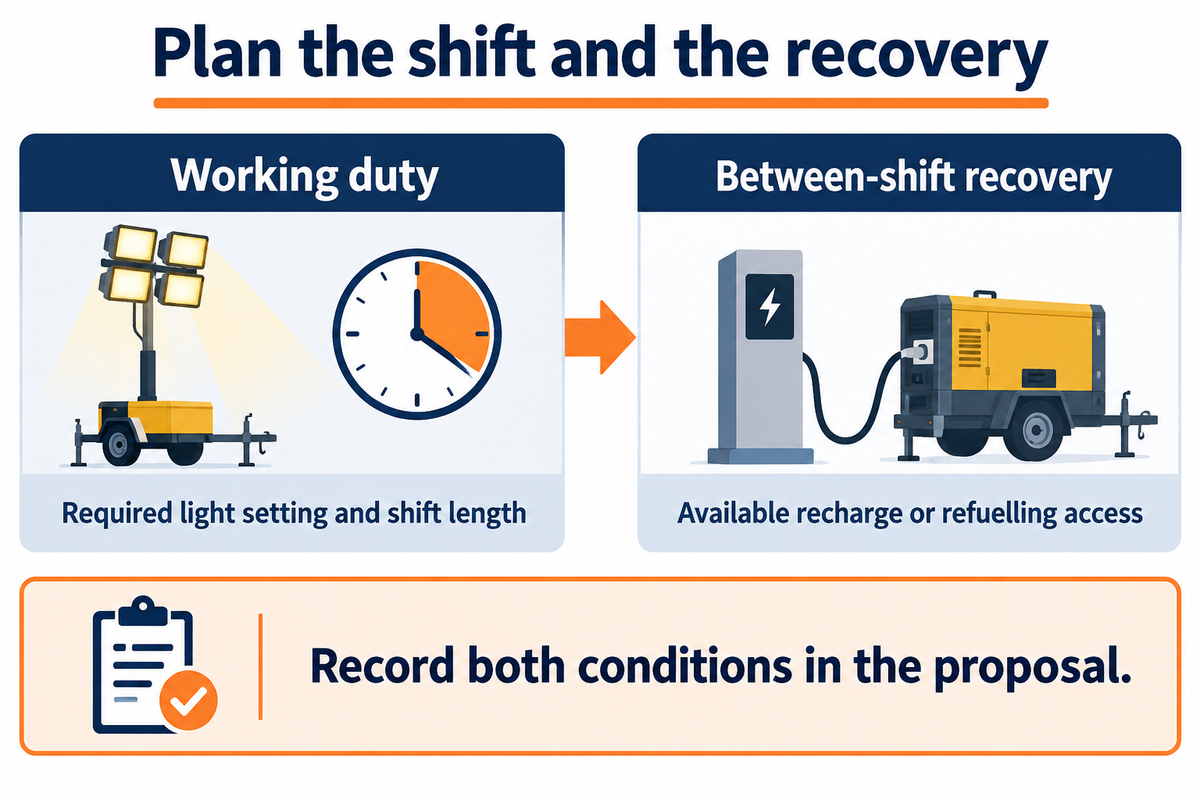
Match the supply to the lighting setting, shift length and recovery between shifts. Mains-powered equipment needs a suitable connection; battery-powered equipment needs recharge access; diesel equipment needs fuel and operating arrangements. Solar and hybrid power systems add charging to the mix. Off-grid job sites make recovery access a selection question from the start.
Power describes a rate; energy describes an amount available or used over time. A battery capacity and a lamp wattage are therefore different specifications. A runtime claim also needs its brightness setting and test conditions. Wanco’s published 10–100% light control range illustrates why adjustable output must be part of the comparison, rather than an unstated change between proposals.
See the separate guides on solar charging and night duty planning, diesel tower operations and maintenance and hybrid light-tower duties and recovery for detailed supply planning. The energy and maintenance requirements are determined after the task and required lighting duty are defined. For towers for construction, including diesel generators or a separate backup generator in the proposal also adds siting and operating responsibilities. Compare emission restrictions against the complete supply arrangement.
Can portable light towers be used indoors as well?
Yes for battery- or mains-powered units whose instructions and location allow it; CDC says to use generators only outside, more than 20 feet from windows, doors and vents. A portable generator must not run inside a home or garage, even with doors or windows open, because of carbon monoxide. An engine-off lighting head doesn’t address where the generator is operated, and whether the connections and equipment are appropriate for the industrial space.
Hazardous locations require special consideration. In accordance with the U.S. OSHA Construction standard 1926.407, approval of equipment for use in classified locations must match the relevant materials. Battery supply or an ingress-protection label alone does not establish that suitability. Indoor work, remote areas and power outages, each require their own supply assessment, and don’t allow for unrestricted use.
How Do You Plan a Temporary Lighting Layout?
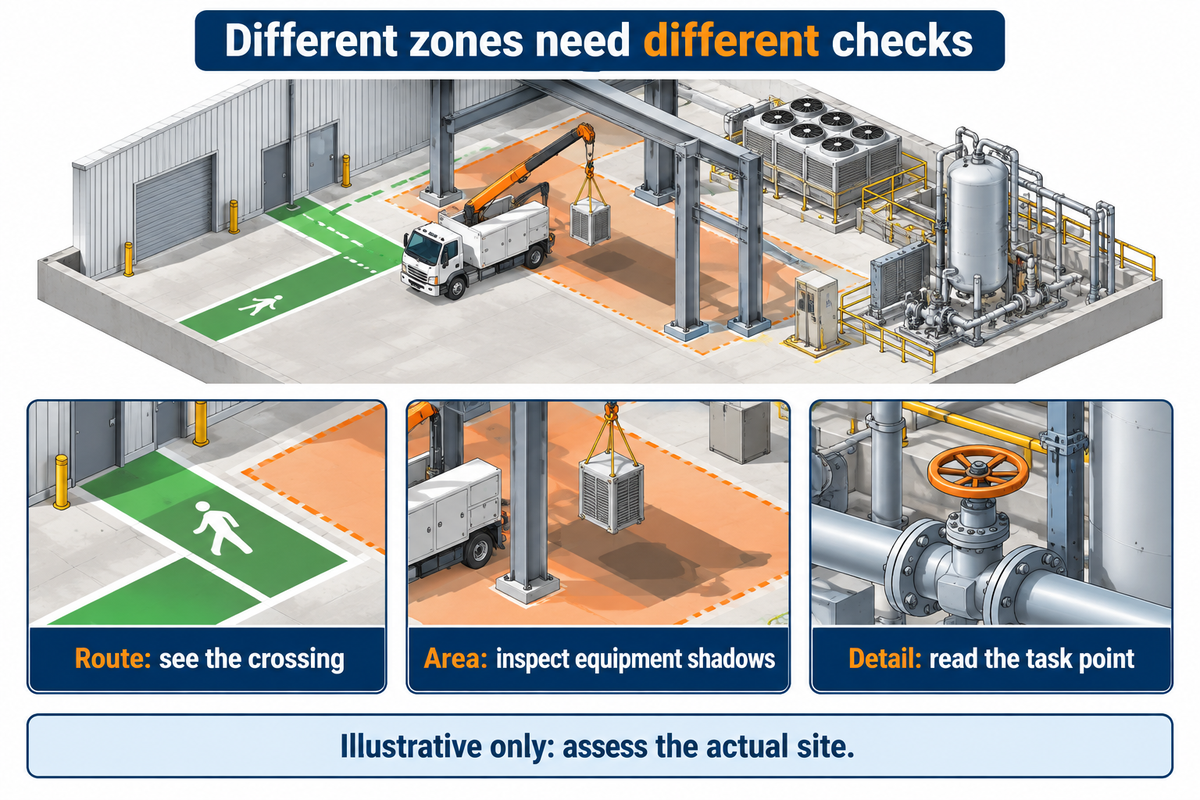
Separate travel routes and work areas, and define tasks. Place equipment in relation to the user’s field of view, and take into account barriers and obstructions. Include the primary lighting, drivers, neighbors and signs. Consider the route out if the primary lighting fails. Recheck the layout when machinery, stock or the task moves; a previously useful beam may then create a shadow or glare.
The 3-Zone Task-to-Placement Lighting Map below turns that distinction into a site briefing aid. These are author-derived examples based on HSE site-lighting guidance and FHWA work-zone considerations; they aren’t engineered layouts or universal mounting instructions. The range of applications changes the task, so carry the map’s questions across settings rather than copying a mounting arrangement.
| Setting / zone | What must be seen? | Placement decision | Verification point |
|---|---|---|---|
| Maintenance yard / route | Pedestrians beside parked plant | Keep supports outside the designated path | Crossing viewed from both directions |
| Maintenance yard / area | Equipment perimeter | Review the shadow behind the tallest machine | Far side with plant in its working position |
| Maintenance yard / detail | A valve label beneath pipework | Add local light from a usable viewing angle | Label seen from the operator’s stance |
| Roadwork / route | Worker access beside traffic | Review aiming from the approaching driver’s view | Approach and entry after dark |
| Roadwork / area | Activity around moving plant | Allow for changing equipment shadows | Task zone during the intended movement |
| Roadwork / detail | A mark on the work surface | Check local contrast without direct glare | Mark at the task viewing angle |
| Workshop outage / route | Signs and exit direction | Include the primary-light failure condition | Route and sign appearance in that condition |
| Workshop outage / area | Walk-around space at a machine | Keep the light and cable clear of access | Access with covers and doors in use |
| Workshop outage / detail | A recessed inspection point | Use a task source that holds its aim | Detail with hands and tools in position |
Example: A maintenance crew works beside an unobstructed pump skid. Later, a service vehicle blocks the area light from the valve bank. The site manager sees a lit yard, but the technician now reads labels in the vehicle’s shadow. A local light may address the viewing task, while its support and cable still need a suitable position. The map provides a basis for an assessment of the detail zone and access route. Before the crew resumes the activity, the agreed task point is checked with the vehicle, hands and tools in their working positions.
That distinction also appears in a Practical Machinist thread: the requester still struggled to illuminate machine work after adding overhead fixtures. A post described using more than one direction to address hand shadows. The transferable lesson is to inspect the actual occlusion; the thread is not a wiring or mounting procedure.
What Should Operators Check Before Deployment?
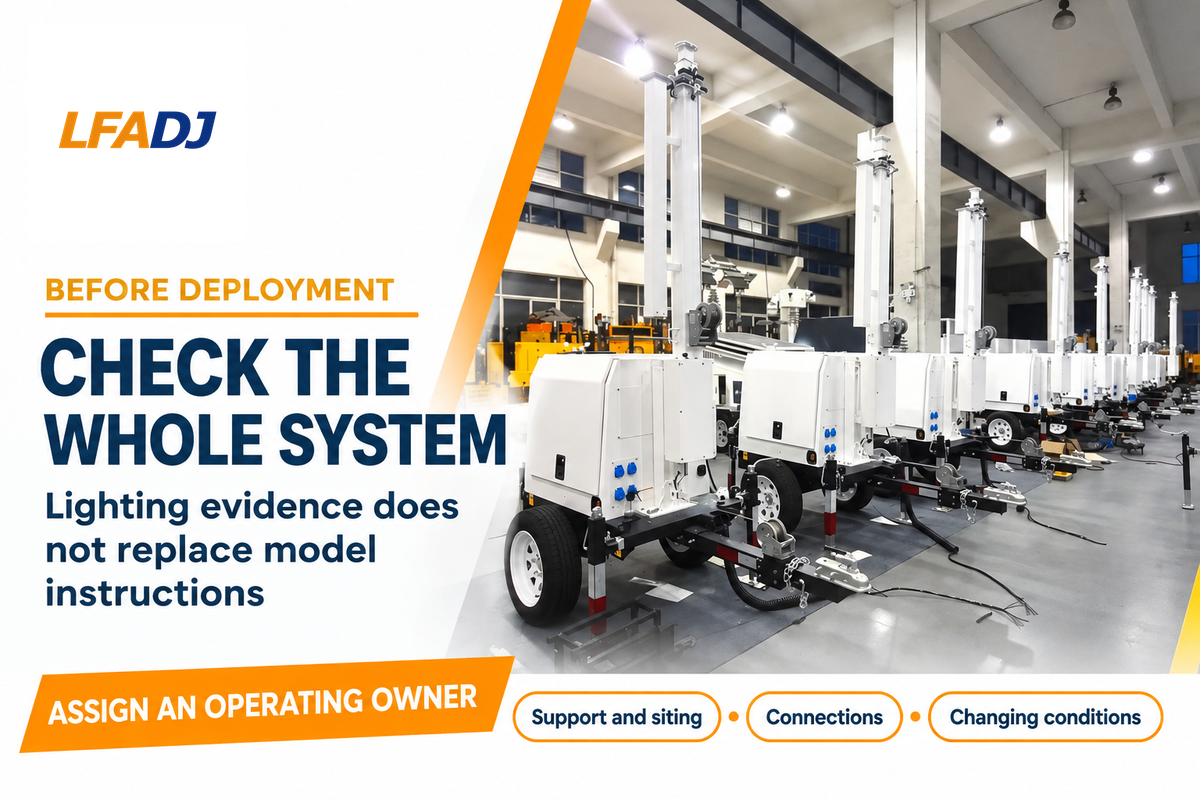
Before deployment, first verify the appropriate model’s siting, support, overhead clearance, weather, connection, and inspection requirements. Assign responsibility for operation and changing conditions. Lighting layouts describe visibility, and don’t replace the operator’s manual, electrical assessment, or the site’s emergency plans. An unresolved support or connection issue can prevent use, even if the lighting layout indicates it’s appropriate to do so.
A WorkSafe Western Australia incident report documents a mobile lighting tower collapse involving partial pin engagement after misalignment. It identified missing manufacturer instructions and written procedures. This is evidence to apply the mast and locking procedures for applicable towers, and shouldn’t be used as a basis to invent a single pin-check procedure for all towers and pneumatic or mechanically raised designs.
For U.S. construction, OSHA 1926.405 addresses temporary circuits and the protection of flexible cords. Its provisions covering wet or conductive locations specify 12 volts or less for portable electric lighting, with a 120-volt option where ground-fault circuit-interrupter protection is used. Have the responsible electrical personnel apply the appropriate provisions; this isn’t a training aid.
Do portable light towers require regular maintenance?
Yes. The required inspection and maintenance are dependent upon the tower, support, power and service conditions. Employ the manufacturer’s manual to determine required checks and intervals. Include a process for damaged equipment. Include the lighting head, connections, aim retention and support arrangement as well as any engine or battery; engine service alone does not cover the whole system.
For emergency preparedness, HSE also refers to visibility when primary lighting fails and the appearance of safety signs under artificial light. Add those checks to the operating plan rather than assuming backup function from temporary area lighting.
How Do You Compare Mobile Lighting Costs and Suppliers?
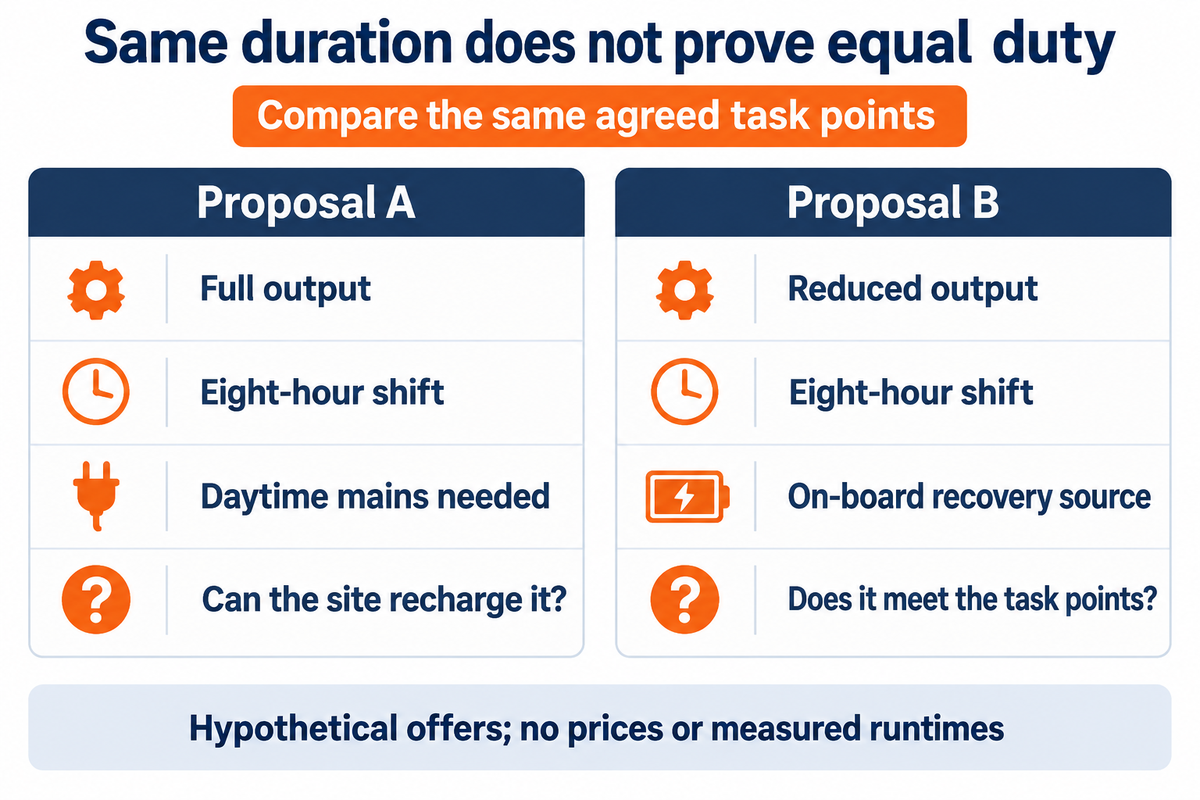
Compare proposals against shared task outcomes and a stated working duty, then consider price and tradeoffs. Make output, recovery, accessories, delivery and service responsibilities visible so procurement can distinguish a lower purchase price from a lower cost of delivering the required work.
The Department of Energy’s life-cycle cost approach explains why acquisition price is only part of the comparison. A cost-effective choice must fit the accepted working duty and support.
Assumed inputs: two hypothetical proposals serve an eight-hour night shift. Proposal A provides full output lighting for that shift and needs mains charging during the day. Proposal B provides eight hours at a reduced setting and contains a built-in recovery source. No market prices, measured runtimes, or LFADJ model specifications are implied.
| Comparison field | Proposal A | Proposal B | Decision consequence |
|---|---|---|---|
| Task requirement | Same agreed task points | Same agreed task points | Use one acceptance basis |
| Light setting | Full output | Reduced output | Obtain both distributions at the proposed settings |
| Operating period | Eight-hour shift | Eight-hour shift | Duration alone does not settle light adequacy |
| Between-shift recovery | Daytime mains needed | On-board source included | Compare available recovery access and restrictions |
| Support and access | Footprint to be confirmed | Footprint to be confirmed | Hold the placement decision open |
| Included accessories | Connection set listed | Recovery accessories listed | Identify missing site-specific items |
| Routine attendance | Charging responsibility unassigned | Recovery servicing unassigned | Maintenance allocates time and ownership |
| Delivery and support | Terms to be agreed | Terms to be agreed | Procurement checks dates, parts and service scope |
| Commercial evaluation | Price not supplied | Price not supplied | Finance prices the accepted duty and disclosed tradeoffs |
The operations manager might prefer proposal A’s light output setting; the finance manager, proposal B’s included recovery equipment. Neither preference establishes whether B meets the task points, or if the site can recharge A between shifts. First, procurement obtains the missing conditions, then records any tradeoff. Next, maintenance assigns the recovery work and access to the service. The offers can remain technically different: the aim is a justifiable comparison of outcomes and responsibilities. Only then is a price comparison of the service being purchased, rather than the towers, justified.
Use one project brief: ask for task-point lighting evidence and duty conditions; confirm supplied equipment, accessories, delivery times and service scope; verify model-specific approvals against the destination and application. A company management system certificate and product approval answer different questions.
According to its company information, Zhejiang LONGFA Lighting Co., Ltd., established in 2013, supplies industrial, mobile, explosion-proof and emergency lighting under its LFADJ business. To discuss solutions for industrial applications and request a configuration, take the filled in brief to its Mobile Lighting Systems solutions page. Warranty, response times and on-site support are negotiated in the agreed contract.
What Is Changing in Mobile Lighting Standards?
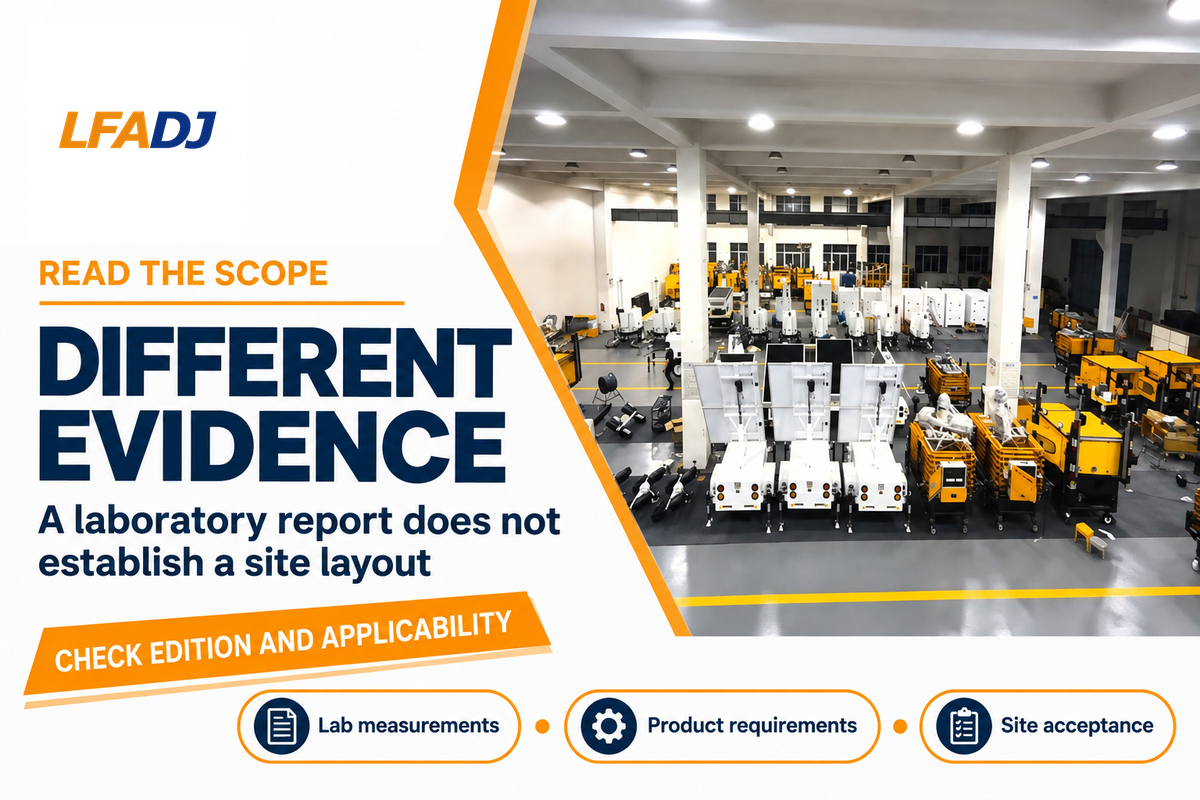
Track the scope, edition and status of the standard applicable to the situation rather than anticipated future publications as new rules of work. Product test methods, product safety standards and installed-site acceptance criteria answer different questions. When making an upcoming purchase, determine the evidence applicable to the proposed luminaire and which site conditions still require an evaluation.
As of October 2026, the IEC lists IEC 60598-2-4:2017, edition 3, as Valid. The scope of the standard covers specified portable general-purpose luminaires for indoor or outdoor use at supply voltages not exceeding 250 V and excludes handlamps. The publisher states edition 4 is in development and forecasts it to be published on 25 June 2027. There are no deadlines to replace existing equipment based on this forecast publication date.
Similarly, IES LM-79-24 describes optical and electrical measurements of solid-state lighting products under standard conditions. This standard is helpful when considering laboratory data; however, it doesn’t provide an installed worksite arrangement. The controls also require an operating owner; local Bluetooth and cellular remote monitoring and control, described in Wanco’s product data, are different arrangements.
| Constraint | Example bottleneck | Owner and release condition |
|---|---|---|
| Delivery | Planned unloading area is occupied | Site manager agrees a usable access and unloading plan |
| Support | Stand legs encroach on the walkway | Operations agrees a position within the model’s requirements |
| Supply | Connection route crosses vehicle access | Responsible personnel approve the temporary supply arrangement |
| Controls | No one owns a remote dimming change | Supervisor assigns control responsibility and recheck points |
| Visibility | A relocated load blocks the inspection beam | Task lead reassesses the viewing point before work resumes |
An acceptable handover provides the necessary constraints for consideration of the evidence provided by lighting. Keep the model documents, proposed layouts, duty conditions, and assigned responsibilities together, so the next shift understands what the accepted arrangement is based on. Around-the-clock work also requires a handover between people; a long operating claim doesn’t assign that responsibility.
Frequently Asked Questions
Are portable light towers resistant to harsh weather conditions?
Yes, within each model’s rated limits; a rental-industry guide says leading systems can keep the tower steady in winds up to 65 mph.
A housing protection rating covers specified ingress conditions only; the wind speed a raised tower can stay in service at is a separate limit for that model. Consider the model’s weather, support, and ground requirements as a whole. The operating plan should define who monitors changing conditions and what the manual says to do about it. Consider the full system and connections in the evaluation, rather than considering it by the lamp enclosure only.
Can portable light towers be customized to meet specific requirements?
Yes, within the options a supplier offers for that product: the lighting heads, support, power arrangement and controls can be specified for the project.
Consider the evidence for task, supply, access, environment, and acceptance when choosing options. Obtain a written description of the supplied lighting heads, support, power arrangement and controls. Accessories and service scope also belong in the proposal. When a configuration changes, relate its documentation to the actual assembly; evidence for another model or an earlier arrangement may not answer the project’s questions.
How long do portable light towers typically take to set up?
For a mobile lighting system, count lamp warm-up as well as positioning, support and connections: metal halide lamps can take five to 10 minutes to reach full output, while LED lamps are instant-on.
Be mindful of the support arrangement, mast, access, ground conditions, connections, and required checks. A demonstration may begin with a prepared location and finish before lighting verification. Inquire about what’s included in a quoted setup time. Based on the model instructions and the site arrangement, plan the work sequence and access required, and use a supplier’s time in the schedule only after determining the plan to be practical.
Can mobile lighting systems be repaired?
Yes, when parts and a service route exist for that model and fault.
Remove damaged equipment from use and follow its inspection and service process. Do not bypass protective devices to keep a lamp running.
Which mobile lighting system is best?
The best choice meets the viewing task and the site’s operating constraints.
Begin with what a worker needs to see and the position where that worker stands. Define the relevant viewing plane, likely obstructions, and routes affected by glare. Compare lighting options before individual models: a tower can serve the area while a smaller task light reaches a detail behind plant. Consider the proposed supply at the required light level and the recovery opportunity between shifts. Consider delivery, support footprint, connections and control responsibility. Ask suppliers to describe their evidence against the same task points and working duty, while recording differences you are willing to accept. Finally, consider price and service range for the specified outcomes. This process can result in different product recommendations for a yard, an inspection task or road work. It can’t result in one universally best light.
About this article: GW prepared this article for LFADJ with reference to guidance from various public authorities, product information, and a company brief. The examples of maps, proposal comparisons, and service definitions are illustrative not based on site inspection or measurement of products. LFADJ is a supplier of lighting equipment and this article separates generic product selection advice from model configuration. Site conditions, terms, and restrictions of services are defined for and related to particular pieces of equipment.
References & Sources
- CCOHS: lighting ergonomics and lighting arrangements
- HSE: lighting, task needs and shadows; construction site lighting
- FHWA Lighting Handbook (2012): work-zone considerations
- FHWA: visual impact guidance, light and glare considerations
- OSHA 1926.56: construction illumination; 1926.405: wiring methods; 1926.407: hazardous locations
- CDC: carbon monoxide basics
- WorkSafe Western Australia: lighting tower collapse report 06/2013
- U.S. Department of Energy: life-cycle costs in acquisition; power and energy units
- IEC 60598-2-4:2017: scope and edition status
- IES LM-79-24: optical and electrical measurement scope