Get in touch with LFADJ Company

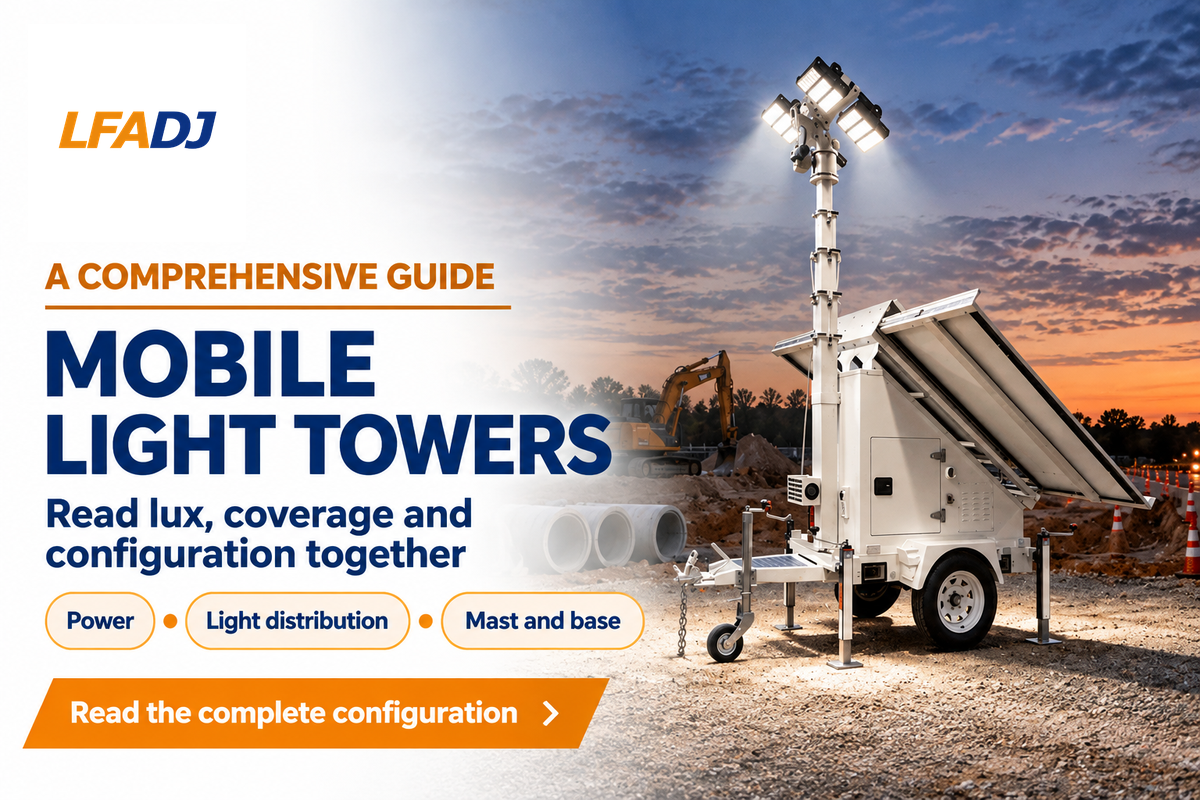
Mobile Light Towers are relocatable lighting assemblies that raise lamps over a work area. The usefulness of a light source is determined by the lux level it provides as well as how evenly the light is distributed. Compare the minimum and average readings over the same mounting height and aiming settings, and only then, compare the advertised square meters.
A tower combines several systems: a light source, a lifting structure, a base and a power supply. Therefore, two similar-looking lighting units can require different transport, charging, and service arrangements. Also, a larger lumen figure can coexist with a corner that’s poorly lit.
What Is a Mobile Light Tower?
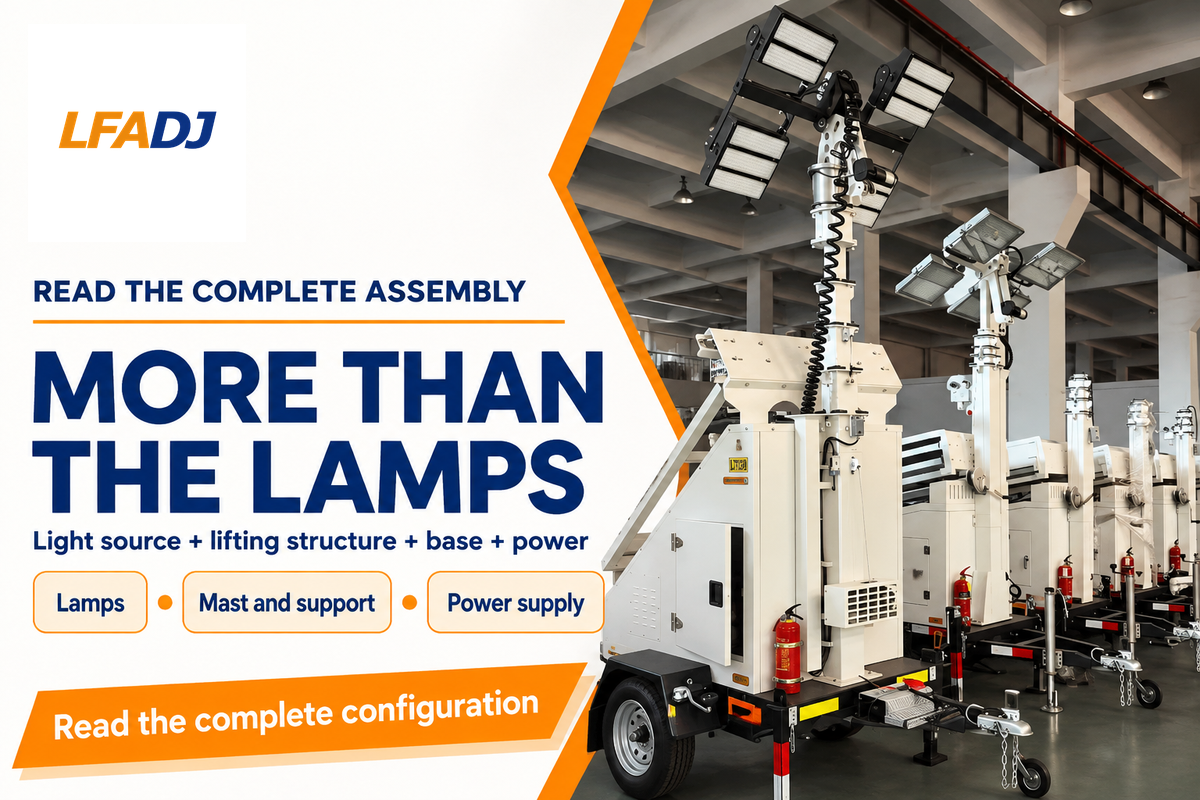
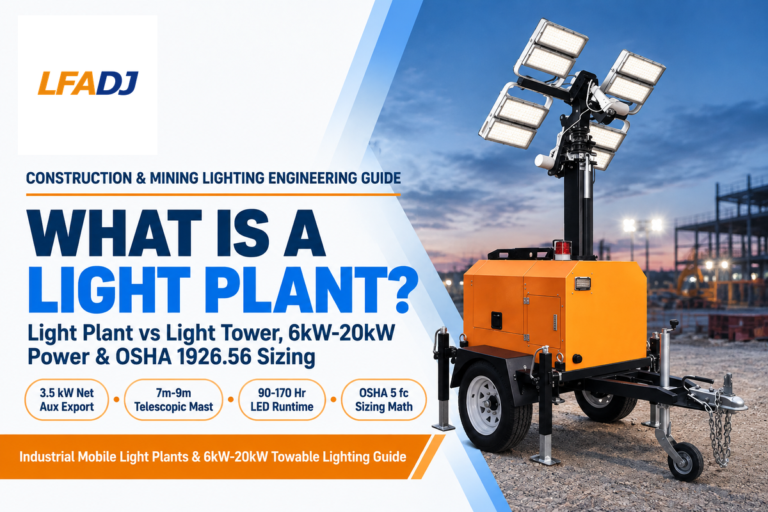
A mobile light tower is a relocatable support that elevates luminaires to direct light over an outdoor work area or an alternative, suitable temporary location. Some units carry a generator or battery, while others are powered externally. Transport can involve towing, lifting, or moving a compact wheeled base.
Generally, read the equipment from top to bottom. The lamps produce light. The optics direct the light. An adjustable bracket changes the aim. The mast elevates the lamps over surrounding obstructions. Stabilizers and the base support the elevated assembly. A trailer, skid, or wheels provide the transport arrangement. The controls connect the power source to the lighting load.
The word portable covers very different equipment. LFADJ lists the LF6128 camera-equipped work light at 15.6 kg, with a 365 mm × 330 mm × 620 mm body. Such portable work lights belong to a different handling class from a towable assembly weighing hundreds of kilograms. A portable light may be carried to a maintenance point; portable light towers can require a vehicle or mechanical handling.
Light towers provide temporary visibility where fixed lighting is absent, unavailable or poorly placed for the work. Construction and emergency operations may require these lighting applications, but their access routes and working tasks may vary. A tower that illuminates an open staging area may still leave an inspection point in shadow.
Diesel, Solar, Battery and Electric LED Light Towers
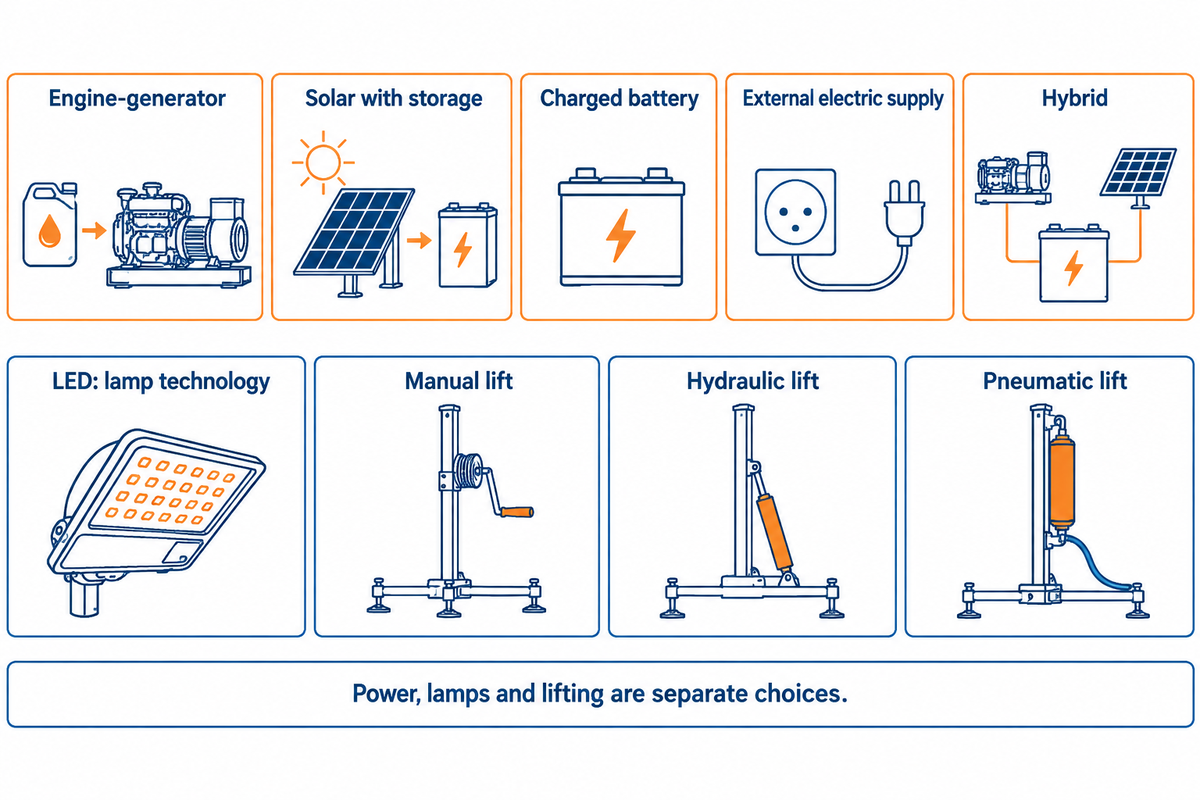
Diesel is the name of a type of fuel for an engine, solar describes an energy source, and battery describes a storage device. LED describes the lamp technology. Therefore, a diesel-powered unit can be an LED light tower. Hydraulic describes a lifting system. Keep these labels separate when comparing power options, charging needs, and lifting systems.
| Type | System described | Main operating dependency |
|---|---|---|
| Engine-generator | Fuel → engine → generator → lighting | Fuel availability and engine service |
| Solar with storage | Sunlight → panels → battery → lighting | Solar exposure and stored energy |
| Charged battery | External charging → battery → lighting | Charging access between operating periods |
| External electric supply | Compatible site supply → lighting | Supply capacity and cable arrangement |
| Hybrid | Two or more supported energy paths | Installed charging options and control settings |
| LED | Light source and its driver | Compatible electrical supply; specified lamp output |
| Manual lift | Operator-actuated lifting mechanism | Model-specific raising and securing procedure |
| Hydraulic lift | Hydraulic lifting mechanism | Hydraulic system and its controls |
| Pneumatic lift | Air-powered lifting mechanism | Air system and specified operating procedure |
There are overlapping types. These types overlap: One unit may be powered by an engine, be LED and be hydraulically raised. LFADJ mentions the manual, hydraulic and pneumatic versions of its telescopic range. Labels should be grouped within the same system prior to comparing competing systems.
The light-tower job aid from the U.S. Forest Service describes engine, solar and hybrid alternatives. Examples in the field include truck-mounted LED equipment. In solar scenarios, the unobstructed path of the sun and a backup plan in case of smoke or dust situations affect deployment. A hybrid label doesn’t identify which paths are fitted for charging.
What Are Electric LED Light Towers?
Electrically powered LED light towers use electric power to light up LEDs, which can be from an external supply, or from an onboard supply. An externally supplied model requires a compatible connection throughout operation. A battery powered light tower runs from stored energy and is rechargeable. An electrical arrangement affects dependencies, rather than LEDs.
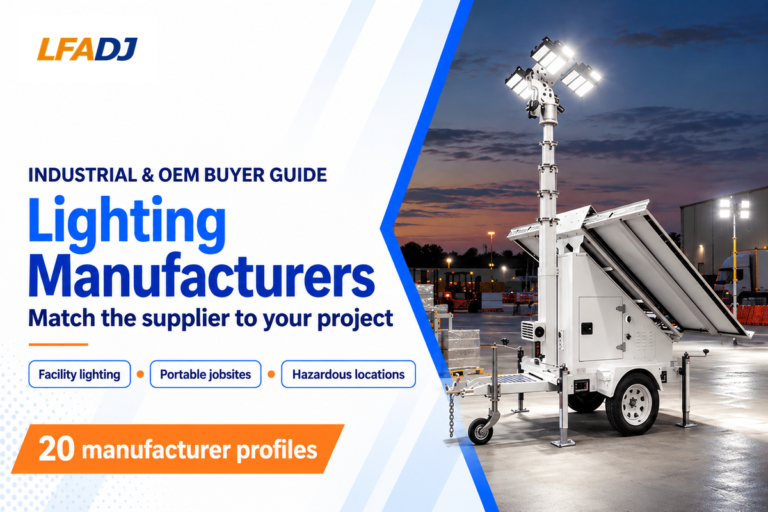
For example, LFADJ’s solar mobile light towers include an S975 configuration with a 25.6 V, 200 Ah battery. Multiplying nominal voltage by capacity gives 5,120 Wh, or 5.12 kWh. Those figures describe nominal storage. Usable energy, lamp settings and other loads determine operating time.
The same S975 configuration includes four 100 W lamps and three 450 Wp solar panels. This gives a total of 400 W of lamp power and 1,350 Wp of panel power. The solar panel rating describes output under its rating conditions, not continuous charging power throughout the day. LFADJ lists a 5,000 K lamp color temperature for this configuration; the value describes color appearance rather than the amount of light on the ground.
Engine-off operation removes engine noise during that period; it is not a promise of zero noise from the complete installation. Fans and other peripheral components may still be audible. High-efficiency LED technology may reduce the electrical load for a given lighting task, but it’s required to compare energy efficiency at equivalent useful illumination. Extended run times require sufficient usable energy for the selected load. Detailed charging and duty-cycle choices belong in the hybrid light towers guide.
Reading Light Tower Specifications
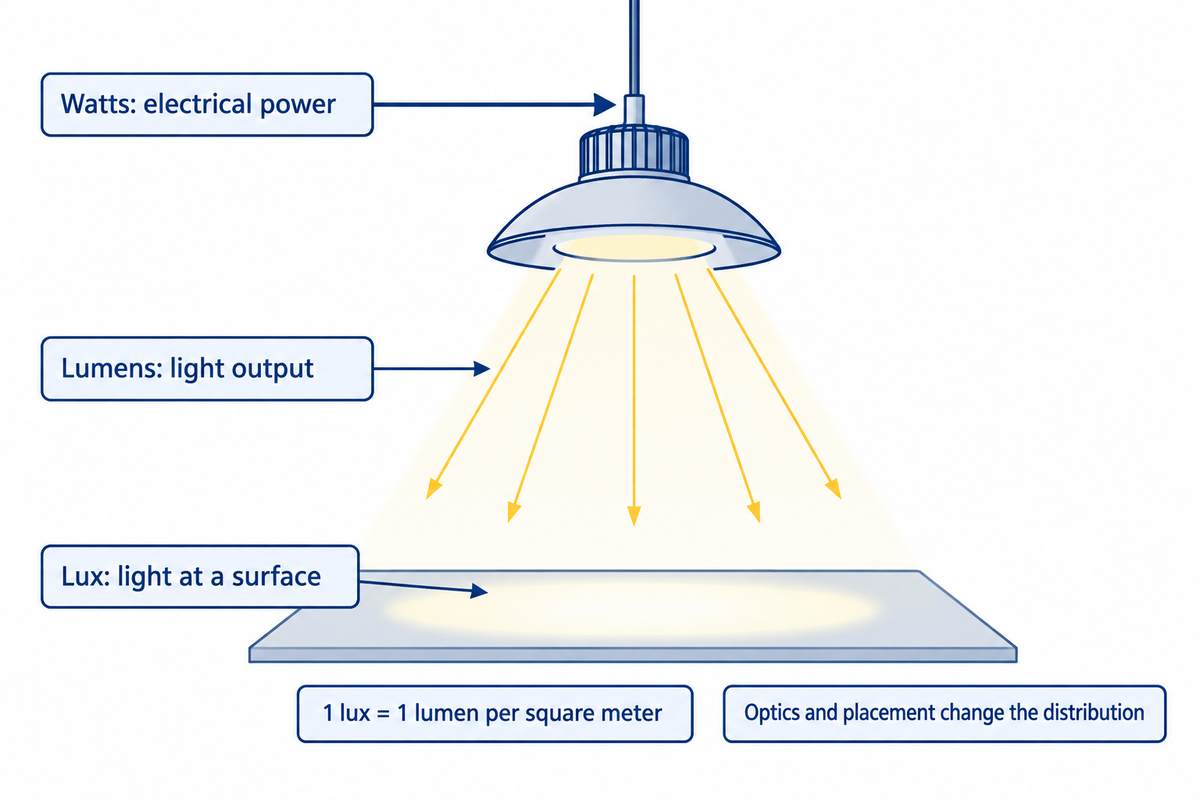
Watts measure electrical power. Lumens measure light output. Lux measures illuminance at a surface. One lux equals one lumen per square meter of surface area. Color temperature defines the appearance of the light. These quantities answer different questions and cannot replace one another.
“SI unit of illuminance”
The same vocabulary entry provides 1 footcandle as 10.764 lux. When units are converted, the number changes, but the physical lighting remains the same. When comparing to a lux specification, a value in footcandles should be converted first.
| Quantity | What it describes | Condition to keep with the value |
|---|---|---|
| Lamp power, W | Electrical demand of the stated lamps | Number of heads and dimming level |
| Light output, lm | Emitted luminous flux | Per lamp or complete assembly; source or luminaire output |
| Minimum illuminance, lx | Lowest value within the stated assessment | Calculation or measurement grid and boundary |
| Average illuminance, lx | Mean over the defined area or samples | Averaging method and measurement plane |
| Coverage, m² | Area associated with a declared lighting criterion | Threshold, mounting height and aiming |
| Color temperature, K | Warm or cool appearance | Specified lamp configuration |
| Working height, m | Raised position of the lighting assembly | Defined reference point and permitted setup |
| Battery capacity, Ah or kWh | Charge capacity or stored energy | Nominal voltage and usable operating limits |
| Runtime, h | Operating duration under stated conditions | Brightness, starting charge or fuel, and auxiliary loads |
| Transport mass, kg | Mass in the stated transport condition | Fuel, accessories and load definition |
The output from a lamp is distributed via its optics. Only a portion reaches the designated work plane and the amount distributed may vary across the work plane. Dividing total fixture lumens by the work-plane area assumes a distribution that the optics and fixture placement may not produce. A photometric plot will show how illuminance is distributed over a given plane.
Example: A procurement coordinator receives a sheet showing 4 × 400 W and another with a total lumen figure. She places the electrical load in the power column and the lumen figure in the output column. Neither entry fills the minimum lux column. The supplier’s plot then shows the lamp aim and the plane used to determine coverage. A site supervisor can compare that plane to the actual work (reading a horizontal plane vs. examining a vertical equipment face) and judge whether the coverage meets the minimum lux criteria. The coordinator keeps the lamp configuration attached to the plot, so a later substitution cannot retain the original coverage figure without checking the changed distribution.
Why Equal Coverage Figures Can Hide Different Lighting
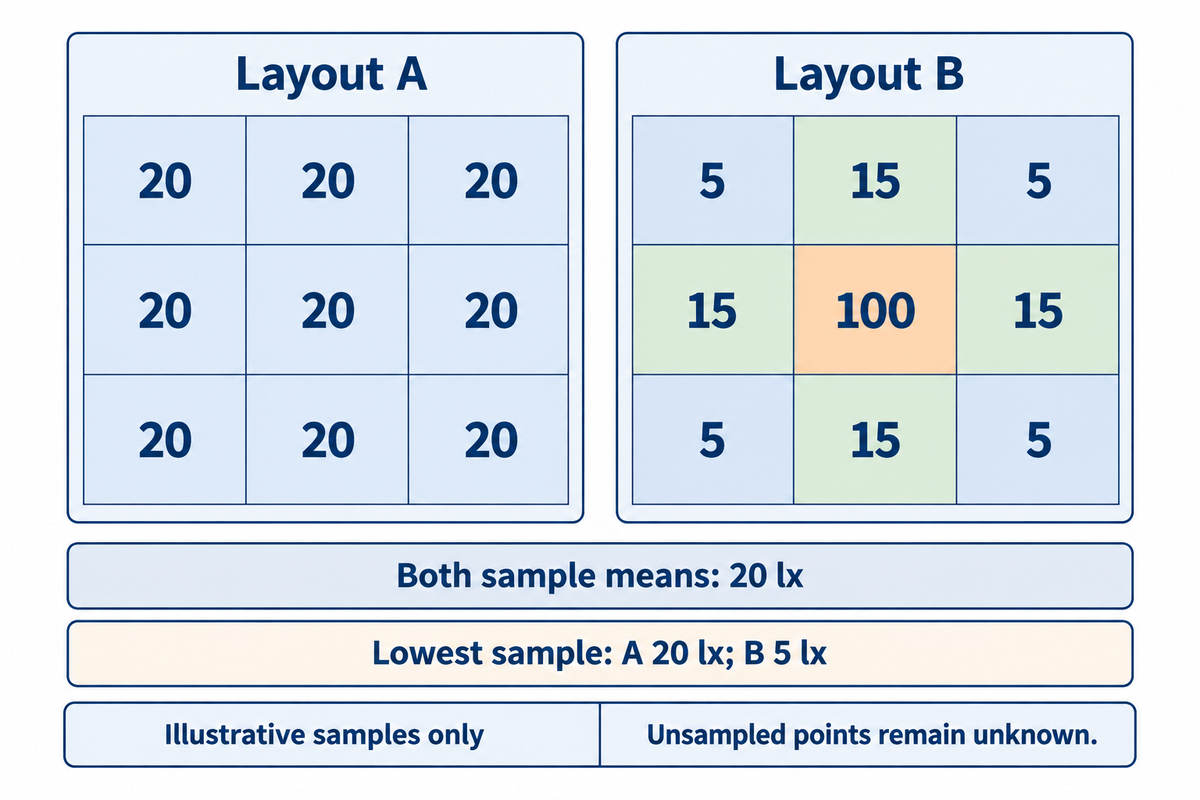
Average illuminance can conceal dark areas, especially when one or more hot spots are present. Compare the lowest measurement with the average, using the same sampling plane and method. Coverage also needs a stated boundary criterion. One area above 1 lux is different from an area above 2 lux.
Generac Mobile’s 2021 light-tower comparison sheet illustrates why coverage must be tied to a lighting criterion rather than lamp watts alone. A supplier comparison is useful for listed configurations; it isn’t a conversion factor for power to illuminated area.
Same Average, Different Minimum Readings
Assumed inputs: Two scenarios having nine equally weighted sample points. All points on Layout A read 20 lx. Layout B reads 5 lx at four points, 15 lx at four points and 100 lx at the center. The readings in these examples are for illustration and aren’t actual measurements, recommended readings, or task level light required for the job.
Layout A: readings in lux
20 20 20
20 20 20
20 20 20
Layout B: readings in lux
5 15 5
15 100 15
5 15 5
| Calculation | Layout A | Layout B |
|---|---|---|
| Sum of sample readings | 180 lx | 180 lx |
| Sample mean: sum ÷ 9 | 20 lx | 20 lx |
| Lowest sampled reading | 20 lx | 5 lx |
| Sample minimum ÷ sample mean | 1.00 | 0.25 |
A site coordinator evaluating these examples would calculate Layout B’s mean as (4 × 5 + 4 × 15 + 100) ÷ 9 = 20 lx. The center sample reading boosts the mean value while the corner samples remain low. The average conceals the local reading, which is more relevant if the task occupies a corner. Layout A has equal values at its sample points, but unsampled points remain unknown in both layouts. The comparison doesn’t establish continuous area uniformity, acceptable glare, and/or compliance of the working environment. A real survey needs a grid and methodology relevant to the task and to the lighting criteria.
What belongs beside a measured lux value?
Measured lux values are meaningless without location, measurement-plane height, sensor orientation and operating conditions. Also include the instrument identity and calibration. Record lamp configuration and dimming as well as other light sources present. This allows a later reading to describe the same condition instead of mixing various measurement conditions.
NIST’s photometric calibration publication discusses calibration services and measurement uncertainty. Nine points in the example provided are a teaching device, not a prescribed survey grid.
The Mast, Base and Transport Arrangement
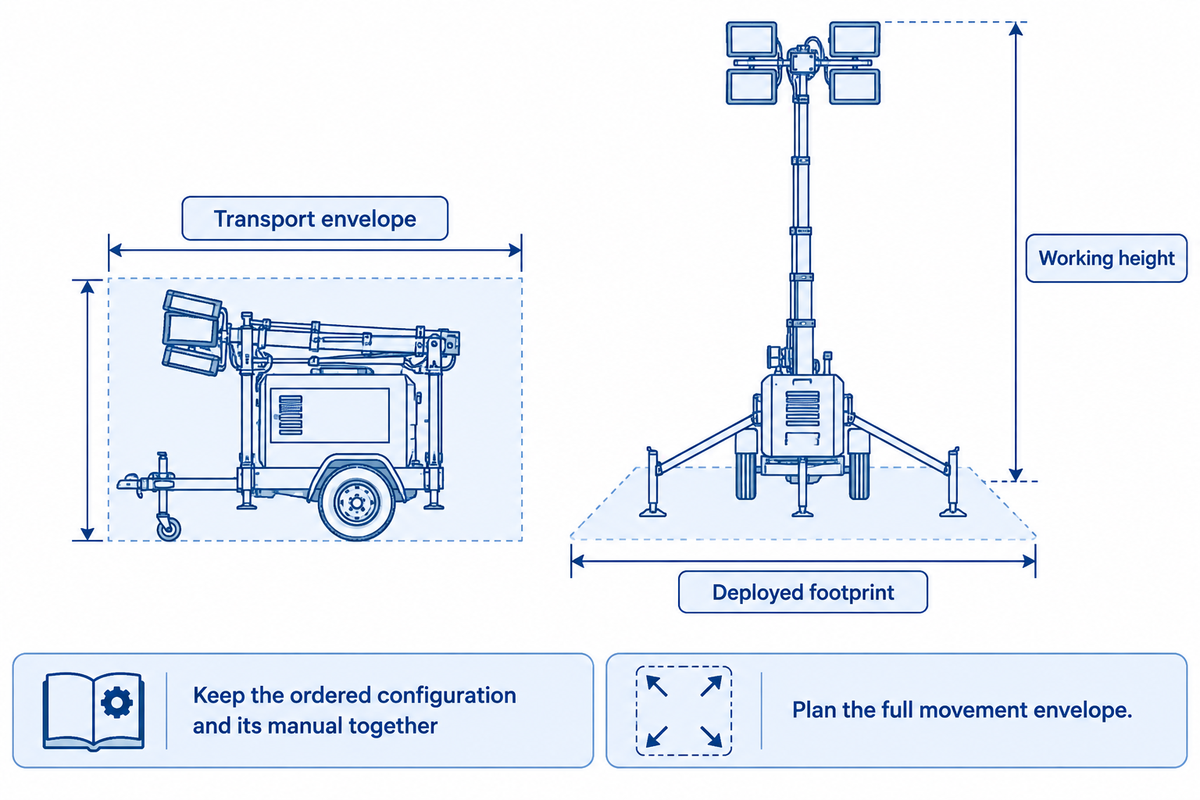
The mast positions the lamps; its lifting method determines how that height is reached. There are differences in manual, hydraulic and pneumatic systems in terms of service and operating conditions. Working height, transport dimensions and deployed footprint describe separate conditions. A higher lamp position can affect shadows and distribution, and it can also change clearance and stability requirements.
LFADJ’s diesel mobile light towers page lists a D955 with a 7 m hydraulic lift. Its telescopic lighting towers page lists a 9 m D955 configuration. Keep the ordered configuration and its manual together rather than assigning one height to every unit carrying that model name. The S975 solar configuration similarly lists a 2,100 mm × 1,450 mm × 2,350 mm folded envelope and a 2,650 mm × 2,450 mm × 7,000 mm deployed envelope.
Can light tower fixtures be adjusted?
Yes, some towers allow mast rotation, and all adjustable fixtures allow aiming within their respective ranges. Aiming a fixture changes the direction of the beam; rotating a mast changes the direction of the assembly. These are separate movements. How far a given adjustment is allowed is determined by the model instructions. Lights may need to be lowered or isolated before a given adjustment is allowed.
A vertical mast doesn’t eliminate overhead hazards. The New York FACE investigation of a 2012 light-tower fatality states that contact with an overhead power line occurred during the work involving the tower. Plan the full movement envelope before positioning equipment. The trailer’s road-use requirements are also separate from the equipment’s ability to move around a site.
Using Mobile Lighting Without Losing the Working View
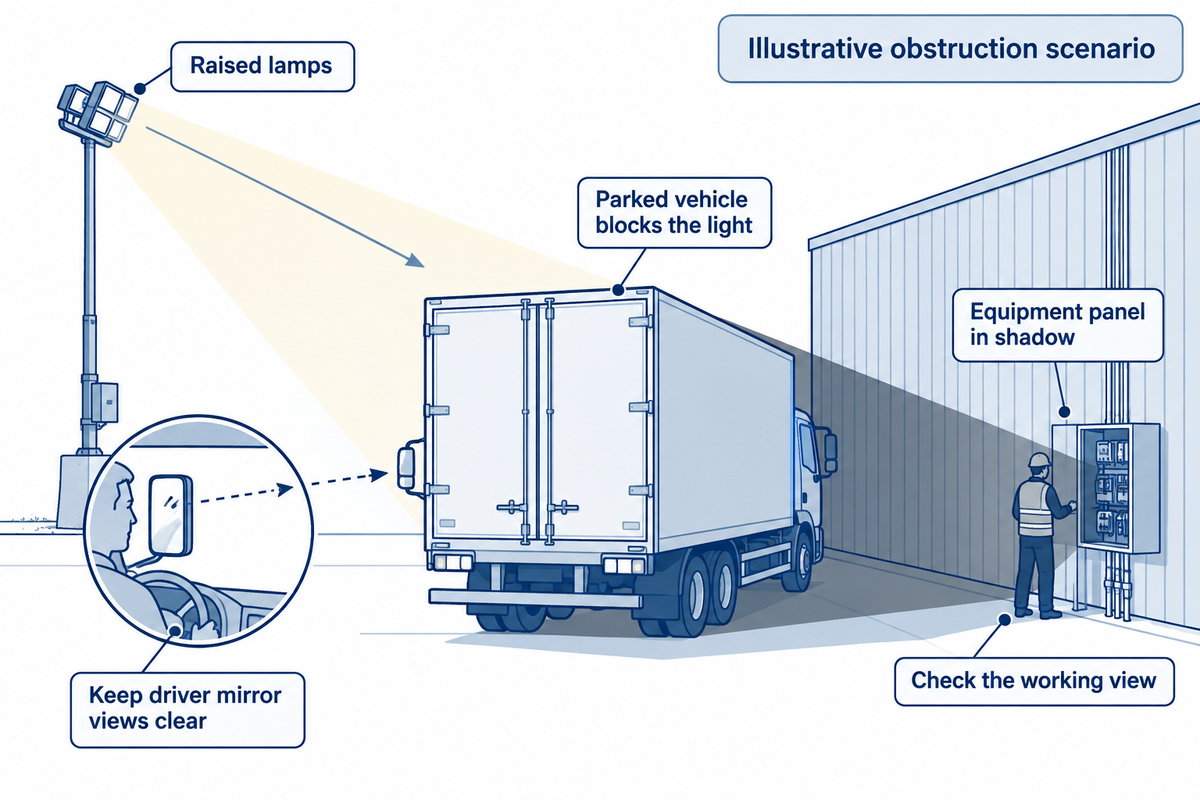
Useful mobile lighting lets people view the task from their working position without disabling glare or obstructing shadows. An increased output can make an area brighter and the lamp harder to look at. Reflections and vehicle movements change the view. Consider the observer’s line of sight and the illuminated ground.
The Canadian Centre for Occupational Health and Safety’s lighting survey guidance mentions issues caused by glare and contrast. The UK Health and Safety Executive’s workplace transport lighting guidance covers vehicle mirrors, shadowing from tall vehicles, and changes from bright to dark.
Example: Initially, nighttime maintenance crew members have an open view across a loading area. A delivery vehicle parks between the raised lamps and an equipment panel. The ground near the tower is still quite light, and the technician’s work is behind the vehicle and in the vehicle’s shadow. Increasing the output of the lamp sends more light into the same obstruction. The supervisor assesses the changed position of the vehicle and the technician’s viewing direction before changing the lighting. There may be a need for a task light at the equipment panel, which would depend on the situation. Drivers also need an unobstructed view in their mirrors, so aiming every lamp toward the work face can create another problem along the vehicle route.
For roadwork, site-related glare affects people outside the immediate crew. Light spilling beyond the site boundary can also affect neighboring properties. Effective lighting must preserve the view along the route of the vehicle as well as the task. The mobile lighting systems guide covers wider layouts. This on-site visual check complements photometry; a plot of an unobstructed area won’t include a truck obstructing the area later.
Engine exhaust is a site-related constraint. NIOSH carbon monoxide guidance identifies fuel burning equipment as a hazard in enclosed and partly enclosed spaces. Battery powered lighting removes that local engine exhaust source during battery operation. It does not make ordinary lighting equipment suitable for an explosive atmosphere.
Maintenance Follows the Tower’s Components
Light tower maintenance covers lamps and optics, lifting structure, power equipment and transport hardware. Each assembly is serviced and inspected per its instructions. Long lamp life does not remove engine servicing, battery care or lift inspection. Service intervals and shutdown procedures are specific to the configuration, model and its instructions.
Lenses should be cleaned to avoid distortion and unwanted scatter. However, cable damage, loose connections, and sticking lifting mechanisms need attention even if all LED lights still turn on. Modular lighting products can have separately replaceable assemblies, but replacement compatibility and safe isolation remain service tasks. Built-in diagnostics or remote monitoring, where fitted, do not replace physical inspection.
A maintenance coordinator can consult the manual for the faulty assembly: the lamp, power supply or lifting mechanism. A diesel engine requires different treatment from a battery charger. For the former, the more detailed light tower for diesel engines guide, in conjunction with the equipment instructions, should be of help.
Durability in harsh environments, for example, includes the state of seals and cables, as well as mechanical parts that are exposed to the environment. Stop using equipment with a dangerous defect and arrange qualified service. Bypassing a protective device to avoid downtime leaves the root cause of the defect active. Reliability requires maintaining the complete assembly, not just replacing a failed lamp. A loss of lighting can interrupt work; include charging and refueling interruptions when estimating shift productivity.
Power Connections and Site Interfaces
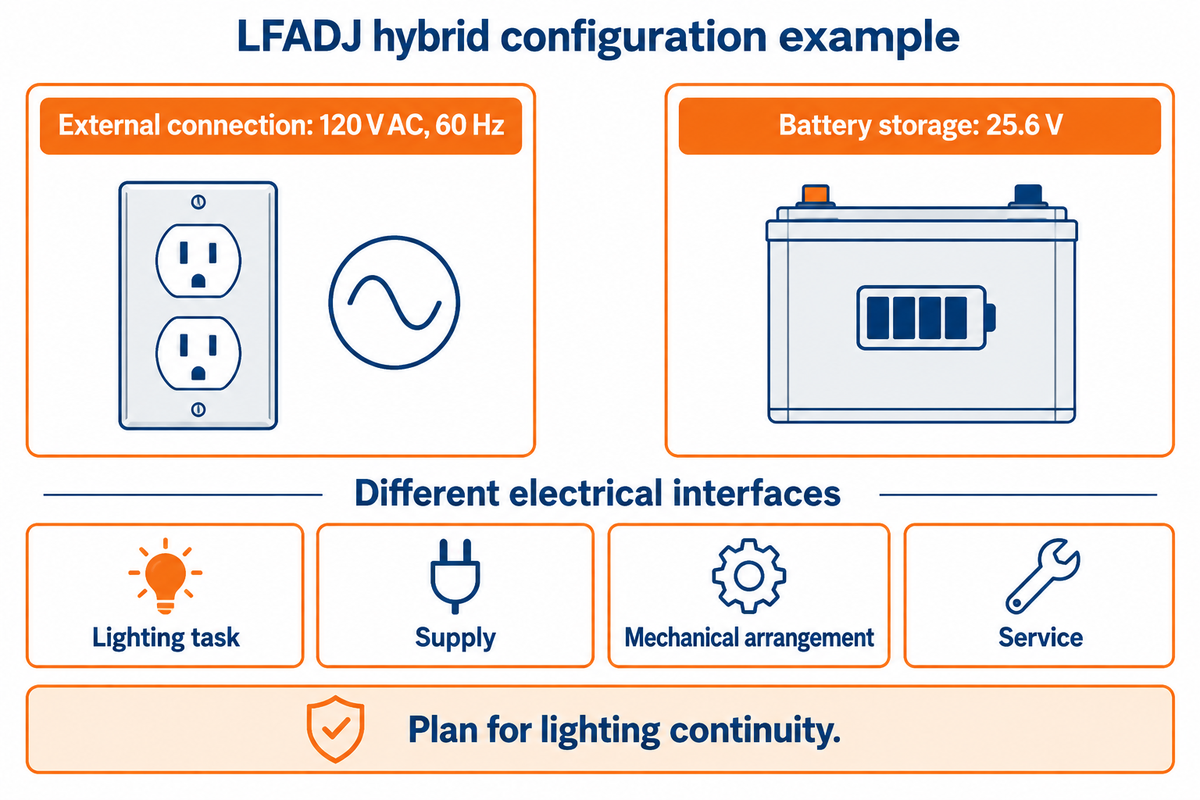
A feasible lighting specification joins the required view with a compatible power supply and a defined equipment configuration. External voltage, frequency and available current must match the connected equipment. Battery voltage defines a different part of the system. Positioning space, transport access and maintenance access complete the installation requirements.
For example, LFADJ lists 120 V AC, 60 Hz for the external connection on a hybrid configuration, while its battery arrangement uses 25.6 V storage. Reversing those figures defines an incorrect electrical interface. Continuous operation also needs a plan for refueling or charging that preserves lighting when the primary unit is unavailable. LED light towers for construction may use the same lamp technology, but require different power connections. Reliable illumination across a shift requires matching that supply arrangement to the scheduled operating hours.
Emergency lighting has its own function. The construction site lighting advice of the Health and Safety Executive addresses backup lighting, where a failure of normal lighting creates a dangerous situation, including escape routes. A tower used in disaster relief or rescue operations isn’t necessarily the independent emergency lighting provision for the site.
Information to include in a configuration enquiry
- Lighting task: State the working surface, occupied area and applicable illuminance criteria. Request photometry with mounting height, aim and dimming settings.
- Supply: Confirm the external electrical requirements, charging options and auxiliary loads. Keep battery ratings separate from input ratings.
- Mechanical arrangement: Identify the lift version, transport mass and dimensions, deployed footprint, and the operating limits in its manual.
- Service: Request the inspection schedule, parts information and agreed support scope for the destination.
LFADJ, the lighting brand of Zhejiang LONGFA Lighting Co., Ltd., offers project-specific configuration discussions and industrial lighting. Its Mobile Light Towers solutions page helps choose a model for a project. A lighting solution for a temporary yard and one for a hard-to-reach maintenance point can use different equipment even if both are described as industrial mobile lighting.
Frequently Asked Questions
What does it cost to rent or buy a mobile light tower?
One published rental price guide puts a light tower at $60–$200 per day in 2026; compare rental or purchase quotes for the same configuration and operating period. The total payable is affected by transport, charging or fuel, and service costs. For a long project, the same guide puts weekly rates at roughly 3–4× the day rate, not 7×, and monthly rates at the best value per day. For purchase, the required lamp output and lift arrangement should be fixed before comparing offers. The portable light towers buying guide provides further details for commercial comparison.
How quickly are mobile light towers deployable?
Deployment includes setting up, positioning, stabilizing, raising and aiming plus checks as required in the model instruction. Quoted time for lifting covers only a part of this work. Rapid deployment also requires clear access and a suitable position already identified. Use of a hydraulic lift would alter the raising operation, while an external electric model still requires its supply connection. Therefore, portable LED light towers have no single setup time across all configurations.
Can a mobile light tower be customized?
Suppliers can customize supported configurations, including lamp arrangements, charging options and controls. LFADJ can offer technical discussions on the application and operating requirements. Selected components must work together as a complete assembly. Changing lamp heads can change photometric distribution; adding an auxiliary load can change energy requirements. The final configuration needs its own agreed specification and instruction.
How many light towers do I need for a 1,000 m² site?
Site area alone won’t give a tower count; on US construction sites, size the count to hold at least the 5 foot-candles OSHA requires for general construction area lighting. Use photometry for the required task plane, including obstructions, minimum illuminance and overlap between units. Division of area by advertised coverage doesn’t account for these conditions.
Can light towers operate in extreme weather?
The limits of operation are determined by the model’s stated wind, temperature and weather conditions and the deployed configuration. A weather-resistant enclosure doesn’t set the wind limit of an extended mast. Batteries and other equipment have temperature limits. Harsh conditions can obstruct solar charging, and change ground support. Use the specified shutdown and lowering procedure when operation limits are reached. Don’t transfer wind limits from another tower, or use an improvised lowering procedure. For emergency response, the lighting plan should include an alternative when weather prevents the primary equipment from operating.
References & Sources
- Light-tower job aid U.S. Forest Service, Greening Fire Team.
- Lux, entry 17-21-085 International Commission on Illumination, International Lighting Vocabulary, 2020.
- NIST Measurement Services: Photometric Calibrations National Institute of Standards and Technology, 2018.
- Light-tower electrocution investigation, NYFACE 12NY018 New York State Department of Health, summary archived by the Centers for Disease Control and Prevention.
- Lighting Ergonomics: Survey and Solutions Canadian Centre for Occupational Health and Safety.
- Workplace transport: Lighting Health and Safety Executive.
- Carbon monoxide guidance National Institute for Occupational Safety and Health.
- Construction: Site lighting Health and Safety Executive.