
Get in touch with LFADJ Company

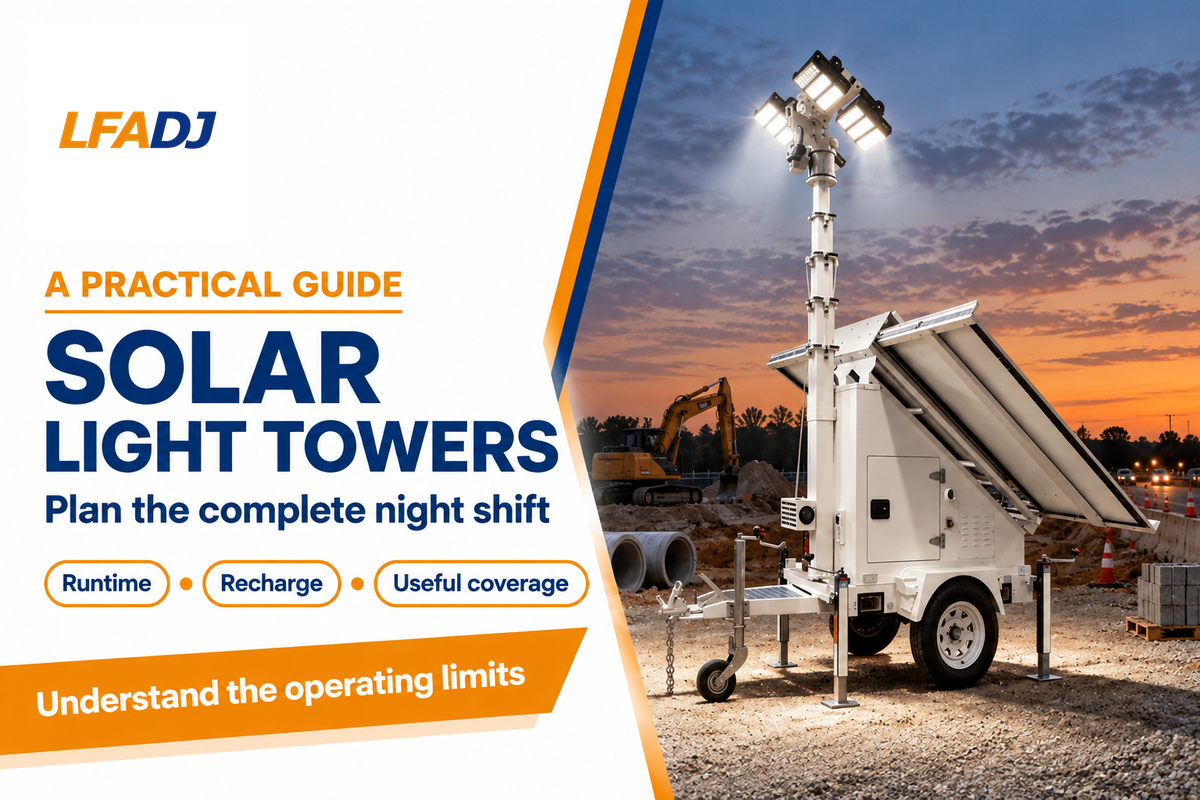
Solar Light Towers are portable lighting systems made up of photovoltaic panels, battery storage and one or more elevated lamps. These units can provide temporary lighting without running a generator during solar-and-battery operation. For a solar-powered light tower, the key factors are adequate energy storage for the shift, sufficient sun to recharge the energy store, and sufficient illumination of the actual work area.
Updated: October 19, 2026.
This guide will explain these relationships, including a sample energy balance, a three-night reserve case, solar vs. diesel vs. externally charged battery vs. hybrid equipment. The guide will show that a long runtime or a large advertised coverage area can mean a critical requirement for the site is unmet.
The useful endpoint is a completed shift at the required illumination. A lamp that stays on by reducing brightness may extend the operation while leaving the shift short of the light required. Check the energy and lighting performance together.
How do solar light towers work?
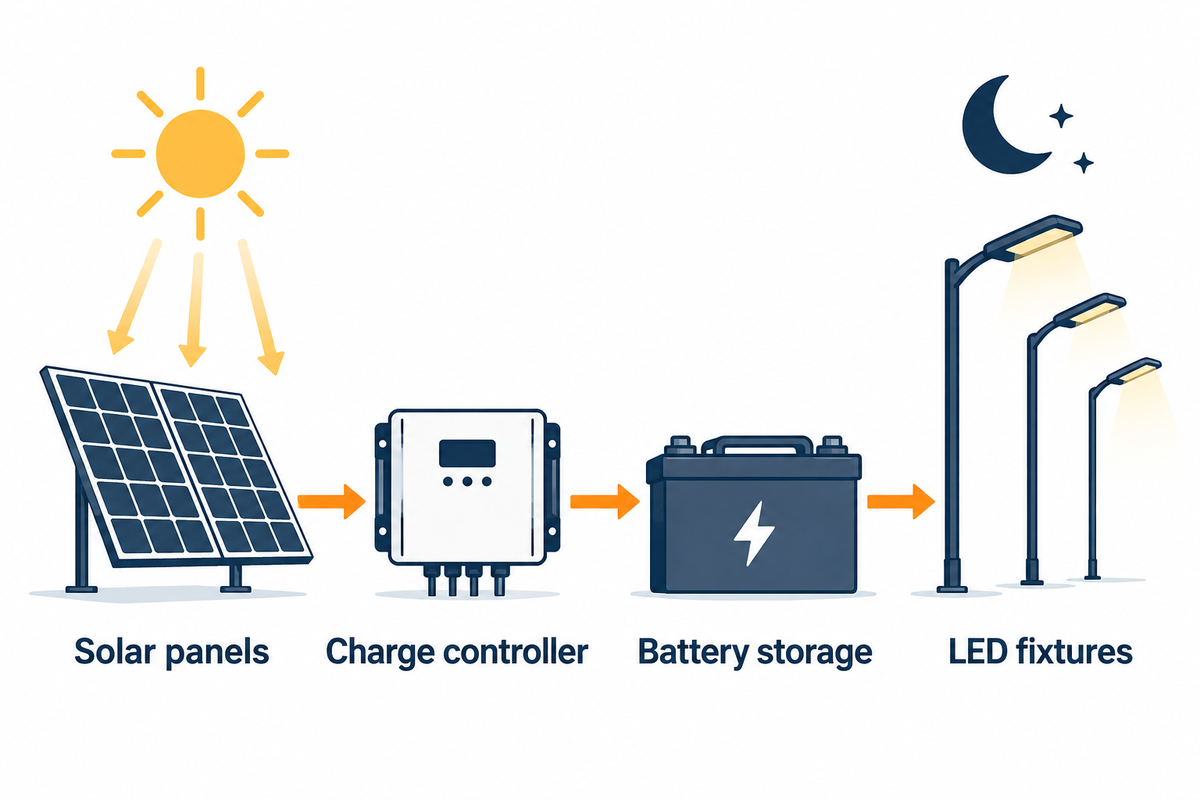
A solar light tower is a lighting system that uses photovoltaics to create electricity and stores energy in a rechargeable battery to supply LED fixtures. The mast raises and positions the lamps. A trailer or other mobile base makes the system relocatable. It doesn’t increase the available energy after sunset. Understanding the power path shows the benefits and limits.
During the day, solar panels feed a charge controller that limits charging to within the system’s operating limits. At night, battery power supplies the LED light through its driver and control system. An inverter is required only for the case where alternating current loads are present. It isn’t required for all direct current lighting circuits.
The US Department of Energy’s solar-and-storage explanation separates power and energy and shows storage losses. A panel rating in watts defines power under specified conditions. Battery energy in watt-hours defines a quantity over a period of time. Substituting one for the other yields a runtime estimate that isn’t valid.
Imagine a utility crew moving a portable solar light tower between two compounds. In the first compound, the arrays are pointed toward the sky. In the second compound, a building blocks the arrays in the afternoons. The crews aren’t changing battery or lamp units, but are changing the daily energy supply. Determining the new parking position is deployment, not an optional efficiency adjustment.
A fixed solar street light is designed for the location where it’s placed. If that location changes, a mobile solar light tower must be reassessed. The greater mobile light tower range incorporates different power arrangements because temporary lighting changes with the site.
Battery capacity and nightly energy demand
For a steady mode, the runtime is the available battery energy divided by the total battery-side power. The discharge limit, temperature, age, and electrical losses also affect the available battery energy. The nominal capacity of a solar-charged battery is a starting point. Define the boundaries for the above factors and then compare runtimes.
How many hours do light towers last?
Runtime is quoted per model and lighting mode; one rental listing for a skid-mounted LED solar tower quotes up to 40 hours of runtime between charges. For battery-powered units, useable watt-hours divided by total battery-side watts gives the runtime for a steady-state configuration. For a changing schedule, the energy demand for each mode must be added. Diesel-powered units rely on fuel and load, while a hybrid light tower unit can change between power sources.
Nominal battery energy is measured in volts × amp-hours = watt-hours. Amp-hours without including the bank voltage are incomplete. A manufacturer’s given figure for usable energy may include its discharge floor; applying that floor again would result in an understatement of capacity.
The American Solar Energy Society’s explanation of electrical units differentiates watts and watt-hours. Consider that relationship and the usable capacity and losses of a given tower.
A shift calculation with declared inputs
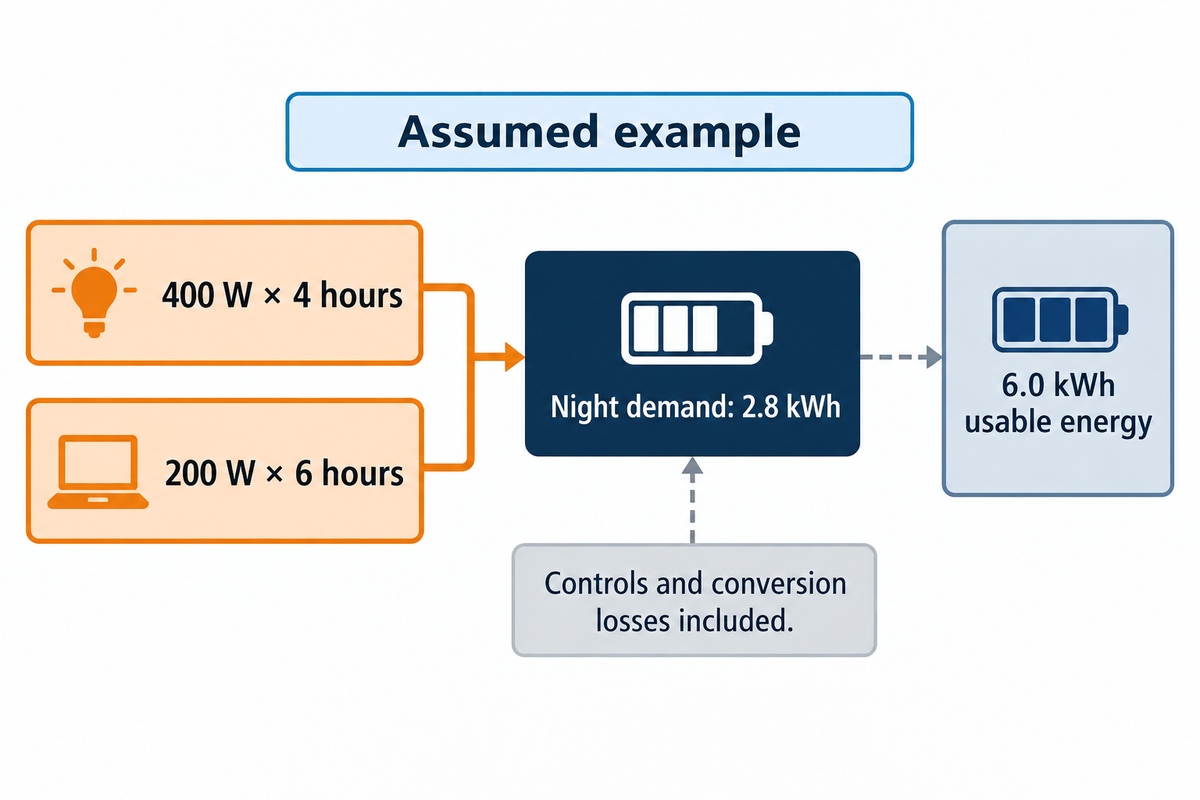
Suppose a configuration has 6.0 kWh of usable battery energy above its discharge floor. During a ten-hour shift, 400 W are drawn for the first four hours, and then 200 W are drawn for the last six hours. Both figures are total battery-side demand in the selected modes, including nighttime controls and conversion losses.
Night demand = (400 W × 4 hours) + (200 W × 6 hours) = 2,800 Wh, or 2.8 kWh.
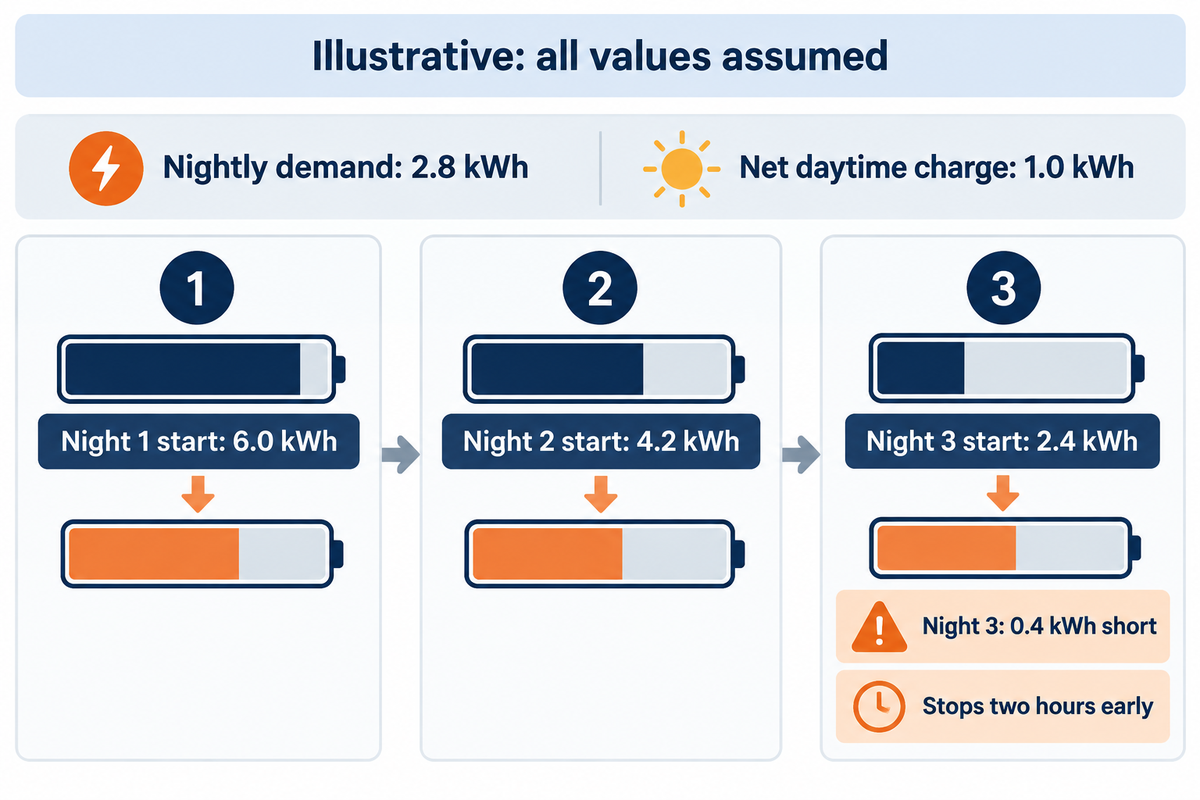
The first shift fits within the assumed usable capacity, leaving 3.2 kWh. If each day adds only 1.0 kWh net, the ledger below shows the third shift stopping two hours short. Nor does it establish that either lighting mode meets the task’s required light level.
Compare actual data for full brightness with each dimmed setting, individually. Include cameras, communications equipment and other auxiliary loads if installed. A 200W lamp label alone doesn’t account for the rest of the electrical demand; it isn’t interchangeable with the 200 W total-system mode assumed in the case study.
Solar recharge, winter weather and multi-night reserve
Battery autonomy and daily solar recharge answer different questions. Autonomy asks how long stored energy can support a specified duty without replenishment. Recharge asks whether the array can replace the energy consumed before the next shift. A battery can conceal an energy deficit for several nights, but it can’t remove a persistent energy shortfall.
Day length and equivalent full-power solar hours aren’t the same. Other factors impact the actual power harvest, e.g. orientation of the panels, shade, dirt, limits on charging, and weather conditions. One shouldn’t assume a clear day will fully charge a partly depleted bank. When solar panels charge the bank, take into account the location and working season, then separate gross generation from net energy after daytime loads and losses.
The 3-Night Energy Ledger
Keep the fictional 6.0 kWh usable start and 2.8 kWh nightly duty. Now assume each intervening day adds only 1.0 kWh net to storage. Daytime auxiliary demand and charging losses have already been deducted from that addition. The following sequence starts immediately before Night 1.
| Shift | Usable start | Required | After shift | Next day’s net charge | Result |
|---|---|---|---|---|---|
| Night 1 | 6.0 kWh | 2.8 kWh | 3.2 kWh | 1.0 kWh | Complete; next start 4.2 kWh |
| Night 2 | 4.2 kWh | 2.8 kWh | 1.4 kWh | 1.0 kWh | Complete; next start 2.4 kWh |
| Night 3 | 2.4 kWh | 2.8 kWh | 0.0 kWh after partial shift | Not needed to assess this shift | Incomplete: 0.4 kWh short |
Under the stated schedule, the third night consumes 1.6 kWh in its first four hours. The remaining 0.8 kWh supports another four hours at 200 W. It therefore stops two hours before completing the ten-hour duty. The permitted battery reserve isn’t available to cover the gap.
This ledger allows the determination of a backup trigger; the inputs behind a runtime claim can be requested. Finance can include the costs of restoring battery charge. Daytime energy should only be added after the previous night. Limit stored energy to the usable storage capacity. Carry the remaining net energy into the next day. A simple average of three days loses the day when service failed.
This example doesn’t compute failure probability. See PVWatts’ interpretation guidance for information about monthly and annual typical-weather outputs. Long-term performance is best described by outputs over a longer period of time. A critical remote deployment needs chronological low-harvest conditions, starting charge, recovery time and backup access assessed together. One average day can’t describe operation for the entire season.
Lighting coverage, lumens and glare
Useful coverage is the area meeting a stated illumination requirement under a particular arrangement of lamps, mast height and aiming. Lumens describe the light emitted; lux and foot-candles describe the light that falls on a surface. Lighting large areas requires a layout; check minimum task illumination, uniformity and glare on that layout and by site measurement, not from electrical watts or total lumen output.
“Different activities require different levels of light.”
Refer to OSHA 29 CFR 1926.56, Table D-3, for different levels of illumination for various types of covered US construction work. It includes 5 foot-candles for general construction area lighting and a separate 3-foot-candle row for listed activities such as concrete placement and excavation. Lower in the same table, three foot-candles of illumination is provided for specific construction activities (i.e. Concrete placement and excavation work). If the activity you’re performing is listed, identify the applicable illumination and project requirements. Size coverage to that foot-candle value, not to an area claimed at a lower light level.
It’s possible that a crew has enough light underneath the tower while a truck casts a shadow across the repair point. Moving the mast to 20 feet or aiming brighter light at the truck doesn’t resolve that obstruction by itself. Adjusting or using a different light distribution may be necessary. The Federal Highway Administration’s nighttime work-zone checklist also separates task lighting from disabling glare for approaching drivers, flaggers and workers. Check all relevant viewpoints after final aiming.
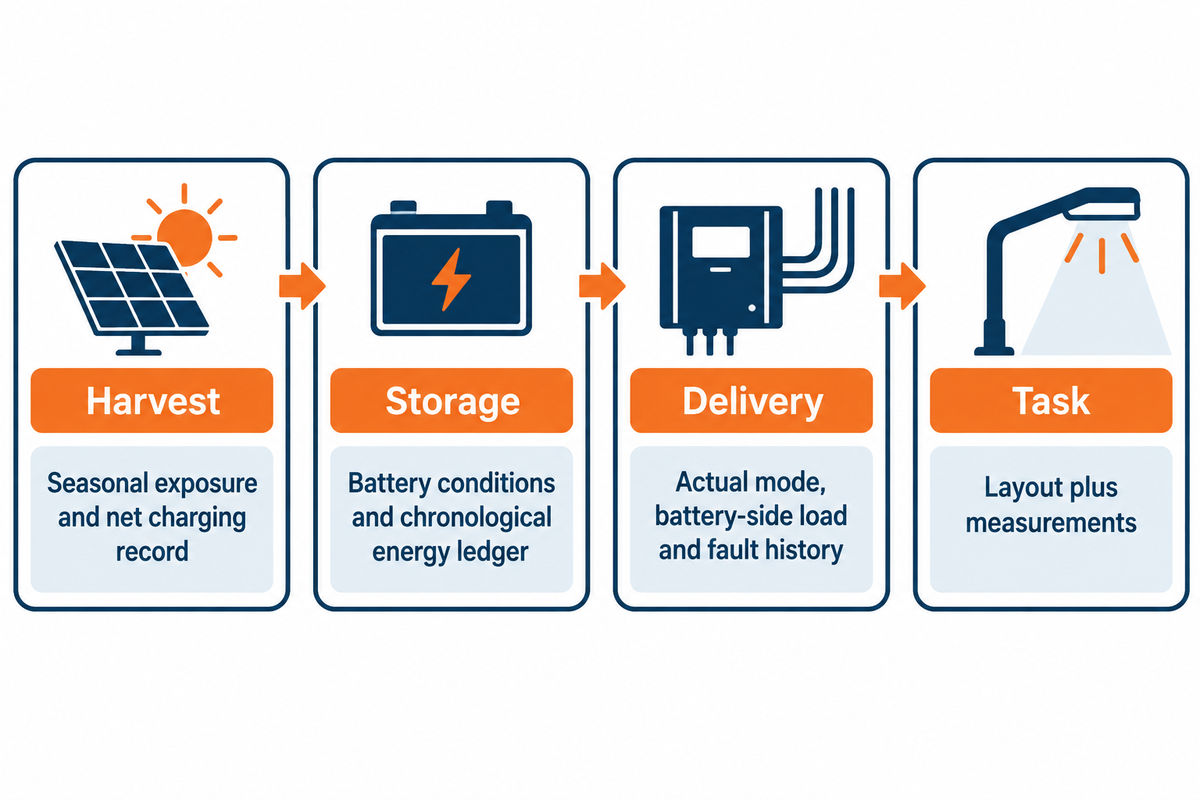
Sunlight-to-task bottleneck map
| Stage | Possible bottleneck | Evidence to collect |
|---|---|---|
| Harvest | Shaded array cannot replace daily demand | Seasonal exposure and net charging record |
| Storage | Usable energy reaches its permitted floor | Battery conditions and chronological energy ledger |
| Delivery | Controller reduces output or a lamp is unavailable | Actual mode, battery-side load and fault history |
| Task | Light misses the work plane or creates glare | Layout plus measurements at the required operating condition |
Electrical engineer Johnson Philip’s signed feature on solar street-lighting design states that low battery dimming reduces light output. A fixed lighting example is useful here: trying to extend operating hours by dimming can create a lighting bottleneck. Increasing battery size will not correct a poorly aimed fixture, and a brighter fixture increases the energy duty that must be checked.
Applications and deployment constraints
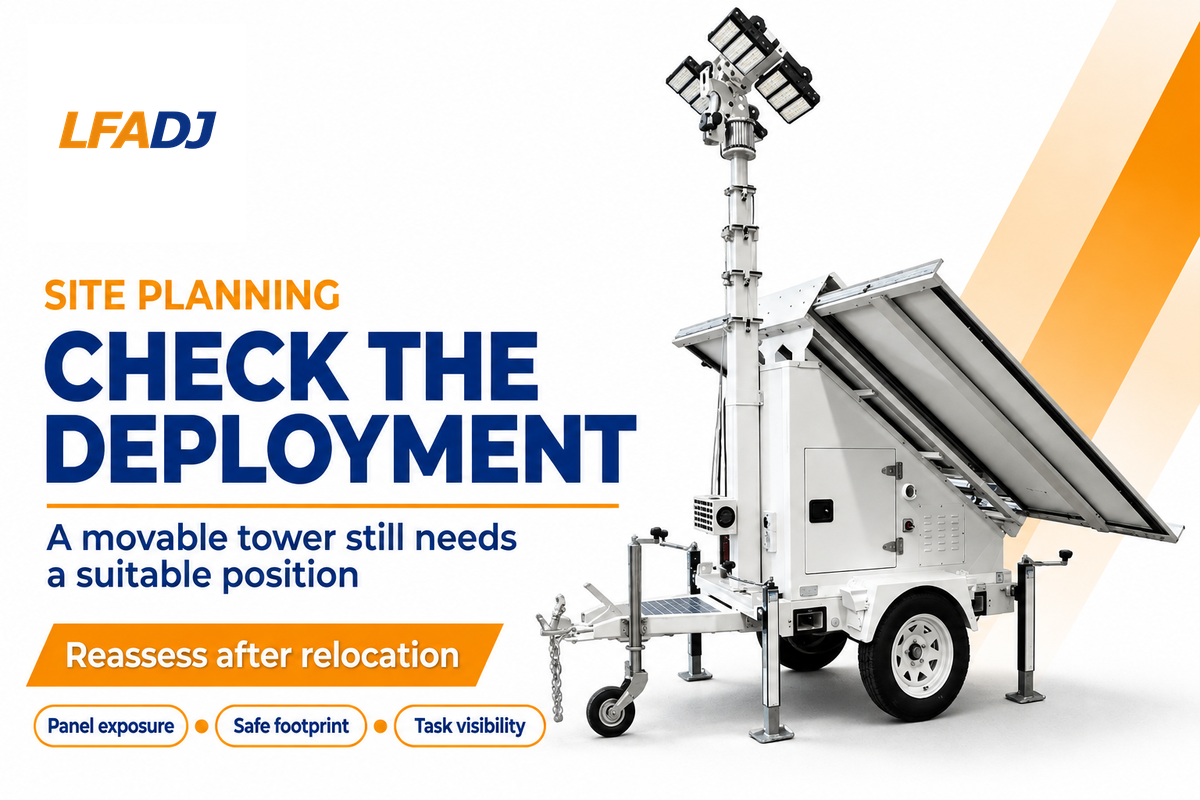
Portable solar lighting fits temporary sites where suitable exposure, an acceptable night load and a safe deployment footprint can be maintained. It becomes increasingly difficult to use where adequate space can’t be maintained or the required service can’t tolerate a charging shortfall. Assess the application before deciding that a towable unit will resolve a lighting problem.
| Application category | First constraint to resolve |
|---|---|
| Roadworks | Worker visibility and approaching-driver glare |
| Building sites | Changing structures, shadows and task locations |
| Utility repairs | Access, overhead clearances and critical work duration |
| Quarries | Dust, vehicle routes and uneven ground |
| Remote compounds | Poor-weather reserve and service access |
| Temporary parking | Low-light pedestrian routes, spill light and obstructions |
| Outdoor events | Crowd routes, quiet periods and backup arrangements |
| Industrial maintenance | Detailed tasks and applicable area classification |
| Emergency staging | Starting charge, access and uncertain operating hours |
Think of a construction site with a single towable solar unit next to a materials yard. The first parking position provides good exposure and the crew records a satisfactory lighting layout. A week later, containers are placed next to the trailer and the work area moves behind them. The equipment faces two challenges: afternoon shade reduces charging and the containers block the lamps. A bigger battery might postpone the energy shortage, but it would do nothing about the blockage. The supervisor must reassess the deployed footprint, exposure of the panels and the position of lamps, then take the relevant measurements. Portability helps only if an alternative position is available where the access is safe.
Before moving equipment to the deployed position, take the transport position, outrigger and panels into account. Verify ground support, and the model’s wind limit, as well as overhead and other clearances, and approved procedures before the mast begins to telescope. Use the specified hitch, towing and transport instructions. Equipment designed for normal sites isn’t automatically safe for use in an explosive environment.
The Federal Highway Administration’s Work-Zone Checklists include positioning of equipment and access for pedestrians. The workable lighting position must consider the surrounding operation as well as the trailer itself.
When planning an application, compare the constraints in Construction and Roadwork lighting with the frequent transportation and inspection needs of Rental fleet lighting deployments.
Solar, diesel, battery and hybrid light towers
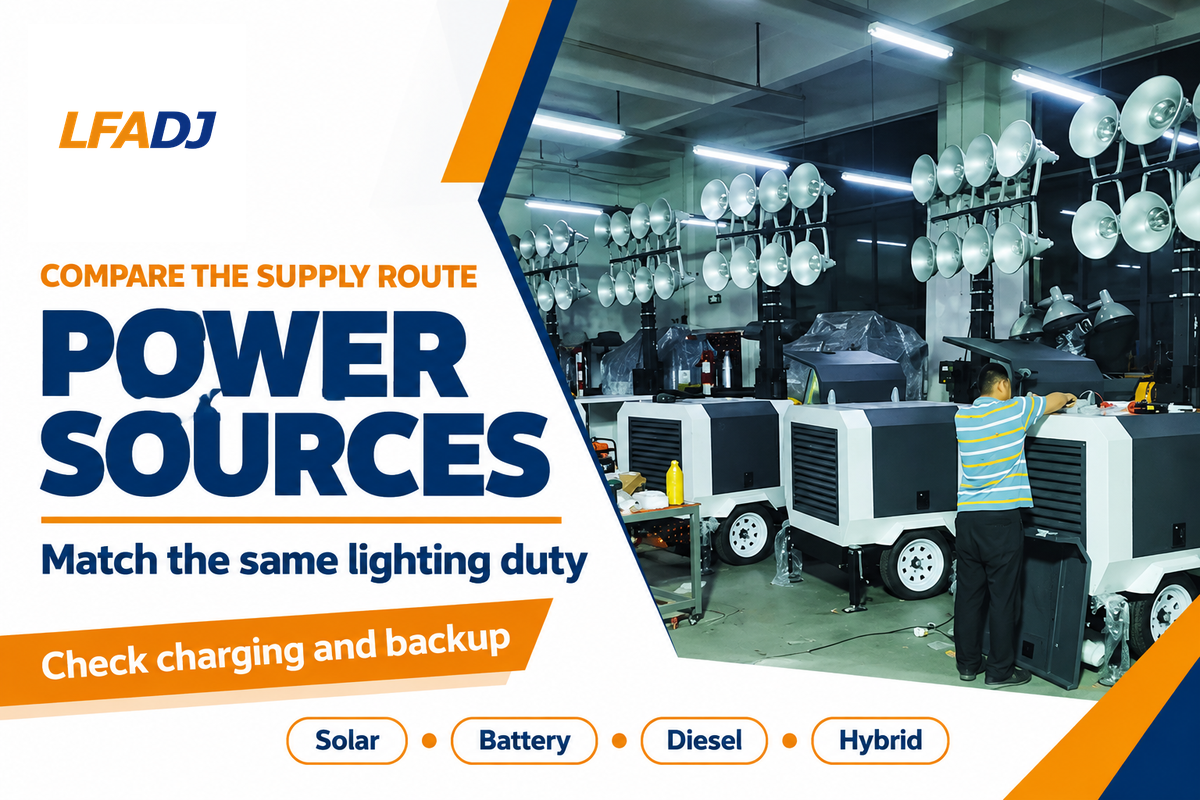
Compare power sources to the same useful lighting duty and availability requirement. Solar adds on-site renewable generation; an externally charged battery tower carries stored energy; diesel generates electricity from delivered fuel; a hybrid combines sources under its own control strategy. The right comparison includes the supply route and backup, not just the presence of solar panels.
| Arrangement | Planning advantage | Dependency to check |
|---|---|---|
| Solar and battery | Lighting without an on-unit combustion engine during this mode | Working-season harvest and reserve recovery |
| Externally charged battery | Local operation independent of on-site sunlight | Charging access, turnaround and transport |
| Diesel lighting equipment | Generation can continue with sufficient fuel and servicing | Refueling, exhaust placement, noise and engine maintenance |
| Hybrid tower configurations | Additional supply can support a changing duty | Backup capacity, start settings and source availability |
A national-laboratory report on US Forest Service fire camps mentions both solar light towers and hybrid towers with backup diesel generation. This is a deployment case, not evidence that one always outperforms the other. Remote locations still need load analysis and supply planning.
For a fleet, ask who can restore service after a bad charging day. An available charging point, spare unit or supported hybrid configuration may matter more than a higher panel rating. Consider light tower rentals the same way. Efficient lighting reduces demand, but can’t make an inadequate energy supply unlimited.
Cost drivers over the operating period
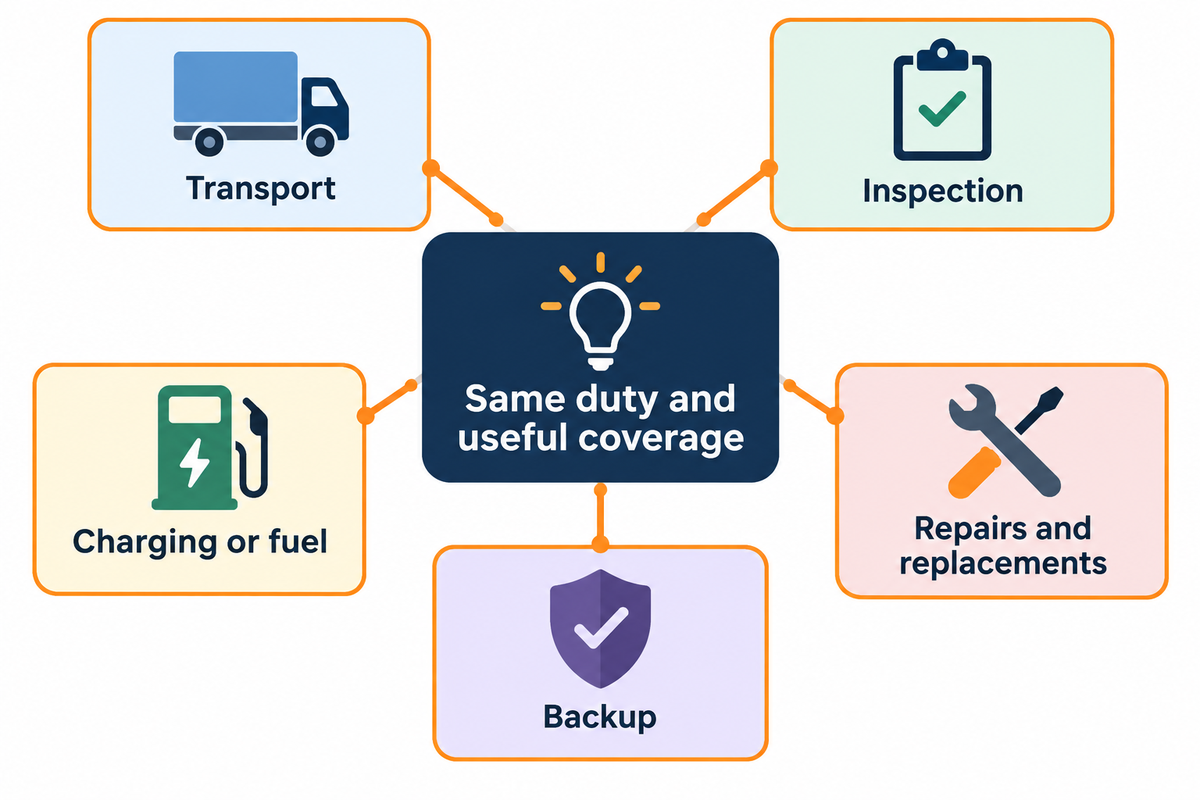
Total cost of ownership accounts for the cost of providing the required lighting service over a specific period. The price or rental of the unit alone doesn’t account for transport, inspection, charging or fuel, repairs and replacements, and backup. A less expensive power source is useful only if the complete configuration meets the same duty, useful coverage and availability as the alternative.
An archived 2021 New York City Housing Authority light-tower solicitation asked vendors to include fuel/refueling, mobilization, demobilization, maintenance, repairs, and security in their proposals. It gives a practical cost boundary, not a list price. The storage-cost methodology of the Department of Energy includes charging and replacement of equipment; the prices of grid-storage aren’t Mobile-lighting prices.
An assumed break-even check
If a solar package costs an assumed $600 more initially and saves an assumed $12 per completed equivalent night after routine operating costs, the simple break-even point is $600 ÷ $12 = 50 nights. This calculation excludes financing, unequal residual values and any unbudgeted backup or replacement.
For a 20-night assignment, those assumed operating savings total $240, leaving $360 of the initial difference unrecovered. Assume a longer assignment and accept the result only after considering what is included in the service and replacement schedule. These are teaching case inputs, not promised savings or quotations.
The case illustrates that an event planner anticipating equipment reuse may take into account several venues. The finance team initially counts every planned night toward that assumed 50-night break-even point. The operations team finds a shaded venue requiring external charging and delivery/collection are charged separately. These costs may shift the break-even point beyond the planned program. The right answer is to rebalance the same-duty case, not to promise a solar payback. Record the case inputs: which package includes each service, the number of completed lighting shifts, and what happens if a venue can’t support normal charging. This helps to evaluate Mobile-lighting for recurring infrastructure projects and event applications.
Adjust for the number of towers required by the lighting layout. One unit of solar and one unit of diesel aren’t automatically the same service. Include maintenance costs and the value of a missed shift when comparing renewable energy with traditional power sources.
Operation, maintenance and troubleshooting
Solar lighting systems still require inspection and maintenance. Keep the array exposed and clean. Check the structure and accessible electrical connections. Monitor charging and the condition of the battery. The correct maintenance requirements depend on the actual model, battery chemistry and environment. A sealed battery doesn’t eliminate maintenance on the trailer, mast, lights and wiring.
The American Solar Energy Society’s system guide identifies the routine maintenance as cleaning the panels. Use the instructions provided by the manufacturer of the tower to determine an adequate service and maintenance schedule.
Why are solar light towers not working properly?
Start with dividing the problem into three cases: A charging shortage, an operating-setting problem, and a component fault. Compare the selected schedule, the state of the battery, and the recent charging cycle before swapping components. A tower that switches off early due to bad weather is a different case from a tower with all lamps working normally, except for one that’s dark.
At shift handover, record starting state, the chosen lighting mode and any fault indication. If runtime decreases, compare recent net charging to the agreed runtime requirements and check energy consumption for issues. If one area appears dark, check individual lamp operation rather than assume battery capacity is the only issue.
- For reduced runtime, look for schedule changes, added loads, reduced harvest, and battery condition.
- For low charging, look for shading, condition of the panels, and controller indications.
- Check for a programmed energy saving mode, if the model has such a feature, to debug unexpected dimming.
- For uneven illumination, look for aiming issues, obstructions and unavailable fixtures.
Battery charging temperature limits, mast wind limits, and replacement intervals are model-specific. Don’t defeat a protective cutoff to finish a shift. Follow the specified isolation and service procedure for electrical work. Arrange suitable lighting while a fault is assessed.
Industry Outlook: Test Reports and Site Validation
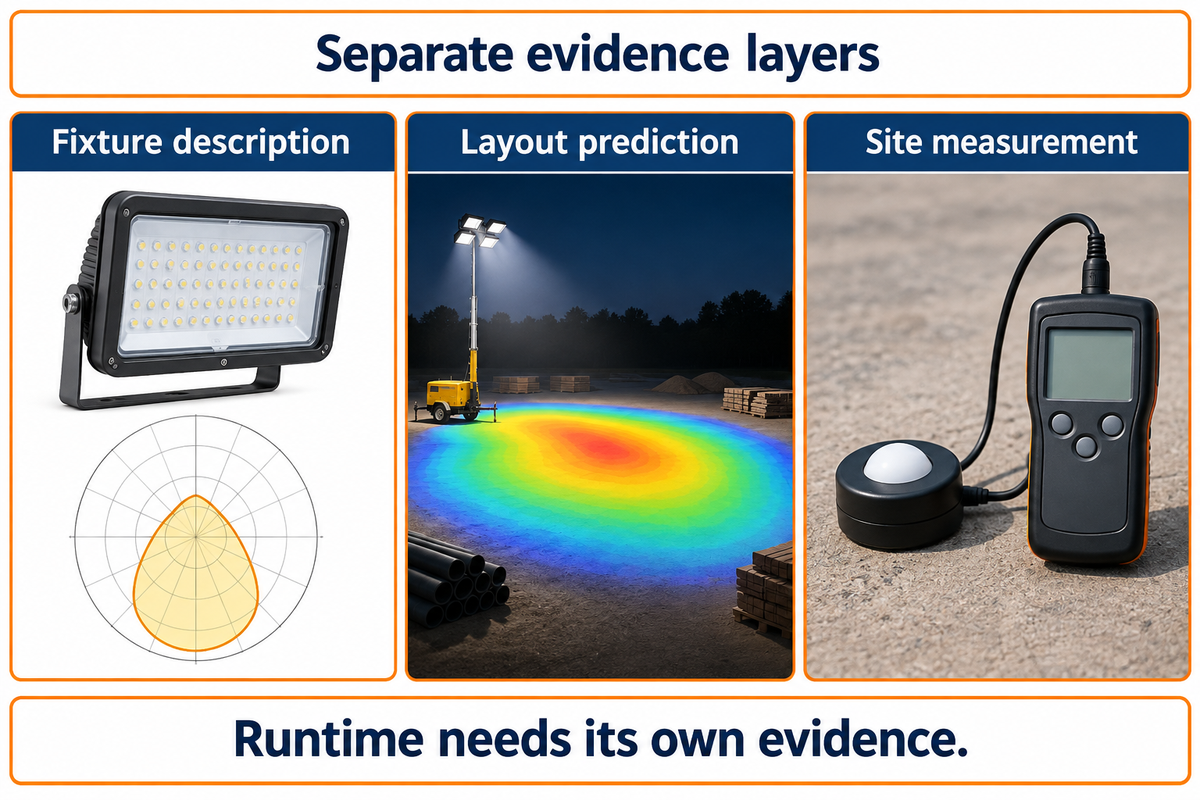
Better controls and efficient lamps make configuration details important for comparison. A programmable mode can alter the energy demand. Evaluate the provided operating mode and supporting documents. Different optics can change where the light lands. Ask for the proposed unit’s own spec sheet and operating mode, which define its configuration, instead of relying on feature descriptions.
The Illuminating Engineering Society’s public listing for ANSI/IES LM-79-24 describes the 2024 evaluation methodology for solid-state lighting products. It evaluates optical and electrical quantities under standard conditions. The report must be evaluated for the version tested and the identity of the fixture. An LM-79 report by itself is not evidence of a battery-runtime test or a battery-operated site’s compliance with illumination.
Keep the illumination evidence in three separate layers. The first is a description of the fixture. The second predicts illumination for an arrangement. The third is a site measurement of what’s delivered by the installed arrangement. Request the spec sheet, usable battery-energy conditions, operating mode, schedule and charging assumptions along with the layout and model-specific instructions.
For acceptability, record the actual starting battery charge and lamp setting and record observation locations at the operating condition the project must support. Repeat the relevant lighting checks for dimming that may occur at the end of the shift. Procurement needs a clearly defined deliverable, operations needs a backup, and finance needs to validate the service boundary and cost.
Once the project and site constraints are defined, take that to LFADJ’s solar configuration options. Zhejiang LONGFA Lighting Co., Ltd. has mobile and industrial lighting solutions. Align the configuration and agreed scope of service to the project, rather than transferring specifications from a different tower.
Frequently Asked Questions
What is a portable solar light tower?
A portable solar light tower is a relocatable lighting assembly with photovoltaic generation, battery storage, and elevated lamps. The base allows for temporary deployment, and the electrical system stores daytime energy for nighttime use. Compared to a fixed solar streetlight, exposure, layout, and operating duty of a portable solar light tower can be changed whenever it’s moved.
Are solar light towers worth it?
Solar light towers can be worth it when the site charges reliably and the assignment is long enough to recover the higher initial cost: in this guide’s assumed case, a $600 premium saving $12 per night breaks even at 50 nights. Compare the total costs of rental or purchase, transportation, inspection, charging, replacement, and backup over the same period. Avoided fuel alone doesn’t establish a total cost saving. Total cost should also include the number of units needed to provide equivalent coverage and the cost of restoring an interrupted shift. A short assignment may not recover a higher initial package cost.
What factors should be considered when selecting a towable solar light tower?
Start with the required task illumination, operating hours, and working season. Consider usable battery energy, exposure of the array, charging assumptions, deployed footprint, and backup access. Adjust the lighting layout and actual operating mode to the requirements. Finally, consider transport, setup and service limitations of the proposed configuration. Confirm the quoted runtime uses the same lamp settings and auxiliary loads of your project. Also, confirm who will provide support when a battery or controller needs replacement.
How do towable solar light towers benefit outdoor event planners?
Towable solar light towers provide temporary lighting without an on-unit combustion engine during solar-and-battery operation. Planners still need to consider other constraints such as exposure of panels, protected set-up space, and pedestrian lighting, as well as backup for energy shortfall or fault during the agreed lighting period.
How much brightness can a towable solar light tower provide?
Brightness is set by the lamp package and mode, so size it to the task: for covered US construction work, OSHA Table D-3 lists 5 foot-candles for general construction area lighting and 3 for listed activities such as excavation. Lumen output describes lamps; illuminance describes light reaching the task surface. Request photometric data for the fixture and a layout (height, aiming, operating mode) and the minimum required light level. Useful coverage can’t be established for claimed areas without that threshold. Check the setup for shadows, uniformity and glare for drivers’ viewpoints. Check modes and outputs for reduced operation later in the shift, as well as the startup mode.
Are solar light towers safe?
Safe operation of a towable light tower depends on how the equipment is set up and operated. Follow the equipment instructions for ground support, mast operation, wind limits, electrical work, and transport. Solar power doesn’t address stability risks and doesn’t make lighting suitable for an explosive environment.
What features do towable solar light towers typically have?
The main components of the equipment are a mobile base, mast with LED lamps, a solar array, and battery storage with charging controls. Other components may be a timer, adjustable lighting modes, or remote monitoring. Confirm what’s supplied, as well as how these may affect energy consumption. Don’t assume that the equipment has backup energy generation, and don’t assume that the equipment has dimming capabilities. The spec sheet and the operating instructions should explain the features and equipment configuration. Optional equipment should appear in the supplied configuration and cost.
References & Sources
- Solar Integration: Solar Energy and Storage Basics US Department of Energy.
- Solar Electric Systems American Solar Energy Society; electrical-unit explanation.
- Cautions for Interpreting the Results PVWatts, National Laboratory of the Rockies.
- Lighting, thermal comfort, working space, noise and vibration UK Health and Safety Executive.
- 1926.56, Illumination US Occupational Safety and Health Administration.
- Sharing Work Zone Effective Practices for Design-Build Projects, Chapter 5 US Federal Highway Administration.
- Best practices for solar street lighting systems Johnson Philip, Buildings/LEDs Magazine, 2023.
- NREL Helps US Forest Service Go Green After 2024 Lake Fire national-laboratory field report, 2024.
- Portable Diesel/Solar Light Towers, Solicitation 145887-4 New York City Housing Authority, archived 2021 notice.
- 2022 Grid Energy Storage Technology Cost and Performance Assessment US Department of Energy; cost-category scope.
- ANSI/IES LM-79-24: Optical and Electrical Measurements of Solid State Lighting Products Illuminating Engineering Society, public publisher summary, 2024.