Get in touch with LFADJ Company

Last updated: November 2026 · Published by LFADJ (Zhejiang Longfa Lighting Co., Ltd.)
The best explosion proof lighting manufacturers are Eaton Crouse-Hinds for one LED family across regions, Emerson Appleton for Division 1 retrofits, Dialight for high-mount sites, R. STAHL for Zone 1 linear lighting, Larson Electronics for built-to-spec US fixtures, and LFADJ for single-unit evaluation orders. Read the marking first, then pick the maker.
Quick Picks
- Best for single-unit evaluation orders of portable and mobile Ex lights: LFADJ
- Best for one LED family certified for NEC, CEC and IEC locations: Eaton Crouse-Hinds
- Best for a Division 1 rating printed for all four gas groups: Warom Technology
- Best for built-to-spec or rented US fixtures: Larson Electronics
- Best for Zone 1 linear lighting in chemical plants: R. STAHL
- Best for marine and port floodlights rated for saltwater: Phoenix Lighting
Disclosure: This guide is published by LFADJ. We list ourselves first because this is our website, not because we claim to be the market leader. The other 19 manufacturers are grouped by region and company type, in no particular order within each group.
How We Selected These Explosion Proof Lighting Manufacturers
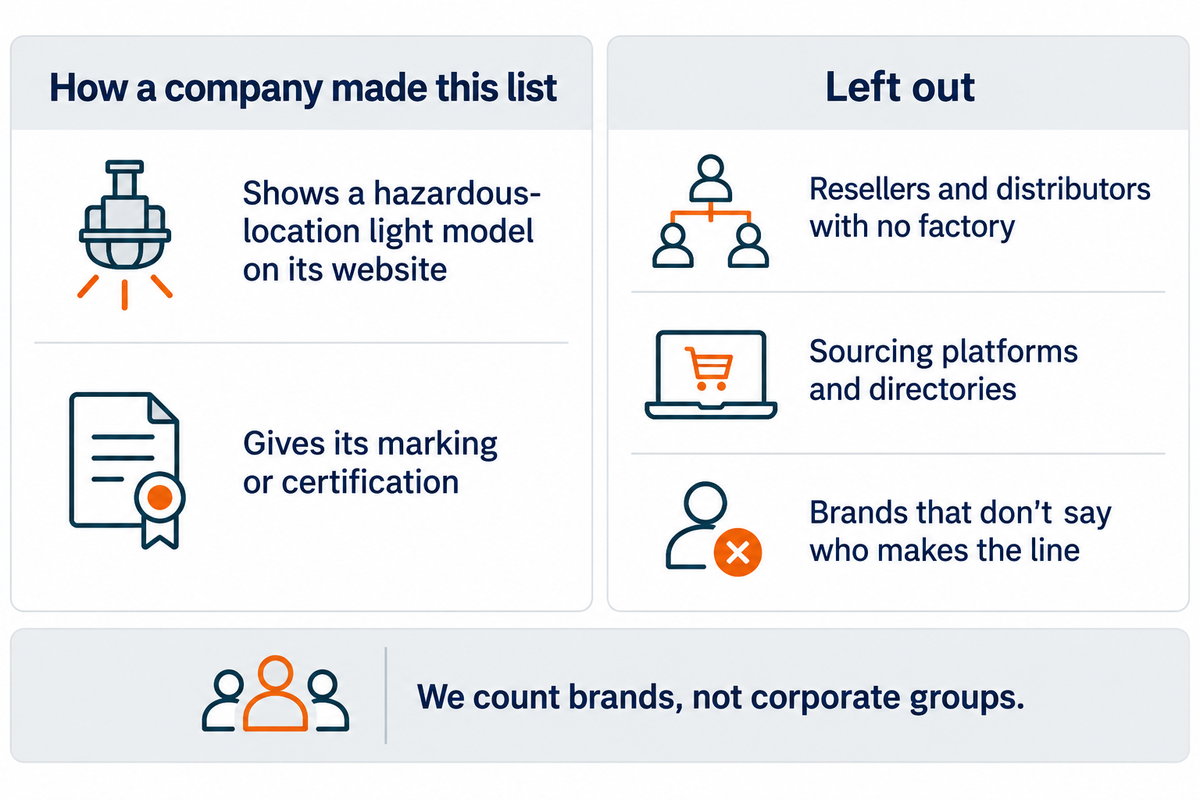
Each of the 20 companies had to display a hazardous-location light model with its marking or certification on its website. Resellers and distributors without their own design or factory, sourcing platforms and directories, and brands whose pages don’t say who makes the hazardous line were excluded. Company information was verified against official websites and public sources in November 2026.
We count market-facing brands, not corporate groups, so cards name a parent where one is on record: Killark and Chalmit belong to Hubbell, Cooper Lighting Solutions bought Nemalux in November 2025, and OPTEX invested in all of Raytec’s share capital in 2012. LEDVANCE was left out under the last exclusion above. Twenty names are a shortlist, not a census. Cortem Group also lists FLOWEX high bays and TIGER floodlights and is worth adding to a wider enquiry, while Unimar’s hazardous pages center on obstruction lighting, a different job. Mobile site lighting has its own list of light tower manufacturers.
Master Comparison Table of the Top 20 Explosion Proof Lighting Manufacturers (2026)
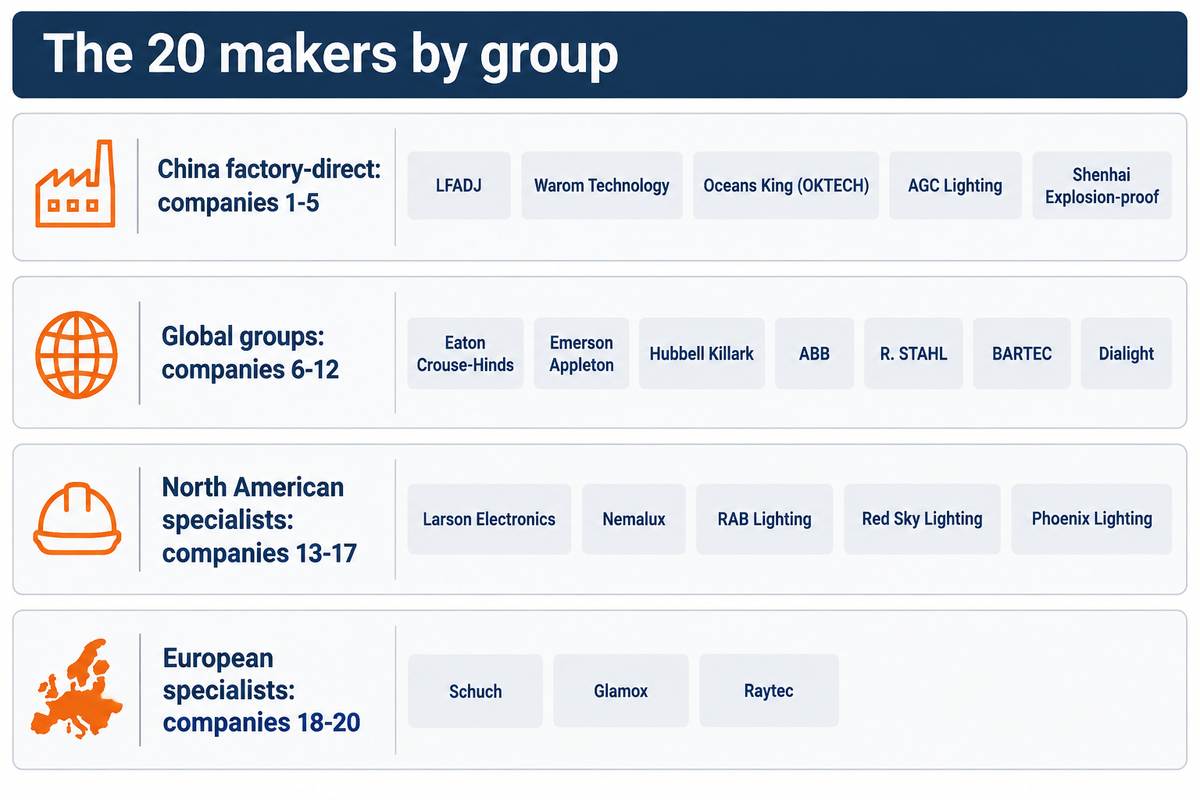
Each row names a model with its top rating, so you can make a short list of three to five makers for your oil and gas facilities or chemical plants and go directly to their cards. Hazardous location lighting and explosion proof LED lighting are sold by marking first and by lumen output second, so the Ex Model column does the heavy lifting. All 20 makers sell LED explosion proof lights, so older fluorescents and other conventional lighting aren’t listed in the table.
| No. | Company Name | Headquarters | Founded Year | Best For | Brief Introduction | Ex Model | Key Advantages | Potential Disadvantages | Official Website |
|---|---|---|---|---|---|---|---|---|---|
| 1 | LFADJ | Yueqing, China | 2013 | Single-unit portable and mobile Ex light orders | Zhejiang maker of mobile, portable and handheld emergency Ex lights | LF6129, 180 W, Ex eb ib mb IIC T5 Gb | 1-unit orders, samples at finished price | No ATEX, IECEx or US listing shown for LF6129; approvals vary by model | lfadjlight.com |
| 2 | Warom Technology | Shanghai, China | 1987 | Oil, gas and marine one-vendor Ex projects | Listed Shanghai group with Ex gear beyond lighting | HRD99, up to 100 W, Class I Division 1 Groups A-D | All four gas groups; 60+ agents | No North American listing shown; IIC ambient floor -20°C | www.waromgroup.com |
| 3 | Oceans King (OKTECH) | Shenzhen, China | 1995 | Zone 1 fittings with emergency battery | Shenzhen professional lighting maker, OKTECH brand | BFC8412, 50 W, Ex e mb IIC T4 Gb | Built-in emergency version; 100+ service centers | 50 W only; no Class/Division marking | www.oceansking.com |
| 4 | AGC Lighting | Shenzhen, China | 2014 | High-output Zone 2 and Division 2 floods | Shenzhen hazardous and industrial lighting factory with OEM service | HA04, 240 W, Class I Division 2 Groups A-D | 33,600 lm; TUV and CSA lab | Division 1 model stops at 70 W | www.agcled.com |
| 5 | Shenhai Explosion-proof | Yueqing, China | 2001 | IEC-scheme petrochemical Zone 1 and 21 projects | Yueqing explosion-proof lamp and apparatus maker | BED61, Zone 1, IIA to IIC, T1-T6 | One series across gas groups | No UL or Class/Division route shown | en.shenhaifb.com |
| 6 | Eaton Crouse-Hinds | Dublin, Ireland | 1897 | One LED family across NEC, CEC and IEC | Eaton’s hazardous-location series, begun in Syracuse | Champ VMVL, to 25,000 lm, IECEx UL 14.0031X | One LED family, NEC, CEC and IEC | All Champ VMVL models stop at Division 2 | www.eaton.com |
| 7 | Emerson Appleton | Rosemont, USA | 1903 | Retrofitting A-51 points in Division 1 | Appleton Group line sold under the Emerson name | A-51 LED, Class I Division 1 Groups C, D | No rewiring; 10-year warranty | Sold through authorized sales representatives | appleton.emerson.com |
| 8 | Hubbell Killark | Fenton, USA (Killark service address) | 1913 | Class/Division plus ATEX under one parent | Hubbell’s Killark and Chalmit hazardous brands | EML4030, 40 W, Class I Divisions 1 and 2 | Two brands, both systems; printed prices | EML4030 Groups C, D only; separate brand sites | www.hubbell.com/killark/en |
| 9 | ABB | Zurich, Switzerland | 1988 | Division 2 area and ATEX emergency lights | Global electrification group with the Hazlux brand | XSL3, to 20,100 lm, Class I Division 2 | ATEX emergency range since July 2024 | XSL3 stops at Division 2 and Zone 2 | new.abb.com/low-voltage/products/explosion-protective-components-systems |
| 10 | R. STAHL | Waldenburg, Germany | 1876 | Zone 1 linear lighting in chemical plants | German explosion-protection specialist with a Weimar luminaire plant | EXLUX 6002/4, Zone 1, IECEx and ATEX | 90% flux at 100,000 h; DALI | No UL or North American listing shown | r-stahl.com/en/global/home |
| 11 | BARTEC | Bad Mergentheim, Germany | 1975 | Offshore and refinery Zone 1 floods | German Ex specialist with 11 production sites | SFD, 179-245 W, Ex db IIB+H2 T6/T5/T4 Gb | Certificates on product page; other Ex lines | Not full IIC; 25 kg | bartec.com |
| 12 | Dialight | United Kingdom | 1938 | High-mount sites across UL 844 and ATEX | LSE-listed industrial LED lighting maker | SafeSite, family to 41,300 lm, UL 844 and Zone 1 by model | One high bay across both systems | T class not on family page; groups vary by certification code | www.dialight.com |
| 13 | Larson Electronics | Texas, USA | 1973 | Built-to-spec or rented Division 1 fixtures | Texas self-described manufacturer and certified panel shop | EPL-LED-100W-RT, 14,000 lm, Class I Division 1 | Custom builds, rentals, printed price | This model Groups C, D only; no ATEX or IECEx shown | www.larsonelectronics.com |
| 14 | Nemalux | Calgary, Canada | 2003 | Confined Division 1 spaces and well heads | Calgary hazardous-location LED maker, now under Cooper Lighting Solutions | EXC, 1,220 lm, Class I Division 1 Groups CD | Maker cites no conduit seals; 2,500 psi housing | Low output; Groups C, D only | nemalux.com |
| 15 | RAB Lighting | New York, USA | 1946 | Division 2 fixtures through distributors | US self-described lighting maker selling through distributors | HAZLED120WMCG, 16,346 lm, Class I Division 2 | Free layouts; three shipping docks | Distributor only; HAZLED120WMCG stops at Division 2 for gases | www.rablighting.com |
| 16 | Red Sky Lighting | Rancho Cucamonga, USA | 2017 | One Division 1 fixture across 80-150 W | California LED luminaire firm, self-described manufacturer | BLOCK H1, to 21,141 lm, Class I Division 1 | 146 lm/W; two-week target | Division 1 Groups C, D only | www.redskylighting.com |
| 17 | Phoenix Lighting | Milwaukee, USA | 1892 | Saltwater marine and port Division 1 floods | Milwaukee marine and industrial lighting maker | DFN2, to 28,000 lm, Class I Division 1 | Saltwater rating; Group B; 24-hour ship list | ABS pending; 200 W limited to 45°C | www.phoenixlighting.com |
| 18 | Schuch | Worms, Germany | 1895 | European Zone 1 refineries and tank farms | Family-run German luminaire maker, 5th generation | ExSTREAM, to 32,000 lm, Zone 1/21 | IEC working group chair; in-house production | No UL listing shown; -40°C optional | www.schuch.de/en |
| 19 | Glamox | Oslo, Norway | 1947 | Offshore fixtures with DNV options | Norwegian lighting group with marine and offshore lines | MAX G2, Zone 1/21, ATEX, IECEx, DNV | DNV mark; -50°C TX60 LED | MIX102953 is Zone 2 and 22 only | www.glamox.com |
| 20 | Raytec | Ashington, UK | — | UK and EU Zone 1 bay lighting | UK hazardous-area LED maker with OPTEX investment since 2012 | SPARTAN MPBY, Mid Power range, Zone 1 & 21 | 180-minute emergency; 5-year warranty | No Class/Division listing on this page | www.raytecled.com |
China Factory-Direct Explosion Proof Lighting Manufacturers (Companies 1–5)
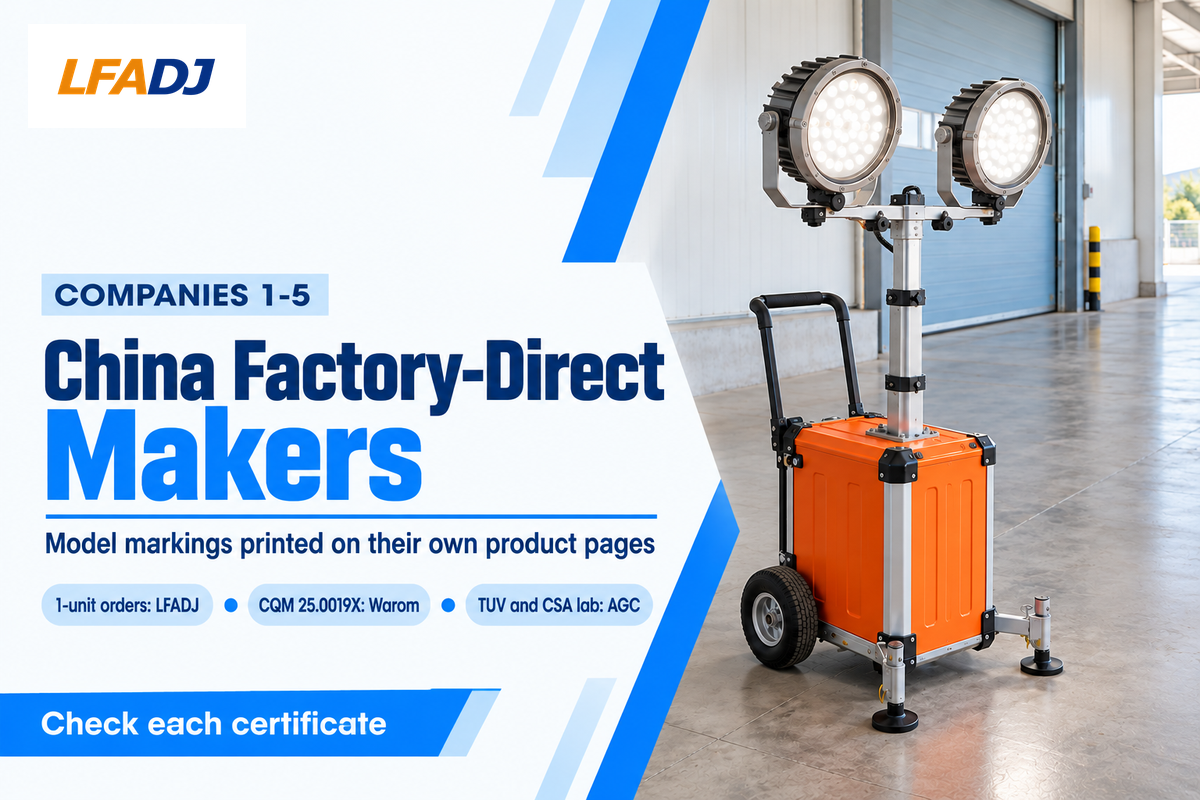
These five sell from factories in China and print model ratings on their product pages, and Warom and AGC show both the Class/Division and Zone systems. Warom, Oceans King, AGC and Shenhai all list ATEX and IECEx on their sites, and they suit export projects. Solutions for hazardous areas from this group come in different order sizes: LFADJ’s single-unit and project MOQ terms are below, so ask the other four directly.
1. LFADJ: Best for single-unit evaluation or replacement orders of portable and mobile Ex lights
Headquarters: Yueqing, Zhejiang, China · Founded: 2013 · Type: Manufacturer covering R&D, manufacturing, trade and service (LFADJ is the brand of Zhejiang Longfa Lighting Co., Ltd.)
Official website: lfadjlight.com
Main products: Mobile lighting systems, lifting lighting devices, explosion-proof panoramic lighting, portable work lights and emergency lighting equipment
Ex model and specs: LF6129 mobile system: 180 W, 600 lx at 10 m, 4 m height, IP66, marked Ex eb ib mb IIC T5 Gb and Ex ib mb tb IIIC T95°C Db. LF2530 search light: 36 W high mode for 5 h, IP65, 1.2 kg, marked Ex nR IIC T6 Gc and Ex tb IIIC T80°C Db. LF7623 flashlight: 3 W, IP66, marked Ex ib IIC T4 Gb (all figures published by LFADJ)
Certifications / notable work: ISO 9001:2015, ISO 14001:2015 and ISO 45001:2018 for the management system, not product approval; domestic explosion-proof certificates for some portable and panoramic lighting products; a 2018 Panjin municipal-government procurement contract in our project list
We accept orders from 1 unit on our explosion proof lighting and portable explosion proof lights pages, price samples the same as finished products, and ask for a 50% deposit. That suits a plant that wants to try one light or replace one before a wider purchase, and the LF6129 page states no minimum, so confirm it in your quote. Cutting, bending and welding run in-house, and the LF6129 is listed on our fixed explosion proof LED lights page. Approvals run model by model: the LF6129 page says to order only after the certificate, nameplate and delivered configuration are complete, the LF2530 page makes no US NRTL claim, the LF7623 page doesn’t claim ATEX, IECEx or UL approval, and flood-light project orders carry a planning MOQ of 50-100 pieces per model.
2. Warom Technology: Best for oil, gas and marine projects buying Ex lighting and electrical gear from one vendor
Headquarters: Jiading District, Shanghai, China · Founded: 1987 · Type: Listed manufacturer (Shanghai Stock Exchange main board, stock code 603855)
Official website: www.waromgroup.com
Main products: Factory explosion-proof equipment, nuclear power lighting, Marine Engineering products, safety and fire protection, monitoring and communication, waterproof and dustproof products
Ex model and specs: HRD99 fitting: 20-100 W, 2500-11700 lm, IP66, Class I, Division 1, Groups A, B, C, D; IECEx Ex db IIC T6/T5 Gb; Ex tb IIIC T80°C/T95°C Db. HRT98 floodlight: IP66, -60°C to +40°C, for marine platforms, chemical tankers and LNG ships
Certifications / notable work: According to its website: ATEX, IECEx, CU-TR, UL, CCS, BV, LCIE, PTB, Nemko and DNV product and factory certification, with more than 400 international certificates; IECEx CQM 25.0019X listed on the HRD99 page
Warom runs a Shanghai industrial park of more than 190,000 m² with more than 2,300 employees, and sells through more than 60 international agents plus subsidiaries such as Warom Saudi Arabia and Warom Europe. A marine or oil and gas contractor can take luminaires and other Ex gear from one vendor, and the HRD99 is the only model in our matrix below that names all four gas groups at Division 1. On that fitting, the IIC ratings (T6 and T5) narrow the ambient floor to -20°C, output tops out at 100 W at 220-240 V AC as standard, and the largest version weighs 27.5 kg, while the page names an IECEx document but no UL or cUL listing behind its Division 1 line.
3. Oceans King (OKTECH): Best for Zone 1 fittings with a built-in emergency battery for offshore and oil fields
Headquarters: Guangming New District, Shenzhen, China · Founded: 1995 · Type: Manufacturer of professional lighting, trading under the OKTECH brand
Official website: www.oceansking.com
Main products: Fixed explosion-proof lighting, Portable explosion-proof lighting, fixed and mobile professional lighting, smart lighting controls
Ex model and specs: BFC8412 (BFE8412 with emergency battery): 50 W, 150 lm/W, IP 67, Ex e mb IIC T4 Gb, Ex tD A21 IP67 T80°C, -40°C to +55°C, 4.8 kg or 5.7 kg; approvals listed as ATEX, IECEX, CB, CCC and CNEX
Certifications / notable work: According to its website: luminaires aimed at ATEX, IECEx and SASO among others; ISO 9001:2008 and ISO 14001:2004; approvals from BASEEFA, DNV, CQST and GOST bodies
More than 100 service centers in China and overseas branches back the OKTECH range, and the company opened a new Shenzhen headquarters and production center in March 2016. Its project list names fixtures such as the BTC8116 and BPC8766 on the DUBAL CCPP H-Class combined cycle power plant at Jebel Ali. The product page rates this fitting for Zone 1 and Zone 2 hazardous areas of offshore platforms, oil fields and drilling, and the BFE version adds an emergency battery for 0.9 kg more than the standard fitting. The BFC8412 is listed at 50 W only, with IEC-style coding and no Class/Division marking, so a North American Division 1 job needs another model.
4. AGC Lighting: Best for high-output Zone 2 and Class I Division 2 floodlights at 150-240 W
Headquarters: Shenzhen, China · Founded: 2014 · Type: Designer and manufacturer of industrial, outdoor and hazardous-area lighting, with OEM and ODM service
Official website: www.agcled.com
Main products: Explosion-proof high-bay and low-bay lights, Floodlights, area lights, linear lights and junction boxes, alongside general industrial and outdoor lighting
Ex model and specs: HA04 Sparkle flood light: 150-240 W, 22500-33600 lm, IP66, UL844 Class I, Division 2, Groups A, B, C, D; Ex nR IIC T6/T5 Gc. HA03 Victory high bay: 30-70 W, 4200-9800 lm, Class I, Division 1, Groups B, C, D; Ex db IIC T6/T5 Gb. HA10 low bay: 30-75 W, 4200-10500 lm, Class I, Division 2
Certifications / notable work: According to its website: ISO 9001, ISO 14001, ISO 50001, ISO/IEC 80079-34, BSCI, CSA and TUV; explosion-proof products tested and certified to IECEx, ATEX and UL844; 5-year warranty on these models
AGC pairs a 37,350 m² Shenzhen factory, 680+ employees and an in-house laboratory certified by both TUV and CSA with an overseas plant in Vietnam, set up in 2022. This explosion-proof LED flood light, the HA04, gives 33,600 lm from one fitting at -40°C to +65°C, so a tall open structure with no Division 1 on its drawing can use fewer poles. OEM and ODM buyers can also start here. Of these three, only the HA03 reaches Zone 1 and Class I Division 1, and it stops at 70 W with Groups B, C and D.
5. Shenhai Explosion-proof: Best for IEC-scheme petrochemical projects needing Zone 1 and Zone 21 fittings across gas groups
Headquarters: Yueqing, Zhejiang, China · Founded: 2001 · Type: Manufacturer integrating R&D, production, sales and service; describes itself as a national high-tech enterprise
Official website: en.shenhaifb.com
Main products: Explosion-proof lamps, electrical appliances, components, pipe fittings and fans
Ex model and specs: BED61 LED light and BED51 LED spot light: Zone 1 and Zone 2 (IIA, IIB, IIC), Zone 21 and Zone 22, temperature groups T1 to T6; the BED61 offers microwave induction dimming and an optional combined emergency device
Certifications / notable work: According to its website: ISO 9001, ISO 14001 and ISO 45001; ATEX and IECEx on main products, plus Chinese explosion-proof certificates, production licenses and 3C
Shenhai says it supplies Sinopec, PetroChina and CNOOC under long-term cooperation, and it describes itself as the domestic R&D partner for Siemens on an explosion-proof cabin project by 2018. A new factory of nearly 30,000 m² holds more than 500 employees and more than 130 product series, and the company calls itself a vice chairman unit of the China Explosion-proof Electrical Appliances Association. For an IEC-scheme plant the appeal is one series across all three gas groups and the dust zones. Shenhai lists GB/T 3836 and IEC 60079, shows no UL or Class/Division route, and publishes wattage tables only as images.
Global Hazardous Area Lighting Groups (Companies 6–12)
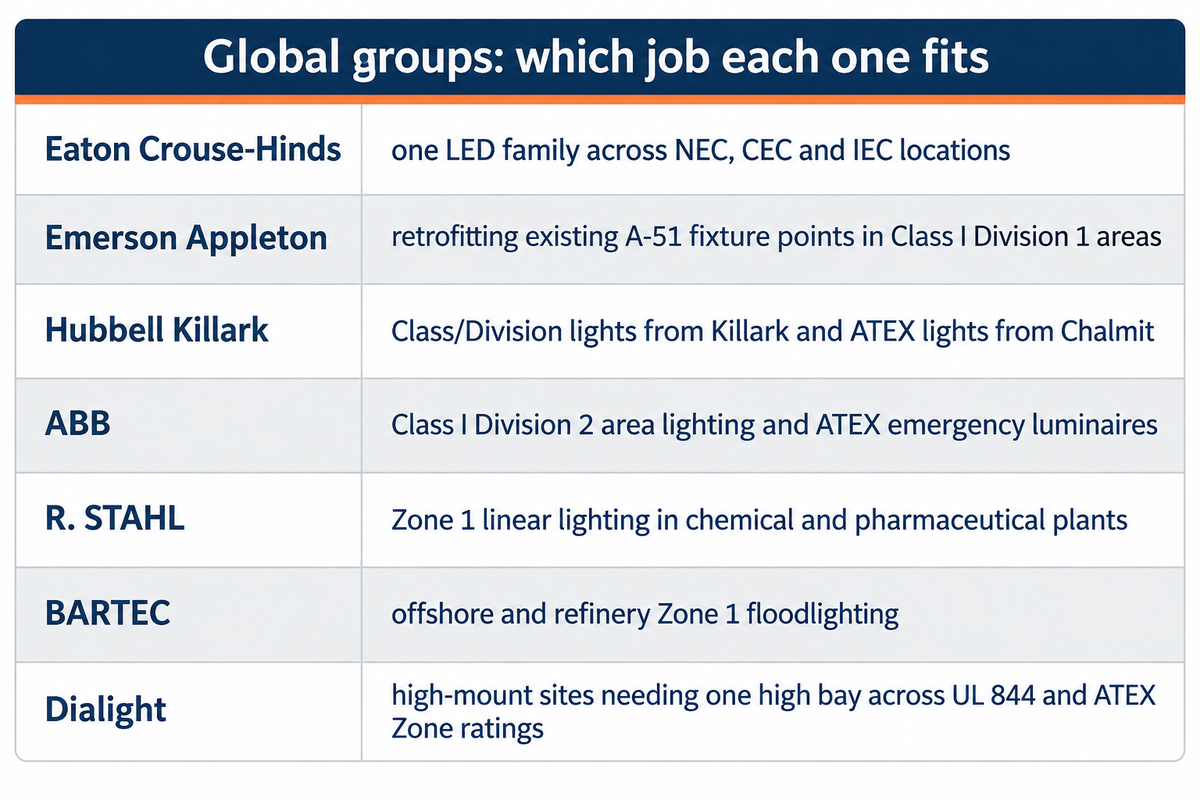
Large groups cover hazardous industrial environments in several regions at the same time, and many also sell other Ex equipment alongside their lighting products. Most sell through reps or quote requests, so published prices are uncommon, and these catalogs cover more than a single model, so the limits below identify the exact fitting.
6. Eaton Crouse-Hinds: Best for refineries and rigs wanting one LED family across NEC, CEC and IEC locations
Headquarters: Dublin, Ireland (Eaton); Crouse-Hinds began in Syracuse, New York · Founded: 1897 (Crouse-Hinds Electric Company) · Type: Product series of Eaton, a power management company
Official website: www.eaton.com
Main products: Explosion-protected lighting, control devices, switches, distribution equipment, junction boxes, plugs, cable entries and emergency lighting, with CEAG products in the same portfolio
Ex model and specs: Champ VMVL LED: nine models from 3,000 to 25,000 lumens, up to 127 lumens per watt, mounting heights from 8 ft to 60 ft; every tier is Class I, Division 2, Groups A, B, C, D, Type 4X, IP66. EV LED: Class I, Division 1, Groups C, D; T6 at 55°C; marine and wet locations, Type 4X, IP66
Certifications / notable work: Champ VMVL LED: IECEx UL 19.0039X and DEMKO 19 ATEX 2118X and 2119X on the 3,000-7,000 lumen models, IECEx UL 14.0031X on the 17,000 and 25,000 lumen models; UL 844
NEC, CEC and IEC hazardous-location certification in one LED family lets a refinery group keep one fixture across plants in different regions, and an integral battery back-up on the Champ VMVL LED gives 90 minutes of emergency lighting. The EV LED adds a factory sealed Class I, Division 1 option for general illumination. Ratings still change inside the portfolio: every Champ VMVL tier stops at Class I Division 2 for gases, and the Division 1 EV LED is listed for Groups C and D.
7. Emerson Appleton: Best for retrofitting existing A-51 fixture points in Class I Division 1 areas
Headquarters: Rosemont, Illinois, USA (Appleton Group LLC) · Founded: 1903 (Appleton Electric Company, Chicago) · Type: Appleton Group business marketed under the Emerson name, one of five brands alongside EasyHeat, Nelson, O-Z/Gedney and SolaHD
Official website: appleton.emerson.com
Main products: Hazardous and explosionproof area, task, flood and emergency lighting
Ex model and specs: A-51 LED: Class I, Division 1, Groups C and D, cULus Listed, equivalent to 100-300 W HID lamps, 10-year warranty. ATX FDLED: 2400 or 4725 lm; ATEX, IECEx and UKEX, 5-year warranty
Certifications / notable work: Mercmaster LED Low Profile: cCSAus and ABS on standard and emergency models; ATEX and IECEx on the standard model
The A-51 LED fits the same mounting hoods as A-51 incandescent luminaires, with no rewiring, so a retrofit can reuse fixture points already in the plant. Emerson also marks a milestone of 1 Million Appleton LED luminaires. On the Mercmaster LED line, Up to 10 dimmable LED luminaires can be wired to one Connected Appleton LED luminaire, which cuts control wiring on a long run. Buyers go through authorized sales representatives, and warranty differs by line: 10 years on the A-51 LED and 5 years on the ATX FDLED.
8. Hubbell Killark: Best for groups buying Class/Division lights from Killark and ATEX lights from Chalmit under one parent
Headquarters: Fenton, Missouri, USA (Killark customer service address) · Founded: Killark 1913; Chalmit 1910 · Type: Brands of Hubbell’s Harsh and Hazardous division; Hubbell bought Chalmit from Whitecroft in 1998
Official website: www.hubbell.com/killark/en
Main products: Killark floods, wallpacks, linear and enclosed area lighting, plus enclosures, controls and fittings; Chalmit ATEX and IECEx luminaires
Ex model and specs: Killark EML4030: 40 W, 3479 lm, Class I, Divisions 1 & 2, Groups C, D; Zones 1 & 2, IIB, IIA. Killark VML-X high bay: up to 28,000 lumens, Class I, Div. 2, Groups A, B, C, D; Ex ec IIC T4/T3 Gc; IP66. Chalmit Protecta X: -40°C to +60°C, over 120,000 hours at 25°C
Certifications / notable work: Chalmit lists ISO 9001 and product approvals from BASEEFA, SIRA, DNV, INMETRO and TRCU (EAC); Killark luminaires carry Class/Division and Zone ratings by model
Two brands under one parent is the case for Hubbell: Killark for Class/Division work and Chalmit for ATEX and IECEx, so a group with plants in both systems can keep one corporate supplier. According to Chalmit, its luminaires are used by oil and gas companies including Shell and BP. Killark also prints list prices, with the EML4030 at $2,482.12. That fitting covers Class I Groups C and D only, the VML-X stops at Division 2, and Killark and Chalmit have separate brand sites, so ask who quotes both.
9. ABB: Best for Class I Division 2 area lighting and ATEX emergency luminaires
Headquarters: Zurich, Switzerland (ABB Asea Brown Boveri Ltd) · Founded: 1988 (merger of ASEA and Brown, Boveri & Cie) · Type: Global electrification and automation group; Hazlux is its hazardous-area luminaire brand
Official website: new.abb.com/low-voltage/products/explosion-protective-components-systems
Main products: Hazlux H3 LED and wide-area luminaires, XSL3 LED series, InduXEL ATEX emergency luminaires
Ex model and specs: XSL3 LED: 5,600 to 20,100 lm, up to 156 lm/W, Class I, Division 2, Groups A, B, C, D; Class I, Zone 2; NEMA 4X; DLC listed. InduXEL121 and InduXEL222: ATEX, one version for Zones 2 & 22, the other for Zones 1, 2, 21, 22
Certifications / notable work: North American hazardous-location ratings on the Hazlux nameplate (NEC, CEC, cUL); ATEX for Zones 1 & 21 and 2 & 22 on the emergency range
ABB extended Hazlux into ATEX-certified emergency lighting from July 2024, so a project can buy zone-rated emergency fittings from the same brand as its general lights. The XSL3 lists a life expectancy of 50,000 to 100,000 hours, and the separate Hazlux H3 LED Generation 2 has a field-replaceable driver, 35, 45 and 65 degree reflectors and a 6 kV surge rating. The XSL3 is an area light for less severe locations: it stops at Class I Division 2 and Zone 2, and ABB routes its ATEX Hazlux emergency range through local specialists.
10. R. STAHL: Best for Zone 1 linear lighting in chemical and pharmaceutical plants
Headquarters: Waldenburg, Germany · Founded: 1876 (Stuttgart) · Type: Explosion-protection specialist manufacturer; stock corporation since 1993, IPO on the Frankfurt Stock Exchange in 1997
Official website: r-stahl.com/en/global/home
Main products: Explosion-protected luminaires, control and distribution equipment, plugs and sockets, enclosures, remote I/O, HMI systems and signaling devices
Ex model and specs: EXLUX Series 6002/4 LED linear luminaire: Zone 1, 2, 21, 22; IP66/IP67 or IP66; luminous flux still 90% of the starting value after 100,000 h; mounting height up to 10 m; optional DALI
Certifications / notable work: Series 6002/4: IECEx (IBE), ATEX (IBE) and India (PESO)
A dedicated luminaire plant in Weimar since 1991 and a Weimar development center for lighting research since 2014 sit behind the EXLUX line. DALI lighting control for monitoring and controlling luminaires in hazardous areas came in 2019, and the company names the chemical and pharmaceutical sectors as a sales focus. R. STAHL reports more than one million EXLUX 6000 luminaires installed over about twenty years. Holding 90% of flux at 100,000 h matters most at a 10 m mounting height, where access for a swap is slow and costly. The Series 6002/4 certificate filter lists ATEX, IECEx and India PESO only, with no UL or North American listing shown.
11. BARTEC: Best for offshore and refinery Zone 1 floodlighting alongside other certified Ex equipment
Headquarters: Bad Mergentheim, Germany · Founded: 1975 · Type: Explosion protection and safety technology specialist with its own production sites
Official website: bartec.com
Main products: Ex floodlight ranges, linear luminaires and escape lights, plus distribution panels, heat tracing, process analyzers and mobile computing
Ex model and specs: SFD LED floodlight: 179 W to 245 W, Zone 1, 2, 21, 22, Ex db IIB+H2 T6/T5/T4 Gb, Ex tb IIIC T85/100/135°C Db, IP66, 60,000 hours L80B20 at Ta 60, 25 kg, 100-277 VAC
Certifications / notable work: SFD LED floodlight: ATEX, IECEx and EAC certificates published for download on the product page
With 11 production sites including Bad Mergentheim, Milano, Sandnes, Pinghu and Chicago, more than 1000 employees and more than 50 subsidiaries, BARTEC can supply a project that also needs heat tracing and distribution panels. Downloadable ATEX and IECEx certificates on the SFD page shorten the document check for a specifier. BARTEC describes the series as especially for offshore oil and gas production installations, pipelines and refineries, and the flameproof housing runs up to 245 W. The SFD floodlight is rated IIB+H2 rather than full IIC, weighs 25 kg, and sales run through a quote request.
12. Dialight: Best for high-mount sites needing one high bay across UL 844 and ATEX Zone ratings
Headquarters: United Kingdom, with operations in Australia, Dubai, Malaysia, Mexico, Singapore and the USA · Founded: 1938 · Type: LSE-listed maker of LED lighting for industrial applications and opto-electronics components
Official website: www.dialight.com
Main products: Industrial LED High Bay, linear, area, bulkhead and obstruction lights
Ex model and specs: SafeSite LED High Bay: 9,500-41,300 lumens, -40°C to +65°C, IP66/67, NEMA 4X, IK05/IK06/IK10; UL 844 (CID1, CID2, CIID1, CIID2, CIII), CSA, IECEx/ATEX/INMETRO (Zone 1, Zone 2)
Certifications / notable work: 10-year warranty on most SafeSite models; a certified flameproof ATEX / IECEx Zone 1 LED fixture introduced in 2010, according to its company timeline
Dialight’s UK-based business reports 2 million fixtures installed worldwide as of its 2019 timeline entry, and it has built LED fixtures for hazardous areas since at least 2010. One high bay family at up to 41,300 lumens, with UL 844 and Zone ratings by model, suits a global operator that wants a single reference for tall process halls. The family page lists no T class, gas groups vary by certification code (Groups C, D or Groups B, C, D at CID1), its photometric files for CID1 and ATEX Zone 1 list 9K to 23K lumens, and impact rating runs from IK05 to IK10 by lens.
North American Hazardous Location Lighting Specialists (Companies 13–17)
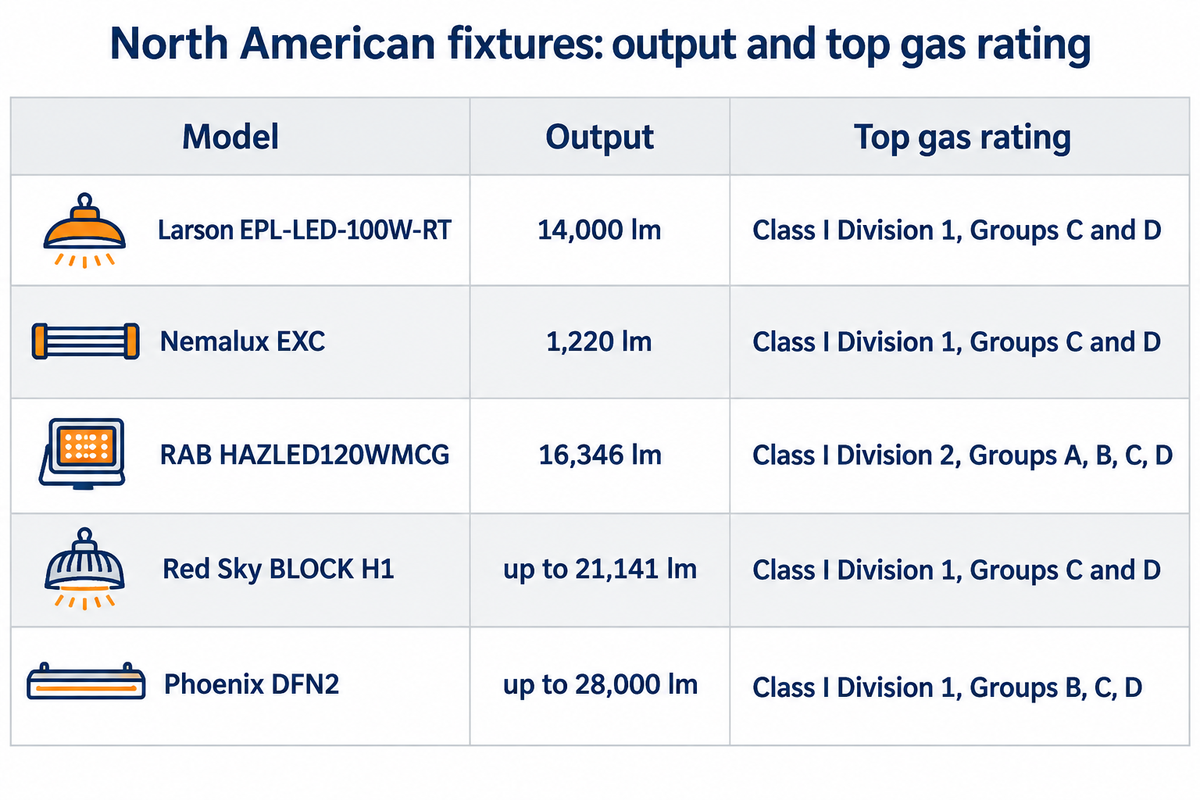
LED hazardous location fixtures made by these manufacturers center on Class I, Divisions 1 and 2 ratings for the US and Canada. A Division 1 rating often stops at Groups C and D, which cover propane and natural gas, but not hydrogen. Many high-output fixtures in this comparison stop at Division 2, so lumens say nothing about Division 1 suitability. Published prices and lead times are more common among these suppliers.
13. Larson Electronics: Best for built-to-spec or rented Class I Division 1 fixtures for US and Canadian sites
Headquarters: Texas, USA · Founded: 1973 · Type: Self-described manufacturer and certified panel shop, including custom built to spec units
Official website: www.larsonelectronics.com
Main products: Explosion-proof and hazardous-location lights (flood, high bay, linear, string, portable, strobe), explosion-proof fans and cameras, transformers and power distribution, light towers
Ex model and specs: EPL-LED-100W-RT flood light: 100 W, 14,000 lumens, Class I, Divisions 1 & 2, Groups C and D; Class II, Divisions 1 & 2, Groups E, F, G; Class III; T5; IP67; -50°C to +65°C; listed at $3,612.24
Certifications / notable work: ISO 9001:2015; facility certified through an NRTL to standards including UL-698A and UL-1203; this fixture lists UL 844 Ed. 13 and UL 1598, for the United States and Canada
Larson states that the lights in its explosion-proof category are Made in the USA, and its Class 1, Division 1 systems can be custom built to spec or are available for rent, which helps during a turnaround when a site needs temporary light. Published pricing also makes budgeting easier, with the 100 W flood listed at $3,612.24. The EPL-LED-100W-RT is listed for the United States and Canada and rated for Class I Groups C and D only, with no ATEX or IECEx certificate shown.
14. Nemalux: Best for confined Class I Division 1 spaces such as lift stations and well heads
Headquarters: Calgary, Alberta, Canada · Founded: 2003 (as Global Scada Inc.; renamed Nemalux Inc in 2008) · Type: Manufacturer of hazardous-location LED luminaires; acquired by Cooper Lighting Solutions, a Signify business, in November 2025
Official website: nemalux.com
Main products: JR, MR, XR, AR, GS, BL, NL, EXC, LS, ZLM, CANLED and XCANLED series hazardous-location luminaires, plus IECEx/ATEX-only RB, RF, RM, RH and RL families
Ex model and specs: EXC Series: 1,220 lm; Class I, Division 1, Groups CD T5; Class II, Division 1, Groups EFG T4A; Class I, Zone 1, Group IIB; IP66; -50°C to +58°C; UL 844, UL 1598, CSA C22.2 No. 137
Certifications / notable work: Lists UL, ETL, DLC, IDA (Dark Sky), ABS, LabTest, IECEx and ISO 9001:2015
The company states that no conduit seals are required when installing the EXC, citing NEC 505.15(A) and CEC 18-108, and that the housing is tested for more than 2,500 psi internal pressure. The company names municipal lift stations, confined areas and well heads among installation locations, where a compact fitting with no seals removes a step. Nemalux pairs in-house lighting design with just-in-time manufacturing from a Canadian facility, and the 2025 change of owner is worth raising when you ask about long-term parts. Confirm seal requirements for your Division 1 installation with the authority having jurisdiction. The EXC is rated for Groups C and D and delivers about 1,220 lumens, so high-output tasks need another fixture.
15. RAB Lighting: Best for Class I Division 2 fixtures bought through an electrical distributor
Headquarters: New York, NY, USA; the Support page names Cranbury, New Jersey as global headquarters · Founded: 1946 · Type: Self-described lighting manufacturer selling only through electrical distributors
Official website: www.rablighting.com
Main products: Hazardous-location families: HAZLED (30-120 W), HAZBAYLED (100-300 W), HAZFFLED (30-400 W), HAZFX, HAZX, HAZL34, HAZSHARK, HAZPAN, HAZVX and exit lights
Ex model and specs: HAZLED120WMCG (wall-mount version of the HAZLED family): 120 W, 16,346 lm, Class I Division 2 (Groups A, B, C, D); Class II Division 1 (Groups E, F, G); Class II Division 2 (Groups F, G); Class III; IP66; -40°C starting, up to 60°C
Certifications / notable work: HAZLED120WMCG: UL Listed, UL 844, UL 1598; 5-year warranty and a 100,000-Hour rated LED lifespan; family listed with the DesignLights Consortium
A contractor with an existing distributor account can add hazardous-location fixtures without opening a new vendor, and RAB offers free lighting layouts with shipping docks in Cranbury NJ, Ontario CA and Coppell TX. RAB’s hazardous range also runs higher, with the separate HAZFFLED floodlight family reaching 400 W. For warehouses and process areas classed Division 2, that’s a short route from drawing to delivery. Products are sold exclusively through electrical distributors, and the HAZLED120WMCG stops at Class I Division 2 for gases.
16. Red Sky Lighting: Best for one Class I Division 1 flood or high bay across 80-150 W
Headquarters: Rancho Cucamonga, California, USA · Founded: 2017 · Type: Self-described manufacturer of LED luminaires (the company says it manufactures them); the California site is described as an office, warehouse and order assembly point
Official website: www.redskylighting.com
Main products: Explosion-proof BLOCK H1, BLOCK MINI H1, BLOCK MAX, LINEAR TUFF, LINEAR TUFF EMERGENCY and LINEAR LOW PRO series
Ex model and specs: BLOCK H1 (SKU BLK2 H1): 80, 100, 120 and 150 W; 11,777 to 21,141 lm; Class I Division 1, Groups C, D; Class I Division 2, Groups A, B, C, D; Class I Zone 1, Group IIB; Class I Zone 2, Group IIC; C1D1 T6; IP66, NEMA 4X, IK09; -40°C to +60°C
Certifications / notable work: BLOCK H1: UL 844, UL 1598, UL 1598A, CSA C22.2 No. 137 and No. 250.0; 10-year LED and 7-year driver warranty
One BLOCK H1 housing covers four wattages from 80 to 150 W and is rated at 146 lm/W, so a site can standardize on one fixture from an access stair to a pipe rack. Red Sky sets a target lead time of two weeks, runs in-house product testing labs and says it now serves clients across four continents. A T6 rating at Division 1 also keeps the surface limit low. BLOCK H1 reaches Division 1 for Groups C and D only, and buying runs through reps and distributors.
17. Phoenix Lighting: Best for marine and port areas needing UL 844 Division 1 floodlights rated for saltwater
Headquarters: Milwaukee, Wisconsin, USA · Founded: 1892 (as Phoenix Printing; lighting fixtures since the 1940s) · Type: Lighting designer with its own manufacturing; part of The Phoenix Company, with JMC Capital Partners involved since 2018
Official website: www.phoenixlighting.com
Main products: Floodlights such as Defend Flood, DC equipment lights, large area lights, loading dock lights, hazardous-location and explosion-proof lights, navigation lights and lighting controls
Ex model and specs: Defend Flood 2 (DFN2-LO and DFN2-HI): 40, 60, 100 and 200 W; 5,600 to 28,000 lm; Class I, Division 1 Groups B, C, D; Class I, Division 2 Groups A, B, C, D; T5 at 40-60 W, T4A at 100 W, T4 at 200 W; IP66, IK10
Certifications / notable work: Earned ISO certification in 2011; Defend Flood 2 is UL/cUL certified to UL 1598, UL 1598A Marine Outside Type (Saltwater) and UL 844
Explosion-proof fixtures joined the Phoenix line in 1983, and the company says the US government has used its Made in USA and BAA compliant fixtures for over 50 years. A 68,000 square-foot facility on Port Avenue supports a quick-ship list of finished goods that leave within 24 hours. The saltwater rating alongside Group B coverage at up to 200 W is what sets it apart for ports and marine loading areas. The Defend Flood 2 list shows UL/cUL only with ABS pending, and the 200 W model is limited to 45°C ambient.
European Explosion Proof Light Specialists (Companies 18–20)
European specialists build around the ATEX Directive, which the European Commission describes as covering equipment and protective systems intended for use in potentially explosive atmospheres. Their pages generally list ATEX and IECEx by Zone, with no North American listings shown. Certified lighting from this group fits European refineries, offshore units and tank farms.
18. Schuch: Best for Zone 1 floodlighting in European refineries and tank farms from German production
Headquarters: Worms, Germany · Founded: 1895 · Type: Family-run German luminaire manufacturer, in its 5th generation
Official website: www.schuch.de/en
Main products: Explosion-protected LED linear luminaires, floodlights and high bays for zone 1/21, plus industrial, street and resistant luminaires
Ex model and specs: ExSTREAM e8820 floodlight and e8825 high bay, 3-module version: 10,500-16,000 lm, 13 kg. 6-module version: 20,500-32,000 lm, 18 kg. Both 110-136 lm/W, Zone 1 / 21, L80 over 100,000 h, -30°C up to a Ta max of 40-55°C by version, -40°C version optional, replacing high-pressure lamps up to 600 W
Certifications / notable work: ExSTREAM: IBExU 20 ATEX 1117 and IECEx IBE 20.0028; company ISO 9001 certification dating from 1995
Schuch delivered its first explosion-protected mining light fittings in 1910, and the head of its explosion protection development chairs the German and the international IEC working groups for explosion-protected luminaires. Production runs in-house from encapsulation to final assembly, with its own tooling and a VDE-approved laboratory center. Schuch names refineries, tank farms, loading stations and port facilities among ExSTREAM e8820 uses, and the 6-module version reaches 32,000 lm at 18 kg. The ExSTREAM page lists ATEX and IECEx for Zone 1/21, with no UL listing shown, and -40°C is optional over the standard -30°C.
19. Glamox: Best for offshore and marine installations specifying ATEX or IECEx fixtures with DNV options
Headquarters: Oslo, Norway · Founded: 1947 · Type: Norwegian industrial group that develops, manufactures and distributes professional lighting
Official website: www.glamox.com
Main products: Ex hazardous luminaires (MAX G2, MIX G2, TX60 LED) alongside marine, offshore, wind and professional building lighting
Ex model and specs: MIX102953: 17 W, 2,721 lm, Ex zone 2 and 22, Ex ec IIC Gc, Ex tc IIIC Dc, T5, IP66/67, IK10, Stainless Steel 316L. MAX G2: Category 2, Ex Zone 1/21 and 2/22. TX60 LED: ATEX and IECEx zone 1, 2, 21 and 22, -50°C to +55°C
Certifications / notable work: Product-level ATEX and IECEx; MAX G2 also marked DNV, with an emergency version of 1.5- or 3-hours duration
Production units in Molde, Estonia, Germany, Suzhou and Poland back a catalog built around marine and offshore work, where a DNV mark can decide a tender. The TX60 LED operates down to -50°C and can replace T8 fluorescent fittings directly, which helps a cold-climate platform swap old tubes without new mounting. The MIX102953 is Zone 2 and 22 only and runs on 220-240 VAC, so Zone 1 needs MAX G2 or TX60 LED.
20. Raytec: Best for UK and EU Zone 1 bay lighting with a self-testing emergency option
Headquarters: Ashington, Northumberland, UK · Type: Manufacturer that designs and builds its luminaires in the UK; OPTEX of Japan invested in all its share capital in 2012
Official website: www.raytecled.com
Main products: SPARTAN hazardous-area LED luminaires (Mid Power Bay, Linear and others), WARRIOR industrial range, security illuminators
Ex model and specs: SPARTAN Mid Power Bay MPBY Zone 1: 5,000 to 15,000 lm in the page’s Zone 1/21 description, Mid Power range up to 20,000 lm in the page body, Zone 1 & 21, IP66 & IP67; ATEX, IECEx and UKEX; self-testing emergency versions of 90-minute and 180-minute duration
Certifications / notable work: Publishes ISO 9001 and ISO 14001 certificates, ATEX QAN, UKCA QAN and IECEx QAR; all SPARTAN luminaires carry a 5-year warranty
OPTEX of Japan invested in the 100 per cent share capital of Raytec in 2012, according to SecurityWorldMarket, and the company put its UK production site at 30,000 sq ft in 2016. Published quality certificates and photometric data make a European specification file quicker to assemble. The SPARTAN Mid Power Bay page lists ATEX, IECEx and UKEX, with no Class/Division listing shown, and North American ranges sit in a separate Americas guide.
The Site-to-Marking Matrix: 15 Explosion Proof Light Models Compared
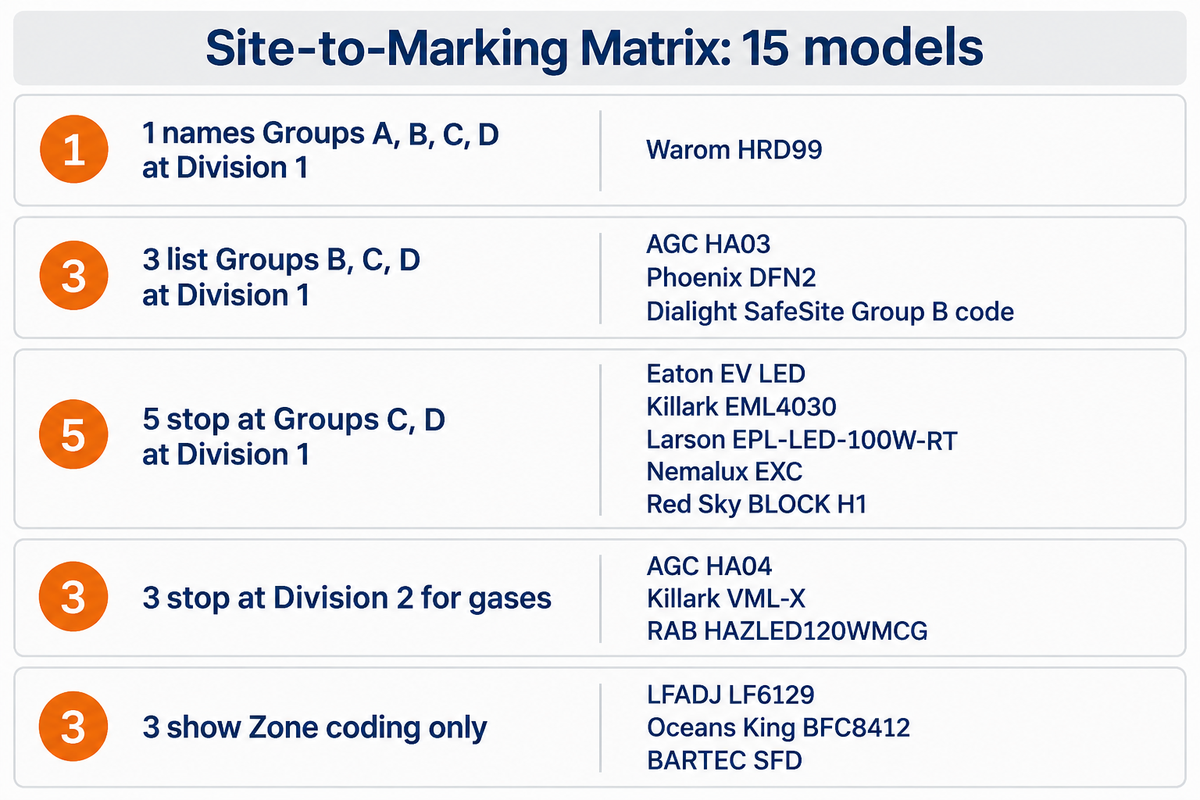
Nine of the 15 models below show a Class I Division 1 rating, and only the Warom HRD99 names Groups A, B, C and D at that level. Three list Groups B, C and D, five stop at Groups C and D, and one of the three is a Dialight SafeSite certification code. Three more stop at Division 2 for gases, and three show Zone coding only.
Use the last column first. It indicates the first site condition that precludes use of the model based on the published marking. This allows you to eliminate many models before contacting the maker for a quote. Our exact-model document match builder lists what to request.
| Model | Output | Top North American gas rating | Gas groups at that rating | Zone or Ex gas marking | First site condition that rules it out |
|---|---|---|---|---|---|
| LFADJ LF6129 | 180 W | None shown | — | Ex eb ib mb IIC T5 Gb | A Class/Division drawing; an ATEX or IECEx project (no such certificate shown) |
| Warom HRD99 | 20-100 W, 2500-11700 lm | Class I, Division 1 | A, B, C, D | Ex db IIC T6/T5 Gb | No North American listing shown; IIC below -20°C |
| Oceans King BFC8412 | 50 W | None shown | — | Ex e mb IIC T4 Gb | Above 50 W; a Class/Division drawing |
| AGC HA03 | 30-70 W, 4200-9800 lm | Class I, Division 1 | B, C, D | Ex db IIC T6/T5 Gb | Group A at Division 1; above 70 W |
| AGC HA04 | 150-240 W, 22500-33600 lm | Class I, Division 2 | A, B, C, D | Ex nR IIC T6/T5 Gc | Division 1 or Zone 1 |
| Eaton EV LED | Replaces 70-100 W HID | Class I, Division 1 | C, D | Class I, Zones 1 & 2, Group IIB | Groups A and B; T6 above 55°C |
| Killark EML4030 | 40 W, 3479 lm | Class I, Division 1 | C, D | Zones 1 and 2, IIB, IIA | Groups A and B; IIC |
| Killark VML-X | Up to 28,000 lm | Class I, Division 2 | A, B, C, D | Ex ec IIC T4/T3 Gc | Division 1 or Zone 1 |
| Dialight SafeSite | 9,500-41,300 lm (family; CID1 and Zone 1 files 9K-23K) | CID1 | C, D; B, C, D on the Group B code | IECEx/ATEX Zone 1, Zone 2 | Group A at Division 1; confirm the certification code |
| Larson EPL-LED-100W-RT | 100 W, 14,000 lm | Class I, Division 1 | C, D | None shown | Groups A and B; ATEX or IECEx projects |
| Nemalux EXC | 1,220 lm | Class I, Division 1 | C, D | Class I, Zone 1, Group IIB | Groups A and B; high-output tasks |
| RAB HAZLED120WMCG | 120 W, 16,346 lm | Class I, Division 2 | A, B, C, D | None shown | Division 1 gas areas |
| Red Sky BLOCK H1 | 80-150 W, 11,777-21,141 lm | Class I, Division 1 | C, D | Zone 1 IIB; Zone 2 IIC | Groups A and B at Division 1 |
| Phoenix DFN2 | 40-200 W, 5,600-28,000 lm | Class I, Division 1 | B, C, D | None shown | Group A at Division 1; 200 W above 45°C |
| BARTEC SFD | 179-245 W | None shown | — | Ex db IIB+H2 T6/T5/T4 Gb | IIC gases other than hydrogen; a Class/Division drawing |
Worked example: a US plant with a hydrogen area classed Class I, Division 1. Hydrogen sits in Group B and acetylene in Group A, so every Groups C and D fixture drops out at once. On gas group that leaves the Warom HRD99, the AGC HA03, the Phoenix DFN2 and the Dialight SafeSite Group B code, and only the DFN2 and SafeSite pages name UL 844, so ask the other two for theirs first. Now ask for output: the HA03 stops at 70 W, the HRD99 at 100 W and SafeSite’s CID1 files at 23K lumens, so a task needing 28,000 lm points to the 200 W DFN2. Then check ambient, because that 200 W model is limited to 45°C. Three questions, in order: which system, which gas group, which ambient at your wattage.
Explosion proof flood lights and high bays compare on the same three questions. Our explosion proof LED flood lights carry a planning MOQ of 50-100 pieces per model, so we are not the route for a single flood fitting. On LED explosion proof fittings the same logic holds for Zones: a Zone-only model such as the BARTEC SFD or the Oceans King BFC8412 may still be the right choice on an IEC project, where the top gas rating column simply does not apply.
How to Choose an Explosion Proof Lighting Manufacturer: 7 Checks
Compare the published marking of the exact model against the area classification drawing before you evaluate lumens or price. These checks apply to any maker in this comparison, including us, and turn a catalog page into a request for quote. Our hazardous-area input checklist captures the same information.
1. Name the System Your Drawing Uses
An area-classification drawing uses the Classes and Divisions system, the Zones system, or both across different areas. Equipment certified under one is not automatically valid under the other. Start with your area classification, then read the marking on the equipment. Class I is flammable gas or vapor. Class II is combustible dust and Class III is ignitable fibers. Division 1 and 2 are not interchangeable, and Division 1 and 2 ratings on one fixture only appear where the page says so.
2. Confirm the Gas Group Before Anything Else
OSHA 29 CFR 1910.307 states equipment shall be approved “not only for the class of location, but also for the ignitable or combustible properties of the specific gas, vapor, dust, or fiber that will be present.” In practice, read the exact gas group on the drawing before you accept a fixture, because a Groups C and D rating doesn’t cover Group A or B, and in IEC markings IIC includes hydrogen and acetylene, while IIB+H2 is Group IIB with hydrogen added. Hazardous substances on site set this, not the supplier.
3. Read the Temperature Class and Ambient Together
OSHA requires marking of the class, group and operating temperature “based on operation in a 40-degree C ambient”, though fixed luminaires marked for Division 2 only need not show the group, and equipment suitable above 40°C must show both figures. The fixture must stay below the ignition temperature of what surrounds it, so a T6 fitting (85°C) and a T4 fitting (135°C) aren’t swaps. Limits also move with wattage: the Phoenix DFN2 runs to 65°C at 100 W and 45°C at 200 W.
4. Open the Certificate for the Exact Model
Ask for the document naming your model, and check it on the IECEx system, which has more than 60 approved certification bodies in more than 35 countries and keeps certificates open to the public. ISO 9001 is a management-system certificate, not a hazardous-location approval, and a stated commitment to safety on a datasheet is no substitute for either. IEC 60079-14:2024, the sixth edition, sets design, selection and installation requirements, so ask your installer which edition the site works to.
5. Treat Dust and Gas as Two Ratings
A gas marking doesn’t cover dust unless the marking says so. The LFADJ LF2530 shows both, Ex nR IIC T6 Gc and Ex tb IIIC T80°C Db, while the Killark VML-X lists Class II separately from Class I. Check that seals and gaskets on the quoted build carry the same protection. For background on hazardous location lighting by hazard, exposure and duty, see our product page.
6. Compare Output at Your Mounting Height, Plus Emergency Time
Family maximums mislead. Dialight lists 9,500-41,300 lumens across SafeSite, and the model you can buy may sit anywhere in that range. Ask for a layout at your height, as RAB offers for free. For explosion proof emergency lights, ask for battery duration on the emergency version: Eaton lists 90 minutes on Champ VMVL LED, Glamox 1.5 or 3 hours on MAX G2, and Raytec 90 or 180 minutes. Our page covers the portable LF7623, not fixed emergency luminaires.
7. Settle Lead Time, Warranty and the Route to Buy
Published terms vary widely. Red Sky targets two weeks and Phoenix ships a stock list within 24 hours. Warranty ranges from 5 years (AGC, Raytec SPARTAN, RAB HAZLED) to 10 years (Appleton A-51 LED, most Dialight SafeSite models). RAB sells only through distributors and Appleton through authorized representatives, so spare parts follow those channels. A new explosion proof fixture also has to match your stock of glands and mounts.
What Is the Difference Between Explosion Proof, Dust Ignition Proof and Intrinsically Safe Lights?
Explosion proof lights employ a housing that contains an internal explosion to prevent the flame from escaping, dust ignition proof lights keep combustible dust out, and intrinsically safe lights limit circuit energy so they can’t ignite the atmosphere. OSHA allows explosionproof apparatus in Class I and dust ignitionproof equipment in Class II locations for which each is approved, so the method follows the hazard.
You can read each method on real markings. Ex db on the BARTEC SFD means a flameproof housing that withstands an internal explosion, and it suits 245 W. Ex tb on the Warom HRD99 is the dust enclosure. Ex ib on our LF7623 is intrinsic safety at 3 W, which shows why intrinsically safe lighting stays low-power: the energy limit that prevents ignition also rules out high loads. Our explosion proof lighting guide covers the wider product family.
Is ATEX or IECEx Enough for a US Plant?
ATEX or IECEx alone is usually not enough for a US plant, which should ask for a North American listing against the class, group and temperature on its drawing. UL 844 is the standard covering fixed and portable luminaires for Class I Divisions 1 and 2, Groups A to D, and for Class I Zones 1 and 2.
Quotes show the gap clearly. R. STAHL EXLUX 6002/4, Schuch ExSTREAM and Raytec SPARTAN MPBY list ATEX and IECEx on those pages with no North American listing shown, while Larson EPL-LED-100W-RT lists UL 844 with no ATEX or IECEx shown. Warom HRD99 and AGC HA03 show a Class/Division rating beside ATEX and IECEx, and Dialight SafeSite lists UL 844 with ATEX and IECEx. ATEX and IECEx serve different purposes too: the current ATEX Directive, 2014/34/EU, applies to products placed on the EU market and has applied since 20 April 2016, replacing Directive 94/9/EC.
Frequently Asked Questions
Which is the best explosion proof lighting manufacturer for refineries?
For refineries, Eaton Crouse-Hinds suits one LED family across NEC, CEC and IEC locations, Dialight suits high-mount process halls, and Schuch suits European Zone 1 tank farms.
Oil refineries with Class I, Division 1 areas in Group C or Group D can shortlist the Eaton EV LED, Killark EML4030 or Red Sky BLOCK H1, which all list those ratings. If hydrogen is on the drawing, shortlist the Warom HRD99, AGC HA03, Phoenix DFN2 or the Dialight SafeSite Group B code, and on a US site ask the first two for a North American listing. Each has an output limit, so match it to your task.
Who is the largest explosion proof lighting manufacturer in the world?
No maker can be named largest on a like-for-like basis, because the published figures measure different things: installed fixtures for some, company capacity for others.
Dialight reports 2 million fixtures installed as of 2019, and Emerson 1 Million Appleton LED luminaires. Warom states annual capacity above USD 500 million across all its products. R. STAHL reports more than one million EXLUX 6000 luminaires. Treat those as size signals for a top explosion proof supplier, not as a ranking.
Which explosion proof lighting manufacturers are in the USA?
Larson Electronics, Phoenix Lighting, RAB Lighting, Red Sky Lighting, Hubbell Killark and Emerson Appleton are all based in the USA, and Larson and Phoenix describe their fixtures as Made in the USA.
Eaton’s Crouse-Hinds began in Syracuse, although Eaton’s headquarters is now in Dublin. Nemalux is Canadian, and Red Sky describes its California site as an office, warehouse and order assembly point. Ask about origin if your project has a domestic-content rule, as Phoenix’s BAA compliant line suggests some do.
What is the difference between an explosion proof lighting manufacturer and a supplier?
A manufacturer designs and builds the luminaire, while a supplier may only resell another company’s model.
Buying from a reseller still means asking whose certificate covers the light. Larson, Warom and Schuch each describe their own production on their sites. Ask who holds the warranty, who stocks spare drivers, and who answers a question about the marking.
How Much Does an Explosion Proof Light Cost?
Two listed examples are $2,482.12 for a 40 W Killark EML4030 and $3,612.24 for a 100 W Larson EPL-LED-100W-RT, both Class I Division 1 fixtures, as of 2 November 2026.
Most makers here publish no price, and minimum order also differs: we take 1 unit on portable lines, while flood-light project orders carry a planning MOQ of 50-100 pieces per model. Efficient lighting at 146 lm/W or more also lowers running cost across a large site.
Are LED lights explosion proof?
LED lights aren’t explosion proof by default: the rating belongs to a tested and marked fixture, not to the LED technology inside it.
Solid-state lighting removes the fragile lamp, and it helps durability, yet a standard LED light can still create sparks or heat at its driver and terminals. Only a marked housing or protection method can withstand or block that source of fire or explosion. Portable work lights follow the same rule, as our portable explosion proof lighting guide explains. Reliable lighting in these areas comes from the marking first and the LED second.
Conclusion: Start With the Marking, Then Pick the Maker
Different makers fit different jobs. China factory-direct builders cover export projects, and LFADJ takes small trial orders. Global groups cover multiple plant regions. North American specialists cover Class I, Division 1 and 2. European specialists cover Zone projects. The best explosion proof light for your site carries a marking that matches your classification, gas group and temperature class and provides the output required at mounting height. Safety in hazardous environments starts there and is followed by all other terms in the quote. LED floodlights, high bay lights and linear fittings follow the same checks, no matter which lighting needs you start from.
If you need a single evaluation unit or a replacement portable or mobile light, send your hazardous-area requirements with your zone or division, gas group, temperature class and required date. We’ll review them against our explosion proof lighting range and tell you which models and documents apply. If your drawing is Class/Division, say so, because the LFADJ models above show no North American rating.
About This Comparison
Product figures come from each maker’s own pages as published in November 2026, and the counts in the Site-to-Marking Matrix are our own tally of those pages. Our LF6129 goes through the same table as every other maker’s models.
References & Sources
- 1910.307 – Hazardous (classified) locations, Occupational Safety and Health Administration
- UL 844, Luminaires for Use in Hazardous (Classified) Locations, UL Standards & Engagement
- IEC 60079-14:2024, Explosive atmospheres, Part 14, International Electrotechnical Commission
- Equipment for potentially explosive atmospheres (ATEX), European Commission
- IECEx, the IEC System for Certification to Standards Relating to Equipment for Use in Explosive Atmospheres, IECEx
- What Is Class 1 Division 2 Hazardous Location, Design Solutions and Integration
- Explosion-Proof Protection Types Explained, Weimiao Control Panels
- Optex acquires Raytec, SecurityWorldMarket