Get in touch with LFADJ Company

Hybrid Light Towers Explained: Power, Runtime and Cost


Hybrid Light Towers combine stored battery energy with another power source, commonly a diesel generator, to supply temporary lighting. Solar panels and mains charging are options on some systems. The primary advantage of this system is the capability to shut off the engine for a part of the cycle, and still have a way to replenish the battery.
A tower may have fuel for several weeks and still not have enough battery energy for an engine-off night. That difference matters on construction sites near homes, during outdoor events and wherever charging access changes between shifts. Start with the light required on the ground, then match the energy system to the working schedule.
Quick planning inputs
- Required illumination across the work area, including dark edges and obstructions.
- Shift length, permitted engine hours and the available recharge window.
- lighting demand in watts, the auxiliary demand and the usable battery energy in kilowatt-hours.
- Fuel, electricity and maintenance responsibilities over the full deployment.
How Hybrid Light Towers Work
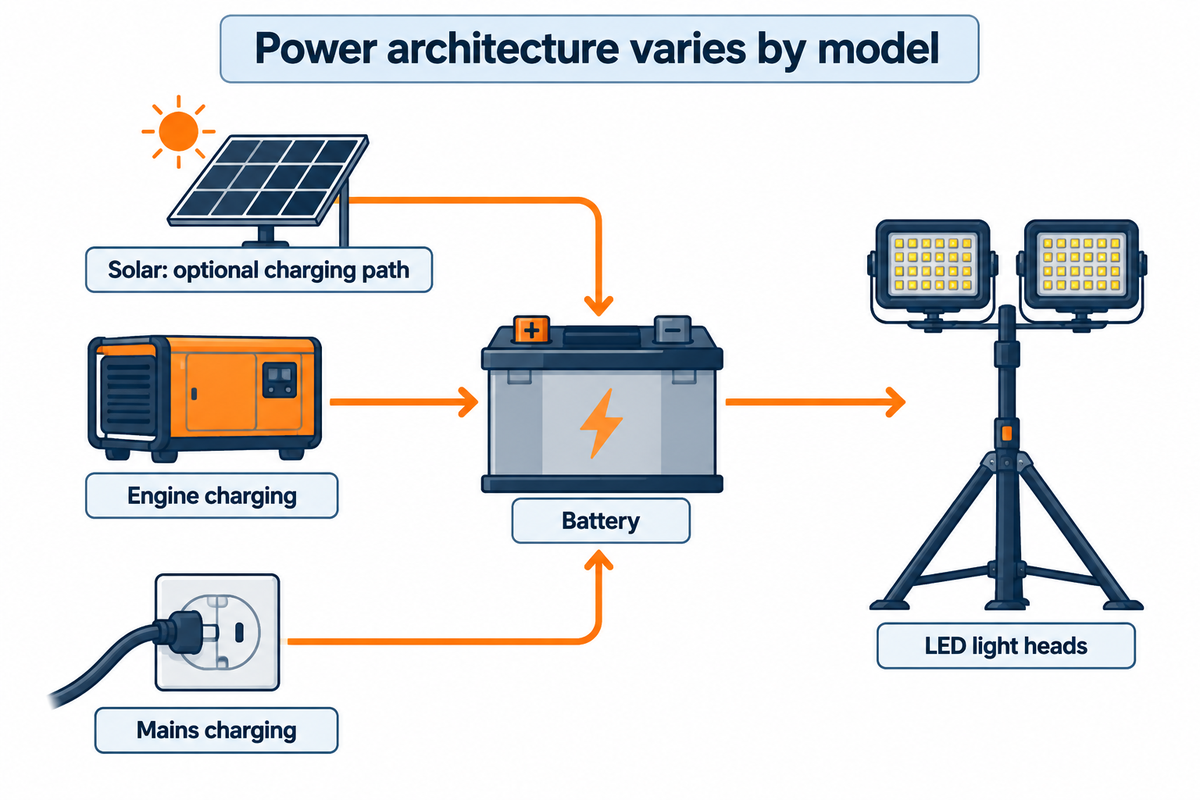
A hybrid light tower is an energy storage system that integrates a battery with a second source. The battery can power the LED light heads while the engine is stopped. Charging restores the reserve when needed. The charging source, switching behavior and available operating modes determine how the tower can be used.
In a battery-and-diesel design, the diesel engine drives a generator during a charging period rather than throughout every lighting hour. A solar hybrid adds solar energy. A shore connection can charge the battery from an external supply. These can occur together, but the term hybrid by itself doesn’t indicate which inputs are provided.
| Description | What supplies the energy? | What to establish |
|---|---|---|
| Battery operation | Stored electrical energy | Endurance at the selected output |
| Engine charging | Fuel through the generator and charger | Start triggers and recharge time |
| Mains charging | An external electrical supply | Site capacity and compatible connection |
| Solar charging | Available sunlight through the charging system | Seasonal recovery and backup provision |
International Rental News’s 2023 report on Atlas Copco’s HiLight BI+ 4 discusses mains, battery, diesel and hybrid settings. The same report touches upon portable products. Their features should remain tied to their own model families, rather than turning into a generic specification for a tower.
How are hybrid light towers built?
A typical engine-equipped hybrid tower brings together LED fixtures, a lifting mast, a mobile base, a battery pack, charging equipment and a control system. The engine and generator restore stored energy. If a solar equipment pack is fitted, it provides an additional charging path. Electrical protection, cooling and the charging logic must suit the selected components.
The chemistry of the battery also falls under the energy storage specification. AGM lead-acid packs and lithium-ion batteries need charging arrangements suited to their design. Lithium batteries differ in chemistry; LiFePO4 does not promise a particular lifespan. The battery-technology overview published by the U.S. Department of Energy explains that storage chemistries have different energy, temperature and lifecycle characteristics. The examples are for vehicles and not tower endurance ratings.
A hybrid tower can have more than one source of energy, but each quoted runtime belongs to a specific mode. For a 10-hour restricted period, identify the battery-only duration at the required light output before comparing tank capacity or solar options.
Hybrid vs Diesel, Battery and Solar Light Towers

Consider the power platform around the most difficult constraint to change. Diesel supports operation where refuelling is practicable. Battery lighting fits an engine-off window where recharging is available. Solar reduces purchased energy when local yield supports the duty. Hybrid energy adds charging flexibility, together with more equipment and control decisions.
Compare equivalent useful illumination and duration of mobile light towers. Define lighting needs by the task and working schedule. Different optics can put different amounts of light on the task with identical electrical wattage. A lower power consumption has little value if it’s obtained by lighting a smaller area, or if it fails to meet the job’s requirement.
| Site condition | Platform to screen first | Decision boundary |
|---|---|---|
| 10-hour engine-off window | Battery or hybrid with adequate reserve | Battery endurance and permitted controller behavior |
| Continuous mains access | Electric lighting | Connection, cable route and outage provision |
| Reliable daytime charging | Battery or mains-chargeable hybrid | Net energy restored before dispatch |
| Remote, repeated long shifts | Diesel or engine-backed hybrid | Fuel access, service and working hours |
| Weak winter sunlight | Hybrid with sufficient non-solar recovery | Daily deficit over consecutive nights |
| Panel location is shaded | Mains, diesel or another verified charging route | Treat solar contribution as site-specific |
| Cameras or other auxiliary loads | A system sized for the complete load | Permitted outputs, energy and starting demand |
| Short, infrequent deployment | Rental options across suitable platforms | Delivered hire cost and charging responsibility |
| Uncertain refuelling access | Battery, solar or hybrid with a demonstrated replenishment plan | Reserve through the longest supply interruption |
The table is a screening framework, not a ranking of machines. For a remote job with predictable fuel deliveries, diesel light tower options can remain a practical choice. An engine-equipped hybrid adds a second energy system whose benefit needs to justify its purchase, transport and service costs.
Advantages: engine-off lighting periods, several possible charging routes and reduced engine operation where the duty permits.
Limitations: Finite stored energy, charging logistics, battery aging and a more complicated control system. Without a charging input, battery-powered quiet runtime ends when the usable energy at the selected output runs out.
Power-source labels also leave dispatch decisions unresolved. NLR’s Alcatraz hybrid-system case describes generators charging batteries too frequently and leaving less storage space for solar energy. It concerns a stationary microgrid, but the operating lesson is useful: charging priority affects how much renewable energy a system can use.
Battery Runtime and Quiet-Hour Planning
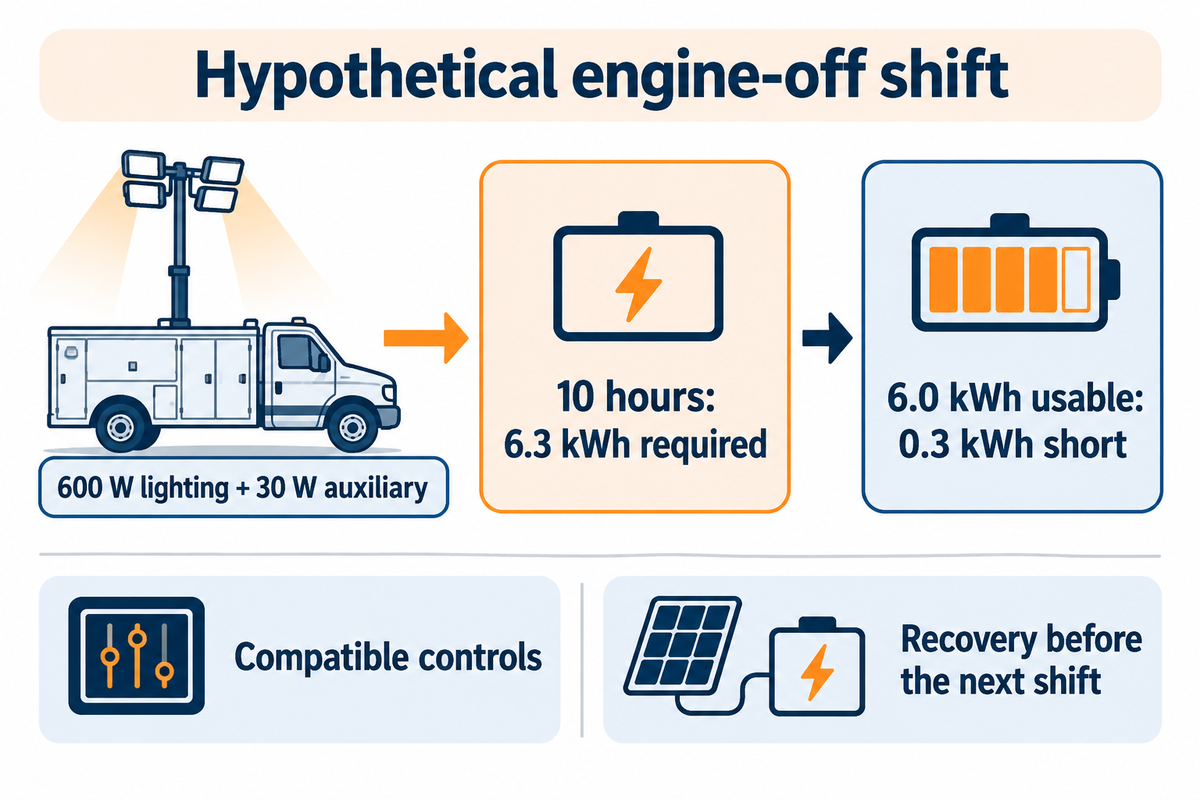
Measure battery-only runtime for scenarios where the engine has to be completely shut off. Divide usable energy by the complete lighting and auxiliary load, using a matching electrical boundary. Then determine whether the controller allows the planned operation, and what happens when charge falls below the expected level.
Separate battery endurance from total hybrid autonomy. The HiLight BI+ 4 launch report attributes seven hours at full capacity and more than 20 hours with dimming to that model. The longer figure belongs to a different output condition. It can’t establish 20 hours of continuous full-output lighting for another tower.
3 Conditions for an Engine-Off Shift
- Enough usable energy: include every permitted load and the reserve required for the deployment.
- Compatible controls: establish permitted engine behavior, low-charge alarms and the response to a shortfall using the approved operating arrangement.
- Recovery before the next shift: restore the energy used within the available charging period.
These are planning checks, not a product rating. If starting the engine is prohibited, an energy shortfall requires an approved backup (lighting) or stop-work response. Automatic diesel backup and uninterrupted silent lighting are two different capabilities.
Worked example, using hypothetical inputs: a 10-hour utility shift needs 600 W of lighting and 30 W of auxiliary power. Demand is 0.63 kW × 10 h = 6.3 kWh. A battery offering 6.0 kWh usable at that load boundary falls short by 0.3 kWh before any additional contingency allowance.
If 6.0 kWh already represents energy delivered after reserve and conversion losses, then the same reductions shouldn’t be applied again. Conversely, subtract reserve and conversion losses from a nominal cell capacity before treating it as delivered energy. Establish where capacity and load are measured before any calculation. Dimming is allowed only if the required illumination is satisfied.
The Federal Highway Administration’s nighttime work-zone checklist includes power-outage contingency planning. A low-charge alarm requires the name of an individual and an action the site can do before useful light is lost. Don’t rely on a remote dashboard that no one will monitor.
A 600 W lighting setting and a 30 W accessory together require 6.3 kWh over 10 hours. Keeping the engine stopped also requires a compatible control policy and a replenishment plan. A longer refuelling interval answers a different question.
Solar Charging and Energy Efficiency Between Shifts
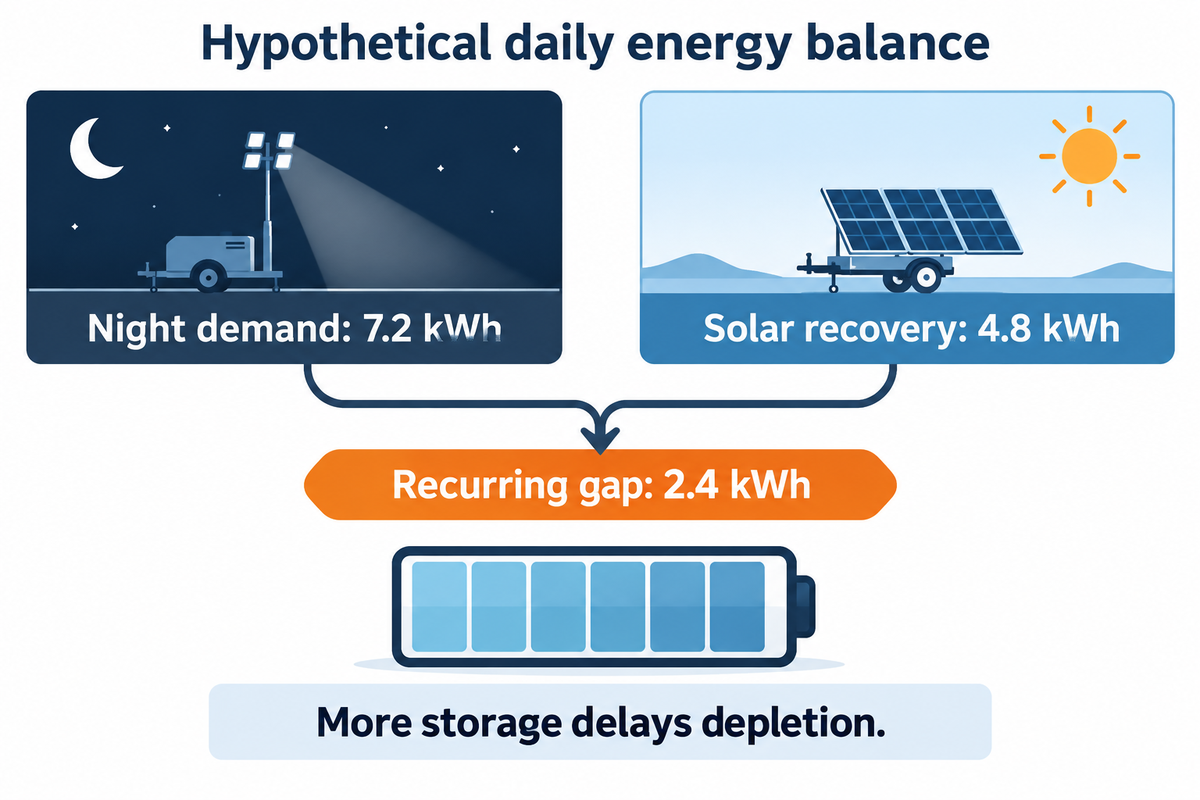
Solar charging must replace energy used over successive shifts, with consideration for local conditions and system limits. Peak panel power describes rated power under specific conditions. Daily energy recovery depends on sunlight, shading, orientation and the charging path. A full battery on delivery can conceal an ongoing daily energy shortfall.
Consider another hypothetical site: Supposing 600 W of lighting for 12 hours consumes 7.2 kWh. If solar restores only 4.8 kWh using a matching energy boundary, the daily deficit is 2.4 kWh. Increasing the size of the battery delays depletion, and it doesn’t clear that repeated deficit. Additional charging or adjustment of lighting duty while fulfilling the requirement is necessary.
Shortening daylight hours is one reason to assess the deployment season. Sunlight recovery also competes with daytime loads. For a tower that remains illuminated during recharge, part of the incoming power supplies lighting rather than restoring the battery. The 2024 International Rental News feature states that Trime’s model-specific charging time is three hours, with lights off, and three-and-a-half hours, with lights on. That difference is a good reason to ask for the right test condition.
The hidden bottleneck: the usable charging window
- Record when a suitable charging source is available.
- Subtract transport and setup time before the next shift.
- Account for lighting or accessories operating during recharge.
- Check the specified charging-temperature range and current limits.
- Confirm how much energy reaches the battery within that window.
Cold-weather charging limits deserve a separate check from discharge endurance. A cold battery may refuse charge even when the power supply is available: Battery University notes that consumer-grade lithium-ion batteries cannot be charged below 0°C (32°F). Refer to the battery and charger instructions provided for the system in question and include the battery heating demand in the energy plan.
Compare solar light tower options if there’s enough space for panels on the site, and a believable seasonal energy balance. Solar tower lights are attractive for a controlled overnight load, but panel placement must work alongside the mast footprint and access routes. The solar tower should be sized more on the work schedule than on an annual average solar resource claim.
A 7.2 kWh nightly demand and 4.8 kWh daily recovery leave a 2.4 kWh recurring gap in this hypothetical case. Match the operating season and charging window before counting solar contribution toward repeated night shifts or promised fuel savings.
Lighting Coverage, Mast Placement and Site Conditions
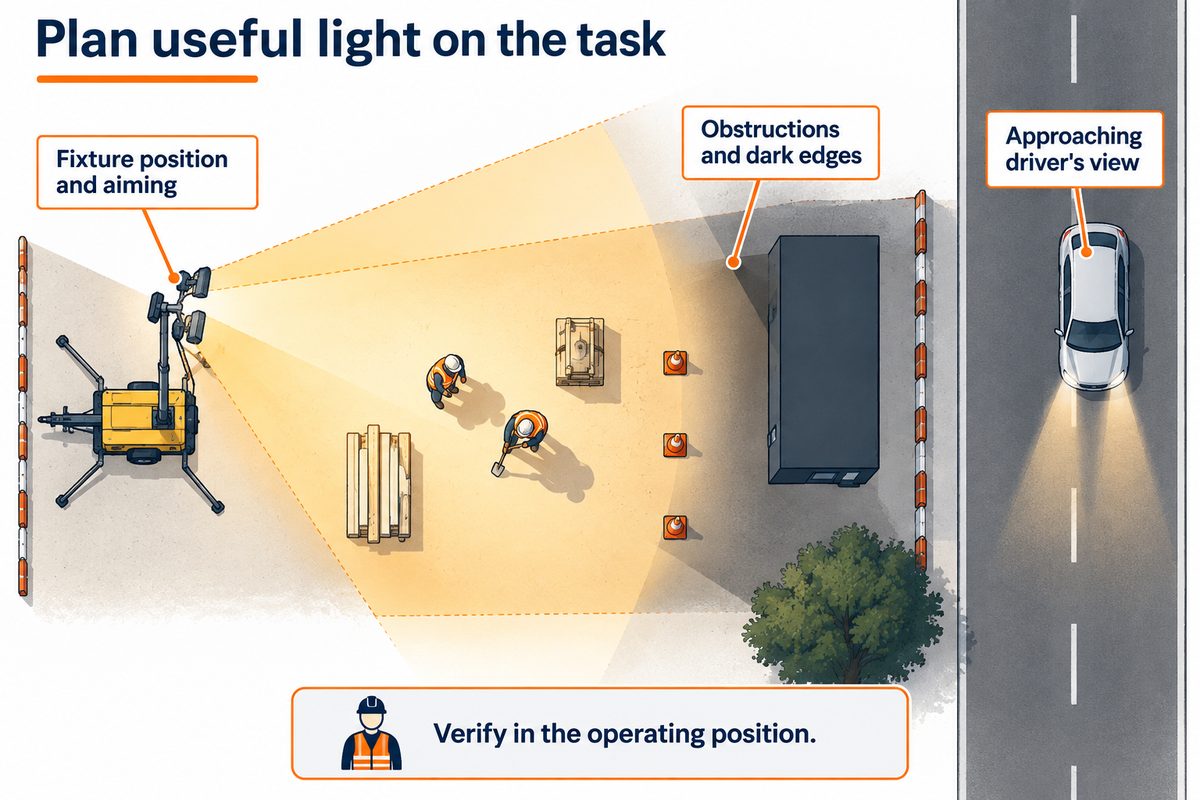
Light coverage needs a task-plane layout showing fixture positions, mounting height, aiming and illumination across the work zone. Total lumens is a measure of the light source, while lux or foot candles is a measure of light on a surface. Include obstructions and approaching road users. It’s possible to obtain a different type of usable coverage from a tower depending on the placement and aiming of the equipment.
“Different activities require different levels of light. In general, the more detailed the task, the greater the light requirement.”
For a U.S. construction example, OSHA 29 CFR 1926.56, Table D-3 lists 5 foot-candles for general construction area lighting and different minima for other listed operations. Apply the requirement for the particular task and jurisdiction. A vendor’s quoted coverage area without an illuminance criterion is insufficient for that comparison.
How are hybrid light towers installed?
A competent site team positions and deploys the tower according to its instructions and the lighting plan. Site assessment covers ground support, stabilizer space, overhead clearance, access and the permitted weather conditions. The team evaluates useful illumination and glare with the equipment in its intended operating position. The team makes the electrical connections in accordance with the approved site arrangement.
Deployment requirements differ between a trailer mast and a tripod unit. Ask for the conditions under which the equipment can withstand wind speeds stated in its documentation, including mast position and stabilizer deployment. Panel area can alter the deployed footprint; check the conditions under which the equipment can withstand wind speeds. Maximum height of the mast should be seen as a limitation rather than a suggested operating condition.
Driver visibility needs its own assessment beside a live road. The published abstract of Bhagavathula and Gibbons’s 2018 work-zone study reports that mounting height and roadway offset affect visual performance and discomfort glare. Include this viewpoint when planning construction and roadworks lighting.
Engineering note: enclosure ratings have a defined scope. The International Electrotechnical Commission’s IP explanation concerns ingress into enclosures. An IP65 statement must identify the rated enclosure or component; it doesn’t establish mast stability or hazardous-area approval.
The IEC 60529 public catalogue identifies the consolidated edition and included amendments. Match documentation to the equipment being offered, rather than assuming a whole-tower approval from a lamp-head marking.
A 5 foot-candle general-construction reference is a U.S. task-specific requirement, not a universal target for every outdoor activity. Establish the relevant lighting criteria and verify the proposed layout, dark points, and glare before accepting a runtime comparison based on dimmed output.
Operating Cost and Payback: A Matched-Duty Example
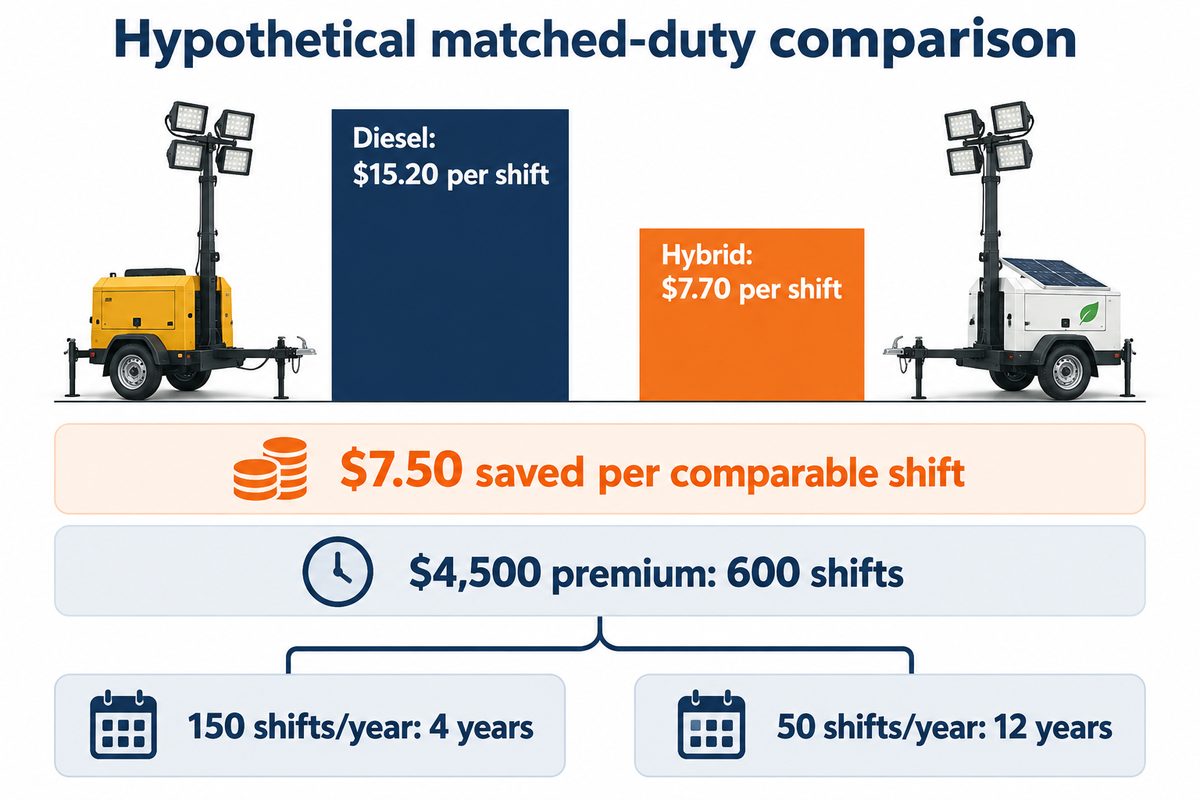
Compare operating costs for the delivery of the same useful lighting and return the battery to its starting energy level. Consider fuel consumed during recharge and purchased electricity. Separate engine-hour maintenance from calendar tasks, battery replacement, and delivery. Otherwise, a low night time fuel figure can simply shift costs to the next day.
This worksheet uses hypothetical U.S.-dollar inputs, not current prices, quotations or measured LFADJ results. Both arrangements are assumed to meet the same site lighting requirement of 12 hours at a 600 W lighting load. The hybrid cycle comprises all recharge needed to restore the initial battery energy; it’s assumed that the contribution of solar is zero.
| Input or cost per lighting shift | Diesel example | Hybrid example |
|---|---|---|
| Lighting duty | 12 h × 0.6 kW = 7.2 kWh | 12 h × 0.6 kW = 7.2 kWh |
| Engine operation, complete cycle | 12 h | 3 h |
| Assumed fuel rate while engine runs | 0.6 L/h | 0.8 L/h |
| Total cycle fuel consumption | 7.2 L | 2.4 L |
| Fuel costs at $1.50/L | $10.80 | $3.60 |
| Purchased grid energy | 0 kWh; $0.00 | 0 kWh; $0.00 |
| Engine-hour service allowance at $0.20/h | $2.40 | $0.60 |
| Assumed battery-replacement reserve | $0.00 | $1.50 |
| Calendar, mast and trailer allowance | $2.00 | $2.00 |
| Avoided delivery or labour credit | $0.00 | $0.00 |
| Illustrative operating total | $15.20 | $7.70 |
Under those assumptions, the difference is $7.50 per shift. An assumed $4,500 purchase premium would take 600 equivalent shifts to recover through that difference alone. At 150 shifts a year, simple payback is four years; at 50 shifts a year, it’s 12 years. These calculations omit financing, tax and residual value.
Modify the assumed fuel rates with comparable whole-cycle measurements. The hybrid engine can consume more fuel per running hour while running fewer hours, so compare liters per delivered lighting shift rather than engine hour rates. If charging ends below the initial battery state, include the missing replenishment before calculating savings.
Maintenance isn’t entirely proportional to engine hours. Pacific Northwest National Laboratory’s standby-generator guidance distinguishes maintenance tasks and includes calendar-based activities. Its generator examples aren’t lighting-tower service intervals. Count a fuel-delivery saving only when a visit or incremental cost is actually avoided, rather than when a crew already visits for other work.
Consider financing, taxes, residual value, transport, rental or capital cost, storage, insurance and replacement timing for total cost of ownership. A carbon footprint comparison needs its own boundary, including electricity source and the relevant lifecycle assumptions. Financial savings and environmentally preferable operation should each be justified by the conditions under which they were calculated.
A hypothetical $7.50 recovery per comparable shift recovers the cost of the $4,500 premium after 600 shifts. Decreasing the annual usage from 150 to 50 shifts triples the simple payback period. Utilization can be as important as a favorable fuel consumption figure.
Applications: Construction, Rental and Remote Work
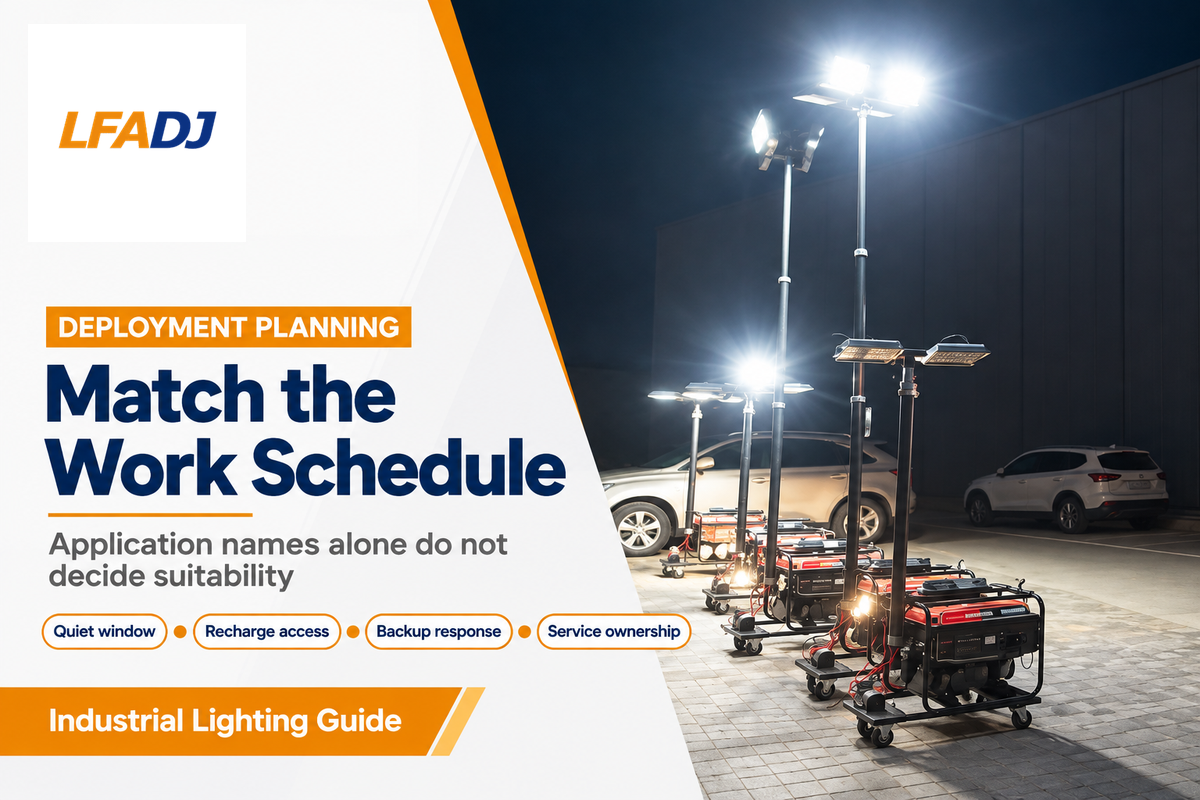
Hybrid mobile lighting can be useful when an engine-off period has value and a reliable route for replenishment is available. Application names alone do not decide suitability. Shift duration, placement, backup arrangements and service access differ within the same industry. A site manager should translate each job into an operating requirement before comparing equipment.
| Application type | Main constraint | Planning action |
|---|---|---|
| Night roadworks | Useful light and driver glare | Check task lighting and the approaching driver’s view |
| Rail maintenance | Access window and clearance | Include transport, setup and withdrawal time |
| Utility repairs near homes | Restricted engine operation | Match battery endurance to the full quiet window |
| Emergency staging | Changing loads and uncertain supply | Assign replenishment and backup-lighting responsibilities |
| Remote work sites | Repeated energy recovery | Check season, fuel access and consecutive-night demand |
| Rental fleet deployment | Handover and recharge ownership | Record dispatch charge, settings and return condition |
| Industrial shutdown | Obstructions and site classification | Confirm lighting layout and the applicable equipment approval |
| Outdoor events | Noise and overnight availability | Include setup, performance and clear-down hours |
| Security and monitoring | Continuous accessories and camera image quality | Include communications loads and verify camera view |
Hypothetical rental scenario: The major construction project works lights from 18:00 to 06:00. The hire team has only from 09:00 to 12:00 to charge before loading the next job. A system that takes four hours to reach the dispatch reserve can’t work in that three hour window, even if it has sufficient endurance to work overnight.
Charge responsibility must be named for a fleet at handover. A working charger back at the depot does not help a tower retained at a remote site. Such arrangements must be provided for rental fleet lighting requirements, as well as transport condition and fault reporting.
Mining areas and industrial shutdowns can introduce site-specific equipment requirements. Treat a hybrid tower as unapproved for explosive atmospheres unless its documentation shows a hazardous-location approval for that area. Evaluate the exact location and equipment documentation before deployment. Worker safety and productivity depend on the complete lighting arrangement, including the response to an unexpected outage identified in the FHWA work-zone planning checklist.
Maintenance and Supplier Evidence
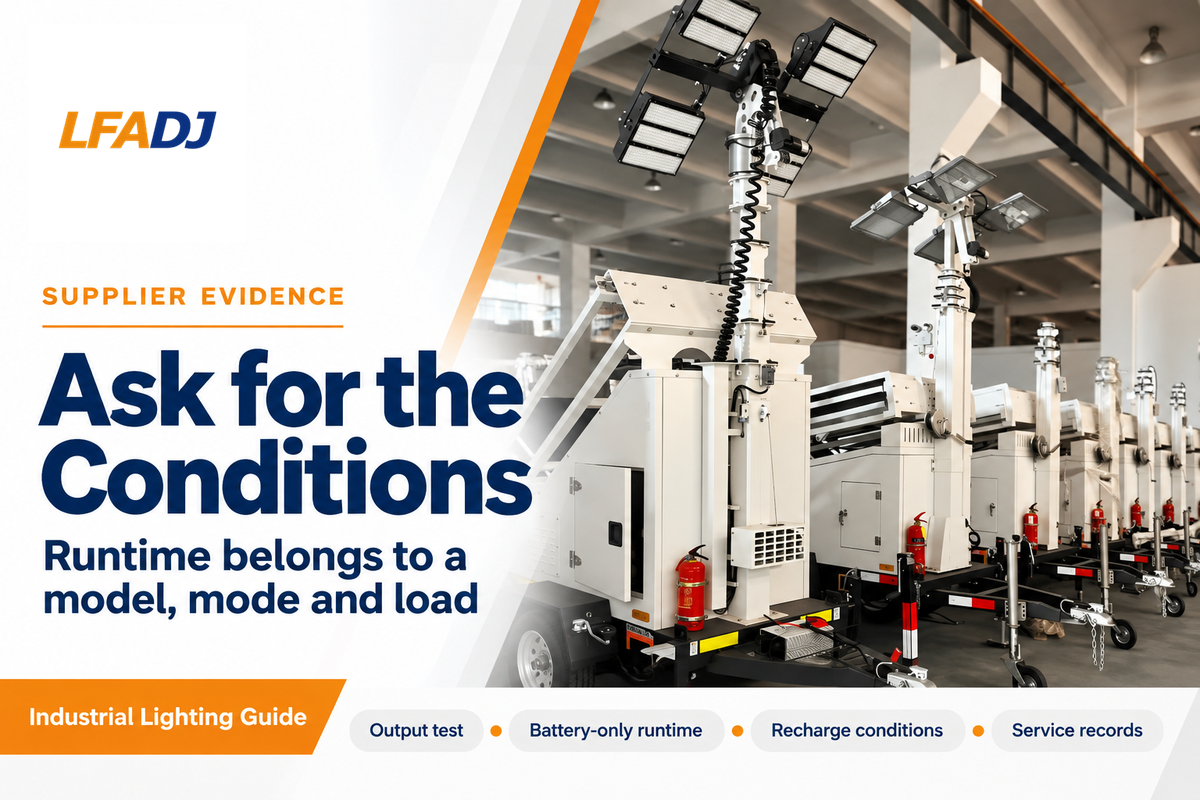
Maintaining the hybrid system covers the engine and stored energy system and the equipment that supports and controls the lights. Reduced engine operation can change engine-hour service needs, while calendar inspections and battery care remain. Use model-specific instructions and record the operating history. Procurement should define who owns what service task before the tower arrives on site.
Are hybrid light towers reliable?
They can provide reliable lighting when energy reserve, charging access, controls and maintenance match the deployment. Reliability is a result of the total system. A large battery can’t indefinitely offset a daily charging deficit, and an automatic engine can’t support a task when engine operation is prohibited.
NLR’s battery life span research accounts for both calendar and cycle aging. Avoid converting a cell cycle-life figure directly to a whole tower warranty or a defined number of years in service.
- Before dispatch: record model identification, charge state, operating settings and any outstanding faults.
- After transport: inspect the mast, stabilizers, tires, visible cables and coating condition as specified by the manufacturer.
- During service: retain engine-hour records, calendar due dates and battery-system warnings.
- At handover: provide the correct manuals, maintenance history, charging instructions and service contacts.
Durability includes parts support and access for service. Portable construction equipment often passes between teams; a useful fault report identifies the affected head or subsystem and when the problem first appeared. For a purchase comparison, request the specified output test, battery-only runtime conditions and a charging test at the intended operating load.
LFADJ’s published example illustrates why the conditions belong together: the LFADJ hybrid light tower configuration lists 7.68 kWh nominal storage, with battery runtimes of 6 hours 30 minutes at full brightness and 12 hours 50 minutes at half brightness. Solar is an option. These are first-party configuration details, rather than a performance range for every hybrid tower. Send the required lighting duty and charging access when requesting a configuration review.
If you customize fixture counts, accessory loads or charging equipment, reevaluate the complete energy balance. A lighting solution described as sustainable still needs a service and replacement plan; the description does not remove battery aging or maintenance responsibilities.
Newer Hybrid Controls: What Buyers Should Check
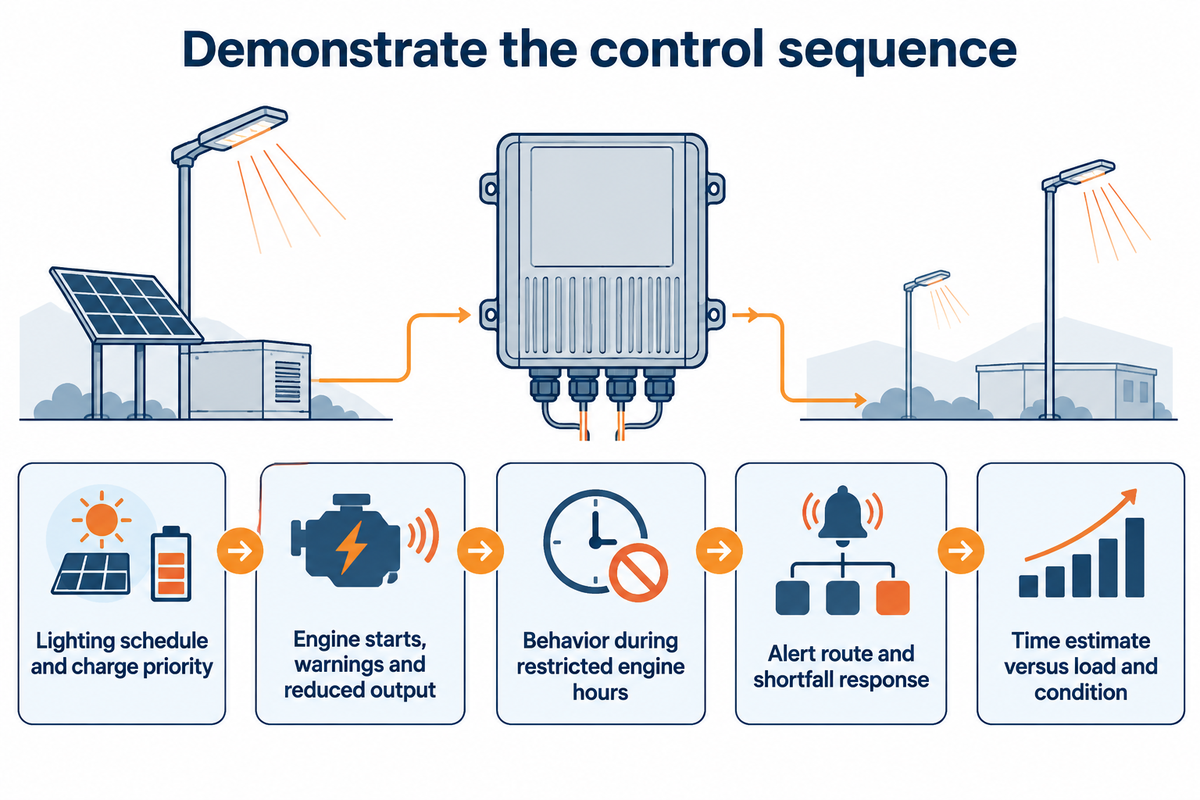
Compare controls based on operating decisions they support: scheduled lighting, charging priority, remaining time info and useful fault reporting. Dated product examples show that these functions differ between models. A new controller or monitoring connection is useful only when its functionality is aligned with site charging access, engine restrictions and response plan.
For background, see the 2024 Allmand hybrid LT-Series concept report. That report explains ideas for electronic runtime feedback. Use the runtime stated for the model actually offered, not a figure from a concept announcement. Likewise, remote monitoring requires a person to act on the alert.
- Demonstrate the selected lighting schedule and charging priority.
- Show what triggers an engine start, warning or reduced output.
- Confirm behavior during the site’s restricted engine hours.
- Test the alert route and the approved shortfall response.
- Check whether remaining time estimates correspond to the operating load and battery condition.
For sensitive locations, useful versatility means a repeatable operating plan as opposed to the largest menu of modes. Ask the supplier to demonstrate the relevant sequence. Energy efficiency, low-noise operation and an emission reduction each need a defined comparison; they do not follow from a screen labelled “hybrid” or a broad sustainability claim.
A 10-hour engine-off requirement should be in the acceptance plan. It should include the light setting, reserve, and alert response. A demonstration of the controller closes the gap between the quoted battery duration and how the tower behaves when charge falls.
Hybrid Light Tower FAQs
Operating conditions should be described prior to using a single runtime or price to evaluate equipment. The information is presented below, separating power architecture, night operation, and ownership responsibilities. For a particular deployment, use the model’s documentation and a lighting duty that includes the work area, permitted engine hours and the next charging opportunity.
Do hybrid light towers always need solar panels?
No. Battery-and-diesel hybrid systems can operate without solar panels.
A battery and diesel generator can form a hybrid lighting system without photovoltaic panels. Solar may be an optional charging input, while some configurations also accept a mains connection. Read the power-source list and charging arrangement for the unit. The word hybrid refers to combined energy sources. It doesn’t indicate the types of panels, charger or operating mode included.
Can a hybrid light tower run all night?
Yes, when stored energy or a permitted charging cycle supports the complete duty.
For a completely engine-off shift, compare battery-only duration at the required brightness with the whole restricted period. Combined tank-and-battery autonomy includes different operating conditions. Starting charge, auxiliary loads and controller settings impact the result. The next charging opportunity determines whether the same plan can be repeated tomorrow. Retain the required light level and an approved response to a shortfall.
Which hybrid light tower is best for a construction site?
Choose the system that meets the lighting duty and the site’s power constraints.
Begin with the site layout and work schedule, then compare battery-only endurance, charging recovery and backup behavior. Include transport constraints and the full deployment cost. For construction sites, rank towers by runtime at the required light level and by recharge time, not by battery size or total lumen output alone. The required illuminance must be maintained during the entire shift, including periods of reduced output.
Can an engine-equipped hybrid tower be used indoors?
Do not operate its combustion engine in an enclosed space.
Use equipment only within the constraints of its instructions and approved operating arrangement. Battery mode does not remove the possibility of an automatic engine start. An indoor task needs equipment and a supply arrangement specifically suitable for that environment.
Does hybrid operation remove the need for maintenance?
No. Engine-hour savings change only part of the service workload.
Maintenance for the engine, battery system, charging equipment, lamps, mast and trailer is model specific. Therefore, maintenance tasks described in the schedule are mandatory. Tasks based on engine hours must be followed according to the manufacturer’s recommendations. Separate engine-hour tasks from pre-deployment inspections, charging-system checks and elapsed-time requirements. If the service manual provides both time and hours for maintenance, follow its stated service trigger. For battery care, use the specified temperature limits, storage conditions and inspection procedure rather than a rule borrowed from another chemistry. Review cable damage, cooling paths and evidence of impact or corrosion. Record the name of the person reporting a fault and the name of the person approving the item for return to service in a rental fleet. A lower refuelling workload doesn’t relieve a person of these responsibilities.
How should I compare rental and purchase options?
Compare the same lighting duty over a realistic deployment and utilization period.
Include energy, fuel deliveries, transport, service responsibilities and replacement risk alongside the rental or purchase cost. Check whether charging is included in the hire arrangement. Estimate the number of shifts the equipment is likely to work.
Prepare a useful lighting brief: include site layout, required light levels, shift duration, engine restrictions and charging source. Include planned destination, quantity and planned deployment date. These inputs provide a practical basis for the supplier to match lighting and power equipment to the job.
LFADJ · COMPANY & TECHNICAL CONTEXT
Practical lighting guidance for real project conditions
LFADJ shares product context, application notes, and selection checks to help project teams compare industrial lighting options with the right site details in view.
What LFADJ covers
LFADJ focuses on industrial lighting and tailored lighting solutions for teams planning, specifying, or operating demanding work environments.
- Product context: mobile lighting, light towers, explosion-proof lighting, emergency lighting, and related industrial lighting equipment.
- Project context: application conditions, target illumination, runtime, site constraints, and product configuration questions.
- Decision support: use the information here as a starting point, then confirm final specifications against the actual installation and local requirements.
Industrial lighting
Application guidance
Project enquiries
NEXT STEP
Have a site question?
Send the operating environment, lighting target, expected runtime, and any drawings or photos you have. The existing enquiry form is ready for a focused discussion.
Start an enquiry Or use the LFADJ contact page