Get in touch with LFADJ Company

Portable light towers for sale can look similar in an online listing while solving different problems. A compact wheeled lighting cart, a rechargeable work light and a road-towable lighting plant vary in how they transport and supply lighting and the work they can support. First, compare lighting tasks, then shifts and finally condition, project cost and first-night readiness.
Portable light towers for sale should be compared for matching lighting duty. First consider useful illumination and shift duration. Then evaluate purchase price. Be sure to include the cost of any required repairs and delivery.
Updated October 2026
Quick buying baseline
LFADJ reference example: four 200 W LED heads and a manual mast extending to 5 m on a wheeled site cart. Compare every machine provided against its own specifications. The worked cost model below assumes an 18-month project and 1,000 useful lighting hours.
- A used machine with low hours may still require work before it can take on its first paid lighting job.
- Maximum brightness and maximum runtime need matching operating conditions.
- Rental billing periods and hours of useful illumination are separate inputs.
- Wheels alone tell you little about public-road transport arrangements.
This selection method is suited for industrial buyers comparing equipment for temporary work. US and UK sources have labeled examples. The project’s destination and application will determine the requirements that apply.
Start by Separating Three Equipment Classes
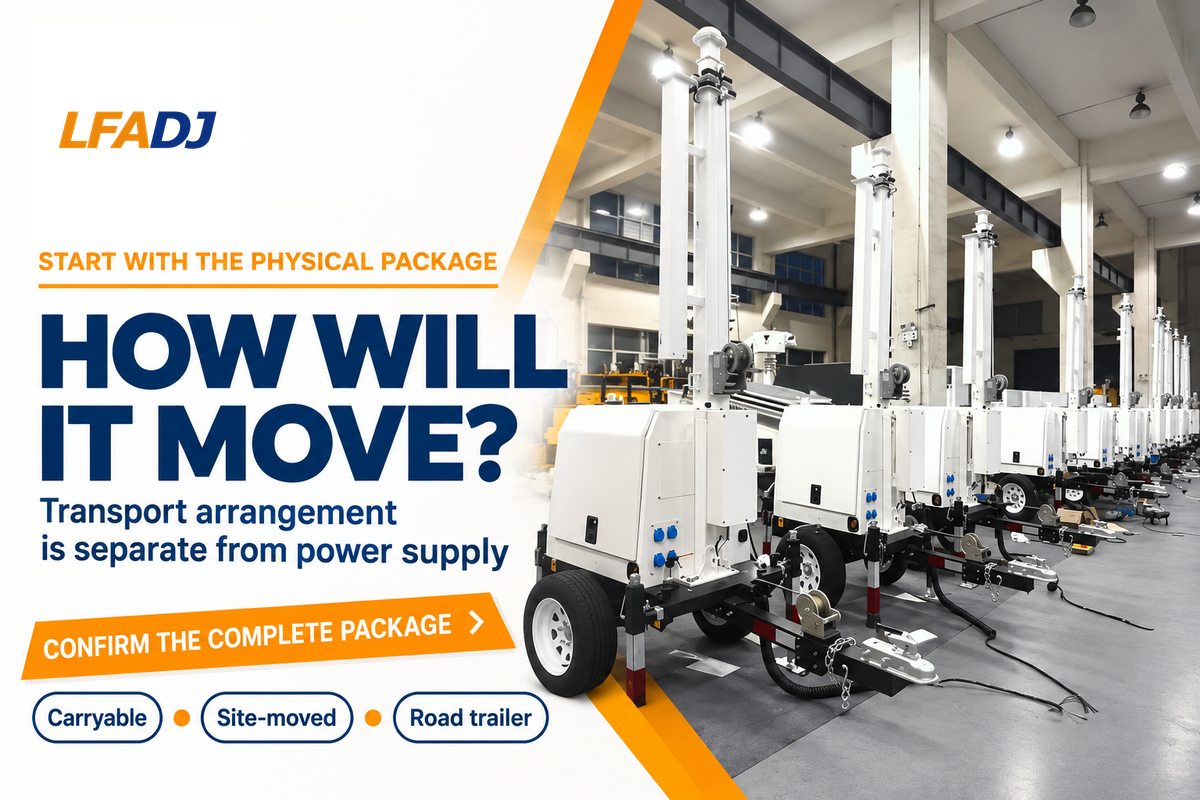
Separate portable lighting into carryable units, equipment moved within a worksite, and equipment transported on a road trailer. These practical buying groups can help determine handling and supply requirements. A battery describes the energy source and a cart describes the chassis. Neither describes the complete lighting duty or transport arrangement.
What are light towers used for?
Light towers provide temporary illumination where permanent lighting is absent or insufficient. Uses include equipment maintenance, construction sites, emergency response and outdoor event support. The job determines the required task visibility, operating duration and placement. Lighting a repair shop bench and lighting a vehicle approach, for example, require different distribution, even if both products are sold as portable lighting.
A telescoping mast raises the fixtures; the supply arrangement keeps them operating. Some towers feature an engine and generator, while other units connect to an external electrical source. LFADJ’s published 4 × 200 W reference is an on-site cart with a manual 1.8-5 m mast. A road-towable configuration needs its own transport information.
UL 153’s public scope describes portable luminaires through their task or ambient-lighting function and supply arrangements. Use the physical groups below as purchasing descriptions. Product assessment still follows the particular design and intended use.
| Configuration type | Useful starting application | First selection check |
|---|---|---|
| Carryable battery work light | A local inspection or repair task | Required brightness through the task duration |
| Tripod-mounted work light | A defined work face | Stability, shadows and available supply |
| Diffused balloon light | Work near people or vehicle approaches | Distribution and glare at the actual viewing positions |
| Cord-connected wheeled cart | Repeated movement near a suitable supply | Electrical interface and cable route |
| Battery lighting cart | Work requiring operation without an engine nearby | Usable energy and charging access |
| Engine-powered site cart | Temporary outdoor work away from mains | Exhaust placement and handling route |
| Diesel trailer tower | Repeated outdoor deployment | Chosen trailer, towing and fuel arrangements |
| Hybrid trailer tower | A duty schedule with different supply modes | Output and endurance in each selected mode |
| Solar trailer tower | A location with a planned solar-energy supply | Seasonal energy balance and backup plan |
What Are Electric LED Light Towers?
Electric LED light towers combine LED fixtures with a supporting mast and an electrical supply. A plug-in version uses an external source; a battery or generator supplied version carries part or all of the electrical supply. Compare light tower models as complete packages that include charging or generation equipment.
For focused tasks, the portable work lights category might be a better starting point. More types of mobile light tower cover various movement and supply arrangements. Choose the smallest complete arrangement that matches the job, instead of buying mast height that the work can’t use.
Compare the Light Delivered, Not the Headline Watts
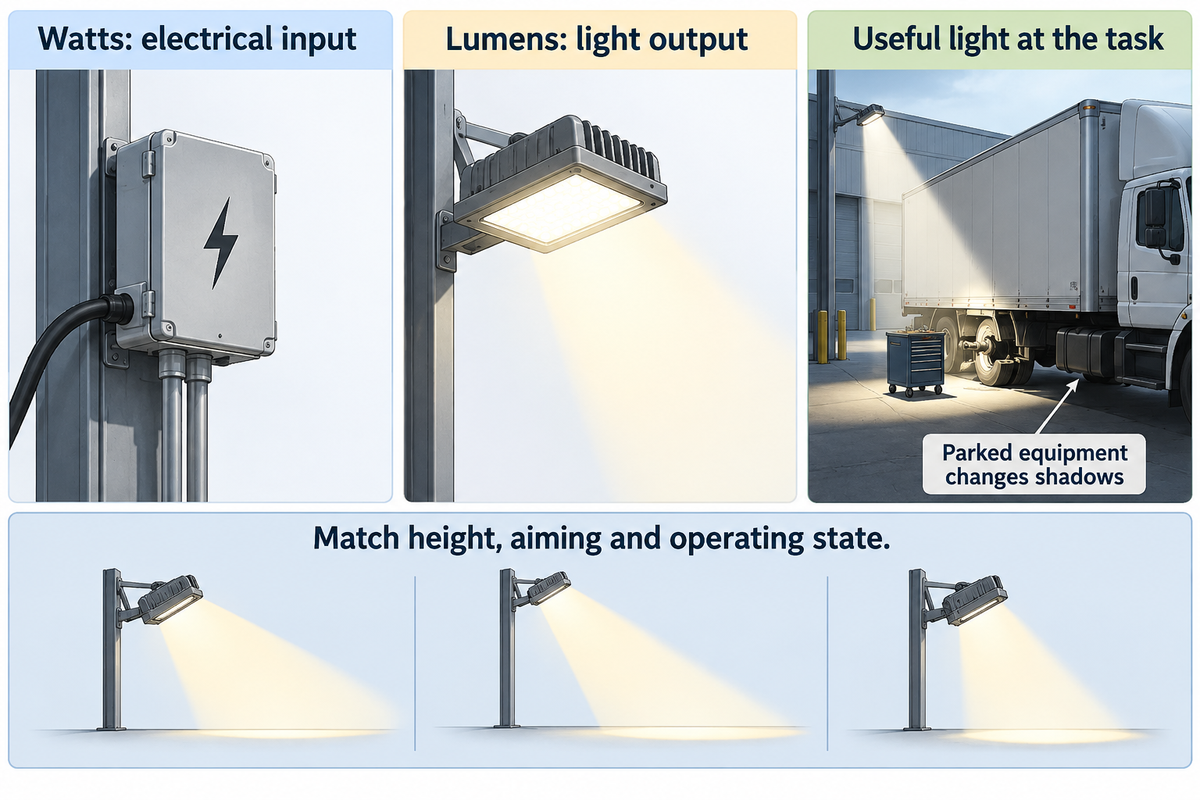
Compare useful light at the work task, with the fixtures at the intended height and aiming positions. Electrical watts describe input; lumens describe light output. Neither number tells the illumination across the work area. Shadows and glare can change which offer meets the job.
A good example of where HSE’s task-lighting guidance is useful is in explaining why different lighting is required for different tasks, and why parked equipment can cast overlooked shadows. A planned layout of a storage yard can be changed when a vehicle arrives with a load or containing a storage container. A photograph taken beside the mast misses the problem.
Lighting for Construction: Compare LED Light Tower Performance
Give all competing vendors the same task boundaries, working planes, and operating schedules. Document the agreed illumination levels and the basis for those levels. When addressing a roadway approach, provide the driver’s line of sight, as well as the location of the worker. Well-aimed towers deliver useful coverage without directing unnecessary light toward other people.
| Record | What belongs in the comparison |
|---|---|
| Task and boundary | The work face, access routes and required occupied positions |
| Illumination criteria | Applicable minimum, uniformity and glare requirements, with their source |
| Fixture arrangement | Head count, aiming, mast position and planned obstructions |
| Operating state | Output mode, supply state and any automatic dimming |
| Acceptance evidence | Layout prediction followed by agreed checks in the installed arrangement |
Applicable legal floors still matter. In United States construction, OSHA 1926.56 Table D-3 lists 5 foot-candles for general construction area lighting and different minima for other listed areas and operations. The same table lists 3 foot-candles for areas such as excavation and waste areas, access ways and field maintenance areas, and 10 for general construction plant and shops such as mechanical and electrical equipment rooms; pick the row that matches the task before developing the lighting plan.
A product report and an installed-lighting check answer different questions. The Illuminating Engineering Society’s LM-79-24 method concerns optical and electrical measurements under standard conditions. A usable layout also needs the geometry and obstructions of the job site.
Example: a maintenance crew works behind a parked service truck for a 10-hour night shift. Moving one fixture changes the shadow on the repair position, even though the wattage of the lamp is unchanged. The supervisor needs the work face and walking route assessed with the truck in position. Finance needs the cost of that accepted situation, which may require a different positioning or task lighting. Procurement needs to evaluate quotations after the situation is resolved. Paying a higher headline lumen total before resolving the shadow may leave the original task uncompleted.
Buying implication: a 5-foot-candle US Construction Reference and a 10-hour schedule define different parts of the need. Task classification determines the appropriate illumination floor; layout and output mode define how the proposed equipment delivers it. Compare prices after those conditions are shared with every supplier.
Can the Power System Complete Your Actual Shift?
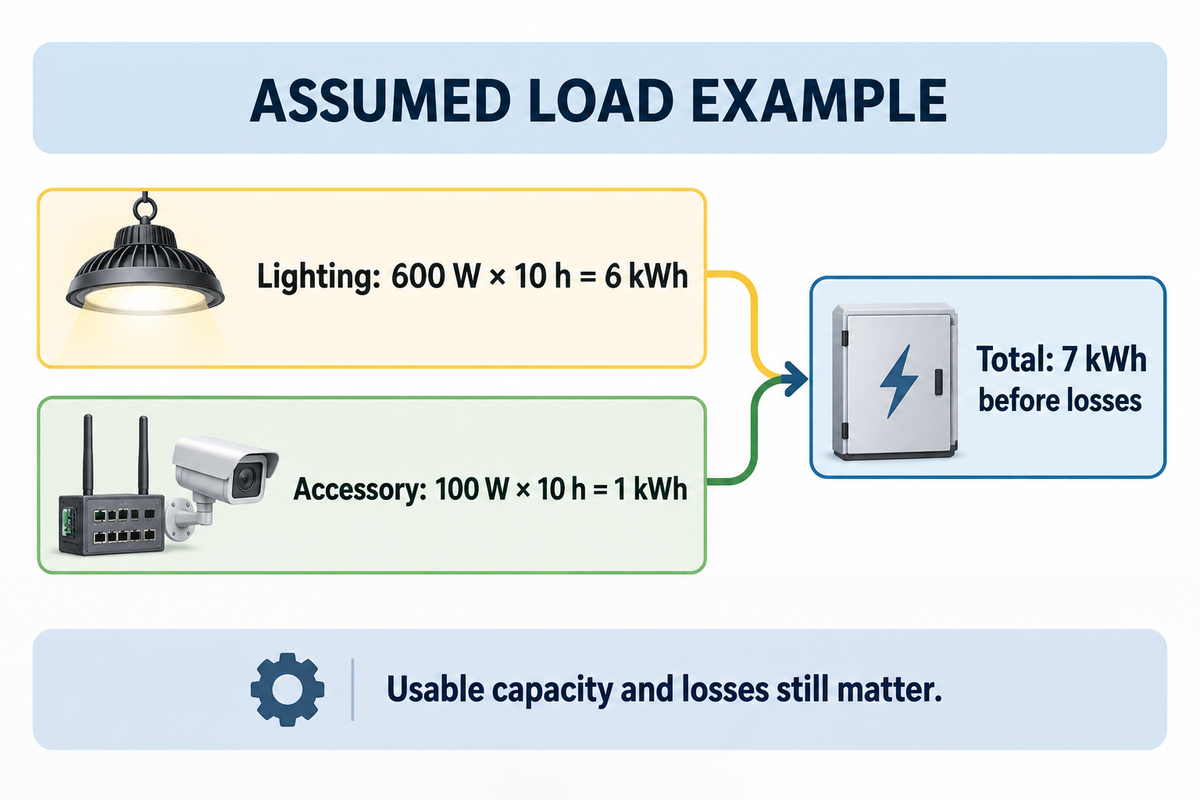
A power system must maintain the agreed lighting duty for the required shift, including accessory demand and any changes in brightness. Compare run times with matching settings. Battery capacity, fuel tank size and generator output describe different limits. A single headline number can’t settle the entire operating schedule.
Runtime and power: one full-shift example
Example: assume a constant 600 W lighting load for 10 hours. Lamp energy is 600 W × 10 hours ÷ 1,000 = 6 kWh. A separate 100 W accessory running for the same 10 hours adds 1 kWh, bringing the load-side total to 7 kWh before losses. The U.S. Energy Information Administration explains the watt-hour relationship.
Those 7 kWh are a load requirement. Battery selection also needs usable capacity, permitted discharge, conversion losses and the intended conditions. A fuel-powered alternative needs the chosen engine’s consumption at the actual load. Dividing nominal battery capacity by lamp watts without accounting for those differences can overstate the shift available.
For solar lighting setups, energy used during the relevant weather and seasonal cycles must be accounted for and replenished in the supply. Hybrid power options increase operating modes. Keep track of when the engine is running, when it’s charging, and if light output changes during either state. Keep standby endurance and constant-duty illumination separate.
Remote work with dependable fuel access may favour an engine arrangement; a suitable mains connection can remove repeated refuelling visits. Compare diesel light tower setups with the required duty and service route. A fuel-efficient claim becomes useful when the quoted load and operating conditions are stated.
Placement of the engine is a separate requirement. CDC guidance on generator carbon monoxide cautions against operating a generator in a home or garage, even with doors and windows open. For enclosed industrial work, choose an appropriate battery or externally supplied arrangement and keep combustion exhaust away from occupied spaces and openings.
Shift check: the assumed 600 W lamp load needs 6 kWh over 10 hours; the 100 W accessory raises demand to 7 kWh before losses. A dimmed endurance claim answers a different question if the work needs full output. Compare the required setting through the end of the shift.
New or Used: Price the Remaining Service Life
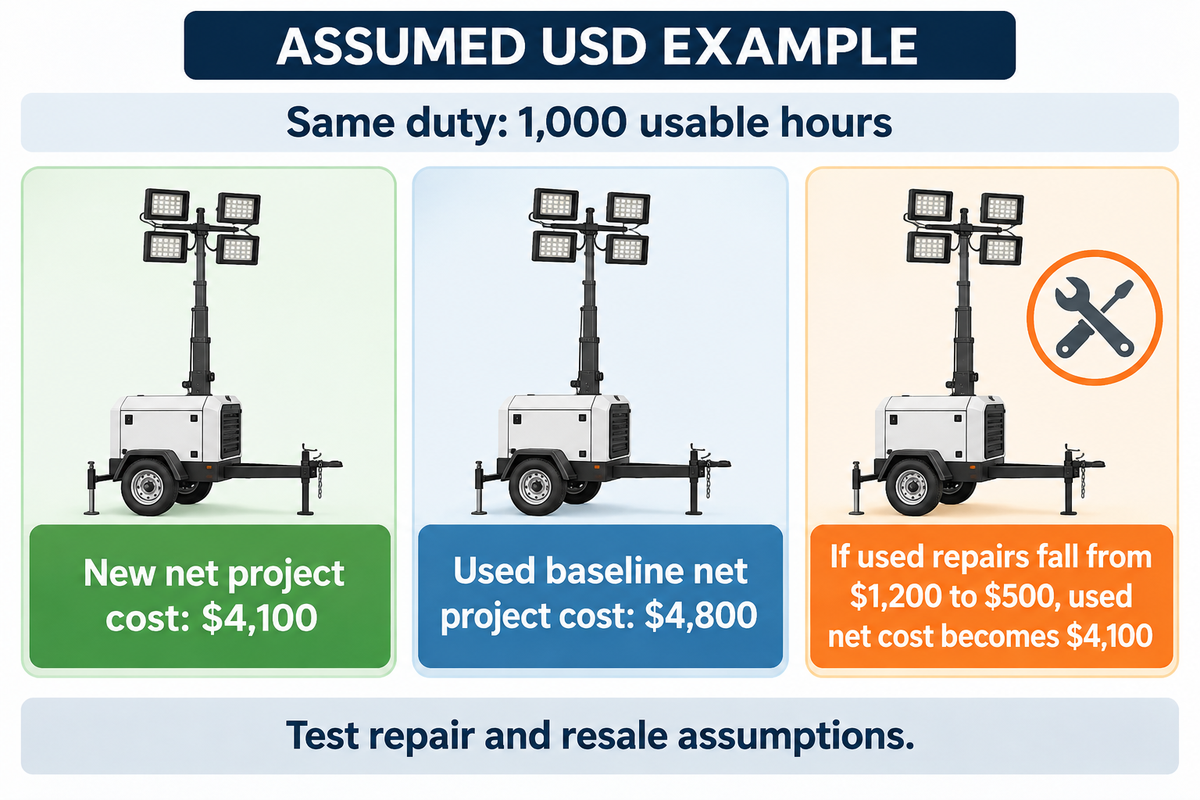
Compare a used unit after immediate repairs, service, and delivery are included. An hour meter, along with a record of previous duty and maintenance, is part of its history. The lower purchase price helps only if the machine can perform the required work and its remaining costs fit the project budget.
New and Used Cost Comparison
A New and Used Cost Comparison analyzes both options using the same duty, ownership period, and condition-adjusted cost.
A detailed version of the Department of Energy’s life-cycle cost training is available. It breaks costs into acquisition, energy, and other life-cycle costs like maintenance, repair or replacement, and disposal. Integrate that method into actual offers. Maintain the anticipated selling price as a sensitivity input. A buyer hasn’t agreed to pay that.
| Cost item or comparison input | New | Used |
|---|---|---|
| Purchase price | $8,500 | $5,200 |
| Delivery | $400 | $400 |
| Immediate repairs | $0 | $1,200 |
| Maintenance allowance | $600 | $900 |
| Energy allowance | $600 | $600 |
| Total before selling | $10,100 | $8,300 |
| Assumed end-value credit | −$6,000 | −$3,500 |
| Net project cost | $4,100 | $4,800 |
| Comparison horizon | 18 months | 18 months |
| Usable lighting time | 1,000 hours | 1,000 hours |
| Net cost per usable hour | $4.10 | $4.80 |
A buyer sees a $3,300 purchase-price saving and initially prefers the used offer. After the listed costs and selling values, however, the used choice costs $700 more over the project. Keeping every other input fixed, its immediate repair bill must fall from $1,200 to $500 for the two choices to tie at $4,100. That gives the inspector a useful decision threshold: a documented repair quotation can change the choice. An unsupported claim that the equipment has plenty of life left can’t replace that quotation.
Test the end value too. Reducing the new machine’s assumed resale credit from $6,000 to $4,500 raises its net cost to $5,600, or $5.60 per usable hour. The ranking reverses. Tax, financing and insurance are outside this simple example; add the actual amounts to each relevant option before contracting.
New equipment
- Higher initial cash requirement in this example
- Acceptance starts from the ordered specification
- Future selling value still needs sensitivity testing
Used equipment
- Lower initial price in this example
- Condition and repair readiness affect first use
- Unknown history increases inspection work
Condition changes the decision: A repair bill for $500 is the tie point in the 18-month assumption, not an industry allowance. The used offer wins or loses based on the condition documented. A buyer projecting only 1,000 useful hours should price that work rather than assume remaining life based on age of the asset.
Buying, Renting and the Cost of a Working Night
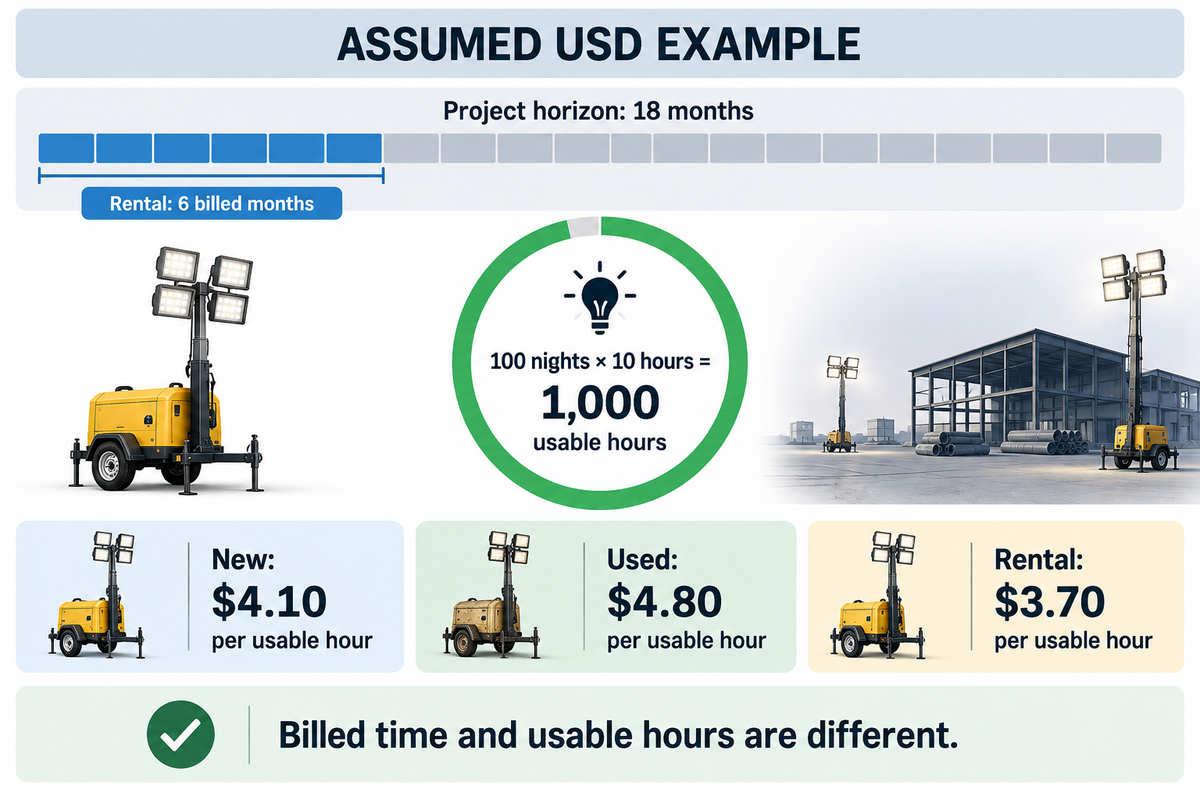
For a given project need, consider both buying and renting. Compare buying and renting over the same project need, using the hours that meet the agreed lighting duty. Rental rates are charged for billed periods; ownership costs include the work done to prepare the asset for use, and the value left at the end of use. In the filled example below, the rental option stays cheapest until one additional billed month at $450 lifts it to $4,150, just over the purchase case.
Cost per Usable Lighting Hour Model
The Cost per Usable Lighting Hour Model divides the comparable net project cost by the agreed usable hours.
Meena Venkatraman of Berkeley Lab illustrates the same-output principle in the Department of Energy training using the following example:
“For a fair comparison, we’ll get two bulbs with the same light output.”
Before calculating the denominator for towers, define the work area and accepted operating mode. Hours when the lights are on but the required task is not illuminated do not count as delivered duty in this model. Keep the cause visible: Supply interruption, repair downtime, and inadequate aiming call for different corrections.
| Comparison | New purchase | Used purchase | Rental |
|---|---|---|---|
| Calendar basis | 18 months | 18 months | 6 billed months within the project |
| Rental rate input | Not applicable | Not applicable | $450 per billed month |
| Rental charge | Not applicable | Not applicable | 6 × $450 = $2,700 |
| Rental delivery and return | Included above | Included above | $400 total |
| Rental energy allowance | Included above | Included above | $600 |
| Net project cost | $4,100 | $4,800 | $3,700 |
| Usable time | 1,000 hours | 1,000 hours | 1,000 hours |
| Cost per usable hour | $4.10 | $4.80 | $3.70 |
It appears rental wins this comparison. With the given prices, one additional billed month would cost $450, and increase rental cost to $4,150, just over the purchase case. So a schedule extension could change the outcome without changing lamp technology. The rental agreement also needs to define included service and authorized operating time, as well as stipulate any additional fees.
A Construction equipment interview with fleet managers says companies own core demand and rent for peaks or shortages. It can be a good strategy for irregular demand. It’s more of a fleet strategy to model, than a universal rule to buy after a fixed number of months.
The existing buy-or-rent cost comparison can help organize inputs. Be consistent with the offers being compared with regards to the time periods, charges included and the operating basis.
Calendar time changes the result: 100 nights at 10 hours equals 1,000 usable hours in this example and rental is billed for 6 months. An extra billed month doesn’t always add usable hours. Finance and the site supervisor need the same schedule before either approves the purchase.
Use a Two-Stage Inspection Before Acceptance
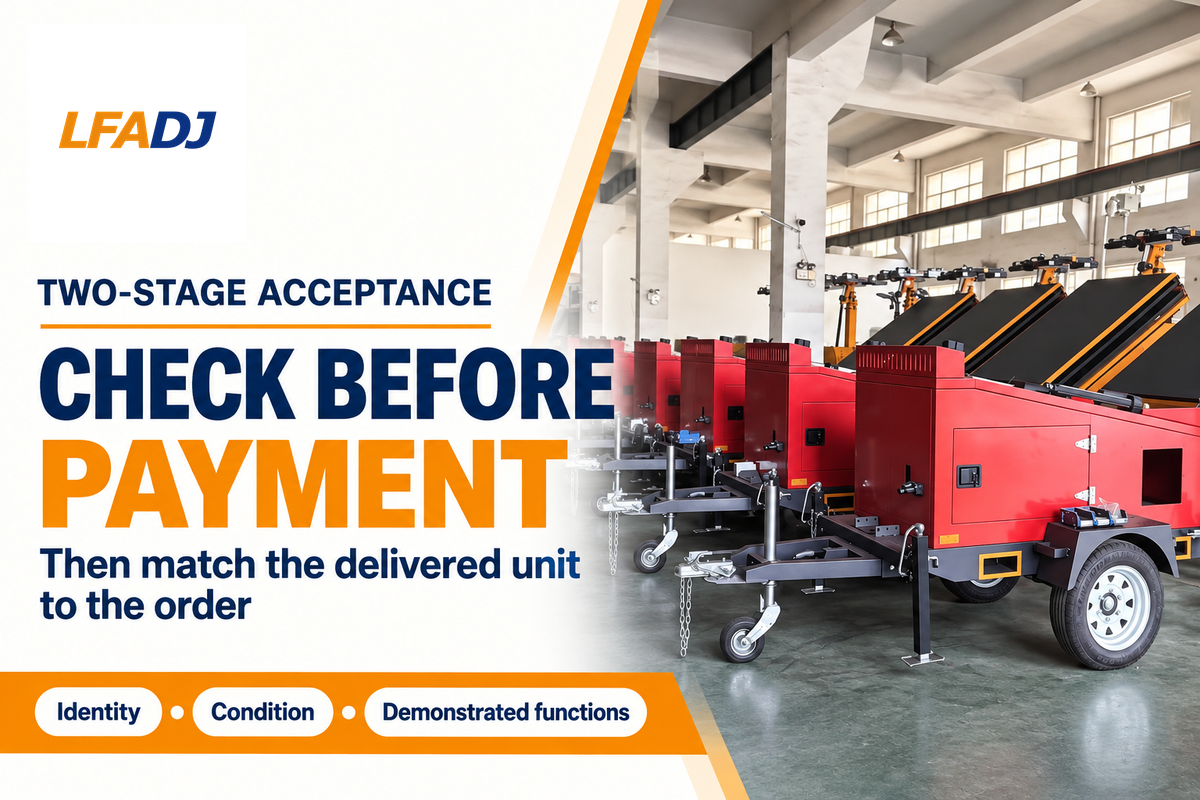
Inspect the proposed condition of the equipment before committing to it, then inspect the delivered unit against the accepted order record. Those are different stages. A machine that starts can still have incomplete lighting, control or transport equipment. Qualified personnel should perform the demonstrations and handle the equipment safely under the chosen model’s instructions.
Light tower inspection before payment and after delivery
A record should identify the exact machine, its history and condition being sold, before payment is made. On delivery compare the serial number, included parts and damage against the record, and functionally inspect the machine. A distant sale makes dated photographs and a clear inspection scope especially useful.
A “repair” entry becomes useful only if it states what was actually repaired, what was replaced and what was demonstrated afterward. “Repaired lights” leaves open whether every head works and whether the fault recurs. Missing component labels can delay the ordering of parts. The acceptance record should state this before the equipment is made available for work.
| Item | Before payment | On delivery |
|---|---|---|
| Identity | Model, serial number and included package | Delivered identity matches the order |
| History and condition | Service records, repairs and inspection findings | Transport damage and condition differences recorded |
| Lighting | All heads, settings and controls demonstrated | Agreed functions and duty checked |
| Mast and support | Qualified inspection and model-specific demonstration | Correct supports, instructions and handling equipment available |
| Supply and accessories | Included supply and permitted auxiliary demand recorded | Chosen interface and complete package confirmed |
| Handover | Training and outstanding work agreed | Operators receive the correct instructions and control familiarisation |
A NY FACE investigation from 2017 reported a fatal powerline contact while a mechanic was taking down rental light towers in May 2012. The contact was unwitnessed. The report found issues including site-surveys, training and control-familiarity. There are also aspects of planning, and erection as well as return and mast lowering that deserve focus. The dimensions of the incident aren’t safe-clearance guidance.
When a seller is unable to demonstrate a complete system as agreed, the buyer should exclude the undemonstrated function from the agreed condition and agree a price for the work required to make the complete system before committing to a purchase. A durable style enclosure doesn’t constitute an inspection. Electrical fault-finding and structural repairs belong with qualified technicians, rather than an improvised buyer test.
Acceptance boundary: the assumed 10-hour shift is the duty being bought; the demonstration still follows the chosen model’s instructions. A seller’s starts-and-runs video leaves lighting heads and controls to check. Any functions not demonstrated should be recorded. A buyer should take into account the price of remediating functions not demonstrated and the date the work will be completed.
Supplier Documents and Support That Matter After Delivery

Documents should be matched to the product or service they describe. Company management system certificates, luminaire reports, engine logs, and transport documents should be placed in different groups. Procurement also needs usable parts information and written support terms, because a technically suitable purchase can sit idle while a missing part or responsibility is resolved.
Build one product handover file containing the model and serial identity, supplied drawing or layout, operating instructions and ordered accessories. For engine-equipped units going into a United States application, the Environmental Protection Agency explains certificate retrieval by engine family and production model year. Match that identity to the actual engine rather than to a general brand brochure.
The consolidated procurement record should request:
- The lighting duty, mast arrangement and permitted operating conditions for the ordered equipment package.
- Supply and charging interfaces, accessory demand and the applicable product reports.
- Battery chemistry and shipping arrangement and shipping documents for installed or spare batteries.
- Transport and unloading arrangements for the selected chassis.
- Identifiable replacement heads, controls and other service parts, with lead time.
- Warranty coverage, exclusions, claim procedure and responsibility for freight or on-site work.
Does equipment come with a warranty?
A warranty applies when it forms part of the agreed offer or contract. Review the covered equipment, duration and remedy, exclusions, and responsibility for freight and/or labor. Terms for new and used offers may differ. A sales description such as reliable or high-performance isn’t a replacement for these written conditions.
LFADJ provides product consultation, selection and lighting solutions for the customer’s working environment. Its response time, warranty period and on-site support scope should follow the agreement between the parties. When the task and required arrangement are settled, use the existing portable light towers for sale solution page to discuss configuration and get a quote.
Prepare the Site and Transport Route Before Arrival
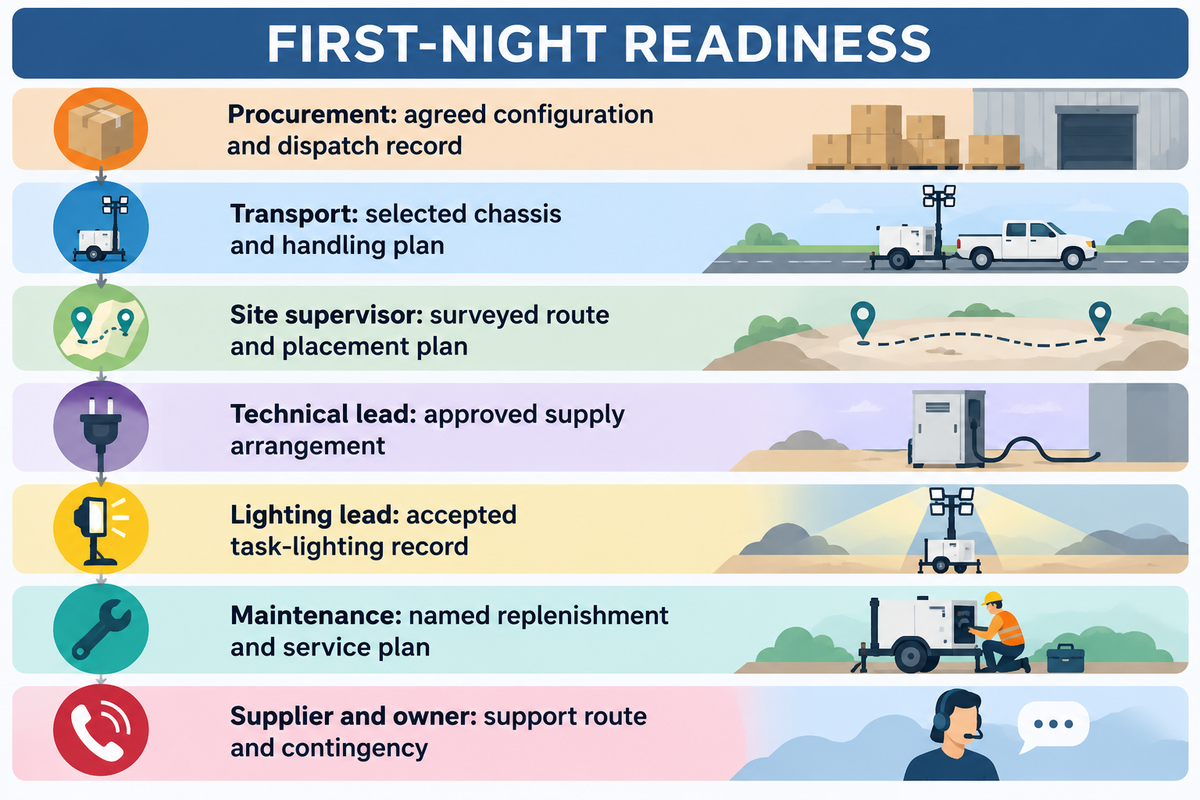
First-night readiness requires a usable arrival route, suitable placement, the correct supply interface and a responsible person for handover. Delivery alone completes only one part of that chain. Prior to arrival of the equipment, determine each condition that could prevent use, assign a responsible person, and document the evidence to support that the condition no longer applies.
Shipping and delivery: the hidden bottleneck map
| Handoff | Possible blocker | Owner | Release evidence |
|---|---|---|---|
| Order to dispatch | Different supply or accessory package | Procurement and supplier | Agreed configuration and dispatch record |
| Dispatch to arrival | Wrong transport or unloading arrangement | Transport coordinator | Selected chassis and handling plan |
| Arrival to placement | Restricted route, unsuitable ground or overhead hazard | Site supervisor | Surveyed route and model-specific placement plan |
| Placement to supply | Unready electrical, charging or fuel interface | Qualified technical lead | Approved connection and supply arrangement |
| Supply to useful light | Shadow, glare or unsuitable output mode | Lighting/site lead | Agreed task-lighting acceptance record |
| First use to next shift | No recharge, refuelling or service responsibility | Maintenance lead | Named replenishment and maintenance plan |
| Fault to restored work | Unavailable parts or unclear remedy | Supplier and equipment owner | Written support route and contingency |
HSE’s workplace-transport guidance discusses pedestrian crossings and loading bays and suggests lighting to avoid glare and shadows. Include those approaches in the layout. Consider the movement of people around a useful work face.
Consider for example the arrival of a unit the afternoon before a 10 hour shift. The receiving team can sign for it. However, an unresolved route for unloading can still prevent use. A bottleneck map gives procurement the reason to address the route before the unit is dispatched. For the supervisor, the map identifies the person who releases the unit into work. If the project can’t lose that night, a standby rental unit should be in the schedule and budget.
Readiness check: A 10-hour lighting requirement includes a supply and handover plan for the entire 10 hours. Distribute charging and fuel and fault-response responsibilities before the first shift. The delivery date is useful when the route from unloading to the accepted illumination has a named owner at each handoff.
Industry Outlook: Version-Matched Buying in 2026
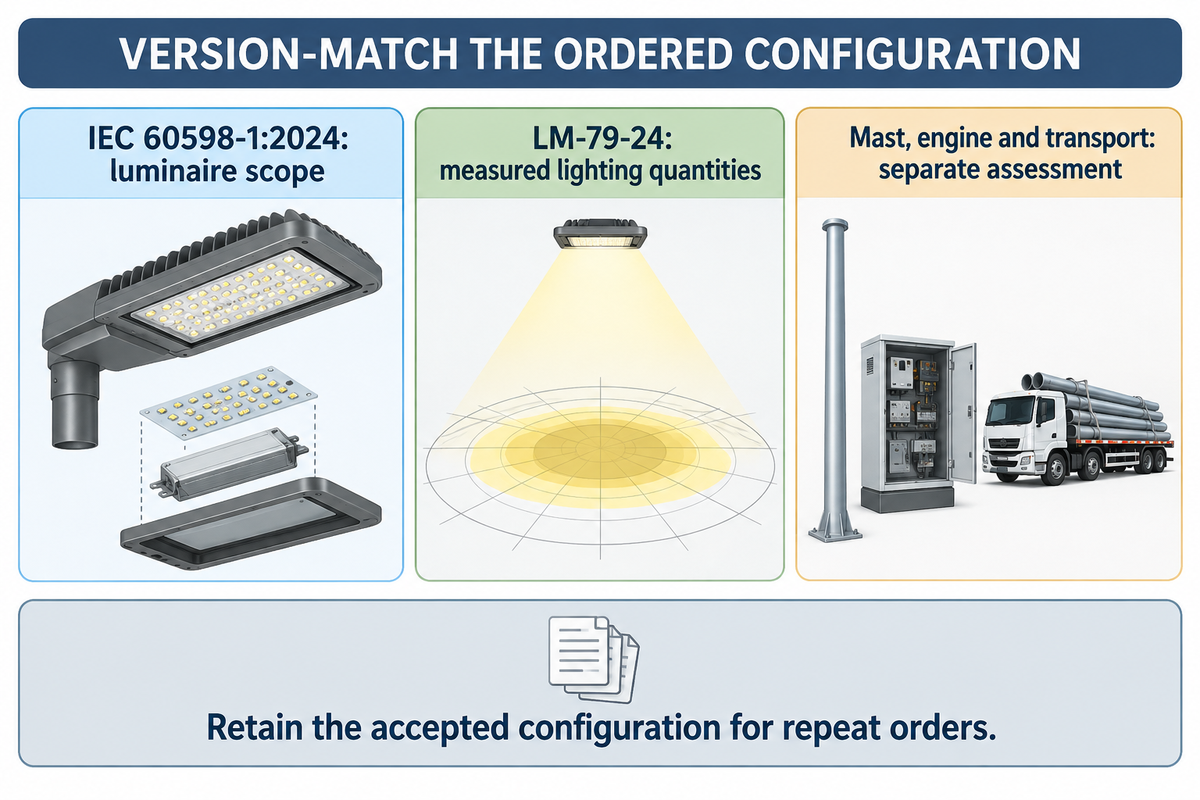
A useful 2026 procurement update is to align luminaire reports to the ordered supply arrangement and cited standard edition. Recent public standards summaries cover battery luminaires and measurement methods. In reviewing a complete lighting package, be sure to include a separate assessment for the mast, engine and transport.
The International Electrotechnical Commission lists IEC 60598-1:2024 as valid edition 10, published on November 6, 2024, replacing the 2020 edition. Its public revision summary includes a new Annex W for luminaires using batteries and changes to supply marking. That is a concrete reason to examine which supply arrangement a report covers.
The change concerns luminaires. Selecting a complete tower also includes its supporting structure, the chosen power system and movements. A different battery, controlgear or supply option should be considered before the order is final. At the time of the procurement, options can easily be compared, and procurement can resolve the report identity with the supplier.
IES’s published LM-79-24 description addresses reproducible optical and electrical measurements of solid-state lighting under standard conditions. Use those results for the measured product quantities; keep field layout, end-of-shift output and the required operating environment in their own acceptance records.
Technology adds value when its operating conditions fit the work. Automatic dimming, remote monitoring, or a shore-power option can change maintenance and supply planning, but each has to have a specific place in the duty schedule. Keep the last accepted configuration for repeat orders and document any changes. That gives the next buyer a reference point instead of an old brochure with a more recent date.
FAQs
Where should I look for portable light towers for sale near me?
Start with local equipment dealers, rental fleets selling used units and manufacturers that serve your delivery area.
Compare the actual package and its condition rather than the distance shown in a listing. A nearby seller is useful when it provides accessible inspection, parts and support. For equipment shipped from elsewhere, establish where service will be performed and who pays the relevant transport costs. The machine’s identity, demonstrated lighting duty and written terms remain the basis of the purchase.
Can a light tower supply power to other equipment?
Some generator-equipped towers have auxiliary outlets, with permitted loads specified for the selected machine.
The lights already use part of the available supply, and a tool can have a different starting demand from its running demand. Include the intended accessory in the supplier’s load assessment and the qualified electrical interface review. An engine or generator rating alone is not a statement of spare outlet power. Keep the permitted accessory use with the operating instructions so later users can follow the agreed arrangement.
Is the equipment equipped with telematics or fleet tracking?
Telematics is a model and service-package option, rather than a feature of every tower.
For a fleet or remote installation, define which information is needed: location, operating state or a maintenance alert, for example. Establish who receives the information and whether connectivity or subscription costs apply. A status screen can support planning, but physical condition and task illumination still need their own checks. Include the agreed controller and reporting package in the order to avoid an unexpected difference at handover.
Can a gasoline light tower operate indoors?
No. Keep a combustion generator outdoors, away from occupied spaces and openings that can admit exhaust.
Open doors do not make indoor engine use acceptable. Choose an appropriate battery-based or externally supplied lighting arrangement for enclosed work.
Can I finance a light tower?
Yes. Equipment sellers and lenders can finance a light tower, subject to that provider’s offer and approval.
Compare the deposit, fees, interest, repayment period and ownership terms with the cash offer. Include the resulting charges in the project-cost comparison.
What if the equipment arrives after my first planned night shift?
Use a contingency agreed before ordering, such as separately reserved temporary lighting or a rental.
The contract should identify the promised delivery milestone and the responsibilities for unloading and commissioning. A replacement cannot be assumed to be available simply because the original order is late. If a missed shift would stop other work, arrange the fallback early enough to reserve the equipment and its transport. Include minimum billing periods, delivery and collection in that plan. The supplier’s delay remedy and any support commitment should follow the actual agreement. Keep a named person responsible for activating the contingency so the receiving team does not discover the unresolved decision when the work is due to begin.
Key takeaway
Set the lighting duty first. Compare complete, ready-to-work offers over the same period, test repair and resale assumptions, then assign the handoffs needed for the first working night.
Bring the task layout, shift schedule and preferred movement arrangement to the supplier. Use those inputs to discuss the lighting duty with LFADJ and evaluate a potential configuration and/or price.
The dollar figures and load examples are stated comparison inputs, not supplier quotations or product test results. LFADJ’s reference specifications are supplier-published. Site design, electrical work and equipment handling require the applicable instructions and competent personnel.
Related Lighting Resources
- Solar light towers guide
- Diesel light towers guide
- Hybrid light towers guide
- LFADJ mobile lighting systems
References & Sources
- UL Standards & Engagement: UL 153, Portable Electric Luminaires, public scope.
- Health and Safety Executive: Lighting and human factors.
- Occupational Safety and Health Administration: 29 CFR 1926.56, Illumination, Table D-3.
- Illuminating Engineering Society: ANSI/IES LM-79-24, public description.
- U.S. Energy Information Administration: Measuring electricity.
- Centers for Disease Control and Prevention: Carbon Monoxide Poisoning Basics.
- U.S. Department of Energy: Take Five, Life Cycle Costs for Acquisition, December 2024.
- Construction Equipment: When to buy, when to rent light towers, March 2021; attributed fleet-practice interviews.
- New York State FACE Program: Mechanic Electrocuted When a Mobile Light Tower Contacted Powerline, report 12NY018, 2017.
- U.S. Environmental Protection Agency: Engine certificate information.
- Health and Safety Executive: Workplace transport, Lighting.
- International Electrotechnical Commission: IEC 60598-1:2024, public edition and revision summary.