Get in touch with LFADJ Company

Mining and quarry light towers provide temporary area lighting where the workfront moves and natural light no longer supports the task. A good plan connects the light reaching the work area with the people, machinery, power supply and the changing ground around it. Start there before comparing equipment packages.
This guide describes the comparison of temporary work space (lighting) evidence and how to keep a layout plan that remains useful as a site changes. The three tools that follow are a point-reading comparison, shift-supply map, and Mining Lighting Change Register.
What Are Mining & Quarry Light Towers Used For?
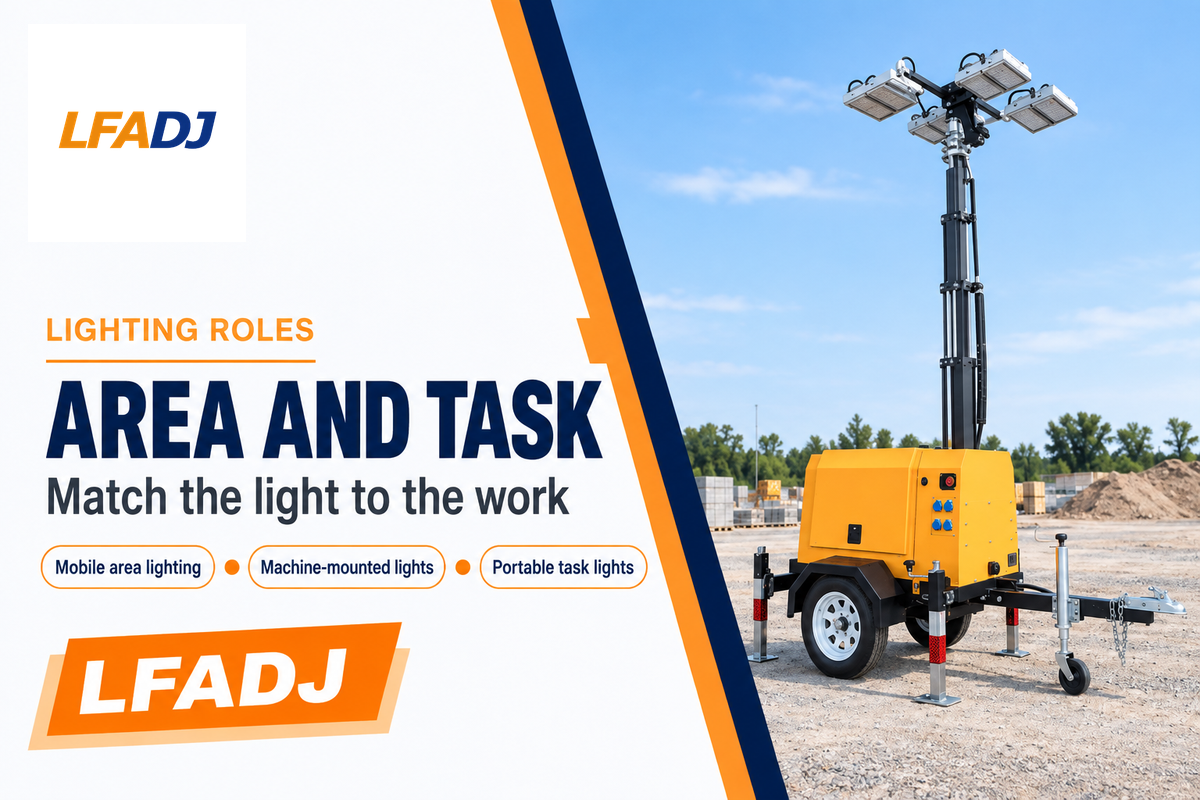
A mobile lighting tower illuminates a temporary work area while local lamps and machine-mounted lights serve closer tasks. At a surface mining operation, the arrangement may support loading, vehicle access or repair work; the required equipment follows the activity, obstructions and operating environment rather than the word “mining” on a brochure.
In US surface metal and nonmetal mines, 30 CFR 56.17001 stipulates sufficient illumination at specified surface structures, routes, loading and dumping areas and work areas. This part of the rule doesn’t state a numerical lux limit for every task. Identify the applicable requirements and the task before asking a supplier for a coverage figure.
What kind of lights are used in mines?
Mine lighting can include fixed installations, mobile area lighting, machine-mounted lights and portable task lights. A tower supports a wider area, while portable work lights can illuminate a maintenance detail screened by equipment. Underground work, a coal mine and an area classified for explosive atmospheres require their own assessment; a surface-lighting guide can’t establish their equipment approvals.
Different light sources may also require different operating questions. An LED light tower and equipment using traditional metal halide lamps should be compared at the useful task, with their actual optics, controls and supply arrangement. Changing the lamp technology doesn’t remove the blind spot behind a truck.
Start with the task, not a coverage claim
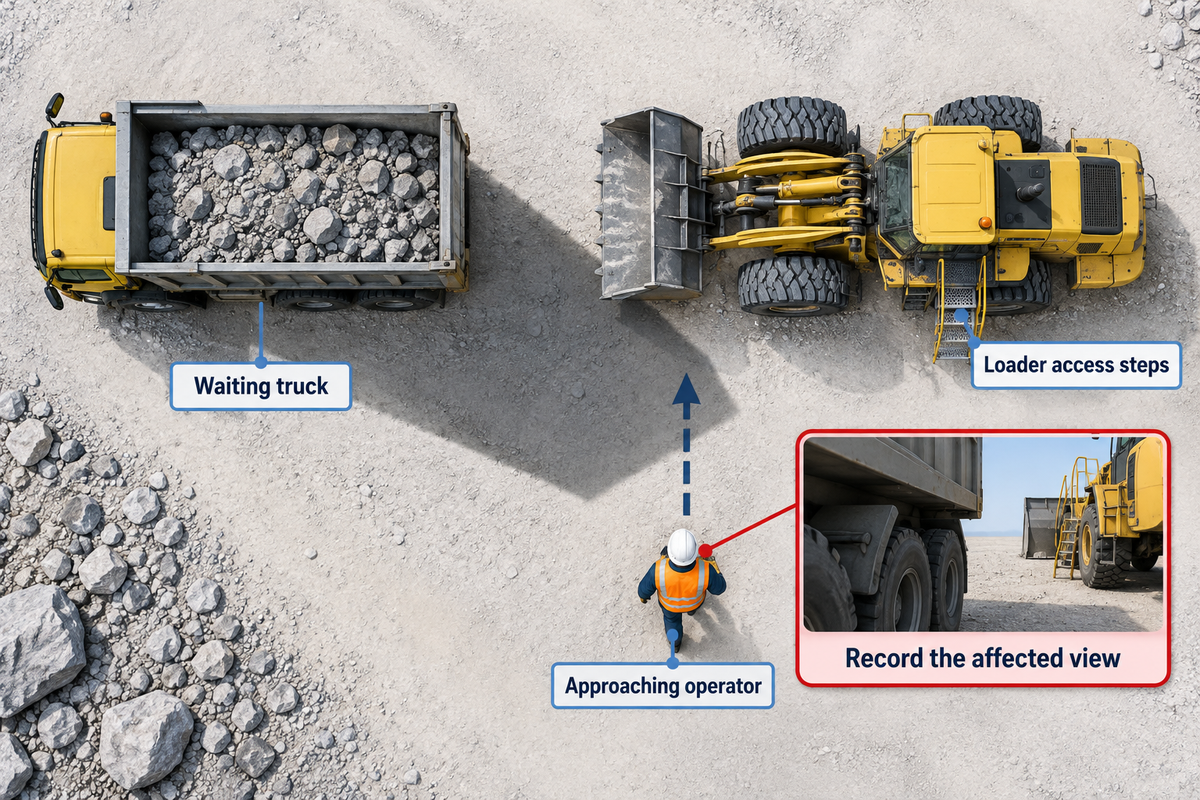
Task planning begins with the view a person requires, from the location where it’s required, and what may obstruct it. A broad light-coverage figure says little about a stair tread behind a loader or a pedestrian approaching a queue. These relationships must be recorded prior to selecting tower positions or accepting a lighting arrangement.
HSE’s human-factors guidance on lighting explains why equipment, trailers and containers can introduce shadows into a workplace that looked adequately lit when empty. Translate that observation into specific entries in the site brief:
- Identify what must be seen at the loading face and the dump point.
- For a conveyor service point, machine access steps or repair pad, identify what’s being inspected, the access route and what obstructs the view.
- A stockpile edge, haul road junction, or pedestrian interface requires consideration of changing geometry, sight lines and where people and mobile equipment interact.
An example is the layout of a quarry loading area. The original lighting check was taken with just one truck at the loader. A second truck is now situated along the access route. The tower is still running and the face looks bright, but the waiting truck obstructs the access steps to the loader from the approaching operator. Changing the position of the waiting truck changes the obstructed view. Adding lamp output may leave the access steps blocked. The record identifies the step, the approach direction, the position of the queue, and the arrangement that was observed during the check. The site can then decide how to control the changed condition and what evidence must be collected again.
For procurement, that record is more useful than “high-quality lighting for mining sites.” It tells the supplier which view the proposal must address. At changing work sites, a useful report of poor lighting tells operations what view to address instead of making a report to propose more output to address the situation.
Read the lighting plan from each working viewpoint
Useful illumination varies with its placement and what’s made available to the observer. Lumens describe source output; lux describes illuminance on a surface. A mean reading can conceal a darker point, while a high-intensity source in the wrong direction can make a driver’s view harder to interpret.
How much light do you really need?
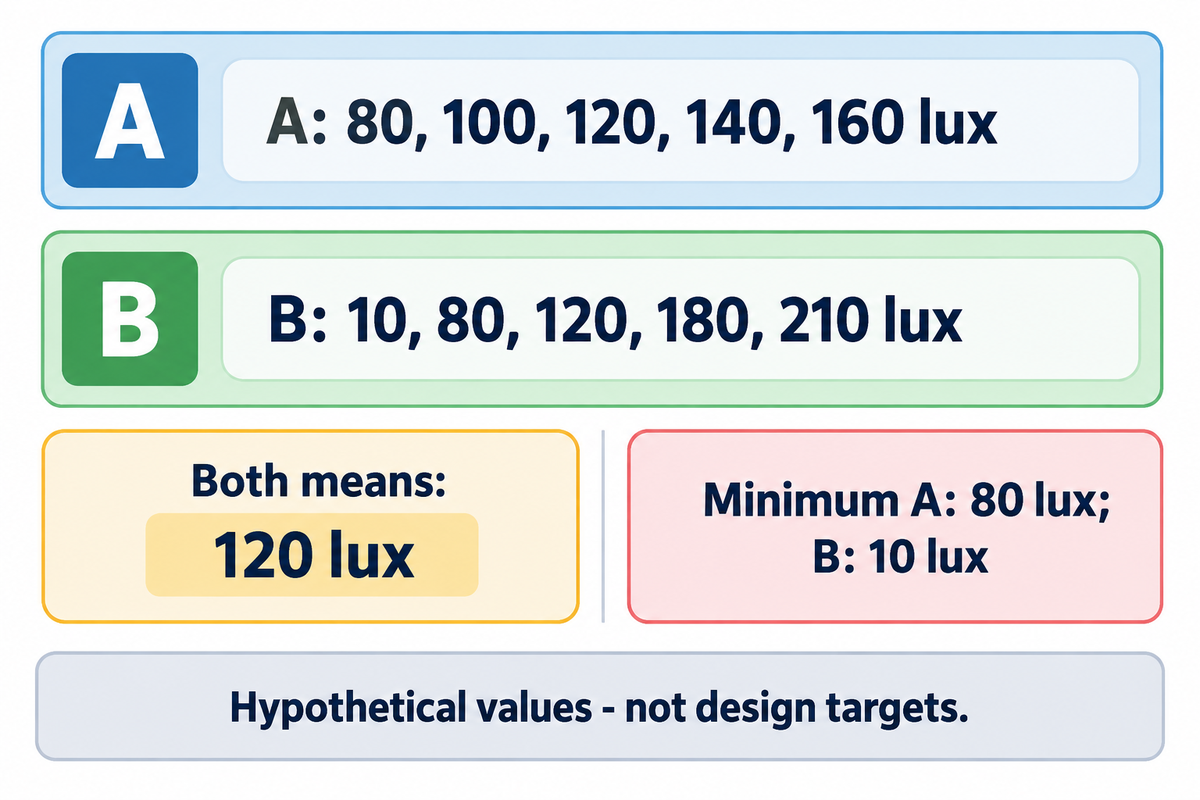
The amount of light required rises with task detail: HSE guidance says a corridor or walkway may only require 50 lux, a process control room 300 lux and studying an engineering drawing 750 lux. Ask for the assessment points, measurement plane and conditions behind a proposal, then examine the distribution and glare as well as the average. Five invented readings demonstrate the arithmetic; they don’t define a sufficient survey grid or a reasonable mine lighting level.
| Invented set | Five point readings, lux | Mean, lux | Minimum, lux |
|---|---|---|---|
| A | 80, 100, 120, 140, 160 | 120 | 80 |
| B | 10, 80, 120, 180, 210 | 120 | 10 |
Each set totals 600 lux across its five readings, so each arithmetic mean is 600 ÷ 5 = 120 lux. Yet the lowest point differs: 80 versus 10 lux. Neither the shared average nor the minimum alone establishes task visibility. Keep individual readings tied to their locations, reference plane, equipment arrangement and observed glare.
Real mining research reinforces the importance of geometry. Mayton, Demich and Nasarwanji’s surface mine study focused on ingress, egress and walkaround tasks for two haul trucks and two front-end loaders. The study used 400- and 663-lumen area luminaires to assess glare. The study concerns machine-mounted lighting, rather than trailer towers; its practical contribution here is to examine the actual task and mounting geometry.
Check motion as well as spatial distribution. DOE’s flicker research explains that temporal light modulation depends on driver loading, dimming level and the driver/dimmer waveform. When a conveyor, drill or other moving machinery is involved, request performance evidence for the intended settings and include motion appearance in the assessment. Matching lux readings doesn’t characterize that behavior.
For vehicle approaches, HSE’s workplace-transport lighting guidance also identifies direct and mirror glare when reversing toward strong lights. Check the view from the working position, including the transition between brighter and darker areas. A bright photograph taken beside the tower can’t answer those questions.
Match mining light tower power to the shift
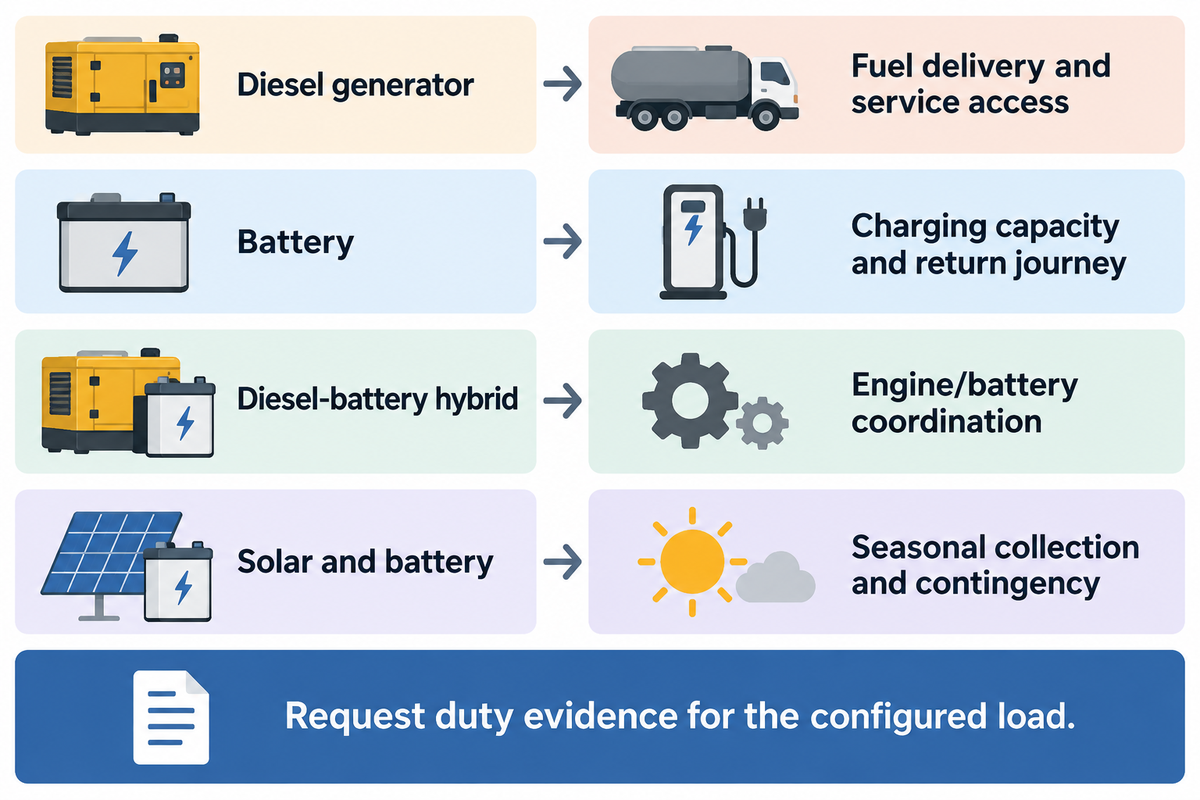
Choose the best supply arrangement to meet the required lighting duty and the next opportunity to replenish energy. Diesel, battery, hybrid and solar-powered equipment impose different fuel, charging and collection demands. A low local fuel requirement helps only when the complete arrangement can deliver the agreed useful light through nighttime operations.
DOE’s purchasing guidance defines luminaire efficacy in lumens per watt and cautions against comparing unlike products. Apply that discipline to tower proposals: compare the same task result before discussing energy efficiency, fuel consumption or long-term savings.
| Supply path | Bottleneck to resolve | Evidence to request |
|---|---|---|
| Diesel generator | Fuel delivery and service access | Duty at the specified lighting load and the replenishment plan |
| Battery | Charging capacity and return journey | Usable duty and recharge conditions at the expected temperature |
| Diesel-battery hybrid | Engine/battery coordination | Operating sequence, lighting load and permitted quiet-running duty |
| Solar and battery | Seasonal collection and replenishment contingency | Site solar assumptions, storage duty and response to a collection shortfall |
Suppose there’s a remote mining repair pad with a charged battery unit at the workshop. The lighting duty looks to be compatible with the supplier’s stated operating conditions, but the charging point is across the site and the equipment transport slot is occupied. The unresolved question is the replenishment route, not if the lamp uses less power. If a verified charging and return window becomes available, the comparison changes. If not, the plan is to develop another supply route or adjust the service frequency. Operations identifies the interruption; procurement requests matching duty evidence; finance compares the complete service cost instead of an isolated fuel figure.
Consult the individual guides on diesel light tower operation, how hybrid light towers work and solar light tower runtime planning for more details on the platform. A solar trailer or a hybrid label by itself doesn’t determine a shift calculation.
LED technology can be part of reducing fuel consumption, but a convincing carbon footprint or emission comparison also needs to define its system boundaries. Ask whether charging energy, engine operation and service journeys are included before linking a proposal to sustainability goals or calling it cost-effective.
Plan the mast footprint and every relocation
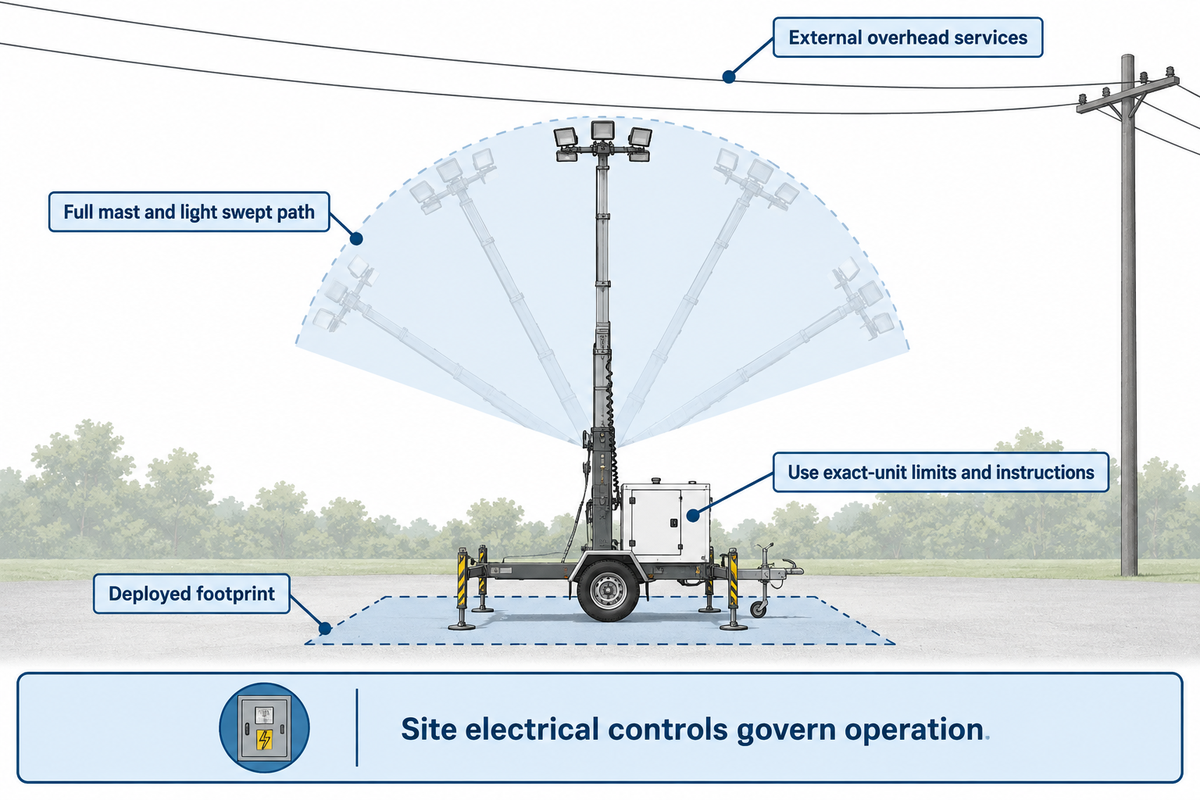
Relocation planning addresses the deployed footprint, the transport arrangement and the entire path swept by mast and lights. Ground support and access, traffic and overhead services may also change when a workfront moves. Obtain the exact unit’s limits and instructions before assigning a new position or arranging its movement.
An official Western Australian lighting-tower collapse report gives the example of an oil field work-over operation during which a mast locking pin, due to imperfect alignment, was engaged only partially. No deployment manual or procedure was available. This example raises the model-specific deployment process to a procurement question; it doesn’t provide a universal locking procedure for all vertical masts.
External electrical hazards remain separate from the tower’s own supply. In OSHA accident record 201086840, a construction worker preparing a tower for transport was electrocuted when the light bar rotated into an overhead line. Earlier, the generator had been switched off. This incident occurred in 2006, and involves construction, but the planning question it raises is what can the moving mast assembly approach?
For US surface metal and nonmetal mines, 30 CFR 56.12071 addresses equipment moving or operating near energized high-voltage lines. The site’s applicable electrical controls and the equipment instructions govern the operation.
Provide the supplier with the expected deployment conditions including types of slopes, ground conditions, low temperatures, extreme temperatures and corrosive exposures if relevant. Request working and transport envelopes separately. A compact transport dimension says little about the space occupied by deployed supports or the permissible operating conditions.
Track changes with the Mining Lighting Change Register
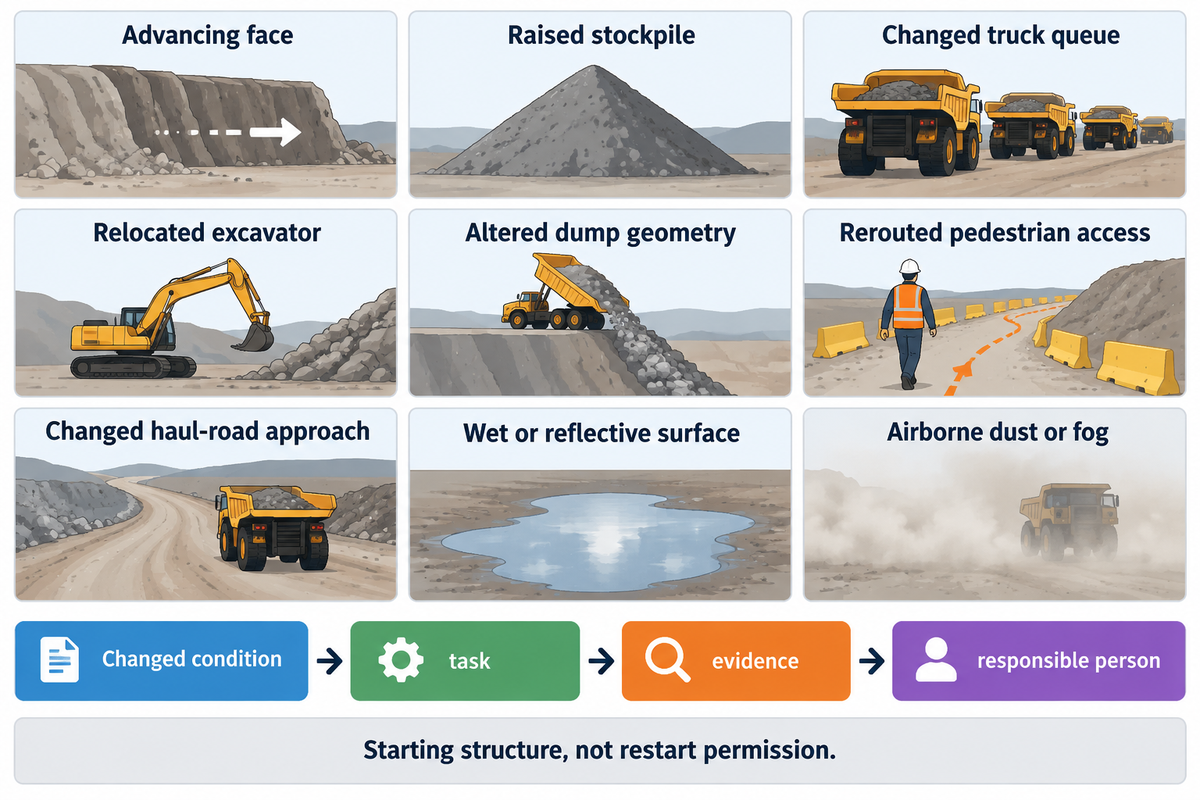
A lighting change register links a changed site condition to the task it affects, the evidence that needs reviewing and the responsible person. Keep the accepted status quo identifiable so the next shift can see what has changed. The register supports the site’s control process and the recorded decisions.
9 Changes That Reopen the Lighting Plan
The Mining Lighting Change Register records nine recurring site changes, the affected view, and the evidence required for a new site decision.
The editorial register below draws on WorkSafe New Zealand’s guidance on changing roads and vehicle operating areas and the obstruction mechanisms described by HSE. These bring together useful review triggers. The site appoints competent persons and determines the controls.
| Changed condition | Affected task or view | Evidence to revisit |
|---|---|---|
| Advancing face | Loading boundary and approach | Current face geometry and assessed work points |
| Raised stockpile | Route beside the pile | New obstruction and sight line |
| Changed truck queue | Access steps and pedestrian approach | Queue arrangement during the lighting check |
| Relocated excavator | Work behind or beside the machine | Machine shadow and observed work position |
| Altered dump geometry | Vehicle approach and dumping task | Current operating boundary and approach view |
| Rerouted pedestrian access | Walking route and vehicle interface | Revised route, obstructions and lighting observations |
| Changed haul-road approach | Driver view and mirrors | Glare and bright/dark transition on that approach |
| Wet or reflective surface | Recognition of the task surface | Observed reflections under the changed condition |
| Airborne dust or fog | Recognition through the affected view | Actual visibility and the site’s environmental response |
An example of a filled out entry might look like this: “Setup Q-07; Loading-area queue moved; Lower loader step screened from pedestrian approach; Observation and annotated site photo attached; Review assigned to shift supervisor under site procedure; Revised queue arrangement and lighting rechecked in Q-08.” The value is the relationship between condition, evidence and decision. An entry like “lights checked” doesn’t show that relationship.
Add the date, affected location, site-assigned owner, required response and disposition to each live entry. Equipment or driver/dimming changes and mast/overhead conditions also need the checks described above. The nine rows are a usable starting structure, rather than an exhaustive hazard inventory or permission to restart work.
Keep visibility intact between shifts
A running tower can lose useful lighting through dirty covers, changed aiming, damage, an obstructed view, or a supply problem. Handover should carry the actual condition and unresolved task observation. Distinguish between maintenance faults and layout changes so a repair isn’t misconstrued as resolution of a different visibility issue.
WorkSafe New Zealand’s vehicles and traffic-management guidance connects visibility with equipment condition, blind spots and dust controls. HSE requests clean light covers and maintained lighting. Use the site’s inspection process and unit’s instructions to determine the work and its interval.
Operators exchange information in many ways, but their exchanges typically involve recording observations and discussing responses. A lamp cover is observed to be dusty; it can be cleaned. A parked maintenance vehicle casts a shadow; no amount of cleaning can resolve that. Report two observations, with different responses. After addressing the obstruction, record an observation of the changed arrangement. If the replacement shift sees only “lamp cleaned,” it may inherit the unresolved obstruction. The same principle applies to a generator that’s running; an engine running indicates something about the status of the engine, but the task still needs its own lighting check. Retain the location, and the setup that’s obstructed and the ownership of unfinished responses.
Durability is also in that maintenance plan. Ask what enclosure, connectors, supports and controls can withstand under the defined conditions. A long life claim over LEDs doesn’t establish the life of the complete tower, or an interval for inspection.
Turn site evidence into a supplier brief
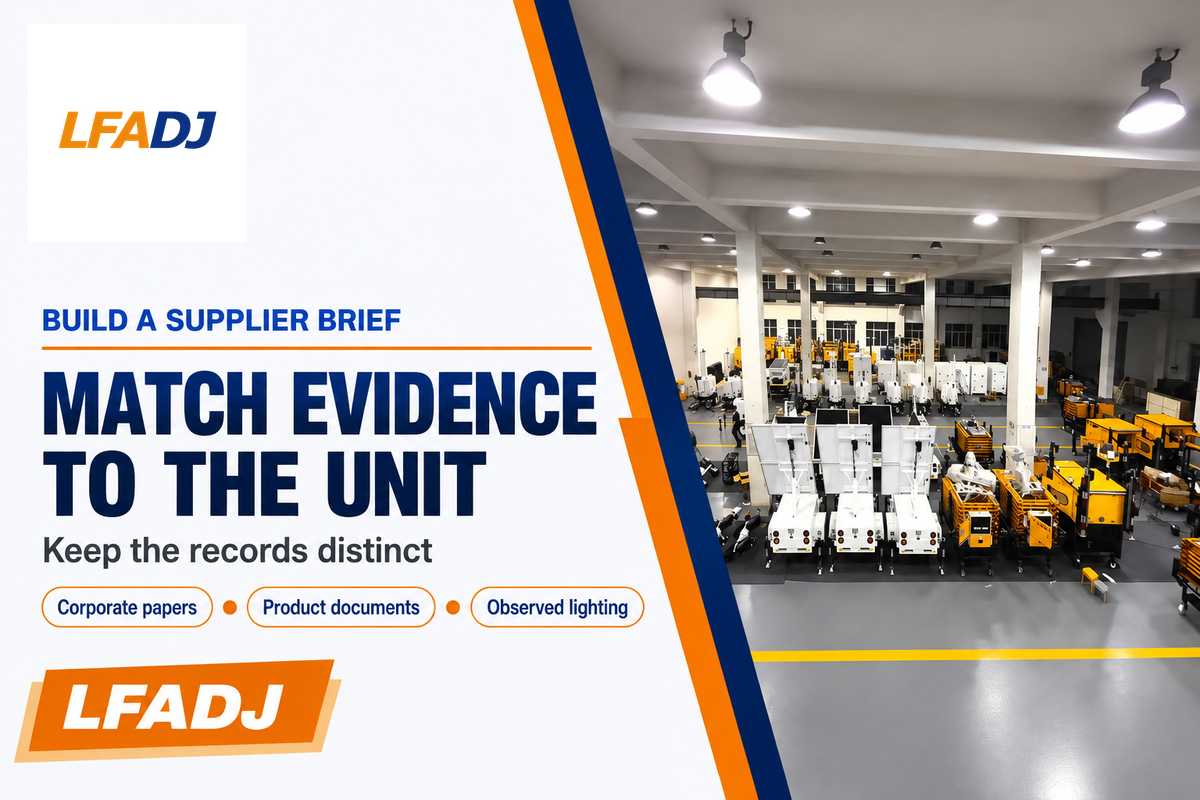
A supplier brief indicates the task, deployment conditions and evidence for the configured product. Proposals can then be compared. Operations and quality personnel on site can determine what still needs to be checked. Maintain corporate papers, product papers and observed lighting performance as distinct records.
The task and obstruction sketch, expected lighting, deployment and transport conditions, and the route for replenishment are sent. The exact model and configuration, relevant photometric data with setting conditions, operating limits, manuals and the acceptance record are requested. Specify auxiliary electrical loads separately from the lighting load.
For equipment, use LFADJ’s mining and quarry light tower configurations and the brief site description. Zhejiang LONGFA Lighting Co., Ltd. manufactures industrial and mobile lighting; the proposed and actual units and documents supplied should govern the discussion on the technology. Agree warranty, response times, and support in the contract.
ISO’s explanation of quality management describes a management system. A company’s management system certification does not, in and of itself, validate a tower’s hazardous area approval or mine site acceptance. Where approval is required, match the exact model, marking, configuration and permitted use to its supporting documentation.
Connect the lighting plan to site services
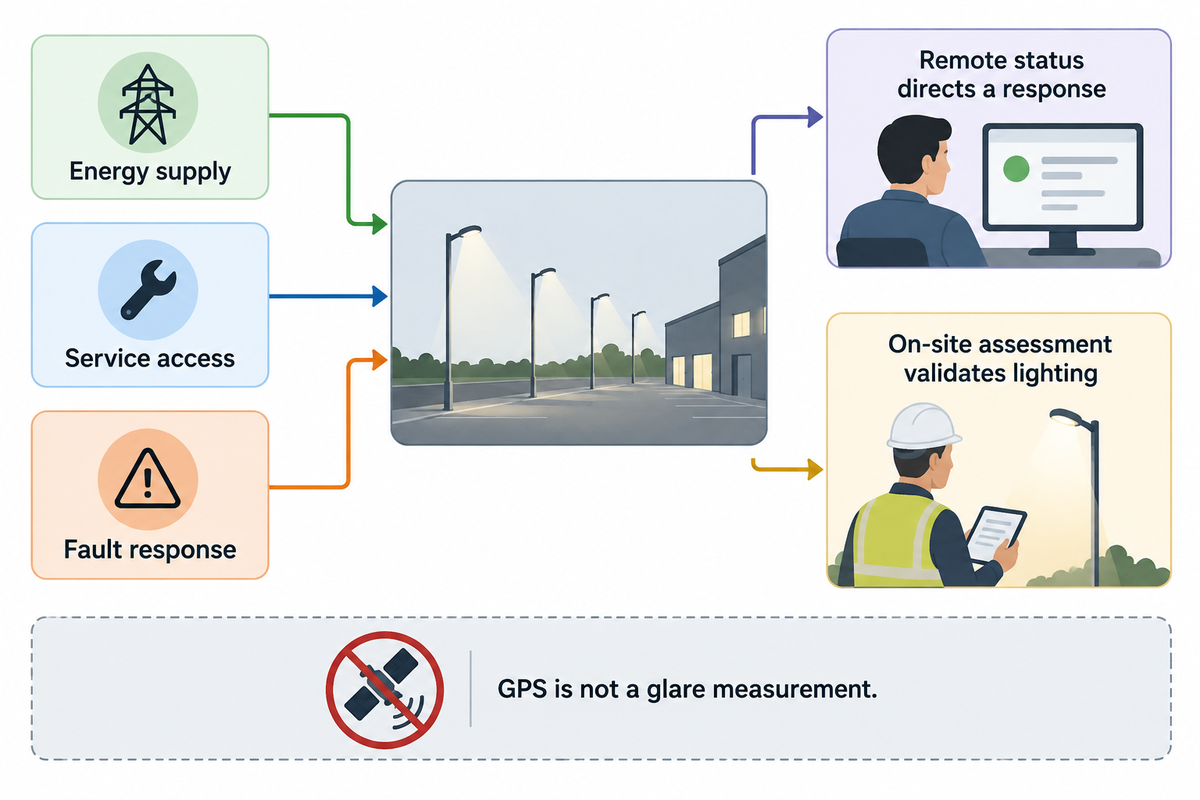
Lighting integration joins energy supply, service access, communications and the response to a fault with the task being illuminated. Remote status can help locate equipment and direct a response, while an on-site assessment is performed to validate the lighting results. Define responsibility for both so that an alarm or changed condition leads to an action.
Define who’s responsible for fuel or charging, how service is provided to the unit, what happens during an interruption and who’s responsible for supported alarms. If CCTV is part of the work-area arrangement, its input is required during lighting checks. HSE states that bright/dark changes can also affect camera adjustment. GPS location and a normal operating signal don’t measure glare in the driver’s eyes.
What the current outdoor standard adds to the brief
For projects using an outdoor-workplace lighting specification, the edition matters. BSI lists BS EN 12464-2:2024, published on 30 November 2024, as current. Its public scope addresses quantity and quality of outdoor workplace illumination for visual comfort and performance, including obtrusive light. Identify the edition and applicable scope in the project brief instead of relying on an unattributed lux table.
Within the mining industry and the wider industrial sector, productivity and risk of accidents are reasons to take lighting seriously. Claims that a package will improve productivity or meet sustainability goals still need their own evidence. Compare the specified task result, service burden and energy boundary rather than assuming that the use of LED technology makes every proposal sustainable.
Bring those interfaces back into the site’s mobile lighting systems discussion. The final record should identify the accepted arrangement, the conditions observed and the person responsible when those conditions change.
Frequently Asked Questions
How durable are LED fixtures in a quarry?
Durability depends on the complete assembly and its specified operating conditions.
Examine enclosure protection, mounting, connectors, vibration, corrosion and the allowable temperature range. A durable light source doesn’t indicate the life of the engine, mast, wiring or a trailer. Request the specific unit’s data and instructions for maintenance. Keep a product rating separate from a result obtained under the conditions at your quarry.
Can construction light towers be used in mining sites?
Yes for surface work, when the exact configuration meets the mine’s requirements and the site’s competent personnel accept it; underground and hazardous areas need their own assessment.
In regard to construction sites’ equipment, assess the mining task, light distribution around machinery, deployment conditions and supply duty and required documentation. Ordinary surface work, underground operations and hazardous areas raise different questions. The site’s competent personnel determine acceptance of the proposed arrangement; a category label on its own can’t settle that decision.
Why is GPS location data not enough in mining?
GPS identifies location, while task lighting requires evidence about the actual view.
A position signal can’t show whether parked trucks block light at a work point, or whether the driver is experiencing glare. Engine status also leaves questions unanswered about lamp condition and output. Use supported remote info to direct inspection and service, then confirm lighting result under the equipment arrangement and conditions being evaluated.
How often should a quarry reassess its lighting layout?
Every shift for working conditions, plus a layout review when the site changes: in US surface metal and nonmetal mines, a competent person must examine each working place at least once each shift for conditions that may adversely affect safety or health.
Reassess the affected tasks when workfronts, traffic, obstructions, weather or equipment arrangements change and record the response.
Does every mining light tower need explosion-proof certification?
No: the required approval follows the location and applicable requirements, such as an area classified for explosive atmospheres, not the category name.
A mine location doesn’t define a hazardous area classification on its own. Surface tasks, underground operations and locations with explosive atmospheres require separate assessment. Where special approvals are needed, check the exact model and configuration, as well as the markings and permitted use against the documentation. An explosion proof product in a supplier’s range doesn’t demonstrate approval for all of that supplier’s products. The same applies to corporate management system certificates.
References & Sources
This guide draws on the linked US mine regulations, official incident records, UK and New Zealand workplace guidance, original surface-mine lighting research, DOE technical guidance and public standard-publisher information. Jurisdictions and study conditions remain identified beside their use. The worked readings and site scenarios are explicitly hypothetical; they’re editorial teaching aids, not LFADJ field measurements. The commercial configuration link leads to LFADJ’s own solution page.
Prepared by GW for LFADJ. Use the task brief and change register to organize the equipment discussion and the site’s own lighting assessment.