
Get in touch with LFADJ Company


Light towers must endure multiple bookings, transport and return to service in time for the next customer. A machine that performs well on one site can still leave a branch short of suitable equipment. Fleet purchases are made based on the jobs, the return process and the actual costs the rental company bears.
Fleet buying snapshot
Compare lighting duty and replenishment support work and capacity, and separately track on-hire days and rent-ready days. Use a recorded trial before committing to a larger order.
Light Towers for Rental Fleets are mobile lighting units that should fit repeat jobs, return to rent-ready condition on schedule and earn their ownership costs. Compare lighting duty and replenishment workload and use on-hire days and owner borne costs per billed day to decide what to retain, trial or add.
- A utilization percentage can rise when repair time is removed from its denominator.
- Charge completion and readiness for a full lighting shift are separate release checks.
- Customer-paid fuel savings belong in the customer’s budget; the fleet model counts the owner’s unrecovered costs.
- Repeated shortages in one specification are more useful buying evidence than a fleet-wide average.
Start with the fleet’s rental jobs

A rental lighting fleet must cover demand within the branch’s delivery and support capacity, grouping bookings by jobs and restrictions within sites before selecting machines. A construction contractor requiring continuous outdoor illumination and an evening event next to homes may require different power sources, controls and replenishment plans, despite requesting the same light tower.
Start with completed rentals and requests the counter could not fill. Include required dates, job sites, reason for rejection, and an acceptable substitute. Something lost because every tower was booked means something different from something rejected because the only available unit was unsuitable for the site. Bookings spanning a wide range may justify several duty classes.
The Health and Safety Executive’s lighting guidance explains why task detail, glare and contrast matter. Shadows from parked trailers and equipment can obstruct pedestrian routes. A large advertised coverage area therefore needs a task layout behind it: where people work, where they walk and which obstructions interrupt the light.
“Different activities require different levels of light.”
| Booking type | Record before selection | Fleet consequence |
|---|---|---|
| Road construction | Task zones, traffic sightlines and shift duration | Separate work-area lighting from driver-facing glare |
| Building site | Changing obstructions and available power | Allow for relocation and revised placement |
| Outdoor event | Evening schedule, sound restrictions and public access | Match power mode and cable routing to the venue |
| Emergency response | Access, replenishment and callout support | Identify a workable supply and recovery plan |
| Industrial shutdown | Workface detail and permitted equipment | Screen the application before offering a general-purpose unit |
| Remote compound | Fuel delivery or charging access | Include the replenishment journey in the offer |
| Noise-sensitive site | Operating windows and lighting duty | Test the required quiet operating mode |
| Seasonal overflow | Concurrent bookings and duration | Compare transfer or cross-hire with a permanent addition |
| Restricted transport access | Tow route, handling space and permitted transport condition | Choose a configuration the branch can move and support |
Use mobile lighting system types to distinguish equipment forms before narrowing the fleet. Detailed construction and roadwork lighting plans also belong with the site team. The fleet record should retain the duty and restrictions that affect repeat hiring.
Compare diesel, battery and hybrid light towers
At a particular lighting duty, compare power platforms and include time required to refuel or recharge. Diesel, battery, plug-in and hybrid equipment place different demands on customers and depots. The suitable option is the one that can deliver the required illumination and be replenished before its next assignment, with the necessary service support available.
Which power source is best?
Select diesel where standalone power generation is required and where a suitable fuel plan is available. Select plug-in equipment where a steady supply is available throughout operation. Battery units fit duties their usable charge can complete, while hybrid units offer more than one operating mode. Solar input needs a site-specific energy and backup plan, particularly in poor weather.
Battery-only run time, total hybrid runtime and time between refuelling describe different things. Compare the actual mode in the quote. Generator export power can also alter the load. A compact unit that completes one booking may need another charging arrangement for the next customer. Circuit capacity and connectors belong in the same group as lamp output. Efficient LEDs still need a suitable power and replenishment arrangement.
For a branch serving mostly remote work and short evening bookings, retaining two power arrangements may be more practical than forcing one machine into every application. United Rentals’ Doug Distel, writing in Rental, highlights supply capacity and a backup source for solar equipment in cloudy conditions.
| Platform | Operating input | Return-to-hire input |
|---|---|---|
| Diesel generator | Lighting load, auxiliary load and fuel supply | Fuel, engine service and inspection |
| Battery | Usable charge at the required fixture setting | Compatible charging, battery condition and duty check |
| Plug-in | Suitable continuous supply and cable arrangement | Cable, connector and electrical inspection |
| Hybrid | Battery, engine and control modes used on the job | Both energy systems and their controls |
| Solar-supported | Solar conditions, storage and backup strategy | Panel condition, charge recovery and next-site suitability |
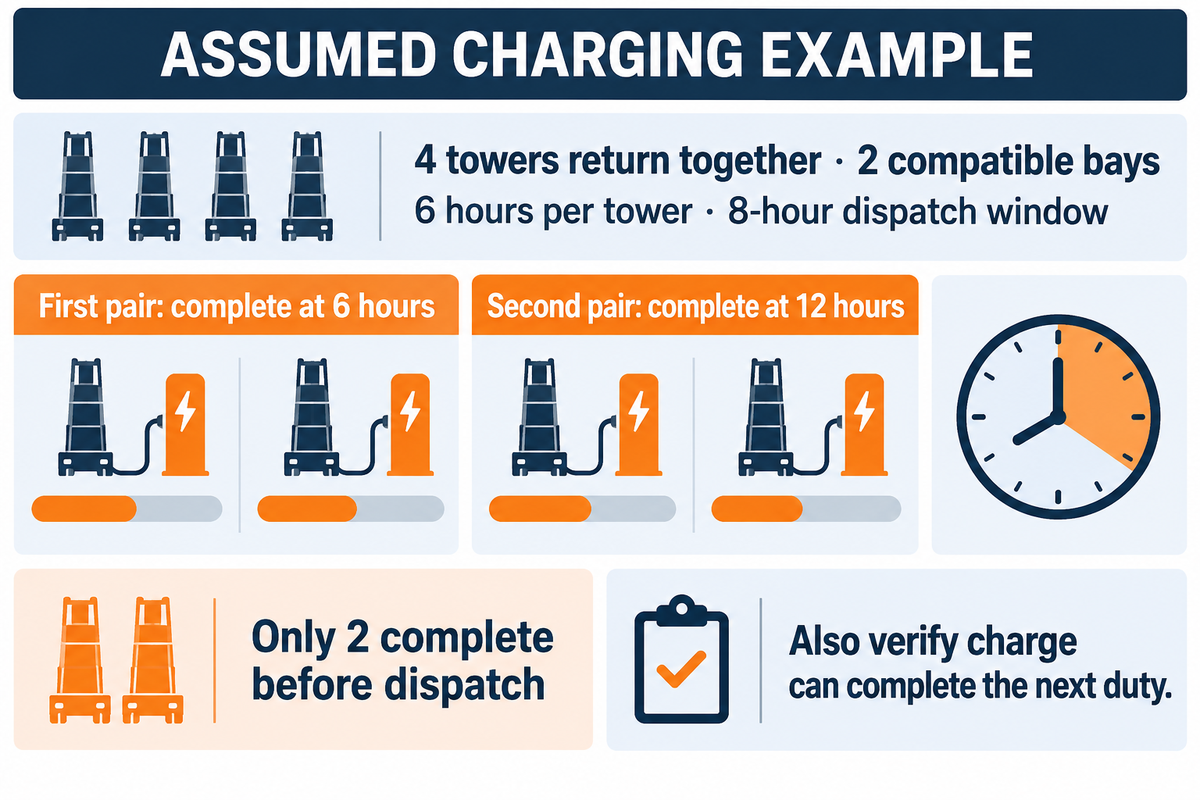
Example: Four battery towers return together, two compatible bays are available, and each tower needs 6 hours to reach the chosen charge-release condition. The dispatch window is 8 hours. Two towers finish after 6 hours; the second pair finishes after 12 hours. Only two complete charging before dispatch, even though all four machines may be mechanically sound.
That schedule assumes no inspection delay, charge interruption or change in charging time. The release check must also establish that a charged battery can complete the next lighting duty. Use diesel tower operating checks for the fuel-specific side of the comparison.
Track utilization and availability without mixing them
Separately track deployment, rent-ready capacity and billing. On-hire days describe deployment; an availability measure describes capacity under a stated readiness policy. Billing is done per the rental agreement. Keeping the numerator and denominator visible prevents a workshop backlog, transport delay or credit note from disappearing inside a favourable utilization percentage.
The American Rental Association has published rental metric definitions, including a day and time utilization, as its association-authored announcement explains. An operating ledger below includes a reconciliation alongside the established definition used in your rental system.
3-Status Fleet Ledger
The 3-Status Fleet Ledger reconciles unit-days for on-hire and ready-idle statuses and not-ready statuses before comparing them to billing.
Three-state fleet tracking has precedents. Rental consultant Carolyn Stansberry’s RER article discusses on-rent, rental-ready and non-rental-ready equipment. For this record, define readiness against the branch’s assigned duty. A serviceable machine in transit can still be unavailable for a new branch booking.
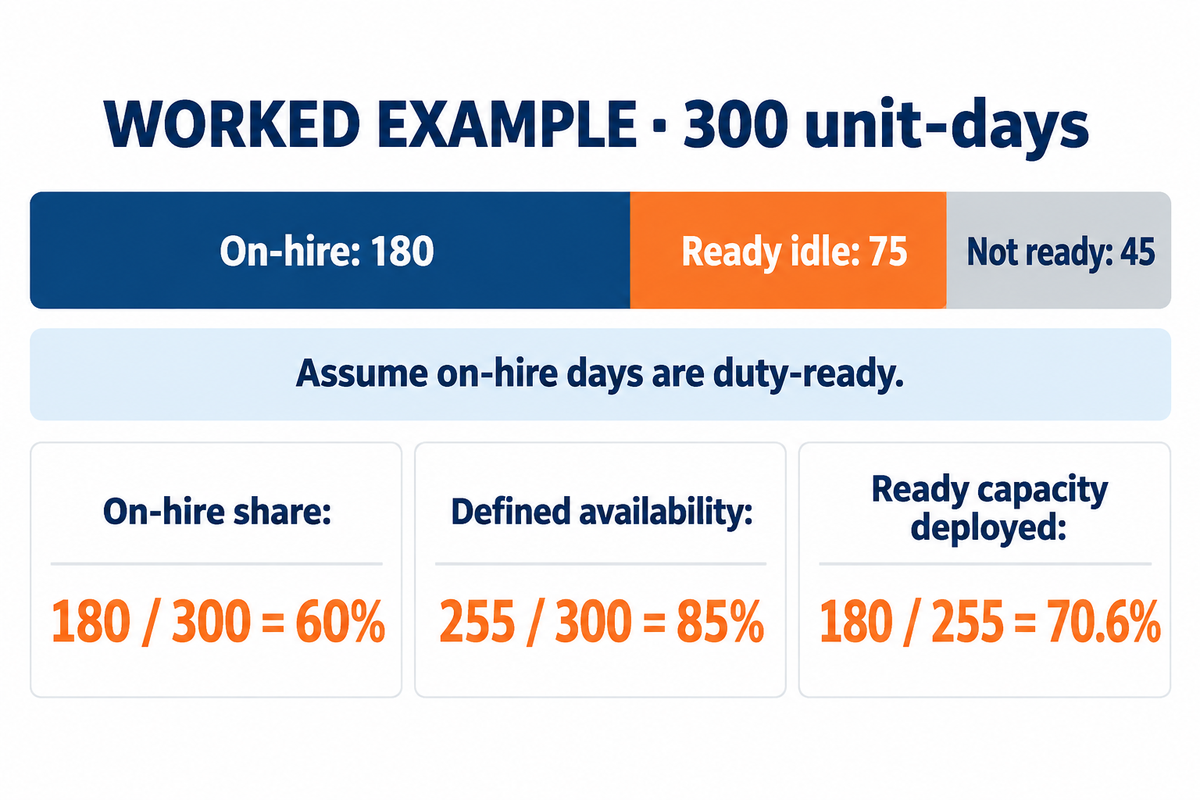
Example: Ten towers in one duty class are tracked for 30 calendar days, which is 300 unit-days. Assume every on-hire unit-day in this example is duty-ready and there are no on-hire faults. Each tower-day gets only one status. Charging and inspection that prevent the assigned duty are included in not-ready time. Repair and transport time that prevent the assigned duty are included in not-ready time.
| Tower | On-hire and duty-ready | Released, idle | Not ready | Total |
|---|---|---|---|---|
| 01 | 24 days | 6 days | 0 days | 30 days |
| 02 | 24 days | 4 days | 2 days | 30 days |
| 03 | 22 days | 6 days | 2 days | 30 days |
| 04 | 22 days | 6 days | 2 days | 30 days |
| 05 | 20 days | 6 days | 4 days | 30 days |
| 06 | 20 days | 6 days | 4 days | 30 days |
| 07 | 18 days | 7 days | 5 days | 30 days |
| 08 | 14 days | 8 days | 8 days | 30 days |
| 09 | 10 days | 10 days | 10 days | 30 days |
| 10 | 6 days | 16 days | 8 days | 30 days |
| Total | 180 days | 75 days | 45 days | 300 days |
On-hire share of the whole period is 180 ÷ 300 = 60%. Operational availability under this stated policy is (180 + 75) ÷ 300 = 85%. The share of ready capacity deployed is 180 ÷ 255 = 70.6%. All three figures describe the same record. The last percentage rises when unavailable days leave the denominator; it doesn’t recover those days.
A fault while a tower is physically on hire requires a separate on-hire flag, readiness status, and billing decision. Don’t merge an invoice credit into a maintenance decision. Dispatch, for example, needs to know the actual count of released towers at the right branch and specification, rather than an average over 30 days.
Use the record: Tower 10 needs a demand review as well as an explanation of its 8 not-ready days. Tower 02 has a different situation, which averages also can’t determine.
Compare cost per billable rental day
Compare the owners’ costs for the same billed-day and lighting-duty assumptions. Separate fixed ownership costs from variable ownership costs that increase with usage, and determine who bears the cost. Reducing fuel consumption benefits the fleet budget to the extent that the rental company absorbs the cost or there’s a related commercial benefit.
The Department of Energy’s lifecycle-cost guidance covers the traditional tradeoff between initial cost and operating cost over the life of a project. A full lifecycle comparison requires the timing of cash flows, assumptions on replacements and residual values. A billed-day screen is a simplified budgeting method.
| Cost | Record the payer and recovery | Owner-model treatment |
|---|---|---|
| Capital recovery | Purchase/finance policy and residual assumption | Use one consistent annual allowance |
| Insurance and registration | Owner charge or separately recovered amount | Include the unrecovered fixed cost |
| Storage | Incremental branch space | Avoid counting a common cost twice |
| Diesel | Customer refill, owner delivery or fuel surcharge | Include only the owner’s unrecovered share |
| Charging electricity | Depot, customer or site provider | Record energy and any cost recovery |
| Service labour | Routine service versus chargeable damage | Separate unrecovered time from reimbursed work |
| Parts and consumables | Service item or customer charge | Allocate to the correct rental period |
| Transport | Delivery/recovery charge and actual incremental cost | Compare the retained contribution |
| Downtime and substitutions | Credits, swaps and lost bookings | Assess separately from a simple operating-cost screen |
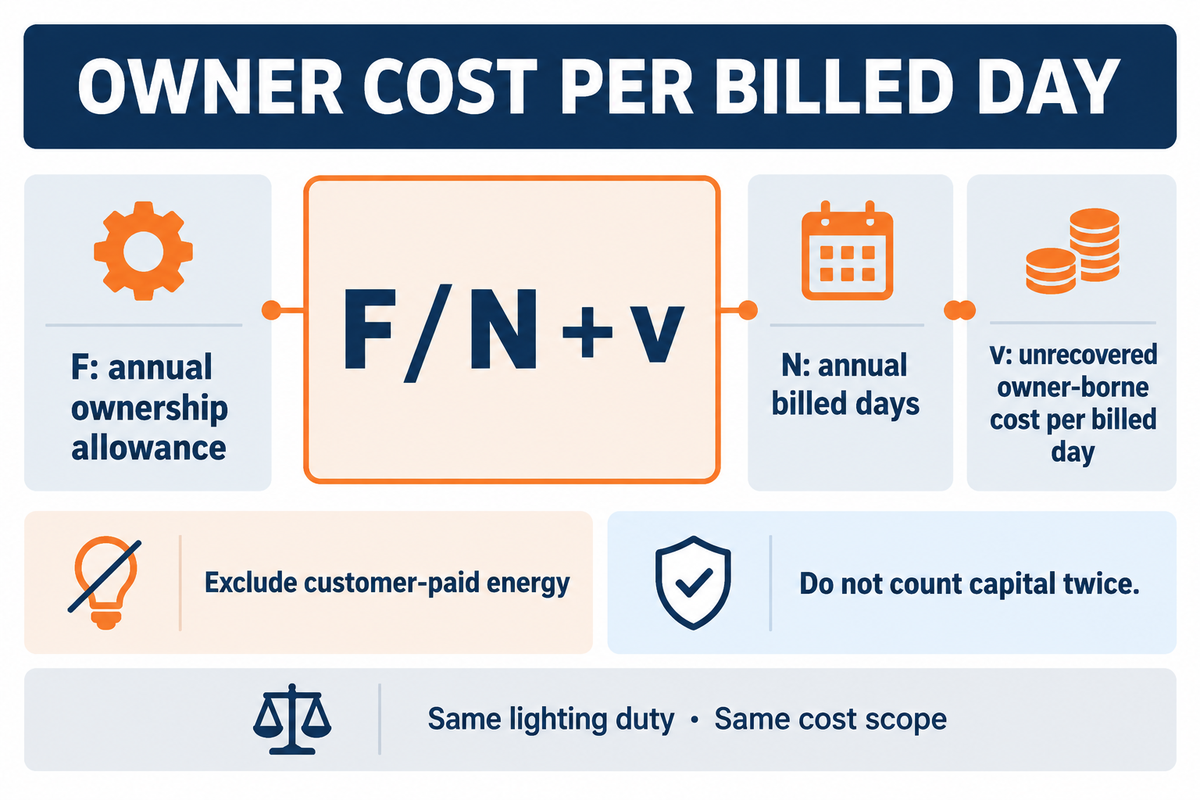
Example: Option A has an annual fixed ownership allowance F of 6,000 currency units and unrecovered owner-borne direct cost v of 20 per billed day. Option B has F of 9,000 and v of 8. Assume a 10-hour lighting duty for each billed day, the same useful lighting and cost scope. The variable inputs include only costs the owner bears after separate cost recovery; customer-paid energy is excluded.
Average cost per billed day = F / N + v, where N = annual billed days. The ownership allowance already includes the selected capital-recovery treatment; do not add the full purchase payment to it again.
| Billed duty | Option A cost/day | Option B cost/day | Reading |
|---|---|---|---|
| 150 days,1,500 lighting hours | 6,000 ÷ 150 + 20 = 60 | 9,000 ÷ 150 + 8 = 68 | A has the lower screened cost |
| 250 days,2,500 lighting hours | 6,000 ÷ 250 + 20 = 44 | 9,000 ÷ 250 + 8 = 44 | The assumed cost functions cross |
| 300 days,3,000 lighting hours | 6,000 ÷ 300 + 20 = 40 | 9,000 ÷ 300 + 8 = 38 | B has the lower screened cost |
The crossing is (9,000 − 6,000) ÷ (20 − 8) = 250 billed days per year. It applies to these inputs. It doesn’t establish which power platform has those costs, whether the branch can achieve 250 billed days or whether either option earns an acceptable rental margin.
When will the costs be amortised?
With a separate assumed extra purchase outlay of 15,000 currency units and owner-retained operating savings of 3,600 per year, simple cash payback is about 4.2 years. Cash payback is based on the incremental purchase price and the annual savings. It excludes financing, discounting and resale changes, and it starts afresh rather than treating the annual ownership allowance as cash expenditure.
The cash-saving assumption could be 300 billed days × 12 currency units retained per day = 3,600 per year. If the customer pays the relevant fuel bill, remove that saving from the owner’s calculation. Higher rental revenue, fewer service visits or improved availability require their own records before entering a forecast.
Treat maintenance capacity as fleet capacity
The number of returned units that become dependable rental inventory can be limited by maintenance capacity. A check list should show the various inspections, repairs, parts waits and energy replenishment as well as a release condition at each step. A running engine is only one check. The mast, fixtures, the transport equipment and controls also must be fit for the intended job before the machine returns to dispatch.
In Jim Siffring’s light-tower maintenance guidance, the Chicago Pneumatic product manager discusses fluid checks, visible wiring, mast components and lenses. The service intervals, procedures and forms pertaining to the equipment model need to be in the workshop record. Maintain an inspection tool and the related parts data with the workshop record.
A HeavyEquipmentForums discussion about starting a rental business raises a practical conflict: breakdown calls can compete with a repair shop’s existing customers. Contributors also stress consumable parts and request tracking. A new fleet purchase adds a service commitment.
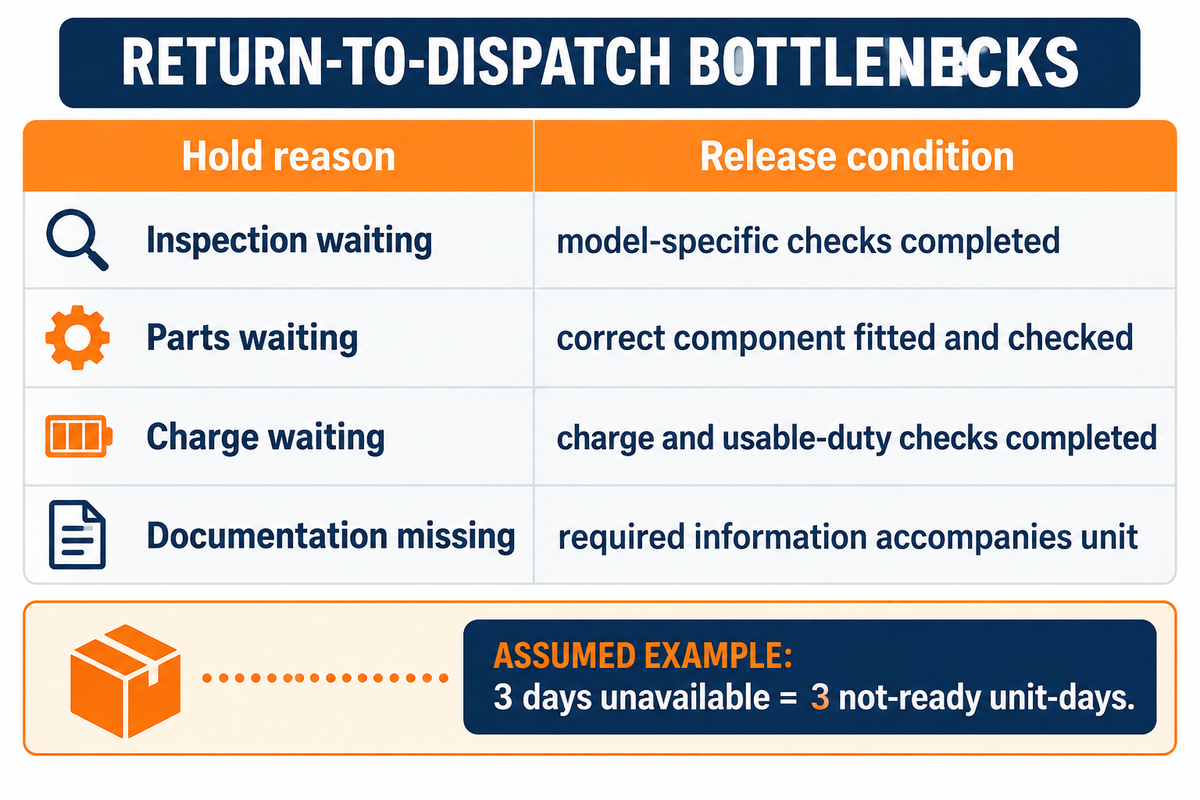
| Hold reason | Record | Responsible role | Release condition |
|---|---|---|---|
| Return awaiting inspection | Arrival and inspection time | Yard/technician | Model-specific inspection completed |
| Reported fault | Symptom and operating context | Technician | Repair and required function checks completed |
| Parts waiting | Part identity and supply status | Parts coordinator | Correct component fitted and checked |
| Mast or restraint concern | Damaged item and inspection finding | Qualified service staff | Released under the unit’s instructions |
| Fixture/lens issue | Damage, contamination or light-pattern change | Technician | Lighting condition checked |
| Wheel/transport issue | Tire, hitch, restraint or lighting defect | Qualified service staff | Transport condition accepted |
| Fuel replenishment | Required fuel and next assignment | Yard team | Fuel condition meets the dispatch plan |
| Charge waiting | Compatible bay and expected completion | Depot coordinator | Charge and usable-duty checks completed |
| Documentation missing | Manual, handover or service record | Fleet administrator | Required information accompanies the unit |
If one missing component keeps a tower unavailable for 3 days, that adds 3 not-ready unit-days to the example ledger. Instead of recording it as a maintenance total, put in the cause. Buying another tower may solve the symptom; however, the same constraint in parts or technicians may persist.
Keep customer responsibilities visible at handover. Refuelling, daily checks and damage reporting can be allocated in the rental agreement, but dispatch needs a clear route for faults. The responsibility of the customer and the owner’s service process must be integrated.
Test transport, setup and lighting before a bulk order

A fleet acceptance trial should be performed through transport, setup, the required lighting duty and return inspection of the quoted configuration. Note the model and options used during the trial, and provide this to procurement for comparison with the offer. Judge coverage at the task locations and check if the branch can support the same configuration repeatedly.
The IES public description of ANSI/IES LM-79-24 explains optical and electrical measurements, including flux, power and intensity distribution, under standard conditions. Useful photometric information helps the site team position lights; it needs to correspond to the supplied fixture and setting.
For United States construction work, OSHA 1926.56 lists minimum illumination intensities by area or operation while work is in progress, for example 5 foot-candles for general construction area lighting. Agree the applicable task criteria in the trial. A lumen total or a high-performance label alone doesn’t describe visibility throughout an obstructed work zone.
Transport acceptance should provide for the quoted towable light towers or handling arrangement, permitted transport condition and available access. A durable frame, a useful control feature and a compact storage footprint address different issues. For equipment-form detail, use the portable light towers buying checks.
Requirements provided below should be copied in the request for quotation and should be based on the job card of the branch and planned trial. Keep all quoted options attached to the same model identifier. A flexible design is valid only if it serves the recorded duties. Use the trial to ensure the offered configuration matches those duties.
| Parameter | Project requirement and units | Why it matters | Acceptance record |
|---|---|---|---|
| Lighting duty | Task points, hours/shift and agreed lux criteria | Defines useful illumination | Measured layout, mode and obstructions |
| Power and replenishment | Supply V/A, fuel plan or charge window in hours | Determines repeat dispatch capacity | Operating and replenishment logs |
| Battery duty | Required duration at the selected fixture setting | Separates full charge from usable capacity | Completed-duty record and battery condition |
| Transport | Quoted mass in kg and transport dimensions | Matches vehicle and route constraints | Unit identification and handling check |
| Setup and controls | Staffing, access and required operating modes | Supports consistent handover | Recorded demonstration using the quoted unit |
| Maintenance support | Parts list, documentation and service scope | Supports return-to-hire work | Named support route and written terms |
| Commercial scope | Configuration, quantities, delivery and warranty terms | Aligns comparable quotations | Accepted quotation linked to trial configuration |
LFADJ’s light towers for rental fleets solution page is the next step for configuration and supply discussions. Send the recurring duties and acceptance record together. Product-specific documentation and the agreed quotation should identify the equipment, support and delivery scope being offered.
Set a replacement or cross-hire decision

Choose an action from repeated demand, unit condition and owner-retained contribution. Retain equipment that covers useful work at acceptable cost, repair a correctable release bottleneck and trial unfamiliar configurations before expansion. Transfer or cross-hire can cover a short term shortage while the branch evaluates if demand is frequent enough to justify another owned unit.
The discussion on buy or rent Construction Equipment describes how contractors combine owned equipment with rentals for short-term needs and shortages. Flexibility is also useful when a rental branch recognizes a specialist demand. Compare a cross-hire offer with the margin after delivery, recovery and support, rather than comparing headline hire prices.
| Observed pattern | Next action | Decision record |
|---|---|---|
| Released units idle while bookings are scarce | Review demand and branch placement | Requests, lost bookings and transfer cost |
| Repeated shortages in the same duty class | Compare addition with dependable cross-hire | Concurrent demand and retained contribution |
| Shortage caused by parts or service waiting | Address the release bottleneck | Unavailable days by cause |
| New or infrequent specialist work | Trial or cross-hire before standardizing | Duty outcome and repeat demand |
| Increasing repair cost with poor rental contribution | Assess replacement or disposal | Unit-level cost, condition and likely recovery value |
A lightly rented specialist can cover an essential recurring application that other machines can’t serve. A versatile unit with high utilization can still require replacement if its condition and support costs undermine the work. A reliable release process can be more valuable than another idle unit; this is the importance of reviewing the constraint before buying.
Plan depot charging, data access and support
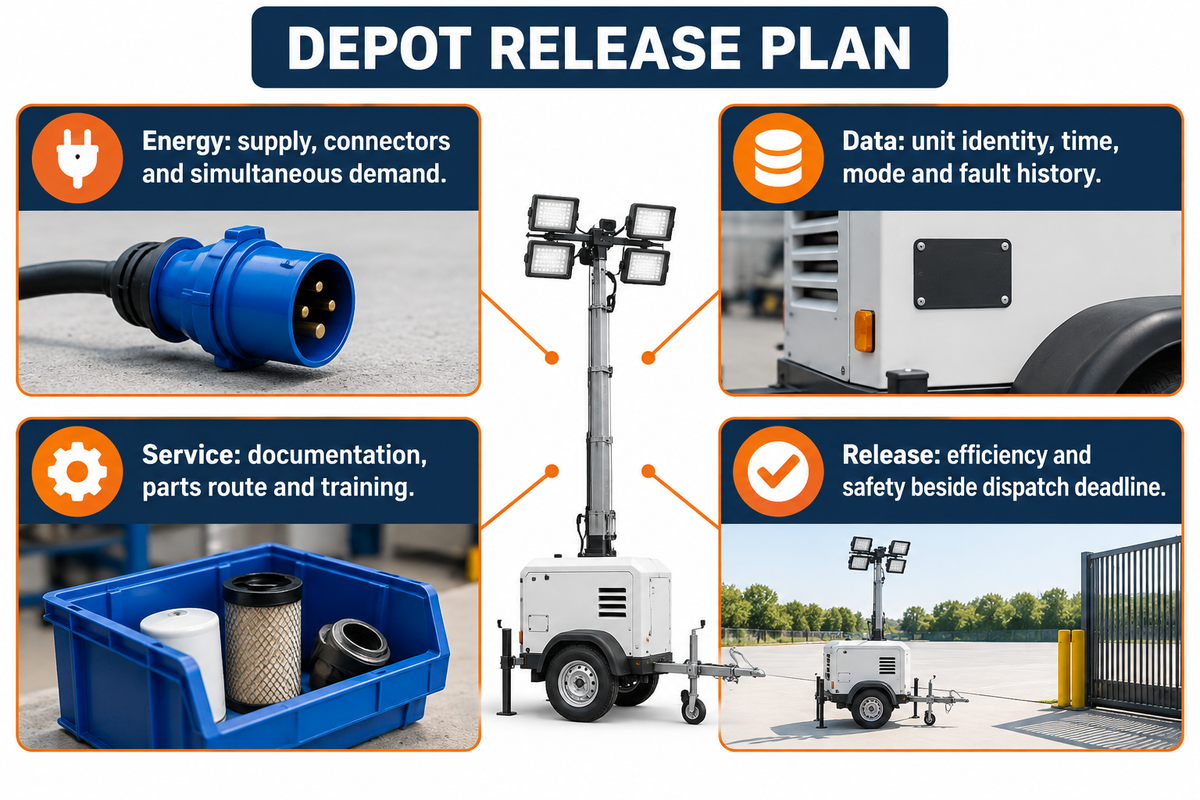
Plan the release process around the number of units released together, the energy available and the data required to clear faults. Limitations of support and connections can constrain expansion before storage space limits. A connected controller should provide operating records and support throughout the fleet for its intended service period.
The two-bay example shows that two complete charges can be achieved in an 8-hour window. To change that result, the branch needs a different arrival schedule, additional suitable capacity or a verified shorter charging process. The electrical supply capacity and proposed charging arrangement need to be assessed together, applying Doug Distel’s supply-capacity check to depot planning.
Smart controls should answer practical questions such as which lighting mode was run, how long the engine was on, what failure occurred and who can access the data. Define ownership and export rights before purchase. Telematics can help with productivity and fuel efficiency analysis, but engine hours will still differ from billed rental days.
- Energy: identify supply capacity, connectors and simultaneous replenishment demand.
- Data: retain unit identity, timestamps, mode and fault history.
- Service: Provide the branch with the documentation, parts route and training for the selected configuration.
- Release: keep efficiency and safety checks visible alongside the dispatch deadline.
Aiming to maximize the number of machines purchased can leave minimal spare support capacity. Expansion should increase the number of suitable, released units available for real bookings. That is the operating result to compare with the capital investment.
Key takeaway
In the worked fleet, 60% on-hire share and 85% defined availability coexist. Use the missing 45 unit-days and the next dispatch requirement to choose an action before adding equipment.
Frequently asked questions
Should a rental fleet standardize on one light tower model?
Standardize the duties and service process first, then keep the models that meet them.
A single model can reduce parts variety and training, but one configuration may not cover all the noise, power or transport requirements. Group together repeat bookings and identify the units that can be substituted for one another. Retain a specialist when its recurring work and support justify its presence. Standardize within a class rather than assuming every light tower is interchangeable.
Is a higher utilization rate always better?
No; a higher utilization figure helps only when its definition stays the same and the branch still has units ready to rent.
Removing downtime from the denominator can raise utilization while leaving fewer units ready to rent. A busy fleet can also have little capacity for inspections or overlapping bookings. Read the percentage beside unavailable days, missed requests and owner-retained contribution. Analyze like duty classes over the same period. Maintain the capacity required to fulfill the branch’s service promise.
Who pays for fuel, charging and service callouts?
The written rental agreement should allocate energy, routine checks, damage and callout charges.
Record whether the customer returns fuel, pays a surcharge, supplies site electricity or receives an inclusive service. Separate routine maintenance from damage and misuse provisions, and explain the reporting route at handover. For budgeting the fleet, include the owner’s unrecovered costs. For rental, a fuel economy achieved by the renter alters the renter’s economics before it affects rental’s margin.
When should we cross-hire instead of buying?
Cross-hire can suit short shortages or unfamiliar duties when a dependable partner leaves acceptable contribution.
Start with the booking and don’t base it on a fleet-wide percentage. Record the exact lighting duty, dates and delivery location and check whether another branch can release suitable equipment. If not, check the proposed cross-hire cost and revenue after transport, recovery and support. The customer and supplier terms must be acceptable to the assignment.
A repeated shortage in the same duty class supports a different decision from a single unusual event. Keep a log of requests, substitutions and bookings declined. Compare that record with the owner’s cost model and the workshop capacity needed for another purchase. A trial is useful where the required power platform or operating environment is new to the branch.
Buying becomes a stronger candidate when recurring work, available support and expected retained contribution justify the ownership commitment. Cross-hire remains useful for peak demand even after the core fleet expands.
Can engine hours stand in for rental utilization?
No; engine hours and rental utilization measure different activities.
A hybrid unit can illuminate a site with the engine off. A tower can remain on hire through daylight hours without running lights. Keep engine time for maintenance and operating analysis; use rental records and the agreed denominator for utilization.
Turn the next purchase into a recorded fleet decision
Bring together the repeat job record, the unavailable day causes, and the trial requirements before making a request for configuration. LFADJ provides product consultation and lighting-solution discussions for the required application. Defining the scope of support and duty gives procurement a basis for comparing offers and deciding the offer’s position in the fleet.
The operating ledgers and numerical scenarios are some examples of planning. Replace with your own booking, cost and duty records. Equipment limits and maintenance procedures are from the supplied unit’s documentation; service and warranty scope are from the agreed contract.
References & Sources
- Lighting and the work environment, Health and Safety Executive.
- Five Key Considerations When Renting a Portable Light Tower, Doug Distel, United Rentals, Rental,2020.
- ARA Introduces Rental Industry Performance Standards, American Rental Association announcement,2011.
- Fleet Management 101, Carolyn Stansberry, RER,2017.
- Building Life Cycle Cost Programs, United States Department of Energy.
- Light-tower maintenance guidance, Jim Siffring, Construction Business Owner,2016.
- ANSI/IES LM-79-24 public description, Illuminating Engineering Society,2024.
- 29 CFR1926.56, Illumination, Occupational Safety and Health Administration.
- When to buy, when to rent light towers, Gianna Annunzio, Construction Equipment,2021.