Get in touch with LFADJ Company

Hydraulic Light Towers
Hydraulic Light Towers for Industrial Night Work
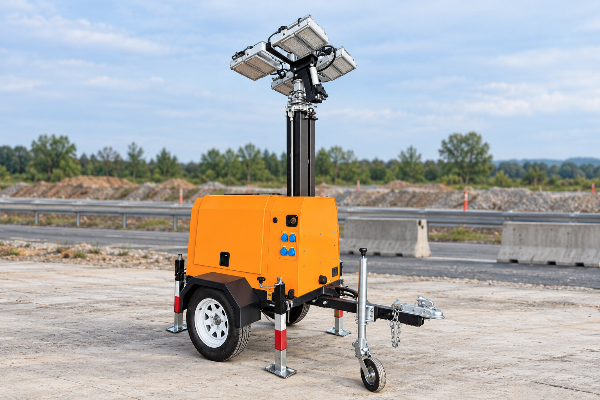
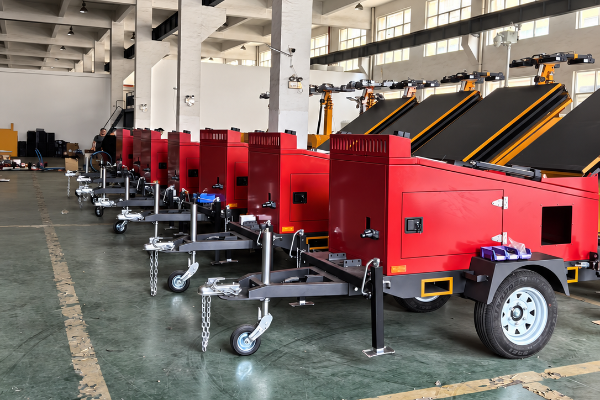
Our D955 hydraulic light towers combine a vertical telescopic mast, diesel power and four LED lamp assemblies for construction sites, industrial shutdowns and emergency lighting. Choose the 9 m, four-400 W package or discuss a 7 m mast configuration against your site brief.
- Hydraulic lifting with 340° mast rotation
- 9 m package: four 400 W LED floodlights
- Production lead time: 45–60 days
Send the work area dimensions, required lighting level, operating hours, quantity, and destination to LFADJ. LFADJ uses that information to determine the configuration and the scope of the tower.
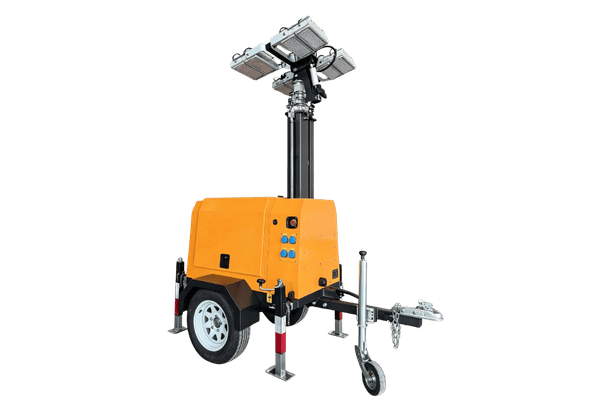
Mast options
7 m or 9 m; lamp package specified with the order
9 m LED configuration
4 × 400 W; 1.6 kW combined rated lamp input
Fuel tank
100 L capacity
Working footprint
2,650 × 2,450 mm
Order quantity
We accept orders from 1 unit
Lead time
We schedule production in 45–60 days
Hydraulic Mast Deployment
Repeated night work needs a mast arrangement that suits the crew, the available ground and the direction of the lighting task. We supply the D955 with hydraulic mast operation and 340° rotation, so the lifting system and light direction form part of the configuration discussion before an order is placed.
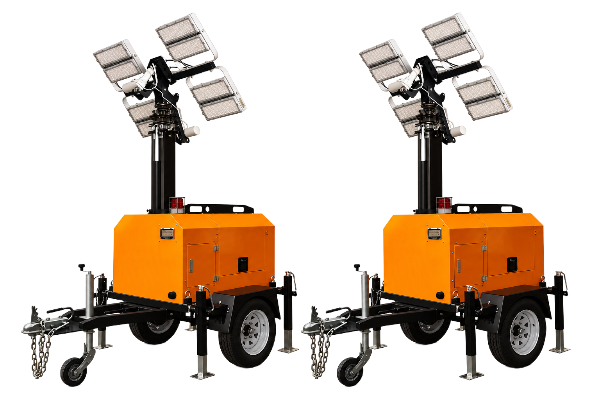
The 7 m and 9 m options give two deployment envelopes rather than a fixed coverage ratio. A taller mast changes the geometry; lamp optics, aiming, nearby structures and the target work plane still decide useful illumination.
- Construction projects: identify the active work zones and access routes.
- Maintenance shutdowns: mark structures that cast shadows on the task.
- Emergency operations: identify vehicle movements and pedestrian areas.
Our team agrees the operating controls, stabilizer arrangement and transport position with the selected tower. The hydraulic power unit, cylinder, hose and valve arrangement belong in the matching manual and component schedule, particularly when a fleet needs common maintenance parts.
- Identify the control panel and normal raising/lowering sequence.
- Check cable movement through the mast travel and rotation.
- Review safe isolation and the support of raised components.
A successful lift does not settle the repair procedure. ISO 4413:2010 addresses hydraulic-system safety across design, operation and maintenance; the tower handoff also needs the manufacturer’s instructions for stopping, isolation and stored-energy control.
- Use competent personnel for maintenance and fault investigation.
- Follow the model manual for pressure release and component support.
- Keep the operating wind limit, ground requirements and overhead clearance in the site deployment plan.
Evaluate a hydraulic lifting system versus a manual winch for relocation frequency and crew working method.
Discuss the mast configurationPowertrain and Trailer Build
Our portable diesel light tower configuration, a portable light system for industrial sites, uses the Kubota Z482 engine specification, a carbon-steel-sheet enclosure and an integrated welded chassis. LFADJ matches the engine, generator, lighting package and electrical arrangement together, because a power source chosen for lighting duty is not automatically a general-purpose site generator.
01
PHASE // 01
Diesel engine configuration
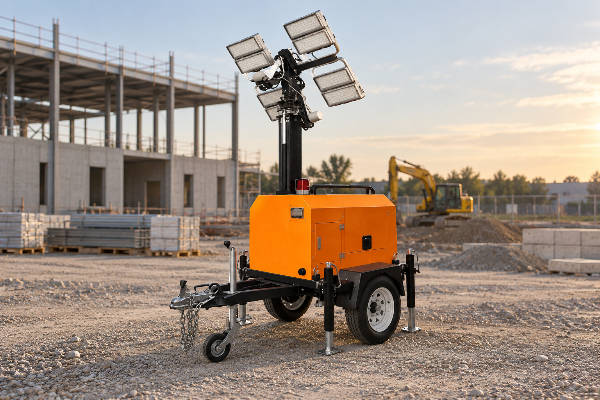
The Z482 specification is a two-cylinder, liquid-cooled arrangement with a 12 V electrical system. Specify the exact engine designation and destination documentation in the order so the supplied component list matches the procurement requirement.
02
PHASE // 02
Trailer and service access
The trailer chassis carries the enclosure, mast and stabilizer legs as a mobile lighting assembly. Match the tow vehicle, coupling, transport restraints and access route to the ordered unit and local transport requirements.
03
PHASE // 03
Fuel and planned maintenance
We supply a 100 L fuel tank. Storing diesel between jobs, refueling arrangements and maintenance access belong in the operating plan alongside shift duration and the required lighting configuration.
04
PHASE // 04
Lamp-On Load Check
The engine’s mechanical rating, the generator’s electrical rating and the power available at a receptacle are not interchangeable. A larger engine does not necessarily provide more usable outlet power when the generator and protection arrangement impose different limits. ISO 8528-1:2018 provides generating-set rating and application classifications; keep those ratings separate from a list of connected loads.
SYS.DAT // 8528-1
MATRIX _ VERIFIED
| Entry for the quotation | What the buyer supplies | What the configuration must identify |
|---|---|---|
| Lighting duty | Selected lamp package and operating schedule | Rated input, operating controls and simultaneous-lighting state |
| Continuous outlet load | Equipment list and running power | Continuous auxiliary output with the lamps operating |
| Starting load | Motors, pumps or tools with starting demand | Permitted starting load and operating sequence |
| Electrical supply | Destination and connected equipment | Voltage, frequency, receptacle and protective-device arrangement |
| Connection mode | Plug-connected loads or an installation interface | Grounding and bonding arrangement reviewed by the responsible electrical professional |
LED Lighting Configuration
The D955 9 m package carries four 400 W LED lamps, giving 1.6 kW combined rated lamp input. Lamp wattage is not a substitute for task-plane photometry, and a taller mast does not necessarily improve illuminance at every work position. Record the beam distribution, aiming and measurement grid to evaluate the required lighting task.
Task-Lux Acceptance Map
Record the lowest task-plane reading separately from the average. For U.S. construction briefs, 29 CFR 1926.56, Table D-3 identifies illumination levels by area or operation. The project team must select the applicable category and any additional destination requirements.
Table D-3 example category
Reference illumination
Converted lux
Specified excavation, access, loading and field-maintenance areas
3 foot-candles
32.3 lx
General construction area lighting
5 foot-candles
53.8 lx
General construction plant and shops
10 foot-candles
107.6 lx
First-aid stations, infirmaries and offices
30 foot-candles
322.9 lx
OSHA’s work-surface measurement interpretation explains why distance, surroundings and reflecting surfaces affect illuminance. The conversions shown above use the NIST factor of 10.76391 lux per foot-candle.
Prepare a lighting brief that can be checked
- Mark the actual task area, its length and width, and the height of the work plane.
- Set the target minimum illuminance and any average or uniformity requirement separately.
- Record mast height, lamp package, aiming positions and obstructions in the proposed layout.
- Check shadows and glare toward drivers, adjacent properties and other work zones.
- Measure at agreed work-surface points with a light meter during commissioning.
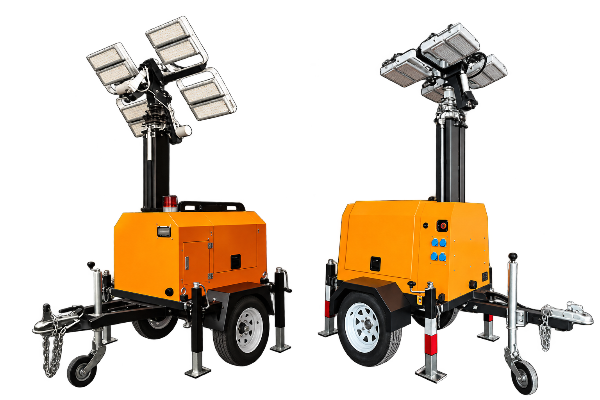
D955 Specifications and Dimensions
Our two mast-height options use the dimensions below. Use the transport envelope for access planning and the deployed envelope for layout planning. The space occupied by the machine is shown separately from the illuminated area and site safety clearance.
7/9 m Deployment Envelope
Configuration item
7 m mast option
9 m LED package
Nominal mast option
7 m / 23.0 ft
9 m / 29.5 ft
Transport length
1,650 mm / 64.96 in
1,650 mm / 64.96 in
Transport width
1,450 mm / 57.09 in
1,450 mm / 57.09 in
Transport height
2,350 mm / 92.52 in
2,650 mm / 104.33 in
Operating length
2,650 mm / 104.33 in
2,650 mm / 104.33 in
Operating width
2,450 mm / 96.46 in
2,450 mm / 96.46 in
Overall operating height
7,200 mm / 283.46 in
9,000 mm / 354.33 in
Hydraulic mast rotation
340°
340°
LED lamp package
Selected with the quoted configuration
4 × 400 W
Combined rated lamp input
Follows the selected lamp package
1.6 kW
Dry / wet mass
1,050 / 1,150 kg
1,050 / 1,150 kg
Fuel tank capacity
100 L
100 L
Hydraulic Light Tower Price and Lead Time
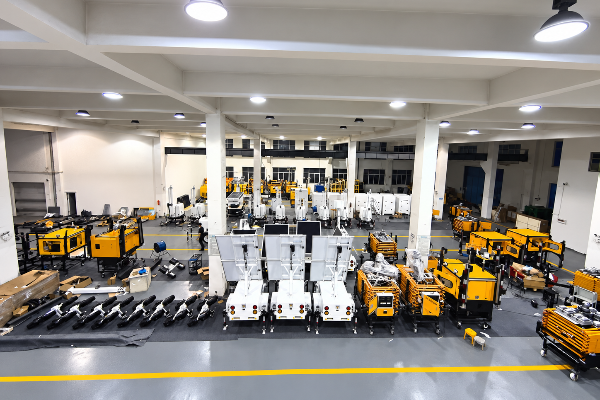
We quote the D955 based on the agreed configuration, quantity and delivery terms. When comparing a hydraulic light tower for sale or a diesel light tower for sale, include the mast, lamps, engine, electrical schedule, packing and shipment scope on the same quotation sheet and compare the totals.
Order terms
- We accept orders from 1 unit.
- We schedule production in 45–60 days.
- We accept T/T or L/C.
- We quote FOB, CIF or EXW.
Items that change the quotation
- Mast height and the selected LED lamp package.
- Engine, generator, voltage, frequency and outlet arrangement.
- Destination documents, inspection scope and agreed accessories.
- Packaging, transport restraints, freight scope and quantity.
Shift Cost Input Model
Compare operating costs with your measured fuel consumption and local fuel quote. Fuel cost is only one expense. Others include acquisition, freight, maintenance, repair, refueling, labor and eventual disposal.
Calculate a shift fuel budget
Tank volume and measured consumption are not the same. A larger tank does not necessarily mean longer endurance. US Department of Energy’s life-cycle cost guidance separates purchase costs from energy costs, maintenance and disposal when equipment is compared.
Fuel budget worksheet //
CALCULATION FORMULA
Shift fuel cost = tower count × operating hours × measured liters per hour × fuel price per liter
- Illustrative buyer inputs: 2 towers, 10 hours, 1.0 L/h and 1.20 currency units/L.
- Calculated fuel use: 20 L; calculated fuel cost: 24 currency units for the shift.
- These are example inputs for the worksheet, not D955 fuel-consumption, runtime or selling-price figures.
Configuration and Delivery Acceptance
The team agrees the configuration and acceptance checklist before production. Lighting faults and an engine running with no electrical output are recorded separately. Electrical output can fail with the engine running because generation, protection and lamp circuits have separate functions.
Acceptance item
Record required
Decision before handoff
Unit identification
Model, serial identification and agreed component list
Match the ordered mast and lamp package
Engine configuration
Exact model and applicable destination documents
Match the supplied engine to the purchase order
Mast function
Raising, lowering, rotation and transport position
Follow the configuration’s operating manual
LED lamps
Head count, rated input, controls and aiming
Confirm the selected package and lighting state
Task-Lux Acceptance Map
Work-plane grid, minimum, average and lamp positions
Agree a layout and measurement record
Auxiliary outlet duty
Lamp-on continuous power and connected-load schedule
Keep lighting and tool loads within the agreed arrangement
Electrical interface
Receptacles, protection, grounding and bonding
Responsible electrical professional checks the site connection
Hydraulic maintenance
Isolation, stored-energy release and raised-component support instructions
Qualified maintenance staff follow the model procedure
Transport preparation
Dimensions, shipping weight, restraint and loading plan
Match carrier limits and destination arrangements
Support handoff
Operating manual, maintenance schedule and contracted service scope
Keep the supplied documents with the fleet record
Electrical and maintenance responsibilities
29 CFR 1926.404 makes generator grounding and bonding conditional on the connection arrangement. HSE maintenance guidance treats isolation, release of stored energy and support of parts that could fall as separate controls; agree the applicable site rules and use competent personnel.
- Do not treat socket ratings as proof of a complete site electrical arrangement.
- Keep defective equipment out of service until the fault is assessed.
- Use the exact tower manual for the operational wind limit and hydraulic maintenance procedure.
“We specify the lighting package and the electrical load together. Lamp input and continuous auxiliary outlet power are separate entries, and the site lighting target needs its own acceptance check.”
From Site Brief to Tower Delivery
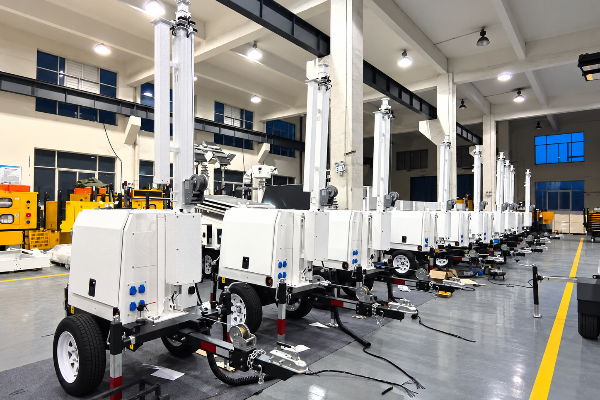
A clear brief stops a quotation from describing a different lighting task to the one the crew is doing. The process is site conditions, ordered configuration, component list, acceptance items and shipping scope. Keep them aligned through the supply process.
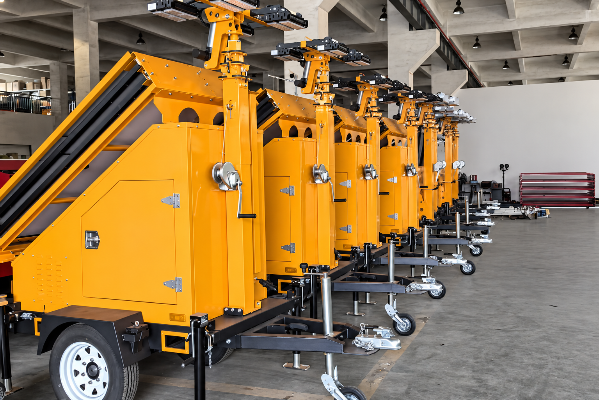
Send the work area, task illuminance, operating hours, ground conditions, access limits, quantity and destination.
Our team discusses 7 m or 9 m height, the lamp arrangement and aiming requirements against the brief.
Identify any additional loads; agree engine, generator, voltage, frequency, receptacles and the intended electrical interface.
The approved quotation records the configuration, trade term, production schedule, inspection scope, packing and agreed documents.
Match the unit identification, operating instructions, component list and acceptance record to the approved order.
The buyer prepares the site and transport arrangements; we handle product-use enquiries and after-sales issues within the contracted service scope.
Brief Details That Prevent Rework
Send this detail
Reason it changes the configuration
Required work-plane illuminance and measurement area
Separates useful task lighting from a broad nominal coverage claim
Access height, deployed space and relocation frequency
Matches the mast option and transport envelope to the working route
Additional equipment and starting demand
Prevents an auxiliary-power assumption from entering the order
Destination and inspection requirements
Defines the document, protection and transport scope before shipment
LFADJ D955 Product and Supply Details
Zhejiang LONGFA Lighting Co., Ltd. was established in 2013 in Yueqing, Zhejiang. Our LFADJ product business covers industrial, mobile, explosion-proof and emergency lighting; the D955 configuration on this page serves temporary mobile area lighting.
Product-led configuration
Our product selection connects the tower configuration with the application brief rather than presenting every lighting task as the same tower configuration. Match mast height, lamp package, electrical duty and transport details in the order so the resulting unit fits the agreed supply scope.
Discuss a unit or fleet order with LFADJ, and request the dimensions and supply checklist for the package of interest.
REQUEST SUPPLY CHECKLISTContainer loading plan
Our D955 loading plan lists 4 units in a 20 ft container and 8 units in a 40 ft container. Coordinate the selected mast version, packing, restraint, accessories and shipping weight with the loading arrangement before booking freight.
04UNITS
20 FT CONTAINER
08UNITS
40 FT CONTAINER
Project Fit and Power Alternatives
A diesel towable light tower can provide mobile lighting for a temporary work situation. Indoor use calls for a different power platform, while a fixed electrical supply, classified atmosphere and noise limits also affect equipment choice. Choose the power platform and approved equipment, and then choose the mast height.
Selection consequence
Diesel exhaust changes equipment placement and ventilation requirements.
Alternative to assess
Electric light towers or a properly specified battery lighting system.
Selection consequence
Independent diesel generation is a separate operating-cost decision.
Alternative to assess
Plug-in lighting with a suitable site electrical supply.
Selection consequence
The acoustic condition needs a project-specific equipment choice.
Alternative to assess
Electric or battery operation assessed for the required lighting duty.
Selection consequence
The complete assembly must have approval for that classification.
Alternative to assess
Equipment selected specifically for the hazardous-area requirement.
Selection consequence
Physical fit alone does not approve elevated mast deployment.
Alternative to assess
A different layout, lower mast arrangement or another lighting platform.
Selection consequence
Lighting and external loads need a matched electrical schedule.
Alternative to assess
A separately specified generator and lighting arrangement.
Hydraulic Light Tower Engineering Tools
Select a tool below to access real-time calculators and interactive specifications for your field deployments.
-
[ SYS_01 ]
Shift Fuel Cost
Calculate operational fuel expenses per shift to optimize your site lighting budget.
-
[ SYS_02 ]
Task Lux Converter
Convert and verify illumination levels to meet strict industrial safety standards.
-
[ SYS_03 ]
Deployment Envelope
Assess the physical footprint and mast extension limits for safe on-site installation.
Request a D955 Configuration Quote
Give us the lighting task and the site constraints. Our team will discuss the mast, LED package, power arrangement, order quantity and delivery basis in one configuration enquiry.
Specifications
- Site dimensions and task illuminance.
- 7 m or 9 m mast preference and available access height.
- Operating hours and any additional electrical loads.
- Quantity, destination, inspection requirements and planned delivery.
Process
Use the enquiry form to attach the site brief and contact details. Scope and service arrangements are agreed for the order.
Discuss Your Project with LFADJHydraulic Light Tower Questions
Request QuotationThe lifting system raises and lowers the vertical mast through its hydraulic arrangement. For selection, compare the crew’s deployment method, relocation frequency, controls and maintenance handoff with a manual winch arrangement; the correct operating sequence comes from the model manual, while site stability and clearance still require their own assessment.
We supply four 400 W LED lamp assemblies for the 9 m package, giving 1.6 kW combined rated lamp input. Identify the lamp model, beam distribution, aiming requirements and controls in the order; rated electrical input alone does not establish luminous flux, task-plane illuminance or the area meeting a project lighting target.
Include the tools and their starting loads in the configuration enquiry. The continuous auxiliary output must be specified with the lamps operating, together with voltage, frequency, receptacles and protection; a generator rating or lamp-input calculation by itself does not approve the connected loads or the site’s grounding and bonding arrangement.
Keep the lighting controls, generator output and any specified outlet functions as separate acceptance entries. Stop using faulty equipment and arrange assessment by qualified personnel with the exact component and wiring documents; an operating engine does not establish that the electrical output, connected load or protection arrangement is working correctly.
We accept T/T or L/C and quote FOB, CIF or EXW. The purchase agreement identifies the named delivery location, payment milestones, freight responsibilities, packing and required documents; compare these entries as part of the delivered scope rather than comparing equipment totals that include different services or transport arrangements.
Choose the height against the lighting layout and access conditions. Both options have a 2,650 × 2,450 mm operating footprint, while transport heights are 2,350 mm and 2,650 mm respectively; the 9 m package described here has four 400 W LED heads, and the 7 m lamp package is specified with the quotation.
Use a lighting layout for the required work area and illumination level. Average illuminance and the lowest measured point answer different acceptance questions; provide the area dimensions, work-plane height, obstacles and lamp positions, then agree a measurement grid rather than treating one broad coverage figure as a guarantee for every jobsite.
Plan storage, fuel quality, inspection and refueling around the engine and tower manuals and your site’s fuel-management procedures. Tank capacity establishes the storage volume, while the load, measured consumption and usable fuel determine the operating plan; use those inputs for a shift budget instead of assuming endurance from tank size alone.
We accept orders from 1 unit and schedule production in 45–60 days. Send the mast option, lighting package, electrical requirements and destination with the quantity so the quotation identifies the equipment scope, packing, inspection items and shipment arrangement; keep freight and site receipt planning separate from the production schedule.
Send the work-area dimensions, required task illumination, operating hours, mast preference, access limits, ground conditions, quantity and destination. Add any auxiliary equipment and special inspection or document requirements; we use those details to discuss the configuration, supply terms and acceptance handoff for your D955 unit or fleet order.