Get in touch with LFADJ Company

Explosion-Proof Emergency Lights: A Lifecycle Readiness Guide

Lifecycle readiness guide
An emergency luminaire can carry the correct hazardous-location marking and still not perform its intended emergency backup function during power interruptions. There are three layers to readiness: the approval for the specific location, the emergency performance of the installed configuration, and disciplined records from commissioning to repair.
Separate Three Evidence Layers
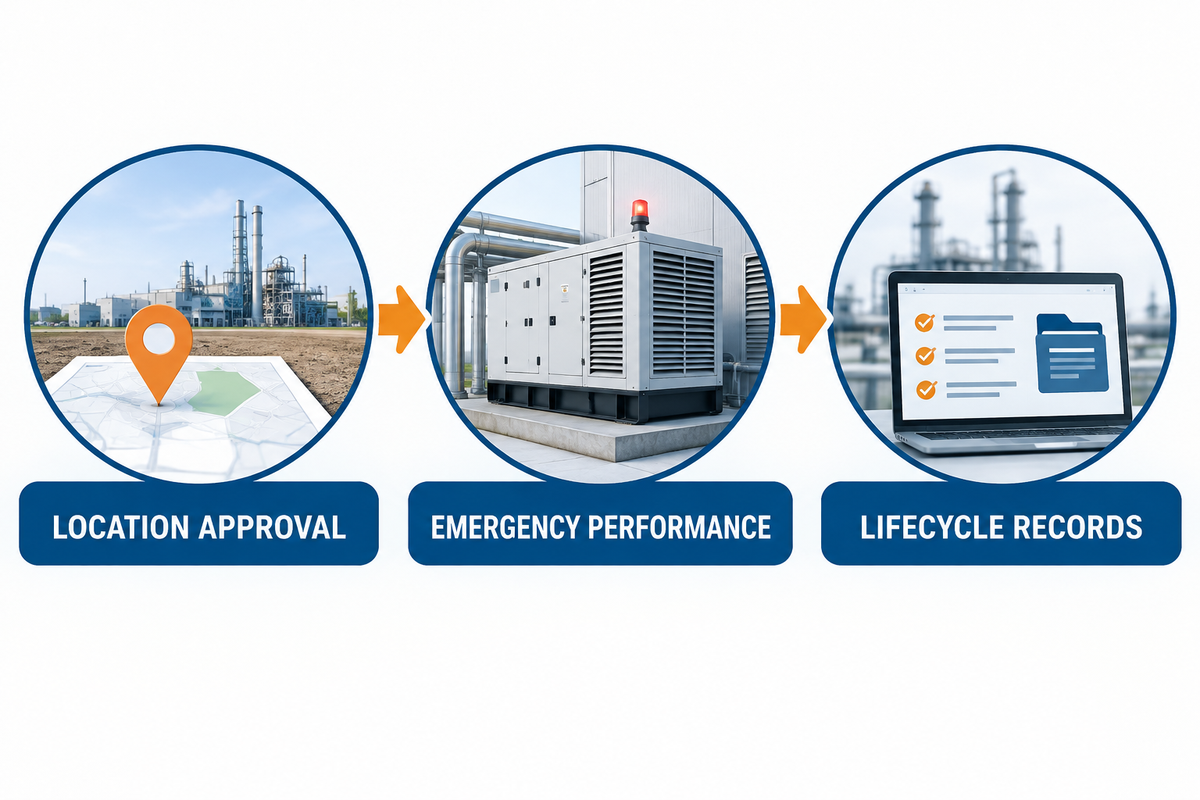
The term “explosion-proof emergency lights” combines different requirements that should be examined separately. First, the configured equipment has to be approved for the classified location. Second, the emergency performance has to meet the project’s activation, illumination, and duration requirements. Third, the project has to retain records that demonstrate the first two conditions after installation, tests, maintenance and changes.
For an industrial project, reliable emergency lighting depends on treating every explosion proof light as part of a complete system of lighting fixtures, wiring, controls, and records that documents lighting systems and compliance. A Class I Division 1 marking or an ATEX certificate answers a defined approval question; neither replaces the commissioning evidence needed to demonstrate operational reliability and safe operation.
OSHA 1910.307 addresses electric equipment in hazardous classified locations. It does not transform an ingress-protection rating to a hazardous-location approval, and emergency runtime is a separate requirement: where the NFPA Life Safety Code applies, emergency lighting is designed to illuminate for at least 90 minutes upon the loss of power. Separately, OSHA 1910.37 requires that exit routes be adequately lighted and exit signs be illuminated. A project still has to account for the applicable code, the authority’s requirements, risk assessment and design criteria.
Do gas, vapor and dust classifications mean the same thing?
No. Classification and protection for gas or vapor hazards and for combustible dusts are different. Identify the actual classification, group, or substance, the temperature, the range of ambient conditions, and the jurisdiction. Then compare those against complete markings and instructions for the exact model and installed accessories.
Build the Evidence Pack Before Commissioning
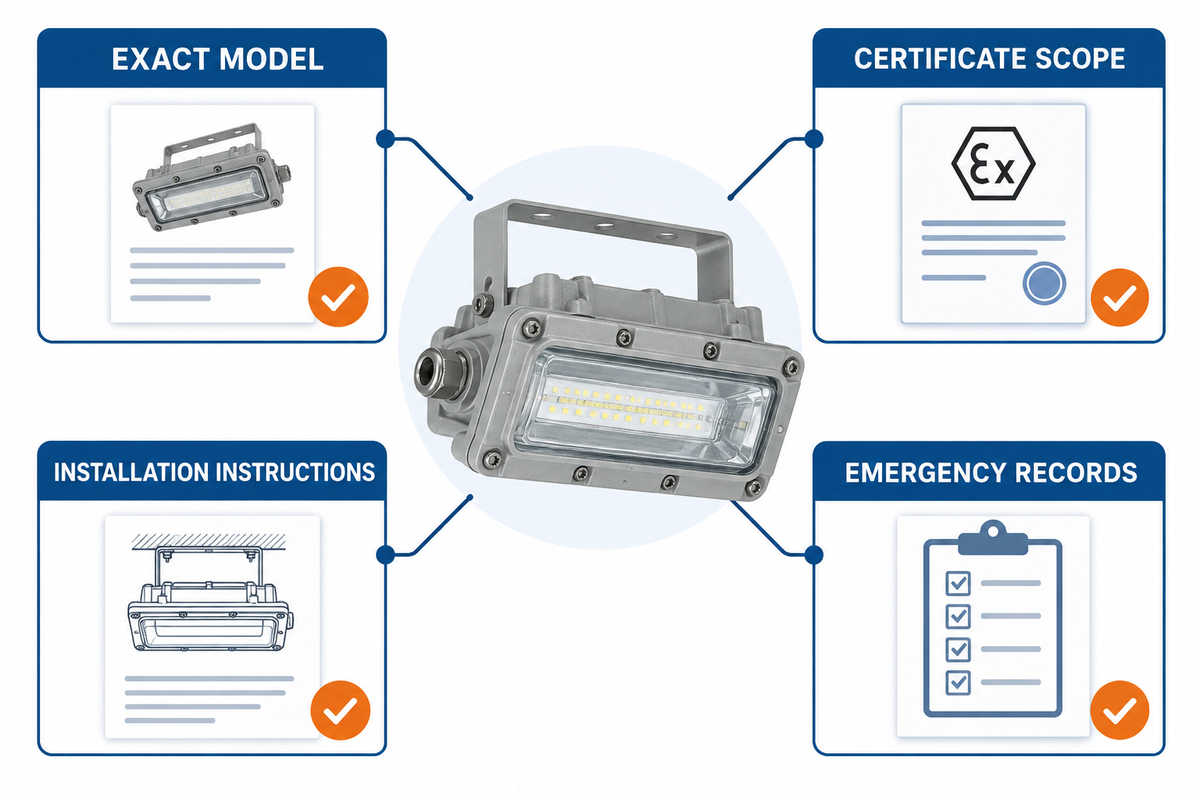
Provide the exact product model name. The acceptance package should be sufficiently detailed to allow for a complete understanding of the luminaire including the battery and charger configuration, glands, permissible accessories, any control or monitoring equipment, and the method of mounting. The acceptance package should also include the applicable certificate or listing, schedules and limitations, installation instructions, drawings and emergency performance records.
The IECEx system is one route to conformity assessment for equipment for use in explosive atmospheres. Whatever route is applicable, verify the certificate number against the issuing system, read its schedules or annexes and confirm model suffixes match the equipment. A logo on a brochure is not the same as verification of an exact model.
| Evidence layer | Question to close | Typical record |
|---|---|---|
| Classified location | Is the exact configuration suitable for this hazard and environment? | Area classification, marking comparison, certificate/listing and limitations |
| Emergency function | Will it activate, illuminate and sustain the required condition? | Design criteria, photometrics, mode, duration and changeover evidence |
| Lifecycle control | Can the site prove ongoing readiness? | Asset register, tests, defects, repairs, parts and recommissioning records |
| Area classification | Which gas, vapor, dust, group, zone or division applies? | Current classification drawing and responsible-person approval |
| Ambient limits | Does the installed condition stay inside approved temperature limits? | Nameplate, certificate schedule and site temperature basis |
| Installed accessories | Do glands, seals and mounting parts match the approved configuration? | Bill of materials, drawings and installation inspection |
| Emergency task | Is the light supporting escape, safe shutdown or standby operation? | Failure-scenario register and task-location map |
| Changeover | Does the intended source transfer occur under the defined failure? | Witnessed functional test and indicator record |
| Post-test recovery | Will recharge and temporary controls preserve subsequent coverage? | Recharge observation, stagger plan and exception owner |
Commission Against Defined Failure Scenarios
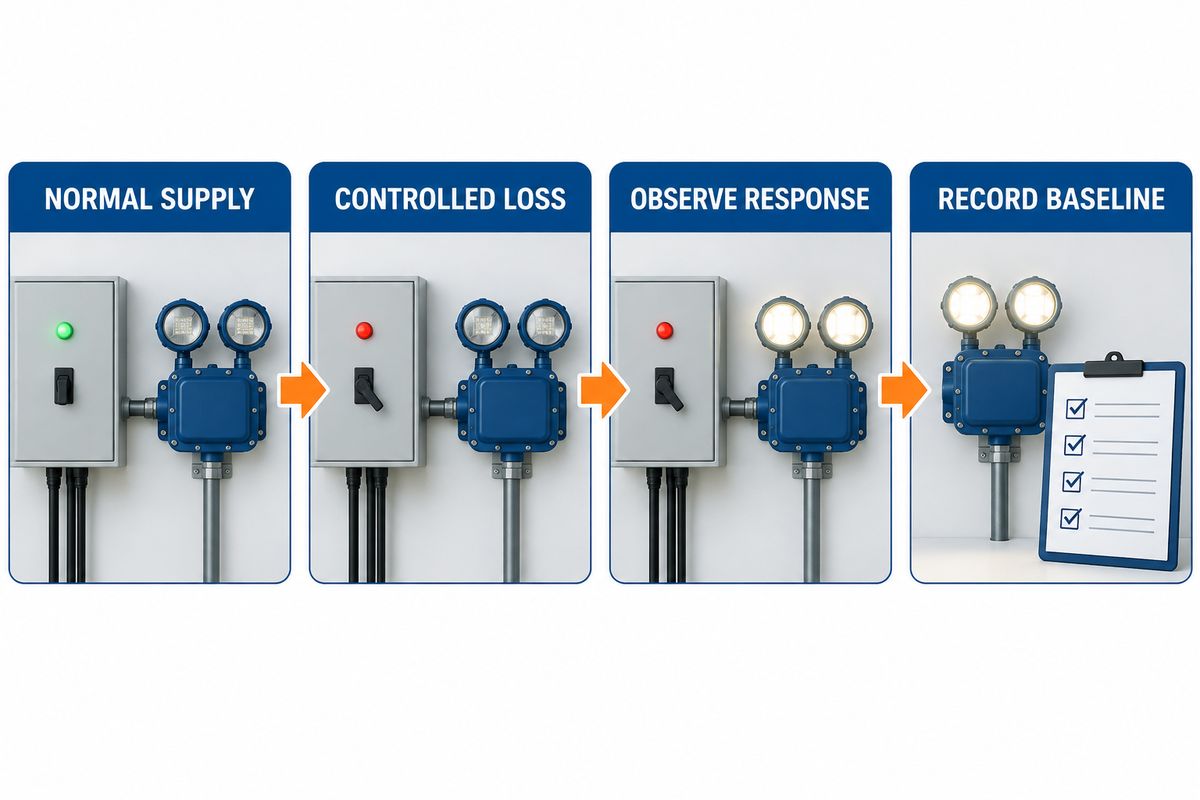
The intent of the industrial emergency-lighting design should be to ensure the specified fail operating conditions. Ensure that normal supply conditions are as defined, and then, as necessary, initiate loss of supply or changeover conditions and observe which luminaires operate. See if the visibility along the routes and tasks are adequate and indicate whether indicator status is as expected. In the case of a design which integrates maintained and non-maintained modes, evaluate the mode which is specified.
Consider common-cause scenarios outside the luminaire. If mechanical ventilation reduces the hazardous area, a power failure may start the emergency light while stopping that ventilation. The UK HSE hazardous-area guidance states assessments should consider the consequences of ventilation failure. Verify the area conditions expected during the emergency state as opposed to treating the normal classification input as fixed.
Record the starting charge condition, ambient conditions, operating mode, test duration and acceptance endpoint. Do not replace the project criterion with a generic claim such as “the lamp stayed on.” IEC 60598-2-22 specifies particular requirements for emergency luminaires. Local adoptions and project acceptance criteria should also be verified.
What belongs in the commissioning baseline?
- Asset ID, location and exact installed configuration.
- Hazardous-area classification and the evidence used to match it.
- Mention the results and state of indicators.
- Photometric or visibility acceptance evidence where required.
- Duration test method, start condition, endpoint and restoration result.
- Open defects, compensating controls, owner and due date.
Test Function Without Creating a Coverage Gap
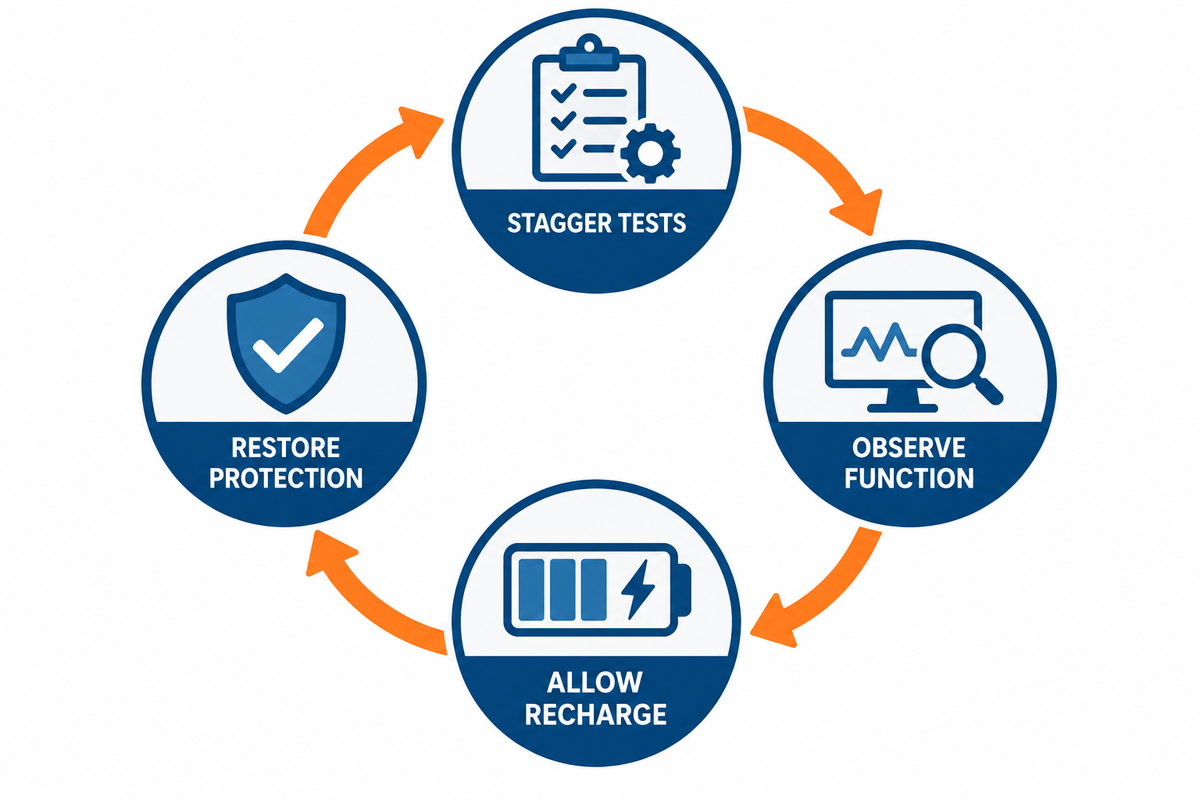
A test schedule should be stipulated by the governing code, authority requirements, manufacturer’s instructions, site risk assessment and the maintenance strategy. Do not copy one test interval from another jurisdiction or installation. The planning of the test should define the failure scenario and expected response. The test interval should define observation points and the criteria on which the test will be deemed successful.
For discharge testing, the system will be without protection during the test and may not recover full protection. Stagger tests if applicable, account for recharge time, and preserve protection for occupied routes. Define what happens if a unit fails during testing. A successful test should be more than illumination of the lamp; IEC 62034 addresses automatic test systems for emergency lighting. Other things, such as indicators and alarms, should also be inspected.
Maintain the Battery, Enclosure and Protection System Together
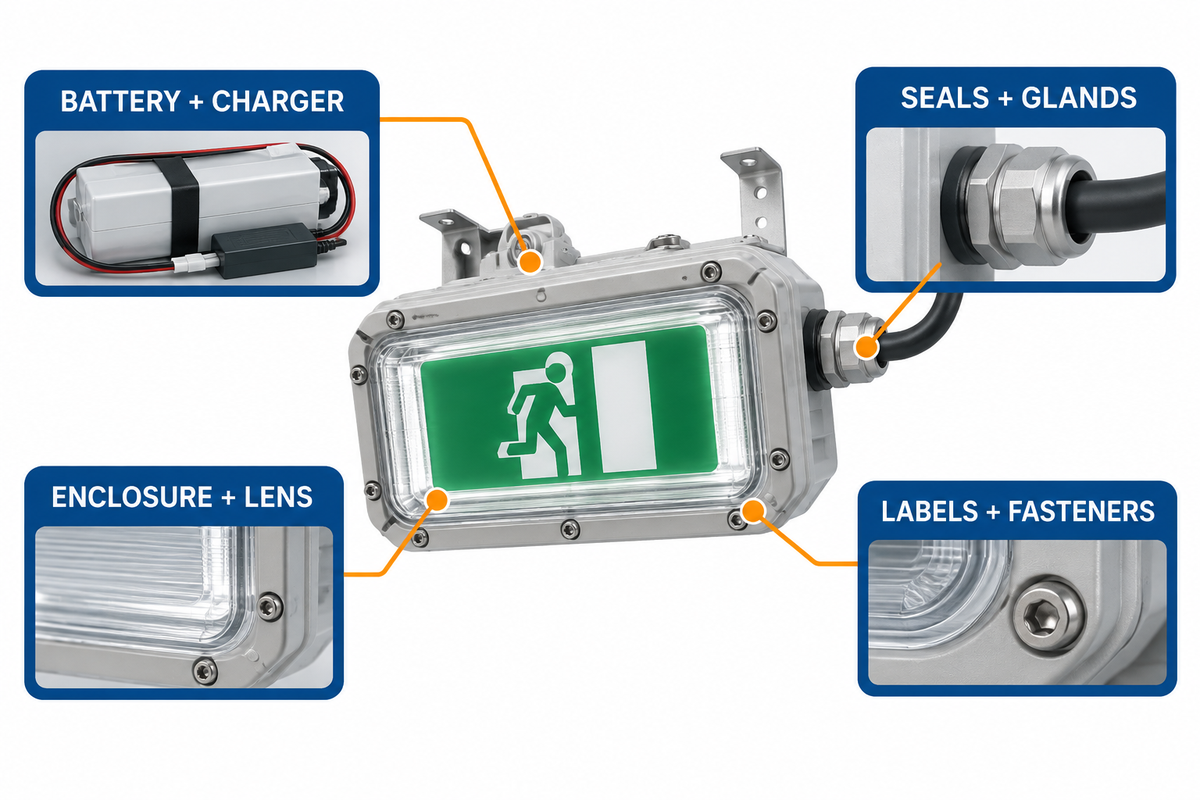
There are a lot of things that can contribute to failure of the emergency luminaire. Inspect items, such as terminals and cables, chargers, lens, mounting, labels, fasteners, seals, corrosion, heat-dissipation paths. If the lamp is illuminated, dust deposits, damaged coatings, loose parts and a obscured nameplate may alter the inspection finding.
Cleaning agents and solvents, seals, cable entries, fasteners and repair methods must remain within the approved documentation. Approved documentation may restrict the use of certain seals; IEC 60079-17 provides the broader inspection and maintenance context for explosive-atmosphere installations. Lubrication and removal of seals may be permitted if approved by a seal manufacturer. Battery performance may be affected by low temperatures, but performance may also be affected if the approved ambient temperature range is exceeded. This must be evaluated independently.
A functional test and a maintenance isolation are not the same state. A test intentionally proves transfer to the backup source. For maintenance to control all energy sources including batteries and backfeed must be in accordance with the site’s approved isolation procedure. Switching off the normal AC feed does not make a self-contained emergency unit safe to open.
Is an IP rating enough?
No, an IP rating evaluates a product’s resistance to the ingress of materials (e.g., water) under defined test conditions and does not evaluate product suitability for a gas, vapor or combustible dust classification. Further, it does not address emergency changeover, duration or route coverage. Therefore, evidence for ingress protection, hazardous location approvals, and emergency performance, if required, should be treated as separate entries in the evidence pack.
Diagnose Failures by Layer
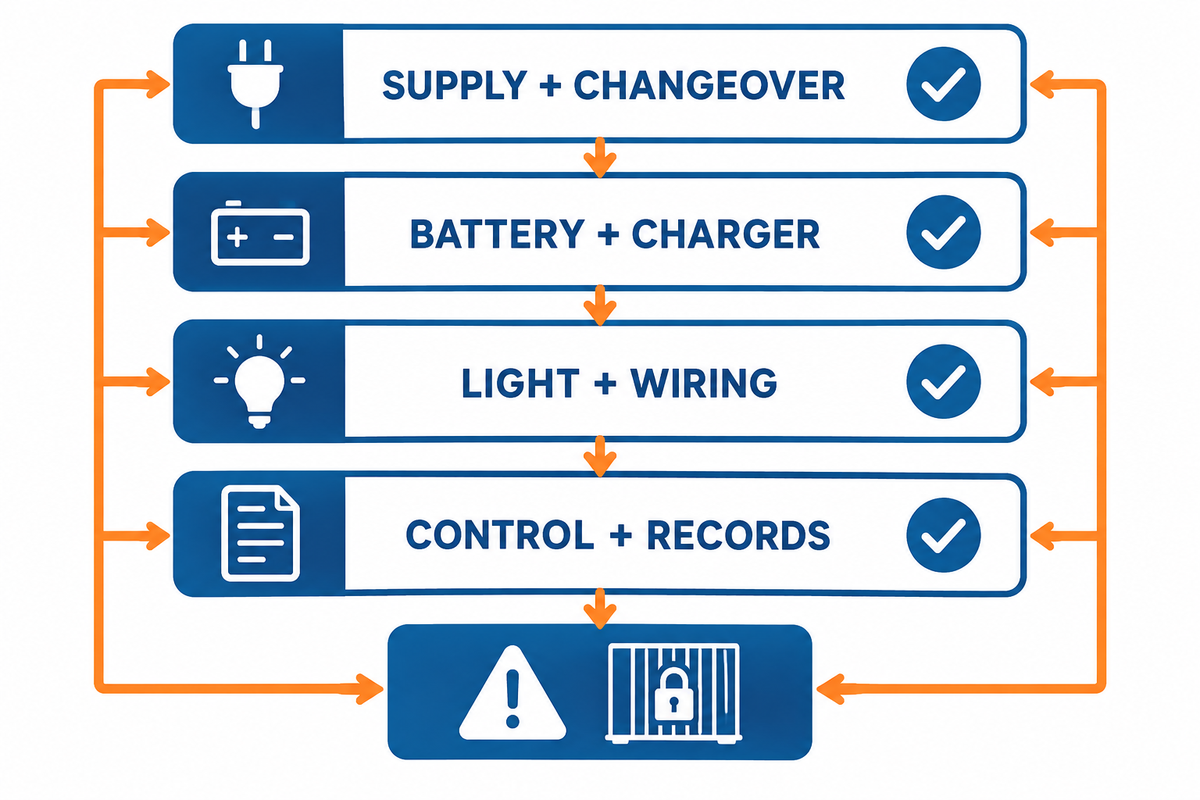
In the event of failure, isolate the layer preceding the replacement of parts. There are many possible causes for failure including normal supply loss, failure of the changeover device, deterioration of the batteries or charger, failure of the driver, light source or wiring, environmental ingress, a fault in the control system, an improper configuration or mismatch.
| Failure layer | First observations | Controlled next step |
|---|---|---|
| Supply/changeover | Normal feed, protective device, transfer signal, mode | Verify the designed failure scenario and circuit state |
| Battery/charger | Indicator, charge state, terminals, temperature, age record | Follow the approved diagnostic and replacement procedure |
| Light/driver | Output, flicker, thermal or visible damage | Use exact approved parts or authorized repair route |
| Enclosure/environment | Seal, gland, corrosion, deposits, impact, water evidence | Isolate and assess whether protection integrity remains valid |
| Documentation | Model suffix, certificate schedule, installed accessories | Resolve the mismatch before return to service |
Temporary repair of a luminaire using an improvised battery, driver, gland or seal may restore functionality, but can compromise the approval basis described by OSHA 1910.307 for equipment in hazardous classified locations. Isolate and quarantine the equipment and/or record the decision.
Control Repairs, Replacements and Modifications
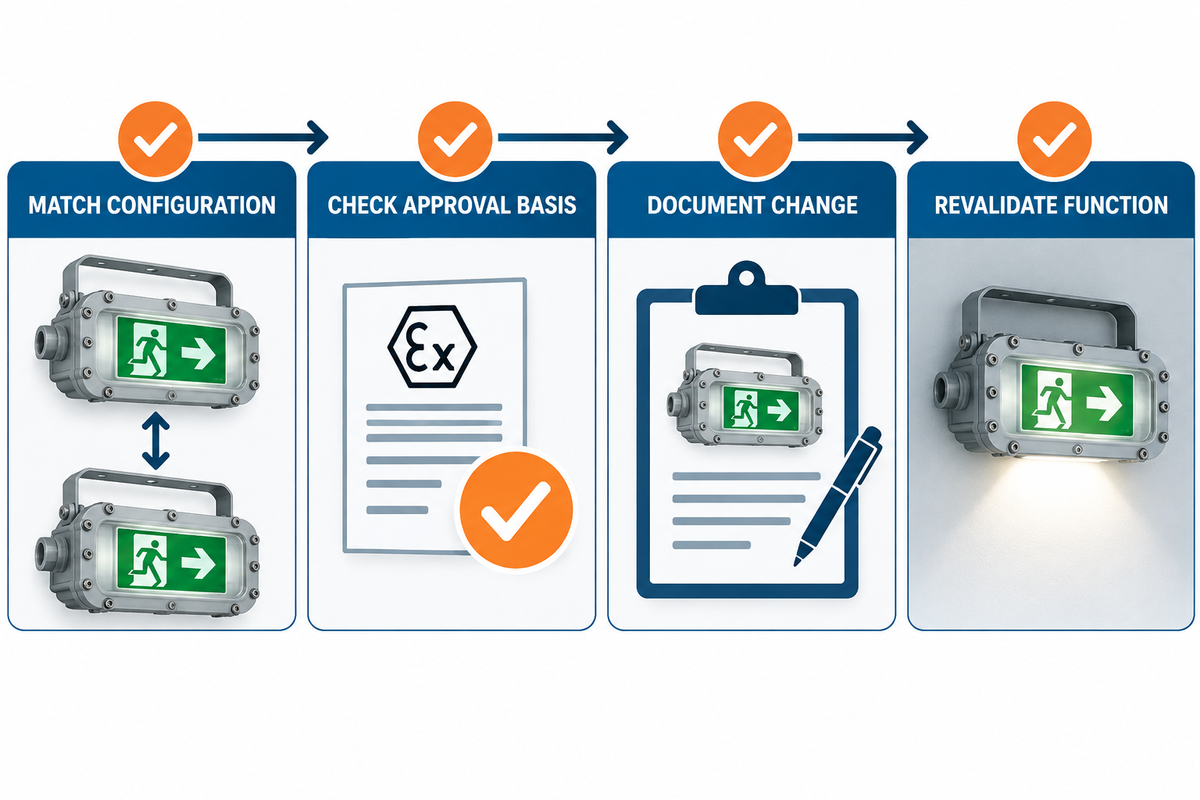
When replacement is required, it is necessary to ensure that the replacement product provides ingress protection and emergency performance. The replacement luminaire should be the same model with the same suffix. It must have the same range, protection markings, battery and charger, optics, mounting, cable, control and permitted accessories. Document deviations to requirements, but do not assume that equipment of “equivalent wattage” meets the requirements.
It is necessary to extend change control to additional equipment in the area, such as walls, enclosures and process equipment. A change in building or process ventilation can also affect the dispersion of flammable materials, therefore requiring a change in the basis of the hazardous area classification. Trigger a review of classification and emergency scenarios when the process or site changes.
After repair or replacement work, revalidate the affected functions. The scope may include changeover, output, indicators, monitoring, duration, and restoration. Any modification that affects the protection concept or certification basis should be assessed and approved by the responsible engineering and conformity process prior to return to service.
Once requirements are frozen, use LFADJ’s explosion-proof emergency lights product page to compare available commercial configurations and request evidence of exact models. That product page is the owner of models, specifications and quotations; this guide is the owner of lifecycle assurance.
Keep an Audit-Ready Lifecycle Record
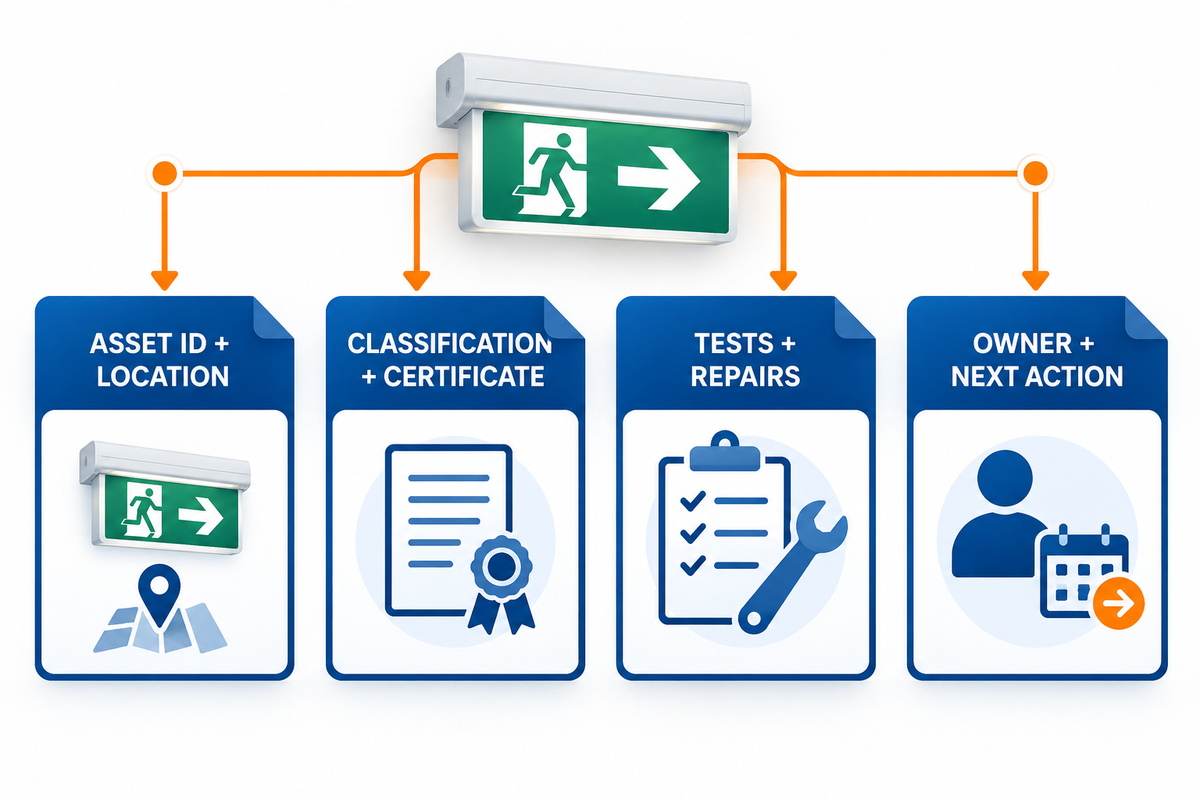
Retain a record to allow another competent person to identify, understand and justify what has been installed and why it has been accepted, and to define any changes that have been made. The record should include asset ID, exact model, location, area classification, certificate or listing, approved accessories, commissioning baseline, scheduled and corrective tests, defects and repairs, replacement parts, responsible person, and next action date.
Link exceptions to a due date and owner. Photographs should only be kept to show a pertinent condition and should be linked to an asset. Keep obsolete documents to allow a later reviewer to distinguish the accepted configuration from a certificate or brochure which no longer applies; this record discipline supports the inspection and maintenance context in IEC 60079-17.
Frequently Asked Questions
Is an IP rating proof that a light is explosion-proof?
No, a high IP rating does not represent a hazardous location rating. IP represents ingress protection under specified test conditions. Explosion protection depends on the applicable protection concept, marking, exact model and installation. A high IP rating may be required for the environment, but it cannot replace a certificate or listing. Evidence of emergency changeover and runtime should be provided again.
Does hazardous-location approval prove emergency runtime or route coverage?
No. Approval for a classified location addresses suitability for that hazard within documented limits. Runtime is dependent on the battery, charger, load, mode, ambient conditions, test method, and endpoint. Coverage is a function of layout and project criteria. Verify the three criteria: location suitability, emergency duration, and required visibility.
How often should explosion-proof emergency lights be tested?
Where the NFPA Life Safety Code applies, manually tested battery emergency lights are operated monthly for at least 30 seconds and annually for a minimum of 90 minutes, according to the NFPA Journal. Follow any different or additional tests required by the applicable code, authority, manufacturer’s instructions, site risk assessment and maintenance program. Define functional and duration tests and coordinate coverage and recharge, retain results on the asset.
Can any replacement battery or seal be used?
No. Physical fit may not be equivalent to electrical, thermal, chemical or sealing characteristics. Use permitted procedures and parts per the equipment documentation or repair authorization. After replacement, record the part, person, test results and recommission affected emergency functions.
What records should be retained after commissioning and maintenance?
Maintain identity, configuration, location classification, certificates, instructions and limitations, commissioning observations, test conditions, test results, defects, corrections, and replacement parts. Retain who performed and accepted the work, the reason for each intervention, and every outstanding exception. For a shared escape route, also record who owns the luminaires, who performs the tests, where the results are held, and how defects are communicated to each affected employer. Keep superseded documents traceable so a reviewer can distinguish the accepted configuration from an outdated brochure or certificate.
References and Sources
LFADJ · COMPANY & TECHNICAL CONTEXT
Practical lighting guidance for real project conditions
LFADJ shares product context, application notes, and selection checks to help project teams compare industrial lighting options with the right site details in view.
What LFADJ covers
LFADJ focuses on industrial lighting and tailored lighting solutions for teams planning, specifying, or operating demanding work environments.
- Product context: mobile lighting, light towers, explosion-proof lighting, emergency lighting, and related industrial lighting equipment.
- Project context: application conditions, target illumination, runtime, site constraints, and product configuration questions.
- Decision support: use the information here as a starting point, then confirm final specifications against the actual installation and local requirements.
Industrial lighting
Application guidance
Project enquiries
NEXT STEP
Have a site question?
Send the operating environment, lighting target, expected runtime, and any drawings or photos you have. The existing enquiry form is ready for a focused discussion.
Start an enquiry Or use the LFADJ contact page