Get in touch with LFADJ Company
Explosion-Proof LED Lights: An Engineering Evidence Guide

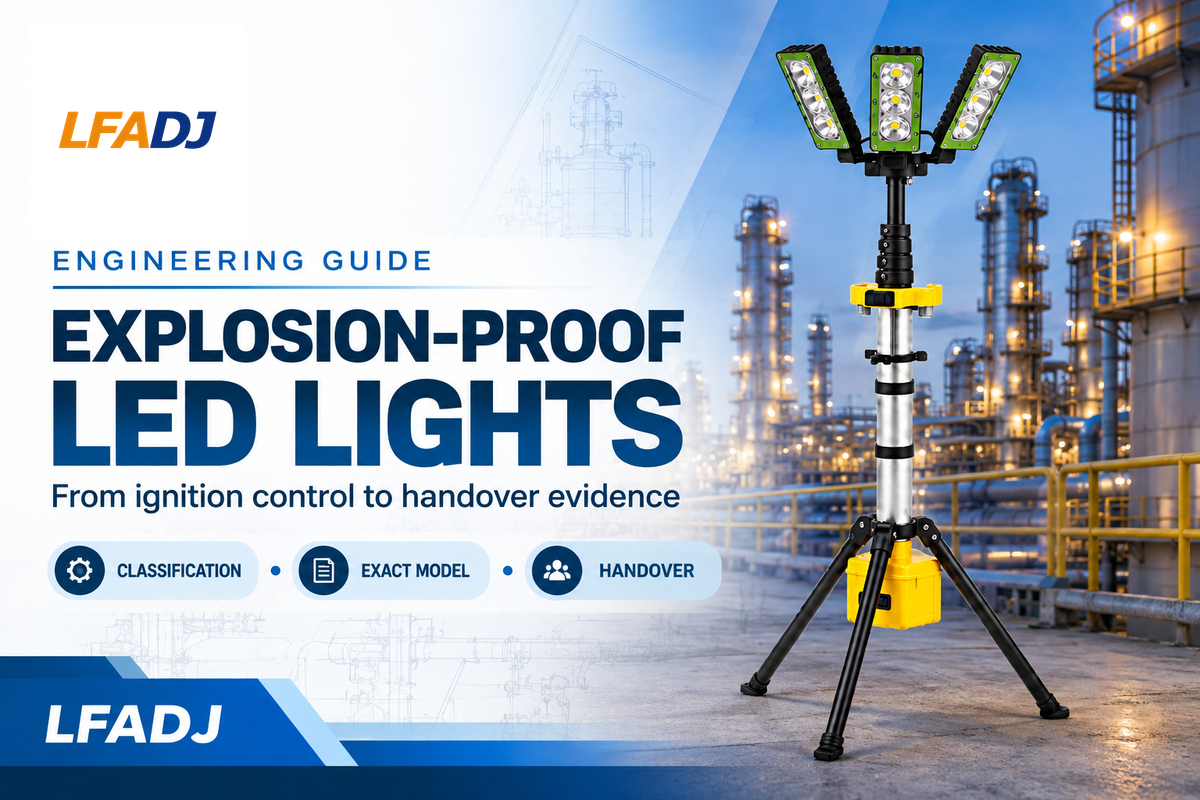
Explosion-proof LED lights are not normal LED lights with a stronger enclosure. They are complete certified assemblies used to control ignition risk within a defined hazardous location and reduce the risk of propagation to the surrounding atmosphere. A defensible project begins with area classification and ends with an installed, traceable evidence record. This is not the case with wattage, lumen output or an IP rating.
This engineering path is taken in this document. Explanation is provided for protection concepts, markings, lifecycle costing, commissioning and handover of documents. If you have a classified area and need to compare explosion-proof LED light fittings, start with the explosion-proof lighting overview. Models, quotations and commercial selection of electrical equipment are covered there, whereas evidence of method is covered in this document.
Safety boundary: This document is an engineering planning aid. It does not replace the governing code, the exact equipment certificate, the manufacturer’s instructions, or approval by the authority having jurisdiction.
Start With the Ignition-Control Chain, Not the Housing Label
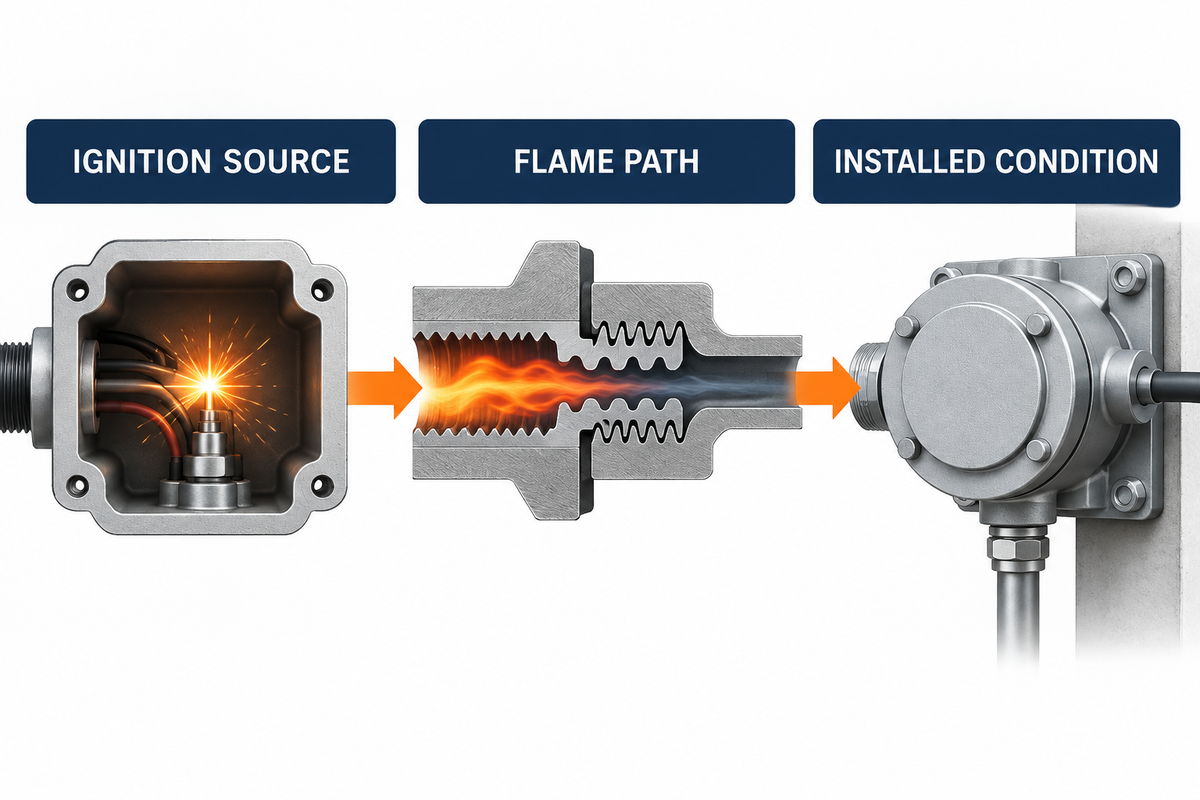
How do explosion-proof LED lights prevent an internal ignition from reaching a hazardous atmosphere?
In a flameproof or explosion-proof design—regional terms whose exact use depends on the applicable IEC-based or North American certification system—an enclosure is intended to contain ignition within the enclosure, because LED explosion-proof equipment and explosion proof lighting is designed to keep an internal fire or explosion from propagating to the external atmosphere. In other protection concepts, risk is controlled by other means (for example, limiting the available energy or avoiding an arc or excessive temperatures). The protection concept must be contained within the approval of the equipment and not inferred by the appearance of the equipment.
The chain has six links: possible ignition source, protection concept, certified enclosure or circuit, maximum surface temperature, approved entries and accessories, and the installed condition. Failure at the last link will erode confidence in the first five. Damaged joints, incorrect glands, missing fasteners, blocked heat paths, and unapproved replacement parts, are not cosmetic.
For workplaces in the United States, OSHA 29 CFR 1910.307 means that equipment needs to be intrinsically safe, approved for hazardous location, or otherwise shown to be safe for that location. The rule also relates approval to the ignitable or combustible properties of the material in question. Other jurisdictions have their own systems, standards, and safety standards.
Decode the Complete Marking Before Comparing Fixtures
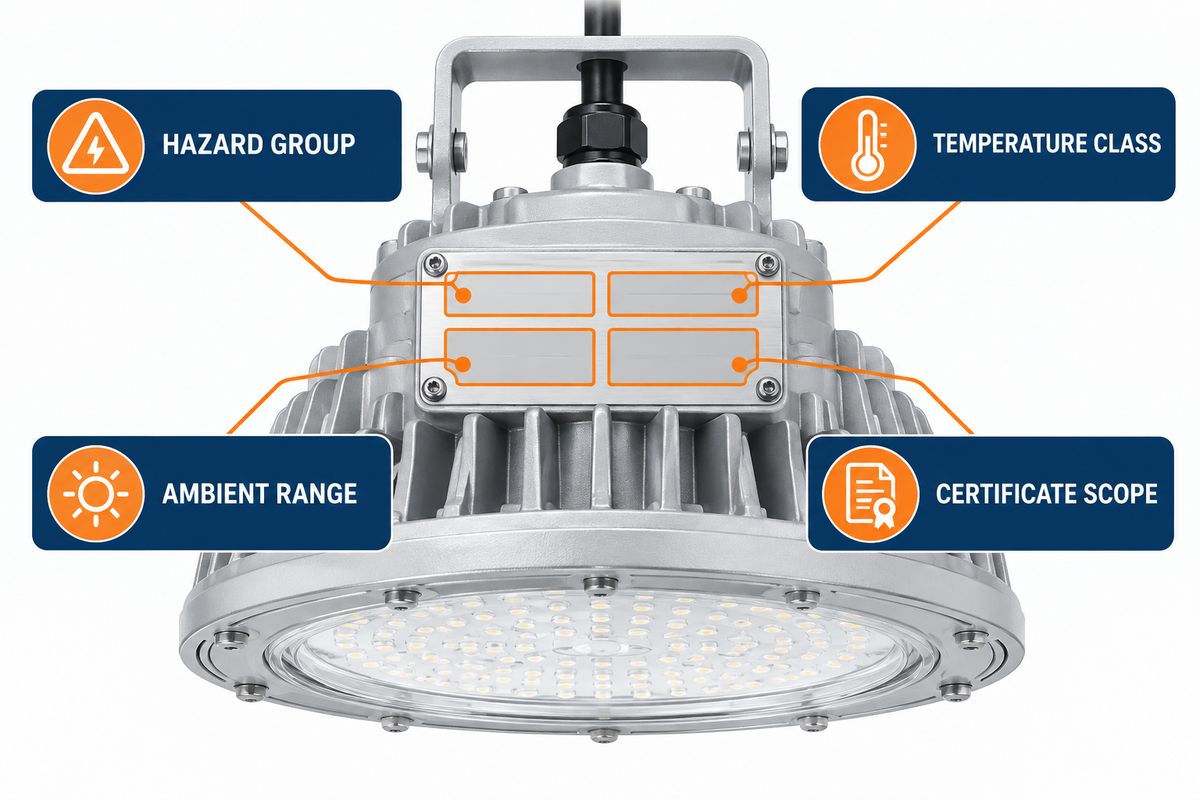
How should an engineer match Class and Division or Zone markings, gas or dust group, temperature class, and ambient range?
Start with documented area classification. Don’t begin with a fixture and work backward to a convenient interpretation. Record the classification system, gas or vapor, dust, fiber, or flying, its group, required protection level, maximum permissible surface temperature, and the minimum and maximum ambient temperatures.
In North American shorthand, a Class I (sometimes typed “Class 1” in search queries) Div 1 location and a Class I Div 2 location describe different possibilities of ignitable concentrations of flammable gases or flammable vapors, and the controls for flammable substances are selected to prevent ignition. Class II addresses combustible dust and Class III addresses ignitable fibers or flyings. In the Zone approach, Zone 1 and Zone 2 have different meanings as well, and these are the inputs to an engineering evaluation, not alternative sales language.
| Project input | Where to verify it | Hold point |
|---|---|---|
| Class/Division or Zone | Hazardous-area classification drawing or dossier | Stop if the location basis is undocumented or mixed systems are being casually translated |
| Gas or dust group | Process safety data and equipment marking | Stop if a gas approval is being used to imply dust suitability, or vice versa |
| Temperature class or maximum surface temperature | Material ignition data, nameplate, and certificate schedule | Stop if the rating is not valid at the project ambient |
| Ambient range | Site design basis and exact-model certificate | Stop if solar load, process heat, cold start, or mounting orientation falls outside scope |
| Special conditions | Certificate suffix, annexes, and instructions | Stop until every “X” condition or equivalent restriction has an owner |
Marking provisions illustrate a single label is not sufficient. Equipment approval considers class, group, operating temperature/temperature range and notes ambient temperature marking if applicable. The IECEx standards index similarly breaks area classification, protection methods, installation, inspection and maintenance as separate components of the IEC 60079 family. Confirm the edition adopted by the project.
Do Not Treat Protection Concepts and IP Ratings as Synonyms
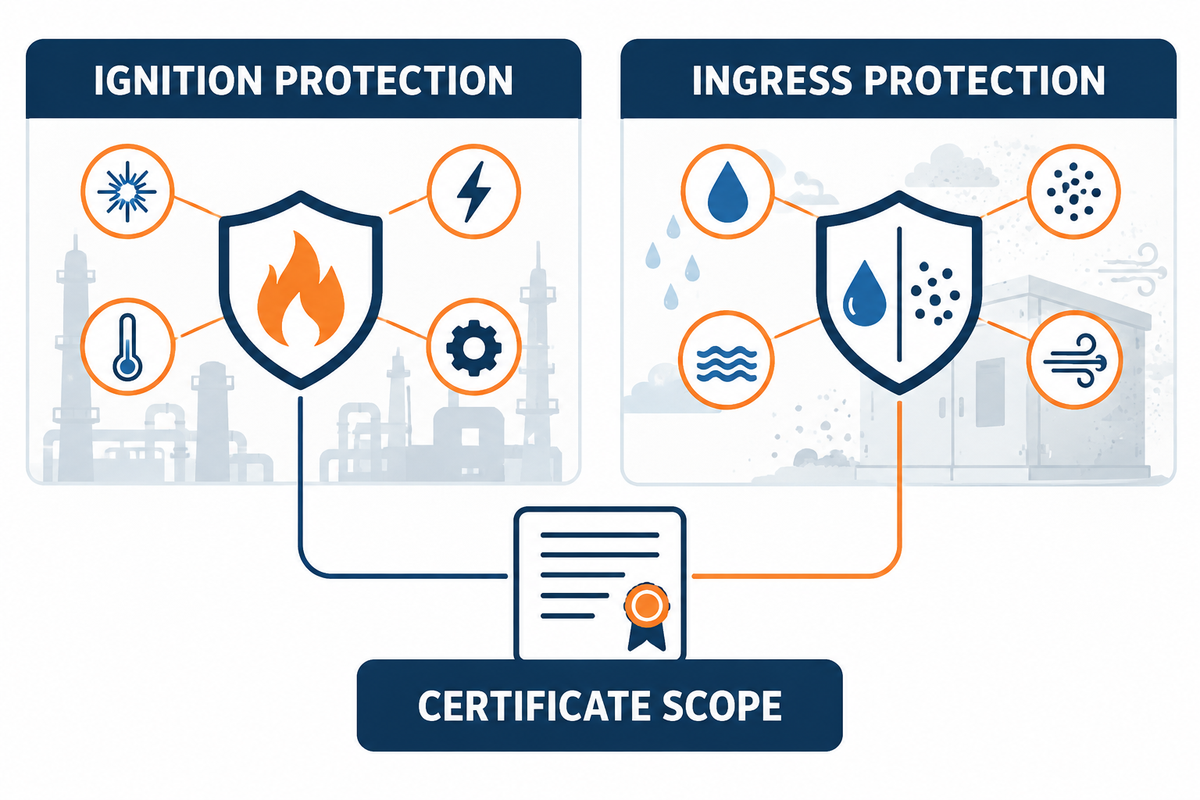
What is the difference between explosion-proof, dust-ignitionproof, increased-safety, intrinsically safe, and ordinary IP-rated lighting?
| Term | What it controls | What it does not prove by itself |
|---|---|---|
| Explosionproof (North American) or flameproof (IEC-based) | Propagation from an internal ignition through an enclosure and joints approved under the governing certification system | Interchangeability between regional designations, or suitability for every gas, dust, Zone, Division, ambient, or field modification; the exact certificate designation controls |
| Dust-ignitionproof / protection by enclosure | Ignition risk associated with combustible dust under the stated approval | Gas or vapor suitability |
| Increased safety | A design intended to avoid arcs, sparks, and excessive temperatures under specified conditions | That the enclosure contains an internal explosion |
| Intrinsic safety | Electrical and thermal energy limitation under defined normal and fault conditions | That any high-power luminaire circuit is intrinsically safe |
| IP rating | Ingress of solids and water | Hazardous-location approval, gas/dust group, or temperature class |
Intertek’s protection-method overview illustrates that terminology and permitted methods differ by region and hazard type. Read the complete equipment marking and certificate scope; do not translate a familiar word into an approval the product does not carry.
Fixture form also follows the task. For example, High bay lights may be used for tall processing bays, flood lights for outdoor work zones, and light fixture for a low-clearance inspection route. Calling any of these a “LED explosion proof light” or an “LED explosion proof” fixture does not establish approval; proper lighting solutions, whether described as led lighting, hazardous lighting, or explosion proof fixtures, still require the exact model, photometry, mounting method, and hazardous-area certificate.
Build a Service-Life Design Basis
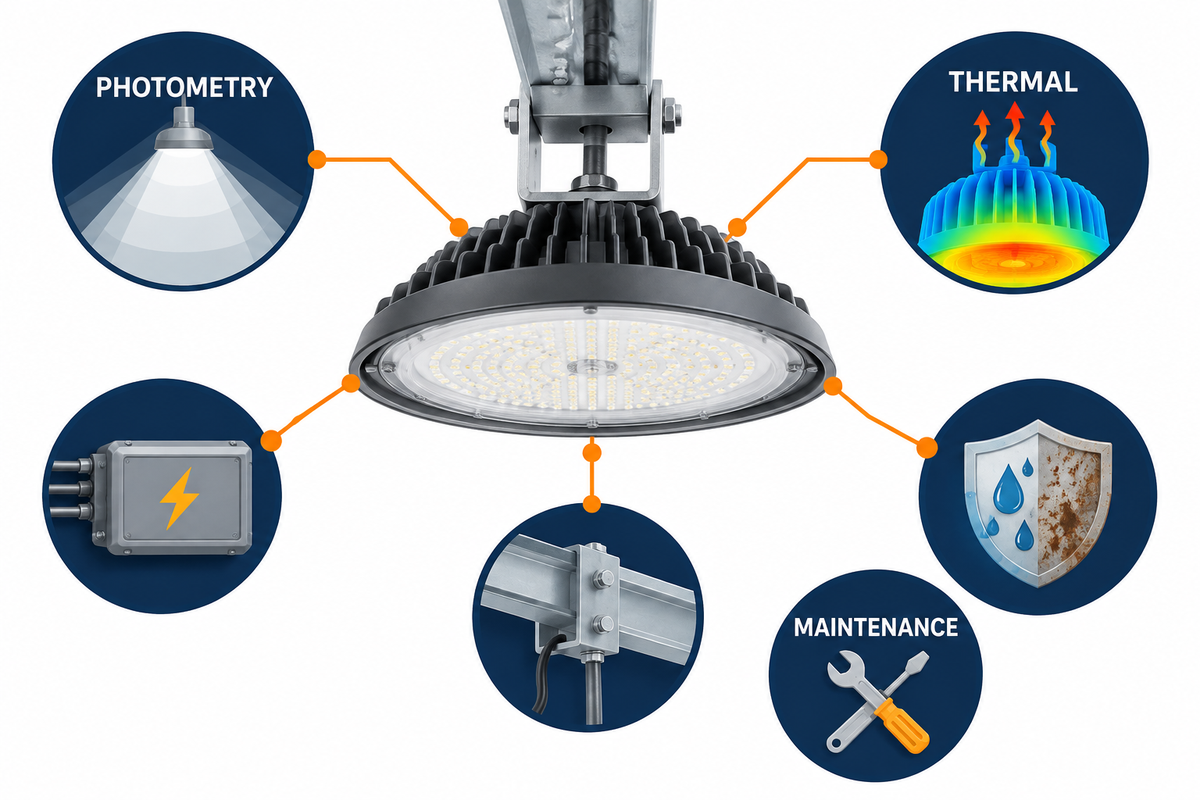
Which photometric, thermal, electrical, mounting, corrosion, and maintenance inputs matter?
A fixture can be certified correctly and still be a bad lighting design, because even when lights are designed as lighting for hazardous areas, photometric performance remains a separate question. The photometric basis should include maintained illuminance, uniformity, glare limits, mounting geometry, obstructions, dirt depreciation, lumen depreciation, and IES or LDT file. Initial lumens do not tell if the task plane is maintained illuminated at the end of maintenance interval.
Tolerance for deviation from prescribed design, equipment, or systems for a refinery, including oil refineries, chemical plant or a bulk-handling facility should be addressed in the illumination plan for normal routes, task surfaces, emergency egress, and maintenance access. LED high bay, hazardous location light, and warehouse lighting labels pertain to form or function and should not be used to state classification or approval scope.
A thermal basis should address the effect of ambient conditions, solar load, adjacent hot equipment, airflow, orientation, and heat-sink clearance. Electrical effects include voltage range, inrush current, surge conditions, grounding and bonding, emergency power systems, control systems, and replacement-drivers. Mechanical and environmental effects include vibration, washdown, corrosion, impact, chemicals, cabling, access equipment, and safe isolation.
The U.S. Department of Energy’s LED guidance cautions against regarding the LED package as the complete system. Drivers, connections, lenses, heat, and application conditions, among others, influence the practical service life. Examples shown in the LED guidance also demonstrate that the complete-luminaire efficacy varies significantly; therefore, compare complete-luminaire efficacy rather than the diode claim.
Use the Ignition-to-Handover Evidence Chain
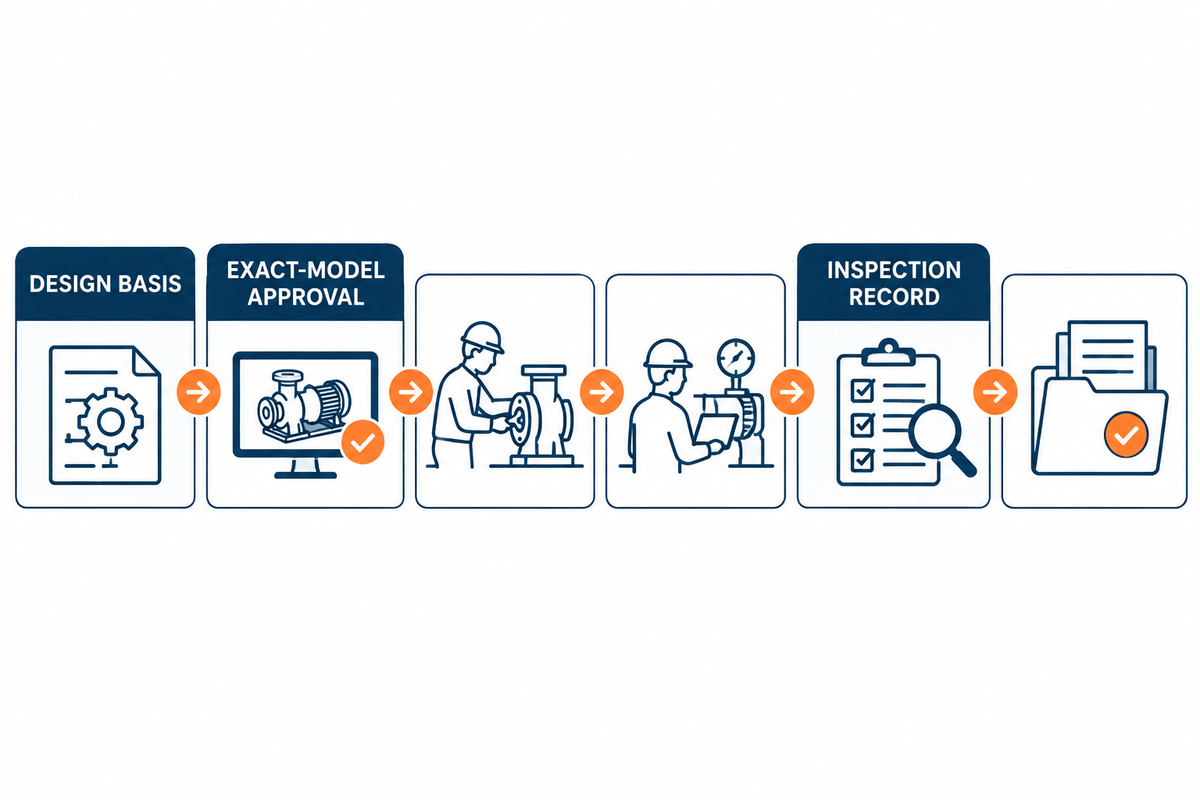
This guide’s Ignition-to-Handover Evidence Chain uses certificate scope—illustrated by UL’s hazardous-areas guidance—as one input to an accountable project record. Each row must name the record owner and describe the mismatch that would prevent acceptance.
| Evidence-chain category | Required evidence | Owner | Mismatch signal |
|---|---|---|---|
| 1. Hazard basis | Classification, substances, groups, temperature limits, ambient range | Plant/process safety | Generic “hazardous area” description with no documented basis |
| 2. Design basis | Maintained-lighting model, electrical and environmental inputs | Lighting/electrical engineer | Selection based only on watts or initial lumens |
| 3. Exact-model approval | Certificate, schedules, nameplate, options, approved accessories | Supplier and quality assurance | Certificate family does not include the ordered code |
| 4. Installation | Entries, seals, fasteners, orientation, torque, bonding, as-built identity | Installer | Field parts or methods differ from instructions |
| 5. Commissioning | Electrical tests, functional checks, photometric acceptance, defect closure | Commissioning lead | No baseline against which deterioration can be judged |
| 6. Lifecycle record | Inspections, cleaning, damage, repairs, replacements, next action | Site owner | Equipment condition and approval history diverge |
| 7. Change control | Approved substitutions, repair method, firmware or driver changes, and engineering disposition | Management of change owner | A replacement part or repair has no traceable approval basis |
| 8. Audit closeout | Open-item register, responsible person, completion date, and retained evidence pack | Asset owner and quality assurance | Unresolved exceptions disappear from the handover record |
| 9. Revalidation trigger | Defined review after process, substance, layout, ambient, or maintenance-strategy changes | Plant engineering | The original selection basis survives after its operating assumptions have changed |
This is not a request for quote (RFQ) matrix. Procurement can collect documents, but it is engineering and quality assurance that must determine if documents describe the actual installation.
Compare LED and HID With a Defensible Lifecycle-Cost Model
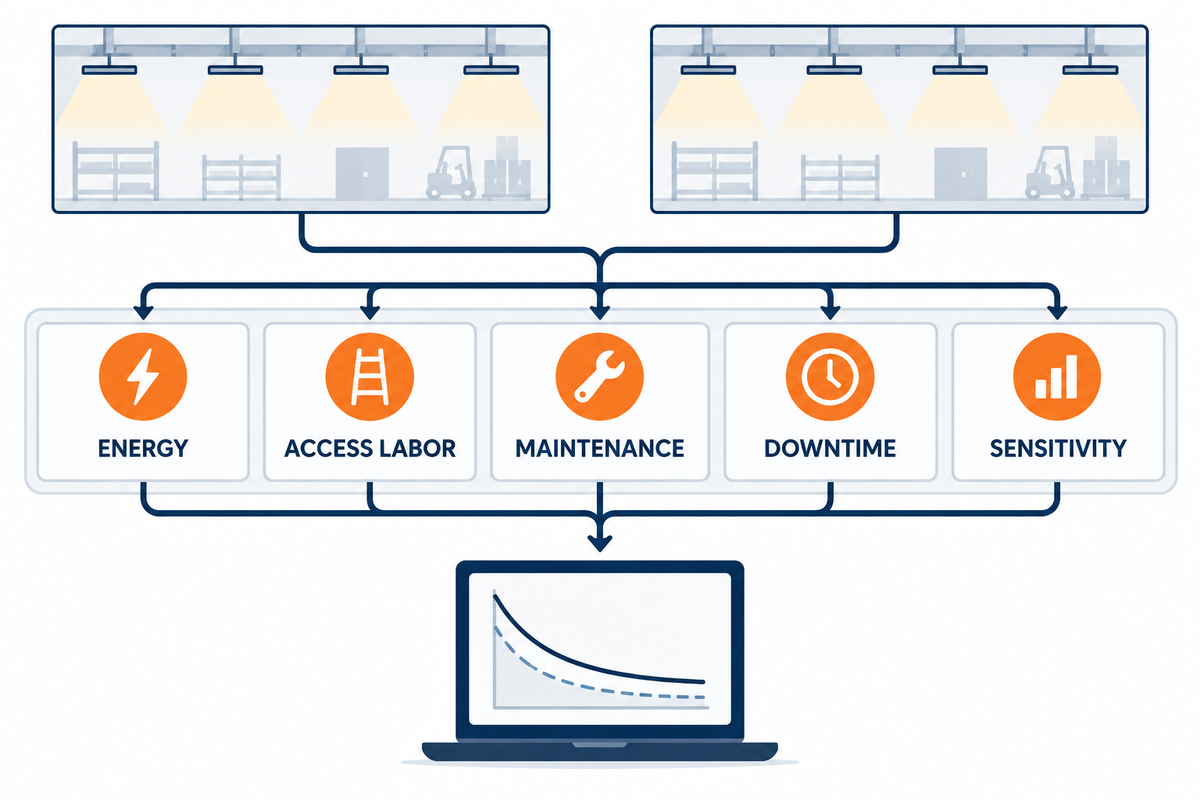
How can a plant compare lifecycle cost without relying on headline wattage or rated life?
First, establish two layouts that deliver the same maintained-lighting result. Next, evaluate energy, planned and corrective maintenance, access, permits, downtime, cleaning, and spares, and discount them over the same study period.
Lifecycle cost equals the installed cost, discounted energy cost, discounted planned maintenance, discounted failure cost, access cost, and downtime cost, less residual value.
Hidden bottleneck map
| Visible assumption | Hidden constraint | Low/base/high scenario |
|---|---|---|
| Fixture wattage | Different beam distributions may change fixture count | Use complete-layout input watts at equivalent maintained light |
| Rated life | Driver, seals, corrosion, heat, and lumen depreciation may set useful life | Model component and useful-light failure separately |
| Replacement price | Lift, isolation, permit, production interruption, and recommissioning can dominate | Record the fully burdened event cost |
| Energy price | Operating hours and tariff escalation vary | Use measured hours and sensitivity ranges |
| Maintenance interval | Dirt, vibration, washdown, and process exposure are site-specific | Use the site plan, not a universal blog interval |
The DOE states reported LED output and efficacy do not always match the laboratory performance, and lumen maintenance alone is inadequate in defining the luminaire lifetime. For a practical review, show the assumptions and sensitivity range to finance; ask plant operations to supply access and downtime inputs; and assign quality assurance to verify the evidence used for useful-life assumptions.
Verify the Exact-Model Handover Package
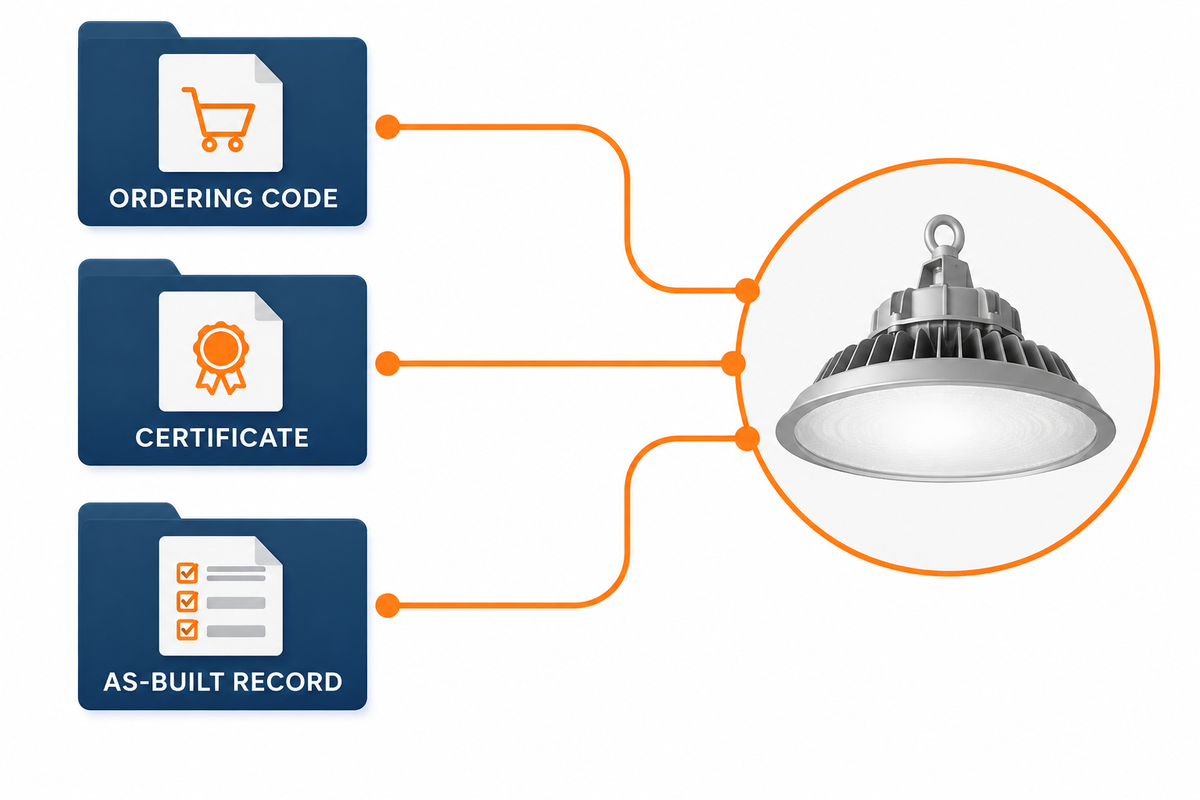
What should a supplier hand over for explosion-proof LED lights?
Request evidence for the exact ordered code and configuration, including the certification scope described by UL’s hazardous-areas certification guidance, all certificates, annexes and schedules, special conditions of use, declaration documents, legible markings, datasheets, wiring diagrams, photometric files, instructions, and approved accessories.
The installer adds as built identity, entries and seals, mounting and orientation, bonding, inspection and test results, deviations, and closed defects. The site owner retains the commissioning baseline and life cycle data. A supplier brochure will not be accepted in lieu of an installer’s record; an installer checklist will not be accepted to expand the scope of a certificate.
Apply a Go / Hold / Reject Decision Framework
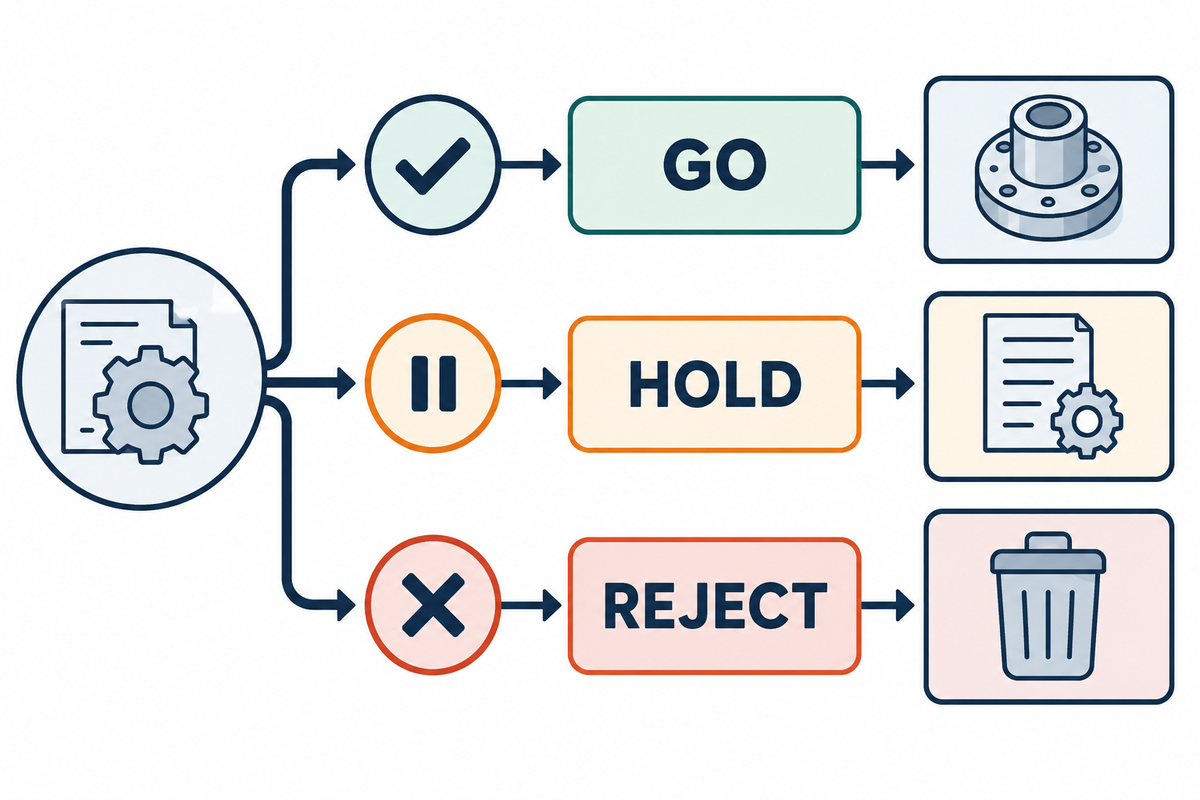
- Go: classification, complete marking, exact model certificate, supplied configuration and installation, photometric results, and retained record agree.
- Hold: A document, calculation, accessory approval, or special condition is missing; keep the decision on hold until traceable evidence closes the gap without assuming suitability.
- Reject: model is out of scope, group or temperature limits are wrong, or conditions of approval are not met.
Commercial considerations are made only after technical holds against the certification scope described in UL’s hazardous-areas guidance have been closed. This ensures that an evidence mismatch, which may be masked by a low price, attractive efficacy claim or short lead time, is revealed.
Common Failure Modes During Installation and Maintenance
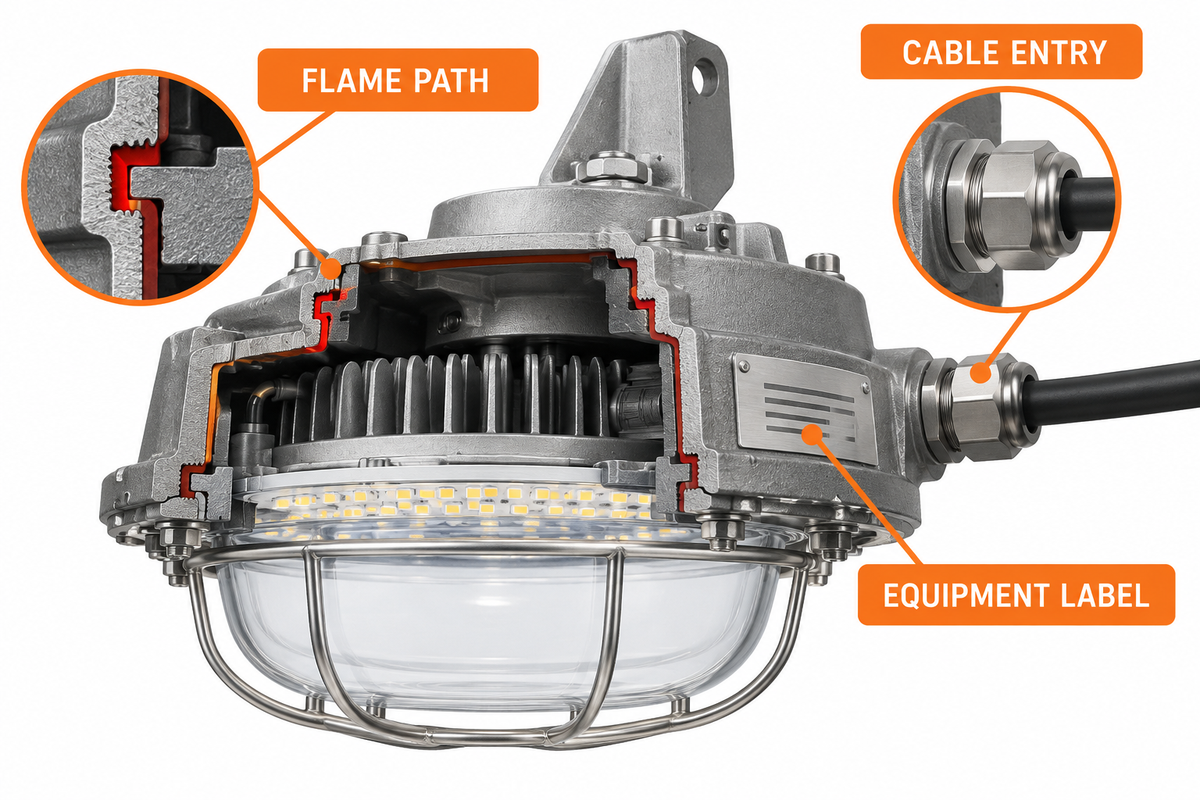
Common problem areas include obstructed or damaged flame paths or threads, incorrect cable glands and stopping plugs, missing fasteners, obstructed thermal paths, corrosion, degraded seals, illegible markings, loose bonding, undocumented repairs and replacement components which are merely similar. Exact inspection tasks and intervals must follow the applicable standard, risk assessment, certificate conditions, and manufacturer instructions; the OSHA hazardous-location rule reinforces that approved equipment must remain suitable for the specific hazard.
A good maintenance record shows what was inspected, the condition, the equipment ID, the defect classification, the person responsible, the action taken, and the next action date. “Checked. OK” is generally not sufficient to show the rationale for a technical decision.
Frequently Asked Questions
Are explosion-proof LED lights the same as waterproof lights?
No. A water or dust ingress rating describes resistance to solids and liquids. It does not indicate hazardous-location approval or a validated ignition-protection method. A project may require both ingress protection and hazardous-location suitability, but each must be verified independently for the exact configuration provided.
Can a higher IP rating replace a hazardous-location certificate?
No. IP and hazardous-location approval address separate questions. IP does not stipulate a dust group, a gas group, temperature class, Equipment Protection Level, Division, Zone or Protection concept. Inferring an equipment safety scope from its enclosure rating is never allowable.
How often should explosion-proof LED lights be inspected?
Where IEC 60079-17 applies, the interval between periodic inspections should not exceed three years, though this can be adjusted based on a documented risk assessment. The interval is determined by the requirements, site risk assessment, environmental conditions, manufacturer’s instructions, the condition of the equipment, and the maintenance history. If there is equipment damage or repair, or if abnormal heat, flooding, impact or other events occur that could compromise the safety protection concept, the equipment safety case needs to be reassessed, whether the unit is a floodlight or another fixture form.
Does an LED lifetime claim prove the complete luminaire will last that long?
No. There are many factors other than LED lumen maintenance that determine the useful service life of a lighting system. These include, but are not limited to, drivers, optics, connections, seals, thermal conditions, surge conditions, corrosion, switching, and the maintained-light requirement. Determine what was actually tested, at what temperature, for what exact configuration, and how does the claim relate to the project maintenance threshold.
What should be ready before requesting a product recommendation?
Document the area classification, substances and groups, ambient temperature range, required temperature limit, supply conditions, mounting and environmental exposure, maintained-lighting criteria, governing certification system, handover conditions, normal operating conditions, and the evidence used to assess hazardous area lighting and durability in hazardous environments. With this information, the LFADJ explosion-proof LED lights product page can help with exact-model configuration comparisons.
References and Sources
- OSHA 29 CFR 1910.307 — Hazardous (classified) locations
- IECEx — Standards operated by IECEx
- UL and C-UL hazardous areas certification for North America
- Intertek — Protection method overview
- U.S. Department of Energy — Adopting LED Technology
Move From Evidence to a Product Shortlist
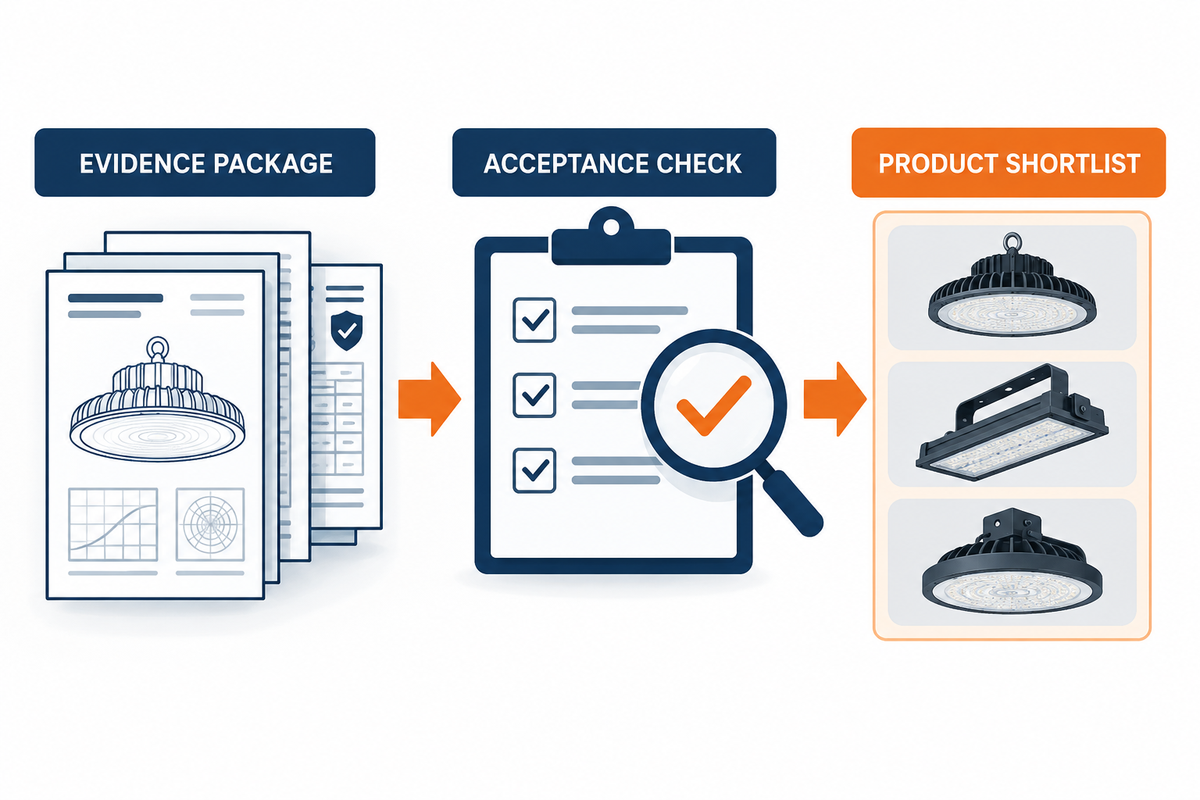
With the classification, ambient limits, and handover requirements documented against a recognized certification scope such as UL’s hazardous-areas program, LFADJ configurations can be compared and exact-model evidence requested before quotation approval.
LFADJ · COMPANY & TECHNICAL CONTEXT
Practical lighting guidance for real project conditions
LFADJ shares product context, application notes, and selection checks to help project teams compare industrial lighting options with the right site details in view.
What LFADJ covers
LFADJ focuses on industrial lighting and tailored lighting solutions for teams planning, specifying, or operating demanding work environments.
- Product context: mobile lighting, light towers, explosion-proof lighting, emergency lighting, and related industrial lighting equipment.
- Project context: application conditions, target illumination, runtime, site constraints, and product configuration questions.
- Decision support: use the information here as a starting point, then confirm final specifications against the actual installation and local requirements.
Industrial lighting
Application guidance
Project enquiries
NEXT STEP
Have a site question?
Send the operating environment, lighting target, expected runtime, and any drawings or photos you have. The existing enquiry form is ready for a focused discussion.
Start an enquiry Or use the LFADJ contact page