Get in touch with LFADJ Company

Mobile Emergency Lighting: A Field Deployment Guide

Field planning guide
Mobile emergency lighting is not a wattage contest. A useful deployment starts with the work people must see, the geometry of the scene, the hazards surrounding the mast and power source, and the evidence required before the start of a shift.
What Mobile Emergency Lighting Is—and Is Not
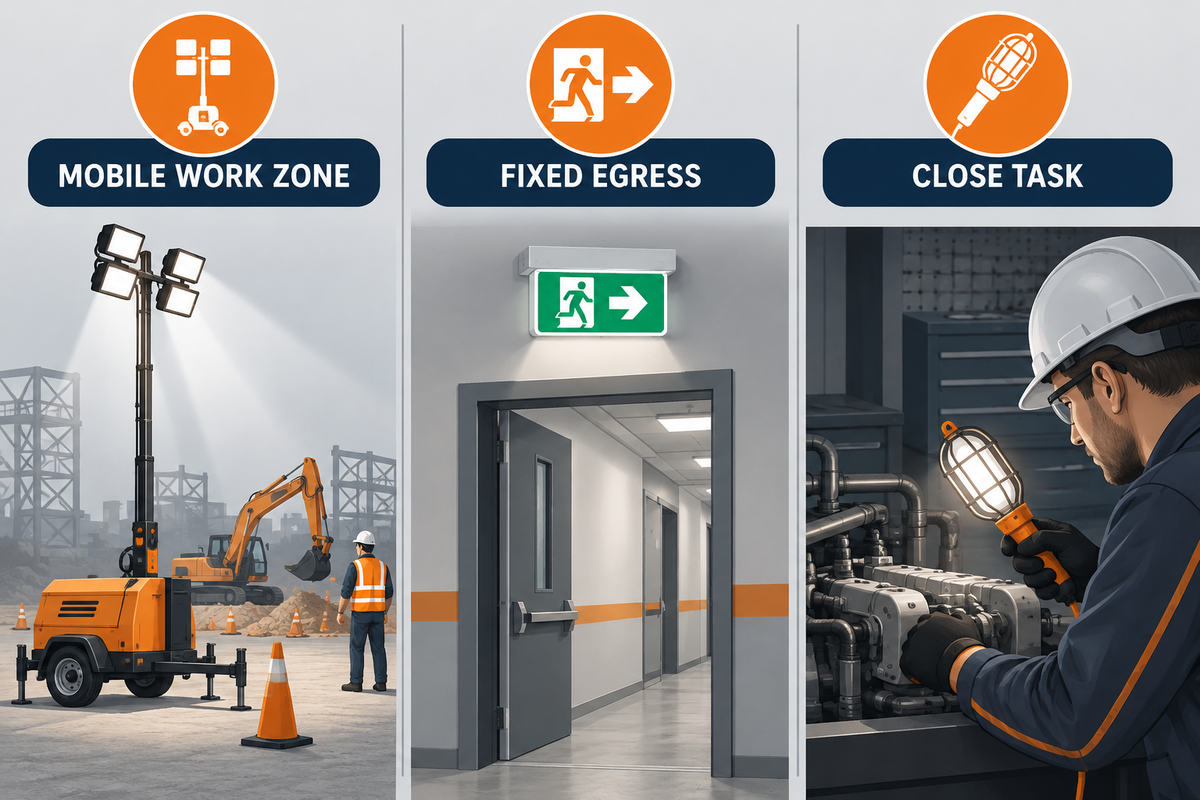
In this guide, mobile emergency lighting refers to relocatable equipment used to temporarily illuminate an outdoor or industrial scene where permanent lighting is missing, damaged, inaccessible or inadequate for temporary work. This equipment may help in recovery, shutdown, repair, inspection, construction, mining, utilities, logistics, or incident response; for example, OSHA 1926.56 defines scoped illumination requirements for U.S. construction work rather than a universal rule for every scene.
This is a different design issue from fixed exit signs and building egress luminaires. These systems form part of a building’s life safety strategy and applicable electrical and fire requirements for that application. A hand lamp is different again: it can help one person see a close task, but it does not establish safe visibility across a work area.
Search results also combine this topic with an LED emergency bulb or other LED light, a rechargeable household fixture sold as a rechargeable emergency light, a light bulb, police lights, and a phone app. These products address different problems. Similarly, fixed lighting systems, a permanently installed exit light, or a mobile app are not substitutes for a field installation that must be transported, positioned, powered and verified at a changing industrial scene.
Start With the Task Plane, Not the Lamp Rating
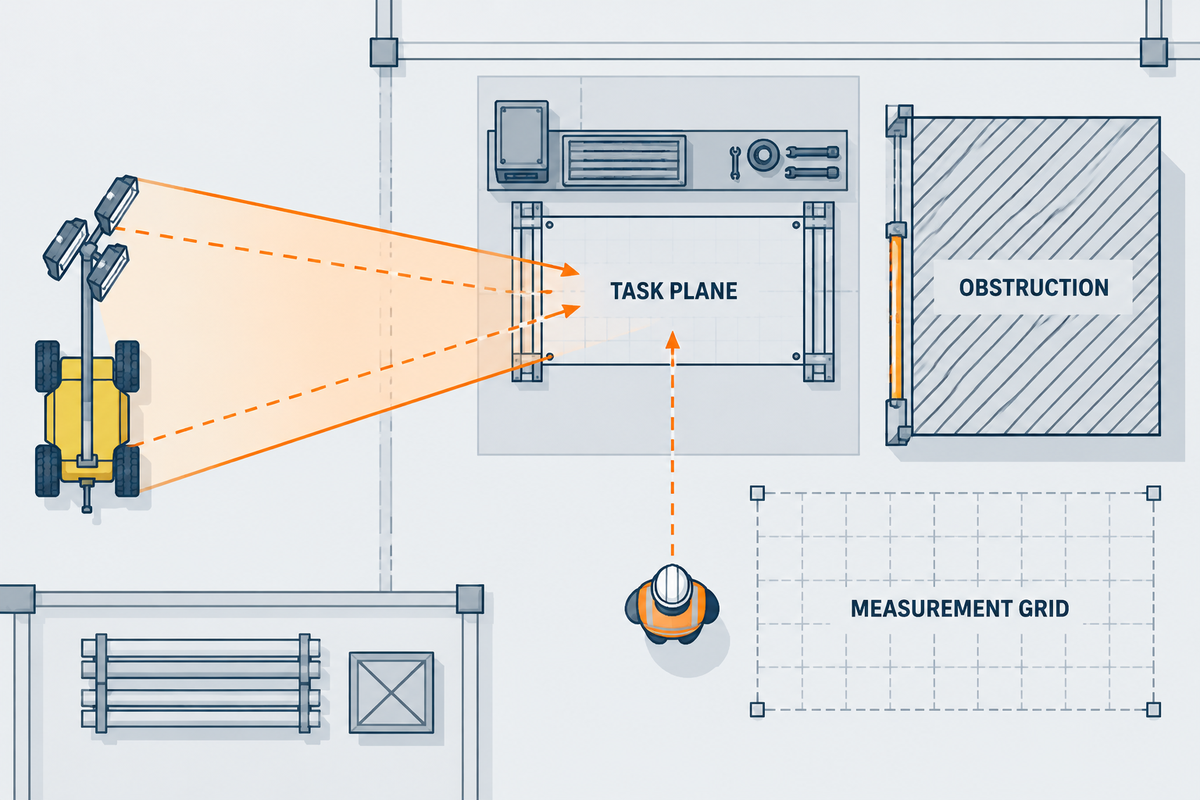
The electrical input of a lamp is not a measure of useful light at the working surface. The practical starting point is the task plane: the surface on which a person must detect a detail, read markings, operate a control, connect a cable, and/or perform an activity safely.
Build a Task-Plane Brief
For each work zone, describe the task, location, and height; the smallest or least contrasting detail to be seen; expected viewing direction; and hours of operation. Also describe obstructions, reflection, dust or mist, vehicle routes, cameras, neighboring properties, and any dark-adaptation outside the work zone.
Explain how the team will verify the result. A typical field record gives locations, orientations, and modes of measurement instruments; positions of the mast and tripods; aiming; weather conditions; and any weatherproof claim being relied on. It should also record blackout-level dark areas and excessive brightness or glare, since an average value of all measurements may conceal an unacceptable or disabling condition.
For US construction work, minimum illumination levels such as 5 foot-candles for general construction area lighting and 3 foot-candles for excavation and waste areas, access ways, loading platforms, refueling and field maintenance areas are set in OSHA 1926.56 and Table D-3. However, these levels should not be extrapolated to other industries and/or jurisdictions. The applicable standard, the owner’s specifications, and the task at hand should dictate the minimum acceptable illumination levels.
Map Access, Ground, Mast Envelope, and Relocation
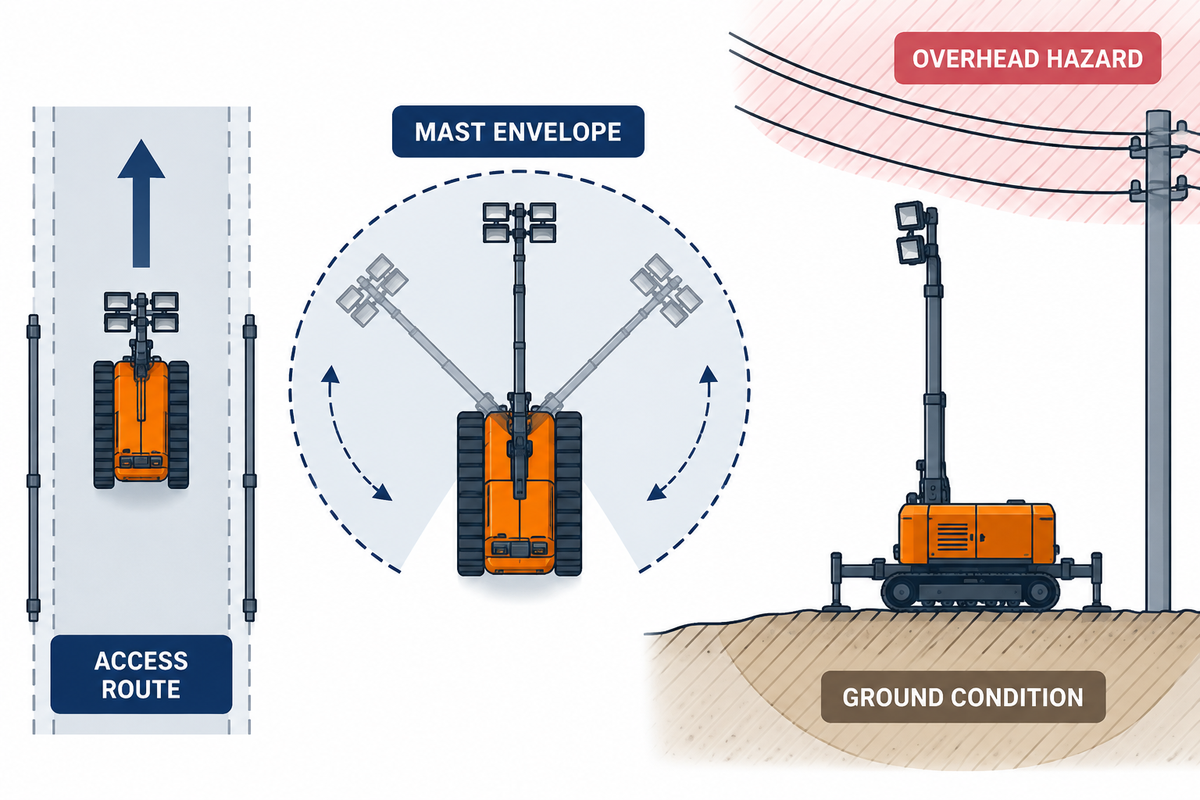
The best photometric proposal is useless if the unit cannot be positioned and/or remain stable at the planned location. Prior to assessing units, draw a simple Deployment Envelope Map and include the mast’s relationship to overhead conductors, following the planning principles in HSE GS6 where relevant.
- Arrival: gate width, turning space, slope, surface strength, overhead restrictions, pedestrian interfaces, and recovery access.
- Deployed footprint: machine body, stabilizers or outriggers where applicable, cable routes, refueling or charging access, barriers, and exhaust direction.
- Mast envelope: the full swept volume during raising, lowering, rotation, aiming, and transport—not only the final lamp position.
- Relocation: when work advances, material stacks change, traffic shifts, or shadows move, define who can reposition the unit and what must be rechecked.
Although tracked or wheeled undercarriages may improve access, this does not ensure stability while the mast is elevated. Operation of the unit must be in accordance with the manufacturer’s instructions, rated limits, and site constraints.
One high source or several lower sources?
Increased height can expand coverage, but can also elongate shadows and expose the mast to more difficult conditions. Multiple lower or more located sources may reduce shadowing around plant and structures, but may also add cable, traffic, inspection and coordination points. Compare compact and full-size layouts using photometric plans and no-light field checks, not single lumens or watts.
Control Glare, Shadows, and Traffic Conflicts
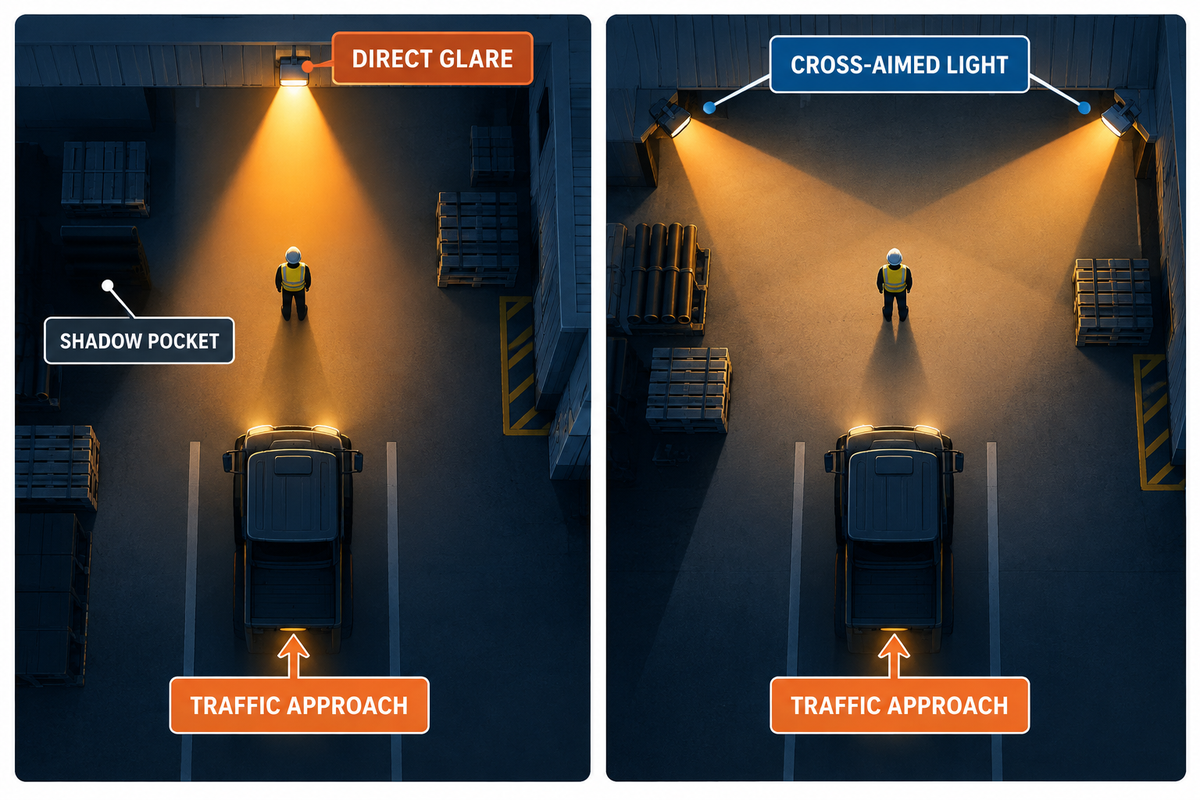
A bright source can reduce visibility when it reflects into an operator’s or driver’s eyes, or into a camera or neighboring work zone. Where possible, position luminaires to illuminate the task and keep high-intensity light out of the normal line of sight, while verifying the required work-area illumination against the applicable rule such as OSHA 1926.56 within its U.S. construction scope. Examine the scene from the positions that actual occupants will occupy.
Walk the perimeter after dark. Look from eye level of workers and equipment. Look from access points, traffic approaches, and security camera locations. Mark deep shadows behind machinery, equipment, containers, walls, spoil piles and vehicles. If the configuration of the work changes during the shift, note the change, rather than assume the initial configuration will remain adequate.
Plan Runtime From Power and Energy
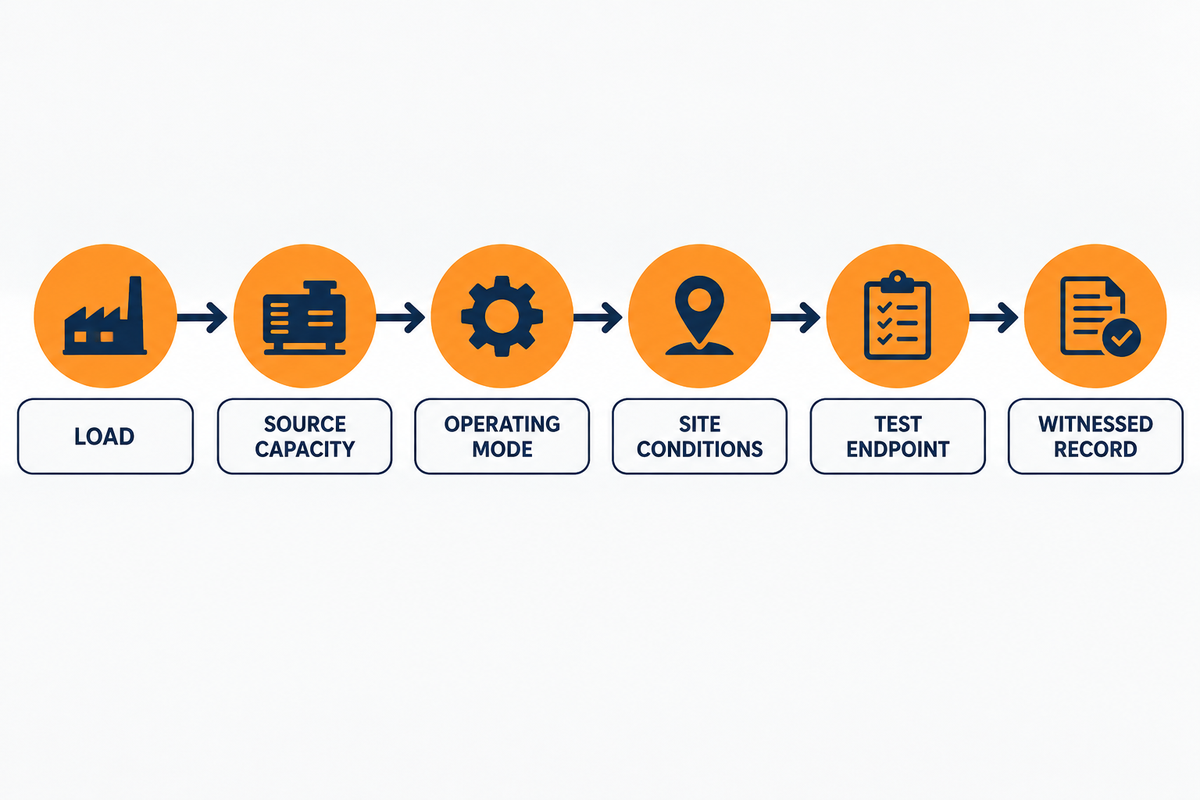
“Eight hours” or “all shift” has meaning only if the load, operating mode, conditions and end-point of the test are defined. For a battery system, the first-pass relationship is that stored energy is divided by the total operating load. For a fuel-powered system, the duration is dependent on the condition and test method of the manufacturer.
Use a Runtime Evidence Chain
- List every load: luminaires, controls, chargers, heaters, communications, and permitted auxiliary outlets.
- Identify the rated source capacity and, for batteries, the usable—not merely nominal—energy under the stated test conditions.
- State the selected output mode and any automatic dimming or cycling behavior.
- Apply only documented derating and reserve rules; do not invent a universal percentage.
- Define the endpoint: shutdown, low-fuel alarm, minimum light level, or another agreed criterion.
- Verify the configuration with a witnessed test or supplier record before relying on it for contingency planning.
LFADJ states an eight-hour working duration for the configuration on their product page. Consider this information product-specific and confirm your configuration and testing conditions on the mobile emergency lighting product page. It is not a general duration for all loads and sites.
Check Overhead Lines, Generators, Weather, and Area Classification
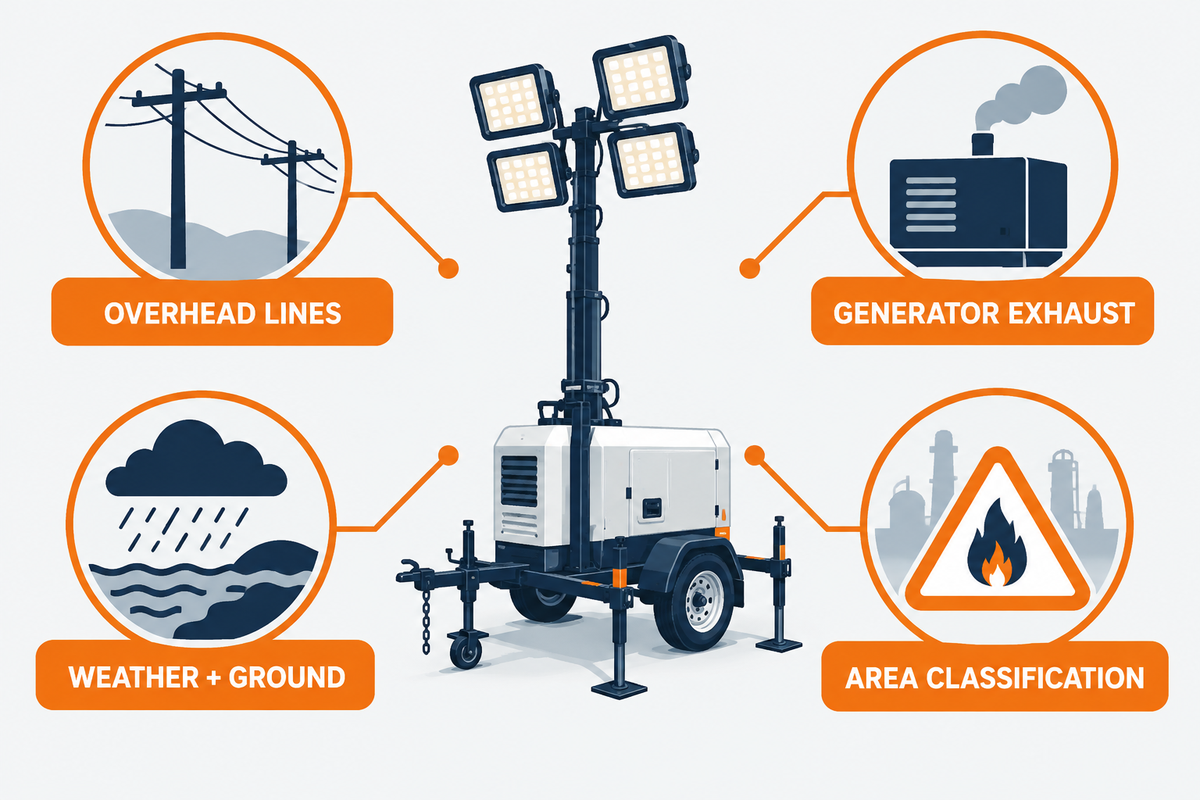
Overhead electric lines
Identify the conductors in the overhead lines before selecting the travel route or erecting a mast. UK HSE’s guidance on avoiding danger from overhead power lines illustrates the importance of planning and controlled access to mobile plant. The type of clearance and control required is dependent on the voltage of the line, the work being performed, the jurisdiction and the utility/line owner. Do not use a generic distance from the Internet in place of project control.
Portable generators
Generator exhaust can be fatal. OSHA’s portable-generator guidance, outlines other hazards including CO, electrical, fire, and noise, and warns against operating in enclosed or partially enclosed spaces. Place the source outdoors in accordance with its instructions, keep exhaust away from occupied areas and openings, secure connections and protect from the elements, and plan for refueling, fire controls, grounding or bonding, and hearing protection, in accordance with the applicable procedure.
Weather, ground, and hazardous areas
Ground conditions such as soft ground, standing water, wind, dust, heat, cold, and ice can change performance and stability, while a waterproof claim addresses a different question. Use the published limits of the model and assess the site. An IP rating on a lamp head does not make the system suitable for use in a hazardous location. With combustible dust, gas or vapor, the area classification and model certification must be aligned. Never infer explosion-proof suitability from appearance or from IP65 alone.
Use a Pre-Deployment and Shift-Handover Checklist
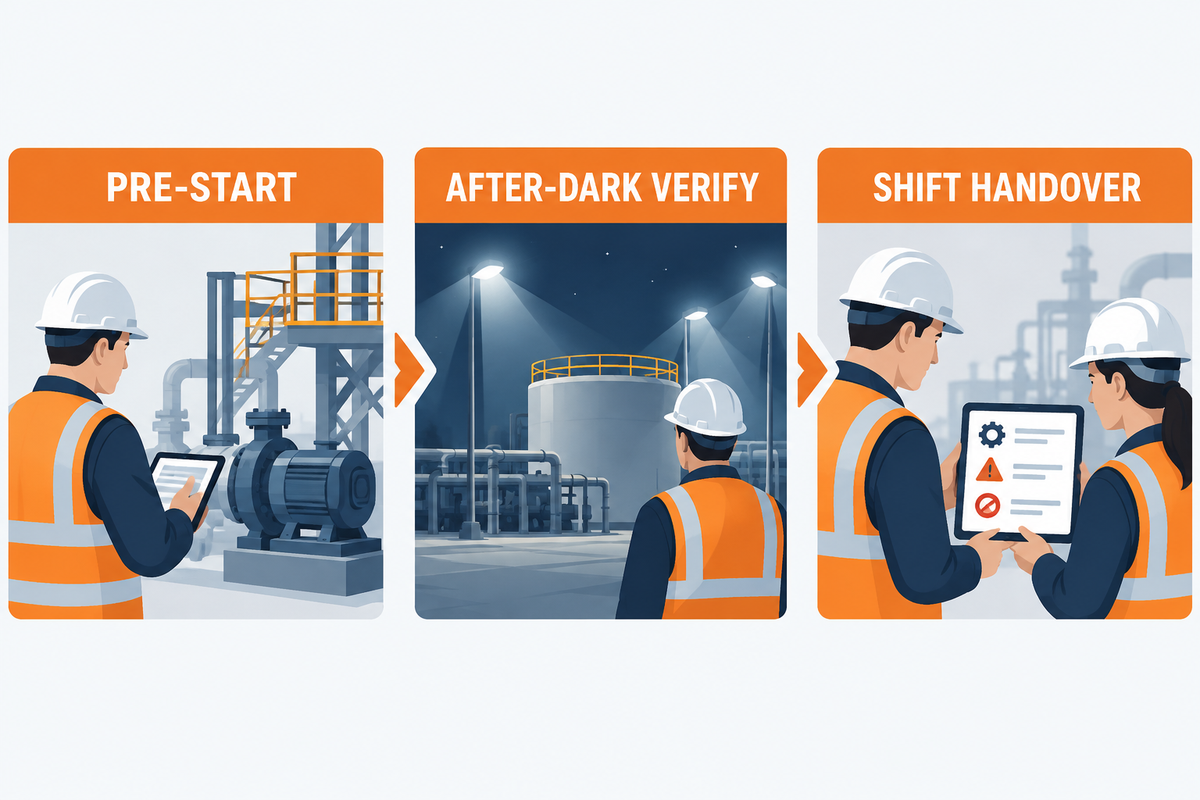
A checklist is only valuable when it captures exceptions and the actual configuration, not a simple series of ticks. Prior to use, identify the unit and revision. Look over the chassis or undercarriage. Inspect the mast, locking devices, luminaires, cables and connectors. Assess guards, Fluids or energies, controls, alarms and the state of emergency. Identify visible damage. Note ground conditions, barriers, access, overhead hazards, exhaust, and the agreed operating mode; OSHA’s portable-generator guidance provides a verified source for the generator hazards that must be handed over when that power source is used.
After dark, check the measurement grid and perform a visual inspection. Document dark zones, glare, unintended spill, traffic conflicts, and camera performance. Correct layout and repeat check.
What should pass to the next shift?
Transmit the unit identity, mast and aiming configuration, operating mode, remaining fuel or charge, measurement results, defects, temporary controls, changes in the work zone, planned relocation, stop conditions, and the person responsible for the next inspection. A verbal “all good” will not maintain those facts or create a maintenance record.
Build an RFQ Suppliers Can Compare
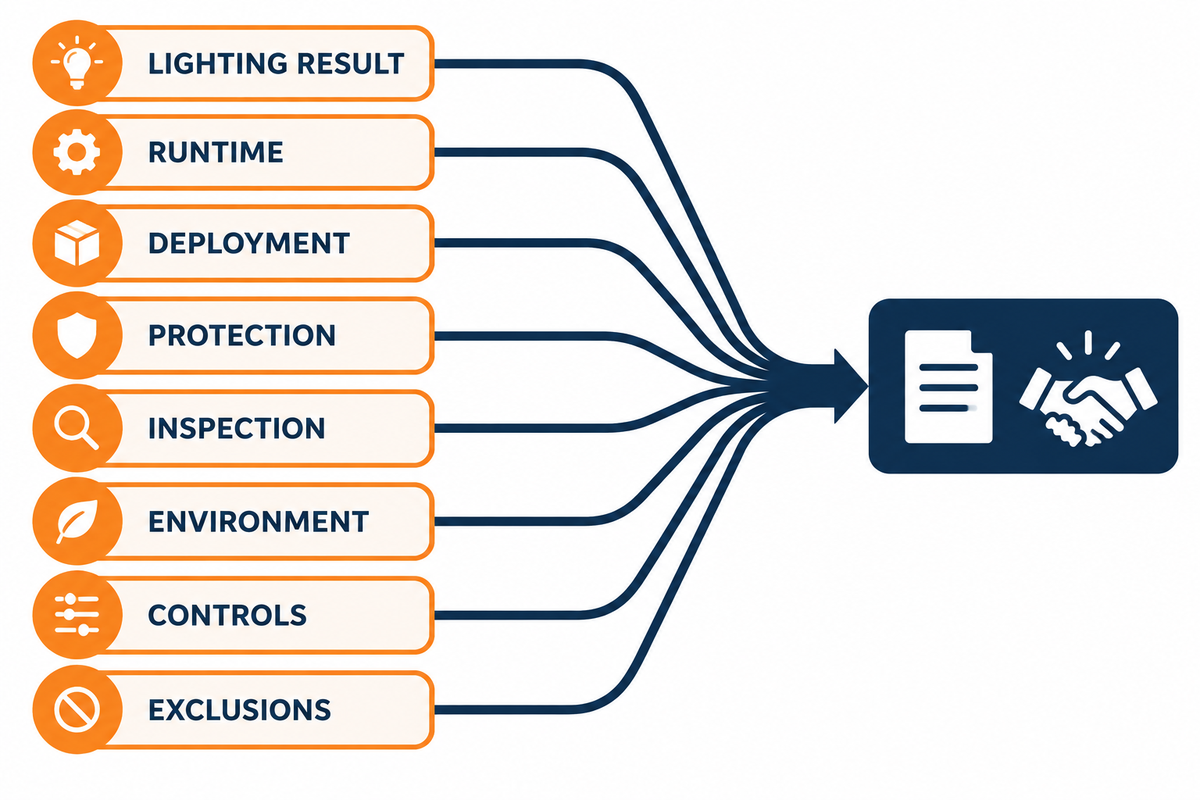
An honest comparison starts with the first input package, including whether the lighting equipment is appropriate for the location as emphasized in OSHA hazardous-waste operations guidance for its regulated context. In the interest of fair competition, you must provide the same basic information to all bidders: drawing, task plane definitions, work schedule, access route, ground and weather assumptions, traffic management plan, overhead line information, power constraints, noise limits and classification of areas, where applicable, of the hazard.
Use a Comparable RFQ Matrix
| RFQ category | What to request | Why it matters |
|---|---|---|
| Lighting result | Photometric plan, task-plane grid, mounting height and aiming assumptions | Compares delivered visibility, not input power |
| Runtime | Load, mode, usable capacity or fuel, conditions, reserve rule and endpoint | Prevents unlike duration claims |
| Deployment | Travel limits, deployed footprint, setup sequence and exact stability documentation | Tests fit with the site envelope |
| Protection | Component-level ingress ratings and exact-model certificates | Prevents a part rating from being applied to the whole system |
| Inspection | Pre-start, periodic and post-use requirements plus service support | Clarifies operational ownership |
| Environment | Rated temperature, wind and weather limits with the applicable configuration | Connects site conditions to documented limits |
| Controls | Local or remote control functions, alarms and emergency-stop behavior | Clarifies how operators control and isolate the unit |
| Exclusions | Items, conditions and services outside the offer | Exposes cost and scope gaps |
Each bidder must capture deviations with the same definition, hence, “flat-paved and smooth” ground must not be interpreted as “rough” ground. Likewise, if one bidder captures travel on a rough surface and photometric evidence is provided by another bidder, but not provided by the third bidder, their prices do not describe the same solution.
Frequently Asked Questions
How do I choose mobile emergency lighting for an industrial site?
Start by defining the work and the surfaces that must be visible. Map access, ground, obstructions, mast movement, traffic, overhead lines, weather, power, runtime, and area classification. Then ask suppliers for a photometric proposal and a runtime definition tied to the offered configuration. Verify the final arrangement after dark and record glare and shadow observations before accepting it.
How should a mobile light tower be positioned?
Use stable ground within the exact model’s instructions, protect the deployed footprint, and keep the full mast envelope clear. Aim across the task rather than into operators or drivers, and check shadows from multiple positions. Identify overhead conductors before movement or setup. The best position is the one that satisfies the task-plane result and site controls, not automatically the highest or closest location.
How long should mobile emergency lighting run?
Plan for the full work period until refueling, recharging or replacement; LFADJ’s product page, for example, states an eight-hour working duration for its configuration. Duration depends on the usable battery energy or fuel, the complete operating load, output mode, auxiliary loads, environmental conditions, documented derating, reserve policy, and the agreed test endpoint. Ask for the exact test conditions and confirm the intended configuration. Plan replenishment, charging, or replacement around the site’s consequence of losing light—not around an unqualified headline figure.
Can mobile emergency lighting be used near overhead power lines?
Only under a planned system of work that identifies the lines and applies the controls required by the relevant authority, utility or line owner, site rules, and equipment instructions. Include both travel and the entire mast-raising and lowering envelope. Do not rely on a generic clearance copied from another voltage or jurisdiction. If the safe boundary cannot be established, select another location or method.
Is IP65 mobile lighting suitable for a hazardous area?
Not on the strength of IP65 alone. An IP code concerns protection against ingress for the identified enclosure or component; hazardous-location use requires the correct protection concept, gas or dust group, temperature class, equipment category or division, and exact-model certification for the classified zone. Obtain the area classification and verify the complete offered system’s documents before use.
Turn the Site Brief Into a Verifiable Deployment
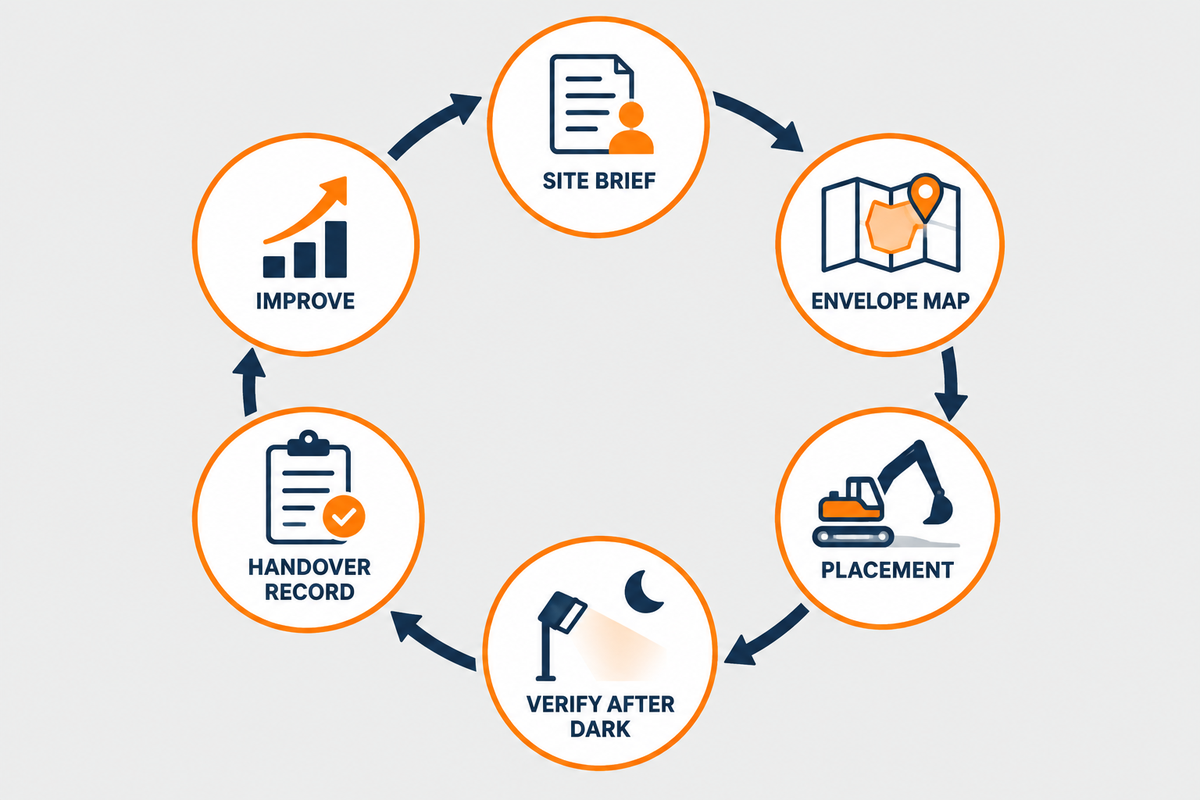
The Task-Plane Brief defines what people must see. The Deployment Envelope Map shows where equipment can work. The Runtime Evidence Chain makes duration comparable. The Comparable RFQ Matrix keeps bidders on the same scope. Together, they turn “we need a bright mobile light” into a plan that can be reviewed, tested, handed over, and improved against applicable evidence such as OSHA 1926.56 when the work falls within its U.S. construction scope.
References & Sources
LFADJ · COMPANY & TECHNICAL CONTEXT
Practical lighting guidance for real project conditions
LFADJ shares product context, application notes, and selection checks to help project teams compare industrial lighting options with the right site details in view.
What LFADJ covers
LFADJ focuses on industrial lighting and tailored lighting solutions for teams planning, specifying, or operating demanding work environments.
- Product context: mobile lighting, light towers, explosion-proof lighting, emergency lighting, and related industrial lighting equipment.
- Project context: application conditions, target illumination, runtime, site constraints, and product configuration questions.
- Decision support: use the information here as a starting point, then confirm final specifications against the actual installation and local requirements.
Industrial lighting
Application guidance
Project enquiries
NEXT STEP
Have a site question?
Send the operating environment, lighting target, expected runtime, and any drawings or photos you have. The existing enquiry form is ready for a focused discussion.
Start an enquiry Or use the LFADJ contact page