Get in touch with LFADJ Company

Hazardous Location Lighting: How to Decode Classifications, Markings, and Evidence

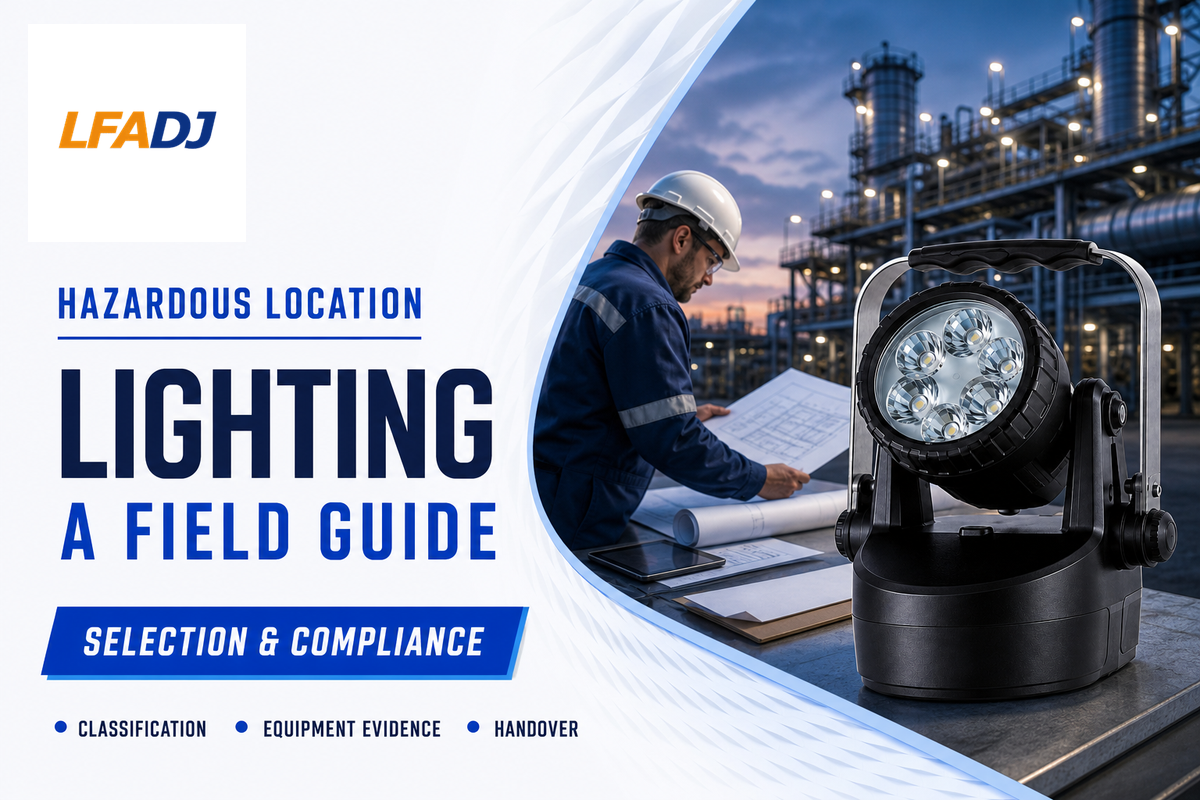
Assessing lighting needs for a hazardous area begins with performing a hazardous area classification and ends with providing evidence of equipment which supports the classification. This evidence survives the test of time and the rigors of inspection and maintenance.
Hazardous location lighting refers to luminaires selected for areas where flammable gases, vapors, combustible dusts, or ignitable fibers may create an ignition risk. This handbook defines the evidence chain for that selection. It doesn’t classify facilities, replace the applicable electrical code, or certify equipment; those functions belong to the qualified professional and the authority having jurisdiction (AHJ).
What Hazardous Location Lighting Means, and What It Does Not Prove
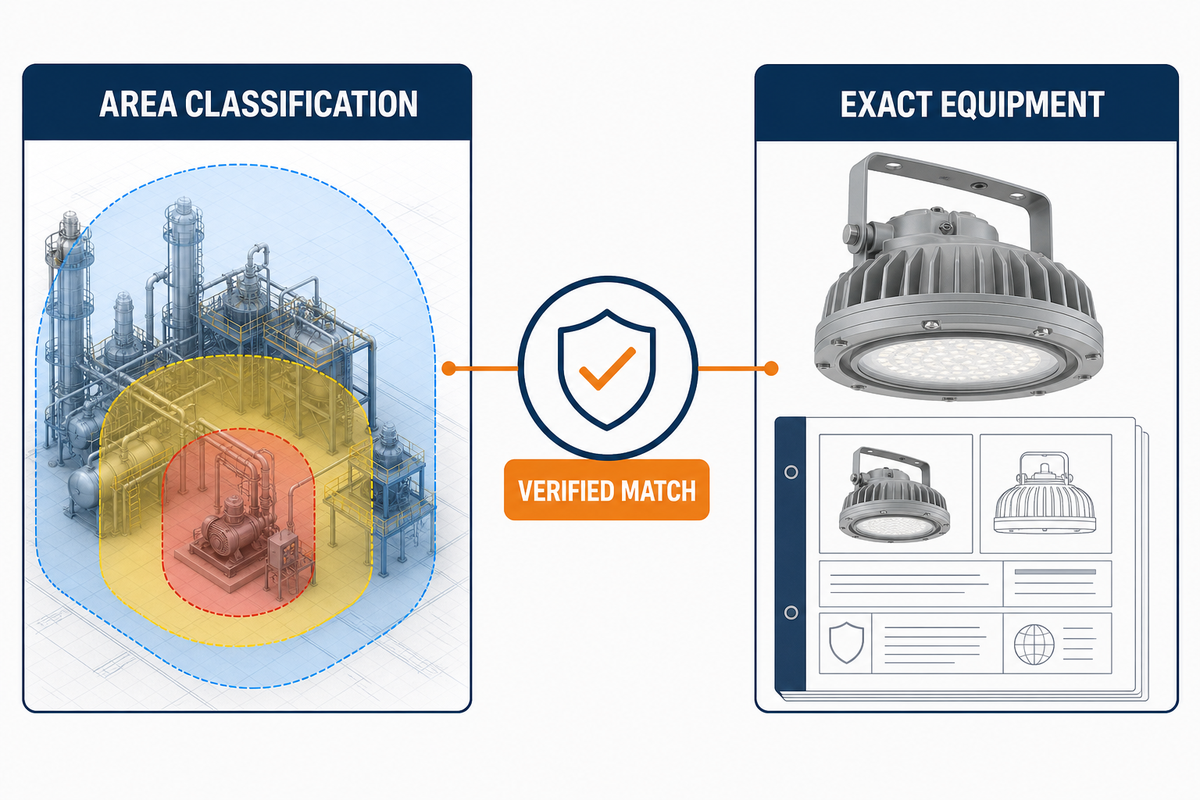
An area is considered hazardous if flammable gases, vapors, combustible dusts, fibers, or flyings can be present in conditions where electrical equipment could become an ignition source. Approval depends on the defined location and the properties of the material to be ignited, not on the general nature of a product.
The terms “explosion proof,” “Hazardous location,” “industrial” and “sealed” aren’t interchangeable and shouldn’t be used to demonstrate suitability for a given area, classification, class, group, zone, temperature or jurisdiction. An IP rating or a rugged enclosure addresses ingress and robustness, not the ignition risk that hazardous-location approval covers. For specific flammable vapors, check the complete marking and approval evidence, not an explosion proof LED or hazardous location LED label.
Decision boundary: first establish what the area requires. Only then determine whether the full marking and certificate scope of a specific luminaire match it.
Start with the Area Classification, Not the Fixture Wattage
OSHA states that locations are classified by the properties of flammable or combustible materials and the probability that a hazardous concentration exists. Each area is considered separately.
If a working area is classified as hazardous, a 100 W explosion-proof LED light is still an incomplete request; check the full marking and certificate scope, not wattage or lumen output, to determine whether the light fixture matches the classified atmosphere. The explosion proof enclosure doesn’t indicate classification to other considerations (i.e. frequency of exposure, ambient conditions, material group, surface temperature, etc).
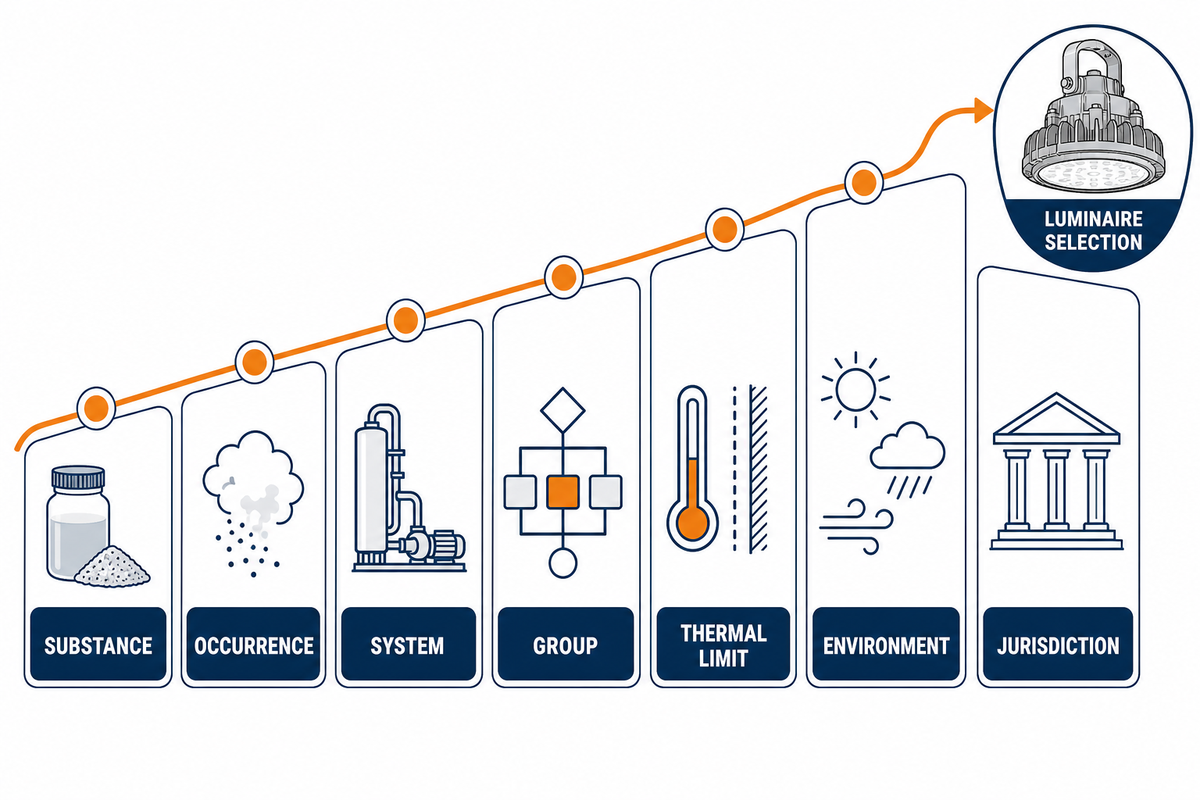
Classification Input Ladder
- Substance: gas/vapor, combustible dust, or fibers/flyings, and the specific material.
- Occurrence: when and how often the hazard can be present.
- System: the project’s Class/Division or Zone basis.
- Group and Thermal Limit: the applicable material group and ignition temperature constraint.
- Environment: minimum and maximum ambient temperature, washdown, corrosion, UV, vibration, and dust accumulation.
- Jurisdiction: the governing specification, listing scheme, and authority acceptance process.
This is a handoff tool, not a remote classification method. Procurement should obtain the inputs from the facility’s qualified engineering and safety team. For the U.S. Class I Zone provisions specifically, OSHA requires area classification and the selection of equipment and wiring methods to be supervised by a qualified registered professional engineer.
Keep Class/Division and Zone in Their Own Systems
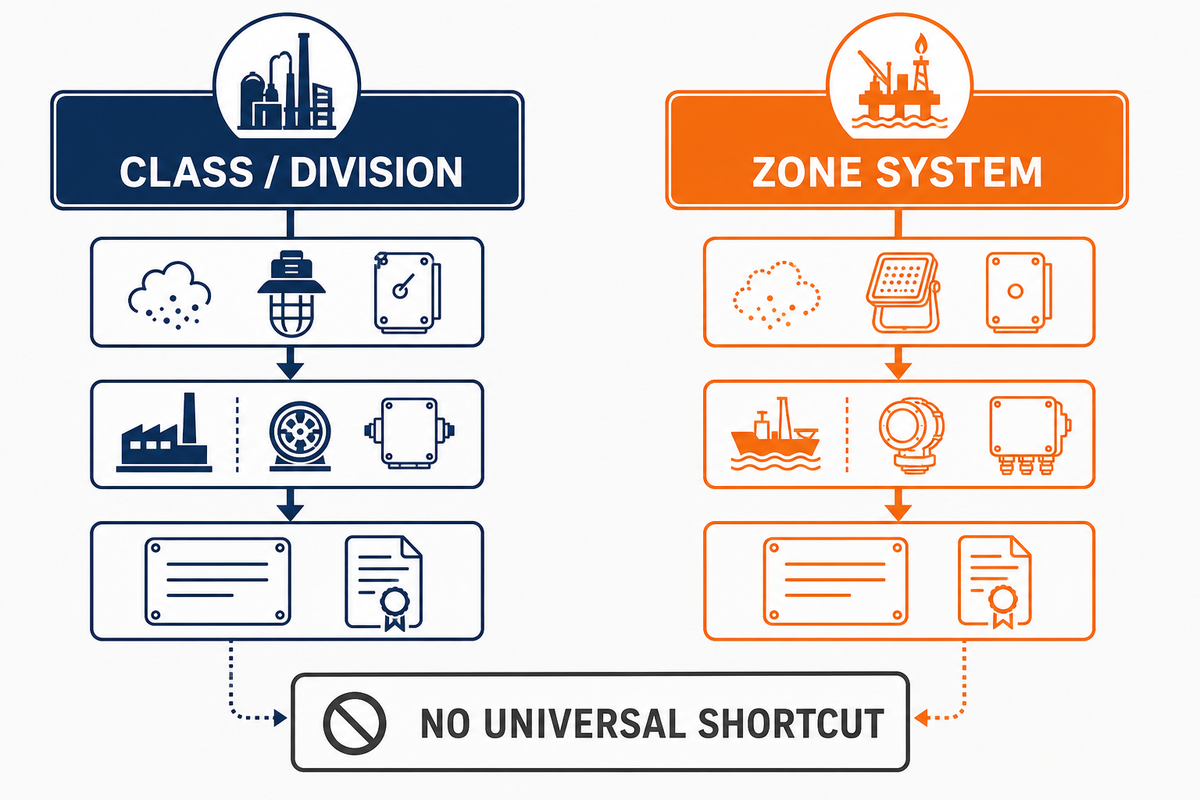
North American documents may refer to Class I locations for gases and vapors, Class II for combustible dust and Class III for ignitable fibers and flyings. Division I and Division II distinguish the likelihood of presence of the hazard. The Zone system refers to Zones 0, 1, and 2 for gases and vapors. Dust may be referred to as Zones 20, 21 and 22. Searchers may write “Class 1 Division 2,” but formal U.S. marking commonly uses “Class I, Division 2”; the project document and nameplate wording control.
The two systems should not be simplified to a single universal shortcut table. OSHA permits the Zone system as an alternative to the Division system for certain Class I locations, but the systems carry different marking structures and protection concepts. UL likewise presents North American hazardous-area certification through the applicable area classification and protection methods.
Procurement rule: write the site’s governing system exactly in the specification. Require the offered equipment marking and certificate to address that same basis. Any cross-system use needs project engineering and authority review.
Read the Nameplate as a Chain of Claims
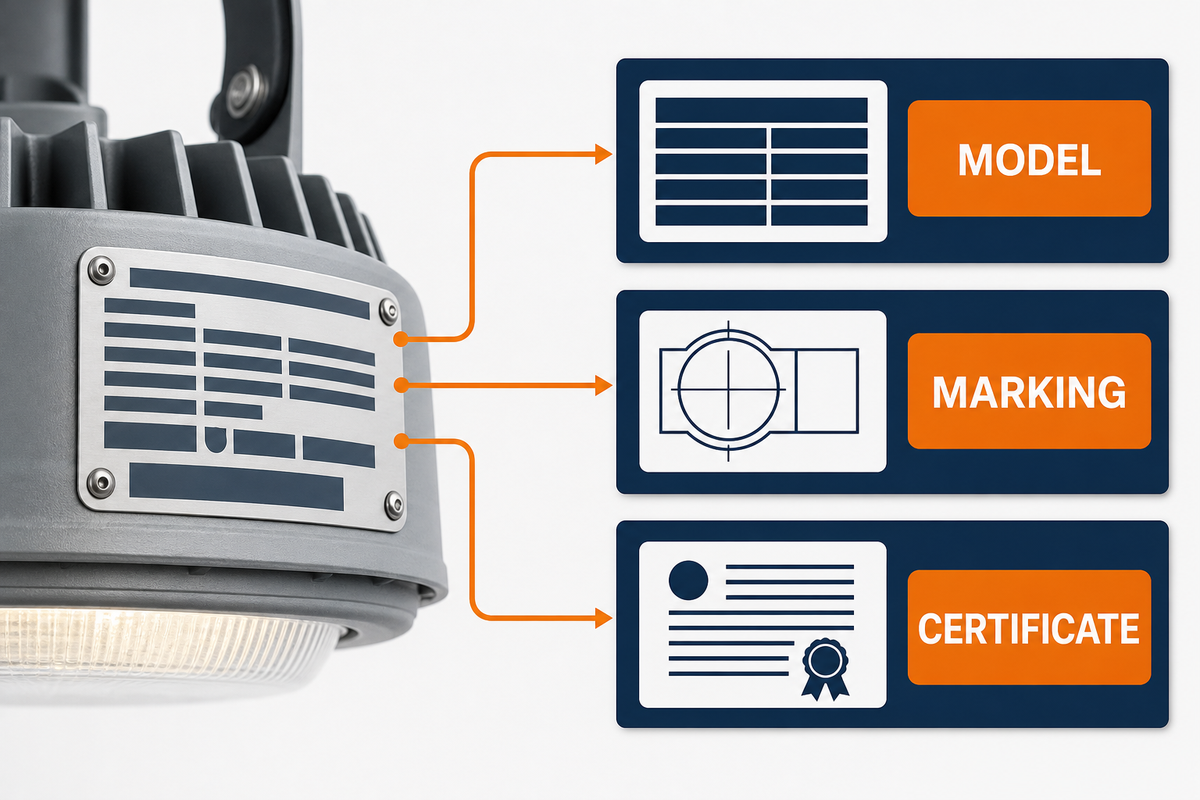
A complete nameplate is a compact evidence statement. For Zone equipment under OSHA provisions, marking sequences include class, zone, AEx symbol, protection technique, gas group, and temperature classification. OSHA states an example of the format is “Class I, Zone 0, AEx ia IIC T6.” This example is given for illustration only; it doesn’t certify a particular device.
| Nameplate field | Question it answers | Where to verify it |
|---|---|---|
| Manufacturer and model/order code | Is this the exact offered configuration? | Quotation, nameplate, certificate schedule |
| Class/Division or Zone | Which classified-location system and occurrence level? | Area-classification document and certificate |
| Group | Which gas, vapor, or dust grouping? | Site material data and certificate marking |
| Protection method or EPL | How is ignition risk controlled? | Full marking, certificate, instructions |
| T-class or maximum surface temperature | What thermal ceiling is claimed? | Certificate and marked conditions |
| Ambient range | Under what surrounding temperatures is the claim valid? | Nameplate, certificate, instructions |
| Special conditions | Are there restrictions on installation or use? | Certificate suffix and instruction manual |
| Certificate status and revision | Is the evidence current for the quoted model? | Official certificate database and retained record |
| Entries and accessories | Are glands, adapters, seals, and mounting interfaces within scope? | Certificate annex, instructions, and accessory evidence |
Match Temperature Class and Ambient Range Separately
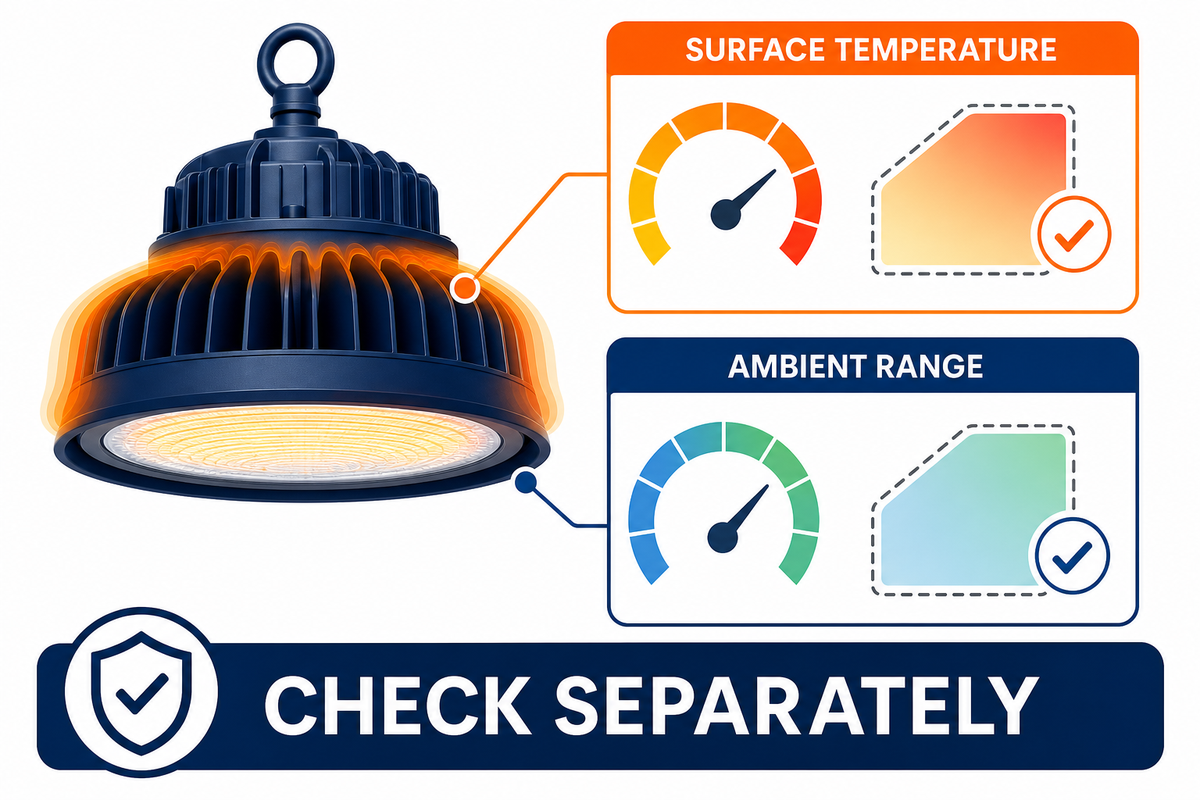
Temperature classification is concerned with the classification of the maximum equipment surface temperature. The ambient temperature range is concerned with the limits of the surrounding temperature within which the equipment is intended to operate. These conditions don’t replace each other.
OSHA requires special marking when equipment is suitable for ambient temperatures above 40°C and calls for attention to low ambient conditions. The practical check therefore has two sides: the surface-temperature limit must be suitable for the material, and the real installation ambient, including nearby process heat, must remain within the documented equipment range.
A buyer should never assume an allowed ambient range from a T-code or vice versa. Use the current certificate and instructions for the specific model.
For combustible dust locations, also document the expected condition of dust layers. Surface temperatures can be impacted by deposits, so a gas-oriented T-code explanation shouldn’t be used to assess a complete dust situation.
Treat IP, NEMA, Corrosion, and Photometrics as Additional Layers
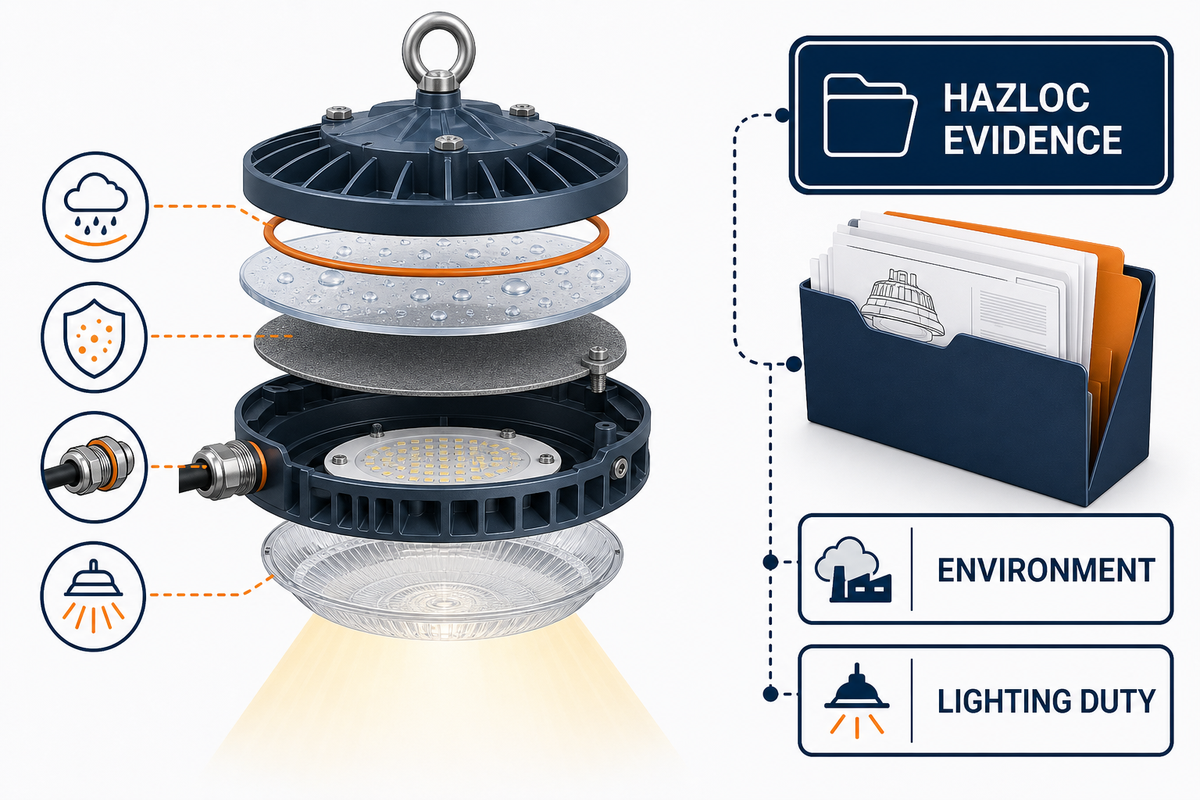
UL defines hazardous-location certification as evaluation against applicable area classification and protection methods, so enclosure and environmental ratings must be independent from the HazLoc approval evidence.
Because of this, enclosure and environmental ratings should be different from the evidence used to support a HazLoc approval.
Ingress protection, the type of enclosure, corrosion resistance, washdown, and hazardous location approvals address different issues. It’s possible for a project to require all of these. The evidence should be kept separate to identify gaps.
| Layer | Typical inputs | Common mistake |
|---|---|---|
| Hazardous-location suitability | Classification, group, protection method, T-class, certificate scope | Accepting “explosion proof” without the full marking |
| Environment | IP/NEMA, corrosion, chemicals, UV, washdown, vibration | Treating IP66 as hazardous-location approval |
| Electrical interface | Voltage, frequency, cable entry, glands, adapters, seals, controls | Checking the luminaire but not its entries and accessories |
| Lighting duty | Mounting height, beam, illuminance, glare, emergency function | Assuming certification proves the layout will perform |
| Temperature | T-class, maximum surface temperature, ambient range, process heat | Reading T-class as the permitted room temperature |
| Gas or vapor group | Material identity, group, release conditions | Extending approval from one group to another |
| Combustible dust | Dust group, deposits, cleaning, surface-temperature limits | Reusing a gas-only assessment |
| Documentation | Certificate status, revision, special conditions, instructions | Accepting a family brochure as exact-model proof |
| Lifecycle control | Inspection baseline, approved parts, repair and change records | Assuming a field modification remains in scope |
Using this method prevents two undesirable outcomes from occurring: an environmentally safe fixture that lacks HazLoc proof or an approved fixture for use in a hazardous location that fails when used in that environment.
Build an Exact-Model Evidence File Before Purchase
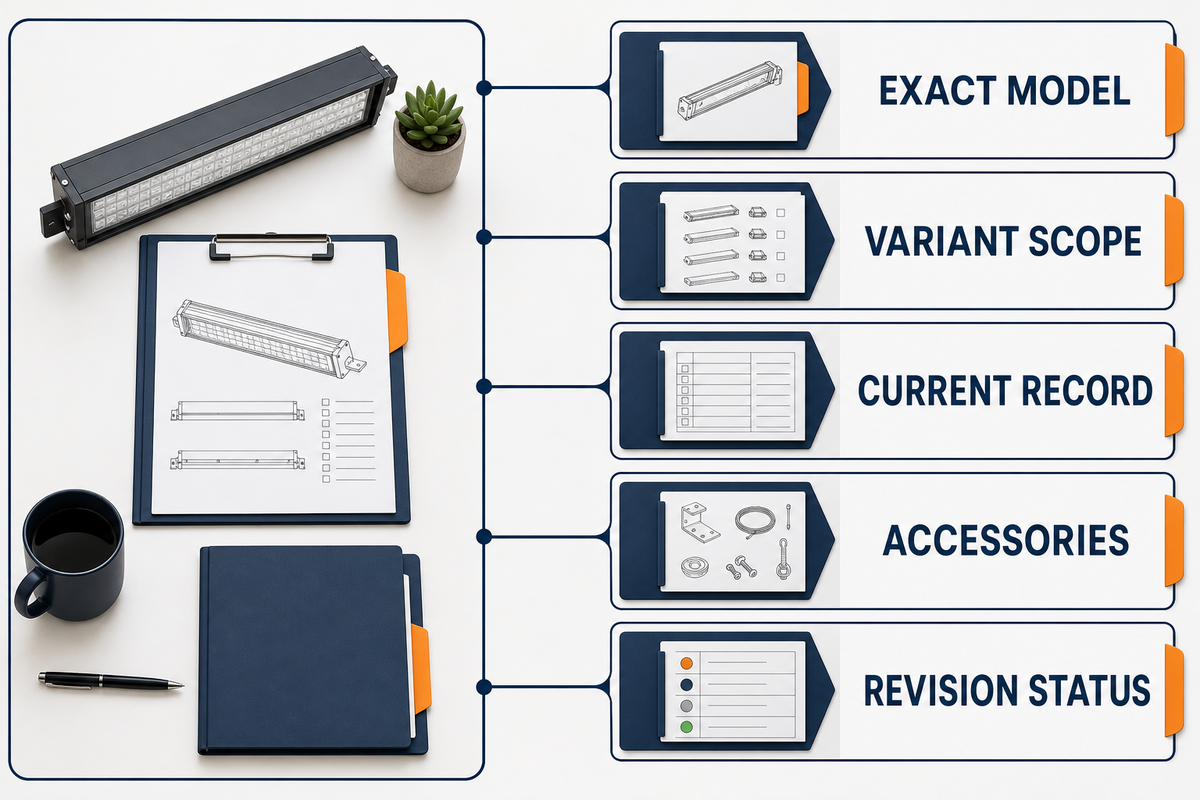
IECEx distinguishes a Certificate of Conformity for complete Ex equipment from component certification and unit verification. It also states that certified equipment is listed in its online certificate system. The implication is direct: a supplier statement or similar family name isn’t enough.
Acceptable evidence may vary with jurisdiction, equipment category, and conformity route. Therefore, “exact model evidence” means the right declaration, certificate, listing or assessment for the applicable scheme, not assuming that all markets use the same third-party certificate format.
Nameplate-to-Document Traceability Matrix
| Quoted item | Required match | Acceptance evidence | Owner |
|---|---|---|---|
| Exact manufacturer and model | Certificate schedule/type designation | Current official record or certificate | Procurement + QA |
| Driver, power, optics, enclosure | Permitted variant scope | Certificate annex and datasheet | Engineering |
| Cable entries and accessories | Approved interface and conditions | Instructions and accessory evidence | Installer |
| Complete marking | Area classification and material group | Classification drawing + nameplate | Safety/engineering |
| Revision and status | Current document set | Official database check and retained copy | QA |
ATEX similarly requires product identification, explosion-protection marking, manufacturer information, and accompanying instructions. Those records are operational inputs, not paperwork to collect after installation.
Carry the Evidence Through Installation and Maintenance
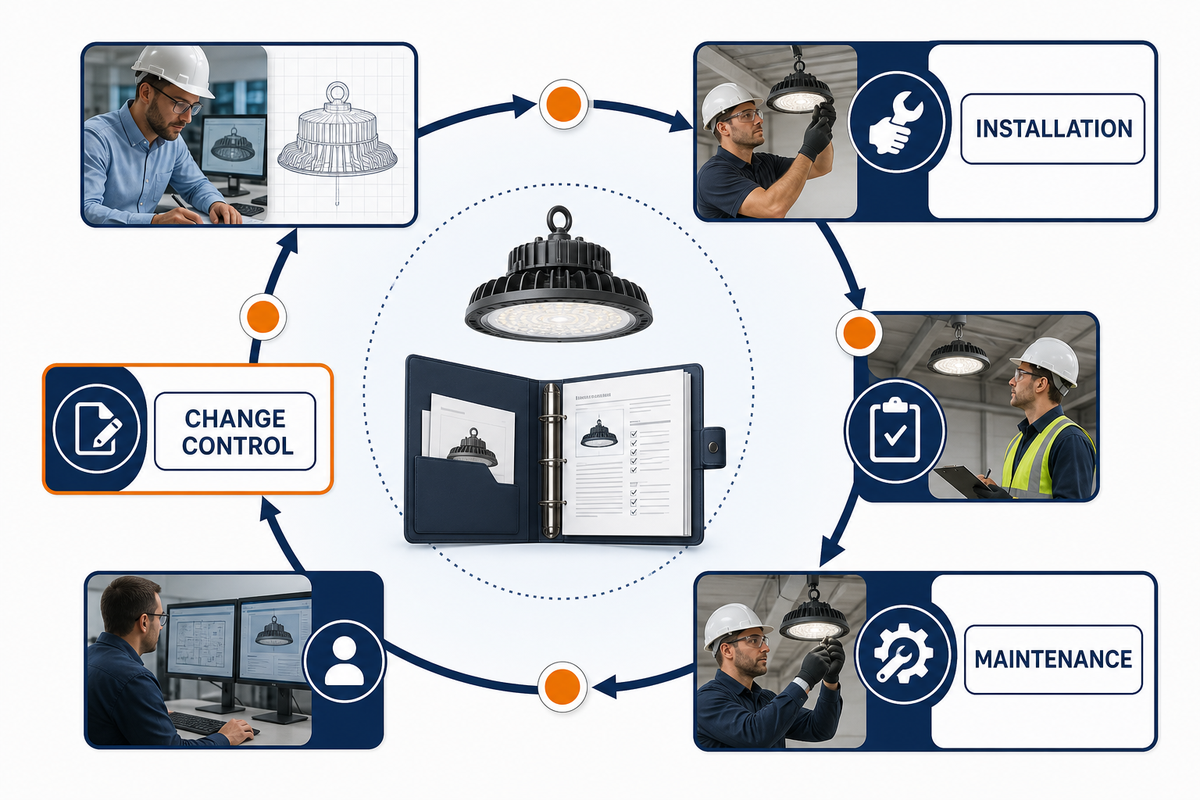
The safety case can fail at an interface. The correct luminaire, for example, can be compromised if an unapproved field modification was done to alter cable gland selection, thread adapters or seals. It could also fail due to the luminaire being used with maintenance equipment that isn’t part of the certified case.
OSHA requires hazardous-area documentation to be available to people who design, install, inspect, maintain, or operate the equipment. ATEX instructions cover putting equipment into service, assembly, installation, maintenance, inspection, and repair.
To meet the restrictions outlined in the closeout dossier, the completed documentation for the approved configuration (including restrictions and controls) must be made available to the user.
Routine maintenance and field modification aren’t the same. If a change alters the certified configuration, protection concept, thermal behavior, entries, or another safety function, the responsible engineering team should determine—using the manufacturer’s instructions, certificate conditions, certification body requirements, and authority guidance—whether reassessment, recertification, or another approval is required before return to service.
Use the Six-Gate Hazardous Lighting Brief
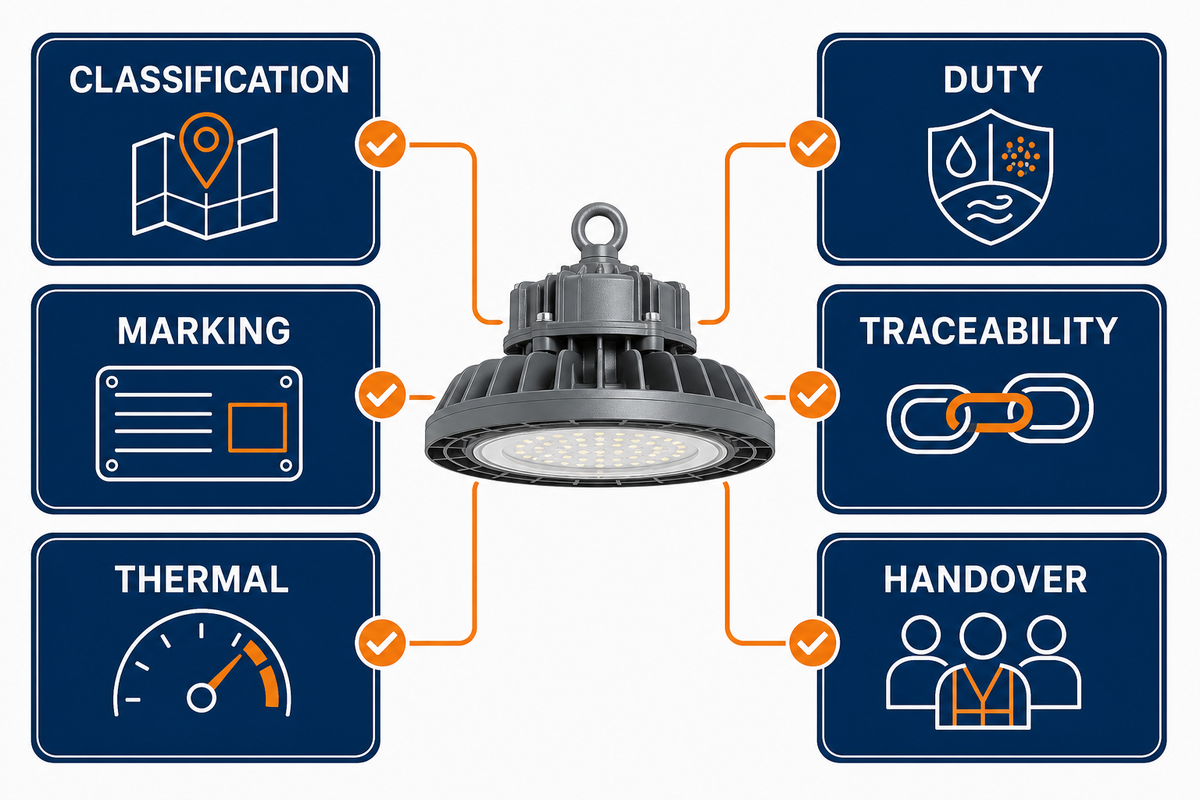
Gate 1, Classification
The exact area, material, occurrence basis, group, and jurisdiction are documented.
The exact area, material, occurrence basis, group, and jurisdiction are documented.
Gate 2, Marking
The complete offered marking matches the governing classification system.
The complete offered marking matches the governing classification system.
Gate 3, Thermal
T-class or surface limit and the permitted ambient range both fit.
T-class or surface limit and the permitted ambient range both fit.
Gate 4, Duty
Ingress, corrosion, electrical interfaces, mounting, optics, and controls fit the site.
Ingress, corrosion, electrical interfaces, mounting, optics, and controls fit the site.
Gate 5, Traceability
The exact model, variant, certificate revision, status, and special conditions reconcile.
The exact model, variant, certificate revision, status, and special conditions reconcile.
Gate 6, Handover
Installation, inspection, maintenance, and change-control owners and records are assigned.
Installation, inspection, maintenance, and change-control owners and records are assigned.
A blank gate means there’s an evidence gap, not an opportunity to estimate. After the six inputs are present, contact LFADJ through the Hazardous Location Lighting Selection and RFQ Assistance page to talk through commercial equivalence, avoiding confusion with site classification or acceptance.
Frequently Asked Questions
Is hazardous location lighting the same as explosion-proof lighting?
Not in all cases. Hazardous location lighting is the broader project category. A luminaire can use a particular protection and marking accepted for a defined Class/Division or Zone. The equipment must be for the documented atmosphere, occurrence likelihood, material group, and temperature limits, match the jurisdiction and approval, and be designed for the site. A marketing label can’t replace the certificate, instructions, and engineering review.
Can a Zone-rated light replace a Class/Division fixture?
Not automatically. Equipment and systems use different protection, and marking concepts, and classification and designation structures. Follow the governing specification. Verify the equipment marking and certificate scope. Check installation interfaces and special conditions. Obtain acceptance from the authority or engineer, and not a simplified conversion chart, to assess equivalency.
Does IP66 mean a light is approved for a hazardous location?
No. IP66 addresses ingress protection; hazardous-location approval addresses ignition risk for a defined atmosphere and classification. A project may require both, but an IP66 rating by itself does not qualify equipment for flammable gases, vapors, combustible dusts, or ignitable fibers.
What should I check on the nameplate?
Check the certification mark or reference, classification system, hazard group, Division or Zone, protection concept or equipment protection level, temperature class or maximum surface temperature, permitted ambient range, exact model or order code, and special conditions. Trace every field to the current certificate and instructions.
Who decides whether an area is hazardous?
The facility’s qualified engineering team and the authority having jurisdiction, or the equivalent governing process, determine the classification from site conditions and applicable rules, including the substance, likelihood of presence, classification system, group, and thermal limits. A lighting supplier can match equipment to that documented basis, but should not classify the site from limited or unverified information.
Make the Evidence Chain Survive Handover

In hazardous location lighting, a strong brief is not the one with the most product claims. It is the brief that preserves traceability across classification, marking, certificate scope, interfaces, and lifecycle records.
Once your six-gate brief is complete, review LFADJ’s hazardous location lighting options →
References & Sources
LFADJ · COMPANY & TECHNICAL CONTEXT
Practical lighting guidance for real project conditions
LFADJ shares product context, application notes, and selection checks to help project teams compare industrial lighting options with the right site details in view.
What LFADJ covers
LFADJ focuses on industrial lighting and tailored lighting solutions for teams planning, specifying, or operating demanding work environments.
- Product context: mobile lighting, light towers, explosion-proof lighting, emergency lighting, and related industrial lighting equipment.
- Project context: application conditions, target illumination, runtime, site constraints, and product configuration questions.
- Decision support: use the information here as a starting point, then confirm final specifications against the actual installation and local requirements.
Industrial lighting
Application guidance
Project enquiries
NEXT STEP
Have a site question?
Send the operating environment, lighting target, expected runtime, and any drawings or photos you have. The existing enquiry form is ready for a focused discussion.
Start an enquiry Or use the LFADJ contact page