Get in touch with LFADJ Company

Portable Construction Lights: Types, Brightness and Site Setup

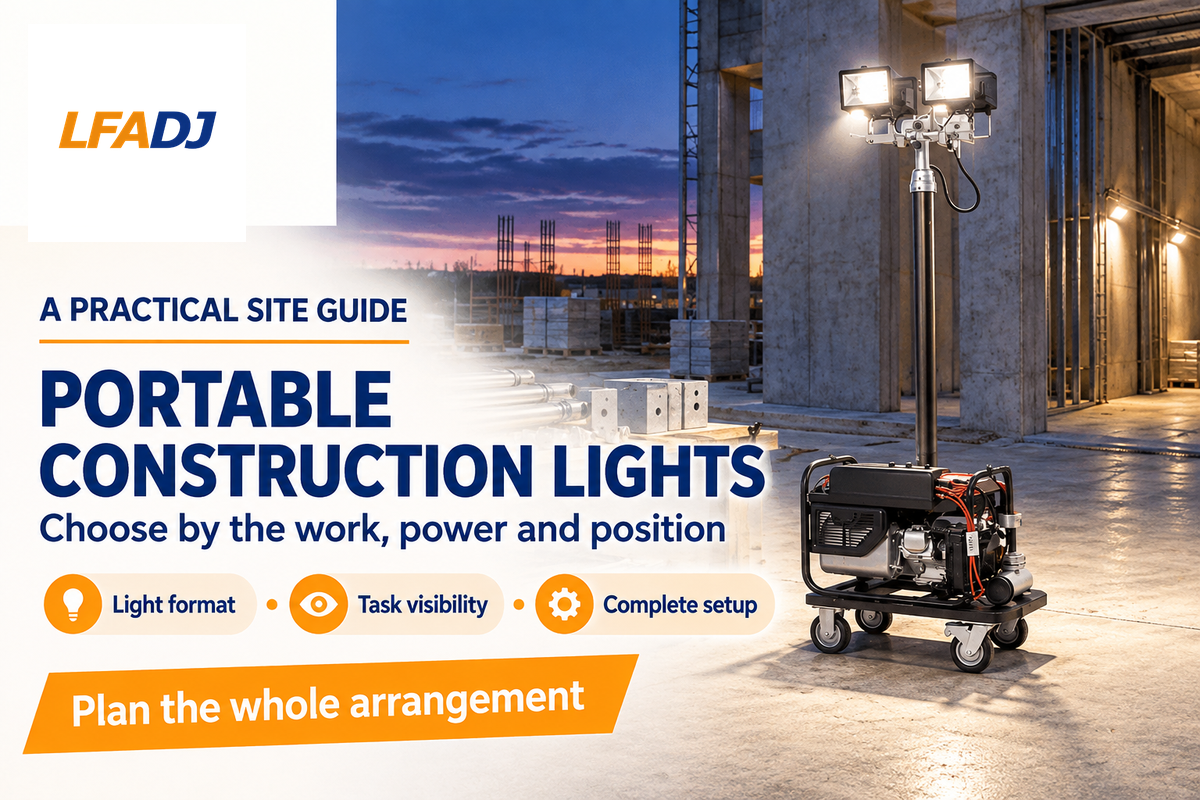
Portable construction lights provide movable illumination for temporary work areas. Portable work lights offer several mounting and power arrangements. Choose a format to match the job, power, and mounting position, and then adjust it accordingly. A room floodlight, inspection lamp, and corridor string all satisfy different needs. A powerful label by itself won’t tell you if the worker can see a cut line, or if they can walk by stored materials.
This work lighting guide covers ordinary construction work, fit-outs and maintenance. It gives the useful numbers and explains power options. It shows how to evaluate and price a complete job. Wherever possible, US federal construction requirements are cited; site-specific electrical and safety arrangements require input from site personnel. Figures provided below are attributed examples rather than ranked prioritized recommendations.
Choose a Portable Work Light by the Job
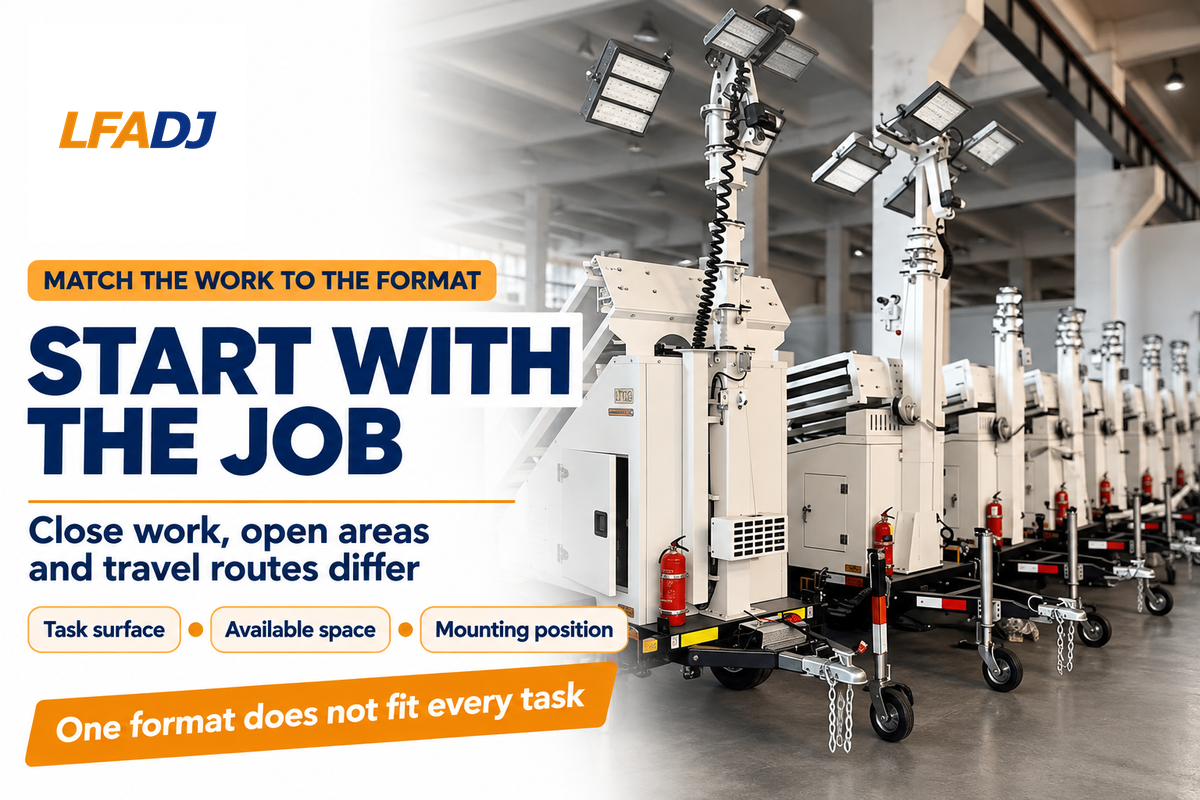
Use a compact lamp for close work; use a flood light for large open areas; use distributed lights for a travel route. The best portable format follows the available space and the surface being viewed. Obstruction problems are often solved with a combination of task lighting rather than a large single light.
A handheld inspection lamp goes with the operator in a cabinet. An adjustable head on a tripod stand throws light across a larger workspace. LED string work lights distribute illumination along a route, while a mobile tower serves a different scale of exterior work. Start with this comparison when reviewing our portable work-light formats by mounting method.
A November 2021 Contractor Talk discussion describes how the progressive removal of usable room lighting during demolition also required smaller grab-and-go lamps. This is a useful planning problem: temporary construction lights may need to move before permanent services return. This thread is an example of work conditions experienced by individual users, rather than a test of any of the products listed in this post.
| Work area or job | Useful starting format | Placement constraint |
|---|---|---|
| Cabinet connections | Handheld or small supported task lamp | Keep hands and tools out of the beam |
| Wall finishing | Movable side light | View the surface from the working position |
| Room fit-out | Raised LED flood light | Check shadows behind people and materials |
| Ceiling work | Tower or elevated adjustable head | Keep the source outside the normal upward sightline |
| Corridor travel | Distributed LED string lights | Maintain visibility between fittings and around turns |
| Two trades sharing a room | Area light plus local lamps | One worker must not darken another’s work |
| Moving inspections | Compact rechargeable lamp | Plan a stable place to set it down |
| Large exterior operation | Mobile lighting system or tower | Allow for access, support footprint and relocation |
| Equipment-bay or automotive maintenance | Designed magnetic or clamp-mounted lamp | Use a suitable mounting surface clear of moving parts |
Example: A fit-out crew is finishing a room while another trade moves equipment through the doorway of that room. A central floor lamp lights the empty room, but a worker and stacked boards block the lower wall. Start with a raised area light clear of the doorway, then add a compact LED lamp beside the finishing surface. Walk the equipment route with the boards in place before settling the layout. During the next room change, the local lamp should be moved with the finishing crew, and route lighting should be maintained. This gives the supervisor separate control of visibility of the work and equipment circulation rather than having to darken the exit of the room during every relocation.
Can I link multiple LED work lights together?
Yes, as long as the specific lights are designed for linking and the entire chain stays within the manufacturer’s limits. Consider the stated maximum connected load, permitted number of fittings, the cord and arrangement, and environmental factors. A link outlet on one product isn’t permission to connect an arbitrary variety of work lights. Have the site electrical lead assess the supply and protection arrangement.
Brightness: Lumens, Lux and Beam Spread
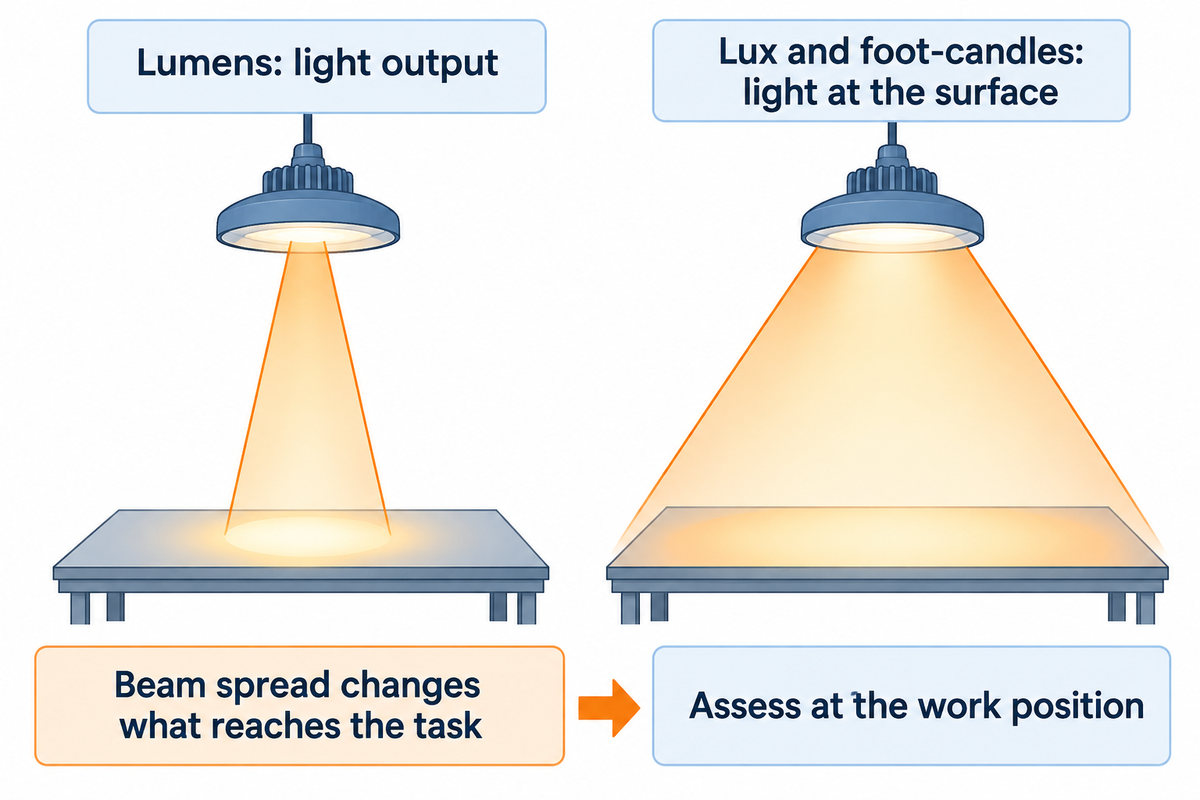
Lumens measure light output. Lux and foot-candles measure light density. For a US job site classified as a general construction area, the minimum published by OSHA is 5 foot-candles (approximately 53.8 lux). Apply the row for the actual area or operation, then assess the installed lighting at the work position rather than choosing a lamp by lumens alone.
Think of a beam like water from a spray nozzle: the same output can be concentrated or spread. A lamp measured in lumens can be positioned to illuminate a small area strongly, or to distribute the amount of light over a wider surface. Height, distance, and shape of the beam will change what reaches the workbench, the floor or wall. A nominal 2000 lumens on a carton will give no fixed size for the room.
| Listed area or operation | Minimum, foot-candles | Converted lux, rounded |
|---|---|---|
| General construction area lighting | 5 fc | 53.8 lx |
| Listed concrete placement, excavation, waste, access, active storage, loading, refueling and field-maintenance areas | 3 fc | 32.3 lx |
| Indoor warehouses, corridors, hallways and exitways | 5 fc | 53.8 lx |
| General construction plants and listed shops | 10 fc | 107.6 lx |
| First-aid stations, infirmaries and offices | 30 fc | 322.9 lx |
The original OSHA table has provisions and exceptions for underground work. These selected rows are minimums for named areas and operations, not a complete lighting specification. OSHA has proposed rescinding this construction illumination rule, but section 1926.56 is still in the current e-CFR.
Conversion example: NIST states that 1 foot-candle = 10.76391 lux. Multiplying 5 by 10.76391 gives 53.81955 lux, rounded above. Converting the units doesn’t answer how many flood lights a room needs. The distribution and the position of the lighting, and the geometry of the room will dictate the light level at the various positions.
How many lumens do I need for a work light?
For construction site work such as framing, drywall or HVAC setups in unfinished spaces, one cordless work-light buying guide suggests 1,000 to 2,000 lumens; from the installed position, that output still has to fill the work area. A focused light placed near detailed work serves a different purpose from wide coverage positioned across an open space. Look at beam information and mounting distance, and then conduct illuminance readings with people and equipment in their normal positions.
For painted finishes and color identification, include color quality in the specification. A 5000K label describes a white-light appearance; it doesn’t describe color-rendering accuracy. Our LED work-light options provide a starting point for choosing a light source around the task, rather than for treating one color temperature as suitable for every trade.
Corded, Rechargeable and Dual Power
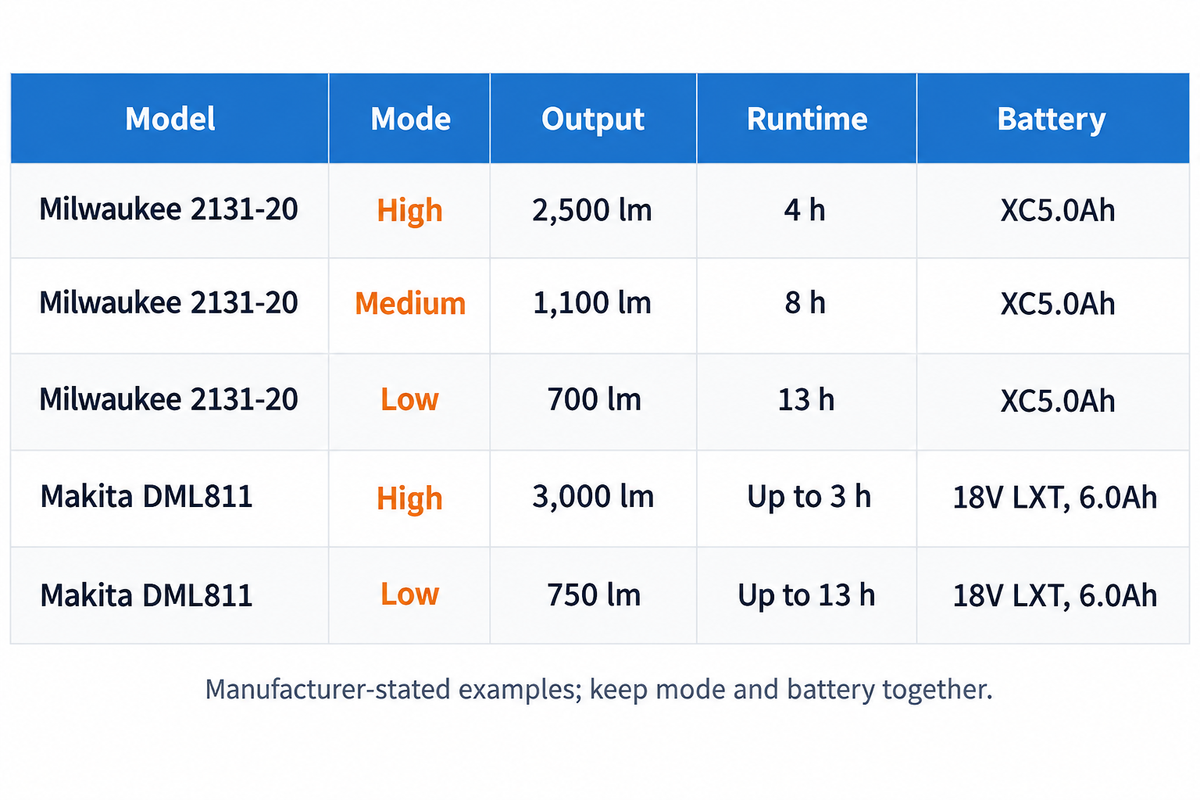
Milwaukee publishes 4 hours at 2,500 lumens on high for its 2131-20 with an XC5.0Ah battery. Longer low-mode run times are achievable, but output is decreased. Choose corded power for a suitable fixed supply, rechargeable options for frequent moves and dual power when the work alternates between the two.
| Manufacturer / model | Mode | Output | Stated runtime | Battery condition |
|---|---|---|---|---|
| Milwaukee 2131-20 | High | 2,500 lm | 4 h | XC5.0Ah |
| Milwaukee 2131-20 | Medium | 1,100 lm | 8 h | XC5.0Ah |
| Milwaukee 2131-20 | Low | 700 lm | 13 h | XC5.0Ah |
| Makita DML811 | High | 3,000 lm | Up to 3 h | 18V LXT, 6.0Ah |
| Makita DML811 | Low | 750 lm | Up to 13 h | 18V LXT, 6.0Ah |
These data are cited from Milwaukee and Makita. Each set of conditions is kept intact. Because of the use of different battery packs and other test arrangements, this is more of a lesson on interpreting specifications than a controlled comparison of battery life.
Example: A maintenance supervisor wants a rechargeable work light for repeated trips to equipment bays. The lamp must run at the mode that makes labels and connection points visible. A long, low-mode headline is of little value if operators regularly set the unit to high. List expected high-mode operating time, spare packs, and when the packs can be charged. If a suitable AC supply is available at a longer stop, dual power can be employed. Portability then serves the movement between bays, and the supply plan serves the longer task.
A dual power LED flood light can accept an AC supply and a battery, but charging a pack in the light is a separate function. Cordless doesn’t mean immune to damage or suitable for every environment. For battery selection and charging logistics, see our dedicated rechargeable lighting guide .
How long do rechargeable LED work lights last?
Per charge, one cordless work-light buying guide puts most compact work lights at 2 to 8 hours, with higher-capacity lights on 4.0 Ah or 5.0 Ah packs reaching 10 hours at a reduced brightness setting. Runtime is the published number for a specific mode and pack; a whole shift at maximum brightness needs its own power plan. Rechargeable lights use different battery capacities and control settings. Useful run time is influenced by battery age, temperature, and the mode of operation. Plan for reserve around output needed for the job, as opposed to longest run time printed on the unit.
For plug-connected equipment, employer’s construction electrical-protection arrangements apply. OSHA 1926.404(b)(1) addresses ground-fault protection or an assured equipment-grounding-conductor program. Hard or extra-hard use cords are covered in Section 1926.405, along with protection from physical damage. The site electrical lead should select the applicable arrangement; a portable LED work light does not replace it.
Position Lights to Control Glare and Shadows
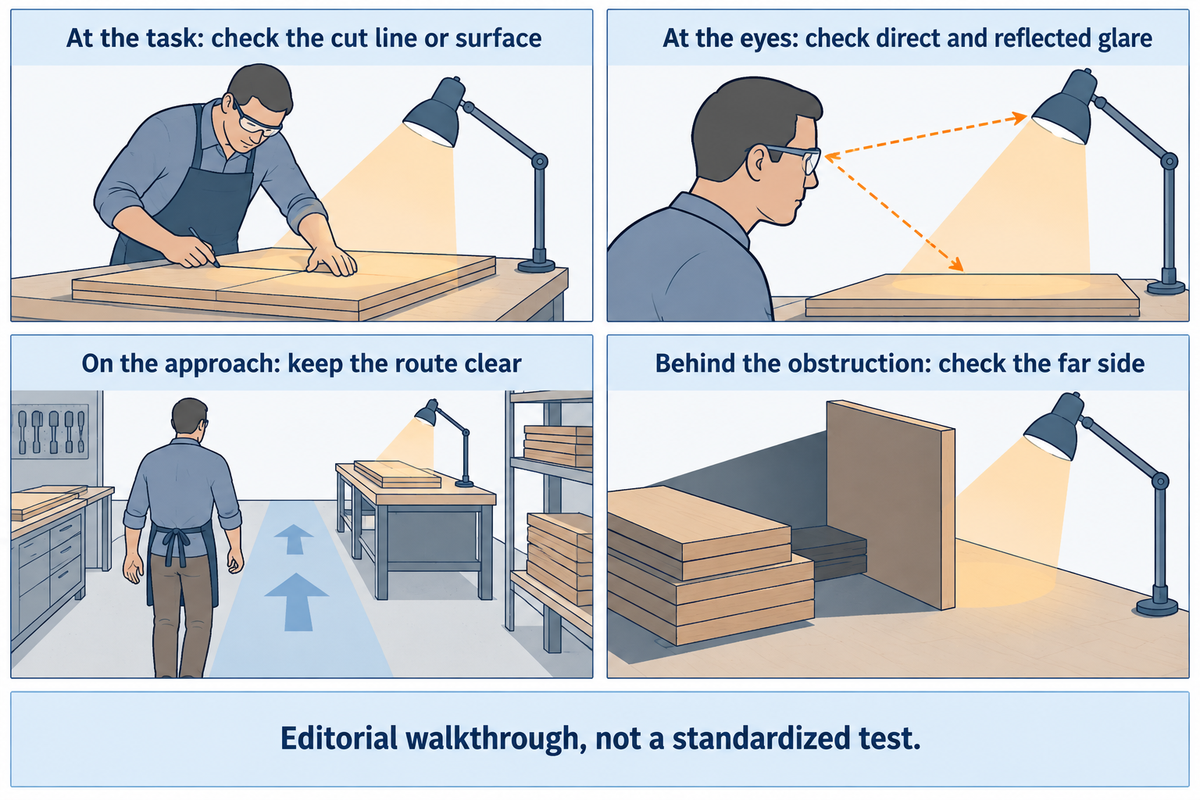
Reduce glare by placing lights off to the side of the working position. Reflected glare from smooth metal or glossy walls can require a different positioning of the light even if the room looks well lit. Always keep a clear line of sight to the working surface and check for glare from light sources.
CCOHS identifies both direct and reflected glare, as well as shadows cast by people and objects. Its survey advice supports moving the fixture or changing the lighting arrangement. A good starting point is one general source plus a local source, supported outside the travel path.
“Objects between the light fixture and the work being done can block the light and cast shadows.”
Use Find What Blocks the Beam as an editorial walkthrough, looking at the task, the operator’s line-of-sight, the approach route, and the space behind an obstruction. It organizes the checks that follow. It isn’t a standardized test procedure.
- At the task: place tools and hands in the position they’ll be used in. Look for a dark cut line, connection, or surface defect.
- At the eyes: stand or crouch in the working posture. If the source is in a direct line with the work, or if a reflection gets in the way, adjust the position of the light source.
- On the approach: walk the route with your tools. Keep stands, cables, and stored materials from obstructing the route.
- Behind the obstruction: check the far side of the equipment or boards. Adjust the light to a more local position, if needed.
Example: A painting crew shows how critical room brightness and useful visibility are. An overhead light may make the floor easy to see, but it may leave surface texture hard to see. Move a local source to an oblique angle and check the finish from the normal inspection position. For other detailed work, use a different angle if the grazing beam creates misleading shadows. The goal is to see the feature being inspected and not put the light right in the worker’s line of sight. Check again after materials or equipment is moved, because the original beam path may now go through an obstruction.
As per OSHA’s temporary lighting provisions, electric cords may support suspended lights only when cords and lights are designed for that suspension. The cord and light must be designed for that purpose. A brighter replacement is an unnecessary purchase when moving the existing light around an obstruction solves the visibility problem.
Durability, Weather Resistance and Site Conditions
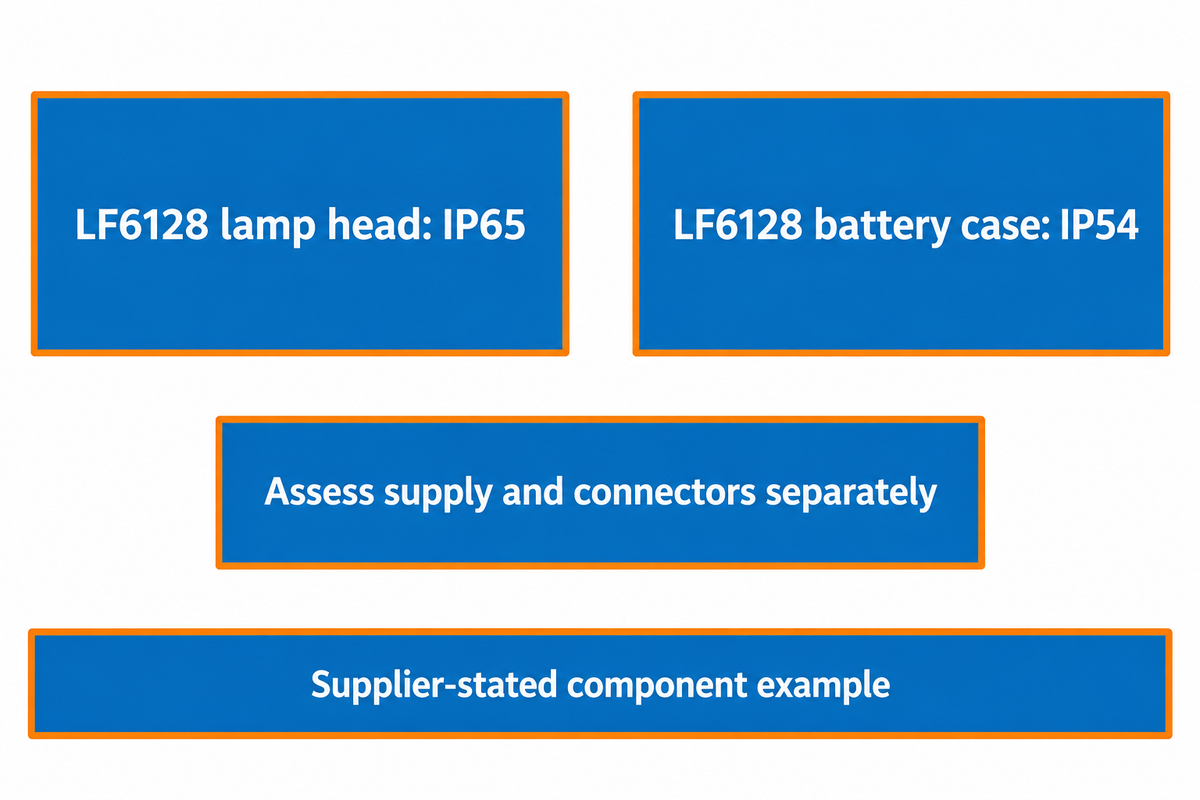
Match the type of protection to the entire assembly, i.e. lamp head, battery case, supply, connectors and support. IP ratings describe enclosure ingress protection. In one example, the LFADJ lists the LF6128 lamp head at IP65, and the battery case at IP54, meaning that in this case, the head and case have different levels of protection.
IEC 60529 provides the enclosure-protection classification. A lamp’s IP code belongs to the stated enclosure and test conditions. Keep a charger and open connections in their intended environment even when a lamp head is designed for outdoor use. A heavy-duty frame can protect the lamp from handling damage; however, an exposed connection will still be vulnerable.
At a harsh work site, assess support stability, cord condition, and lens protection as elements of durability. The ability to move the light without damaging it also needs assessment. LED work lights feature different handles, brackets and guards; consider those parts and assess them against the work; don’t assume a durable LED chip makes the whole fixture rugged. Weather resistance also needs to cover the mode of use, including any open covers or connected cables.
Wet and/or conductive locations need an electric decision separate from portable lighting. OSHA 1926.405(a)(2)(ii)(G) mandates portable lighting at or below 12 volts for those locations; 120-volt lights are allowed with a ground-fault circuit interrupter. Apply that provision with the rest of the site’s electrical requirements, rather than treating a high IP code as a substitute.
A permit-required confined space has another boundary. OSHA 1926.1204(d)(5) requires lighting approved for the ignitable or combustible properties of the specific material present, along with sufficient visibility for work and rapid emergency exit. Regular indoor and outdoor work lamps shouldn’t be used in lieu of that approval. See our explosion-proof portable lighting guide for specialist selection questions.
At a damp maintenance bay, an apparently well-sealed head can still be connected through unsuitable accessories. Keep head rating, battery enclosure and supply as different lines on the equipment request form. That lets the supervisor and electrical lead resolve the actual exposure without paying for a higher head rating while leaving the vulnerable component untouched.
What a Complete Work-Light Setup Costs
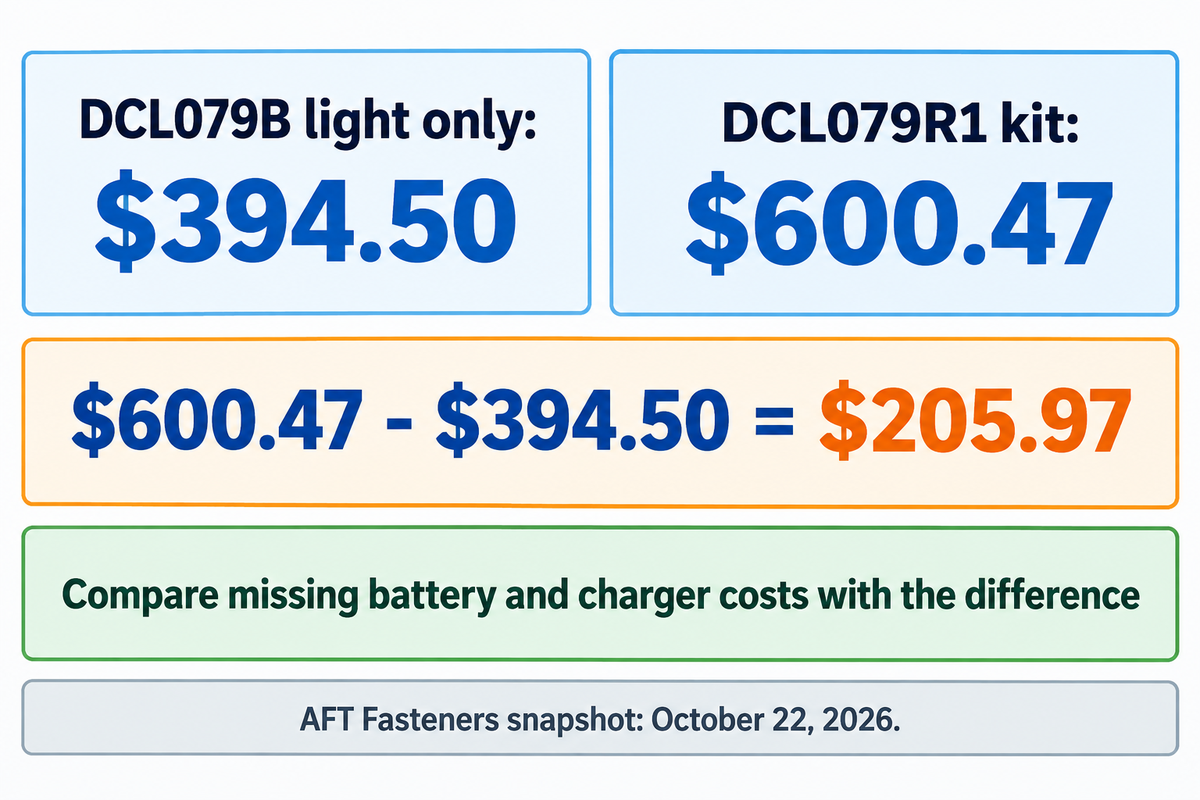
In one same-retailer snapshot, a DeWalt DCL079B light-only item cost $394.50 and the DCL079R1 kit cost $600.47. The $205.97 difference is the add-on budget threshold for that comparison. Begin with the equipment you already own, and compare the battery, charger, and support and delivery to put each option to use.
Price example: AFT Fasteners displayed those US-dollar prices on October 22, 2026. The DCL079B listing was light only. The DCL079R1 listing was a kit, and included the light, a charger, and a 6.0Ah battery, per DeWalt. Shipping is calculated at checkout and prices can vary.
The arithmetic is $600.47 − $394.50 = $205.97. An owner with the needed packs and charging capacity can use the bare option without buying the parts again. A user starting from scratch must compare the cost of the separate battery and charger against that break even threshold, while keeping package contents equal. Tying up a battery already needed by another trade also has an operating consequence, even if it has no new purchase price.
| Line to compare | Record on each offer | Who resolves it |
|---|---|---|
| Light-only purchase | Exact model and quantity; example $394.50 for DCL079B | Buyer |
| Kit purchase | Exact kit contents; example $600.47 for DCL079R1 | Buyer |
| Working battery | Pack model, capacity and whether included; example kit 6.0Ah | Equipment manager |
| Spare battery | Output-mode coverage while the working pack is unavailable | Supervisor |
| Charger capacity | Included charger and competing packs awaiting charge | Equipment manager |
| Support and mounting | Integral support or separately priced approved stand or bracket | Supervisor |
| Corded supply accessories | Required cords and site electrical-protection arrangement | Electrical lead |
| Delivery and tax | Same delivery address, charges and tax basis | Buyer |
| Project duration | Purchase versus a rental quote for the planned working period | Project manager |
| Replacement parts | Battery, lens, cable and service terms for the intended use | Equipment manager |
A work lamp can be used for an infrequent garage or home improvement task. Frequent relocation, shared batteries and repair access change the decision on jobsites. Add the missing components to the offer before deciding that a product is cheaper; don’t compare a bare lamp (without components) with a complete kit and equate the difference to a brand premium.
Manufacturers and Battery Platforms
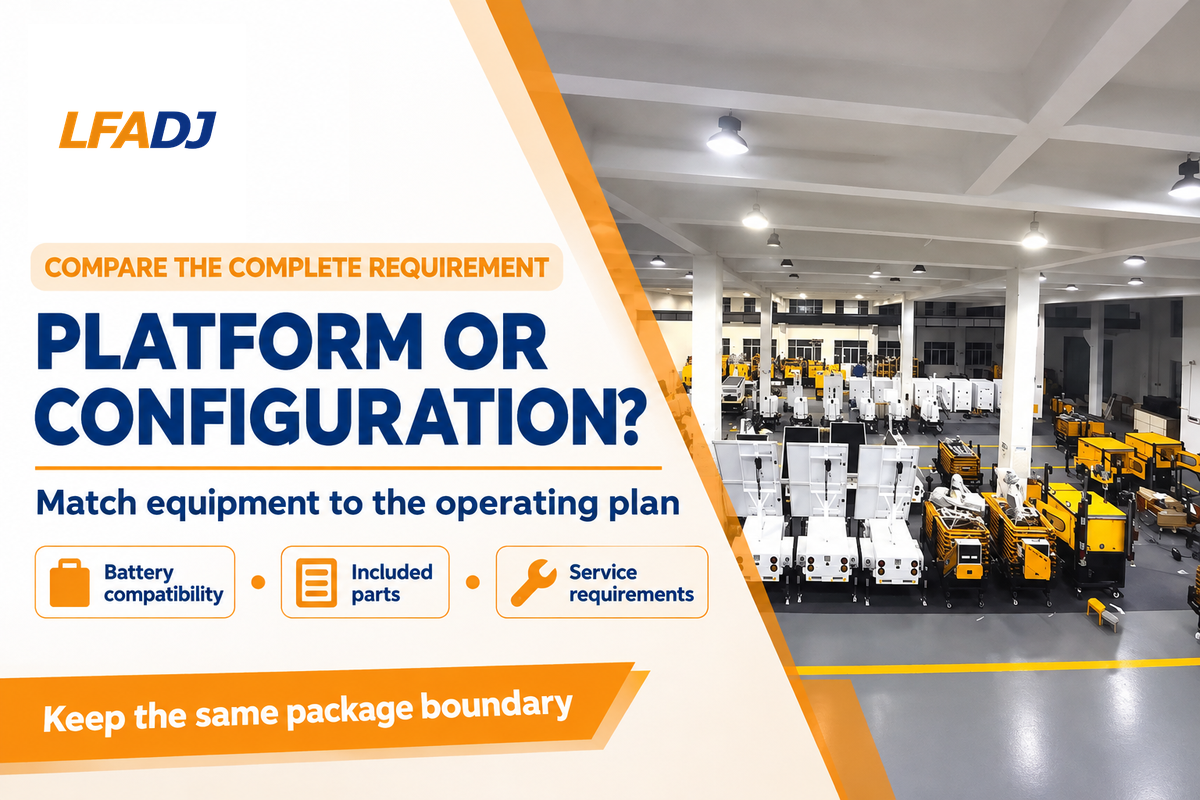
Choose an existing tool-battery platform, if the job and project already allow for the tool and battery to be incorporated. Choose an industrial lighting supplier if the project calls for a specific operating environment or a coordinated mobile arrangement. The useful comparison is the complete lighting and service requirement, rather than a universal best overall pick.
Milwaukee’s tower uses an M18 pack or an extension cord. Makita’s DML811 uses 18V LXT batteries or AC power; its AC cord is included, while the battery, charger and stand are separate. The DeWalt 20V MAX LED work light kit includes its battery and charger. When comparing rechargeable options across brands, keep the same pack family attached to the model.
LFADJ offers industrial, mobile, portable and emergency lighting, configured to match the operating environment and lighting requirement. For model configurations and project enquiries, use our (construction-site lighting solutions). This page is the next step after the operating plan and support arrangement have been determined.
For an equipment request, provide the specific model, included parts, output and runtime at the intended mode, compatible pack, enclosure ratings by component, mounting instructions, applicable electrical and/or atmospheric approvals, intended destination, and required service. This information allows procurement, operators and the electrical lead to evaluate the same work lighting configuration.
What Is Changing in Jobsite Lighting?
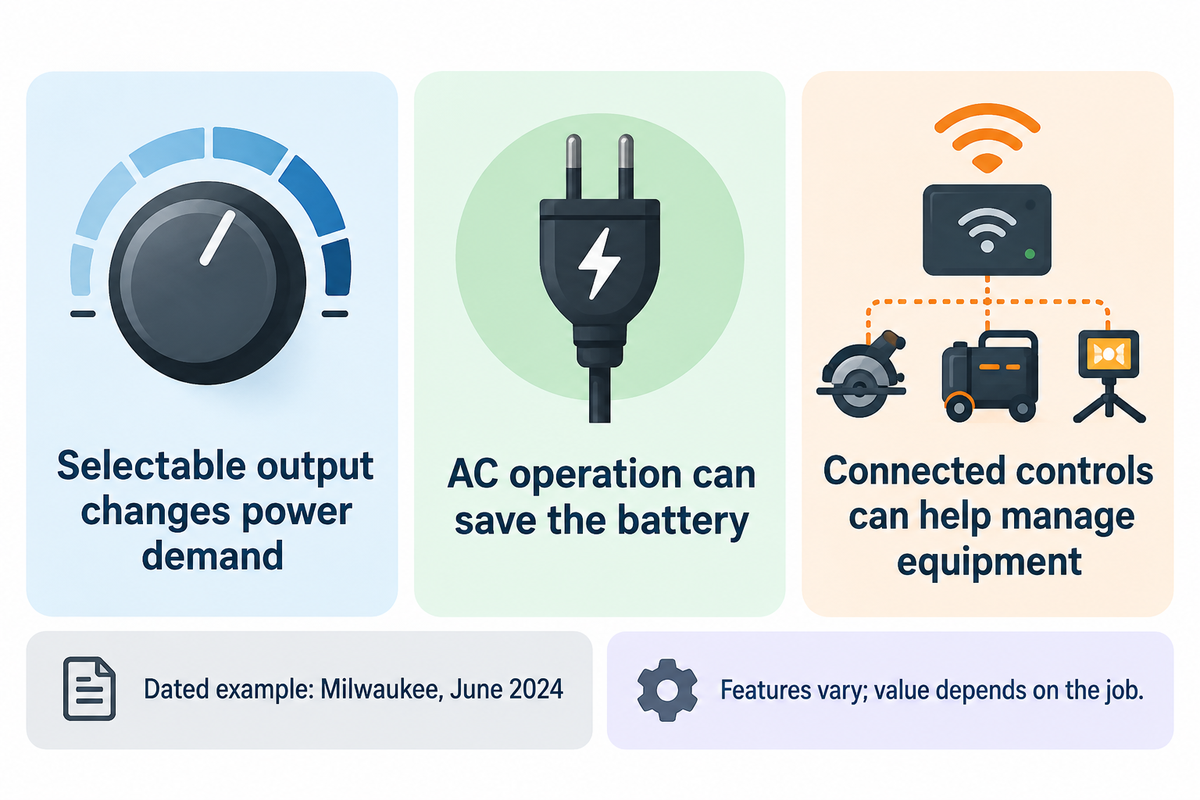
Documents for jobsite lighting indicate several improvements including a variable output, AC operation, and control of connected equipment. Milwaukee’s June 2024 compact MX FUEL tower release includes those features. A dimming control changes the power demand, an AC option can help save the battery, and controls for connected equipment can help a team manage the lights. The value should be based on the job.
The dated manufacturer release should be taken as a feature demonstration rather than an indication that all new lights are made that way. Multiple brightness settings are good when a light needs to move between close work and a wider area. A battery only model can be a better choice for short distance movement between work areas when a light cable gets in the way.
LED construction lighting also supports compact designs, but the label doesn’t explain much about the light’s features. For reliable lighting, consider replacement parts and the service arrangement for supporting equipment. When comparing service parts, identify whether the assembly uses replaceable LED bulbs or an integrated module. Energy-efficient lights consume less electrical power for the same light output. Compare LED lights at the intended operating mode. A 50W LED work light rating describes electrical input; it does not specify illumination at the working surface. How long a light runs is the useful battery planning time.
For a larger work site, the decision may move beyond a carryable lamp. Our mobile lighting systems guide addresses this situation more broadly. Bring the working distances, access ways, and available power to the discussion so that the proposed system will meet the requirements of the site.
Frequently Asked Questions
Are portable construction lights required by OSHA?
OSHA requires the specified minimum illumination for construction areas and operations; a portable fixture is one way to provide it. Section 1926.56 sets the relevant levels, while the arrangement also has to satisfy applicable electrical and equipment requirements. Permanent lighting may cover some areas. Where it’s missing, blocked or removed during work, the employer needs suitable lighting for the actual conditions and activities.
Should portable construction lights be grounded?
Cord-connected lights that require grounding must retain the designed grounding arrangement; don’t remove a grounding pin. OSHA specifically requires metal-case sockets for temporary general illumination to be grounded. Listed or labeled double-insulated equipment has a separate exception under 1926.404. A battery-powered lamp is a different electrical arrangement. Have the site electrical lead apply the rule to the complete product and supply rather than adding an improvised earth connection.
Are LED work lights better than halogen lights?
LED is usually the practical starting point for a new movable work-light setup because compact rechargeable formats and selectable output are readily available. Compare usable illumination, input power, handling temperature and repair needs for the actual models. Halogen lights can still be part of an existing arrangement. Replacing one should preserve the required distribution and working visibility rather than merely matching a wattage label with a lower-power LED fixture.
Can a work light operate while charging?
Yes, if the model expressly supports simultaneous operation and charging. Dual power identifies available power routes; it doesn’t automatically include charging during use.
Will LED work lights work in cold or wet environments?
Models rated for the actual temperature and exposure can work there. Check the complete arrangement, including battery and charger conditions, rather than only the head’s ingress rating. Wet or conductive locations also trigger specific electrical requirements. Cold-weather runtime needs allowance in the intended mode.
Can I use a household lamp as a temporary construction light?
Don’t substitute a household lamp without establishing its suitability for the construction environment and electrical arrangement. Cord protection, lamp guarding, mounting and exposure requirements still apply. A domestic fixture that lights a garage adequately may be unsuitable around moving materials, damp conditions or an active construction route.
How should I compare a cheap work light with a professional kit?
Compare the complete working package at the output and duration the job requires. Add missing batteries, charging capacity, supports and supply accessories, then include delivery and service terms. A lower bare-light price remains useful when compatible equipment is available; it becomes less useful when the missing parts consume the initial saving. For a shared fleet, record which crew owns the spare packs and when they return to charge. For a fixed maintenance station, include the suitable supply and mounting arrangement. Both comparisons should use the same delivery address and intended working period.
References & Sources
- OSHA, 29 CFR 1926.56: Illumination and Table D-3.
- e-CFR, current section 1926.56; retrieved snapshot current through October 16, 2026.
- NIST, Guide to the SI, Appendix B.9: Light conversion factors.
- CCOHS, Lighting Ergonomics: Survey and Solutions; Positioning and Glare.
- OSHA, 29 CFR 1926.404: Wiring design and protection.
- OSHA, 29 CFR 1926.405: Wiring methods, components and equipment.
- OSHA, 29 CFR 1926.1204(d)(5): Permit-space lighting equipment.
- IEC, IEC 60529 consolidated edition 2.2: Degrees of protection provided by enclosures, public catalogue.
- OSHA, Deregulatory Rulemaking: Construction Illumination proposal.
- US Department of Energy, Purchasing Energy-Efficient Exterior Lighting: luminaire efficacy definition only.
LFADJ · COMPANY & TECHNICAL CONTEXT
Practical lighting guidance for real project conditions
LFADJ shares product context, application notes, and selection checks to help project teams compare industrial lighting options with the right site details in view.
What LFADJ covers
LFADJ focuses on industrial lighting and tailored lighting solutions for teams planning, specifying, or operating demanding work environments.
- Product context: mobile lighting, light towers, explosion-proof lighting, emergency lighting, and related industrial lighting equipment.
- Project context: application conditions, target illumination, runtime, site constraints, and product configuration questions.
- Decision support: use the information here as a starting point, then confirm final specifications against the actual installation and local requirements.
Industrial lighting
Application guidance
Project enquiries
NEXT STEP
Have a site question?
Send the operating environment, lighting target, expected runtime, and any drawings or photos you have. The existing enquiry form is ready for a focused discussion.
Start an enquiry Or use the LFADJ contact page