Get in touch with LFADJ Company

Portable Work Lights Explained: Light, Power and Placement

Portable Work Lights offer movable illumination for tasks and spaces where fixed lighting doesn’t provide the needed view. Describe a light by its light source, power supply and support form: an LED work light can also be rechargeable and tripod-mounted. Then consider where its beam falls, what the task looks like, and which equipment is suitable for the location.
A bright workshop can contain a dark recess beneath a machine, and a powerful flood light can obscure a polished identification plate with glare even when the surrounding floor looks well-lit. What you need to see from a work position determines what kind of illumination is needed. This guide explains the labels and relationships behind that determination, from a handheld light for close inspection to a stand light for illuminating a shared work area.
Portable Work Light Types: Three Separate Questions
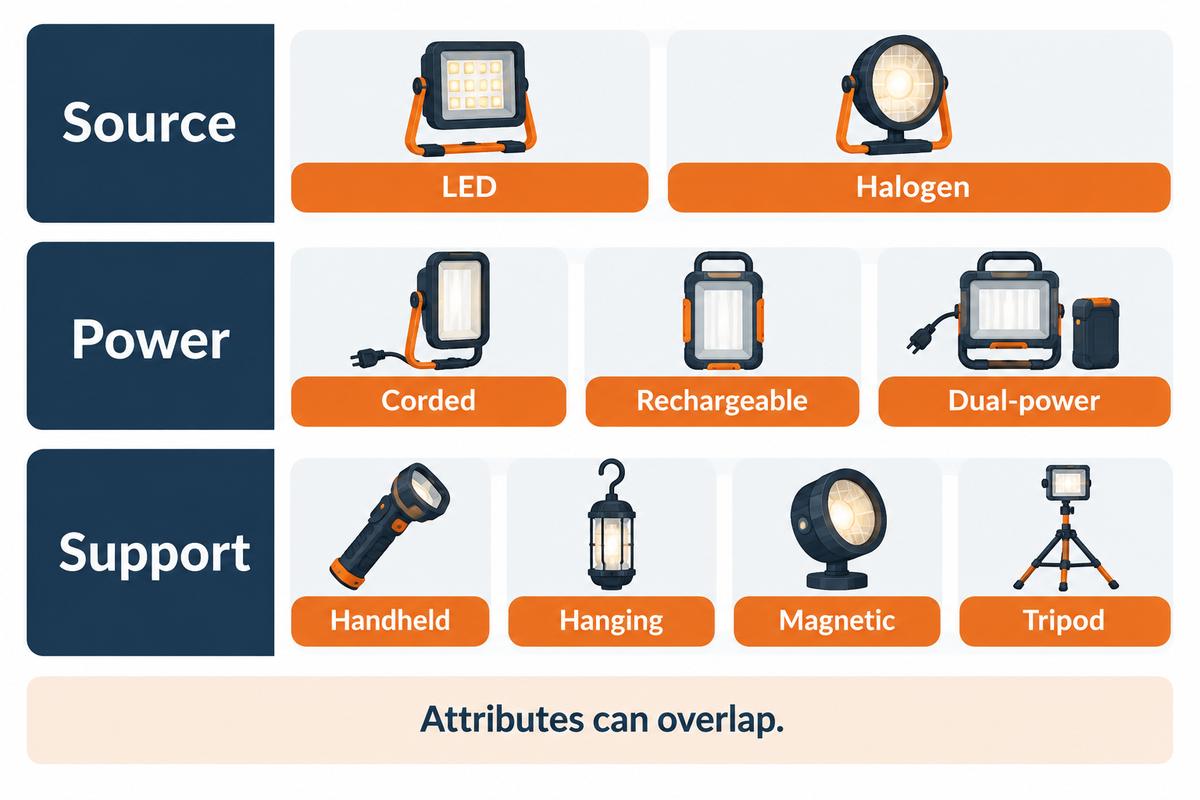
Work-light names describe different features of the same product. LED and halogen name the light source; plug-in and rechargeable identify the power supply; handheld, magnetic and tripod identify support. The labels together show that a rechargeable LED fixture can also be tripod-mounted, and they answer different questions about the arrangement.
With portable LED equipment as with halogen lights, the support alters where the light can be placed and the optics determine how the light is cast toward the task.
The 3-Axis Work-Light Map below allows an operator to visualize the arrangement; a maintenance lead to identify accessories; and a buyer to decipher which product descriptions they may compare. Its rows describe attributes, so a single light may appear in several rows.
| Axis | Label | What it describes | What remains a separate question |
|---|---|---|---|
| Source | LED | The technology producing the light; available in several power and support forms. | Beam distribution, supply and intended use. |
| Source | Halogen | A lamp technology found in older portable fixtures. | Permitted replacement lamp and fixture instructions. |
| Power | Corded | A supply connection to a suitable electrical source. | Cable routing, connection protection and location suitability. |
| Power | Rechargeable | Operation from a battery that can be recharged. | Compatible charging equipment and output-specific runtime. |
| Power | Dual-power | More than one documented supply option. | Which operating modes the exact model permits. |
| Support | Handheld | The light can be carried or directed by hand. | Whether hands-free use needs another attachment. |
| Support | Hanging | A hook or other purpose-designed hanging feature. | Approved attachment, orientation and mounting instructions. |
| Support | Magnetic | A magnet provides a model-specific attachment option. | Suitable mounting conditions; the label alone gives no holding-load guarantee. |
| Support | Tripod | The fixture uses or connects to a stand. | Compatible interface, stability and the stand’s instructions. |
For instance, in Milwaukee’s lighting range, they describe their 2368-20 as having battery or AC power and a hook, as well as magnet and keyhole mounting options. All of those co-exist. A rechargeable flashlight and a rechargeable flood light may share a supply description while producing very different views of the work.
The map describes physical features, not certification schemes. UL Solutions distinguishes intended-use categories for portable hand lights and portable work lights. The equipment’s intended use determines the relevant category and evaluation alongside those physical features.
Do work lights use special bulbs?
Some work lights accept a replaceable lamp; others contain an integrated LED assembly. Follow the fixture’s specified lamp type, rating and replacement instructions. UL notes that portable luminaires can use screw-shell or bi-pin lampholders as well as LED arrangements. Keep replacements within the fixture’s permitted type and rating even when another bulb fits the base.
String work lights are arranged along a cable, while a headlamp light follows the head. For the source-technology branch, see the LED portable work-light options; keep the exact fixture and its permitted light bulbs together when considering replacements.
Mounting Forms: Handheld, Hanging, Magnetic and Tripod
Choose the support along the light path that you need. Handheld work lights offer portability and enable quick angle adjustment. A headlamp offers hands-free lighting, but moves with the user. Clamp lights, a magnetic base or a tripod stand can position the light source in different ways, freeing the user’s hands for other tasks.
Interfaces are very specific. The product page for DEWALT’s DCL077B states it includes a rotating handle and 5/8-in-11 and 1/4-in-20 tripod mounts. It describes those as connections, not stating that an arbitrary stand or hanging arrangement is stable. For work lights with magnetic attachments, refer to the exact model’s instructions for mounting; don’t infer a holding force from the word “magnetic.”
Brightness Labels: Lumens, Lux and Beam Shape
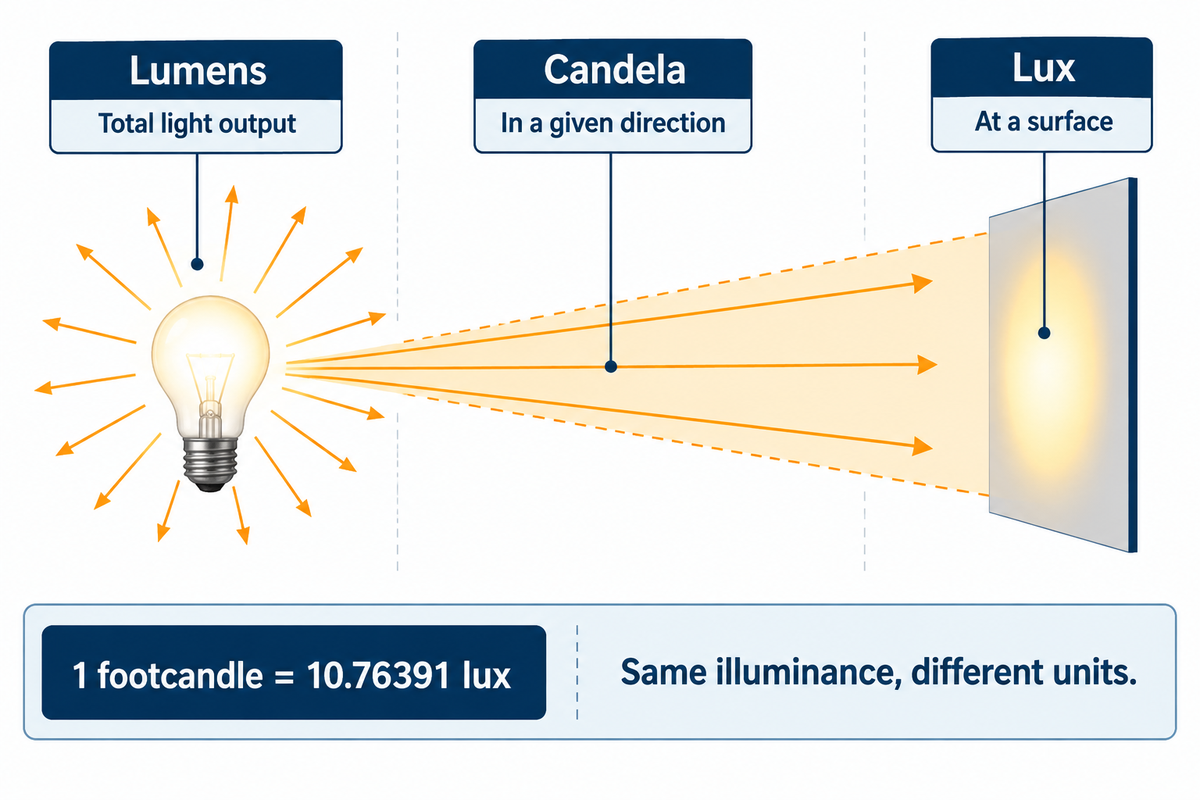
Lumens describe total light output. Candela describes luminous intensity in a given direction. Lux describes illuminance arriving at a given surface. These are different quantities and reveal different answers to questions. A lumen describes a source, but a given situation depends on many other factors, such as distance, how the light is spread, obstructions, and how it’s viewed. Keep the quantity and the measurement conditions together.
NIST’s explanation here distinguishes flux from intensity. Its glossary gives this definition of lux:
“It is equal to one lumen per square meter”
This definition doesn’t mean that a lamp’s entire output illuminates the work surface evenly. Some light is always diverted elsewhere. Objects can interrupt the light path, and the beam can vary across a work surface. Use this decoder when an operator reports poor visibility, when maintenance personnel are comparing lamp replacements, or when the purchasing department is reviewing lamp specifications.
| Label or quantity | What it describes | Useful reader question | Limit of the label |
|---|---|---|---|
| Lumens, lm | Total luminous flux from the source. | What output is stated for this operating mode? | Does not specify task illuminance or uniformity. |
| Candela, cd | Luminous intensity in a direction. | How is light concentrated toward the target? | A directional value does not describe every part of the beam. |
| Lux, lx | Illuminance at a surface. | Where and under what conditions was it measured? | A value at one position does not describe the whole work area. |
| Beam pattern | How the fixture distributes its light. | Does the pattern suit a recess, a bench or a shared space? | A flood label does not prove even illumination around obstructions. |
| Input watts, W | Electrical power input. | What supply and energy demand does the mode have? | Input power alone does not describe useful light at the task. |
| IP code | Specified enclosure protection against solids and liquids. | Which enclosure or component carries the rating? | Does not establish hazardous-location suitability. |
| Color temperature, K | The appearance of the source’s white light. | What white-light appearance is specified? | Does not describe object-color rendering by itself. |
| Color rendering | How object colors appear under the source. | Does the available color information suit the inspection task? | A color-temperature label is not a rendering score. |
| Temporal behavior | How light output varies over time. | What information is available for the intended mode and visual task? | A high lumen figure does not establish low modulation. |
How many lumens do I need for a work light?
Size a work light for a workbench, vehicle repair or job site by the lux it delivers at the task, not its lumen label: CCOHS lists 200 to 500 lux for high-contrast tasks such as simple assembly and 500 to 1000 lux for medium-contrast work such as vehicle repair shops. Define the task, the location where illumination is required, the position of the light source and the criteria for the workplace. Then, assess the light that reaches the task. A label showing 3000 lumens describes the output of the device, while seeing a recessed fastener or a reflective scale still depends on the beam and the viewing angle.
Task guidance illustrates why the distinction matters. For example, CCOHS’s lighting survey differentiates between illuminance levels for tasks such as simple assembly and vehicle repair. Those are Canadian ergonomic guidance in a stated context, rather than universal US legal requirements or lumen ratings for portable fixtures. Use task criteria that apply to your situation.
Converting units is a smaller, separate job. NIST’s conversion table lists one footcandle as 10.76391 lux. Multiply a footcandle reading by that factor to express the same illuminance in lux.
| Illustrative input | Calculation | Rounded equivalent |
|---|---|---|
| 1 footcandle | 1 × 10.76391 | 10.8 lux |
| 5 footcandles | 5 × 10.76391 | 53.8 lux |
| 20 footcandles | 20 × 10.76391 | 215.3 lux |
Converting units of measure doesn’t increase the amount of light. It doesn’t determine a fixture’s coverage area. It doesn’t decide how many lamps are required, or change a lumen rating to an illuminance measurement.
Beam Placement: Shadows, Glare and Reflections
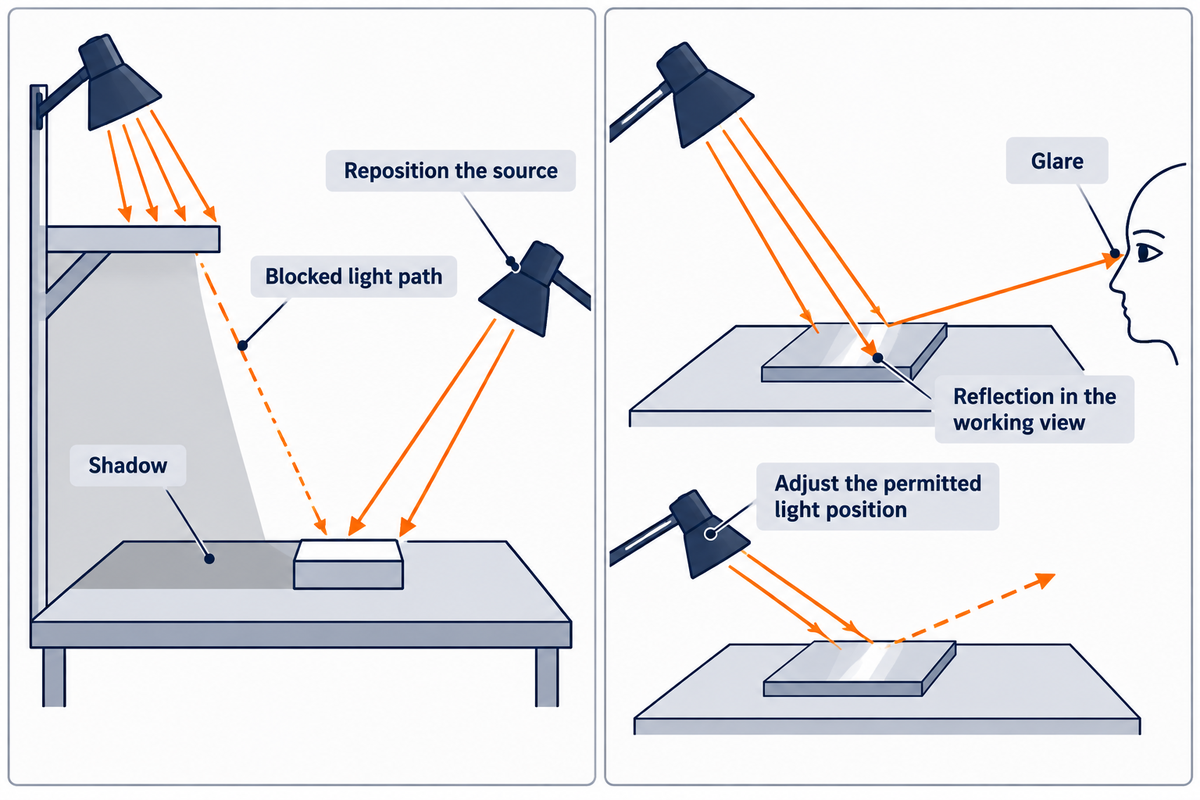
A useful beam reaches the object in question without placing a distracting source or reflection in the line of sight. When visibility is poor, it’s often worthwhile to examine the position of the source and object being illuminated in relation to the eye. If something in the light path is in the way, repositioning the source might clear the obstruction and solve the problem.
According to CCOHS, shadows are the result of incorrect placement of lights or objects in the path of light. Glare occurs when a bright light source or reflection interferes with seeing an object. The distinction helps clarify if the problem is truly a lack of light.
Read the Task Before Ranking the Light
The best portable arrangement varies based on the visual task, location and permitted placement. Sometimes, in order to get a close-up view, a source must reach into a recess. A shared work area may need a broader arrangement. A reflective surface may become clearer as the source is moved away from the reflection angle. The needs described above aren’t necessarily met by giving the highest lumen score to a single product.
Under a shelf: an overhead light can illuminate the front of a bench while the shelf shades the work behind it. Consider a suitably supported local source with a clear path to the detail. If your hand blocks that path during the task, reconsider the source position rather than assuming the LED light needs a higher setting.
On a polished plate: an identification plate or machine scale can reflect the bright face of a lamp to the user. View it from the normal working position and adjust the permitted light position to move the reflection away. A diffused light source and a directional source can reveal surface details of a given workpiece; the optimal arrangement depends on what needs to be inspected.
Across a shared area: an LED flood light can cast a wide beam, but a cabinet, vehicle or worker can still obstruct it. A higher tripod position can change the paths and shadows, and introduce support and access considerations, which are important when people and equipment are moved around a work site. Large work areas may require a few viewpoints and sources rather than a single, brighter source aimed from a single obstructed location.
A Practical Machinist discussion about a metrology area begins with a dark work surface beneath a shelf. Users discuss local lighting and reflections. While this post is useful for describing a positioning problem, it isn’t a controlled comparison or an absolute value for lighting levels.
Power Choices: Corded, Rechargeable and Dual-Power
Corded lights require a suitable outlet and route for the cord. Rechargeable lights carry stored energy to places without a live mains connection. Dual-power models provide the supply options mentioned by their manufacturer. For job site lighting, consider the work position and infrastructure, and keep in mind the limitations of the model being considered.
Runtime and charging conditions are specific to the light and battery. One supply option may assist access while introducing another requirement, e.g., a protected route for the cord or a compatible charging source.
Corded supply
- Depends on a suitable electrical source.
- Requires a cable route compatible with the work.
- Keeps connection and location protection relevant.
Rechargeable supply
- Carries energy to a disconnected work position.
- Requires a documented output-and-runtime pairing.
- Keeps charger compatibility and battery condition relevant.
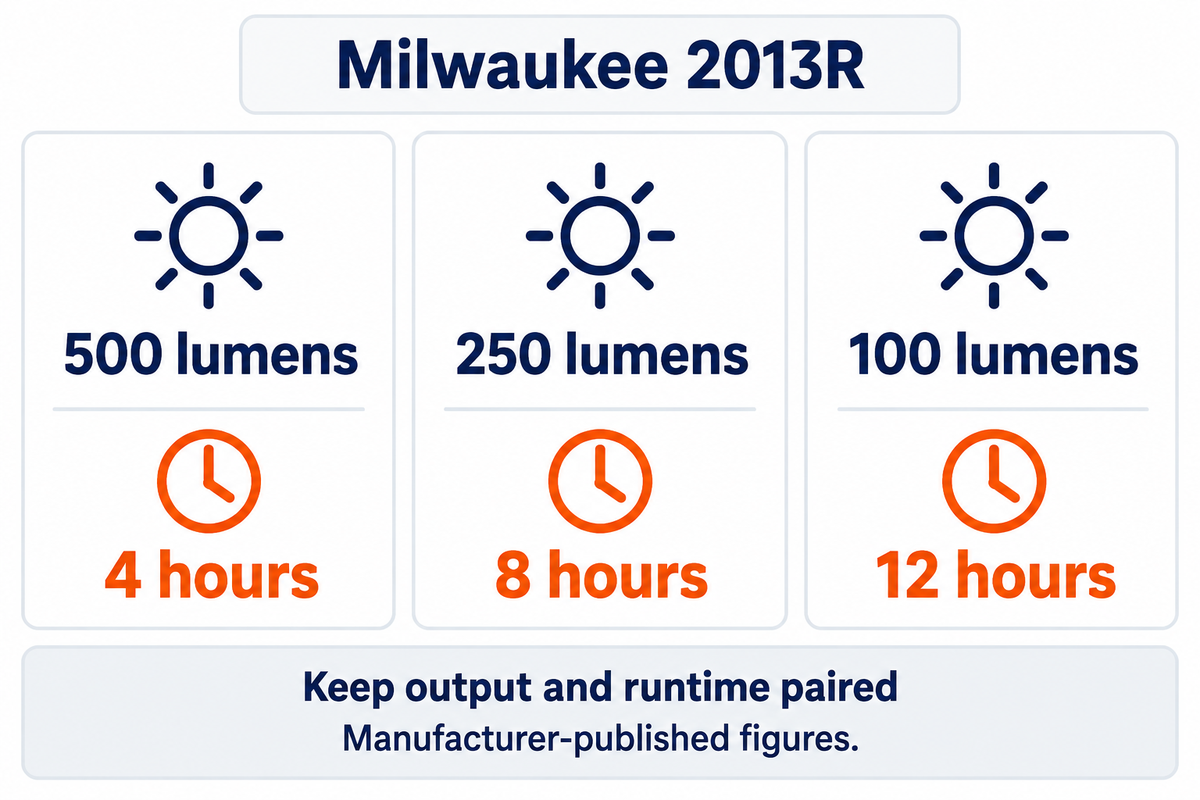
Battery life should also be placed with the selected output mode. Milwaukee’s published 2013R example pairs 500 lumens with 4 hours, 250 lumens with 8 hours, and 100 lumens with 12 hours. These are the manufacturer’s figures for the model. Pairing its highest output with its longest runtime describes a combination the listing does not promise.
Battery voltage labeling also requires context. DEWALT distinguishes maximum initial voltage from nominal voltage on its 12V/20V MAX product page; the latter system is described as 18V nominal. Read voltage within the battery system’s stated convention, and compare operating periods using the documented mode and compatible battery of each rechargeable LED fixture.
For USB-C and dock models, follow charging input requirements, as well as charger compatibility. Lithium-ion packs require special attention to condition. Thermal runaway is possible due to damage, extreme temperatures and improper charging as identified by OSHA. A cordless arrangement removes a supply cable from the task, but charging and battery use still impose limits.
For battery rotation and shift questions, use the rechargeable work-light planning guide. Here, the focus is on the supply and model-specific operation rather than a universal recharge schedule.
Use Conditions: Ordinary Sites and Rated Equipment
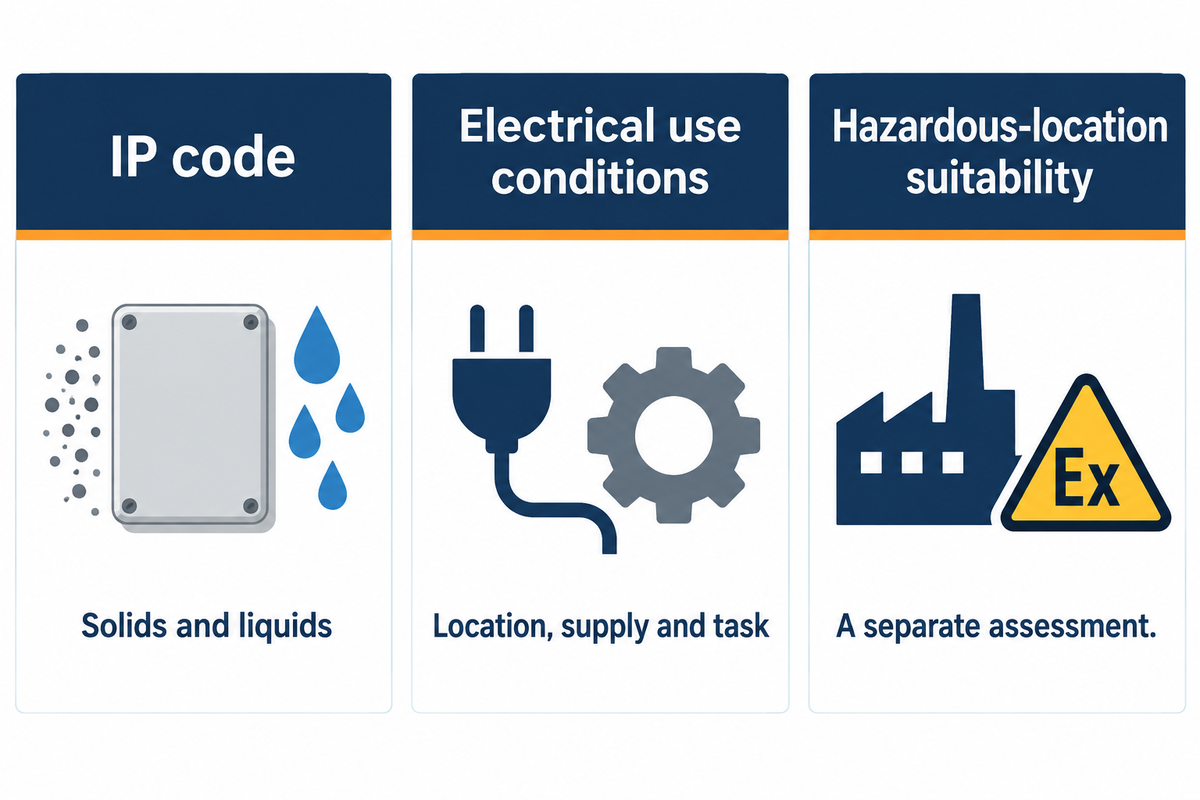
Environmental protection, electrical use conditions and hazardous location suitability are distinct concerns. A dust- and water-resistant enclosure doesn’t, by itself, establish suitability for an ignitable atmosphere, a charging operation in a wet area or all indoor or outdoor applications.
The IEC explains the IP code as a measure of protection against the ingress of solid and liquid bodies. The first digit of the IP code pertains to protection against ingress of bodies of solid materials, the second, against bodies of liquid. Read the complete model documentation for those conditions rather than treating “waterproof” or “heavy-duty” as a complete specification.
An example pertaining to a component illustrates the type of discrepancy that exists in practice. LFADJ’s published LF6128 entry says the lamp head is rated IP65 and the case is rated IP54. These are separate reported component ratings. Treat it as IP65 at the lamp head and IP54 at the case, not as an IP65 unit.
OSHA 1910.334(a) addresses handling, inspection and certain conductive-location conditions for US general-industry cord-and-plug equipment. It prohibits lowering or raising equipment by the flexible electric cord; equipment that remains connected and is not exposed to damage need not be visually inspected until it is relocated. Keep this exception tied to the rule.
A construction site has its own relevant provisions. OSHA 1926.405(j)(1)(iii), (v) addresses portable-lamp connections, portable handlamp handles and guards, and wet or damp location fixtures. These are construction electrical provisions, rather than a statement that every sealed rechargeable fixture needs the same corded-lamp arrangement when someone carries it onto a jobsite with different equipment and supply conditions. See the construction-site lighting options for that application branch.
Hazardous locations require a separate assessment. OSHA 1910.307 lays down criteria for electrical equipment for classified locations, and includes materials and locations covered. An ordinary IP code won’t take the place of that assessment: under OSHA’s class-and-division rules, approved equipment is marked with the class, group and operating temperature it is approved for, with listed exceptions. “LED”, “rechargeable” and “magnetic work light” won’t establish ignition protection.
The IEC publisher’s handlamp page lists IEC 60598-2-8:2013 as valid and a fourth edition under development, with a tentative publication in June 2028. Its public scope is handlamps and similar portable luminaires; it is not a general standard for the entire portable lighting system. An anticipated or target publication date will not serve as a compliance deadline.
Buying Context: Price Examples and Manufacturer Routes

A price for work lights describes a particular package through a particular seller. When comparing prices, be sure to consider the light, battery, charger and support accessories. Compact bare-tool offers, battery bundles and configured industrial lighting systems have different scopes, even when all are described as portable lighting solutions.
Portable Work Light Prices: Compare the Package
On October 22, 2026, Acme’s listing displayed USD 149 for a DCL077B bare tool. A separate listing displayed USD 398 for the light with two 5Ah batteries. DEWALT specifies the bare light’s battery and charger separately. Check the bundle’s complete current contents, including the charger, before ordering. Prices change; these seller examples don’t define an industry price range.
Industrial Work Light Manufacturers: Read the Product Scope
A home improvement listing may suit a compact workshop purchase. An industrial requirement may involve different mounting, supply or operating conditions. Zhejiang LONGFA Lighting Co., Ltd., the company behind LFADJ, supplies industrial, mobile and emergency lighting. Its Portable Work Lights solution page covers the industrial product route. For larger equipment boundaries, the mobile lighting system guide explains the wider system category.
Light Quality: What Deserves Attention Beyond Output
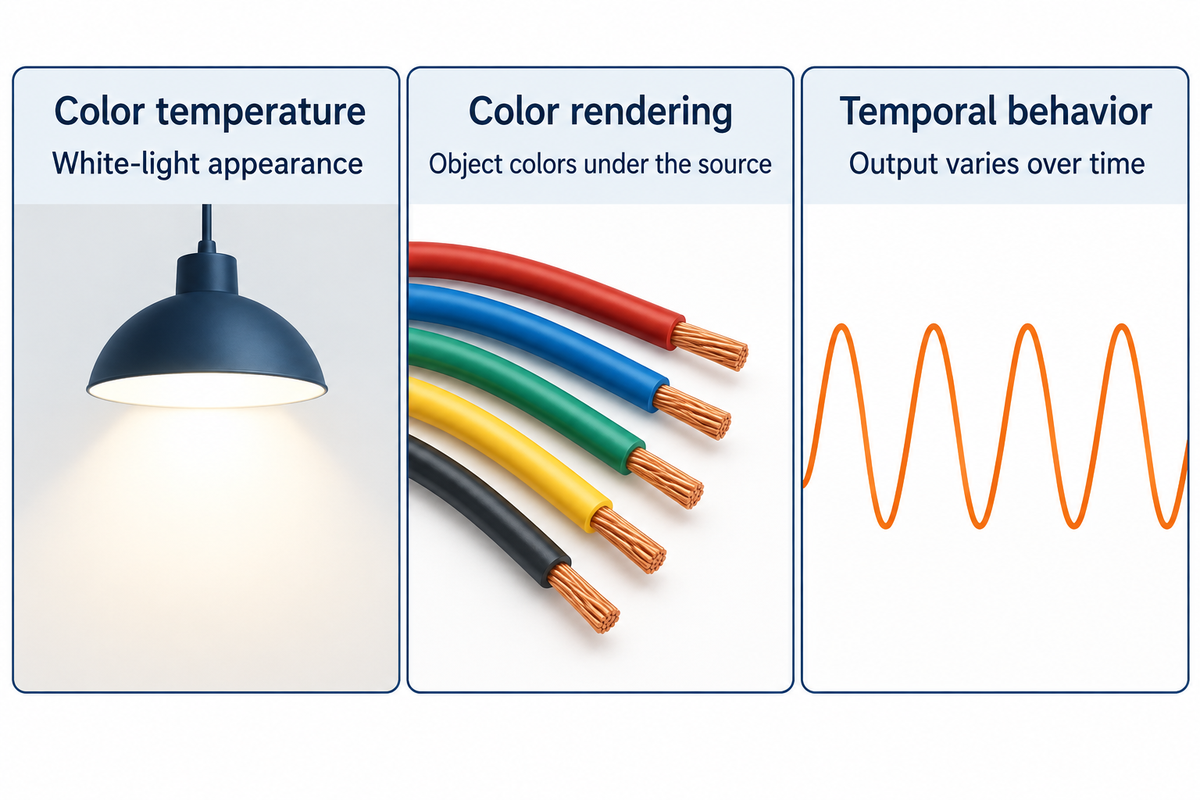
Light quality deals with the appearance of white light, how colors of objects are rendered, and how light output varies over time. These are different from total light output. One inspection task of colored wiring may raise a different question compared to walking through a work area. For a task such as checking colored wiring, ask for the color rendering index (CRI) rather than relying on a single “bright” label; for comparison, ENERGY STAR-qualified light bulbs must have a CRI of 80 or greater.
The definitions provided by the DOE make a distinction between color temperature and color rendering. “Neutral white light” describes an appearance, and without additional information, doesn’t give a rendering score. Likewise, saying LED bulbs are energy-efficient doesn’t tell us about their beam, color rendering or their suitability as replacements in a given light fixture. Halogen work lamps and LED assemblies still need to be interpreted as complete fixtures.
Variation with time is the concern for temporal light modulation. DOE’s flicker research page looks at different forms of flicker (static, motion and eye movement related), says research is ongoing and mentions a 2024 paper on a phantom-array visibility measure. This is measurement research, rather than evidence that every newer work light has better temporal performance.
For moving machinery or a demanding visual inspection, obtain information for the actual operating mode and follow the applicable equipment and workplace requirements. A strobe feature or a clear phone video doesn’t generally certify temporal performance. The variety of work lights on sale makes these separate specification questions more helpful than a general ‘best-work-lights’ ranking when your lighting needs involve particular surfaces, movements and viewing positions.
Frequently Asked Questions
What is the best portable work light?
The best portable work light is the one whose documented operating conditions, support and beam suit the actual task.
Compare the view of the detail from the working position, rather than choosing only by output or a general product ranking. A close inspection, a shared work area and an identification plate with reflective material may require different arrangements. Consider the allowed supply, battery operation and location suitability when determining which model fits the need.
What is the most powerful rechargeable work light?
Compare maximum lumen output among lights suited to the same task.
Published maximum output can help compare particular models, but keep it paired with the output mode, compatible battery and stated runtime. The highest-output setting and the longest-operating-time setting may be different. Determine if you need focused task lighting or broad area illumination. For charging, use the specified compatible input and charger, follow the permitted conditions and avoid improvised arrangements for a damaged lithium-ion pack.
What safety measures should I consider when using a work light?
Match the equipment and accessories to the location, supply and task.
Use the allowed support arrangement to keep the light path useful and keep glare out of the working view. Comply with the applicable electrical requirements when managing cables, and follow model instructions for charging, heat and damaged parts. Temporary construction, general industry and hazardous locations have different relevant provisions. A magnetic attachment, IP label or rechargeable supply is one feature of the equipment. None of these items addresses every question concerning the work conditions.
Are there any lights that work without electricity?
Battery-powered electric lights work without a live mains connection, but still use stored electrical energy.
A rechargeable work light still needs a compatible charging source to replenish its stored energy. A remote work position therefore still needs a plan for the model-specific operating time and the next allowed charging opportunity.
How many work lights do I need?
Start with the tasks and the paths light must take to reach them.
A fixture that works for an open bench may leave a recess behind equipment in shadow. When people move between working positions, the useful view can change as well. One work light with a stand may cover several tasks, or separately positioned sources may be required to illuminate details that share no clear light path. Consider each task from its normal viewing position, including hands, tools and objects that interrupt the beam. Other sources can reflect off surrounding surfaces, so count alone is not an indicator of quality. On US construction sites, OSHA’s illumination table sets a minimum of 5 foot-candles for general construction area lighting while work is in progress; the count is however many lights it takes to reach the applicable level at each work position. Evaluate the layout according to the actual line of sight of the visual tasks and applicable lighting criteria, and do not select solely based on the sum of the offered lumens of light.
Does an IP rating mean a work light is explosion-proof?
No.
IP describes specified protection against ingress of solids and liquids; hazardous-location suitability is a separate question. The portable explosion-proof lighting guide explains that equipment family; match the exact model’s approval to the intended location.
Key takeaway
Describe the source, power and support together, then relate the beam to the task and the equipment to its intended location. A brighter label alone cannot settle the whole lighting decision.
LFADJ’s Perspective on Portable Lighting
LFADJ supplies industrial, mobile and emergency lighting. This guide explains portable-light categories, photometric units and the relationship between a light and its visual task. Named product examples retain their manufacturers’ published scope; the LF6128 example identifies separate component labels. Discuss the intended environment and configuration with the supplier when moving from these general explanations to a particular industrial application. GW, for LFADJ.
References & Sources
- Photometry, Lux and unit conversion table NIST.
- Lighting Ergonomics: Survey and Solutions CCOHS.
- Portable Luminaires UL Solutions.
- IP ratings and IEC 60598-2-8 public scope and lifecycle IEC.
- 1910.334: Use of equipment, 1910.307: Hazardous locations, 1926.405: Construction electrical equipment and lithium-ion battery hazards OSHA.
- Color and lighting definitions and Flicker Research US Department of Energy.
LFADJ · COMPANY & TECHNICAL CONTEXT
Practical lighting guidance for real project conditions
LFADJ shares product context, application notes, and selection checks to help project teams compare industrial lighting options with the right site details in view.
What LFADJ covers
LFADJ focuses on industrial lighting and tailored lighting solutions for teams planning, specifying, or operating demanding work environments.
- Product context: mobile lighting, light towers, explosion-proof lighting, emergency lighting, and related industrial lighting equipment.
- Project context: application conditions, target illumination, runtime, site constraints, and product configuration questions.
- Decision support: use the information here as a starting point, then confirm final specifications against the actual installation and local requirements.
Industrial lighting
Application guidance
Project enquiries
NEXT STEP
Have a site question?
Send the operating environment, lighting target, expected runtime, and any drawings or photos you have. The existing enquiry form is ready for a focused discussion.
Start an enquiry Or use the LFADJ contact page