Get in touch with LFADJ Company

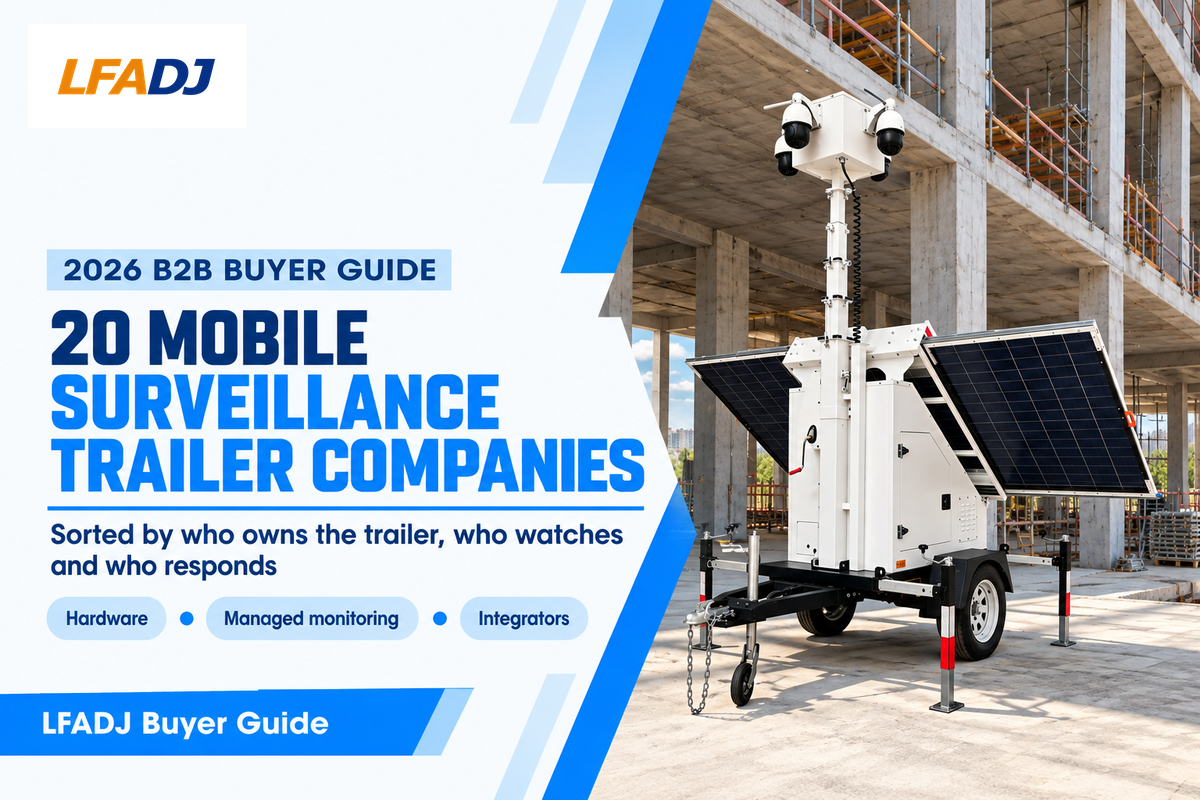
Last updated: November 2026
The best mobile surveillance trailer companies are Backstreet Surveillance for listed prices, LVT for retail parking lots, ECAM for monitored jobsite units, WCCTV for rentals with an option to buy, Vision Detection Systems for documented US-built trailers, and Verkada for existing Verkada camera users.
Quick Picks
- Best for buying a configured solar surveillance trailer as hardware, from a single unit: LFADJ
- Best for listed prices and direct purchase: Backstreet Surveillance
- Best for retail parking lots: LVT
- Best for monitored jobsite units: ECAM
- Best for 33-foot masts and long deployments: Mobile Pro Systems
- Best for NDAA-documented US-built trailers: Vision Detection Systems
Disclosure: This guide is published by LFADJ. We list ourselves first because this is our website, not because we claim to be the market leader. The other 19 companies are grouped by what they’re best for, in no particular order within each group.
How We Selected These Mobile Surveillance Trailer Companies
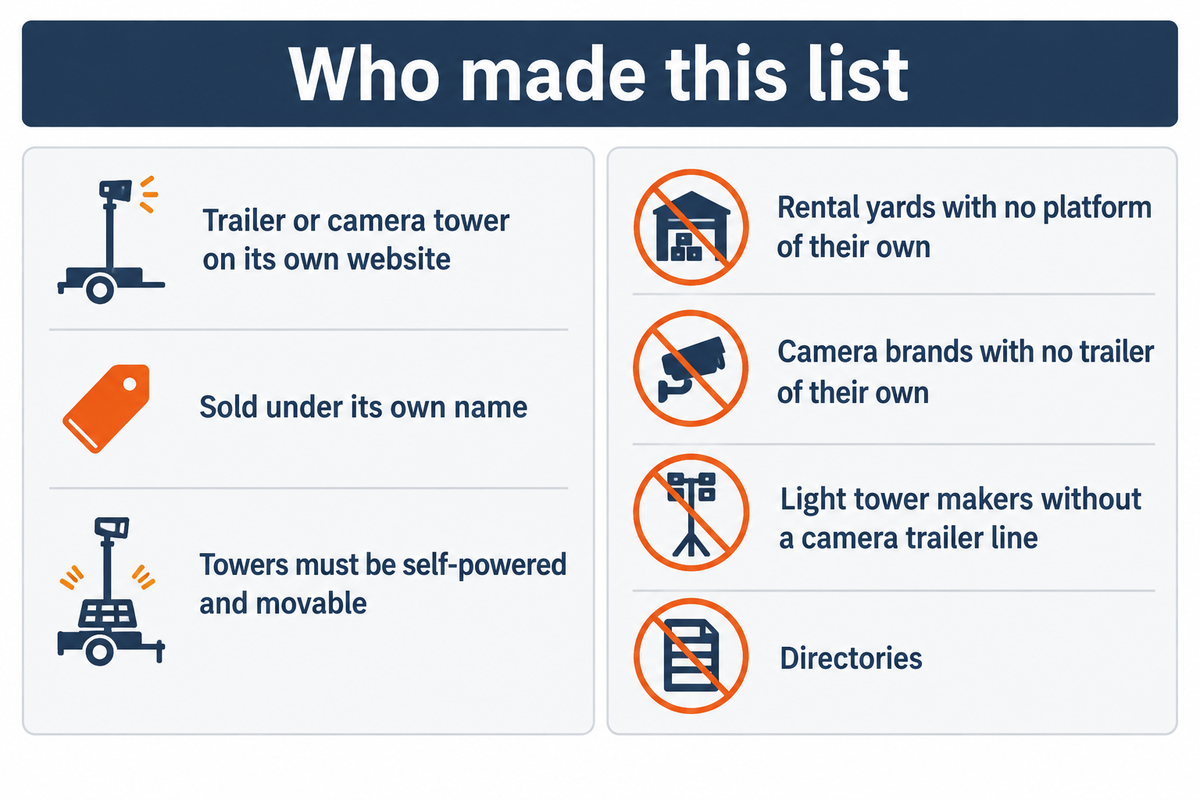
Each of the 20 companies had to show a mobile surveillance trailer or security camera tower on its own website, under its own name, and units sold as security towers count only if they’re self-powered and movable. Rental yards with no platform of their own, camera brands with no trailer of their own, light tower makers without a camera trailer line and directories were excluded. Company information was verified against official company websites and public sources in November 2026. All but LFADJ and BigLux are headquartered in the US, so buyers elsewhere should treat the compliance and price sections as US-specific.
Most lists of the 10 best mobile surveillance trailer companies are written by a vendor on that list: Pioneer Security, 2M Technology and Sharpvue each publish one with themselves at or near the top, ours included, which is why this page carries a disclosure and says whose figure each price is. The names that recur across those rival lists are LVT, Pro-Vigil and the two brands now merged into ECAM. Brands are counted here, not corporate groups, so ECAM and Pro-Vigil appear separately although both now belong to GardaWorld. Readers new to the equipment can start with our beginner’s guide to camera trailers; buyers who also need site lighting can compare our list of solar light tower manufacturers.
Mobile Surveillance Trailer Companies Compared at a Glance
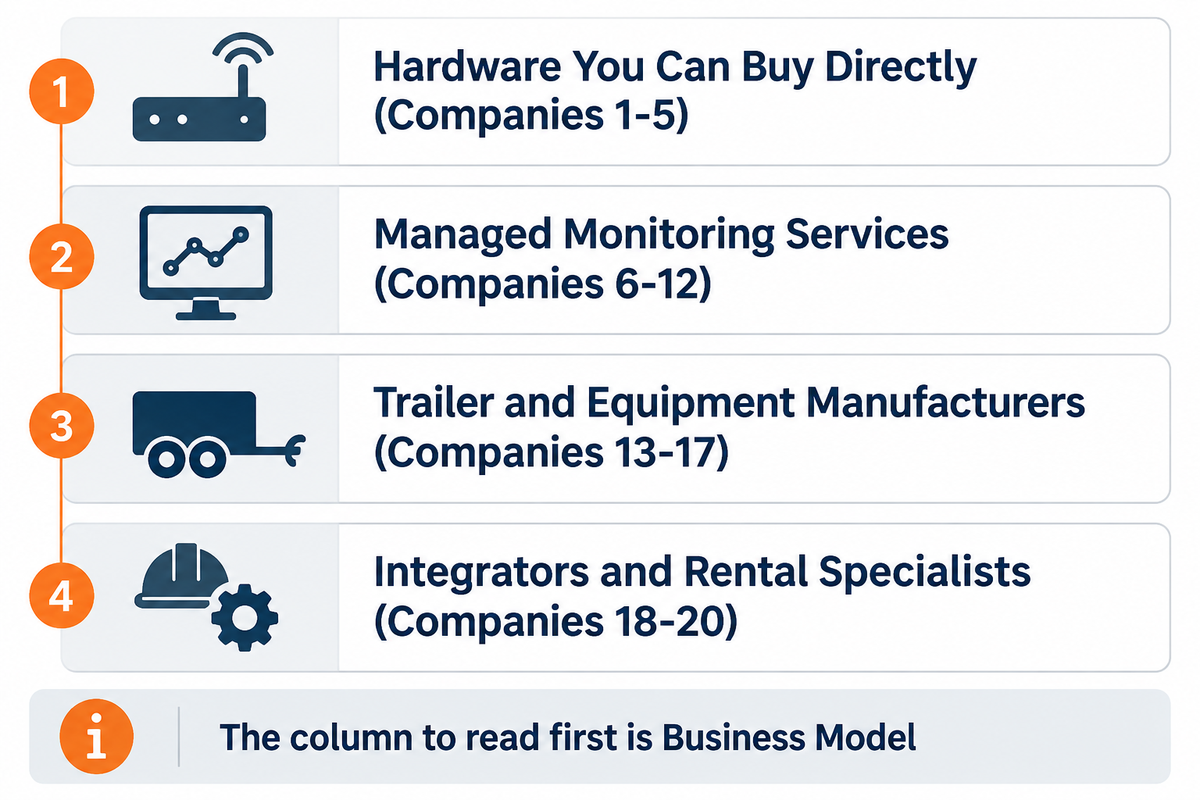
The column to read first is Business Model. A trailer manufacturer sells you a surveillance platform to run yourself, while a monitoring service keeps the unit and bills you monthly. Several of these trailer companies in the USA and abroad offer both, and SDM Magazine’s feature on security trailers describes the same split between buying, leasing and monitored service. Mobile surveillance trailers provide temporary surveillance where fixed camera systems and security personnel can’t reach. A job site without power needs different trailer systems from a retail parking lot, so the use case decides the model.
| No. | Company Name | Headquarters | Founded Year | Best For | Brief Introduction | Business Model | Key Advantages | Potential Disadvantages | Official Website |
|---|---|---|---|---|---|---|---|---|---|
| 1 | LFADJ | Yueqing, Zhejiang, China | 2013 | Buying a configured solar surveillance trailer as hardware, from a single unit | Supplies the S973 solar trailer | Hardware sale | Published S973 specs, MOQ 1 unit | Monitoring and service arranged separately | lfadjlight.com |
| 2 | Backstreet Surveillance | Salt Lake City, Utah | 2012 | Buyers wanting listed trailer prices and direct purchase | Trailer builder printing list prices | Hardware sale and rent-to-own | Scout listed at $27,999 | Delivery adds $1,199 to $2,199 | backstreet-surveillance.com |
| 3 | Verkada | San Mateo, California | 2016 | Verkada customers extending cameras to off-grid sites | Cloud security firm with MT81 trailer | Hardware sale plus license | 24 ft mast, 13.2 kWh option | Cameras and license cost extra | verkada.com |
| 4 | Sharpvue | Chapin, South Carolina | 2015 | Buyers wanting to own trailers without per-unit licensing fees | US trailer maker with MAST line | Hardware sale, dealer rental | No per-unit licensing | Solar-only rating covers Zones 1-3 | sharpvue.com |
| 5 | BigLux | Bao’an District, Shenzhen, China | Not publicly disclosed | Integrators and rental firms sourcing factory-direct trailers from China | Factory-direct Chinese tower maker | Hardware sale | Up to 20 kWh and diesel backup | One-year system warranty | bigluxpower.com |
| 6 | LiveView Technologies (LVT) | American Fork, Utah | 2005 | Retail parking lots wanting a subscription camera unit | Mobile unit and software company | Subscription or purchase | SOC 2 Type II platform | Cameras supplied by LVT | lvt.com |
| 7 | ECAM | Dallas, Texas | 2025 (merger) | Sites wanting monitored trailers from a GardaWorld business | GardaWorld monitored trailer business | Managed service | Deployment in 5 days or less | Recurring cost; same parent as Pro-Vigil | ecam.com |
| 8 | Pro-Vigil | San Antonio, Texas | 2006 | Construction sites wanting trailers with live virtual guards | Remote monitoring provider, now GardaWorld | Managed service | UL and TMA Five Diamond center | Same parent as ECAM | pro-vigil.com |
| 9 | WCCTV | Richardson, Texas | 2001 | Temporary jobsites needing monitored rentals with an option to buy | Texas-based mobile video supplier | Rental or purchase | Up to 10 days without sunlight | Trailers stand up to 20 ft | wcctv.com |
| 10 | Mobile Video Guard | Maryland | 2016 | Contractors wanting guard-monitored camera units rented as one service | Rental units with live monitoring | Managed service | Install within 24 hours | Standard watch is 6 p.m. to 6 a.m. | mobilevideoguard.com |
| 11 | Flock Safety | Atlanta, Georgia | 2017 | Police and property teams already using Flock license plate readers | Public safety platform with trailers | Subscription | Ties into Flock plate readers | Sold by subscription | flocksafety.com |
| 12 | TrueLook | Winston-Salem, North Carolina | 1995 | Construction teams wanting trailers on a jobsite camera platform | Construction camera platform | Purchase or rental | Current trailer mast up to 30 ft | Quoted with a subscription plan | truelook.com |
| 13 | Wanco | Arvada, Colorado | 1984 | Fleet buyers wanting preconfigured or integrator-ready solar trailers | Road and fleet equipment maker | Hardware sale | One-person setup under 10 minutes | Mini has two PTZ cameras | wanco.com |
| 14 | Mobile Pro Systems | West St. Paul, Minnesota (contact address) | Not publicly disclosed | Agencies needing 33-foot masts and generator-backed long deployments | Built-to-order platform maker | Hardware sale | 33 ft mast, generator backup | Built to order | mobileprosystems.com |
| 15 | 2M Technology | Grand Prairie, Texas | Not publicly disclosed | Oil, gas and hazardous-site operators wanting solar trailers and explosion-proof cameras from one integrator | Texas integrator with own trailers | Hardware sale | Explosion-proof camera options | Gel battery and manual mast on 2MVSC-4000B | 2mtechnology.net |
| 16 | Vision Detection Systems | Pikesville, Maryland | Not publicly disclosed | Buyers needing NDAA-documented US-built trailers with staffed monitoring | US maker with monitoring center | Sale and monitoring | 11,776 Wh LiFePO4 battery | One-year standard warranty | visiondetectionsystems.com |
| 17 | Duck View Systems | Kaysville, Utah | Not publicly disclosed | Integrators and sites wanting AI trailers on monthly lease | AI tower maker on monthly lease | Lease or purchase, with monitoring | Published monthly price range | Delivery quoted separately | duckviewsystems.com |
| 18 | Security 101 | West Palm Beach, Florida | 2005 (origins in 2003) | Enterprises needing trailers tied to any chosen camera or VMS | National integrator with trailers | Lease or purchase | Open to any camera or VMS | Up to five days without sun | security101.com |
| 19 | Stone Security | Salt Lake City, Utah | 2005 | Buyers wanting Axis-based trailers purchased outright or leased | Integrator’s Axis-based trailer line | Lease or purchase | Up to ten days of sunless power | Axis camera platform only | mobilesecurity.net |
| 20 | Stallion Infrastructure Services | Houston, Texas | 2004 | Remote or multi-site jobsites renting LTE or Starlink trailers | Oilfield rental firm with trailers | Rental, purchase in most cases | Same-week delivery in most markets | Delivery priced by location | stallionis.com |
Hardware You Can Buy Directly (Companies 1–5)
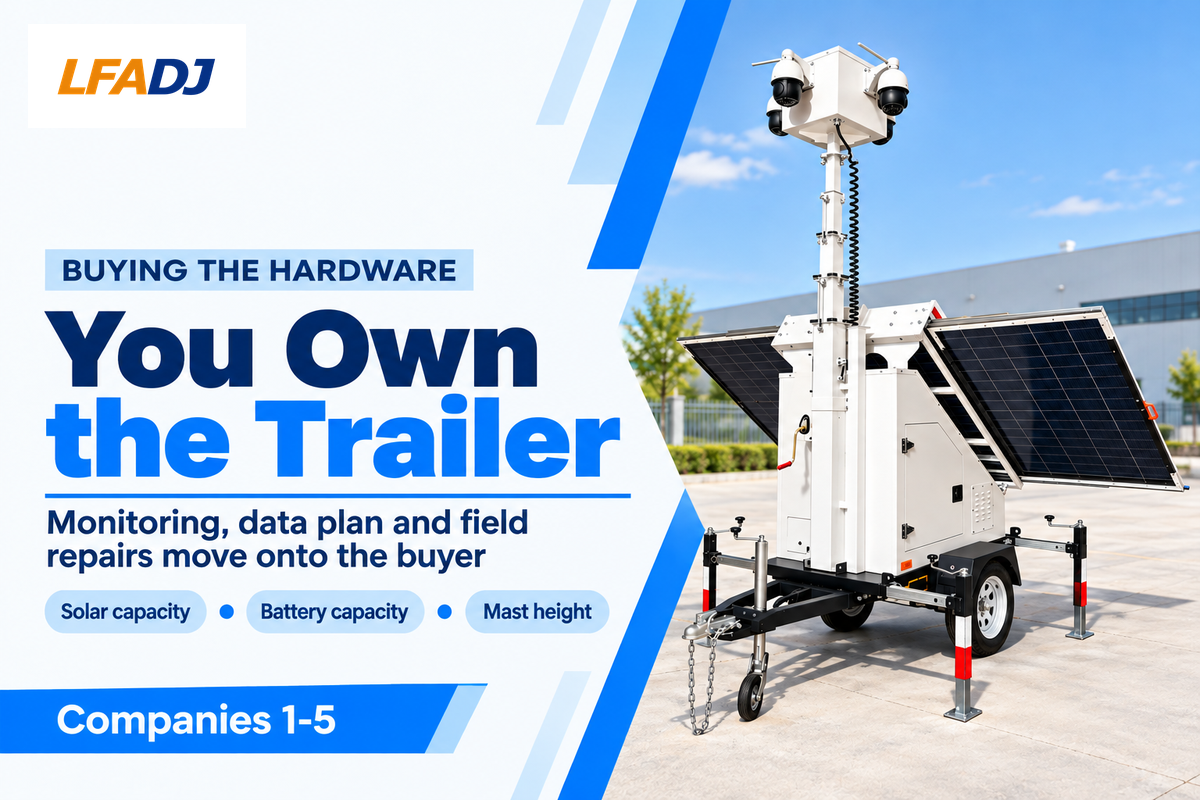
These five sell surveillance hardware a buyer can own, so the buyer has to make a decision based on published solar and battery capacity and mast height. Trailer configurations differ mostly in battery systems and mast type, and your surveillance needs should set both. Ownership also means the monitoring service, data plan and field repairs move onto the buyer.
1. LFADJ: Best for buying a configured solar surveillance trailer as hardware, from a single unit
Headquarters: Yueqing, Zhejiang, China · Founded: 2013 · Type: Lighting equipment manufacturer covering R&D, manufacturing, trade and service; supplies the S973 trailer (brand of Zhejiang Longfa Lighting Co., Ltd.)
Official website: lfadjlight.com
Main products: S973 mobile surveillance trailer, mobile light towers, telescopic lighting towers, portable work lights
Key specifications: S973: 4 PTZ cameras, 3 x 450 Wp solar array (1.35 kWp), 5.12 kWh nominal LiFePO4 battery (25.6 V, 200 Ah), 7,000 mm deployed height, 800 kg, -10 to 50 °C
Certifications / notable work: Minimum order 1 unit; 50% deposit with the balance before shipment (published by LFADJ)
LFADJ publishes the S973 configuration on its mobile surveillance trailer page and takes orders from one unit, which suits an importer or integrator testing a single trailer before committing to a fleet. Cameras, recording and communications are agreed per project against a marked site plan. One limit is plain: LFADJ supplies the hardware, so monitoring staff, cellular plans and field service are arranged separately; warranty and response times are set in each contract, and buyers subject to US federal or critical-infrastructure rules should fix a non-restricted camera brand there too.
2. Backstreet Surveillance: Best for buyers wanting listed trailer prices and direct purchase
Headquarters: Salt Lake City, Utah · Founded: 2012 · Type: American owned company supplying CCTV systems and its own solar surveillance trailers
Official website: backstreet-surveillance.com
Main products: Scout, Sentry-X, Sentry-Pro and Sentry All-Terrain solar surveillance trailers
Key specifications: Scout: 23 ft electric mast, 3 PTZ cameras, coverage up to 500 ft, 10+ day battery backup. Sentry-Pro: 18 ft tilt-up mast, 800 W solar, 1,100 lb
Certifications / notable work: Sentry-Pro page states NDAA compliance; 5-year warranty, extendable to 10 years
Backstreet prints its prices: the Scout is listed at $27,999 and the Sentry-Pro at $39,999 as of November 2026, and the Scout can be rent-to-own with a 12-month minimum and ownership after 24 months. Optional 24-hour live monitoring is priced at under $1 per hour. The limit is freight, because Scout pricing is factory pickup and site delivery adds $1,199 to $2,199 depending on US time zone.
3. Verkada: Best for Verkada customers extending cameras to off-grid sites
Headquarters: San Mateo, California · Founded: 2016 · Type: AI-powered, cloud-based physical security company
Official website: verkada.com
Main products: MT81 Security Trailer, alongside video security, access control and alarms
Key specifications: MT81: 24 ft telescoping mast with electric-powered winch, 1600 W solar panel, 6.6 kWh or 13.2 kWh battery, up to six Verkada cameras
Certifications / notable work: FedRAMP Moderate Authorization and GovRAMP Moderate Authorization at platform level; five-year hardware warranty
Verkada lists the MT81-6KWH at $58,000 and the MT81-13KWH at $65,000 MSRP, as read in November 2026. An organization already running Verkada cameras gets the trailer on the same cloud dashboard. The catch is the bill of materials: cameras, speakers and gateways are sold separately, a cloud license starting at $349 for one year is added, and availability is stated for the United States.
4. Sharpvue: Best for buyers wanting to own trailers without per-unit licensing fees
Headquarters: Chapin, South Carolina · Founded: 2015 · Type: Manufacturer of mobile surveillance trailers (Sharpvue, LLC)
Official website: sharpvue.com
Main products: MAST and MAST-mini AI trailers, Alarm.com and OpenEye Mobile Security Trailers, iVISION cloud VMS
Key specifications: MAST: 22 ft mast, 1,180 W solar, 200 Ah at 51.2 V (10,240 Wh), 8-10 days on a full charge, 1,600 lb (Sharpvue notes some specs are still being finalized)
Certifications / notable work: NDAA compliant and manufactured in the USA (company statement)
Sharpvue manufactures the MAST line, an AI surveillance trailer, in South Carolina and includes its fleet portal with no add-on fees or per-unit licensing. Its BYOT program converts trailers from other makers by replacing the top box. Two limits matter: on solar alone the MAST is rated only for Zones 1-3 of Sharpvue’s solar zone map, and no MAST price is published, so the $25,000 MASTvorp listing applies to a model still marked Coming Soon.
5. BigLux: Best for integrators and rental firms sourcing factory-direct trailers from China
Headquarters: Bao’an District, Shenzhen, China · Founded: Not publicly disclosed · Type: Chinese manufacturer of mobile solar trailers, CCTV towers and light towers
Official website: bigluxpower.com
Main products: HiSTAR mobile solar CCTV towers, mobile solar light towers, mobile solar trailers
Key specifications: HiSTAR-V: electric telescopic mast to 30 ft (9 m), up to 2300 W solar, up to 20 kWh battery, built-in auto-start diesel generator
Certifications / notable work: Lists ISO9001, DOT, CE and CR certificates on its About page
BigLux sells factory-direct and leaves the camera choice open through its CCTV hub, so an integrator can fit its own brand. Export buyers can plan containers from published figures: 3 units fit a 20GP and 7 fit a 40HQ. Bulk orders take 25 to 45 business days, and the full-system warranty is one year.
Managed Monitoring Services (Companies 6–12)
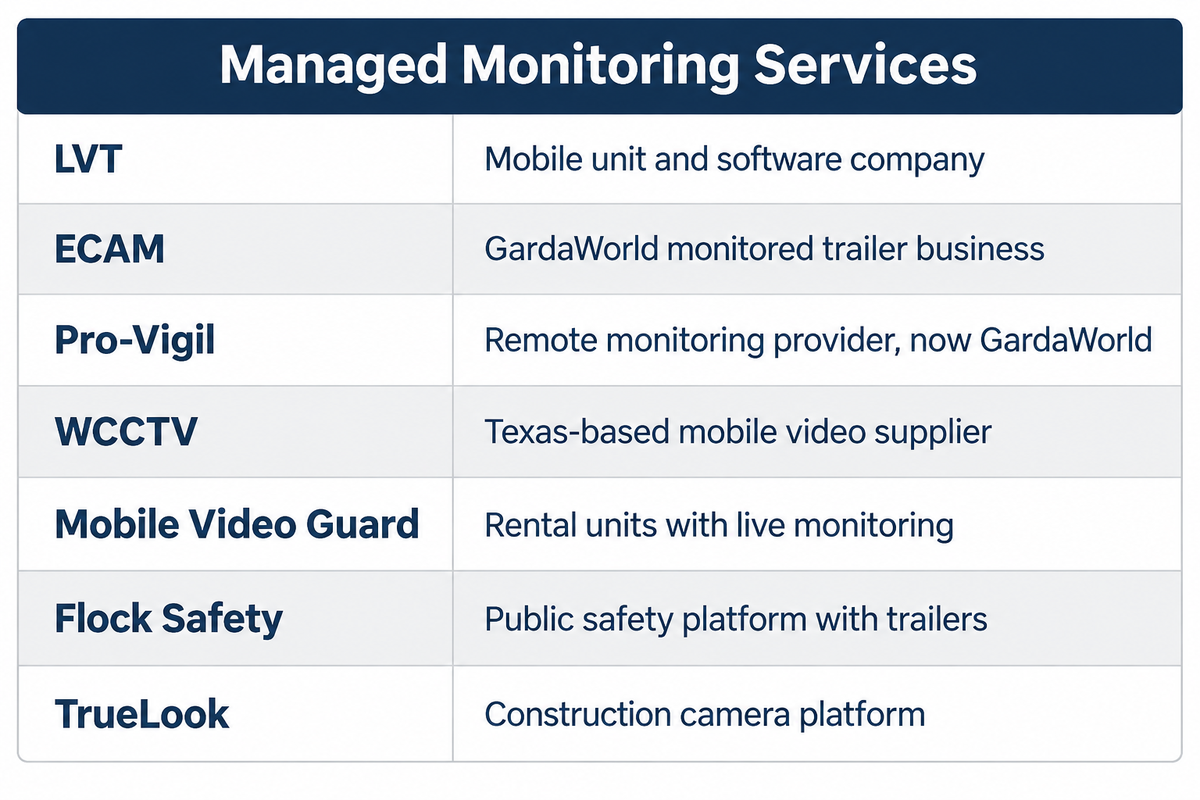
These organizations sell mobile units bundled with software, connectivity or remote monitoring, usually on a monthly or annual contract. They usually suit remote surveillance at temporary or remote locations where nobody on site can watch live video, and they publish far fewer hardware figures. Their monitoring capabilities run from AI analytics with real-time alerts to staffed operators, so comparing these security services on hardware alone misses what the contract covers.
6. LiveView Technologies (LVT): Best for retail parking lots wanting a subscription camera unit
Headquarters: American Fork, Utah · Founded: 2005 · Type: Privately held mobile surveillance hardware and software company
Official website: lvt.com
Main products: LVT mobile surveillance units with D3 and Essentials head units, LVT Platform cloud video management system
Key specifications: 22 ft deployed tower height; solar panels and battery backups, with smart generators where sunlight is short
Certifications / notable work: LVT states its platform has a SOC 2 Type II audit
LVT began with construction-site cameras, turned to Utah DOT road-condition cameras after the 2008 downturn, and moved into a 110,000-square-foot manufacturing facility in Springville in 2024. Its entry Site Awareness Focused unit (one camera, strobe only, no speaker or automatic alerts, 14 days of storage) is listed at $12,000 per year paid up front, as a limited offer for pre-qualified accounts on refurbished units only. LVT says retailers deploy its units to guard parking lots and deter shoplifting. LVT trailers ship with cameras supplied by LVT, so a buyer can’t reuse an existing camera fleet; the entry package uses an Axis P3747-PLVE.
7. ECAM: Best for sites wanting monitored trailers from a GardaWorld business
Headquarters: Dallas, Texas · Founded: 2025 (merger) · Type: Operating business within GardaWorld, formed from ECAMSECURE and Stealth Monitoring
Official website: ecam.com
Main products: Mobile surveillance units, AI-driven detection and remote video monitoring
Key specifications: Four models (Pro Solar +, Pro Solar, Standard, Mini) with PTZ, thermal, multisensor and LPR camera options
Certifications / notable work: UL-listed, TMA Five Diamond Certified monitoring centers
GardaWorld acquired Stealth Monitoring in 2024 and merged it with ECAMSECURE in 2025 to form ECAM, which reports 1,600+ units deployed across North America and 140+ field technicians. Deployment is guaranteed in 5 days or less. MT Builders, running up to 18 active jobsites, reports saving at least $3,000 per month on security costs. ECAM’s offer is built on rental and service terms, so budget it as a recurring cost, and each model has to be quoted because the product page gives no unit price, mast height or battery capacity.
8. Pro-Vigil: Best for construction sites wanting trailers with live virtual guards
Headquarters: San Antonio, Texas · Founded: 2006 · Type: Remote video monitoring provider acquired by GardaWorld (announced August 20, 2026)
Official website: pro-vigil.com
Main products: Monitored mobile and fixed video surveillance
Key specifications: Self-contained units with cameras, solar panels, battery storage and 4G LTE or 5G cellular connection
Certifications / notable work: Monitoring center holds UL Certification and TMA Five Diamond designation; SOC 2 Type II examination completed
Pro-Vigil says its trailers are designed and built in-house and deploys them as a monitored service. For one mobile customer it reports processing 2.7 million motion alerts and preventing 517 crimes since 2024, and homebuilder D.R. Horton has placed units in its most theft-prone communities. Pro-Vigil now sits under the same parent as ECAM, so the two aren’t independent bids. Its pages give no price, mast height, battery capacity or solar wattage.
9. WCCTV: Best for temporary jobsites needing monitored rentals with an option to buy
Headquarters: Richardson, Texas · Founded: 2001 · Type: Manufacturer and supplier of mobile video surveillance
Official website: wcctv.com
Main products: Solar surveillance trailers, rapid deployment video surveillance, pole cameras, LPR solutions, live monitoring and software
Key specifications: Trailers standing up to 20 ft with PTZ night vision cameras; up to 10 days without sunlight; IR PTZ range up to about 650 ft
Certifications / notable work: NDAA-compliant products; UL-listed, 5 Diamond Certified operations center
WCCTV says it designs and builds its own systems and offers them for rent or purchase with live monitoring. WCCTV deployed 6 solar surveillance trailers for Swinerton on the LAX Airport Auxiliary Curbs project, and basic trailers can be running within 20 minutes. WCCTV states up to 10 days of battery autonomy without sunlight, but its trailers stand up to 20 ft, below the taller masts elsewhere in this list, so a large site may need more units, and prices are by quote.
10. Mobile Video Guard: Best for contractors wanting guard-monitored camera units rented as one service
Headquarters: Maryland · Founded: 2016 · Type: Remote video surveillance service provider; SMART Security Pros is its parent company
Official website: mobilevideoguard.com
Main products: Mobile Video Guard trailers and pole/wall mounted units, delivered with live monitoring
Key specifications: Four camera views per unit, optional 360-degree surveillance from heights of 20 feet, off-grid solar units
Certifications / notable work: licensed in MD, DC and VA
Mobile Video Guard designed its own trailers, and its rental model covers the trailer and the watching as one service. Staff with law enforcement experience monitor feeds live from 6 p.m. to 6 a.m. daily, with optional 24-hour weekend and holiday coverage, and its technical team can install an operational system within 24 hours of contact. Homepage client logos include Whiting-Turner and Gilbane. Daytime coverage sits outside the standard schedule, and no purchase option or named trailer model is published.
11. Flock Safety: Best for police and property teams already using Flock license plate readers
Headquarters: Atlanta, Georgia · Founded: 2017 · Type: Public safety technology company combining hardware, software and machine learning
Official website: flocksafety.com
Main products: Mobile security trailers with license plate reader cameras, video cameras and audio detection
Key specifications: Mobile Security Trailer: two PTZ cameras and one panoramic camera for 360-degree coverage
Certifications / notable work: Mobile Trailers launched in 2024; AmCap is a named customer
Flock Safety added Mobile Trailers to its platform in 2024, so a department already running Flock license plate readers can add a trailer to the same system. Guardian Mode points the PTZ camera at a person or vehicle without an operator. The trailer is sold by subscription with no list price, and mast height, solar wattage and battery capacity aren’t listed.
12. TrueLook: Best for construction teams wanting trailers on a jobsite camera platform
Headquarters: Winston-Salem, North Carolina · Founded: 1995 (as Perceptual Robotics) · Type: Construction camera and jobsite visibility company (founded as Perceptual Robotics, Inc.)
Official website: truelook.com
Main products: Construction cameras, Mobile Surveillance Trailer, TrueShield and TrueDeter security units, TrueAI platform
Key specifications: Mast up to 30 ft, solar panels with battery backup, built-in cellular, optional generator hookup
Certifications / notable work: SOC 2 Type 2; cameras stated NDAA compliant
TrueLook fits construction teams that want progress cameras and security on one platform. Its new trailer, listed as coming December 2026, has 3 panels totalling 1,005 W, a 20 ft manual-winch mast and about 10,560 Wh of gel batteries. Quotes pair the hardware with a subscription plan, and entry software plans start around $129 a month.
Trailer and Equipment Manufacturers (Companies 13–17)
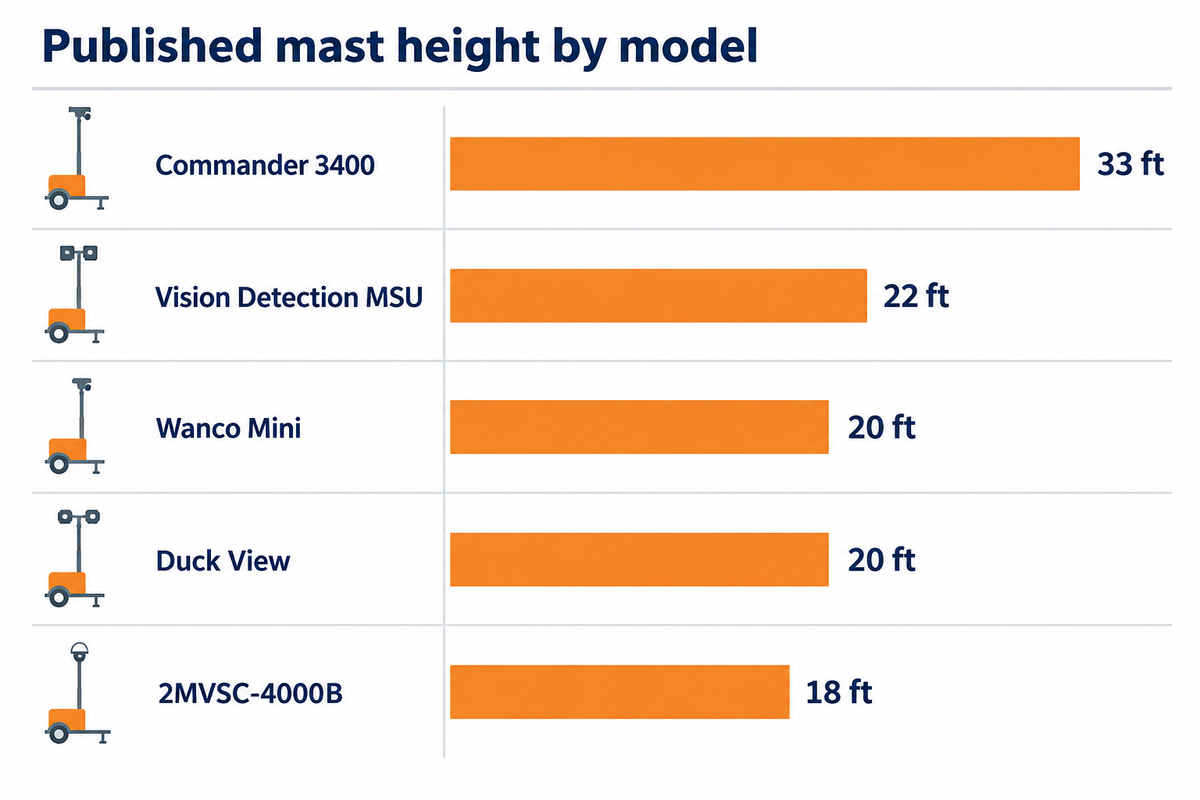
These builders supply trailer platforms to fleets, agencies and security integrators, and some also sell road or towable light tower equipment. Their spec sheets tend to be the most complete in this list. Wanco and Mobile Pro Systems sell integration-ready platforms, so an integrator can fit its own surveillance systems, and fleet buyers ordering several trailer units can compare these trailer solutions model by model.
13. Wanco: Best for fleet buyers wanting preconfigured or integrator-ready solar trailers
Headquarters: Arvada, Colorado · Founded: 1984 · Type: family owned and operated manufacturer with over 300 full-time employees
Official website: wanco.com
Main products: surveillance trailers, variable message signs, arrow boards, light towers, generators
Key specifications: Mini Solar Surveillance System: 20-foot telescoping tower, 800-watt solar, 400 Ah battery, two PTZ cameras, 4 TB storage, two-year cellular plan
Certifications / notable work: ISO 9001:2015
Wanco builds equipment for road and fleet work, and one person can deploy its Mini Solar Surveillance System in less than 10 minutes. Integrators can choose the Solar Integrator Trailer, a 24-foot tower platform for installing their own gear. Its production facilities cover more than 340,000 square feet. Pricing is by inquiry, so the catalog gives specifications and a buyer has to request the number, and the Mini carries two PTZ cameras on a 20-foot tower, while the integrator trailer needs cameras, recording and software fitted by the buyer.
14. Mobile Pro Systems: Best for agencies needing 33-foot masts and generator-backed long deployments
Headquarters: West St. Paul, Minnesota (contact address) · Founded: Not publicly disclosed · Type: US manufacturer of mobile surveillance platforms
Official website: mobileprosystems.com
Main products: Rapid-deployment camera trailers and integration-ready mobile surveillance platforms
Key specifications: Commander 3400: 33 ft 3-section mast, 12,500 watt-hour lithium battery, 800 W solar, autonomous generator with 20-gallon fuel supply. Falcon 3100: 18 ft mast, 1200 W solar, 900 Ah AGM battery
Certifications / notable work: DOT compliant trailer specification
Mobile Pro suits agencies that need height and long deployments, because the Commander 3400 reaches 33 ft and backs its lithium battery with an autonomous generator. Trailers are built with U.S.-sourced steel. Every unit is built to order and quoted per configuration, so a price can’t be compared from the website.
15. 2M Technology: Best for oil, gas and hazardous-site operators wanting solar trailers and explosion-proof cameras from one integrator
Headquarters: Grand Prairie, Texas · Founded: Not publicly disclosed · Type: Commercial and industrial security integrator that designs and fabricates custom systems
Official website: 2mtechnology.net
Main products: Mobile solar surveillance trailers, explosion-proof surveillance cameras, license plate recognition and access control systems
Key specifications: 2MVSC-4000B: 18 ft manual double mast, 2 x 410 W solar panels, 5.76 kWh usable gel battery, 2,050 lb, 60 mph wind rating, -35 to 60 °C
Certifications / notable work: Texas Private Security License B15309; explosion-proof cameras built for ATEX, IECEx and UL compliance
2M Technology sells solar trailers and, as a separate line, explosion-proof cameras and custom housings, so one integrator can cover both; the ATEX and IECEx wording covers the camera line, so agree the trailer’s own rating in the quote for a classified location. It states usable battery capacity for the 2MVSC-4000B, a figure most rivals leave out, and sells trailers with no contracts. The 2MVSC-4000B uses gel batteries and a manual mast, so buyers wanting lithium storage or an electric mast should ask for a different build.
16. Vision Detection Systems: Best for buyers needing NDAA-documented US-built trailers with staffed monitoring
Headquarters: Pikesville, Maryland · Founded: Not publicly disclosed · Type: US manufacturer of mobile surveillance trailers with its own AI software and monitoring center
Official website: visiondetectionsystems.com
Main products: Mobile Surveillance Unit (MSU) trailer, lighting trailer, solar surveillance kit, VisionStream AI platform
Key specifications: MSU: 22 ft telescopic mast (30 ft available), 900 W bifacial solar, 11,776 Wh LiFePO4, 5MP 25x PTZ plus three 8MP turrets, up to 30 days storage
Certifications / notable work: Spec table lists NDAA 889, FCC and UL compliance
Vision Detection Systems publishes a runtime of 70+ hours at a 150 W load before solar input, the kind of figure a buyer can test. Every unit gets a 48-hour burn-in test before shipping, and a signed NDAA 889 letter with component attestation is available on request. The standard warranty is one year, and the published 48-hour dispatch covers in-stock units leaving the plant, with delivery to site on top.
17. Duck View Systems: Best for integrators and sites wanting AI trailers on monthly lease
Headquarters: Kaysville, Utah · Founded: Not publicly disclosed · Type: American manufacturer of AI-powered mobile surveillance towers
Official website: duckviewsystems.com
Main products: Self-contained, solar-powered mobile surveillance units in Mallard Tower and Canvas Back Tower configurations
Key specifications: 5 ft x 5 ft base, 20-foot mast, 4 or 6 cameras; Canvas Back adds a methanol backup generator
Certifications / notable work: Sportsman’s Warehouse is a named reference
Duck View publishes lease pricing: a four-camera solar unit with LTE and monitoring runs $1,500 to $2,300 per month, and monitoring is about $400 to $500 per tower per month. One unit covers up to 2-3 acres, depending on layout and sightlines. Delivery is quoted separately, and there’s no published outright purchase price.
Integrators and Rental Specialists (Companies 18–20)
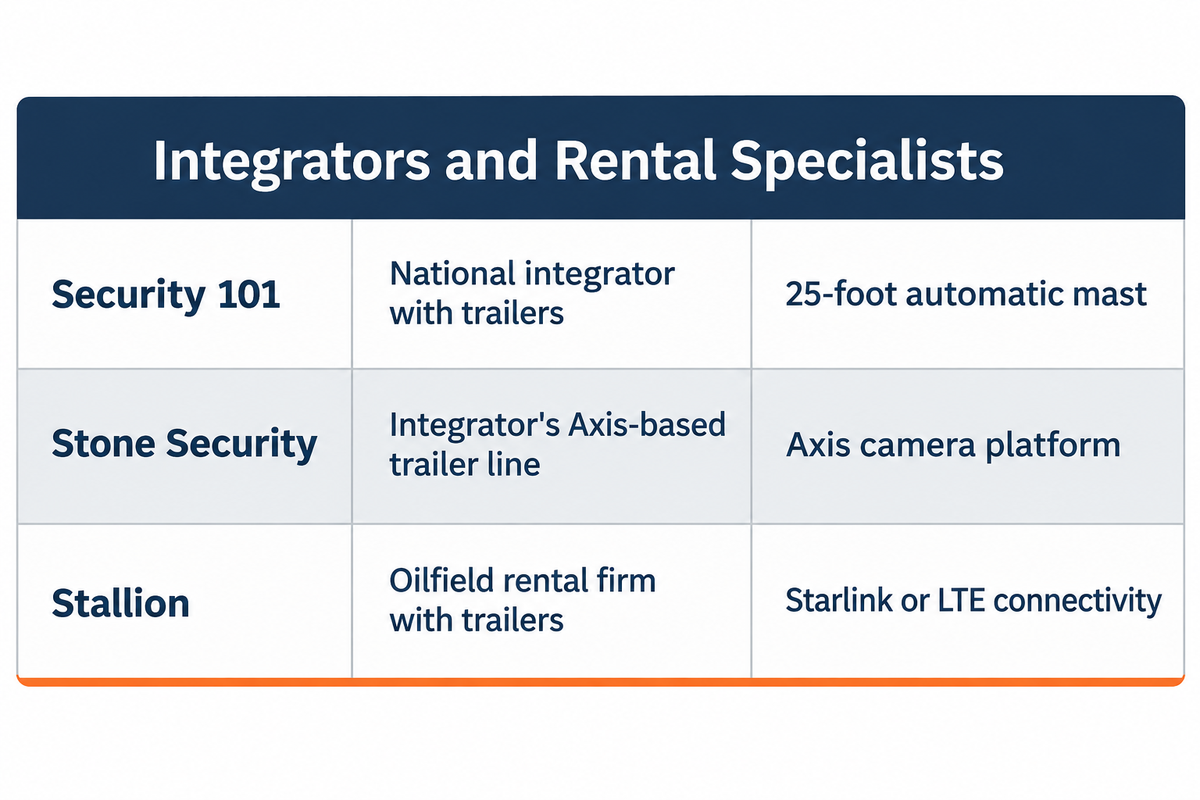
These three reach trailers through an integration or rental business, which is important if the unit has to connect to an existing video management system or if it has to be supported across multiple sites. An integrator can be the better surveillance partner if existing camera infrastructure has to stay in place.
18. Security 101: Best for enterprises needing trailers tied to any chosen camera or VMS
Headquarters: West Palm Beach, Florida · Founded: 2005 (origins in 2003) · Type: National commercial security systems integrator
Official website: security101.com
Main products: Mobile Surveillance Trailers, alongside access control, video and intrusion integration
Key specifications: 25-foot automatic mast, battery array rated for up to five days without sunlight, up to 90 days of recorded storage, five cameras as standard
Certifications / notable work: Triumph Protection Group is a named case study
Security 101 acquired Flint, Michigan integrator Eos Business Surveillance Solutions in December 2024 and gained its mobile surveillance trailer business. It keeps trailers open to the customer’s choice of camera or VMS, which suits an enterprise already standardized on a brand. Product pages carry no named trailer models or list prices, so lease and purchase are both by quote, and the battery array is rated for up to five days without sunlight, shorter than the longest figures in this list, so a shaded or winter site needs a closer power budget.
19. Stone Security: Best for buyers wanting Axis-based trailers purchased outright or leased
Headquarters: Salt Lake City, Utah · Founded: 2005 · Type: Security integrator that builds its own trailers; a BearCom company joining the StoneOne brand
Official website: mobilesecurity.net
Main products: MobileMax surveillance trailer and MobileMini compact unit
Key specifications: MobileMax: up to ten days of sunless power, back-to-back 180-degree cameras, setup in less than 10 minutes through an app
Certifications / notable work: Lists MIL-STD-810G and NEMA TS-2 compliance among its camera technology features (company statement)
BearCom announced its acquisition of Stone Security on December 20, 2024, and the trailer business became a separate entity to build a resale channel through Wesco. Trailers use the Axis camera platform and are made in the USA, so a site standardized on another camera brand is a poor fit, and customers can lease them for seasonal use or buy them outright. The skid-like MobileMini is the smaller option, and the product site lists no mast height, battery capacity, solar wattage or price, so those come from a demo or quote.
20. Stallion Infrastructure Services: Best for remote or multi-site jobsites renting LTE or Starlink trailers
Headquarters: Houston, Texas · Founded: 2004 · Type: Jobsite and oilfield equipment rental and logistics provider
Official website: stallionis.com
Main products: Solar-powered Mobile Surveillance Trailers, skid-mounted Mobile Surveillance Units, StallionVMS software
Key specifications: 18-foot mast, dual 4MP PTZ cameras, 3 x 330 W solar panels, 6 x 150 Ah batteries, Starlink or LTE connectivity
Certifications / notable work: NDAA-compliant units (company statement)
Stallion comes from oilfield equipment rental, and its product page cites 40+ branches with same-week delivery in most markets, with technician setup of a trailer in 30 minutes. At CEMEX it deployed site surveillance across more than 20 plant sites and captured 15 safety-related incidents over a 12-month period, so one unit can serve security and safety teams at once. Delivery and return are priced by location, so a remote site should get that line in writing.
The Who-Answers-the-Alert Test for Mobile Surveillance Companies
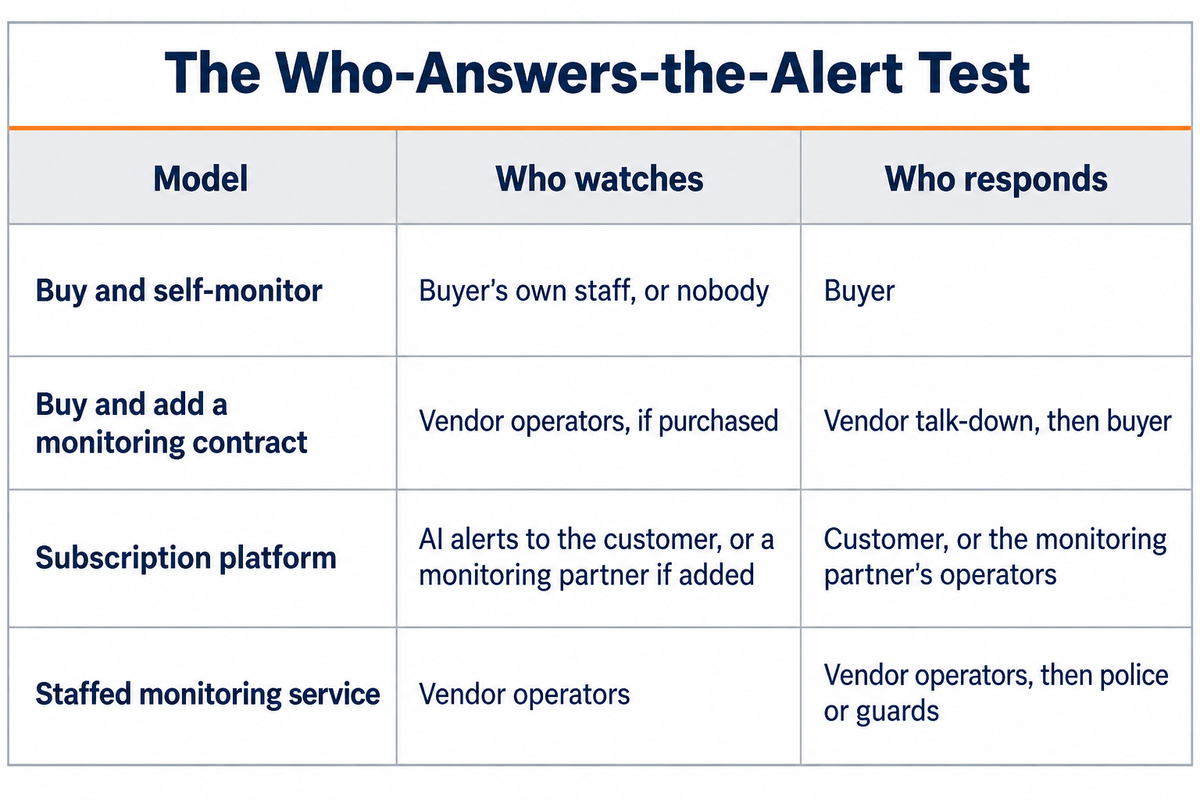
The Who-Answers-the-Alert Test sorts every company above by one question: if the camera detects a person at 2 a.m., who is responsible for acting on it? Trailers can be bought, leased or bundled with monitoring, which produces four service models with four different answers, and the monthly price only makes sense once you know which one you are buying.
| Model | Who owns the trailer | Who watches | Who responds | Examples in this list |
|---|---|---|---|---|
| Buy and self-monitor | Buyer | Buyer’s own staff, or nobody | Buyer | LFADJ, BigLux, Mobile Pro Systems |
| Buy and add a monitoring contract | Buyer | Vendor operators, if purchased | Vendor talk-down, then buyer | Backstreet Surveillance, Vision Detection Systems |
| Subscription platform | Vendor or buyer, by contract | AI alerts to the customer, or a monitoring partner if added | Customer, or the monitoring partner’s operators | LVT, Flock Safety, TrueLook |
| Staffed monitoring service | Vendor | Vendor operators | Vendor operators, then police or guards | ECAM, Pro-Vigil, Mobile Video Guard |
Run the test before comparing surveillance capabilities or prices. An AI subscription and a $36,000 purchase can both leave the alert on your own phone, and security staffing on your side is then the biggest expense in the plan. A deterrence strobe or talk-down speaker works only if a rule or person triggers it, and a trailer is a complete security solution only if someone is assigned to it, so ask each vendor to name the role that acts on a verified event and the hours that role is covered.
How to Choose a Mobile Surveillance Trailer Company
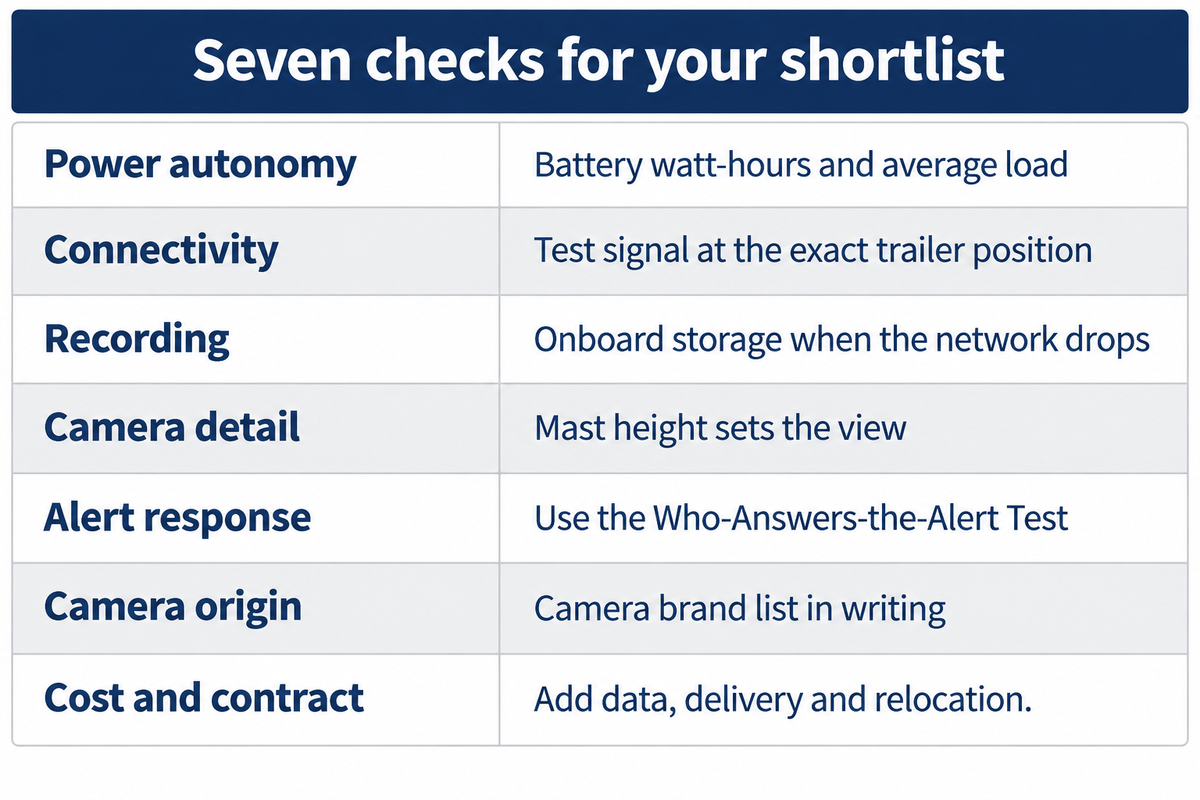
Run seven checks against your shortlist to select a mobile surveillance trailer company. In order, the checks are powering through sunless days, connectivity at the exact position, recording during outages, camera detail at distance, who responds to an alert, camera origin, and total monthly cost including data, delivery and relocation. Teams that deploy mobile surveillance trailers at several sites should do the first three checks at each position.
- Power autonomy. Solar-powered trailers still go dark with an undersized battery, so ask for battery watt-hours and the average load behind any runtime claim.
- Connectivity: Starlink is an option at Stallion, Vision Detection Systems, Sharpvue and BigLux for sites with no cellular coverage; signal elsewhere has to be tested at the exact trailer position.
- Recording: Specify onboard storage so footage continues when the network drops, and size it with our video storage planning calculator.
- Camera detail. Camera count says little by itself; a 25x PTZ security camera and a wide turret do different jobs. Mast height sets the view, and integrators fitting their own mast can start from our list of telescopic mast manufacturers.
- Alert response: Establish who receives and responds to an alert, using the Who-Answers-the-Alert Test above.
- Camera origin. Government and critical-infrastructure buyers need the camera brand list in writing.
- Cost and contract. Add data, delivery and relocation to the monthly total, and put certification claims, warranty length and spare parts in the contract, with certificates for anything marked as certified.
What Keeps a Solar Surveillance Trailer Running at Night?
A solar-powered mobile surveillance trailer runs at night on the battery its solar panels charged during the day. Runtime equals usable battery energy divided by average load: the S973’s 5.12 kWh is nominal energy, so usable energy has to be stated in the quotation before any runtime is calculated, and at the 2.5 kWh used for illustration on LFADJ’s product page, a 100 W average load gives 25 hours, which isn’t an S973 rating.
Published figures can be tested with the same division. Vision Detection Systems lists 11,776 Wh and 70+ hours at 150 W, and 11,776 divided by 150 is 78.5 hours before losses, so that claim is consistent. Sharpvue lists 10,240 Wh and 8-10 days; dividing the battery by that runtime gives an upper-bound average load of about 43 to 53 W before losses, so ask what the cameras are doing at that power level. Our surveillance trailer energy budget worksheet does this arithmetic for your own load. Where solar power falls short because the site is shaded or winter days are short, a generator or a generator-and-battery setup like those on hybrid light towers is the usual answer, and Wanco, Mobile Pro Systems and BigLux all list generator options or backup.
Which Cameras Can US Government Buyers Accept?
FAR 52.204-25 bars covered telecommunications equipment from Huawei and ZTE, which can include a trailer’s cellular hardware, and, for public safety, government facility security, critical infrastructure surveillance and other national security purposes, video surveillance and telecommunications equipment from Hytera, Hikvision and Dahua. The clause applies that rule to federal contracting under Section 889 of the 2019 defense authorization act, and the rule extends to subsidiaries and affiliates.
The FCC Covered List has named Hytera, Hikvision and Dahua since March 12, 2021. Backstreet (on its Sentry-Pro page), Sharpvue, WCCTV, TrueLook (for its cameras), Vision Detection Systems and Stallion state NDAA compliance, and Vision Detection Systems offers a signed letter. Anyone importing a trailer should fix the camera brand in the purchase contract. Enclosure ratings follow IEC 60529, and ONVIF Profile S and T conformance helps a third-party video management system read the cameras.
How Much Does a Mobile Surveillance Trailer Cost?
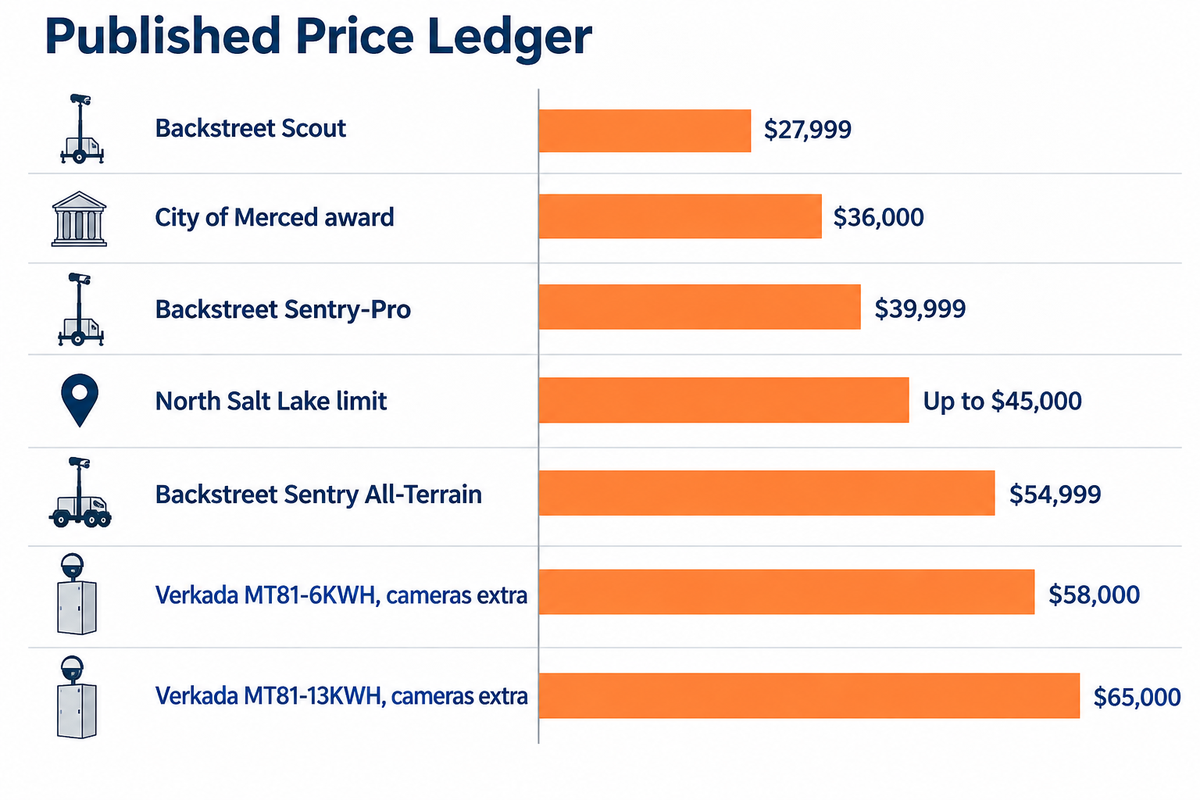
A mobile surveillance trailer costs about $28,000 to $65,000 to buy new at the list and award prices below (the top figure excludes cameras), and roughly $1,000 to $3,500 per month to rent on the market range published by TrueLook, a trailer seller on this list. Purchase prices rise with battery size, mast type and whether cameras are included, and rental rates rise with live monitoring.
The Published Price Ledger only keeps figures with a named seller or buyer and a date, because most online ranges don’t carry either.
| Source | Item | Price | Date | Note |
|---|---|---|---|---|
| Backstreet Surveillance | Scout trailer | $27,999 (regular $34,209) | Read November 2026 | Factory pickup |
| Backstreet Surveillance | Sentry-Pro trailer | $39,999 (regular $43,999) | Read November 2026 | Up to 6 cameras |
| Backstreet Surveillance | Sentry All-Terrain | $54,999 (regular $62,999) | Read November 2026 | Not applicable |
| City of Merced, California | One solar surveillance camera trailer | $36,000 | June 16, 2025 | Bid awarded to MID Valley Protection |
| City of North Salt Lake, Utah | Four-camera mobile surveillance trailer | Up to $45,000 | May 20, 2025 | Council-approved limit, per Citizen Portal summary |
| Verkada | MT81-6KWH / MT81-13KWH | $58,000 / $65,000 MSRP | Read November 2026 | Trailer hardware only; license extra |
| LVT | Site Awareness Focused unit | $12,000 per year | Read November 2026 | Refurbished, pre-qualified accounts |
| Duck View Systems | Four-camera unit with LTE and monitoring | $1,500 to $2,300 per month | Read November 2026 | Delivery extra |
The Merced city council item is a public award, and the North Salt Lake figure comes from a Citizen Portal summary of the council meeting. TrueLook’s March 2026 cost guide puts the market at $1,000 to $3,500 a month to rent and $15,000 to $50,000 to buy, with delivery often $300 to $800 each way and managed monitoring adding $300 to $600 a month. A true total cost of ownership also counts data, relocation and battery replacement, and our two-option project cost comparison tool takes two quotes and compares them over the same number of months.
Should You Rent a Monitored Trailer or Buy One?
Renting wins on short projects and buying wins on long ones, provided someone can answer alerts; on the example below the crossover is about 18 months of coverage. In North Salt Lake the police chief cited leasing costs of $24,000 to $38,000 per year against a purchase limit of $45,000, so on those costs a purchase would equal approximately 14 to 23 months of lease payments.
Here’s the calculation with monitoring included. Take a $36,000 trailer and a $2,500 monthly lease, which sits inside that yearly range. If the owner still pays $450 a month for monitoring (the midpoint of Duck View’s $400 to $500), buying saves $2,050 a month and pays back in about 18 months. Data plans, repairs and resale value move that figure, so put your own quotes through the same three numbers.
Frequently Asked Questions about Mobile Surveillance Trailer Companies
Which mobile surveillance trailer companies are the best?
For ownership, compare Backstreet Surveillance and Sharpvue, or LFADJ if you want one configured unit as hardware; for a managed service, start with LVT, ECAM and WCCTV.
Choose from the first group if you have staff to answer alerts and from the second if you want a vendor watching the cameras. Backstreet prints its list prices, which makes it the quickest of the six to budget against.
Who makes mobile surveillance trailers in the USA?
US builders in this list include Wanco, Backstreet Surveillance, Sharpvue, Vision Detection Systems, Mobile Pro Systems and LVT.
Service companies also deploy units under their own names, and Pro-Vigil says it builds its trailers in-house. Integrators Security 101 and Stone Security run their own trailer lines too, and 2M Technology sells its own trailer models.
Do mobile surveillance trailers work without Wi-Fi?
Yes, most send video over 4G LTE or 5G cellular networks, and some add Starlink.
Pro-Vigil states cellular transmission without Wi-Fi or wired internet, and Stallion offers Starlink or LTE. Starlink suits sites with no cellular coverage. Specify onboard recording as well, because a lost connection interrupts remote access and alerts sent over that connection.
Are mobile surveillance trailers watched by a person?
Only some are: ECAM, Pro-Vigil, Mobile Video Guard and WCCTV sell staffed monitoring, while most hardware buyers arrange their own.
Backstreet offers live monitoring as an option at under $1 per hour.
Is a surveillance trailer cheaper than a security guard?
Usually, for overnight coverage, because a rental runs about $1,000 to $3,500 a month in TrueLook’s March 2026 market range.
About $9,100 a month is the guard cost at an example rate of $25 an hour for 84 hours a week and 4.33 weeks a month. The trailer figure excludes anyone attending the site, so add the cost of dispatch if a person has to respond.
What is the difference between a trailer manufacturer and a managed service?
A manufacturer sells the trailer; a managed service provides monitoring and connectivity, whether the trailer is rented or owned.
Several companies here do both, so ask which contract you’re signing.
Choosing Your Shortlist

Begin with the business model, then do the Who-Answers-the-Alert Test, and then compare the Published Price Ledger to your own quotes. If you wish to own a solar-powered surveillance trailer, review the S973 configuration and contact our team with your site plan, camera views and the deployment length and destination, and we’ll quote it based on your requirements.
About This Comparison
Company facts, mobile surveillance trailer specifications and prices come from each company’s own pages, trade press and public purchase records read in November 2026. The runtime and rent-versus-buy figures are our own arithmetic on those numbers, and our S973 example goes through the same kind of division using the usable energy LFADJ illustrates on its product page.
References & Sources
- FAR 52.204-25, Prohibition on Contracting for Certain Telecommunications and Video Surveillance Services or Equipment
- Federal Communications Commission, Covered List
- Federal Register, Prohibiting Importation and Marketing of Previously Authorized Covered Communications Equipment
- City of Merced, File 25-562, solar surveillance camera trailer award
- Citizen Portal, North Salt Lake council summary, May 20, 2025
- IEC 60529:1989+AMD1:1999+AMD2:2013, degrees of protection provided by enclosures
- ONVIF Profiles
- SDM Magazine, What’s the Buzz About Security Trailers?, January 26, 2026