Get in touch with LFADJ Company
Construction Light Tower for Night Work and Road Projects
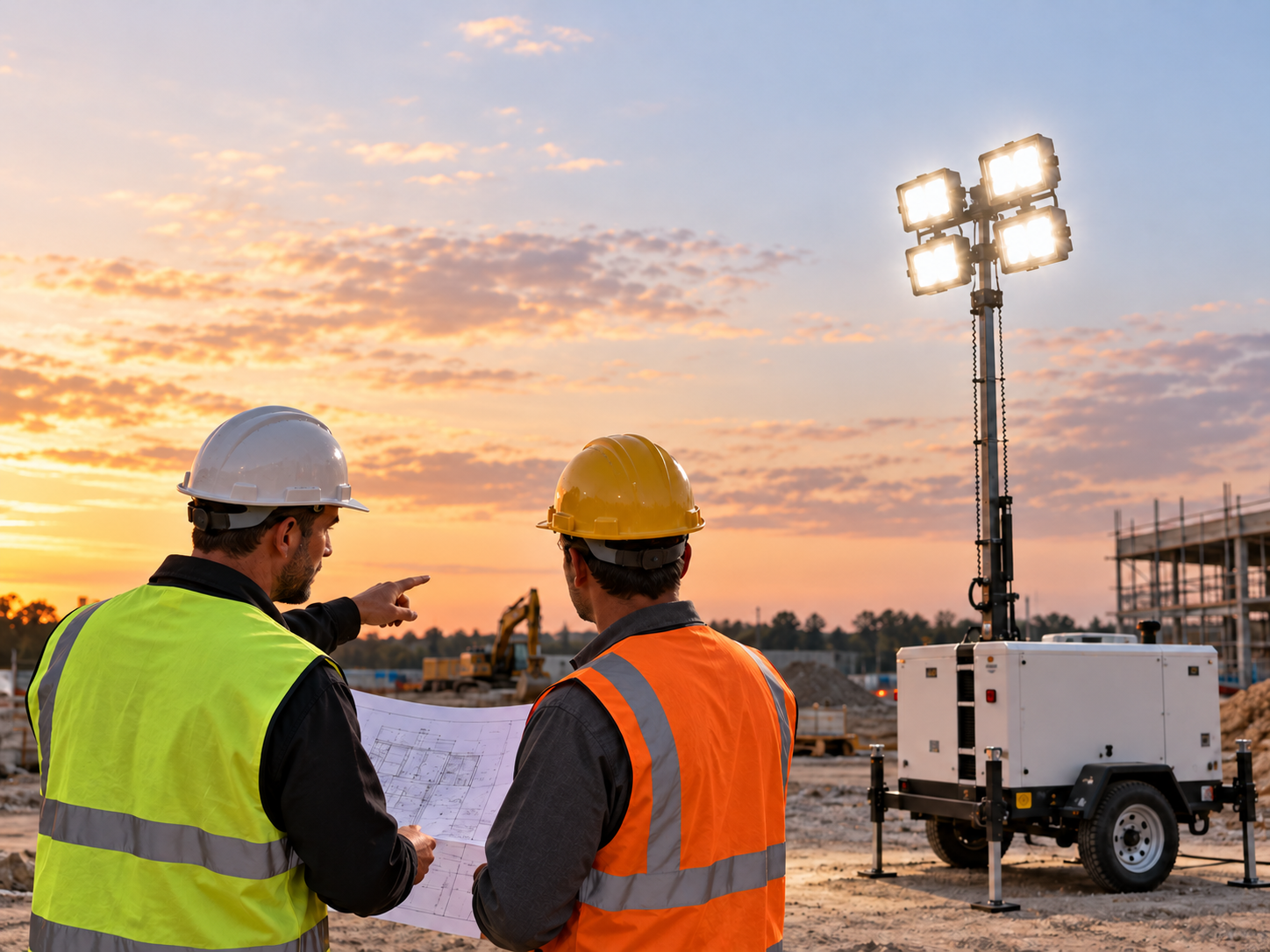
Choose a construction light tower around the work your crew needs to see. LFADJ supplies D955 portable construction light towers with 7 m or 9 m hydraulic masts, four LED heads and diesel generator power for outdoor construction and roadwork.
- Compare 4 × 300 W and 4 × 400 W LED lighting packages.
- Plan for the operating footprint, traffic, power, and shift pattern.
- Send your site layout, quantity and destination for a project quote.
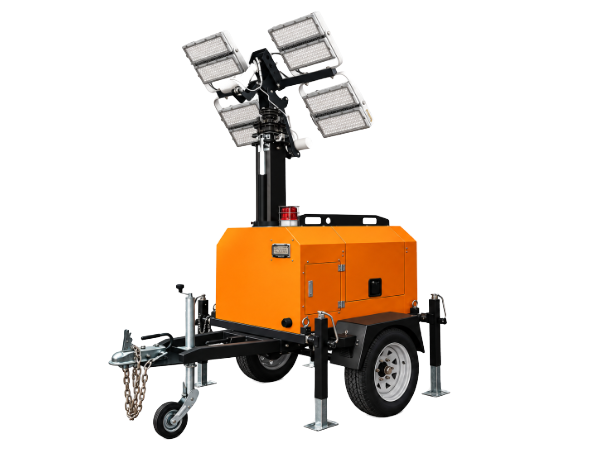
D955 at a Glance
Use these LFADJ specifications to compile a shortlist for your engineering assessment.
Mast height
7 m or 9 m hydraulic mast; 340° rotation.LED lamp packages
Four 300 W heads or four 400 W heads.Generator and engine
2.4 kW generator; Kubota Z482 engine; 120 V, 60 Hz specification.D955 LED Light Tower Configurations
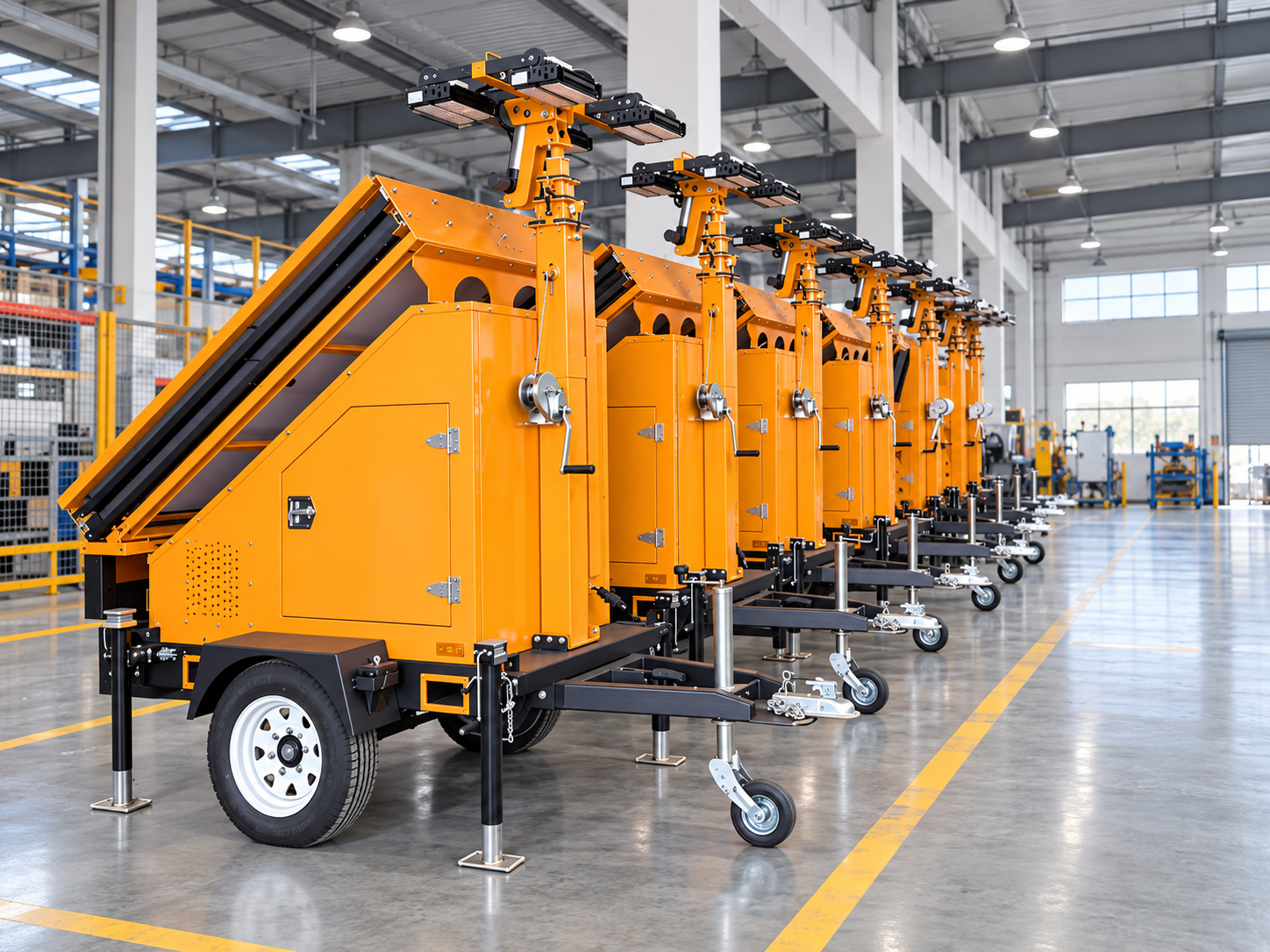
Our D955 range gives the buyer two defined height and lamp combinations. The 7 m package has a lower transport height; the 9 m package adds mounting height and higher rated lamp input, with the same listed working footprint.
7 m · Four 300 W LED heads
This D955 package includes a hydraulic mast and a 1.2 kW lamp input. Its transport height of 2,350 mm should be evaluated in relation to access and loading.
9 m · Four 400 W LED heads
Our taller D955 combines a 9 m hydraulic mast with 1.6 kW of combined rated lamp input. Allow for its 2,650 mm transport height and review overhead obstructions along the deployment route.
D955 specification comparison
| Specification | 7 m package | 9 m package |
|---|---|---|
| Model designation | D955 | D955 |
| Mast height | 7 m / approx. 23 ft | 9 m / approx. 29.5 ft |
| Lamp arrangement | 4 × 300 W LED | 4 × 400 W LED |
| Combined rated lamp input | 1.2 kW | 1.6 kW |
| Mast operation | Hydraulic | Hydraulic |
| Rotation | 340° | 340° |
| Generator rating | 2.4 kW | 2.4 kW |
| Electrical specification | 120 V / 60 Hz | 120 V / 60 Hz |
| Engine | Kubota Z482 | Kubota Z482 |
| Transport dimensions, L × W × H | 1,650 × 1,450 × 2,350 mm | 1,650 × 1,450 × 2,650 mm |
| Working dimensions, L × W × H | 2,650 × 2,450 × 7,200 mm | 2,650 × 2,450 × 9,000 mm |
| Dry weight / wet weight | 1,050 / 1,150 kg | 1,050 / 1,150 kg |
Check the trade-off between added mounting height and the transport envelope before selecting the package. A taller mast can change shadows and glare; the usable result also depends on aiming, beam distribution, obstacles and the required illuminance at the work surface.
Both of these specs use the D955 model. Be sure to specify the mast height and lamp wattage on the purchase order so that the model name, which leaves the configuration open, is not the only information provided.
Open the D955 configuration comparison to review lamp input and listed unit weight for your quantity.Portable Construction Lighting for Changing Work Areas
Temporary site lighting has to follow the job site as work progresses. A tower placed for excavation may need to be relocated when formwork, stockpiles or parked machines obstruct the light path.
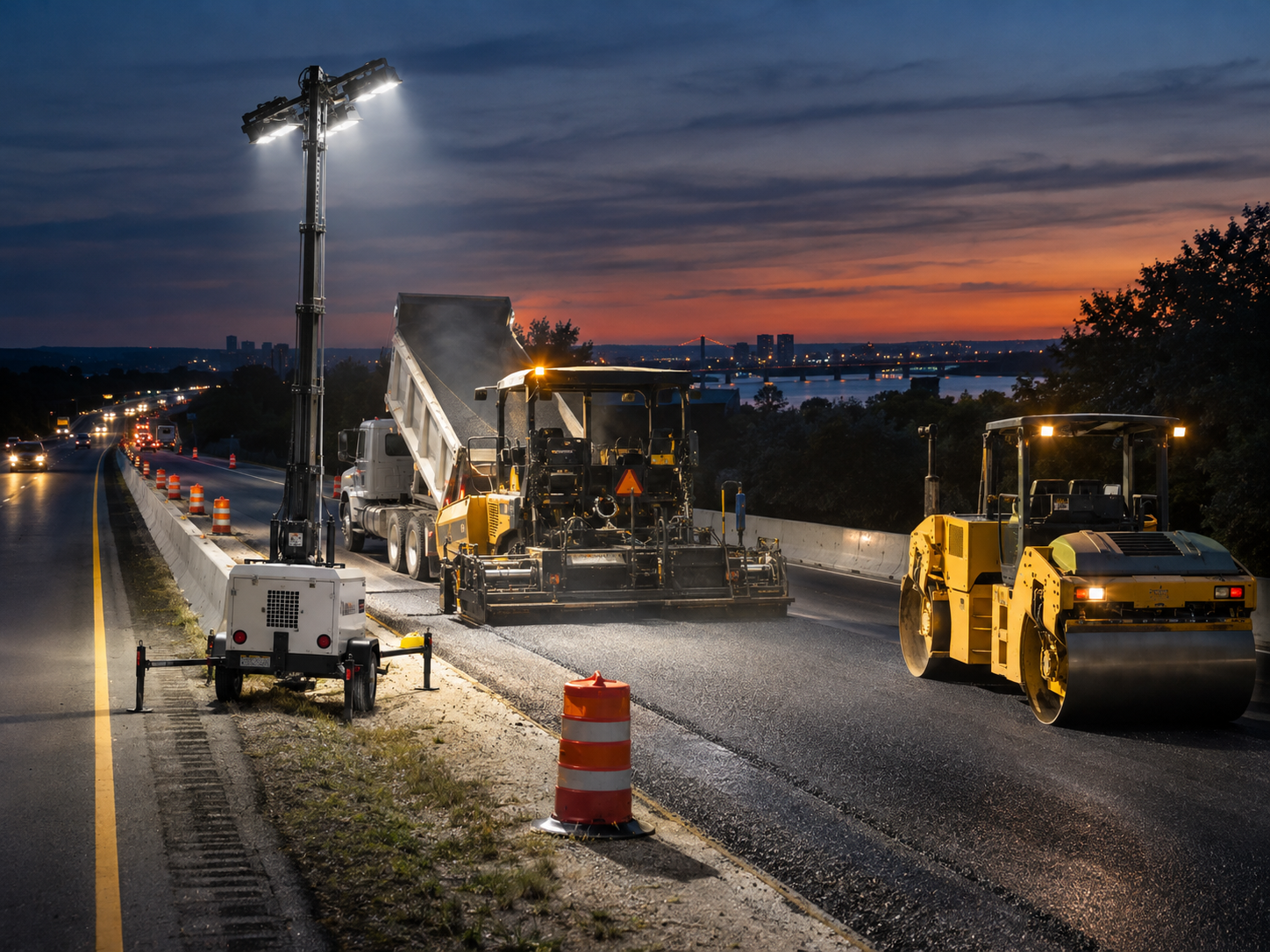
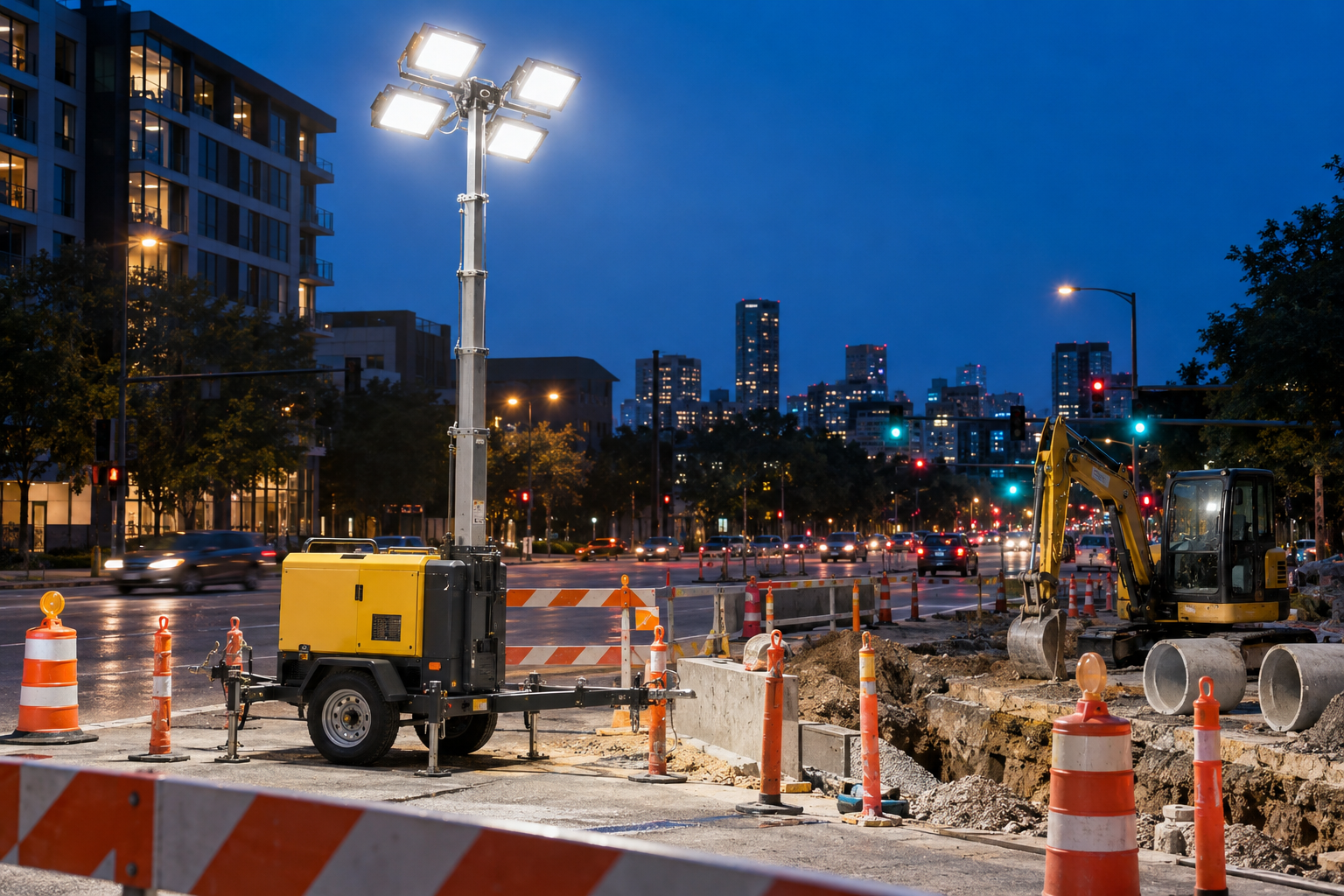
Roadwork and paving
A roadwork light tower must serve the crew without shining in the eyes of oncoming drivers. When selecting the position of the tower, take into account the approach of traffic, the work front and relocation points.
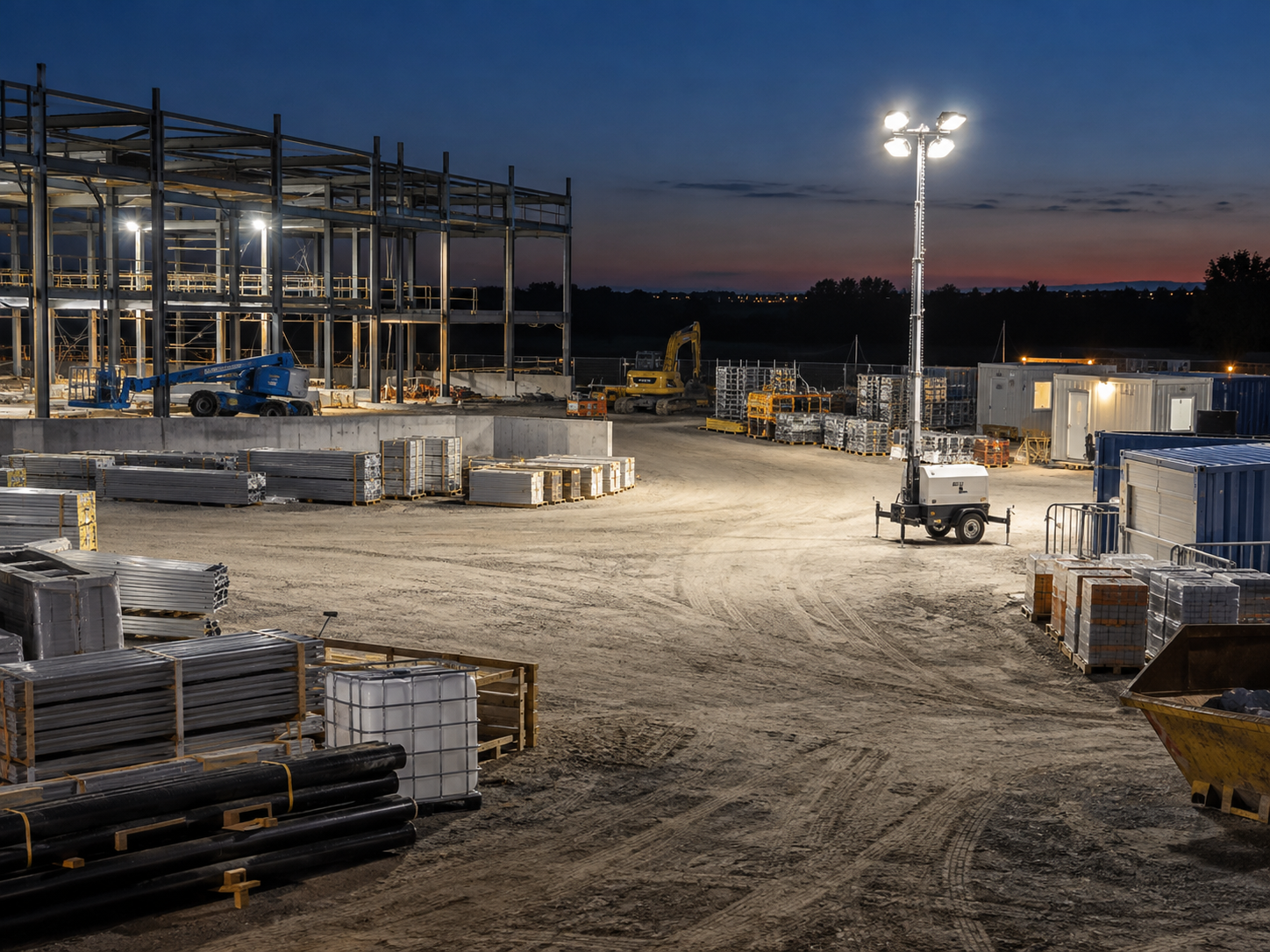
Construction compounds
Keep active work areas clear of access and loading routes, and storage. Positioning one central light can cause shadows on the work area behind obstructions.
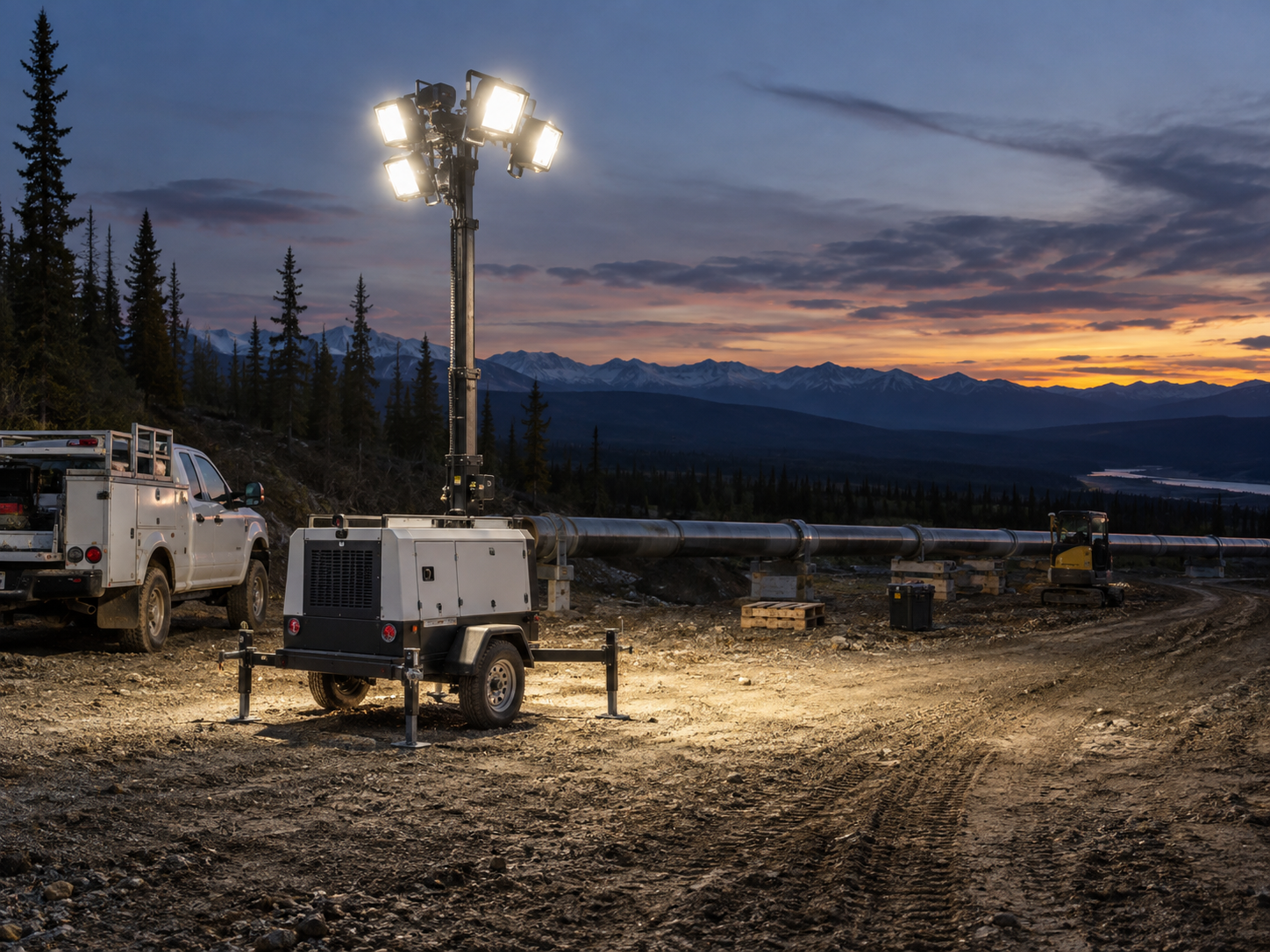
Remote outdoor work
Where a fixed supply is unavailable, a self-contained lighting arrangement powered by diesel can be used. Fuel access, engine servicing and a clear route for relocating the trailer have to be considered in the site plan.
For a municipal road project, lighting and traffic control need a shared layout. FHWA’s nighttime work zone safety guidance includes lighting practices within the bigger framework of a work zone approach; a tower alone does not replace the plan.
- Night concrete work: mark the pour, truck path and washout area separately.
- Industrial maintenance: identify the actual inspection surface and access route.
- Emergency work: confirm the operating environment before selecting ordinary or hazardous area equipment.
Lighting and Power Options Matched to the Task
A rugged portable lighting solution requires the right power source and fixture arrangement. Using the task, available supply and permitted engine location, reduce options, then compare the tower’s headline wattage.
These lighting solutions satisfy different constraints. A compact hand-carried light might work for a close task, and an elevated light tower might work for a larger outdoor work zone; neither removes the need to check illumination where the work takes place.
Temporary lighting choices for the site
Lighting type
Useful starting point
Check before selection
D955 diesel LED light tower
Outdoor work needing elevated lighting without a fixed supply
Trailer access, exhaust location, ground conditions and engine service
Externally powered flood lights
A work area with a suitable existing supply
Distribution, protection, power cord routing and secure mounting
Temporary string light system
Distributed access lighting through a structure
Required illumination, bulb or lamp protection, cage where applicable, and cord support
Rechargeable work light
A small workspace or close inspection task
Runtime at the chosen output and a charging plan
Light Placement and Site Conditions
coverage is a task-level result. A lumen figure describes light; work crew members need useful illuminance and uniformity over the surface being worked without shadow or glare. Extra height is not a substitute for checking the actual task lighting.
Task accuracy and work area
Drawing, work-plane height and required minimum illuminance
Review a lighting layout and measure at the task; do not size by square metres alone
Traffic, neighbours and sightlines
Direction of approach, occupied boundaries and obstructions
Plan aiming and positions to manage glare and light spill
Space at the tower base
Clear length and width, support surface and edge conditions
Start with the 2.65 × 2.45 m working envelope, then add the required clearances and exclusion area
Overhead space and weather
Cables, structures and wind exposure at full mast height
Apply the supplied operating instructions and site restrictions before raising the mast
Power for tools while lighting
Tool running loads, starting loads, sockets and protection arrangement
Confirm the permitted simultaneous load; 2.4 kW is the generator rating, not spare tool capacity
Advancing work front
Moves per shift, route and people needed for each move
Include lowering, moving, levelling and checking light placement in the shift plan
Inspection Checklist
The FHWA nighttime inspection checklist separates three task-accuracy levels from measurements of uniformity and checks of spacing, mounting, and aiming. That distinction is important because a high average can conceal a poorly lit edge or a shadow at the actual task.
Configuration Inputs
Give us the work area, the task to be done, and the restrictions. Our discussion on configuration starts with those inputs and checks the mast, lamp package and power arrangement with respect to the job.
LFADJ Application Support
Check the listed working footprint against your available space. This is an envelope check; it does not approve ground stability, wind limits or electrical clearance.
Project Pricing and Lead Time
We quote the D955 against your selected mast height, lamp package, quantity and destination. Our stated lead time is 45–60 days; the quotation must identify the starting event and agreed dispatch or delivery milestone so your schedule uses the correct date.
Equipment and delivery
Add freight, destination charges, and site handling to your own cost sheet, and compare the same supplied package and packing basis and delivery terms.
Operating inputs
Use the operating hours planned, your fuel price and a confirmed fuel consumption basis. Ownership gives you availability, and you budget for maintenance, storage and service for the period you own the equipment.
Movement and labour
Count crew time spent repositioning the equipment as the work front moves in your cost analysis along with the purchase price, when two alternatives require different deployment arrangements.
Illustrative relocation labour comparison
For planning, assume two people, two moves per shift and 20 shifts. At 15 minutes per move, the job uses 20 crew-hours; at 30 minutes per move, it uses 40 crew-hours.
The 20 crew-hour difference shows why access and repositioning the equipment should be included in the purchase price analysis. It is a comparison of assumptions and not a promised saving, a guaranteed improvement in productivity, or a measured setup time for either D955.
Calculate relocation labour with your own inputs and attach the result to your project brief.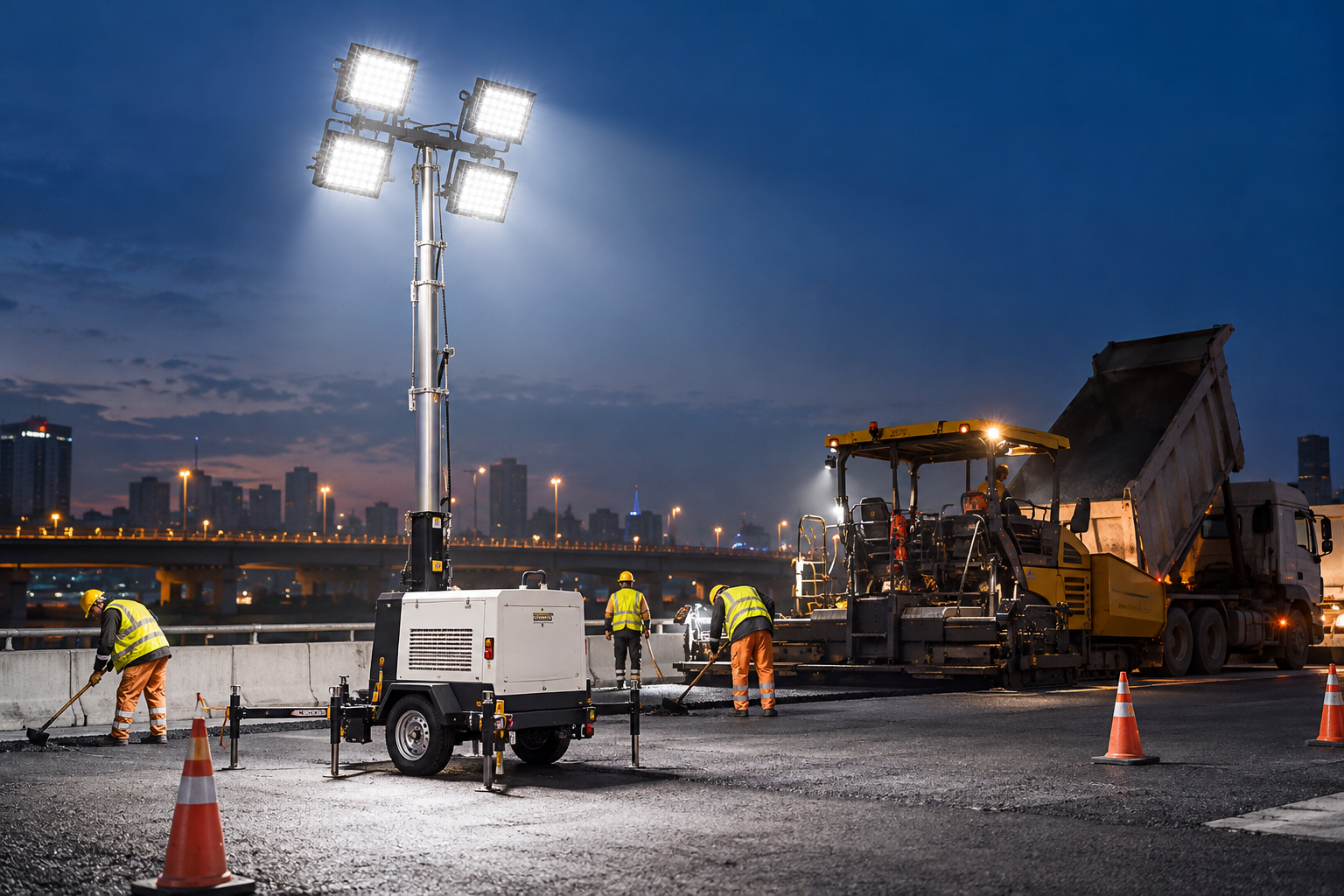
Buyer-input labour model, not a D955 time trial
| Input or result | Scenario A | Scenario B |
|---|---|---|
| People × moves × shifts | 2 × 2 × 20 | 2 × 2 × 20 |
| Minutes per move | 15 | 30 |
| Crew-hours: people × moves × shifts × minutes ÷ 60 | 20 | 40 |
| Labour cost | 20 × your hourly labour rate | 40 × your hourly labour rate |
Project Documents and Technical Support
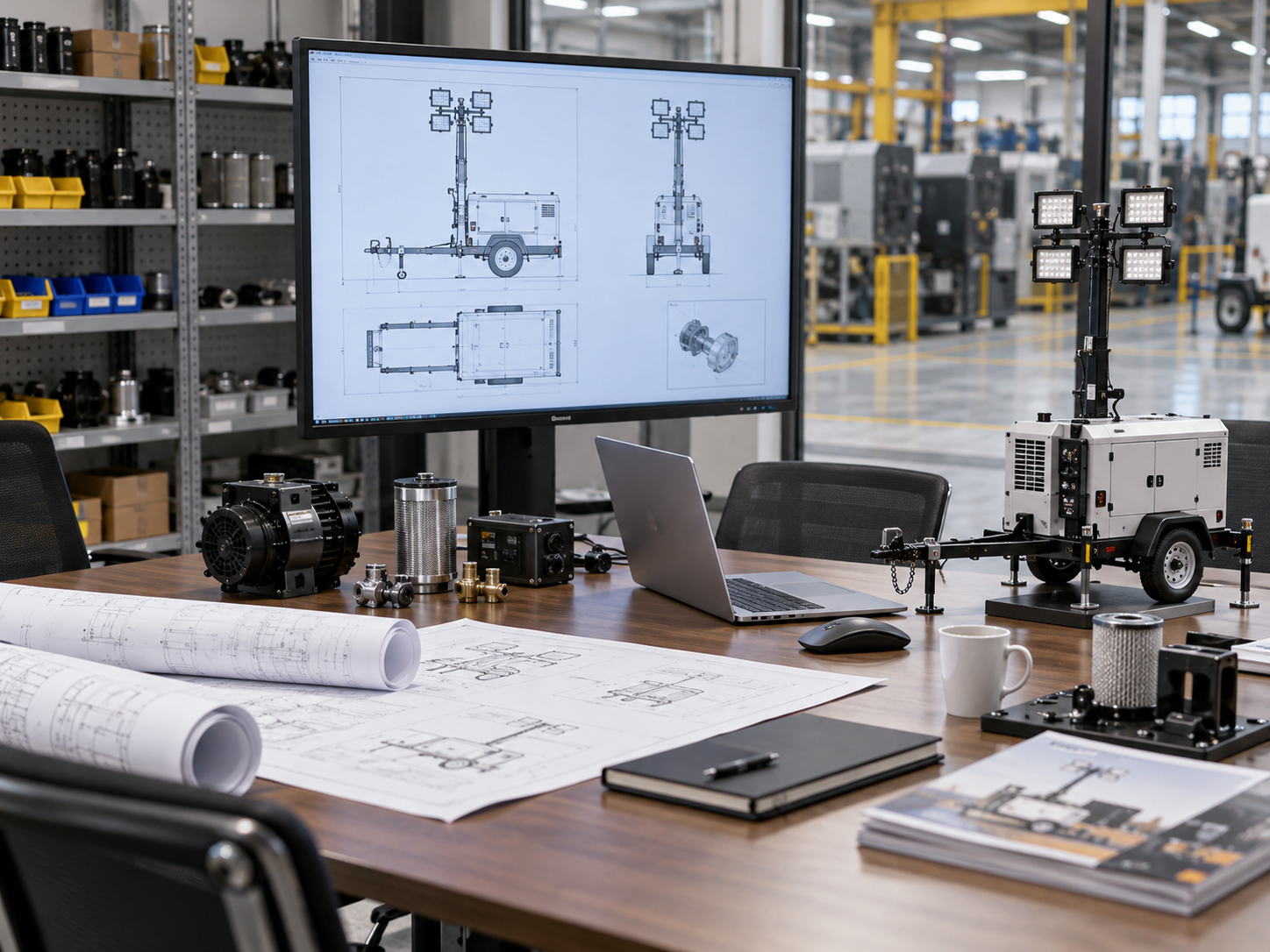
We support product selection and configuration discussions for your operating environment. For an engineering review, connect each requested document to the D955 package and destination to prevent a general company credential from being mistaken for a product approval.
OSHA Guidelines / Review
For U.S. construction applications, OSHA 1926.404 sets requirements and conditions for electrical protection and grounding. The 120V / 60 Hz specification and 2.4 kW rating do not by themselves establish the correct installation or authorize every connected load. The construction light tower generator can face a load mismatch or a commissioning risk because each tool must suit the supplied circuit and protection arrangement.
Documents to agree during technical review
Confirmed mast, lamp and generator schedule
Match the order to the 7 m or 9 m package
Applicable operating and maintenance instructions
Plan inspection, servicing, mast operation and storage
Lighting layout and available photometric information
Assess task illumination, placement and acceptance measurements
Electrical arrangement and permitted simultaneous loads
Review sockets, starting demand, protection and grounding with the site electrician
Destination-specific product and engine requirements
Identify required declarations, approvals, labels and shipping documents before order confirmation
Agreed support and spare-parts scope
Allocate responsibility for maintenance and long life in the intended service environment
01
Provide the tool list and starting loads when auxiliary power is needed.
02
Understand the actual generator and panel arrangement to determine the most appropriate protective measures.
03
Agree warranty duration, service response and on-site support scope in the contract.
How We Work: Site Brief to Confirmed Configuration
For portable light towers, LFADJ product consultations include lighting-solution support. A clear brief reduces the risk of revising the equipment package after packing or transport has been arranged.
STEP 01
Describe the job:
Send the site drawing, task, shift duration, required illumination and traffic or access restrictions.
STEP 02
Review the D955 package:
Compare mast height, LED heads, electrical requirements and transport envelope with our team.
STEP 03
Confirm the commercial scope.
Align quantity, destination, lead-time milestone, delivery terms and required documents in the quote.
STEP 04
Plan use and service.
Confirm after-sales arrangements as per the contract and define inspection and maintenance responsibilities.
Live Preview
Project Enquiry Note
Already have a lighting specification? Send it with your project enquiry so the configuration review can address the requirements directly.
LFADJ Industrial Lighting Experience
Zhejiang LONGFA Lighting Co., Ltd. was established in Yueqing, Zhejiang, on February 21, 2013. We work across industrial, mobile, emergency and explosion-proof lighting, with product consultation and application-based configuration support.
Our D955 offer includes trailer-mounted lighting with hydraulic lift and a diesel package. Our wider range serves the needs of industrial production, maintenance, night construction and emergency operations.
The LFADJ brand was registered in 2019. Select equipment by its specific model and applicable conditions, particularly where a project requires explosion-proof lighting.
Company certificate copies issued on February 19, 2024 list ISO 9001:2015, ISO 14001:2015 and ISO 45001:2018, with a registration expiry date of February 18, 2027 and a stated scope of sales of lighting fixtures and accessories. Review current certificate validity and project-specific product conformity separately during procurement.
Read about LFADJ or contact our team for the company and model documents relevant to your procurement review.Application Boundaries for Diesel Light Towers
Diesel is not the right option if the site prevents the safe operation of the engine or the proper deployment of the tower. A higher mast or a brighter lamp package can not solve an unsuitable environment.
01
Indoor or partly enclosed work
Don’t use diesel engines in these areas. NIOSH guidance on engine exhaust includes diesel engines; locate engines outdoors away from air intakes.
02
Hazardous locations
Only equipment approved for the actual hazardous-area classification should be used. The ordinary D955 configuration is not presented as explosion-proof.
03
Not enough space for deployment
Allow for the operating envelope and support conditions, as well as the exclusion area required by the instructions and site plan.
04
Engine, noise or emissions restrictions
Establish project limits before deciding on diesel power; consider other power options if the contract requires it.
Construction & Roadwork Light Tower Tools
Estimate workforce and time requirements for deploying and repositioning light towers on active sites.
Access EstimatorEvaluate mast heights, lamp inputs, and fleet weights to specify the optimal D955 package for your project.
Compare ConfigurationsAssess physical deployment dimensions and outrigger spread to ensure safe positioning in confined work zones.
Check FootprintConstruction Light Tower FAQs
How many light towers does my construction site need?
Begin with the jobsite lighting requirement and work area and obstacles, and review the layout and measurements. Area alone cannot establish quantity because of factors such as the direction of the beams, shadows, mounting height and the minimum illumination at the work area.
Does the 9 m D955 replace more than one 7 m tower?
No fixed replacement ratio applies. Compare measured task illumination for the proposed layout.
Can I use power tools while the lights are operating?
Request confirmation for your exact tool list, including equipment that starts under load and anything that could run simultaneously. The 2.4 kW generator rating is not a spare-power allowance: the lighting load, generator conditions, socket ratings, protective devices and tool starting loads all matter. A nameplate subtraction alone can therefore give a misleading answer about usable auxiliary power.
How can I reduce shadows behind machinery?
Review tower position and lamp direction from the worker’s task position. Equipment can block a single light path, so an altered position or additional lighting may be needed; check the result after equipment and loads are placed.
What should I check for maintenance and long life?
Refer to the included engine and tower maintenance instructions to establish a preventative maintenance schedule for the environment. During maintenance be sure to check the lifting system, lamp assemblies, cables, supports and trailer; confirm responsibility for service and replacement parts before purchase.
Is there one minimum brightness level for all construction work?
No. OSHA 1926.56 Table D-3 shows 5 foot-candles of general illumination for construction area lighting, with other levels shown for specific area operations; the project task and applicable local provisions determine the design basis.
Are LED tower lights automatically more energy-efficient for my job?
Analyze the complete operating situation. Rated lamp input helps define electrical demand, but the unit’s fuel use, owning and operating cost may vary due to operating hours, use, loading, servicing and how the unit is used; lower wattage alone does not establish a project saving.
Which light color temperature should I specify?
The project’s color temperature and visual task requirements must be provided during technical review. Confirm the actual LED package provided, including any color rendering requirement, in the quote.
Can the same tower be used for mining or emergency operations?
Only after the site conditions are reviewed. Depending on the situation, different systems may be required (e.g. an outdoor application may be appropriate for mobile lighting, while an underground, enclosed or hazardous situation may require a different system and approval).
How do I compare a construction light tower for sale with rental?
Compare expected use, maintenance responsibility and availability alongside the equipment price. Repeated projects and available service resources may favor ownership, while short-term demand may favor rental; evaluate the actual local terms against your planned hours and fleet requirements.
What is the delivery lead time?
Our stated lead time is 45–60 days. Confirm the start date, supplied package and dispatch or arrival milestone in the quotation before committing the site schedule.
What information helps LFADJ prepare a quote?
Send a description of the mast and the number and type of lamps, the quantity, destination, site layout and expected use. Provide electrical and document requirements, as well as delivery requirements, so our team can define the supplied scope and terms.