Get in touch with LFADJ Company

LFADJ · Industrial mobile lighting
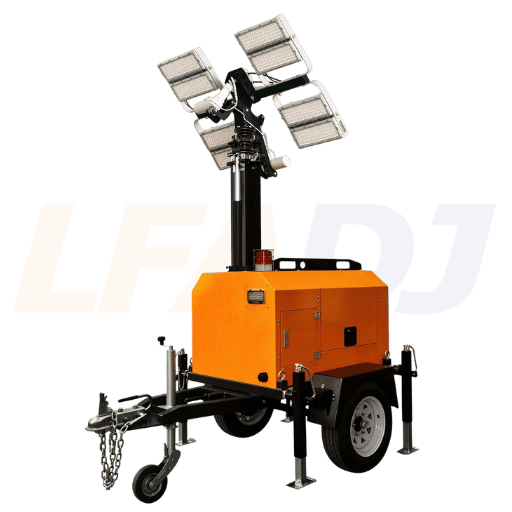
Hybrid Light Tower for Industrial Projects
Our hybrid light tower offers four 200 W dimmable LED fixtures with battery, diesel, hybrid and mains operation for temporary site lighting. Match the power mode to your shift, available electricity and engine operating restrictions.
- 7.68 kWh nominal LiFePO4 battery capacity
- 120 Vac / 60 Hz configuration
- Optional solar charging for a site-specific energy plan
1 unit
Minimum order quantity
50% deposit
Balance before shipment
Sample orders
Samples follow the same terms as finished products.
Hybrid Light Tower Power Modes
LFADJ provides a multi-energy light tower configuration for sites where the power changes during the project. The trade-off is the length of engine-off lighting versus the available charging window, fuel supply and mains connection.
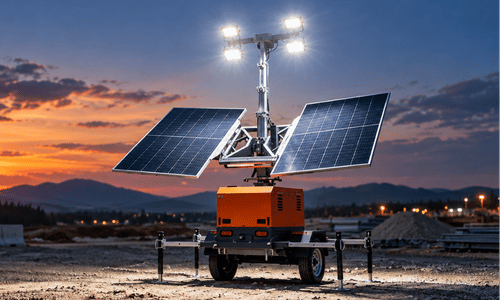
Configuration check: Start with the illumination the task needs, then select the brightness, battery duration and charging route that support it for the whole shift.
Battery operation
Use stored energy for lighting time with the diesel engine off. Set the required brightness first. Compare the battery’s autonomy at that setting to the required work time.
Diesel operation
Use the engine power option where a suitable mains supply is unavailable. Plan refueling and ventilation, and adjust for the restrictions on permitted operating hours at the site.
Hybrid operation
Use battery storage in conjunction with diesel to cover a longer lighting period. Check settings and automatic startup and shutdown sequences, charging priority and engine schedule in the configuration.
Mains operation
Use the available site electrical supply for the mains operating mode. Match the connections and site protection measures, voltage and frequency before use.
Engine-off operation and backup timing
Automatic engine start is not always permitted during a restricted work period, even when backup power is needed. To reduce the risk of an interrupted shift, compare the LFADJ configuration’s 6 h 30 min full-brightness battery duration with the required hours, because a 10-hour shift leaves a 3 h 30 min gap that needs another power source.
Battery and Solar Charging Configuration
Our battery configuration uses two 25.6 V, 150 Ah LiFePO4 packs with a combined nominal energy of 7.68 kWh. Battery capacity describes stored energy; the lighting load and conversion losses determine how that energy is used.
Solar hybrid lighting tower option
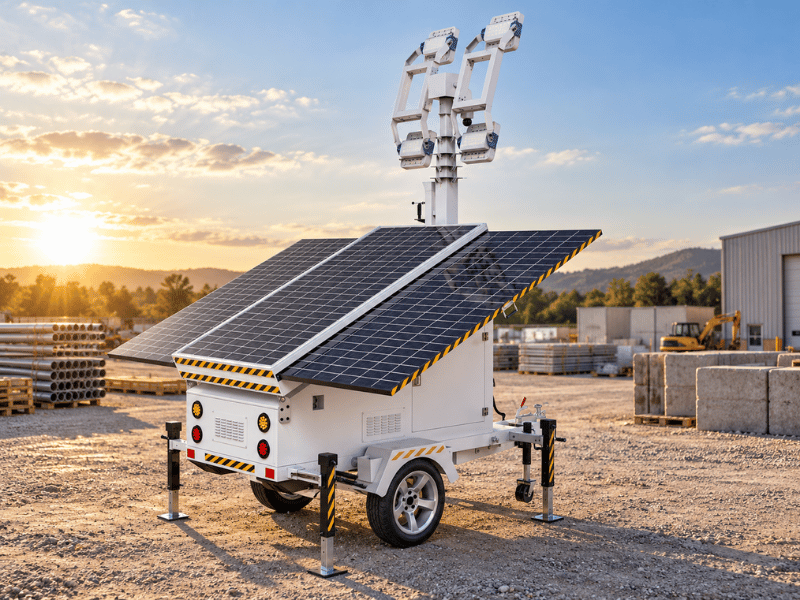
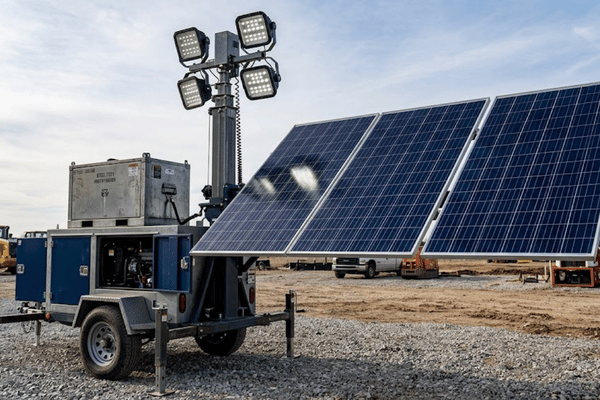
Mobile solar charging is optional, with an 800 W maximum input listed for this configuration. For a solar diesel hybrid light tower quotation, include the location, operating season and available panel space so the charging arrangement can be matched to the site.
Charging between shifts
Solar panel power is not a substitute for a daily energy balance; the charging plan requires a defined starting battery level and a usable charging window. Generator charging, an external mains charger and solar charging have different input conditions; select the required equipment in the order specification.
Power Recovery Check
| Site input | What it affects | Send with your inquiry |
|---|---|---|
| Lighting schedule | Energy used between charging opportunities | Hours per shift, brightness needs and consecutive workdays |
| Daytime electrical access | Charger selection and recovery window | Supply voltage, frequency, available current and connection hours |
| Solar exposure | Daily solar energy reaching the charging system | Site location, season, shading, panel position and usable area |
| Engine restrictions | Availability of diesel backup | Permitted operating periods and local emission requirements |
Site Lighting and Deployment
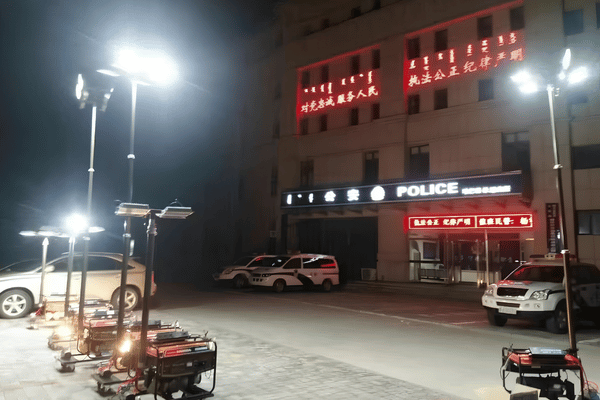
We configure LED light towers for temporary work area lighting, equipment service and maintenance, and emergency operations. The light is placed around the work area, accessways and obstructions, to provide reliable lighting where the crew is working.
Illumination at the work surface
An average coverage figure is not a substitute for the minimum light level at every work position. OSHA 29 CFR 1926.56 Table D-3 cites 5 foot-candles for general construction area lighting; other values are specified for different areas and operations; confirm the requirement and check the lighting layout against it.
Construction and infrastructure
Match floodlight aiming and mast placement to the work area, vehicle movement and glare limits. On construction sites, adjust brightness to extend runtime, if needed, to adequately illuminate the task.
Industrial maintenance
Describe the equipment being serviced, shadowed surfaces and the distance from the tower to the work, including any close inspection tasks.
Emergency deployment
Access width, surface conditions and power available on arrival determine where the lighting unit can be placed. The operating footprint and transport weight should be in the unit mobilization plan.
- Send a site plan with the area dimensions, obstructions and intended tower positions.
- Specify the minimum illuminance, measurement plane and glare restrictions.
- Confirm ground support, wind conditions, transport route and destination requirements for the trailer.
Hybrid Light Tower Specifications
Configuration options include LED lighting, battery storage and multiple power options. Before finalizing your configuration, assess the light demand against transport restrictions and the electrical supply available at your site.
Lighting and equipment features
| Item | Configuration | Selection detail |
|---|---|---|
| LED fixtures | 4 × 200 W | Dimmable SMD LED lighting |
| Total luminous flux | 156,000 lm | Review the photometric layout for the task area |
| Color temperature | 5,000 K | Confirm any project color requirement |
| Battery chemistry | LiFePO4 | Lithium iron phosphate |
| Battery packs | 25.6 V / 150 Ah × 2 | 7.68 kWh combined nominal energy |
| Electrical configuration | 120 Vac / 60 Hz | Match site supply and destination |
| Optional solar charging input | 800 W maximum | Panel and charging arrangement confirmed with the order |
| Transport dimensions | 2,300 × 1,450 × 2,350 mm | Length × width × height |
| Operating footprint | 2,850 × 2,450 mm | Allow additional access and working clearance |
| Dry / wet weight | 1,250 / 1,380 kg | Check handling and transport capacity |
Shift Fit Table
The longest listed runtime does not necessarily cover a shift at the brightness the task requires: battery runtime is 6 h 30 min at full brightness and 12 h 50 min at 50%. The table compares each setting with a 10-hour example shift, showing the time difference without changing the illumination requirement.
Battery runtime by brightness setting
| Brightness | Battery runtime | Difference from a 10-hour shift |
|---|---|---|
| 100% | 6 h 30 min | 3 h 30 min short |
| 75% | 8 h 30 min | 1 h 30 min short |
| 50% | 12 h 50 min | 2 h 50 min longer |
| 25% | 25 h 30 min | 15 h 30 min longer |
Match duration to useful light
Operation depends on starting charge, condition of the battery, temperature and connected loads. Choose a brightness that meets the work requirement and plan supplemental power when the battery duration is shorter than the shift.
Full-brightness shift planning
For a 10-hour job that requires full brightness, it is better to plan for a mains supply or a permitted engine operating window instead of assuming battery-only operation for the entire job. Hybrid operating hours and battery-only runtime are not interchangeable. The longer hybrid period includes engine use.
Pricing, Lead Time and Order Terms
We quote the lighting configuration based on your site requirements, quantity ordered and destination. Compare equipment that has the same light output, operating schedule and included charging options to evaluate the price difference.
Order terms
- Our minimum order quantity is 1 unit.
- Payment terms are 50% deposit, with the balance before shipment.
- Samples follow the same terms as finished products.
Price and delivery inputs
- Lighting output and battery operating requirement
- Solar panels, external charger and selected accessories
- Quantity, destination and transport requirements
- Required arrival date and project documentation
Lead time is agreed after configuration, quantity and delivery time arrangements are finalized. When requesting equipment, include the required arrival date.
Operating cost comparison
Fuel costs, the cost of electricity to charge the equipment, the labor costs to refuel the equipment and perform maintenance all impact the operating budget. Compare them over the same operating period and lighting duty, alongside the equipment price; a rental-provider cost study illustrates why the assumptions matter.
Compare your operating cost inputsLFADJ Manufacturing and Project Support
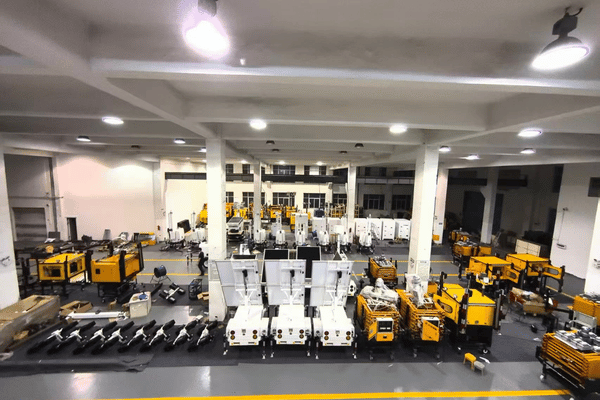
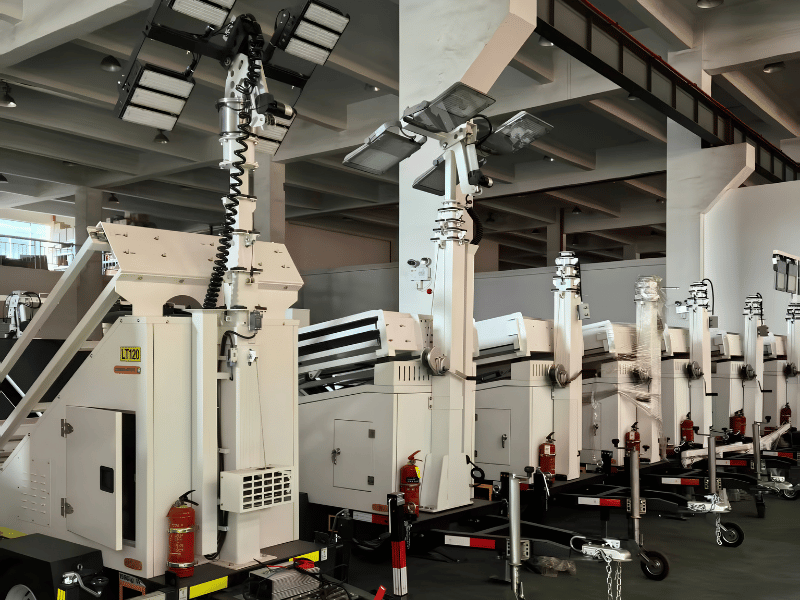
LFADJ is a brand of Zhejiang Longfa Lighting Co., Ltd., established in 2013 in Yueqing, Zhejiang, China. Our factory business incorporates industrial lighting development and manufacture, as well as trade and service, and covers product lines of mobile lighting, lifting lighting devices and emergency lighting equipment.
Before the order
Based on the environment and requirements of use, we will provide suggestions on product models and lighting solutions. In your inquiry, please detail the environment on site so we can determine the type of lighting that best supports the work.
During supply
We communicate configuration of the product and associated technical requirements for the project. Provide any required inspection documents and acceptance checks in the order discussion, along with the equipment scope and supply arrangements.
After delivery
Consultation and handling of post-sales issues include after-sales service, warranty, response time, maintenance arrangements and on-site support as agreed between both parties.
Process & Specifications
From Site Requirements to Supply
Equipment configuration and supply terms are first discussed in the context of the application and lighting requirements. A shared brief helps the site team, project engineer and procurement team evaluate the same equipment scope.
1
Send the site brief. Include the work area and operating schedule.
2
Review the configuration. Match lighting, power modes and charging options.
3
Review the quotation. Compare equipment, quantity and delivery scope.
4
Confirm the order. Agree technical requirements, payment and support terms.
5
Coordinate supply. Confirm preparation and transportation arrangements.
6
Arrange use and support of the equipment in accordance with the equipment instructions and agreed service scope.
Quote Inputs Table
| Information | Include | Why it matters |
|---|---|---|
| Work area | Site plan, area dimensions, required illuminance | Fixture aiming, tower position and lighting layout |
| Operating schedule | Hours per shift, brightness requirement, engine-off periods | Battery duration and backup power plan |
| Charging | Mains voltage and frequency, available current, solar conditions | Charger and panel configuration |
| Environment | Temperature, wind, ground condition and noise restrictions | Deployment limits and required options |
| Purchase | Quantity, destination and required arrival date | Quotation, lead time and transport arrangements |
| Acceptance and support | Required documents, checks and after-sales scope | Written order requirements and responsibilities |
Operating Limits and Alternative Configurations
Choose power arrangements and mode around the site's actual energy access and lighting duty. A suitable operating mode can improve efficiency, but it still requires sufficient stored or supplied energy to do the work.
- In case of stable mains power, operation can be compared to a light tower with a dedicated electric supply, where a suitable supply is continuously available.
- Strict engine-off periods: match battery runtime to the required brightness for the entire restricted period.
- Limited sunlight: include an electrical or diesel charging route instead of relying on panel rating alone.
- Special work environments: specify any hazardous-area, road transport or project approval requirements before equipment selection.
Get more useful light from the layout
Aim each fixture at the required work surface and consider shadows before increasing lighting load. Good positioning maximizes useful illumination and ties selection to the job requirement.
Energy required across the shift
An 800 W lighting load over 10 hours requires 8 kWh before system losses, so a 7.68 kWh nominal battery leaves no headroom for that duty. This is an energy-balance check, not an estimate of measured runtime; use the brightness-specific durations and a charging plan to avoid a power shortfall.
Hybrid Light Tower Planning Tools
Compare battery-only runtime across dimming settings against your required shift hours to identify any backup power window needed.
Check nightly lighting energy demand against daytime solar and generator charging inputs across consecutive workdays.
Evaluate fuel consumption, charging electricity, and maintenance intervals over the same lighting duty and project schedule.
INQUIRY // PROJECT SPECIFICATION
Request a Hybrid Light Tower Quote
Requests for quotation for the hybrid light tower should be made with quantity, delivery location and required charging sources to LFADJ. Include the required brightness, shift length and available charging sources to receive a quotation aligned with the project.
- Site plan and lighting requirement
- Shift duration and engine operating restrictions
- Power supply, solar conditions and charging window
- Quantity, destination and required arrival date
Support & Knowledge Base
Frequently Asked Questions About Hybrid Light Towers
Solar charging is an option. The configuration lists an 800 W maximum solar input; include panel space, site location and operating season when requesting a solar hybrid light tower.
Compare the shift with the required brightness setting: battery runtime is 6 h 30 min at 100% and 12 h 50 min at 50%. For longer periods, specify the permitted charging or backup power arrangement.
Hybrid operation permits use of battery or diesel power, so the engine can run during the operating cycle. If an engine-off period is required on site, include its duration and the required light output in the configuration review.
Charging equipment and control settings must be configured as a system. The electrical interfaces must also be matched as part of the system. Identify the power sources you will use so charging priority and automatic engine behavior can be confirmed for the configuration you have chosen.
Identify the external equipment's voltage, continuous load and starting demand prior to including it in the project scope. Auxiliary power requires a confirmed output arrangement, and additional loads impact the energy available to lighting.
A lighting layout with the fixture height, aiming angles and required minimum illuminance for the task at hand will indicate light level at the darkest work location. A lumen total or average coverage area alone will not determine light level.
The configuration shown is 120 Vac / 60 Hz. Include the destination and site supply in your inquiry so the electrical requirement is checked before the order is confirmed.
The price of the system is affected by the configuration of lighting and power, the type of charging options, quantity and the destination. Send those inputs with the required arrival date for an LFADJ quotation.
Our minimum order quantity is 1 unit. Samples follow the same terms as finished products.
Payment terms are 50% deposit, with the balance before shipment. Warranty, response time and on-site support are agreed in the contract alongside the selected equipment scope.
For a solar light tower, a daily energy plan that accounts for the operating load and solar conditions is desired. Where such a plan results in an energy shortage, a hybrid lighting configuration with a confirmed backup charging route is an alternative option.