Get in touch with LFADJ Company

LFADJ · LF6119 MOBILE LIGHTING PLATFORM
Portable LED Work Light for Industrial Projects
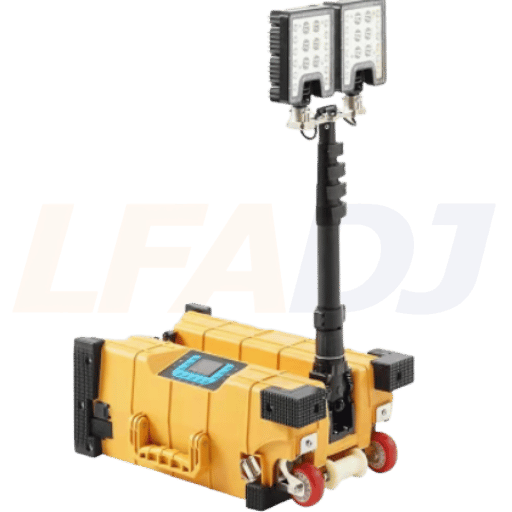
Bring a portable led work light to the maintenance point, temporary work area or inspection task. Our LF6119 combines two lamp heads, a rechargeable battery and a wheeled case for jobs that move beyond fixed lighting.
- Spot and flood lighting for different work positions
- Raised lamp heads with a compact transport configuration
- Product selection and configuration support for your site
Send your application, quantity and delivery destination.
2 × 55 W
Lamp-head power
21.6 V DC
Rated voltage
34 Ah
Battery capacity
20 kg
Unit weight
1,860 mm
Deployed overall height
IP65
Lamp heads and enclosure
LFADJ Portable LED Work Light with Stand
Our cordless LF6119 is a rechargeable work light with stand and wheeled base for industrial maintenance and temporary operations, without a power cord running to the lamp during battery use. Its wheeled case groups the lighting and battery system for relocation, while the folded dimensions help you plan vehicle and storage space.
01
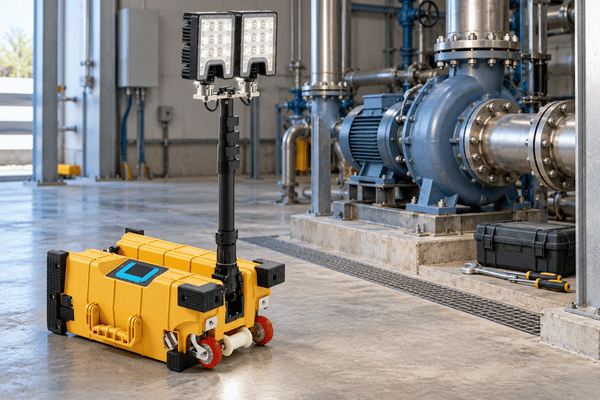
Maintenance beside fixed equipment
Position the platform alongside pumps, machinery and inspection points where installed lighting casts shadows. Use spot lighting for the task and flood lighting for the surrounding work area and check visibility from the operator’s position.
02
Temporary work areas
For night construction and repair work, position the light source at the active work front. Keep the light out of access routes and evaluate ground conditions before extending the mast.
03
Inspection and service stops
Move the system between service locations where carrying separate lamps and supports adds handling. Include stairs, thresholds and vehicle loading in your handling plan: the LF6119 weighs 20 kg, so portability starts with the route to the job.
04
Light and site communication
Our platform includes 30 W audio, MP3 playback, Bluetooth audio, recording and voice amplification. Specify these functions when your team needs site announcements alongside lighting, and include their use in the requested operating profile.
Deployment details that affect selection
- Transport: check the folded case dimensions against storage bays and access openings.
- Setup: confirm the ground surface, mast locking procedure and permitted operating conditions.
- Position: keep the beam clear of obstructions without shining directly into workers’ eyes.
- Acceptance: assess stability as a separate requirement; a heavier case does not necessarily prevent tipping, so weight alone is not a substitute for stability testing. IEC 60598-2-4:2017 includes stability testing for portable general-purpose luminaires.
Spot and Flood Lighting Configurations
Our LF6119 provides spot and flood lighting for versatility across job site tasks. A narrow inspection point and a wider working zone need different placement, even when they are served by the same portable work light.
| Work requirement | Configuration to discuss | Check at the work position |
|---|---|---|
| Read a label or inspect a component | Spot lighting directed toward the target | Legibility, reflection and shadows from tools or hands |
| Light a repair area | Flood lighting aimed across the workspace | Useful coverage at the edges, not only the bright center |
| Task plus nearby working zone | Combined spot and flood lighting | Beam overlap and whether equipment blocks either head |
| Work around reflective metal | Change lamp position and beam direction | Glare from the actual viewing angle |
| Read color-coded markings | Review color temperature and color-rendering requirements | Correct identification of labels, wires and safety signs |
| Work across separate positions | Review additional lighting locations | Dark gaps between tasks and access routes |

Measure illumination where the work happens
A lumen rating describes light output; higher output does not necessarily improve visibility at every work surface. For US construction, OSHA 1926.56 sets task-specific minimum illumination levels, including 5 foot-candles for general construction area lighting, so agree the applicable task and measurement positions before assessing a layout.
- Record the working distance and measurement plane.
- Check shadows with equipment and workers in their normal positions.
- Review glare and sign visibility as well as the measured level.
Battery Power and Shift Planning
Our LFADJ rechargeable work light uses a 21.6 V DC, 34 Ah battery and includes a battery indicator. A shift can run out of usable light because the selected mode and auxiliary loads change the demand on the battery. Plan runtime around those loads and the starting charge; maximum lamp-head power and a battery capacity figure do not establish a full-shift operating duration.
Mode-to-Shift Planning
| Planning field | Your input | Configuration decision |
|---|---|---|
| Lighting task | Inspection point, repair bay or temporary work area | Select spot, flood or combined use |
| Required duration | Continuous light-on time and scheduled breaks | Confirm runtime for the selected mode |
| Other loads | USB output, audio or voice amplification | Include these loads in the operating requirement |
| Charging window | Available time between deployments | Compare with the LF6119 charge time of 8 hours |
| Charging location | Supply, plug format and ambient conditions | Agree the charger configuration and instructions |
| Continuity | Whether the task can pause | Arrange unit rotation or another suitable power option |
Ask for runtime under a defined test method and operating mode when comparing portable rechargeable work lights. For LF6119, we review the requested duty with you before confirming the configuration; operating and charging temperature limits are not interchangeable.
The charging window can be the bottleneck
- Plan charged-unit rotation when there is too little time between jobs instead of assuming a partially charged lamp will complete the next duty.
- No suitable charging point: arrange a charging location before deployment or review another power source.
- Continuous fixed work: compare battery operation with a suitable corded lighting arrangement and safe cable routing.
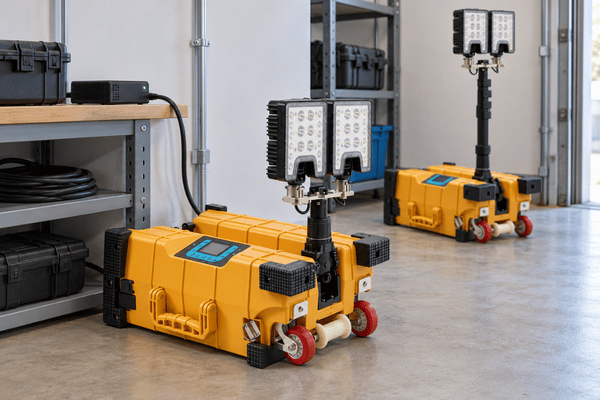
For the lighting task, required duty and charging window, select the appropriate configuration.
— LFADJ · project selection approach
LF6119 Technical Specifications
We supply the LF6119 as a wheeled lighting platform with two LED lamp heads, battery power and auxiliary functions. Use the dimensions below to assess access and transport, and use the electrical details to frame your operating requirements.
| Specification | LF6119 configuration | Selection note |
|---|---|---|
| Rated voltage | 21.6 V DC | Battery system rating |
| Battery capacity | 34 Ah | Confirm runtime at the selected mode |
| Lamp-head power | 2 × 55 W | Separate from a duration claim |
| Charging time | 8 hours | Match charger and charging conditions |
| Folded dimensions | 645 × 350 × 210 mm 25.4 × 13.8 × 8.3 in |
Transport and storage configuration |
| Deployed dimensions | 645 × 350 × 1860 mm 25.4 × 13.8 × 73.2 in |
Allow working clearance around the platform |
| Weight | 20 kg / 44.1 lb | Plan loading and handling |
| Operating temperature | -20 to 40 °C / -4 to 104 °F | Operating range; charging conditions require a separate check |
| Ingress protection | IP65 lamp heads and enclosure | Check connection and charging arrangements separately |
| Audio power | 30 W | MP3, Bluetooth audio and voice functions |
| Lighting modes | Spot and flood | Choose beam arrangement for the task |
| Additional functions | USB output; battery indicator | Include connected loads in duty planning |
Match the rating to the condition
IP65 describes ingress protection for the lamp heads and enclosure; it is not a substitute for hazardous-location approval. An open connection, charging arrangement or different enclosure condition needs its own suitability check rather than an assumption based on the closed unit.
- Use the millimeter dimensions for fit checks; inch and pound values are rounded conversions.
- Confirm the working height and clear space for people, vehicles and equipment.
- Keep environmental constraints, charging instructions and site acceptance requirements with the selected configuration.
Project Pricing and Delivery
We quote industrial portable work lights against the configuration, order quantity and destination. Specify your operating constraints at the enquiry stage, so the commercial offer reflects the equipment and support your team actually needs.
| Quote input | What it changes | How to compare offers |
|---|---|---|
| Lighting configuration | Model and required functions | Compare the same duty and selected mode |
| Quantity and deployment plan | Supply scope and unit rotation | Include units needed during charging |
| Charger and accessories | Included equipment and destination suitability | List each item rather than assuming inclusion |
| Delivery destination | Transport arrangements and packing requirements | Compare the same delivery scope |
| Required documents | Configuration-specific document review | Name the document and applicable model |
| Service requirements | Warranty, maintenance and on-site support scope | Use the terms agreed for the order |
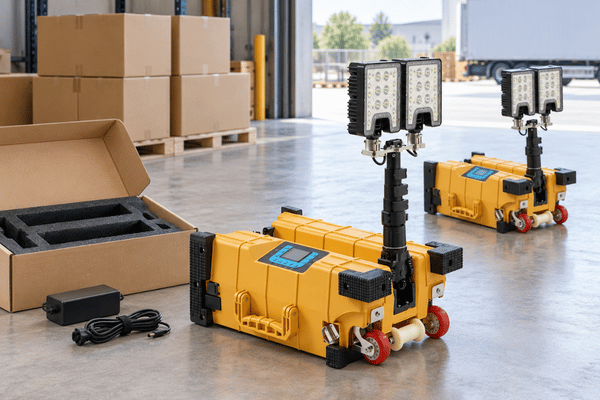
Agree the supply schedule with the configuration
We talk about the required delivery date when finalizing product configuration and supply arrangements. The quotation and order agreement define the scope of supply, commercial terms and delivery schedule, and how transport is handled.
A complete budget starts with a complete scope
Consider the lamp, charging arrangement, accessories, transport and support together. Sometimes the lowest equipment price is not the lowest total cost when a quote fails to include items needed to match your working pattern.
LFADJ Manufacturing and Service Support
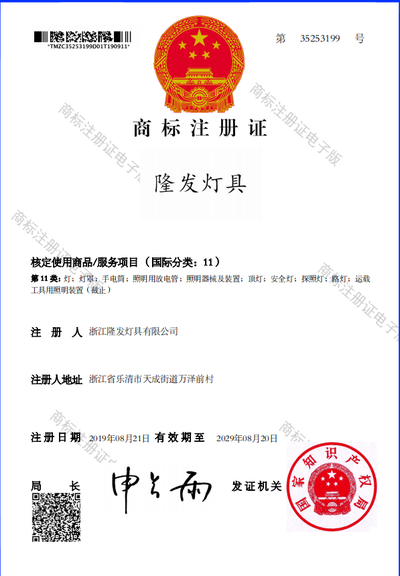
Zhejiang LONGFA Lighting Co., Ltd. was established in 2013 in Yueqing, Zhejiang, China. We bring research and development, manufacturing, trade and service together across industrial, mobile, explosion-proof and emergency lighting.
Application-led selection
We provide product consultation, model selection and lighting solutions based on the working environment and operating requirements. For LF6119 enquiries, our technical discussion connects the lighting task with configuration, handling and power arrangements.
Support through the order
We coordinate configuration and technical communication during supply, then provide product-use consultation and after-sales problem handling. Warranty duration, response arrangements, maintenance and on-site support follow the agreement for your order.
- Identify the selected model on the specification and quotation.
- Specify which product documents your project requires before order confirmation.
- Keep company management-system documents separate from product-specific approvals.
- Give the equipment model, operating conditions, and describe your problem for an assessment of the next step.





From Site Requirements to an Agreed Configuration
- Describe the job: send the work area, task, operating conditions, quantity and destination.
- Review the lighting arrangement: we discuss beam choice, placement, handling and duty requirements.
- Confirm the configuration: identify the light, charger, accessories and required documents.
- Agree the commercial scope: align quotation, supply schedule and support terms.
- Set acceptance criteria: agree what will be checked and under which operating conditions.
- Use and support: Follow the equipment instructions, and contact us for service support.
Project Requirements and Acceptance Table
| Requirement | Example input to provide | Responsible review |
|---|---|---|
| Task visibility | Pump repair; labels and fasteners visible at the working position | Site supervisor identifies tasks; engineering agrees measurement points |
| Illumination requirement | Applicable site requirement and measurement plane | Site engineering confirms the criterion and checks the installed arrangement |
| Operating duty | Light-on duration, mode, breaks and auxiliary loads | LFADJ reviews configuration; buyer agrees the acceptance conditions |
| Charging | Available supply and time between deployments | Site team plans charging; LFADJ confirms the charger arrangement |
| Handling and placement | Vehicle bay, stairs, ground surface and mast clearance | Site team checks access, safe handling and setup instructions |
| Visual conditions | Reflective surfaces, machine shadows and safety signs | Operators check visibility in the actual work position |
| Order scope | Quantity, destination, accessories and required documents | Procurement agrees the written offer; finance compares the complete scope |
Consider plant and equipment in position and check the proposed arrangement, since machine(s) or operator(s) may block light that looked adequate in an empty area. Plan escape-route lighting and any required emergency lighting alongside task lighting, with their requirements assessed for the site.
Before deployment
- Inspect the unit, cord, plug and charging equipment for damage.
- Confirm local electrical requirements for the selected equipment and supply.
- Protect temporary cables from traffic and trip hazards; keep access routes clear.
Alternative Lighting for Different Site Conditions
Lighting formats involve trade-offs between handling, placement and continuity. Compare the LF6119 platform with smaller task lights or another power arrangement when access, duration or location classification changes the selection.
| Situation | Constraint | Practical alternative |
|---|---|---|
| Close-quarters automotive work in a garage | A floor platform cannot reach every inspection point | A handheld light, flashlight, headlamp or suitable clamp light for localized work |
| Hands-free work beside a bench | Limited floor space or changing viewing angles | Compare a secure clamp or magnetic mounting arrangement with an adjustable tripod work light |
| Continuous work at a fixed location | Charging interrupts the operating pattern | Suitable corded lighting or a planned charged-unit rotation |
| Large work areas | Distance and obstructions leave dark zones | A planned arrangement of area lights or a different lighting system |
| Classified hazardous location | The atmosphere requires specific equipment approval | Use a model approved for the identified hazardous conditions |
For US construction operations involving flammable liquids or gases, OSHA 1926.151 requires battery-operated portable lights of an approved type for the hazardous location. Share the classification and applicable requirements when asking LFADJ to select a suitable model.
Portable LED Work Light Tools
Shift Coverage Planner
Calculate required battery capacities and rotation schedules based on your specific lighting tasks and charging windows.
Access Planner
LF6119 Folded-Unit Clearance Check
Verify dimensions against your vehicle bays, access routes and storage facilities prior to deployment.
Check Dimensions
Project Quote Scope Comparison
Evaluate multiple commercial offers by aligning the lighting configuration, supplied accessories and service scope.
Compare Scope
Request Your LF6119 Project Quote
Tell us where on the jobsite your LED light will be used and what the team needs to see to be safe and productive. We’ll help plan for the operating requirements and the supplies needed to support the team.
- Application, work area and environmental conditions
- Required light-on time, charging window and accessories
- Quantity, destination and required delivery date
KNOWLEDGE BASE