Get in touch with LFADJ Company

Updated November 2026 · Reviewed by the LFADJ technical team (Zhejiang Longfa Lighting Co., Ltd.)
A magnetic work light is a portable LED light featuring a permanent magnet base, which uses neodymium, ferrite, or pot-magnet assemblies, to attach to ferromagnetic steel. In TotalElement’s clean, smooth bare-steel model, static friction for a nickel-plated magnet equals roughly 0.15 to 0.25 of actual normal clamping force . Paint clearcoats, rubber boots, and thin sheet metal reduce clamping force first, while aluminum hoods require a hook or clamp.
Sizing a reliable rechargeable magnetic work light means matching mounting mechanics, beam diffusion and battery capacity to the work zone. Personal inspection lights span Harbor Freight’s 500-lumen BRAUN 71095 folding wand to Klein Tools’ IP54-rated 56403 swivel pod (460 Lumens for 9 hours on High) . Stationary non-ferrous bays can use a tripod, while multi-person turnarounds can use a floor-standing wheeled battery-powered light case.
Quick Selection Rules: Bench-test painted or rubber-booted mounts on the actual panel, since large magnets need 2 to 4 mm of steel. Neodymium bases should not be used on hot manifolds or weld preheat zones. Diffused multi-mode heads should be used with stowable hooks for aluminum hoods, and cordless tripods or wheeled battery cases should be used for crew zones.
How a Magnetic Work Light Holds—and Why Pull-Force Labels Mislead on Vertical Steel
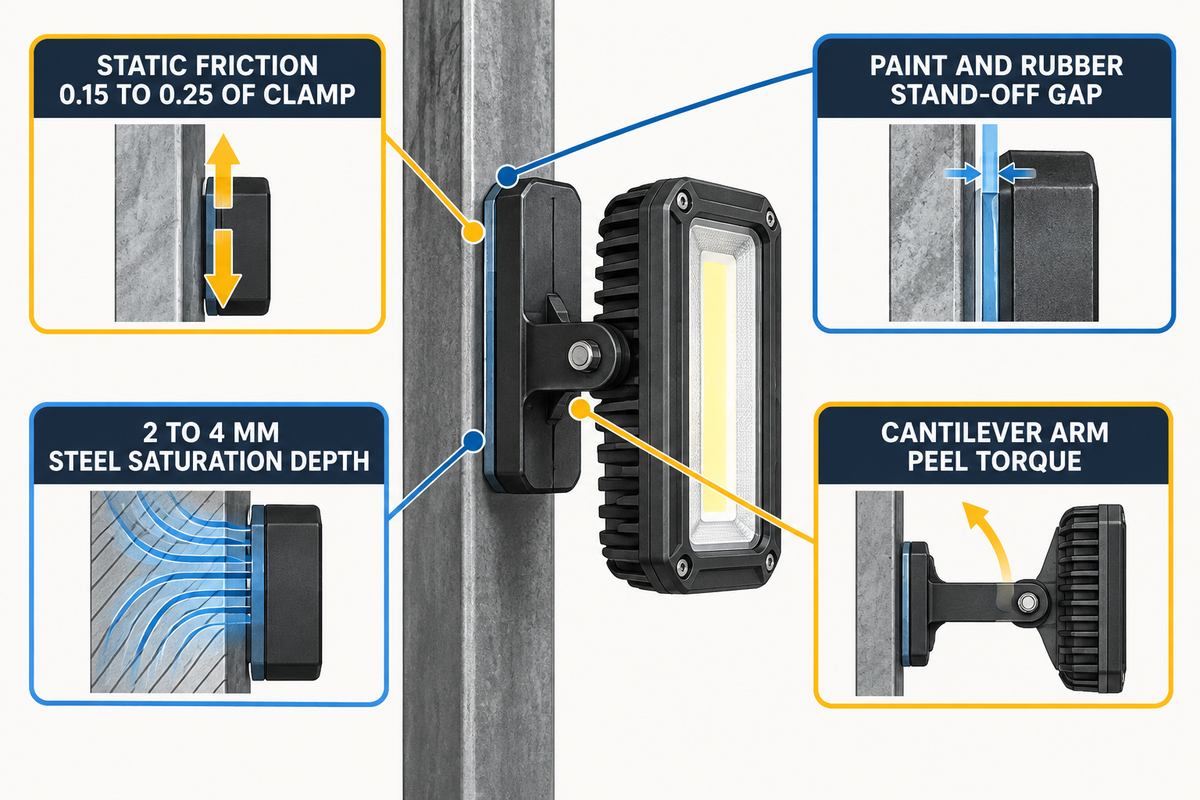
On clean, smooth bare vertical steel, TotalElement puts static friction for a nickel-plated magnet at roughly 0.15 to 0.25 of actual perpendicular clamping force . Paint, rubber covers, thin panels, and arm overhang cut real clamping force below lab pull ratings, requiring target-panel verification.
Imagine trying to push a heavy block sideways against a vertical steel post. Magnetic attraction supplies the inward normal squeeze. Friction opposes gravity pulling the heavy lamp down. Pull labels indicate the tension needed to break away from a thick, flat steel plate. In this test setup, the steel plate is unpainted, with its surface perpendicular to the pull axis. Mounting a heavy lamp sideways against a vertical steel post turns weight into shear. For example, if you turn that same base through a 90 degree angle onto a painted lift post, real-world slip resistance is governed by surface friction, an air gap, and prying torque.
Protective base covers alter clamping forces and friction in opposing directions. Bare nickel-plated magnets maintain zero air gap on clean steel, yet smooth metal-on-metal contact keeps static friction near that 0.15 to 0.25 fraction . K&J Magnetics’ painted car-roof tests illustrate thin sheet plus rubber stand-off. Its MM-E-32 magnet, rated 75 lb on thick steel, measured just 6.6 lb straight pull and 7.4 lb sideways shear with its rubber cover installed . Conversely, K&J Magnetics saw a smooth waterproof plastic-coated magnet suffer direct sliding failure on a car roof from low shell friction.
In the case of bare neodymium magnets, per TotalElement, small magnets can hold on thin sheet metal, whereas some large strong magnets may require 2-4 mm of steel. Pot-magnet circuits and the stiffness of the panel affect the actual saturation limits. The 9-Condition Magnetic Shear-Slip Derating Table below compiles published benchmarks from TotalElement and K&J Magnetics alongside their test conditions.
| Mounting Condition & Test Article | Published Pull / Shear Figure | Governing Physics Mechanism | Source & Sizing Rule |
|---|---|---|---|
| Overhead straight pull on thick unpainted steel (2 to 4 mm+) | Direct tension load along pull axis | Zero air gap and full magnetic flux return in thick steel | TotalElement: size rated straight pull at ≥1.5× fixture weight |
| Vertical clean smooth bare steel (50 lb magnet developing full 50 lb normal clamp) | 7.5 to 12.5 lb model slide limit (0.15–0.25 of actual clamp) | Metal-on-metal static shear friction scales with actual normal clamping force | TotalElement bare-steel guide: ≥7× rated straight-pull vs fixture weight |
| Vertical thin bare sheet metal (TotalElement thin-sheet example) | 50 lb rated pull example for a 5 lb vertical load | Thin steel can saturate early depending on magnet size and cup circuit | TotalElement bare-steel guide: step toward 10× fixture weight and bench-test |
| Rubber-covered MM-E-32 magnet on painted car roof (K&J vehicle test) | 6.6 lb straight pull & 7.4 lb sideways shear vs 75 lb rating (cover thickness alone cuts pull up to 75%) | Rubber stand-off air gap plus painted thin vehicle roof sheet | K&J Magnetics: verify hold on actual painted panel |
| Waterproof smooth plastic-coated magnet on painted car roof | Direct sliding failure in vehicle push/wind test | Hard plastic shell lowers interface friction vs rubber cover | K&J Magnetics: prefer grippy rubber boots over slick plastic |
| Dynamic airflow / mobile vehicle exterior (60mph vs 30 mph) | 24 lb vs 6 lb drag force (4 times force jump) | Aerodynamic shear load scales with velocity squared | K&J Magnetics: remove magnetic work lights before driving |
| Hot steel near manifolds or weld preheat (K&J N42 D82 disc test) | Irreversible loss began above 80°C in tested N42 disc | Operating point drops past B-H curve knee (threshold varies with shape/circuit) | K&J Magnetics: check grade thermal curve for base geometry |
| High-temperature neodymium grade (N42SH) near warm metal | 302F (150C) max operating temperature spec | Higher intrinsic coercivity raises thermal demagnetization resistance | K&J Magnetics (check lithium pack 32°–113° F limit separately) |
| Aluminum pickup hood or annealed 304/316 stainless panel | Negligible magnetic hold on non-ferromagnetic sheet | Non-ferromagnetic or low-permeability alloy fails to close flux loop | Switch to spring clamp, stowable hook, or floor tripod |
Worked Slip Calculation (Assumed bare-steel inputs): Suppose a machinist mounts a 3 lb corded lamp sideways on a bare 15 lb pull-rated magnet against clean vertical steel. TotalElement’s 0.15 lower bare-steel friction fraction yields 15 lb × 0.15 = 2.25 lb of slide resistance, already below the 3 lb lamp weight . TotalElement’s 7× bare-steel starting rule puts un-gapped pull screening at 3 lb × 7 = 21 lb before adding paint or rubber-boot margin.
How Does a Magnetic Light Work on Vertical or Overhead Metal?
Overhead mounts hold fixture weight in direct tension (≥1.5× rated pull vs weight on thick bare steel per TotalElement), while vertical mounts rely on static friction . Industrial magnetic LED lights often seat permanent magnets inside steel cups or rubber-booted bases, unlike architectural magnetic track lighting. Because cantilevered heads add peel torque and engine heat lowers coercivity, always test vertical hold with the arm extended.
Lumens vs Task Lux: How Bright Should an Adjustable LED Work Light Be?
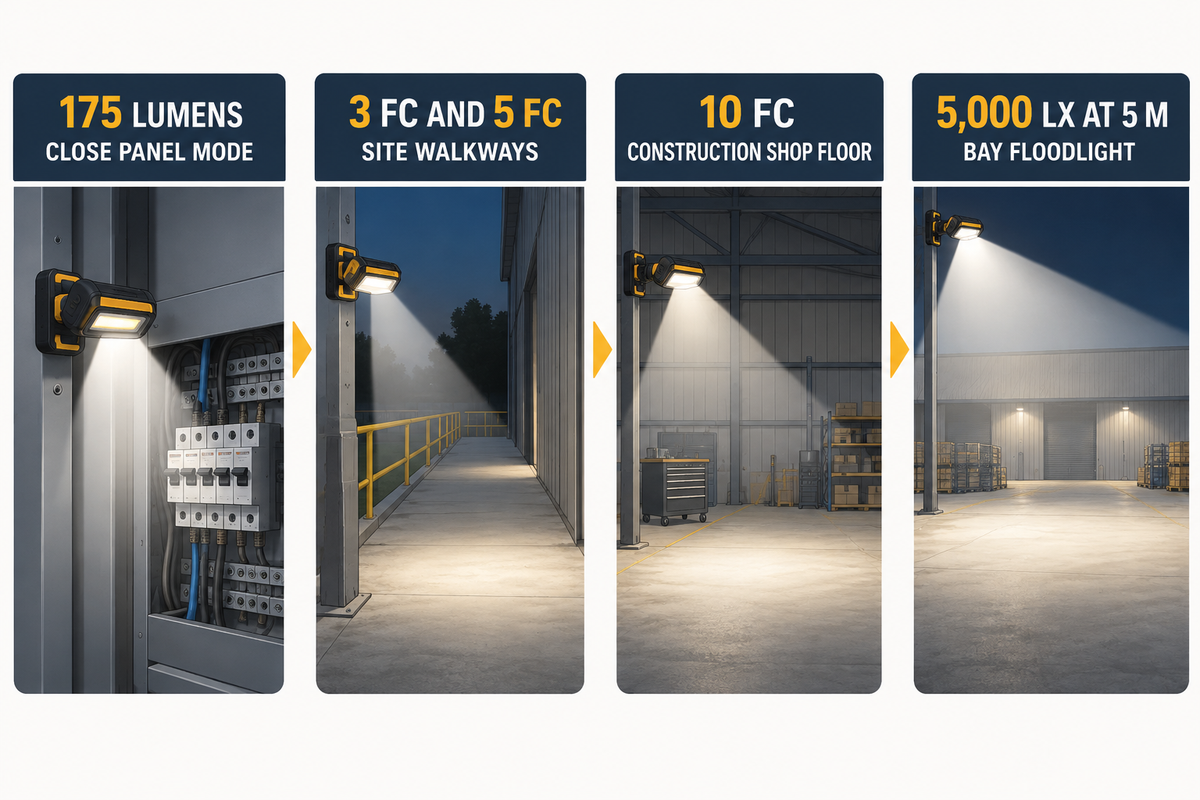
Personal magnetic inspection pods commonly publish 175 lumens on Low to 460 or 500 lumens on High for close-range mechanical work. On construction jobsites, OSHA 29 CFR 1926.56 Table D-3 sets ambient area illuminance minimums of 3, 5, and 10 foot-candles across active work zones.
Buyers often confuse raw emitter lumens with illuminance reaching the task plane. Statutorily, OSHA 29 CFR 1926.56 covers construction sites rather than general-industry auto bays. Per 1000Bulbs’ summary of 1926.56, loading platforms, refueling, and excavation sites require 3 fc, while indoor corridors require 5 fc . Construction shops, plus tunnel and shaft headings during drilling, mucking, and scaling, require 10 fc ambient floor lighting. The Canadian Centre for Occupational Health and Safety (CCOHS) advises adding local task lighting and reflected light to clear body shadows while angling heads against glare.
Bare COB LED work bars delivering 1200 lumens, or a 3000-lumen underhood flood bar, can bounce harsh reflected glare off shiny stainless panels when aimed straight at close range. A frosted lens softens hotspots and neutral 5000K color temperature keeps white light balanced. High color rendering (CRI) then helps electricians distinguish faded red, orange, and brown wire insulation. Across open bays, LFADJ’s LF6119 dual-head portable work light lists 5,000 lx at 5 m for standoff floodlighting . See our companion guide on evaluating usable task illuminance in portable LED work lights.
| Work Task & Standoff Geometry | Published Fixture Output Example | Published Illuminance Benchmark | Glare & Beam Control Rule |
|---|---|---|---|
| Close panel diagnosis & low-glare reading | 175 Lumens Low mode (Klein Tools 56403) | CCOHS local shadow-free task lighting | Step down brightness inside shiny metal enclosures |
| Arm’s-length engine bay & suspension car repair | 460 Lumens (Klein 56403) to 500 lumens (BRAUN 71095) | Refueling/excavation: 3 fc; walkways/corridors: 5 fc (OSHA 1926.56) | Aim wide COB flood light across components at an oblique angle |
| Construction shop floor & active tunnel/shaft heading | Adjustable flood bar delivering 800 lumens to 1200 lumens | OSHA 1926.56 ambient floor minimum: 10 fc in construction shops and in tunnel/shaft headings during drilling, mucking, and scaling (bench work needs higher local task lux) | Mount above eye level with diffused optics and adequate CRI |
| Multi-crew plant turnaround or outdoor job site | 2 × 55 W dual heads (LFADJ LF6119) | 5,000 lx point illuminance at 5 m (LFADJ spec) | Raise floodlight heads above operator sightlines |
What’s Better, 800 Lumens or 1,000 Lumens for Close Inspection?
Neither 800 lumens nor 1,000 lumens wins on raw lumen count alone for arm’s-length inspection. Whether buyers prefer 2-mode pods or a mechanic light advertising 3 modes of dimming, lens diffusion and high CRI make far more difference. According to CCOHS lighting ergonomics, bare emitters aimed along an operator’s sightline onto shiny metal can cause disabling specular glare. Frosted optics, oblique angles and lower dimming modes mitigate reflected glare and extend battery life.
Slim Light Bar, Gooseneck, or Swivel Pod: Choosing the Right Form Factor
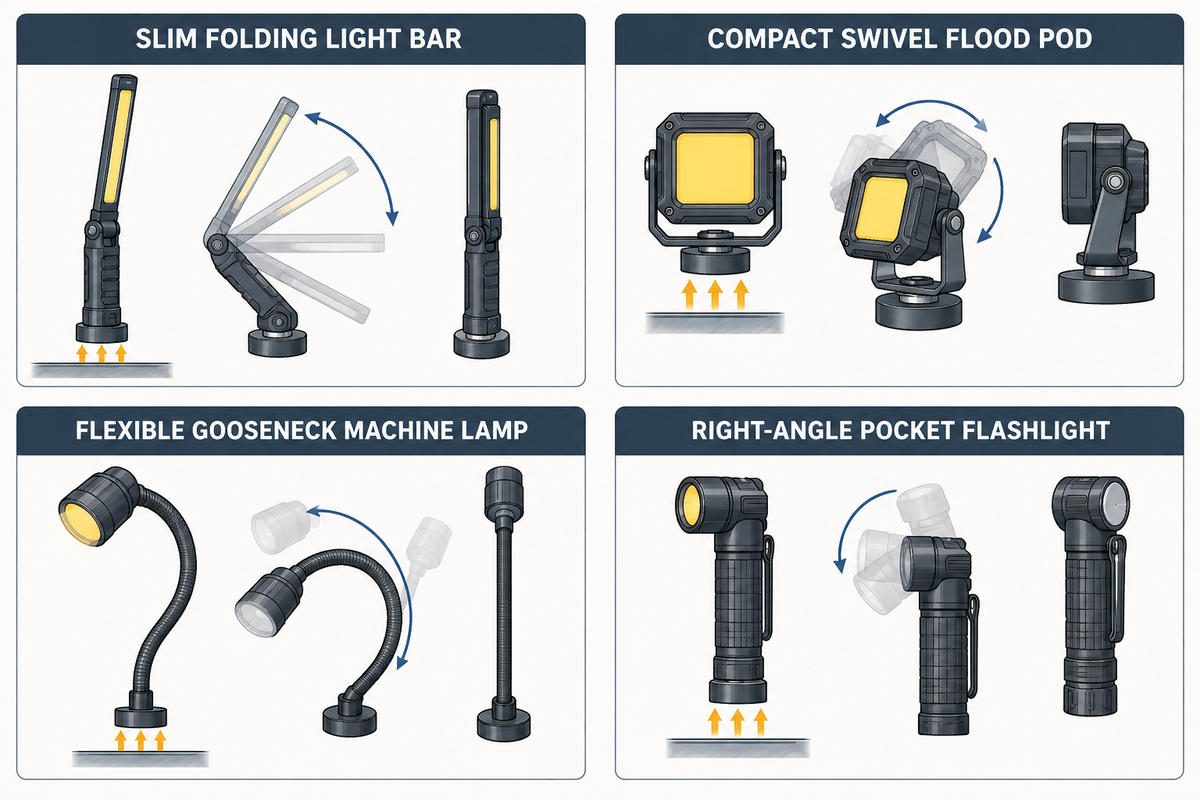
For narrow engine bays use a slim folding stick light, and for panel maintenance use a compact 360° rotation pod. For cast-iron lathes, use a stiff gooseneck LED machine lamp. Keeping hinge mass close to the magnet base limits the prying torque on the vertical steel.
All articulated arms act as moment arms against their magnet base. U.S. Patent US12050000B1 notes prior-art light devices separating the light source from a base member via a flexible neck. Extending a heavy lamp head outward creates a prying moment that can lift one magnet edge or cause it to slip.
Folding bars and magnetic bases commonly share one tool body. Harbor Freight’s BRAUN 71095 pairs a 500-lumen foldable design wand with a magnetic kickstand base and 360° swivel hook . Long wands can still catch on pedals under tight dashboards. Compact pods like Klein Tools’ 56403 use a rotating design (360 degrees head, 270 degrees kickstand) to aim bright lighting out of corners . A pocket light or right-angle magnetic flashlight suits quick walkdowns.
| Form Factor | Articulation & Beam Geometry | Best Shop Application | Mechanical Failure Risk |
|---|---|---|---|
| Slim folding light bar (stick light) | Folding blade + magnetic base + swivel hook (e.g., BRAUN 71095, 500 lumens) | Wheel wells, timing covers, and narrow engine slots | Horizontal blade extension increases prying torque on thin fenders |
| Compact swivel flood pod | Dual-axis head and magnetic kickstand (e.g., Klein Tools 56403) | Breaker panels, HVAC service, and hands-free magnetic bench work | Shorter reach behind deep intake manifolds |
| Flexible gooseneck shop tool lamp for lathe | 360° pivot flexible neck over heavy switchable or pot magnet base | Cast-iron CNC mill columns, drill presses, and manual lathes | Long neck droops or walks under spindle vibration if base is undersized |
| Right-angle magnetic flashlight / pocket light | Right-angle emitter head with tail-cap magnet and pocket clip | Line walkdowns, emergency use, and utility service bags | Narrower spot hotspot requires frequent repositioning |
Rechargeable Battery Life, USB-C Inputs, and Real Shift Runtime
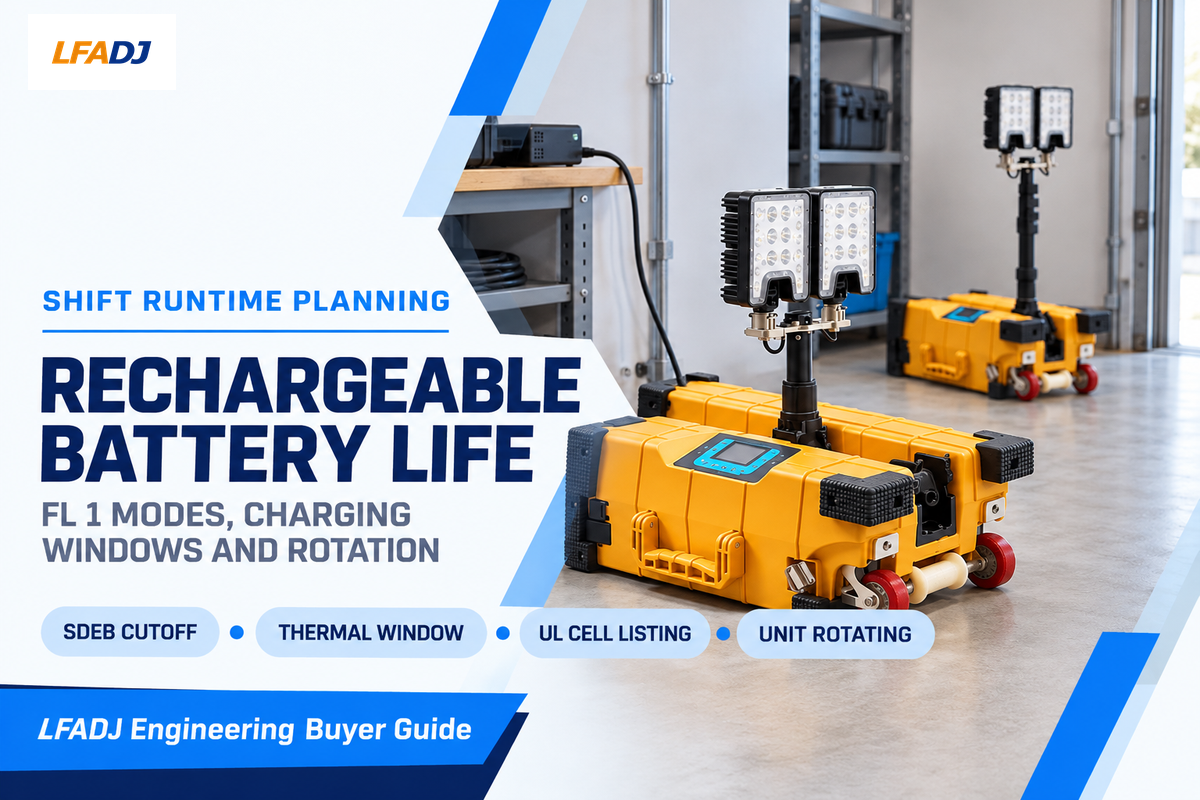
Published magnetic rechargeable work light runtimes span wide mode brackets across models. Klein Tools rates its 56403 pod at 460 Lumens for 9 hours on High and 175 Lumens for 16 hours on Low . Harbor Freight’s BRAUN 71095 lists up to 14.5 hours on floodlight and 26 hours on flashlight .
Under PLATO’s ANSI/PLATO FL 1-2025 testing guidance, traditional long runtime curves allow deep output decay before stopping the clock. By contrast, the new Short-Duration Elevated Brightness (SDEB) Turbo/Boost test stops much earlier. In PLATO’s SDEB benchmark example, if peak initial illuminance hits 1,000 lux, SDEB runtime ends once output reaches 900 lux.
“For example, if the maximum measured output during that initial interval is 1,000 lux, runtime ends when output reaches 900 lux.”
Charging ports and safety evaluations separate disposable utility light wands from industrial crib tools. Models like Klein Tools’ 56403 specify DC 5V, 1.3A charging input and charging temperatures from 32° to 113° F and storage temperatures from -10° to 55°C . Newer cordless bars adopt sealed USB-C rechargeable inputs for shared shop cables. Per UL Solutions, UL 153 Supplement SA requires UL 1642 or UL 62133-2 lithium cells. It also verifies that luminaire charge and discharge limits match cell maker specs.
Multi-shift maintenance teams also need to account for recharge downtime. Sealed USB charging wands stay offline while plugged in unless designed for pass-through dual power or corded 120V AC operation. Crews running M12, DeWalt 20V MAX, or Ryobi cordless tools can swap slide packs in seconds on bare tool flood lights. Portable magnetic lights follow voluntary runtime curves rather than fixed NFPA 101 building egress rules. Lighting vendor Rock Lighting notes emergency-power egress paths may decline over 90 minutes to at least 0.6 foot-candle average and 0.06 foot-candle minimum . . Fleet managers can use our whole-unit shift coverage and recharge roster to stagger chargers.
How Long Does Magnetic Light Power Last on High Brightness?
Moderate-output personal pods like Klein Tools’ 56403 carry a 9-hour High rating at 460 Lumens . Super bright bars step down to protect cells and long battery endurance. Specialized structural firefighting lights face harsher heat rules: Best Pocket Clips notes NFPA 1971-8.6 requires withstanding 500°F (260°C) for five minutes without failure . Winter bays below 32° F breach Klein’s 32° to 113° F charging spec and cut lithium-ion capacity. Only rechargeable light packs with low-temperature cutoff block sub-freezing charging.
Automotive Bays vs Machine Shops: Aluminum Panels, Cutting Fluids, and Swarf
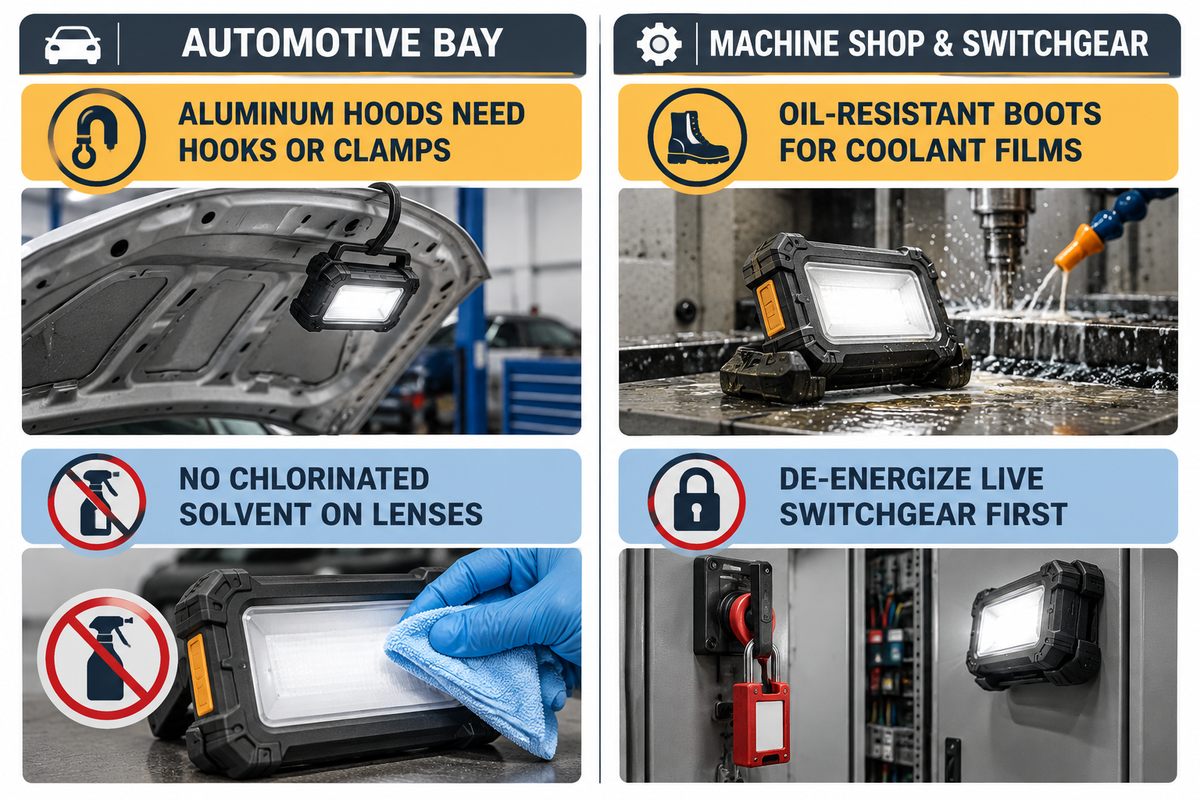
Aluminum vehicle closures are non-ferromagnetic, and annealed 304 or 316 austenitic stainless steel is typically non-magnetic. Cold working can lead to partial attraction in 304 or 316 sheet but may not provide enough hold for a work light. In CNC shops and switchgear rooms, coolant films, swarf and OSHA’s electrical rules govern mounting.
Mechanics working on late-model pickups and electric vehicles find that magnet-only wands drop straight off aluminum hoods and composite liftgates. Trade coverage in Vehicle Service Pros highlights inspection LEDs pairing magnetic mounts with stowable hooks. This hybrid hardware makes a slim folding bar ideal for auto repair on hood strikers and suspension springs. Don’t use a chlorinated solvent to clean uncoated polycarbonate lenses. It crazes the lens.
Machinists trying to mount LED magnetic lamps on vertical mill columns and lathe headstocks have a problem with coolant and metal chips. Shop practitioners commonly observe that water-soluble coolant lubricates smooth magnet faces, making oil-resistant rubber boots essential. Inside switchgear rooms, hands-free lighting stays subordinate to OSHA 29 CFR 1910.333 electrical safety practices. Always de-energize live circuits first, apply lockout/tagout, and keep conductive magnetic lights away from exposed energized busbars.
Will Magnets Damage Painted Surfaces?
Yes, bare magnet bases pick up ferrous swarf around grinders and brake lathes and gouge paint the first time the base is slid or twisted into place. On finished body work, use a rubber boot magnet base and remove stuck metal with tape.
Ingress Protection, PWM Stroboscopic Hazard, and Hazardous-Location Red Lines
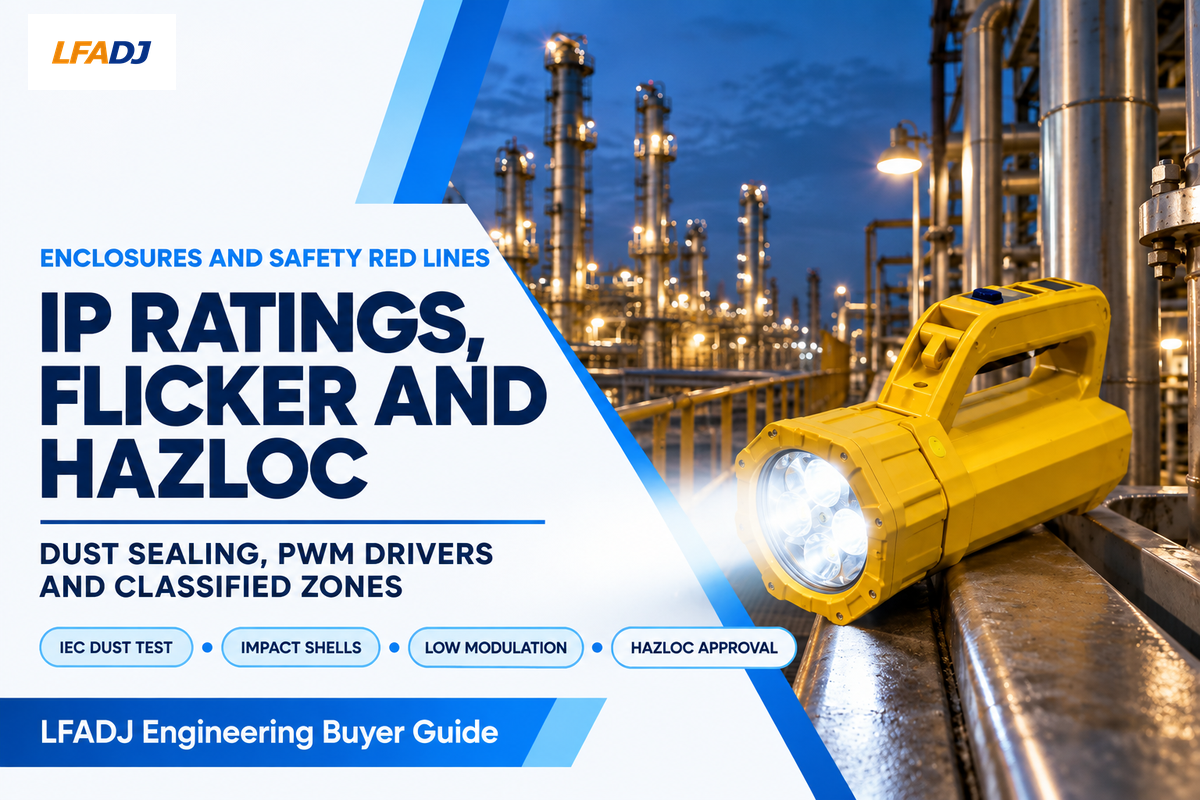
Match splash-resistant IP54 or water-jet-rated IP65 enclosures with separate drop ratings (Klein Tools’ 6-Foot drop test) or IK08 impact shells in wet bays. Around spinning shafts, higher drive frequencies (>12,000 Hz) can help reduce light modulation artifacts. Ignitable atmospheres require the use of certified hazardous location luminaires.
Dust and water ratings now face pre-heated testing. Under ANSI/PLATO FL 1-2025, PLATO added IEC 60529 dust testing after running the lamp for 5 minutes on its highest non-SDEB mode. That pre-heat step checks whether cooling internal air draws fine dust past warm gaskets. Check sub-assemblies separately and test coolant seal compatibility: LFADJ rates LF6128 heads IP65 and its case IP54, whereas LF6119 carries IP65 throughout . For emergency responder gear, vendor Fire Safety Services notes NFPA 1970 took effect in late 2024 to replace NFPA 1971, 1975, and 1982 .
Dimmed LEDs can distort how operators perceive spinning chucks and belts. Per U.S. Department of Energy Solid-State Lighting Flicker Research, stroboscopic and phantom-array effects can also appear at and below 80 Hz where direct flicker (3 to 80 Hz) dominates. Stroboscopic visibility measure (SVM) covers motion waveforms roughly from 80 Hz up to about 1000 Hz, and phantom arrays reach 11,000 Hz in dark spaces. High-frequency (>12,000 Hz) switching or non-PWM waveforms help reduce modulation, though driver ripple can still affect output.
⚠️ Hazardous-Location Red Line (OSHA 29 CFR 1910.307)
An IP65 rating covers dust and water jets rather than hazardous-location suitability. Under OSHA 29 CFR 1910.307, equipment for use in classified areas must bear approved protection, e.g. intrinsic safety or explosion-proof construction. Approval must be given for both the location class and the specific ignitable gas, vapor, dust, or fiber present. Uncertified ports or mechanical impact sparks may create ignition hazards in classified fuel, paint-spray, or grain-dust zones. Read our rules for explosion proof lighting and classified zones first.
Magnetic Base vs Clamp, Hook, Headlamp, and Tripod Work Lights
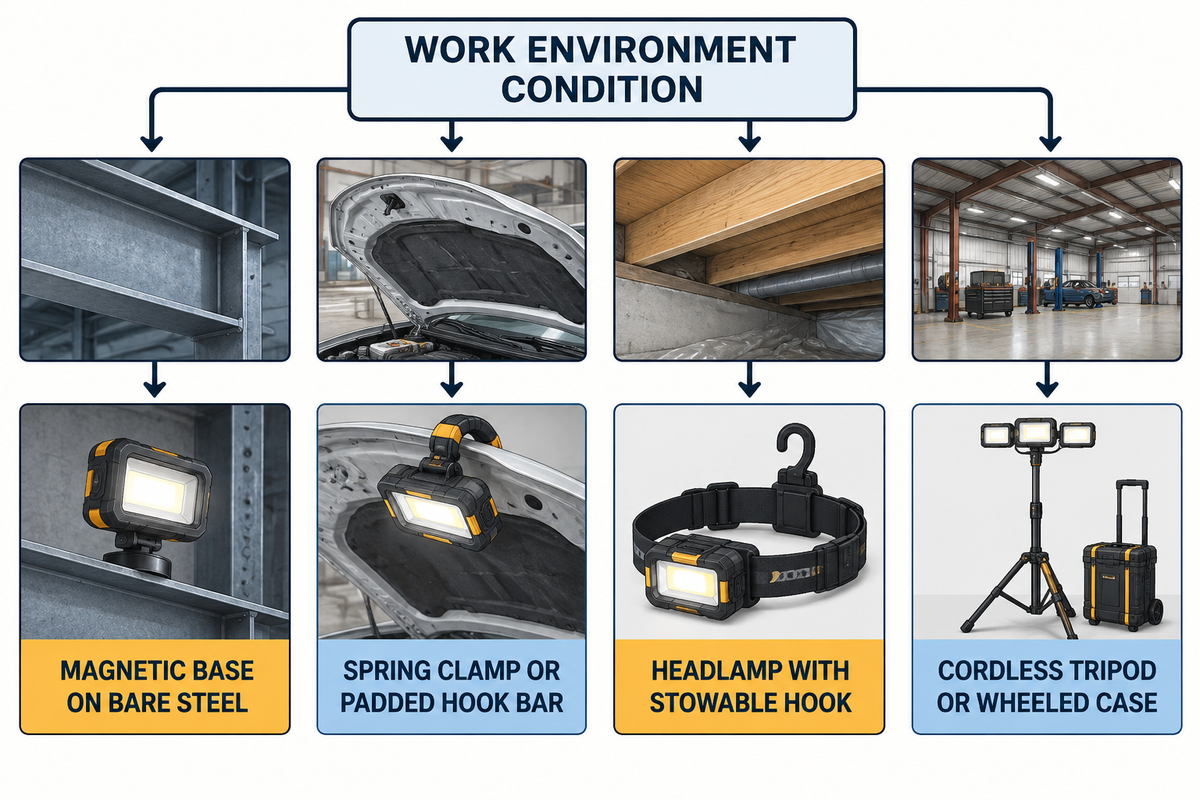
Select a magnetic base on unpainted structural steel ≥2 mm thick. Switch to a spring clamp light or padded hook bar for single-worker tasks on aluminum hoods or wood studs. Pair hands-free headlamps with stowable hooks for crawlspaces, and deploy cordless tripods or wheeled battery cases for crew zones. Suitable enclosure seals, hazardous-zone ratings, and mounting hardware support crews working across mixed bays.
Equipping a garage workshop or plant crib solely with magnet-only bars forces technicians to prop lamps on hoses around non-ferrous panels. Safety coverage in Industrial Safety & Hygiene News (ISHN) notes that hands-free magnetic placement keeps beams aimed without awkward neck posture. Real jobsites still mix steel columns, aluminum cabs, and open yards. Our article on how portable work light placement and power architectures compare covers site layouts; use the mounting architecture matrix below to determine tool placement.
| Mounting & Fixture Architecture | Target Substrate & Crew Task | Verified Spec Example | Limitations / Not Suitable When |
|---|---|---|---|
| Rubber-booted magnetic swivel pod | Steel structural columns, lift posts, and de-energized panel doors | Klein Tools 56403 (460 Lumens / 9 hours High, IP54, 6-Foot drop) | Aluminum panels, annealed 304/316 stainless, or hot steel in magnet demagnetization zones |
| Slim folding bar with magnet + swivel hook | Mixed steel/aluminum engine bays, wheel wells, and semi trailers | BRAUN 71095 (500 lumens, up to 14.5 hours floodlight) | Tight under-dash footwells or vertical thin sheet with horizontal foldout |
| Heavy magnetic gooseneck machine lamp | Cast-iron lathe headstocks and milling enclosures verified on actual surface | 120V AC or low-voltage CNC constant-current LED machine lamp | Thin <2 mm sheet metal or deep-PWM drivers near spinning chucks |
| Spring-jaw clamp light | Wood studs, pipe racks, aluminum ladders, and non-ferrous framing | Cordless 20V MAX or corded 120V clamp shop light | Flat flush walls and wide I-beams lacking a clamping edge |
| Padded underhood telescoping hook bar | Wide aluminum pickup hoods and EV frunk service bays | Dual-hook 3000-lumen underhood flood bar | Hoodless chassis cabs, undercarriage lifts, or narrow cabinets |
| Hands-free rechargeable headlamp / head light | Walking line inspection, crawlspace routing, and camping light backup | Hard-hat LED head light on Low/Medium inspection mode | Shared repair tasks where head motion dazzles coworkers |
| Cordless tripod stand / 20V MAX bare-tool pod | Stationary single-bay angles for M12, DeWalt, or Ryobi crews | Swappable slide-pack tripod or portable flood light | Narrow aisles where tripod legs create trip hazards or lack spare packs |
| Wheeled rechargeable battery case area light | Multi-worker plant turnarounds, rail maintenance, and outdoor yards | LFADJ LF6128 (554.4 Wh, 15.6 kg) / LF6119 (734.4 Wh, 20 kg) | Tight single-hand engine slots or stair routes unsuited to 15.6–20 kg cases |
Where Pocket Magnetic Lights Hit Their Ceiling: Stepping Up to Wheeled Shift Systems
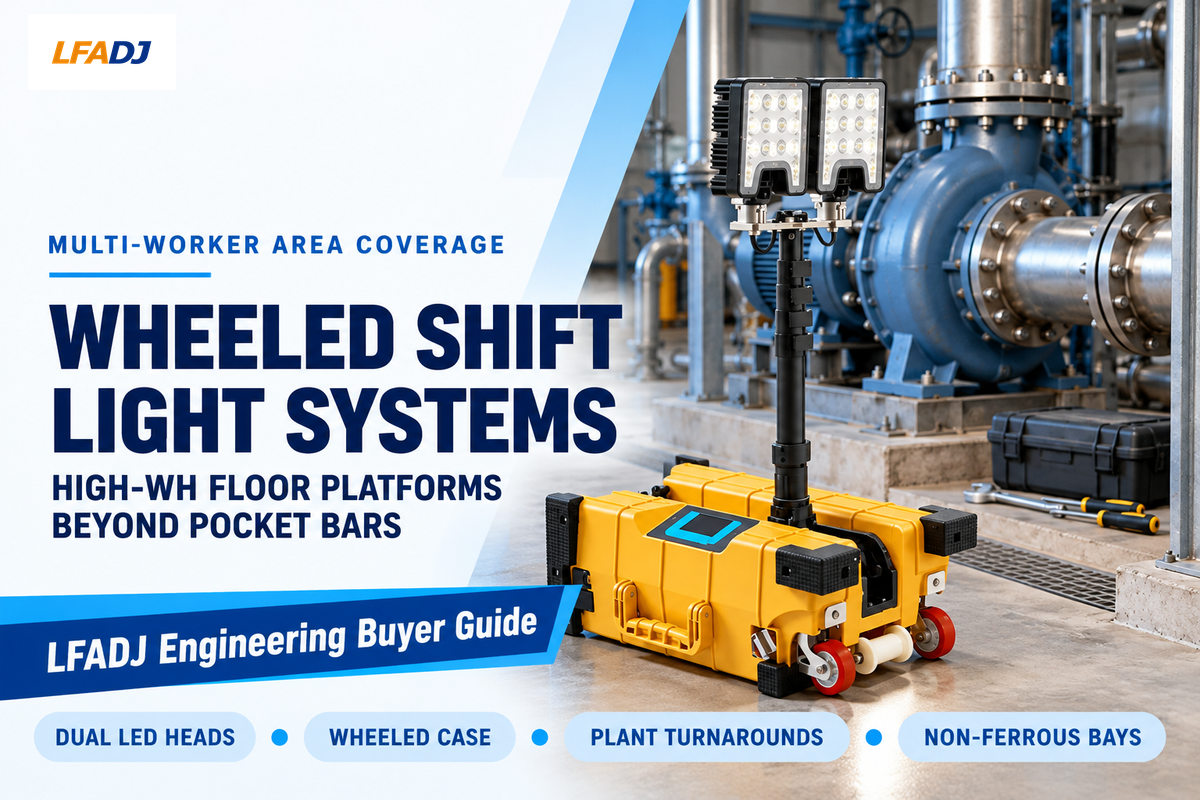
Pocket magnetic lights or hook bars are good for single-technician work in shadowed areas. A cordless tripod can be used for one fixed bay angle. A wheeled rechargeable battery case is better for multi-worker crews doing self-contained shift area lighting. LFADJ lists its 554.4 Wh LF6128 as operating for at least 8 hours.
Single-operator magnetic wands address close-range shadow pockets, not whole substation shutdowns or pipe-rack repairs. When non-ferrous surfaces block only a single mechanic, a stowable hook, clamp, or a light tripod is sufficient. When multi-trade crews need floor-standing floodlighting without generator cords, planners deploy wheeled rechargeable portable work light systems. Note LFADJ’s manufacturing scope directly: our 15.6 kg and 20 kg wheeled case platforms carry no magnetic bases. They complement, rather than replace, handheld magnetic inspection bars.
Shift Watt-Hour & Load Comparison: Multiply battery voltage by amp-hour capacity and compare against lamp head wattage. LFADJ’s 15.6 kg LF6128 pairs dual LED heads with a 25.2 V, 22 Ah lithium battery (25.2 × 22 = 554.4 Wh). It lists IP65 heads, an IP54 case, at least 8 hours of continuous operation, and charging within 6 hours . Among our higher-output dual-head portable LED work light platforms, the 20 kg LF6119 pairs 2 × 55 W heads with a 21.6 V DC, 34 Ah pack (734.4 Wh). It reaches an 1,860 mm height and 5,000 lx at 5 m . Running both 55 W heads (110 W combined) continuously caps theoretical energy at 734.4 ÷ 110 ≈ 6.68 hours before losses. Full-shift high-lux coverage therefore uses staged unit rotation with a charged spare.
Price Tiers, Brand Ecosystems, and the 6-Point Magnetic Work Light Field Test
Budget hardware-store folding bars like Harbor Freight’s 500-lumen BRAUN 71095 retail at $19.99 with 90 days of warranty . Commercial pods (Klein Tools 56403) and M12 or 20V MAX bare tools publish no fixed MSRP on manufacturer spec sheets and sell via distributor quotes.
Verified commercial datasheets omit fixed retail dollar figures, and bare-tool cordless floodlights sell battery packs and chargers separately. Fleet buyers should request bundled distributor quotes rather than comparing bare-tool tags against $19.99 consumer wands. Entry wands fit trunk backup, while industrial cribs buy 6-Foot drop and IP54 or IP65 ratings. Multi-unit wheeled cases are quoted to project battery Wh and plug specs; see our industrial work light and jobsite luminaire manufacturers guide.
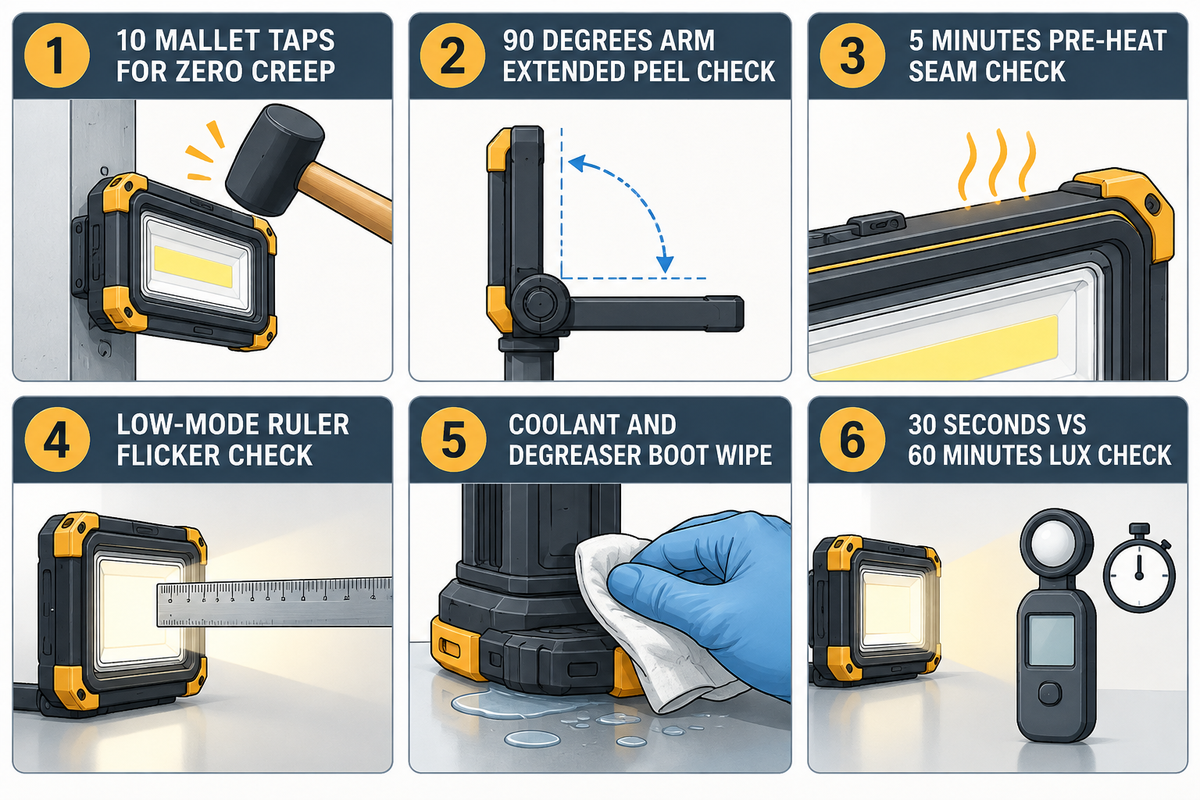
6-Point Magnetic Work Light Field Test (Pre-Purchase Bench Protocol)
- Weigh the complete lamp, mount it sideways onto the thinnest painted shop panel or cabinet door, and check for zero downward creep by tapping the panel lightly with a rubber mallet 10 times.
- Fold the slim blade or swivel head out 90 degrees horizontally from the vertical column and make sure the top magnet edge stays flush.
- Run High mode for 5 minutes (matching PLATO FL 1-2025’s dust-test pre-heat step) . Inspect USB port covers and lens seams for thermal gap warping.
- Dim to Low mode and wave a shiny metal ruler rapidly across the beam. Reject drivers showing discrete stroboscopic ghosts; DOE research notes that >12,000 Hz dimming or waveforms without deep PWM oscillation can help reduce artifacts .
- Wipe a sample corner of a rubber magnet boot with shop cutting coolant and degreaser to reject elastomers that swell or get slippery.
- Record lux at 30 seconds and 60 minutes on High mode to distinguish sustained shift illuminance from short SDEB Turbo bursts.
When writing fleet tool specs or B2B purchase orders, copy the benchmarks below into your RFQ package:
RFQ checklist — copy these into your quote request:
| Parameter | Recommended range | Why it matters | How to verify |
|---|---|---|---|
| Vertical magnetic mounting screening | TotalElement bare-steel starting rule: 7 to 10× rated straight-pull vs fixture weight (2 to 4 mm clean steel guide for large magnets) | Clean bare-steel friction is ~0.15–0.25 of actual clamp, while painted roofs, rubber covers, and extended arms cut hold sharply | Side-mount weighed sample on actual painted shop panel with head extended 90° |
| Magnet & battery thermal window | Check magnet grade curve for base geometry (e.g., tested N42 disc knee near 80°C vs N42SH 302F / 150C spec); Li-ion charge 32°–113° F | Demagnetization onset varies with grade, shape, and magnetic circuit, while cells enforce narrower charge limits | Confirm magnet grade thermal curve for cup geometry plus battery datasheet range |
| Runtime & SDEB Turbo disclosure | Separate High/Low FL 1 curves from SDEB bursts (1,000 to 900 lux cutoff example) | Prevents sizing full shifts on brief boost claims or ignoring wattage-to-Wh limits | Request ANSI/PLATO FL 1-2025 mode sheet and check battery Wh divided by head watts |
| Battery & luminaire safety listing | Battery-operated portable luminaire listing (such as UL 153 Supplement SA) | Confirms pack protection and integrated charger operating limits match cell ratings | Request luminaire safety listing certificate and pack datasheet |
| Ingress, impact & light modulation | IP54–IP65 dust/water ingress; separate 6-Foot drop or IK08 impact rating; >12,000 Hz or non-PWM low-oscillation driver | IP water tests exclude coolant chemistry, drop and IK ratings measure distinct impacts, and deep PWM can cause stroboscopic hazards | Verify sub-assembly IP ratings, elastomer coolant compatibility, and low-mode waveform |
| Hazardous-location & electrical work rules | OSHA 29 CFR 1910.307 Class/gas-group approval; 1910.333 lockout/de-energizing | Uncertified lamps risk vapor ignition and conductive bases hazard energized busbars | Check nameplate Class/Zone gas-group approval and verify zero-energy state before hang |
What Is the Best Rechargeable Magnetic LED Work Light by Architecture?
A 500-lumen folding slim bar with a stowable hook fits tight engine slots best, whereas a 460-lumen swivel pod leads personal panel maintenance . Among the best magnetic work lights in our verified dataset, Harbor Freight’s BRAUN 71095 covers budget folding bars, and Klein Tools’ 56403 adds 9-hour High runtime plus USB-A 5V, 0.5A output. M12 or 20V MAX packs swap onto each bare-tool rechargeable LED work light, while shift zones use wheeled battery cases.
Design Shifts Reshaping Magnetic Work Lights: Aluminum Closures, USB-C PD, and High-CRI Emitters
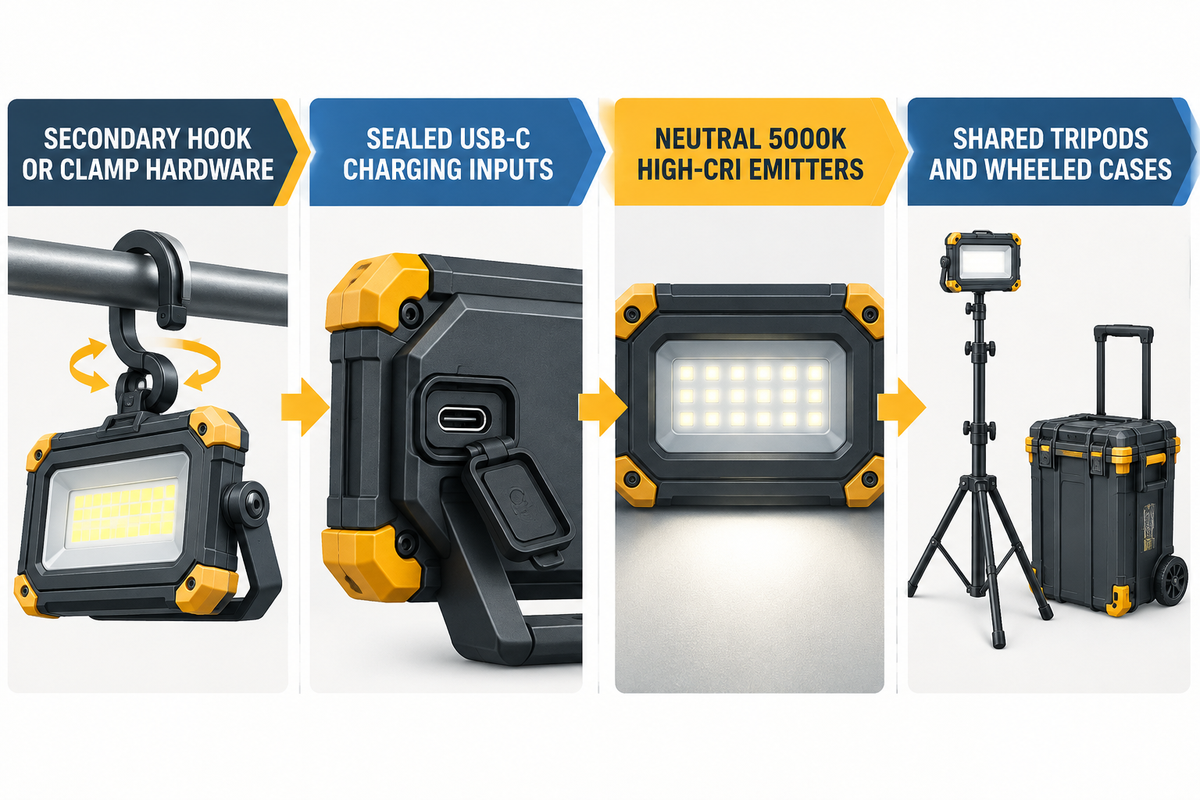
Three shifts are retiring older magnet-only Micro-USB wands from commercial tool cribs across 2026 maintenance fleets. Aluminum vehicle body closures can require a hook or clamp, sealed USB-C inputs can replace proprietary cradles, and short-burst boost claims should be separated from sustained output when reporting performance per ANSI/PLATO FL 1-2025.
Updated test standards give tool buyers clearer procurement baselines. Per Brinyte’s summary of PLATO’s release, PLATO published ANSI/PLATO FL 1-2025 on February 2, 2026 as its biggest update since 2009 . It adds SDEB Turbo/Boost testing alongside pre-heated IEC 60529 dust checks. Portable inspection lamps also stay distinct from fixed facility emergency lighting, where Consulting-Specifying Engineer’s NFPA 101 summary notes monthly 30-second functional checks and written records .
For shop standardization, phase out magnet-only wands lacking a secondary clamp or swiveling hook for aluminum panels. For personal inspection lamps, standardize on USB-C charging and high-CRI neutral white 5000K emitters. Assign shared bay floodlighting to cordless tripod or wheeled battery units.
Frequently Asked Questions About Magnetic Work Lights
Q: Which magnetic base flashlight is the best for mechanics vs industrial maintenance?
In our verified dataset, Harbor Freight’s 500-lumen BRAUN 71095 ($19.99) is the best budget magnetic-base flashlight-bar hybrid for mechanics .
It pairs an up to 26-hour top flashlight beam with an up to 14.5-hour flood blade and 360° hook. For industrial panel service, Klein Tools’ IP54-rated 56403 (460 Lumens, 9 hours High, 6-Foot drop) leads our personal magnetic pods, while cylindrical tail-cap flashlights outside our dataset require separate spot-throw and UL cell checks .
Q: Can a magnetic work light damage vehicle electronics, sensors, or lithium-ion batteries?
No – a static permanent magnet base won’t erase solid-state vehicle ECUs, flash memory, smartphones, or lithium-ion cells through a steel enclosure.
Modern vehicle modules store data electronically rather than magnetically. During live diagnostics, just keep strong neodymium bases away from Hall-effect wheel-speed sensors, ABS tone rings, magnetic reed switches, electronic compasses, and active medical implants.
Q: Why do neodymium magnets permanently lose holding strength near exhaust manifolds or welding arcs?
K&J Magnetics describes roughly 80 °C as a typical operating limit for standard neodymium grades; exceeding it can cause irreversible strength loss when the magnet’s operating point crosses the knee of its demagnetization curve.
Thicker magnets or closed steel cups shift that B-H curve threshold across exhaust and weld zones, whereas high-coercivity N42SH carries a 302F (150C) max operating spec (subject to lower lithium battery heat limits).
Q: Is 4,000 lumens too bright for a close-range magnetic work light?
An unshielded 4,000-lumen emitter can cause severe glare at arm’s length when its reflection in bare metal enters the viewer’s eyes; aiming the light away from that reflection path reduces glare.
Inside reflective cabinets or engine bays, emitter luminance, lens diffusion, and viewing angle govern glare; step down to low inspection modes close up.
Q: Do magnetic work lights stick to stainless steel?
Ferritic, martensitic, and duplex stainless steels attract magnets, whereas annealed 304 and 316 austenitic grades are typically non-magnetic.
Cold-forming 304 or 316 panels can create slight magnetic pull, yet rarely enough grip to hold an inspection lamp; keep a clamp or hook handy.
Q: How do industrial crews light a full night shift when magnetic lights run out of battery?
For zone lighting, crews can pair pocket magnetic inspection wands with wheeled rechargeable floodlights or swappable tool-pack floodlights.
LFADJ lists its wheeled LF6128 (25.2 V, 22 Ah = 554.4 Wh) for at least 8 hours of operation and charging within 6 hours. Its higher-wattage LF6119 (21.6 V DC, 34 Ah = 734.4 Wh, 2 × 55 W heads) covers high-lux area jobs when staged across rotated spare units.
Our Industrial Lighting Engineering Perspective
Founded in 2013 in Yueqing, Zhejiang, LFADJ manufactures wheeled rechargeable portable work lights, telescopic light towers, and explosion-proof luminaires. Maintenance buyers regularly ask us where handheld magnetic work light bars stop and floor-standing shift systems take over. This guide pairs published magnet shear physics with OSHA, DOE, UL, and ANSI/PLATO FL 1-2025 benchmarks. Reviewed by the LFADJ technical team (Zhejiang Longfa Lighting Co., Ltd.).
Need Full-Shift Rechargeable Area Work Lights Beyond Pocket Magnetic Bars?
Floor-standing systems become more advantageous than handheld magnetic lights across large multi-worker turnarounds, outdoor yards, and non-ferrous bays. Compare LFADJ’s LF6128 (554.4 Wh, 15.6 kg case, at least 8 hours operation) and LF6119 (734.4 Wh, 1,860 mm mast, 5,000 lx at 5 m) wheeled lighting platforms.
References & Sources
- 1926.56 – Illumination (Table D-3 Minimum Illumination Intensities) Occupational Safety and Health Administration, U.S. Department of Labor (OSHA)
- Lighting Ergonomics – Survey and Solutions Canadian Centre for Occupational Health and Safety (CCOHS)
- US12050000B1, Light with Adjustable Tail for Articles United States Patent and Trademark Office (Google Patents)
- ANSI/PLATO FL 1-2025: Getting the Testing Right Portable Lights American Trade Organization (PLATO)
- UL 153 Expanded to Add Battery-Operated Portable Luminaires UL Solutions
- Portable LED Work Light Underhood & Bay Service Coverage Vehicle Service Pros
- 1910.333 – Selection and use of work practices (Electrical) Occupational Safety and Health Administration, U.S. Department of Labor (OSHA)
- Flicker Research, Solid-State Lighting U.S. Department of Energy (DOE)
- 1910.307 – Hazardous (classified) locations Occupational Safety and Health Administration, U.S. Department of Labor (OSHA)
- Magnetic-Mount LED Work Light Industrial Task Coverage Industrial Safety & Hygiene News (ISHN)