Get in touch with LFADJ Company

Electric Mast Light Towers
Electric Mast Light Towers for Industrial Site Lighting
LFADJ Electric Mast Light Towers help you plan powered mast operation around the lighting task, site supply and deployment routine. We provide product consultation for construction, equipment maintenance and emergency work, then discuss the complete configuration for your enquiry.
- Separate mast actuation from lamp power before comparing equipment.
- Match the LED light package to the work area and shift schedule.
- Send quantity, destination and operating requirements for a project quotation.
Application selection
For your application, we select lighting configurations around the environment and operating requirements.
Customized lighting
For temporary operations, we develop customized lighting solutions around industrial production requirements.
Technical discussion
For project requirements, we provide technical communication throughout configuration discussions.
Product-use support
For product-use questions, we provide product-use advice through our service network.
Electric Mast Controls and Deployment Fit
The deployment plan for a lighting mast includes positioning, stabilization, lifting, aiming, inspection and recovery. The incorrect power labels identify which circuit operates the mast; an electric light tower describes a lighting supply choice, while an electric mast describes power operations of a mast. Because power motion depends on more than lamp supply, LFADJ discusses mast operation as part of the project configuration.
Specify the actuator and its energy source
An electric motor can drive an electric winch or a hydraulic pump, so electric and hydraulic are not interchangeable classification labels. The actuator, controls and load-holding arrangement need their own entries in the proposal. ISO 14118:2017 also separates supplied and stored energy when addressing unexpected start-up.
Mast, Power Fit Sheet
| System | Detail to specify | Result for your project |
|---|---|---|
| Mast actuator | Cable winch, hydraulic cylinder or other named mechanism | Inspection and service tasks match the actual mechanism. |
| Lifting supply | Voltage, current, source and connection point | The lift circuit is distinguished from the lighting load. |
| Lamp supply | Onboard generator, external power, battery or agreed package | Shift duration and site access drive the supply choice. |
| Controls and recovery | Control location, operating limits and documented power-loss procedure | A stalled mast delays relocation when recovery is undefined. |
| Connection topology | Integral loads, outlets, external loads and bonding diagram | Electrical review uses the actual installation arrangement. |
SYS. OP
We select lighting configurations around the application environment and operating requirements.
LFADJ application support
Prepare your mast and power enquiry
Power Packages and Lighting Load
We discuss product configuration according to the project requirements, including mobile, towable and lifting lighting equipment. Keep diesel engine rating, generator output, rated lamp input and lifting supply separate when comparing a portable light tower.
D953 Electric-Mast Diesel Reference
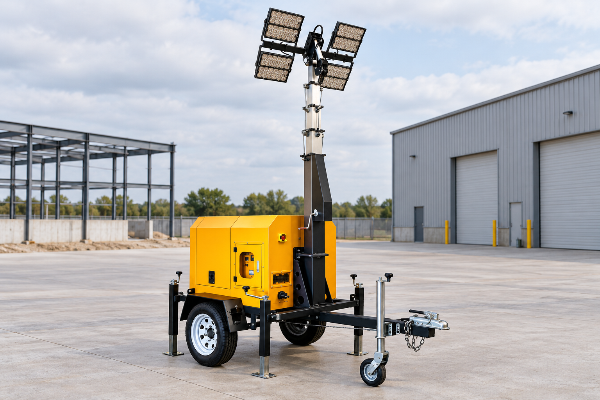
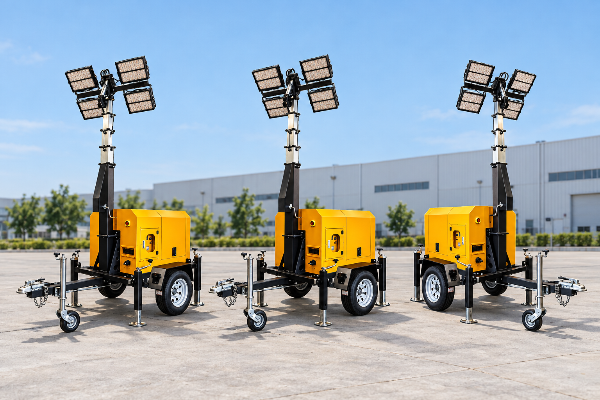
The published D953 platform includes a 7 m electric mast, four 400 W LED lights, and a water-cooled Kubota Z482 engine. Use this arrangement as a reference when making inquiries and specify the selected model, revision and options in the equipment proposal.
| Configuration item | D953 reference | Enquiry detail |
|---|---|---|
| Mast height | 7 m | Requested working height and deployed limits |
| LED lamp count | 4 | Lamp positioning and beam distribution |
| Rated input per lamp | 400 W | Selected fixture and driver package |
| Total rated lamp input | 1,600 W / 1.6 kW | Listed separately from generator output |
| Engine | Kubota Z482 | Engine package and service items |
| Container planning | 20 ft: 4 units | Packing arrangement for the selected configuration |
| Container planning | 40 ft: 8 units | Packed dimensions, weight and loading plan |
| Mast operation | Electric lifting | Actuator, controls, supply and recovery instructions |
01
Lamp energy example
Four 400 W lamps operated at rated input for 10 hours use 16 kWh of lamp energy. This arithmetic is not a substitute for generator sizing, fuel consumption or a battery runtime calculation.
Calculate your lamp schedule02
Auxiliary-load scope
Auxiliary loads compete with the lighting package for generator capacity. List connected tools, starting loads, outlets and mast demand for electrical review under the applicable project rules, including OSHA 1926.404 for US construction.
LED Light Output and Worksite Illumination
A construction site lighting plan begins with the task area, obstructions, access routes and people in the area. Glare from vehicle lights will negatively affect a lighting plan for night work, even if the lamp wattage appears adequate.
- Mark jobsite dimensions, work zones, vehicle routes and the boundaries where light spill matters.
- State the required task illuminance and uniformity, with the measurement plane.
- Request lamp photometry, mounting height, beam direction and aiming assumptions.
- Check shadows and glare from the positions occupied by workers and passing drivers.
OSHA 1926.56 lists 5 foot-candles for general construction area lighting, with different minima for other specified tasks. Its task table and the Purdue 2022 workzone study support reviewing illumination and aiming together; Purdue tested 49 lighting arrangements and found that mounting height, orientation and tilt affected disability glare.45
For an LED light tower serving moving road work a wider beam may provide better control of glare and spill. Portable electric light towers, diesel packages and other portable vovefihs should be assessed against the same site lighting goals.
Deployment Envelope and Operating Limits
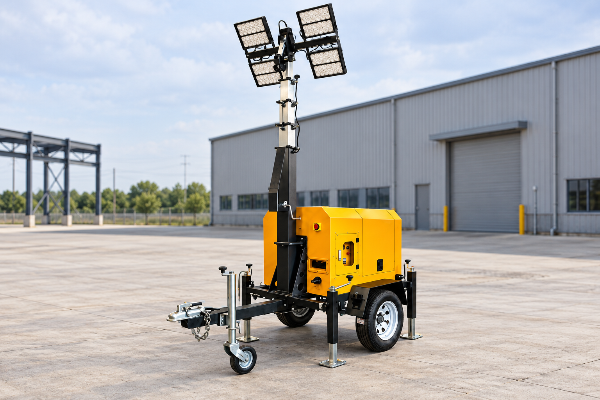
Access for the complete Trailer lighting rig is limited to certain locations. A small VVV transport footprint does not establish the working space for a stabilized, vertical mast.
Hidden Deployment Bottleneck Map
| Constraint | Input to record | Decision it changes |
|---|---|---|
| Access and unloading | Gate width, route, lifting method and ground condition | Trailer and handling arrangement |
| Working envelope | Mast height, fixture load, stabilization footprint and overhead constraints | Placement and permitted lamp assembly |
| Deployment frequency | Raises, lowers and relocations per shift | Operating procedure and crew-time comparison |
| Wind exposure | Model limit in m/s or mph, deployed height and lamp arrangement | Conditions the complete tower is rated to withstand |
| Loss of lift power | Recovery instructions, tools and responsible personnel | Recovery preparation before dispatch |
| Service access | Inspection tasks, component access and requested spare parts | Maintenance plan and durability review |
[ Safety Compliance ]
Compare complete deployment labor
ISO 14118:2017 addresses unexpected start-up from electrical, hydraulic, pneumatic and stored energy, including gravity and external influences. Use the selected machine’s risk assessment and instructions to define isolation and intervention procedures; the standard does not prescribe the means for each specific machine.
Light Tower Mast Price and Complete Tower Scope
- Equipment: mast assembly, lighting package, power platform and controls.
- Project options: requested remote functions, outlets, accessories and service items.
- Logistics: packed dimensions, loading, freight destination and delivery responsibility.
- Documents: operating instructions, electrical information and project inspection requirements.
- Schedule: required arrival date, configuration agreement and transport milestones.
Missing service scope leaves outage responsibilities unclear. We handle after-sales enquiries and arrange the technical discussion around the agreed supply scope.
Worked Deployment-Time Scenario
For an illustrative planning exercise, a 12-minute procedure with two people repeated 40 times uses 16 labor-hours. A 7-minute procedure with the same crew and count uses 9.33 labor-hours, a difference of 6.67 hours.
| Illustrative input | Reference procedure | Proposed procedure |
|---|---|---|
| Minutes per complete deployment | 12 min | 7 min |
| Crew × deployments | 2 × 40 | 2 × 40 |
| Total labor time | 16 h | 9.33 h |
Replace these inputs with measured complete procedures before comparing equipment cost. The exercise is a time-budget model, not a measured LFADJ lifting speed or savings promise.
Use your measured deployment timesQuality Assurance and Configuration Documents
We arrange maintenance under the agreed contract, with service responsibilities defined for the supplied equipment. Before order confirmation, match the model, lamp assembly, mast configuration and operating documents.
Keep the equipment and document revisions together
- Identify the supplied model, revision and included options on the quotation.
- Review lamp input, lifting supply and generator output as separate electrical items.
- Request the actual controls, operating limits, inspection tasks and recovery instructions.
- Agree the project-specific test reports and documents needed for the destination.
[ COMPLIANCE REVIEW ]
For an external electrical connection, review neutral bonding, equipment grounding and protective devices against the circuit diagram. OSHA 1926.404 makes portable and vehicle-mounted generator provisions conditional on the installation; a generic instruction to add a ground rod is not a substitute for that review.3
Company Credentials and Machine Requirements
Company management credentials and model-specific approvals serve different purposes. ISO 14118:2017 also treats power, stored energy and external influences separately when addressing unexpected start-up.6
List the documents required by your projectHow We Work With Your Project Requirements
We coordinate the supply connection through product configuration and technical communication. A useful enquiry gives us the work environment, lighting task and order requirements together.
Deployment-to-Quote Matrix
Project input
Filled planning example
Output to review
Application
Night road-maintenance work
Task zones and glare review
Height and lift
D953 7 m electric-mast reference
Selected mast and mechanism
Lamp package
4 × 400 W LED reference
Fixture details and lighting layout
Shift schedule
10 h per shift, 20 shifts
16 kWh lamp energy per shift at rated input
Deployment routine
Relocation between work areas
Complete operating and recovery sequence
Supply
Onboard diesel package under discussion
Generator rating, outlets and lift supply
Site access
Gate, unloading area and working space recorded on plan
Transport and setup dimensions
Order details
Buyer enters quantity, destination and required arrival date
Itemized quotation and delivery timing
Support
Buyer identifies site maintenance resources
Parts, instructions and agreed service responsibilities
01.
Before supply
We provide technical communication for the project requirements and discuss the configuration with you. Confirm the equipment scope, documents, packing and delivery responsibilities before accepting the proposal.
02.
After supply
We provide product-use advice and handle after-sales enquiries through our service network. Warranty, response timing and on-site support are set by the agreement for your order.
LONGFA Industrial and Mobile Lighting Experience
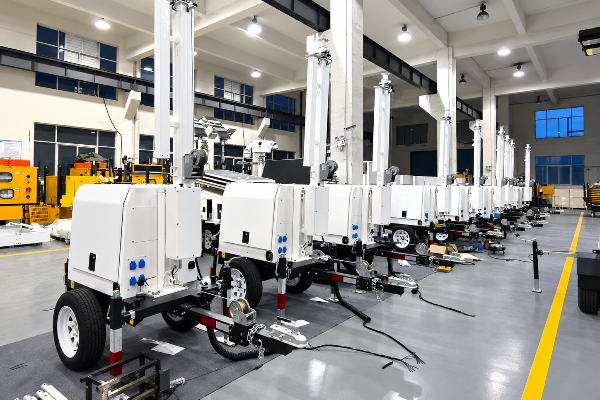
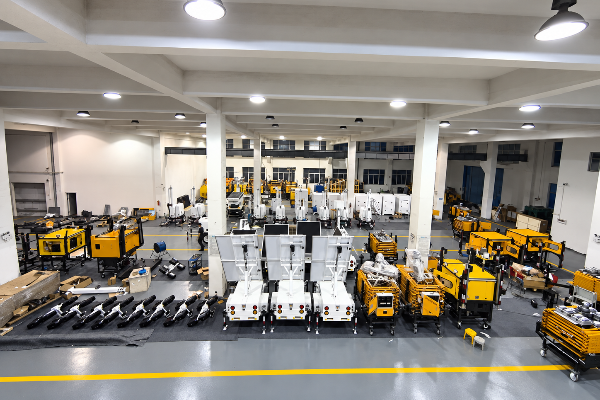
Zhejiang LONGFA Lighting Co., Ltd. was established on February 21, 2013 in Yueqing, Wenzhou, Zhejiang. We manufacture mobile lighting systems and combine research, manufacturing, trade and service for industrial lighting applications.
- We supply industrial and emergency lighting equipment for production, maintenance and temporary work.
- Our product scope includes mobile lighting, lifting lighting devices, portable work lights and emergency lighting.
- Application consultation covers power, transportation, petrochemical, metallurgy and public-safety work.
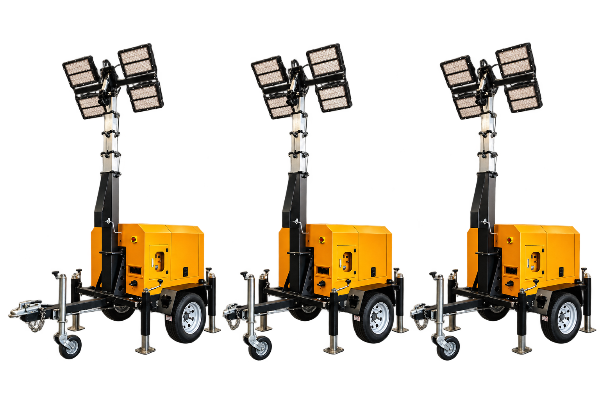
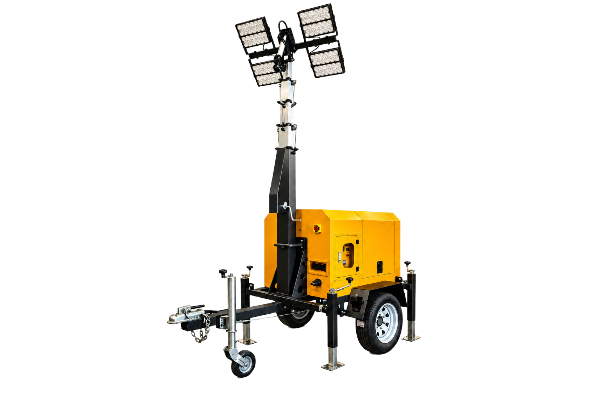
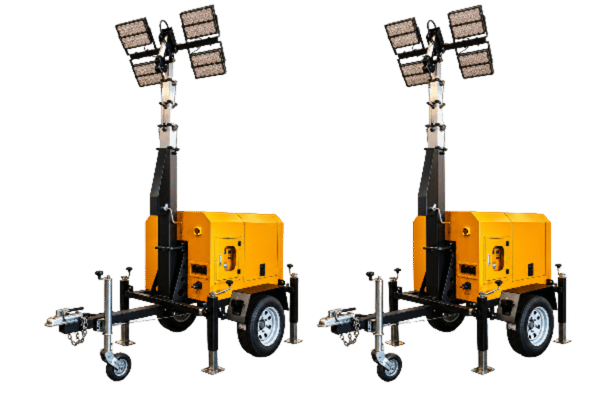
Hand-winch tower layout reference: lamp heads, mast, trailer and stabilizers. Discuss the electric-mast assembly and controls for your selected configuration separately.
Mast-System Alternatives for Different Work Cycles
An electric winch with light tower fits a purchasing specification that requests that actuator and its documented control system. The proper compromise is dependent on deployment frequency, the equipment mounted on the actuator, the available energy and the maintenance resources.
Manual winch
Compare a hand-operated telescopic light tower when the complete setup routine is infrequent and suits the crew. Count the time for stabilization and securing as well as winding the winch.
Electric-driven hydraulic
Compare the pump, cylinder, controls and recovery arrangement as one system. An electric motor and hydraulic actuation can coexist; the electrical label alone does nothing for identifying service tasks.1
Pneumatic mast
Compare air supply, seals, controls and the documented load-holding arrangement. Sections that telescope upward need assessment as a complete assembly; ISO 14118:2017 includes pneumatic and stored energy in its scope.6
Lighting-platform alternatives
For occasional work, compare whether to rent or own against utilization, rental terms, storage and service costs. For continuous lighting, compare run times, refueling access and site electricity separately from mast operation.
Request an Electric Mast Light Tower Configuration
Provide the application, quantity and destination, as well as the working height, and the requested delivery date. Also provide the documents your project needs, the site supply, number of shifts, frequency of deployment, and the hours the site will be supplied.
- Marked site plan and task-lighting target
- Preferred mast operation and recovery requirements
- Equipment, accessories, packing and delivery scope
FAQ: Electric Mast Light Tower Questions
Does an electric light tower always have an electric mast?
No. Specify the lighting supply and mast actuator separately.
What should I check in an electric winch light tower for sale?
Check the named winch, permitted lamp assembly, lift supply, controls, inspection tasks, and recovery instructions. The proposal should specify the model and its operating limits.
Is 1,600 W the generator output for the D953 reference?
No. Four 400 W lamps total 1,600 W rated input; generator output, auxiliary loads and lifting demand are other entries.2
How much lamp energy does a ten-hour shift use?
At 1,600 W input, ten hours is 16 kWh of lamp energy. Use the Lamp Load Planner to determine another lamp count or a shift schedule.
How should I compare manual and powered mast deployment?
Measure both the complete setup and the complete recovery, using the same crew and the same site conditions. The Deployment Time Budget shows an comparison of labor input, without lifting speed assumption.
What happens if normal lifting power is lost?
The recovery or securing procedure for the model selected defines how the recovery is to be done. Determine the necessary tools and personnel before equipments is deployed.
Does mast height determine the illuminated area?
No. The illumination of the work plane also depends on the distribution of the beam, aiming and obstructions, and the lighting target (e.g. equipment); review site plan and photometric data.45
Which electrical documents belong in the enquiry?
Request a schedule showing rated lamp input, lift motor demand, generator output and connected auxiliary loads, together with a connection diagram and information about protective devices. In your request, include the supply voltage and frequency, the site connection’s bonding arrangement, and any responsibility you may have for the site connection. The installation rules at the destination and the actual circuit configuration will determine which electrical checks and project documents will be required.3
What determines price and delivery timing?
The quotation will depend on the equipment configuration, order quantity, packing, and destination. Provide the requested documents, as well as the date and time you require the equipment.
What support should be agreed before ordering?
Agree product-use support, maintenance, service parts, warranty and response responsibilities for the order. We arrange maintenance under the agreed contract.
Are mobile light towers suitable for hazardous areas?
The equipment selected must meet the site’s classification and model-specific approvals. Explosion-proof equipment in a supplier’s wider range does not grant approval for all mobile Towers.