Get in touch with LFADJ Company

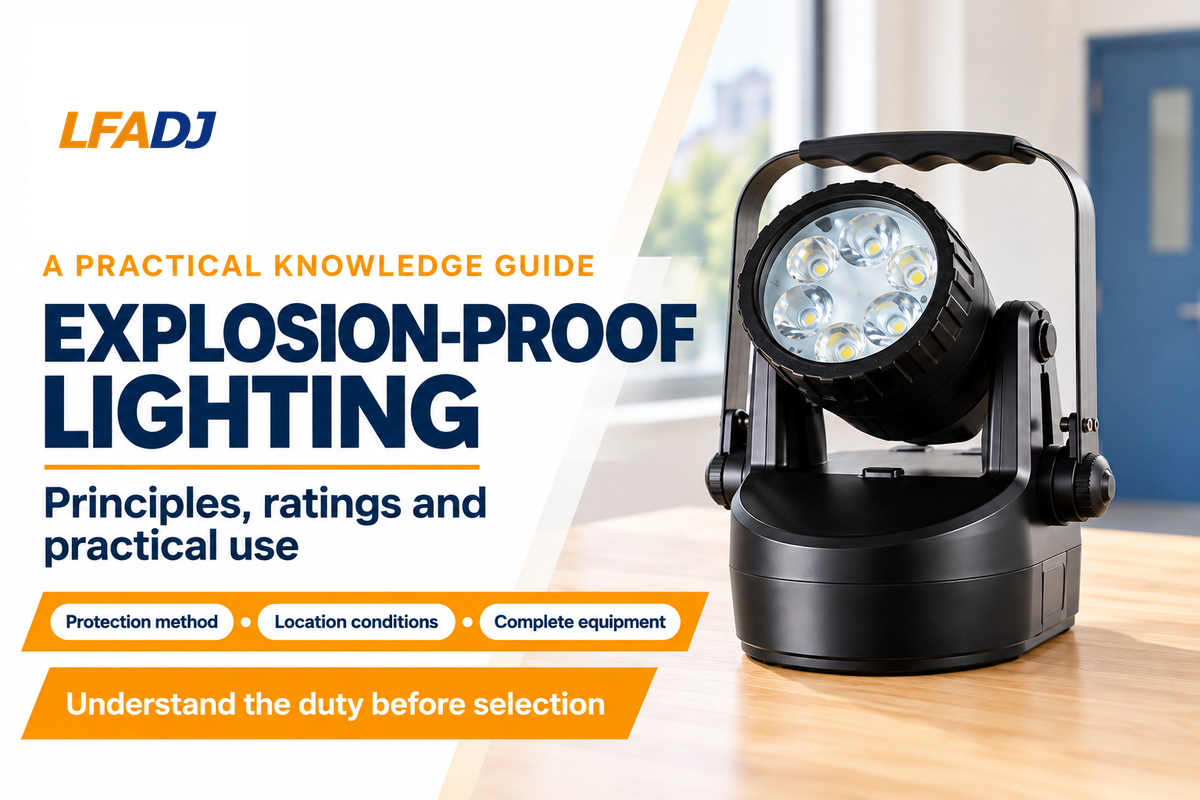
Explosion-Proof Lighting controls the risk that a light will ignite hazardous surroundings. Explosionproof enclosures contain an internal explosion and prevent ignition outside. The choice of enclosures also depends on the substance, the location and the operating conditions.
By CYH · Updated October 2026
Explosion-Proof Lighting uses a specified protection method to control equipment ignition risks in hazardous locations. Gas, dust, temperature and installation conditions determine suitability. LED describes the light source; it does not grant an approval.
Quick reference
| Starting point | Documented hazardous-area classification and substance |
|---|---|
| Gas versus dust | Separate hazards with different protection provisions |
| Useful light | Distribution and maintained task illumination, alongside input power |
| Running cost | Complete-system kilowatts × operating hours × electricity tariff |
- A sealed enclosure isn’t automatically approved for a potentially explosive atmosphere.
- A component certificate and a complete-equipment certificate cover different objects.
- Lower wattage alone doesn’t authorize a lamp conversion inside an existing protected fixture.
What Is Explosion-Proof Lighting and How Does It Work?
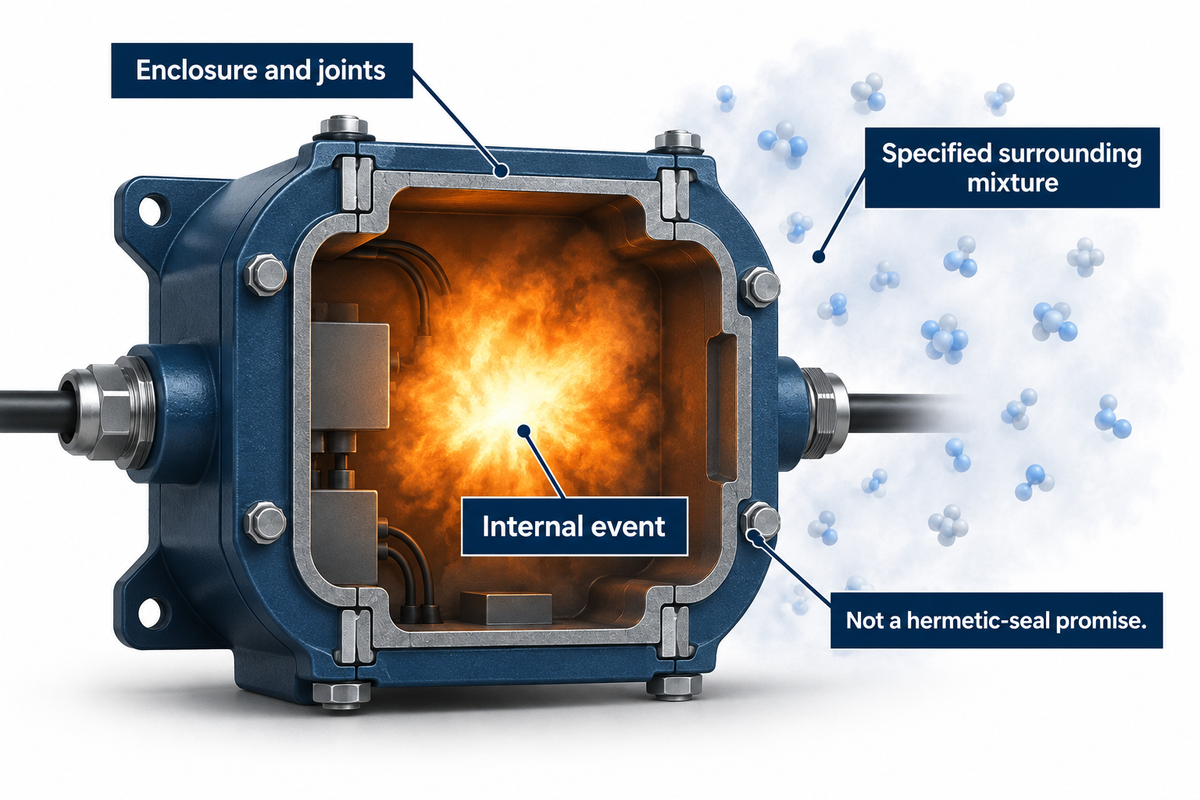
Explosionproof lighting contains an internal ignition within an enclosure designed for a specified gas or vapor. The enclosure withstands that internal event and prevents the surrounding specified mixture from igniting. Its permitted construction and external temperature conditions remain part of the protection.
In other hazardous locations, ignition is controlled in other ways.
How does explosion proof lighting work?
An explosionproof enclosure designed to hold a given mixture contains the pressure caused by the explosion and prevents ignition of the surrounding atmosphere. Joints of that enclosure are also part of the containment. A housing shouldn’t become an ignition source just because it contains electrical parts.
How OSHA defines explosion-proof apparatus includes specified gases and vapors. The word does not promise that a lamp survives every external blast. Neither does it mean flammable gases can never enter an enclosure. The phrase “Nothing can get in” should never be used to explain this protection principle.
Hazardous location lighting is the broader category. Intrinsic safety limits electrical and thermal energy; other techniques protect electrical components through different construction or circuit arrangements. Battery-powered apparatus still retains electrical energy. A change in power supply, from mains to a battery, doesn’t by itself make a portable apparatus intrinsically safe.
A rugged industrial light can resist vibration and water yet lack the protection needed for an ignitable atmosphere. Explosion proof fixtures need both a protection marking and a permitted configuration matched to their duty. Housing thickness or a protective cage by themselves won’t satisfy that need.
Which Hazardous Locations Need Special Lighting?
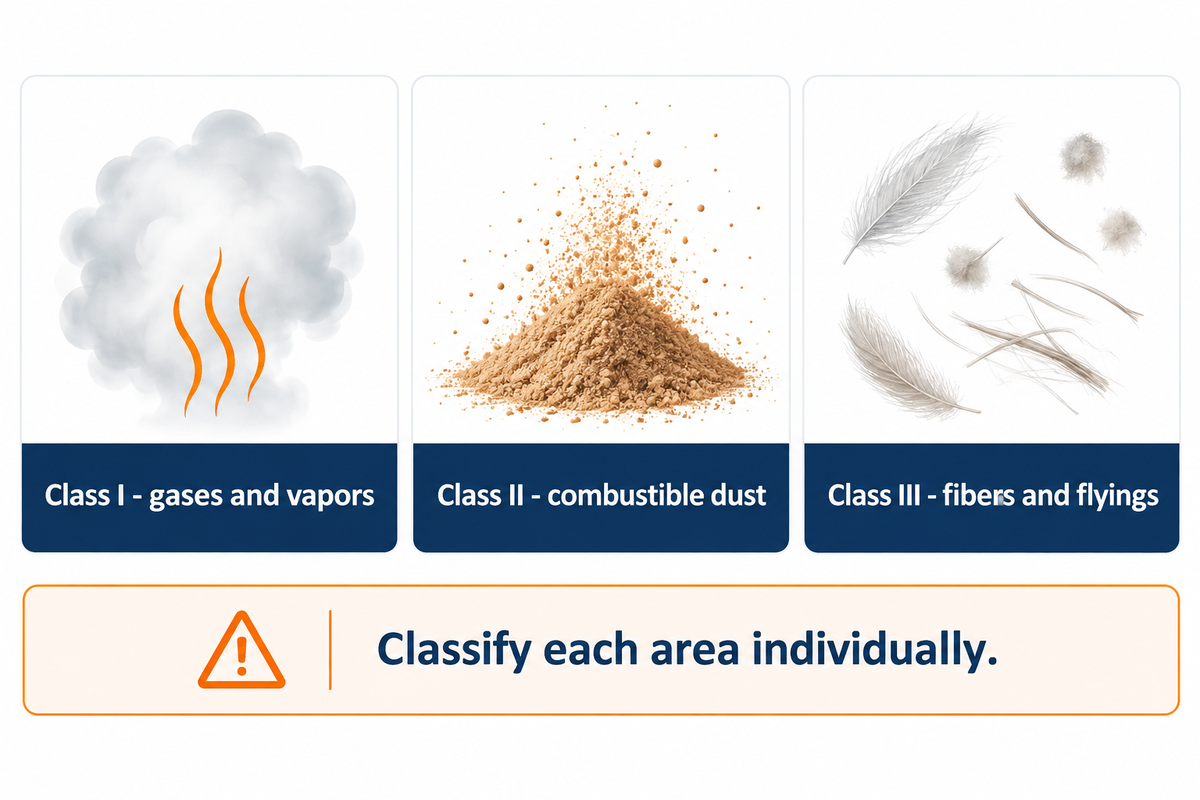
Class I is for gases and vapors; Class II is for combustible dust; and Class III is for ignitable fibers and flyings. Classification is location-specific. US Class I and Class II provisions can apply to parts of an industry or a building.
Where is explosion proof lighting required?
Lighting for hazardous locations must be suited to the classified area and the particular material involved. Relevant gas or vapor hazards may arise from Oil and gas installations and from chemical plants and paint spray operations. Agricultural and powdery processing facilities may contain combustible dust. Different provisions may apply to other parts of the same building.
“Each room, section or area shall be considered individually in determining its classification.”
Class I, Division 1 includes locations where ignitable concentrations of flammable gases or vapors may exist under normal operating conditions, or frequently because of repair, maintenance or leakage; Division 2 usually covers locations where flammable gases or vapors are used but would become hazardous only in case of an accident or some unusual operating condition. Division and Zone labels aren’t a conversion chart. Dust Zone 21 and Zone 22 labels belong to their applicable dust-classification framework, not to the US Class I gas-Zone provisions.
Example: Members of a chemical processing maintenance team enter a solvent-handling area to read a valve tag. The surrounding warehouse uses ordinary industrial lighting, but the assessed solvent-release area has a different duty. A portable work light must match that local classification even for a short inspection. Using a low-power LED won’t change the release conditions or the identified material. During shutdown, the area’s documented conditions and any authorized reclassification govern the work; switching off production is not itself a new lighting approval. The difference is in the area in which the lamp is kept and the area in which it will be used.
Explosion-Proof, Intrinsically Safe or Vapor-Proof?
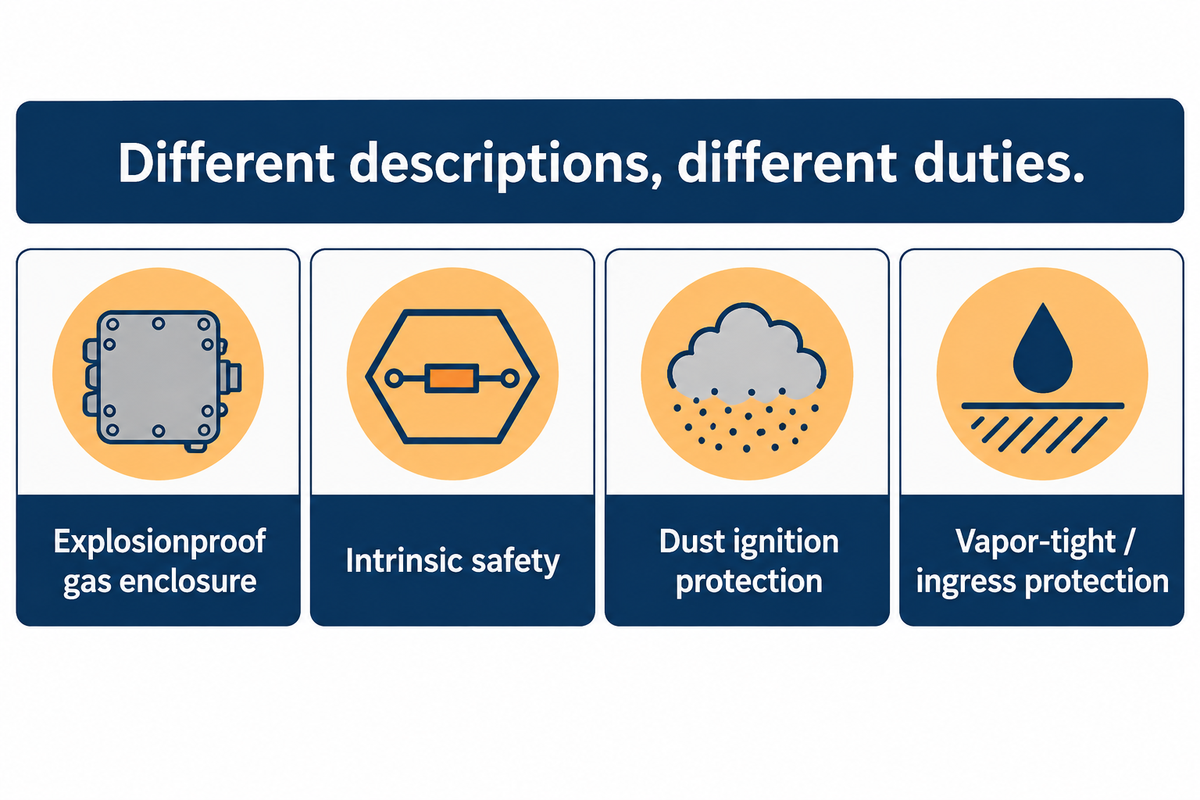
Explosionproof containment, intrinsic safety and environmental sealing solve different problems.
Protection-Concept Comparison Table
The consideration allows the buyer to read each claim against the duty it actually addresses.
| Description | What it addresses | Practical distinction |
|---|---|---|
| Explosionproof gas enclosure | Internal explosion and surrounding ignition | Specified gas/vapor and approved construction |
| Intrinsic safety | Electrical and thermal ignition energy | Complete circuit and stated fault conditions matter |
| Dust ignition protection | Dust exposure and hot surfaces | Dust properties and accumulation affect the duty |
| Vapor-tight / ingress protection | Specified environmental ingress | Separate from the ignition-protection method |
OSHA mentions explosion proof, dust ignition proof and dusttight as three different techniques. In the IEC framework, IEC 60079-31:2022 addresses dust protection by enclosure together with surface-temperature limitation. Thus a gas-rated product may not answer dusty requirements.
Example: powder builds up above work areas at a flour transfer station, and a lamp may collect dust on its housing. Assessment involves dust and allowed surface temperatures, as opposed to borrowing a gas T-class from a different room. HSE states that the ignitability of dust layers is dependent on the thickness of the layer and contact time. Cleaning and/or inspection must be done to preserve the protection condition of the equipment. Adding an unassessed cover to the lamp to keep powder from collecting on the lamp housing can also alter the way heat is dissipated, and that would be part of the assessment, as opposed to an improvised housekeeping measure.
For equipment specifics, the hazardous-location lighting options split the equipment discussion from this description of protection principles.
How to Read a Hazardous-Location Lighting Marking
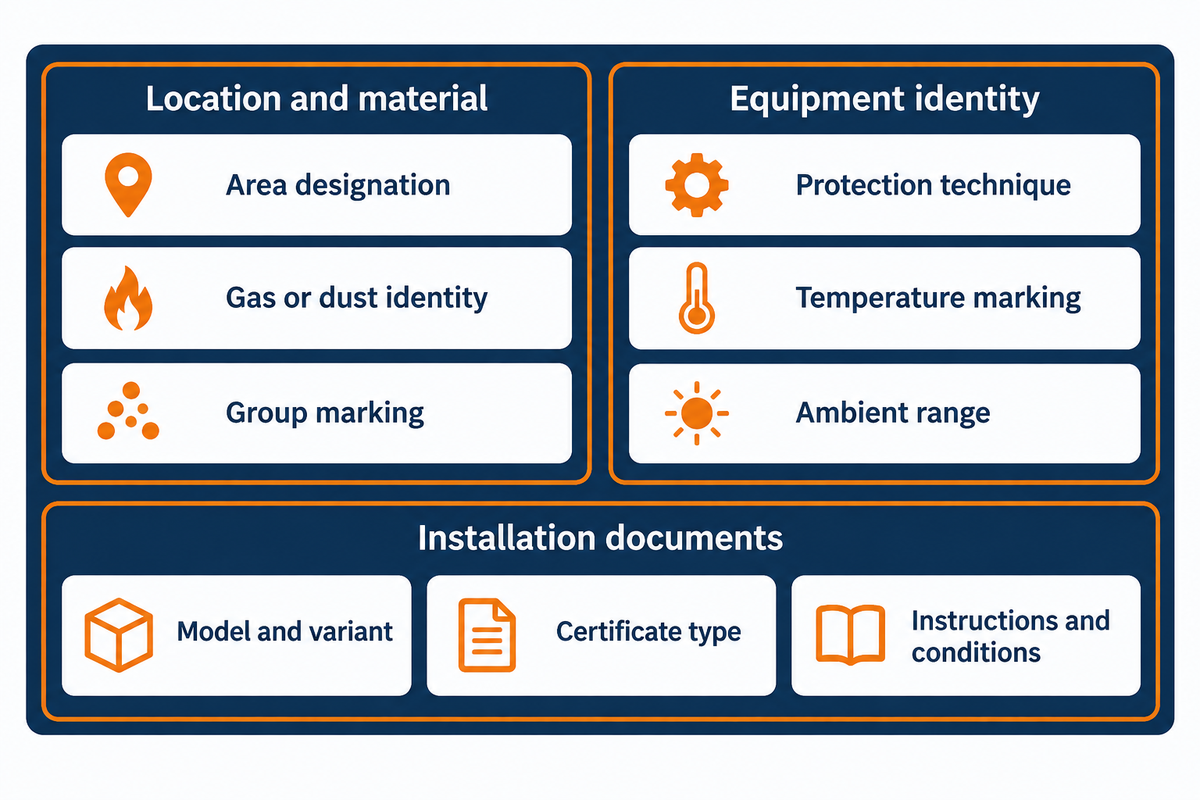
Read a hazardous-location marking as a set of matching conditions: hazard classification, protection method, material group and temperature designation. Under OSHA’s Class and Division marking rule, the operating temperature is marked for a 40-degree C ambient and may not exceed the ignition temperature of the specific gas or vapor; the actual ambient temperature is a separate operating condition. The equipment identity and certificate scope must also be the same as those of the complete luminaire, because an approved component doesn’t become an approved assembled light by itself.
Marking Reading Walkthrough
The walkthrough connects each marking or document field to the operating question it answers.
Example S-1 from OSHA uses Class I, Zone 0, AEx ia IIC T6. Here, Class I identifies the gas/vapor hazard; Zone 0 is the location designation; AEx identifies the US Zone marking convention; ia identifies intrinsic safety; IIC is the gas group; and T6 is the temperature class, which HSE’s classification table ties to a maximum surface temperature of 85 °C. This is the regulator’s example and isn’t an LFADJ nameplate.
| Field | Meaning or connection | Responsible reader |
|---|---|---|
| Area designation | Matches the documented location system | Plant engineer |
| Gas or dust identity | Matches the material, not just the industry | Process engineer |
| Group marking | Identifies the applicable material group | Technical reviewer |
| Protection technique | Explains how ignition risk is controlled | Technical reviewer |
| Temperature marking | Connects hot-surface behavior to the hazard | Process engineer |
| Ambient range | Defines surrounding operating-temperature conditions | Plant manager |
| Model and variant | Links delivered equipment to its documents | Procurement |
| Certificate type | Separates complete equipment from components | Quality assurance |
| Instructions and conditions | Connect mounting, entries and service to approved use | Installer / maintenance lead |
There are exceptions in US marking provisions. For example, a number of fixed Class I, Division 2 and Class II, Division 2 lighting fixtures need not carry a group marking. That exception doesn’t make every material interchangeable. A formal Class I designation defines the gas/vapor hazard, and Division 2 defines location conditions.
The IECEx equipment scheme differentiates between complete-equipment conformity certificates, component certificates, and unit verification. A component certificate applies to a part that needs additional certification when incorporated into complete equipment. A serious mismatch can be avoided by checking the quoted model and delivered equipment variant against the complete-equipment documentation.
Catalogue shorthand Class 1 Div 1 is comparable to Class I, Division 1; however, the material group and temperature conditions still require individual entries. A quote labeled Class 1 Division 2 also requires the full equipment identity rather than just that location label.
LED, Fluorescent and HID: What Changes Inside the Fixture?
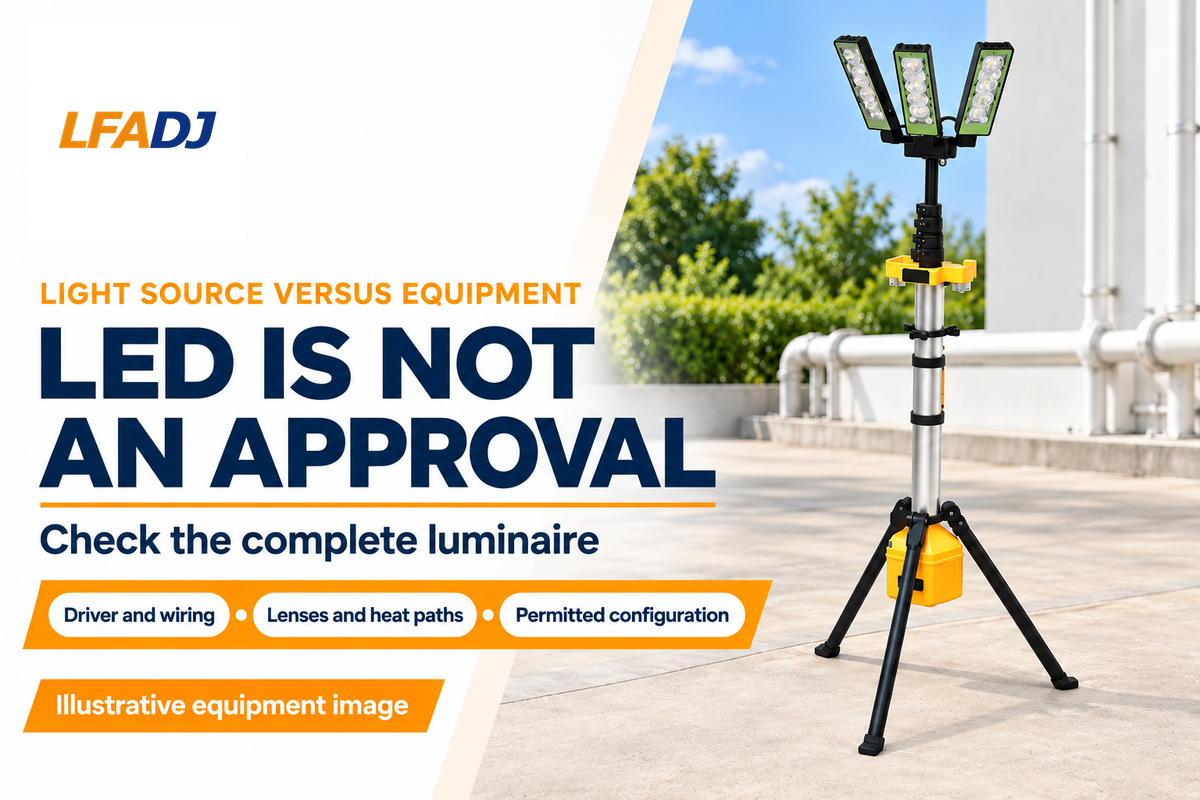
LED alters the behavior of the light source, both electrically and thermally. It doesn’t independently create hazardous-location protection. Compared with fluorescent, metal halide or incandescent equipment, a purpose-designed LED luminaire can offer a different power demand and maintenance profile. Comparison must include complete equipment and its operating condition.
Are LED lights explosion-proof?
Some complete LED lights are designed and approved for particular hazardous locations; ordinary LED bulbs are not automatically explosion-proof. Drivers, wiring, lenses and heat paths are part of the equipment. For industrial use, an LED explosion proof light requires the relevant complete-equipment suitability rather than an efficient diode or an extra-strong housing.
A fluorescent fitting uses its specified lamp and control gear; an HID system uses its corresponding lamp and ballast. A complete explosion proof LED light uses drivers and thermal management suited to its design. High efficiency can reduce electrical demand at a comparable lighting duty; however, a longer lifespan is a model and environment claim rather than a universal property of every LED hazardous location product.
Eaton’s 2025 retrofit white paper identifies thermal and light distribution issues with some screw-in LED replacements for HID lamps. The paper also discusses some assessed retrofit kits. The main distinction is a permitted conversion vs. an unassessed bulb swap. A reduction in power doesn’t allow a change from the original configuration.
Cast aluminum and a powder coat can be features of industrial construction; neither is an ignition-protection marking. Corrosion-resistant materials and sealed housings address environmental duties alongside the required protection method. The LED fixture configurations cover equipment choices after project conditions are established.
How Do Fixture Types Change the Lighting Result?
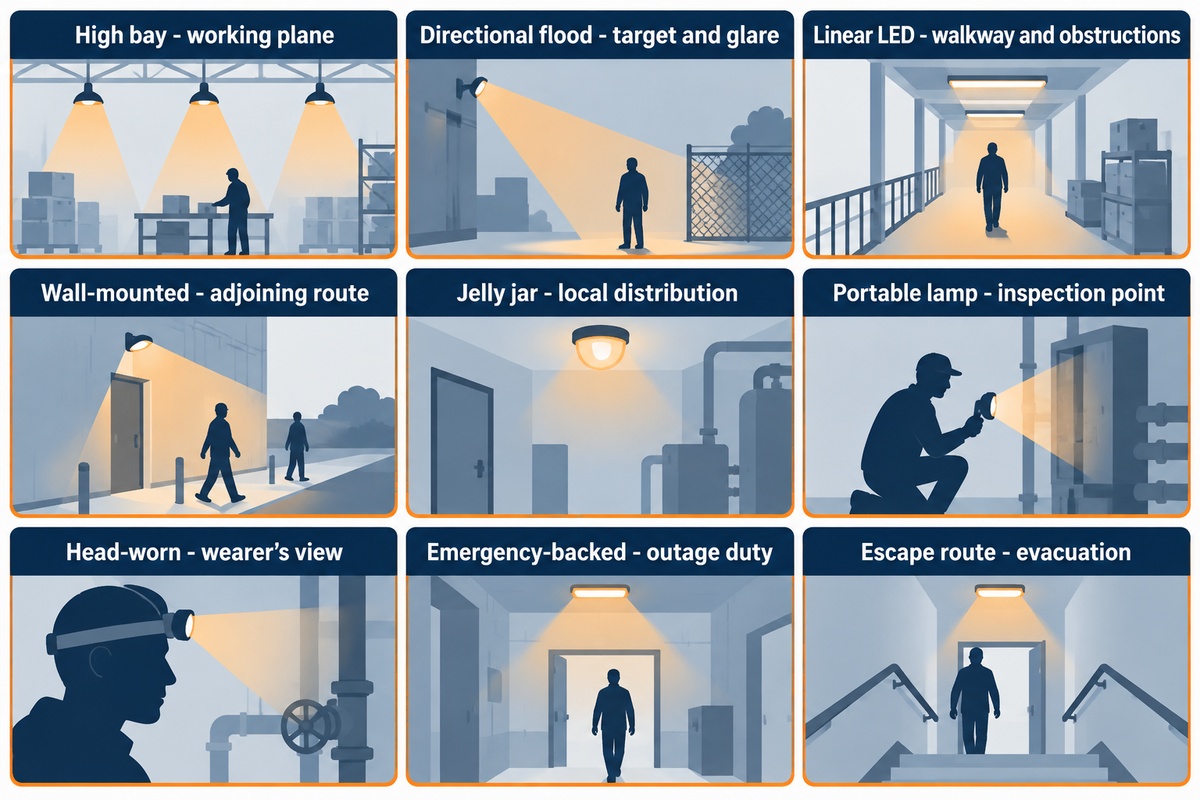
Fixture types adjust where light reaches the task and where glare or shadows occur. High bay lighting illuminates an area from overhead; a flood light illuminates a local work area; local work lights illuminate close-up tasks. The arrangement, mount and optics of the lamp assembly determine the outcome; the housing name doesn’t determine the beam.
| Form or duty | Useful comparison | Potential obstruction or tradeoff |
|---|---|---|
| High bay | Light on the working plane below | Equipment can shadow local tasks |
| Directional flood | Illumination across the intended target | Aiming can put glare in an operator’s sightline |
| Linear LED | Distribution along a walkway or process line | Nearby pipework can obstruct the beam |
| Wall-mounted unit | Light reaching the adjoining route | Mounting position changes shadows |
| Jelly jar form | Local distribution around its installed position | Globe shape alone does not specify beam control |
| Portable inspection lamp | Visibility at the inspection point | Handling position can block the light |
| Head-worn lamp | Light following the wearer’s view | Other workers can face direct glare |
| Emergency-backed luminaire | Output and duration after primary-power failure | Emergency output can differ from normal output |
| Escape-route lighting | Visibility of the route during evacuation | Normal task illumination is a different duty |
CCOHS distinguishes general lighting from localized and task lighting, and addresses glare and distribution using optics. An operator’s body or machine can block an otherwise bright overhead source. A lumen measures the light output; task illumination also depends on direction and distance, and for a source that is small relative to that distance it falls with the square of the distance.
For a long process aisle, explosion proof LED linear lighting may be a better fit; led linear lighting with emergency backup serves a separate loss-of-power duty. Neither provides a universal mounting height. Hazardous area lighting must satisfy the installed task. LED area lighting and a handheld inspection lamp complement each other if the classified task requires both general visibility and close work.
Compare hazardous-area flood lighting with portable protected work lights based on the installed task, as opposed to nominal wattage alone.
What Does Explosion-Proof Lighting Cost to Run?
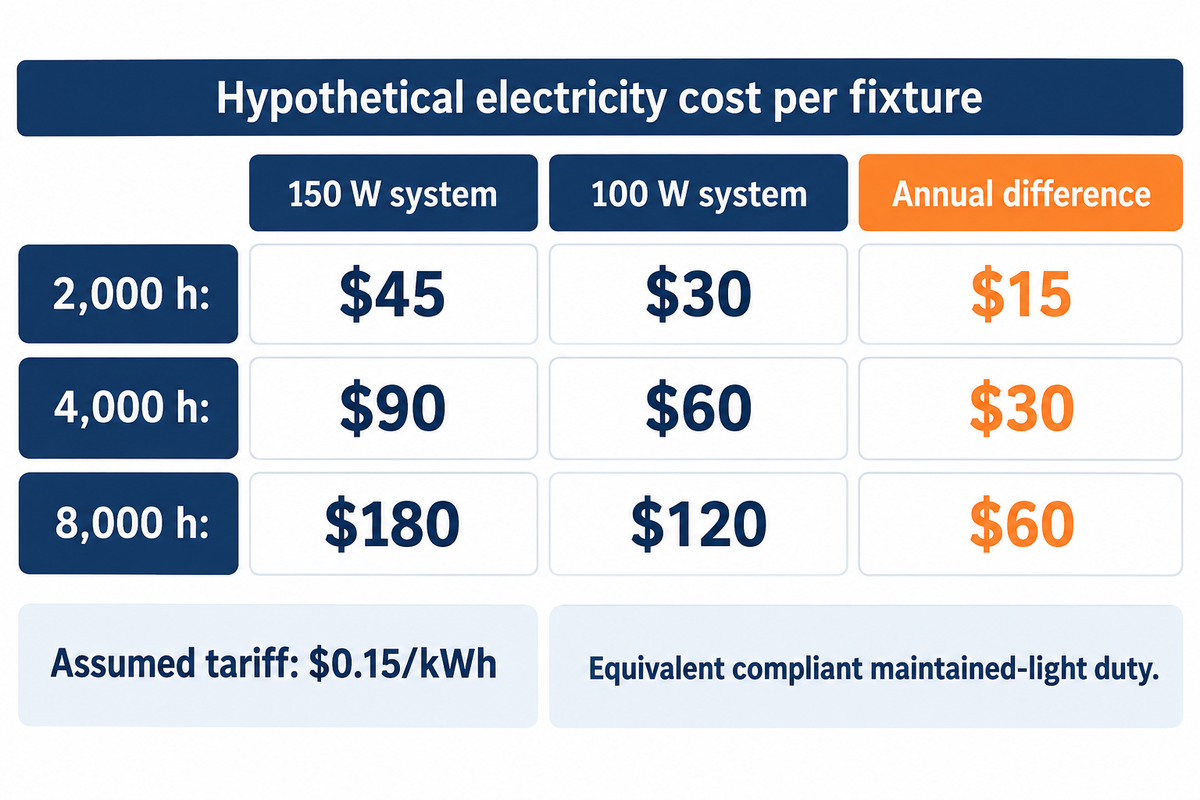
A hypothetical 100 W complete lighting system costs $60 per year at 4,000 operating hours and $0.15/kWh. Annual electricity cost is system kilowatts multiplied by hours and tariff. Useful comparisons of two systems are only possible when both satisfy the same required compliant, maintained illumination for the same task.
Running-Cost Sensitivity Table
The sensitivity table assumes fixed power and tariff, and changes operating hours.
Assumed inputs: compare 150 W and 100 W complete systems at $0.15/kWh, with equivalent compliant maintained-light duty. These are hypothetical comparison inputs. Include ballast or driver losses in system power. The US Department of Energy’s luminaire guidance uses complete-luminaire input watts and like-product comparisons.
| Annual hours | 150 W system | 100 W system | Annual difference |
|---|---|---|---|
| 2,000 h | $45 | $30 | $15 |
| 4,000 h | $90 | $60 | $30 |
| 8,000 h | $180 | $120 | $60 |
For the 150 W system at the middle duty: 0.150 kW × 4,000 h × $0.15/kWh = $90/year. Subtract the two comparable annual costs to obtain the electricity difference.
Example: The finance department is reviewing a replacement quote, and the plant manager is concerned about a shadowed inspection station. If the proposed fitting draws less power and leaves that inspection station poorly lit, the comparison fails and payback isn’t calculated. Procurement should compare the complete, installed options, and any additional task fixture. Finance can then separate electricity savings from maintenance labor, access equipment and installation cost. Those other costs must be evaluated; not all will be automatically proportional to watts. A lower cost for an off-the-shelf light can’t be a substitute for the required hazardous-area equipment.
What Keeps Protection Intact Through the Service Life?
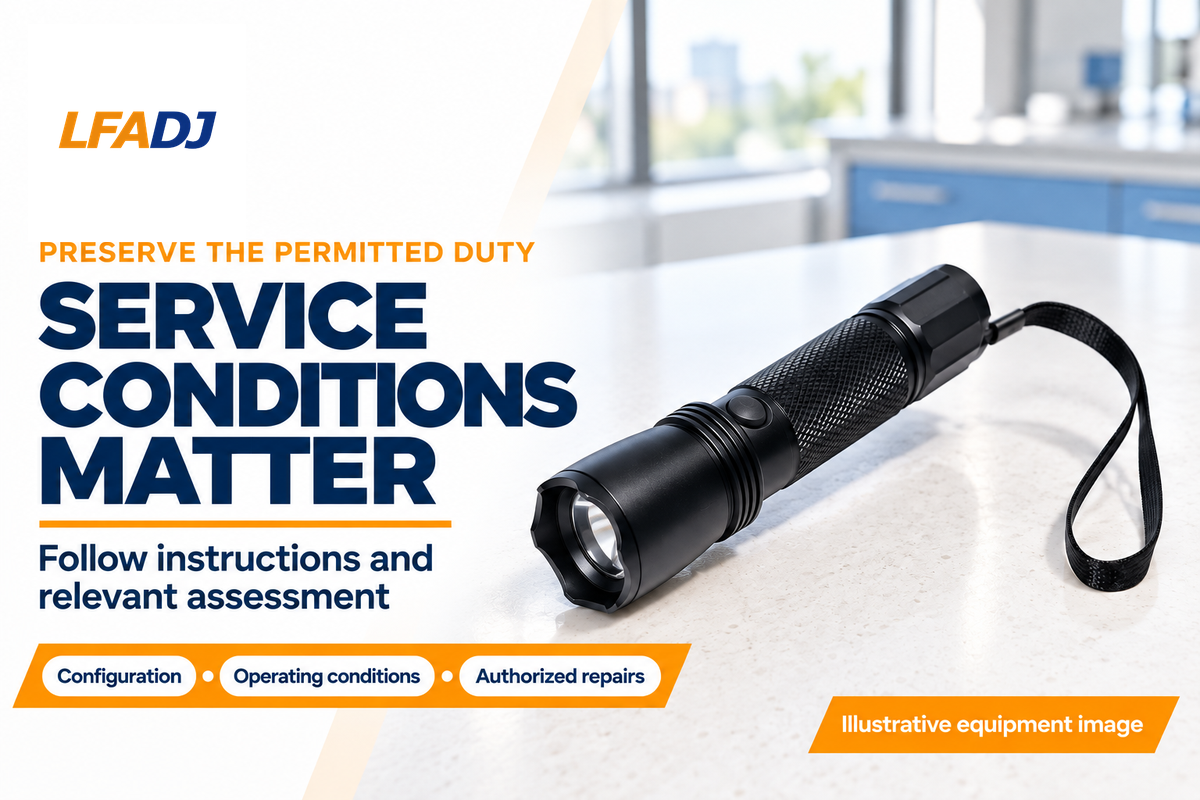
The protection remains valid throughout the service life of the equipment, as long as the equipment retains its permitted configuration and operating conditions. Inspection, cleaning and authorized repairs cover damaged enclosures and entries, joints and electrical parts. Include dust and environmental exposure in the maintenance assessment, along with the manufacturer’s instructions and the applicable installation requirements.
IEC 60079-14:2024 connects equipment selection and installation with initial inspection, documentation and competence. A technically suitable luminaire can still be installed incorrectly. Cable-entry devices, mounting and associated equipment therefore belong to the installation, rather than being treated as unrelated accessories.
Damaged threads or joints can affect the integrity of a containment system. Deposits can affect thermal conditions. Even if an ignition protection concept is present, the equipment can still be affected by corrosion and moisture. A fixture that’s suitably matched to wet locations still requires other project ratings. A harsh environment or hazardous environment can impose a number of competing demands on the system. Operation of equipment at extreme temperatures depends on the stated range of ambient conditions.
Maintenance staff need the correct replacement identity, not a physically similar part. Manufacturer documents for particular families can permit specific driver replacements or retrofit arrangements. An ordinary LED lamp of the same nominal size is a different proposition. A proposed change to the lenses, coatings, or other components of a luminaire should be done in accordance with the manufacturer’s recommendations, instructions for use and relevant assessment documentation.
HSE’s construction industry guidance separates ordinary work lighting from escape illumination after primary lighting fails. The emergency-duty lighting branch provides information on models.
Industry Outlook: LED Upgrades and Installation Requirements
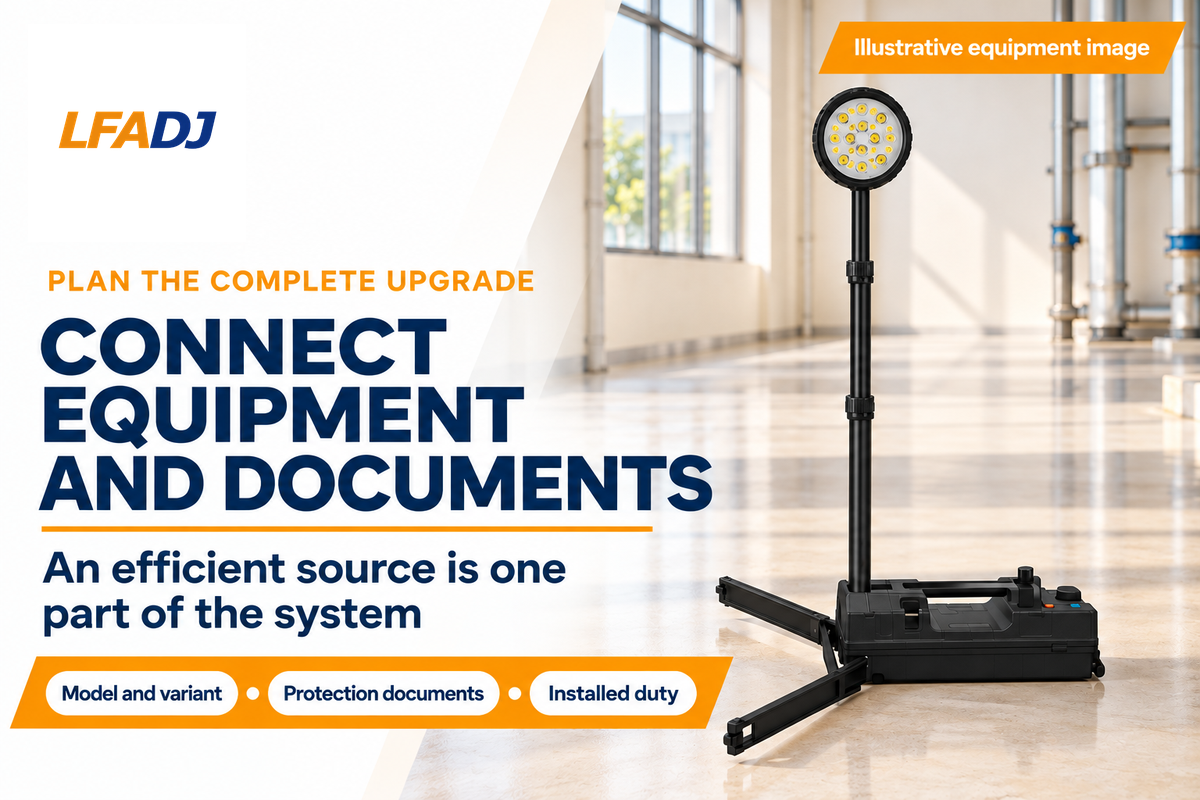
LED upgrade projects connect equipment with installation documentation and the assessed operating duty. IEC published edition 6 of IEC 60079-14 on August 30, 2024, which replaces the 2013 edition. As a frame of reference for design, selection, installation and initial inspection, this publication makes the installation an essential aspect of equipment upgrades.
A product change and a change in the applicable requirements (regulatory change) are deemed to be different events. Publication of an international standard doesn’t set one replacement deadline for the world’s installed lighting. A 2026 project requires the applicable adopted requirements and equipment documentation. The technical team can connect the variant and the protection method to site conditions and not accept a generic “latest standard” claim.
Migration to LEDs alters the service conversation. Some of the concerns regarding older source components of a luminaire (lamp and ballast) are eliminated. However, other concerns regarding the system (e.g. driver and thermal management) are added. Purchasing an efficient light source doesn’t address the complete scope of a luminaire, including electrical connections and permitted repairs. A documented complete luminaire replacement and an assessed kit can be legitimate project routes; an unassessed lamp swap doesn’t follow either route.
The hidden constraint in a running-cost comparison is the availability of suitable equipment and effective lighting. A low-energy alternative that requires additional fixtures or additional emergency provisions changes the cost comparison. Plant management owns the duty and access conditions; quality assurance links the model to its protection documentation; finance evaluates the comparative cost. Procurement brings the requirements determined to the discussion.
For this handoff, identify the area of application, the material, the ambient conditions, the supply and mounting conditions, the required function and the emergency illumination. Match the complete model and variant to its certificate scope and instructions. Keep component certificates separate from complete-equipment approvals.
LFADJ, the brand of Zhejiang LONGFA Lighting Co., Ltd., provides industrial, mobile, explosion-proof and emergency lighting with project based configuration support. The page covers the Explosion-Proof Lighting solutions. It connects a defined project with equipment families, and this reference guide details the principles behind that.
Discuss your lighting application
Frequently Asked Questions
What makes a light explosion proof?
A gas explosionproof light uses a purpose-designed enclosure and joints to prevent an internal event from igniting the specified surrounding atmosphere.
The design must also control exposed temperatures and retain its protection through the permitted installation. Approval concerns the complete equipment and its intended conditions, rather than a thick housing alone. Gas and dust hazards have different provisions. A lens guard, waterproof seal or low-power bulb cannot independently create this protection, even when it improves the lamp’s ordinary durability.
Does explosion proof lighting stop explosions from happening?
Explosion-proof lights control the equipment’s ignition risk within their specified protection conditions; they do not eliminate every possible cause of an explosion.
Process releases, other electrical equipment and non-electrical ignition sources require their own controls. A lighting upgrade therefore sits within the site’s wider explosive-atmosphere assessment. The lamp still needs the correct substance and location suitability, and maintenance must preserve its permitted configuration. Preventing an ignition from the light is different from containing an external process explosion or removing the hazardous material.
What is the difference between ATEX and explosion proof?
ATEX is an equipment and workplace regulatory context in Europe; explosionproof describes a particular protection concept, especially in North American terminology.
The equipment directive covers products intended for potentially explosive atmospheres, with conformity routes that vary by category. Some lower-risk categories permit manufacturer self-declaration. IECEx is a separate international certification scheme. A product’s protection marking, certificate scope and destination-market requirements must be considered together. A company’s management-system certification, such as ISO 9001, is a different kind of certification from approval of a particular luminaire.
Why are explosion proof lights so heavy?
Containment-style lights often need substantial enclosures and joints to withstand the internal event covered by their design.
Different protection techniques can use different construction. A portable intrinsically safe lamp need not resemble a heavy fixed containment fixture. Weight alone does not identify the protection method or the approved duty.
Can standard LED lights be modified to be explosion proof?
An ordinary LED light does not become approved explosionproof equipment through a simple bulb, seal or housing modification.
A complete luminaire’s protection depends on its construction and operating conditions. An internal change can alter temperatures, electrical behavior or the paths through which an internal event is controlled. A physically compatible replacement therefore needs more than a matching socket. Specific evaluated retrofit kits and manufacturer-authorized replacements can still be permitted routes. The equipment model, the proposed kit and the relevant instructions determine the permitted change, with the necessary approval or acceptance under the governing system. Eaton’s retrofit discussion describes both problematic screw-in replacements and an assessed-kit route. For a project, distinguish replacing the entire approved luminaire from changing components within it. The assessment must preserve the required protection and useful light after the change, rather than merely reduce input power.
LFADJ’s perspective on protected lighting
LFADJ works across industrial and emergency lighting applications. This guide connects protection principles, marking interpretation and energy arithmetic so a project discussion can start with a defined duty. The running-cost example uses stated hypothetical inputs; it isn’t a record of a customer installation. Author: CYH.
References & Sources
- OSHA: Hazardous (classified) locations, 29 CFR 1910.307
- OSHA: Definitions applicable to electrical safety, 29 CFR 1910.399
- HSE: Equipment and protective systems for explosive atmospheres
- HSE: Hazardous area classification and ignition sources
- IEC 60079-14:2024: public scope and edition history
- IEC 60079-31:2022: dust protection by enclosure
- IECEx: equipment certification scheme and certificate types
- CCOHS: Lighting ergonomics, general guidance
- Illuminating Engineering Society: inverse-square law and its conditions
- US Department of Energy: commercial and industrial LED luminaires
- HSE: construction site lighting and emergency routes