Get in touch with LFADJ Company

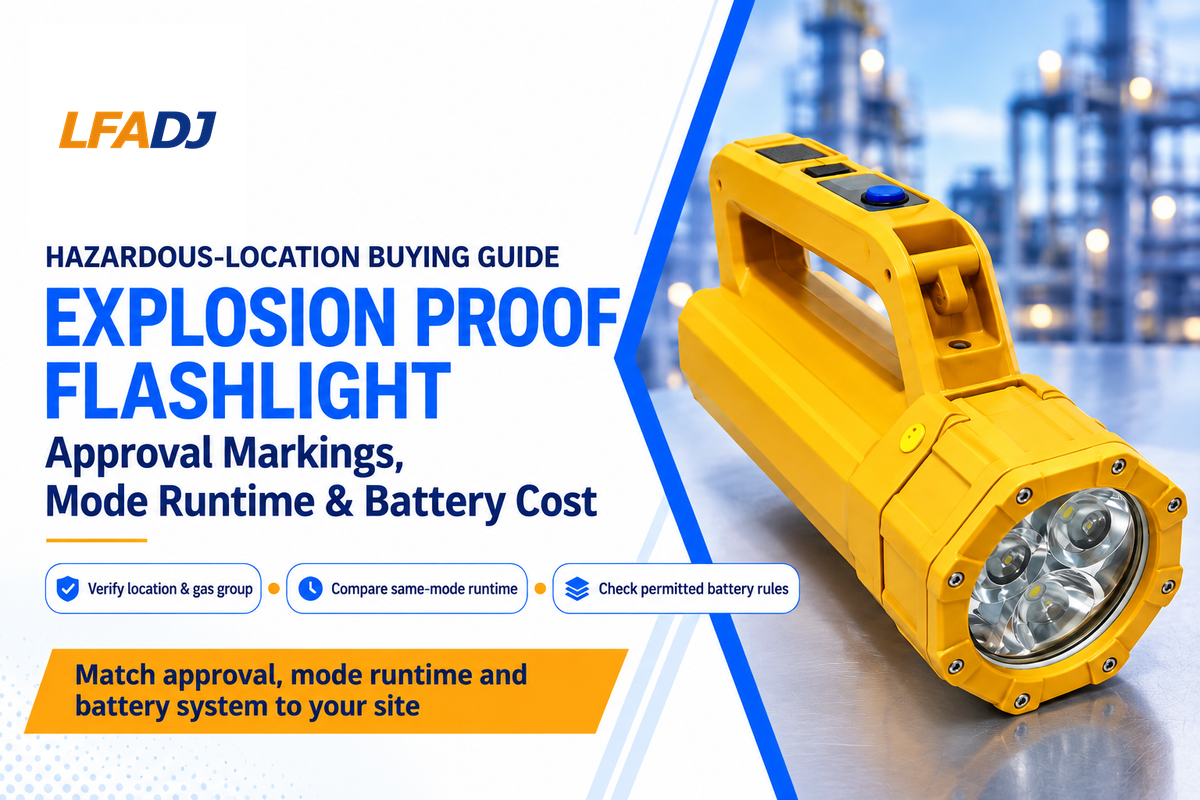
An explosion proof flashlight must match the worksite’s hazardous-location classification, substances, and operating conditions. First, consider the actual model’s approval and permitted battery system. Then, consider the beam you’ll actually use, its useful runtime, and the cost of keeping it available between shifts.
This guide will compare compact inspection torches, a double beam handheld, and a larger portable searchlight. It will address industrial purchasing, including the oil and gas industry; mining lights require a separate consideration. Choosing the right equipment begins with the task, whether in manufacturing facilities or on offshore platforms.
What Makes an Explosion Proof Flashlight Suitable for Hazardous Areas?
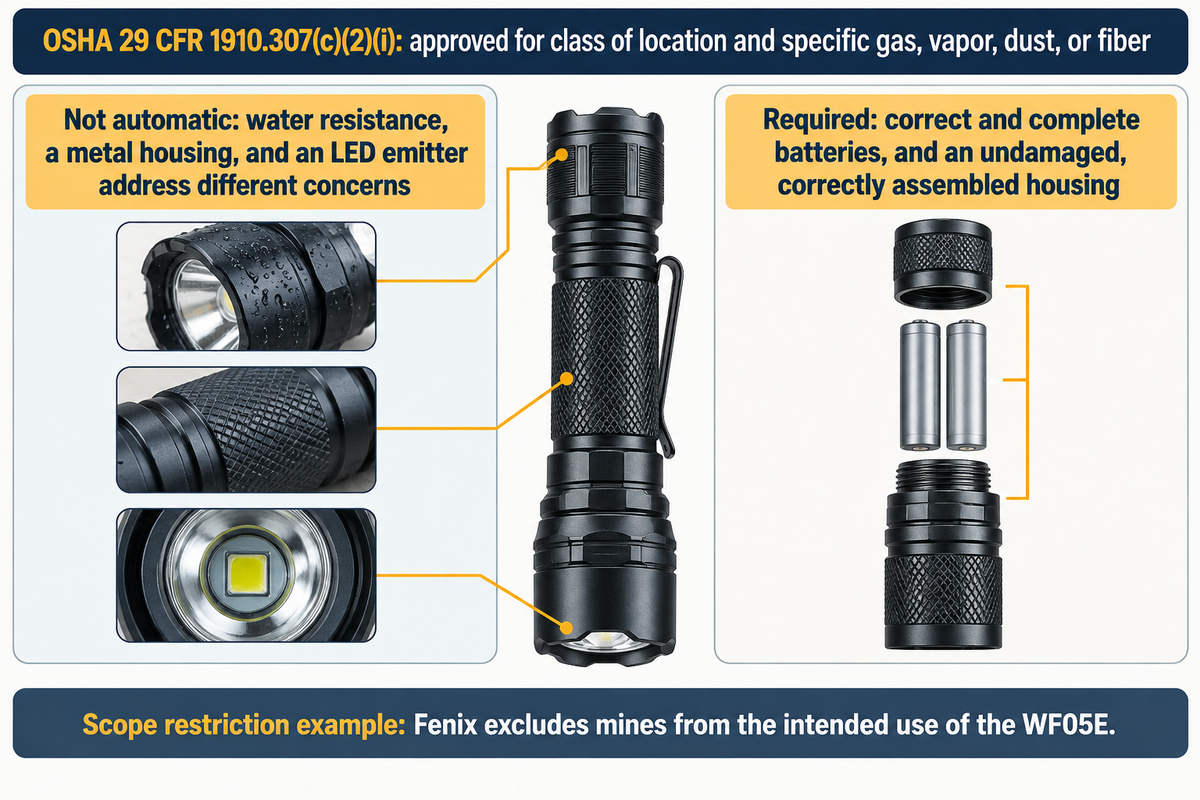
A suitable explosion-proof flashlight has approval for the hazardous area and substances present, and instructions that describe how workers will use it. Water resistance, a metal housing, and an LED emitter address different concerns. A safety-rated light also requires the correct and complete batteries, and an undamaged, correctly assembled housing.
“Equipment shall be approved not only for the class of location, but also for the ignitable or combustible properties of the specific gas, vapor, dust, or fiber that will be present.”
Are LED lights explosion proof?
Not automatically: LED lights require appropriate hazardous-location approval before use in the presence of flammable gas or combustible dust. Select a complete flashlight assembly for ignition protection, rather than by the efficiency of the emitter alone. OSHA requires approval for the location’s class and the ignitable or combustible properties of the specific gas, vapor, dust, or fiber.
A standard flashlight with a waterproof seal remains a different purchase from a flashlight for hazardous environments. For example, Fenix excludes mines from the intended use of the WF05E and warns users to abide by the restrictions on battery use.
For a refinery purchasing team, “explosion proof LED” on a product listing is a starting category. Add the required marking on the purchase order. If the proposed substitute changes the marking, the technical approver must resolve the discrepancy before procurement accepts it. Our guide to industrial explosion protection covers wider equipment options.
Intrinsically Safe vs Explosion-Proof: What Changes?
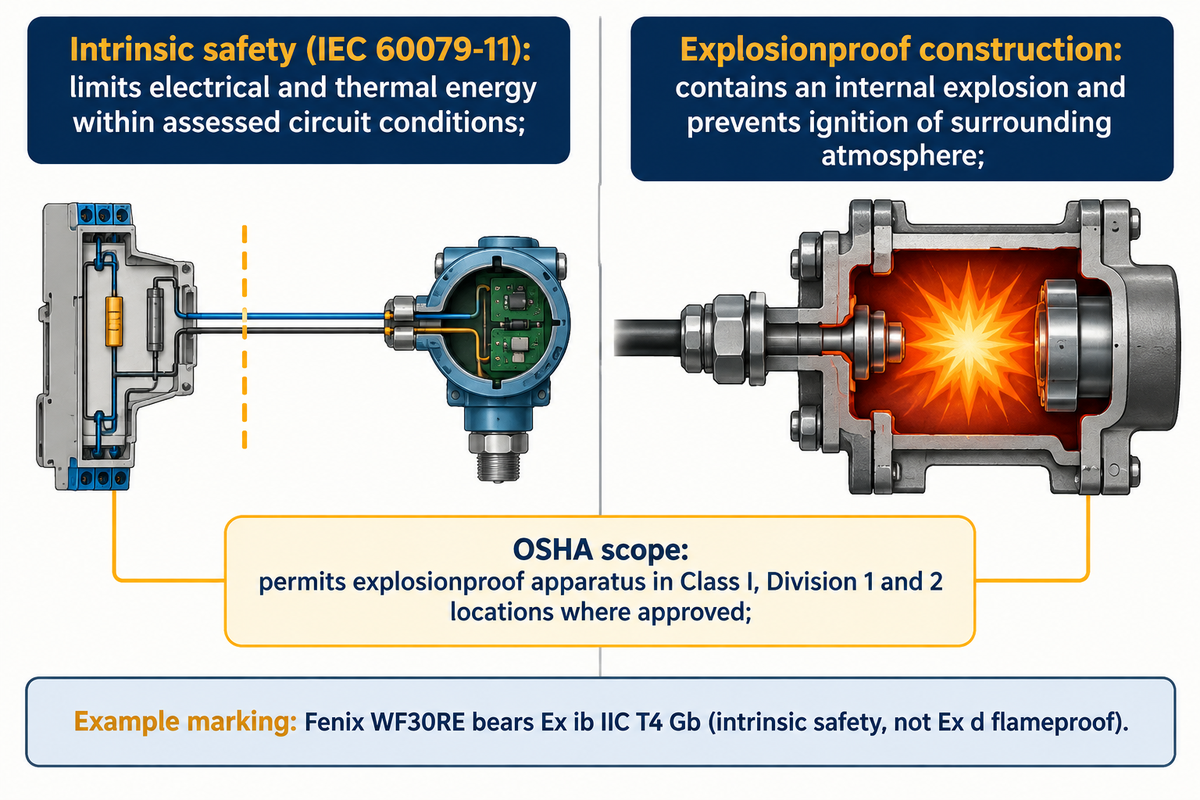
Intrinsic safety limits electrical and thermal energy within the assessed circuit conditions. Explosionproof construction contains an internal explosion and prevents ignition of the surrounding atmosphere. Both address ignition risk, but their designs and approval conditions are different. Retailers typically place intrinsically safe lights in the “explosion proof flashlights” category, so check the protection marking.
Think of the distinction as limiting an ignition source versus containing an internal event. Under IEC 60079-11, intrinsic safety is limited to electrical equipment whose circuits are incapable of igniting the surrounding explosive atmosphere. OSHA permits explosionproof apparatus to be used in Class I, Division 1 and 2 locations where it is approved. Fenix’s WF30RE bears the marking Ex ib IIC T4 Gb. The “ib” indicates the safety feature is intrinsic. It is not an Ex d flameproof enclosure.
Classifying explosionproof construction as applicable only to lower risk locations would unnecessarily limit design alternatives. Conversely, ‘certified intrinsically safe’ clearly states that damage isn’t tolerated and that batteries shouldn’t be changed arbitrarily. Safe use depends on an approved configuration. Choose the method through the approved configuration as opposed to specifying the biggest looking body.
Read the Certification Before Comparing Brightness
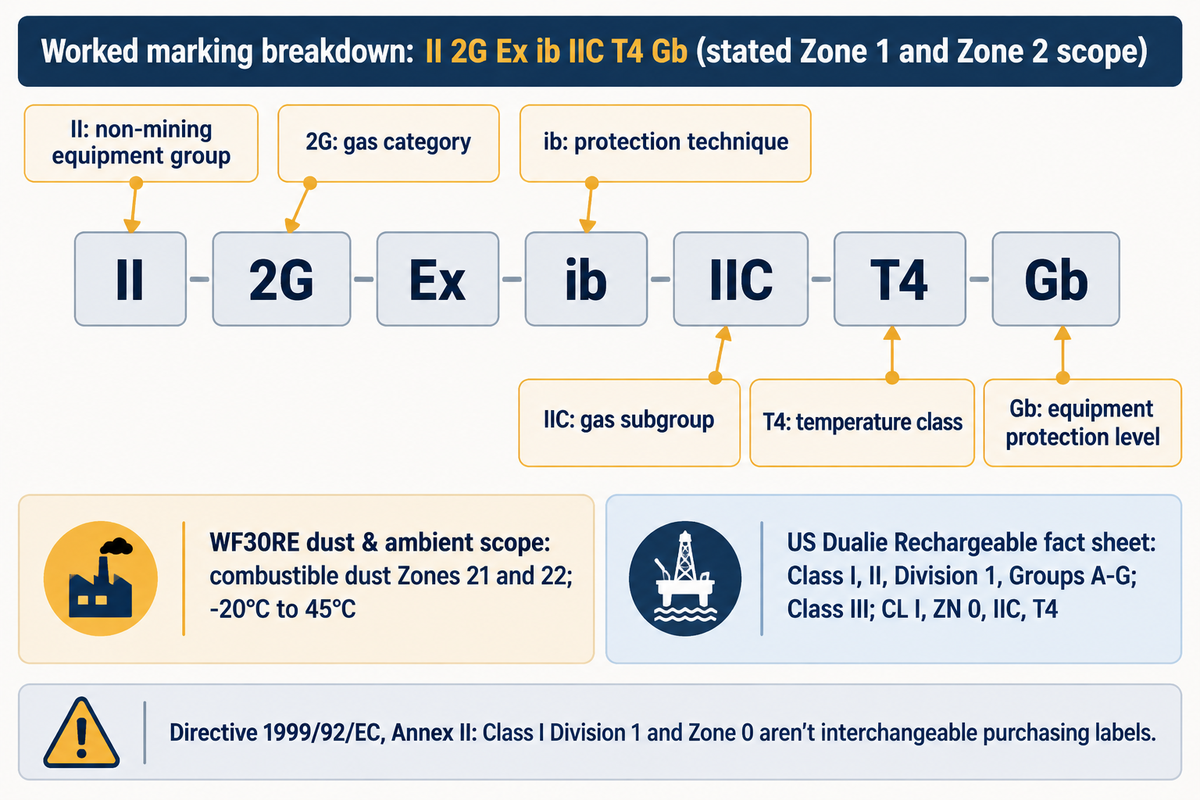
The WF30RE’s published gas marking of II 2G Ex ib IIC T4 Gb aligns with Fenix’s stated Zone 1 and Zone 2 scope. Therefore, a Zone 0 condition determines the shortlist prior to brightness considerations. Check the supplied variant against the country of use, classification system, substance group, temperature marking and ambient range.
In the referenced marking, II indicates a non-mining equipment group, 2G a gas category, ib a protection technique, IIC a gas subgroup, T4 a temperature class and Gb an equipment protection level. Dust uses a different marking. Fenix lists this model for combustible dust Zones 21 and 22 and an ambient range of -20°C to 45°C.
The US Dualie Rechargeable fact sheet lists Class I, II, Division 1, Groups A-G; Class III; and CL I, ZN 0, IIC, with T4. This is a combined Class I and Class II listing and doesn’t assign all seven groups to Class I. Keep that US document with the US variant. An ATEX product with a similar name requires its own documents. Class I Division 1 and Zone 0 aren’t interchangeable purchasing labels.
For an ATEX Zone 0 candidate, Streamlight’s June 2026 announcement identifies the Dualie Rechargeable ATEX as approved for that location. Request that variant and its related certificate. The US model’s particulars below should remain with its related quotation.
The zone system defines the frequency and duration of an explosive atmosphere. Gas Zone 0 comprises a location where an explosive atmosphere is present continuously, for a long duration or frequently. Zone 0 and Zone 1 thus require individual consideration in selection. Match the site’s zone classification to the specific zones listed for the model; review gas and dust markings separately.
For US procurement,
OSHA’s recognized testing laboratory program explains recognized laboratories and certification marks. Directive 1999/92/EC, Annex II lays out requirements for equipment category selection for the European zone-based selection. If a vendor offers a lower priced alternative, the full marking should be reviewed rather than accepting “Class 1” or “Div” in isolation. Check our hazardous-location classification reference for further information.
Choose the Beam and Runtime for the Job
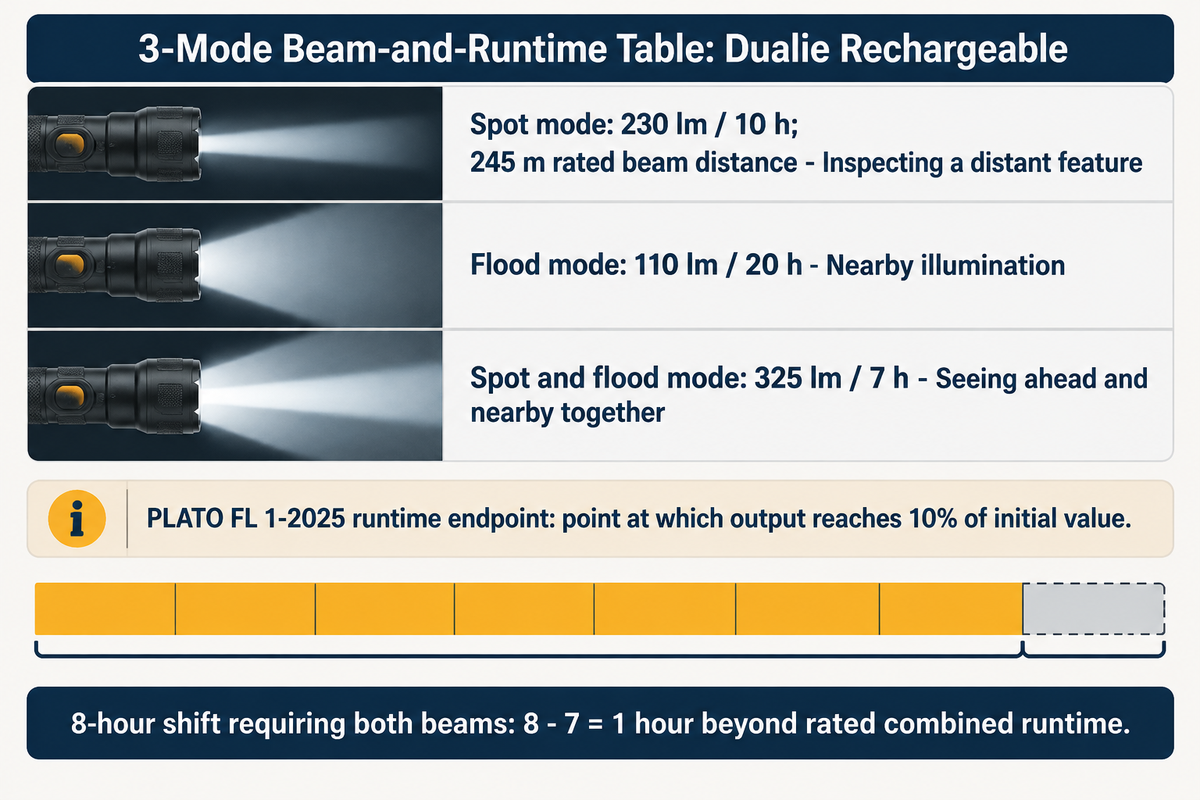
Streamlight rates the Dualie Rechargeable at 230 lumens for 10 hours in spot mode, 110 lumens for 20 hours in flood mode, and 325 lumens for 7 hours with both beams. Different modes deliver the highest output and the longest runtime.
| Mode | Rated output / runtime | Task to assess |
|---|---|---|
| Spot | 230 lm / 10 h; 245 m rated beam distance | Inspecting a distant feature |
| Flood | 110 lm / 20 h | Nearby illumination |
| Spot and flood | 325 lm / 7 h | Seeing ahead and nearby together |
How should I compare the runtime of rechargeable portable lights?
PLATO’s FL 1-2025 explanation defines ordinary runtime through the point at which output reaches 10% of its initial value. Compare the same mode, then check how light output declines during the rated period. For comparison, it’s useful to consider output levels and to interpret the declining output rather than using the largest numbers.
Let’s say that an inspection job requires both beams for an 8-hour shift. Comparing that requirement with the published combined-mode rating gives 8 − 7 = 1 hour beyond the rated runtime. Moving the quotation to the 10-hour spot figure doesn’t fix that problem; the job still requires nearby flood illumination. The plant manager should specify a minimum useful brightness for the inspection, and a replacement-light arrangement that’s supported by site procedures. Finance then prices that arrangement with the light. A rated runtime that’s longer than the shift requires a run-down check, since the endpoint may be too dim for the work. This is a planning example, not a measured shift trial.
Rechargeable or Alkaline: What Does Each Cost?
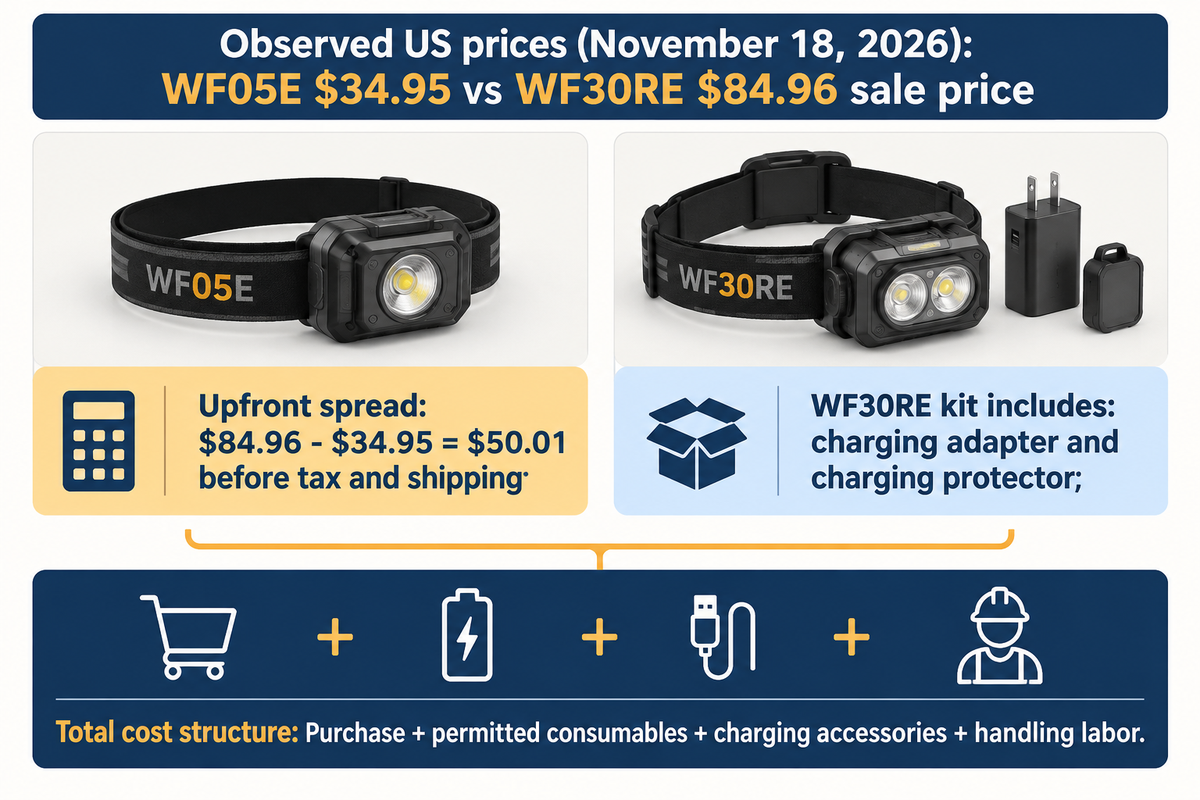
Fenix’s US pages showed $34.95 for the alkaline WF05E and a sale price of $84.96 for the rechargeable WF30RE on November 18, 2026. Paying more makes sense when the rechargeable model meets a task the WF05E can’t, or when a like-for-like operating cost comparison justifies the extra cost.
Suppose a buyer is deciding between those two advertised configurations. The upfront difference is $84.96 − $34.95 = $50.01, before tax and shipping. That amount buys a different model, battery system and output capability; it isn’t a rechargeable-battery payback result. To compare lifetime cost, finance needs the cost of permitted replacement cells, how often the actual task consumes them, and the handling time for each option over the same period. The WF30RE configuration includes a charging adapter and charging protector; list that equipment in the quotation. Without the operating-cost inputs, a claim that weekly use will recover the difference has no sound basis. A cheaper torch can remain the right purchase for a compatible short inspection.
Use this cost structure: Purchase + permitted consumables + charging accessories + handling labor. For an intrinsically safe rechargeable model, you’d have to include charging space and availability outside hazardous locations. Rechargeable battery life and time between charges are different questions.
Compare Exact Flashlight Models, Not Brand Names
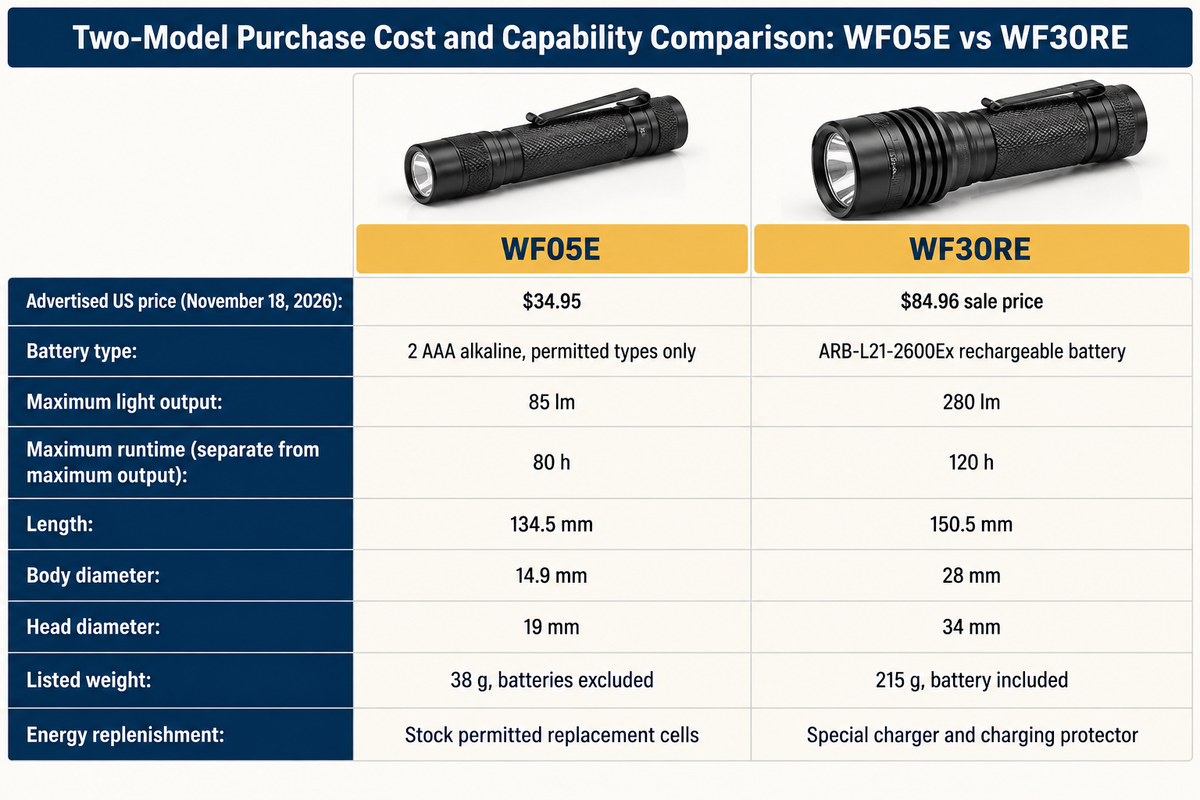
Fenix lists the WF05E at 38 grams, excluding batteries, and the WF30RE at 215 grams, including the battery. Along with beam output and charging, the difference in measurement basis should be considered. Compare exact models from any flashlights collection; brand-level recommendations can’t tell you which variant is suitable for the classified area.
| Purchase criterion | WF05E | WF30RE |
|---|---|---|
| Advertised US price, November 18, 2026 | $34.95 | $84.96 sale price |
| Battery type | 2 AAA alkaline, permitted types only | ARB-L21-2600Ex rechargeable battery |
| Maximum light output | 85 lm | 280 lm |
| Maximum runtime, separate from maximum output | 80 h | 120 h |
| Length | 134.5 mm | 150.5 mm |
| Body diameter | 14.9 mm | 28 mm |
| Head diameter | 19 mm | 34 mm |
| Listed weight | 38 g, batteries excluded | 215 g, battery included |
| Energy replenishment to plan | Stock permitted replacement cells | Special charger and charging protector |
Manufacturer specifications; prices can change. Maximum runtime isn’t runtime at max output. Nightstick, Pelican and AE Light candidates should enter the same comparison only with their exact model documents; there’s no “best intrinsically safe” brand for all cases.
Battery and Charging Rules That Change the Purchase
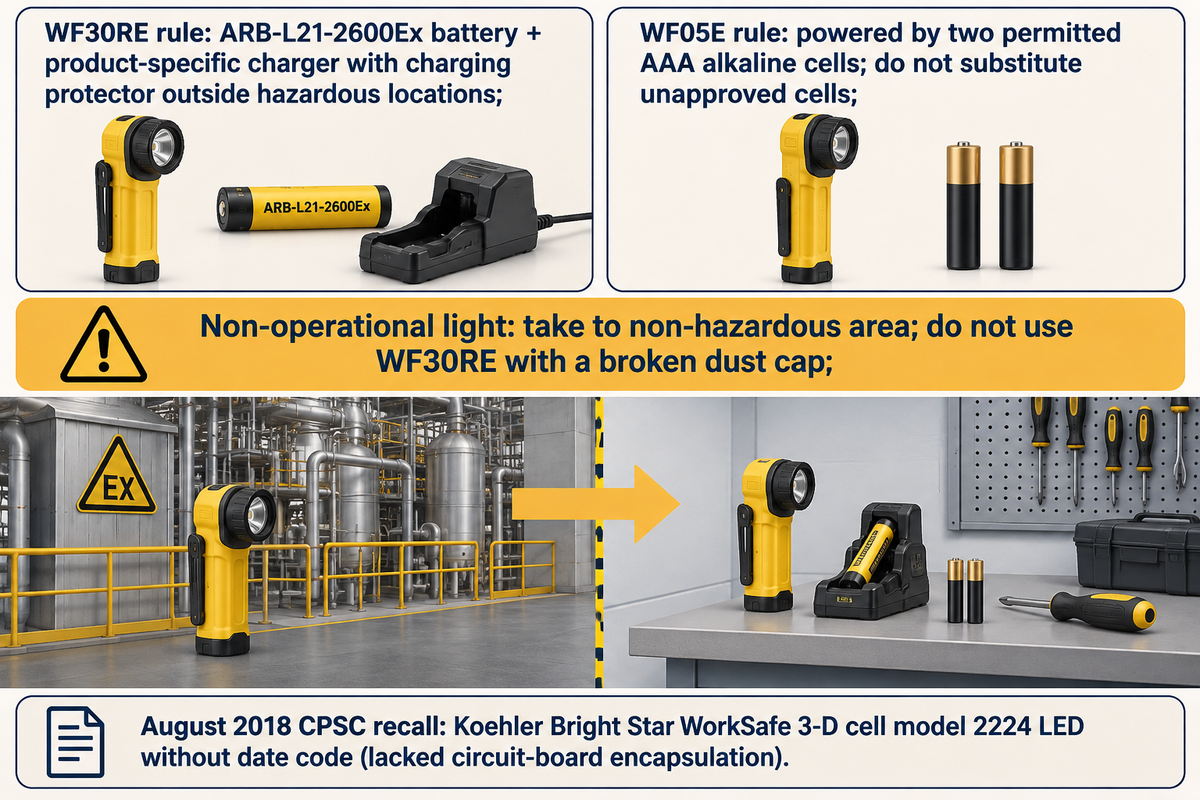
Fenix stipulates the use of the ARB-L21-2600Ex battery and the product-specific charger with charging protector for the WF30RE, charging outside hazardous locations. The WF05E is powered by two permitted AAA alkaline cells. Build these battery rules into the order and issue process, because a physically fitting substitute may change the approved assembly.
Why is an explosion proof flashlight not working?
A depleted battery, an incorrect cell or damage can make the flashlight non-operational. Take it to the non-hazardous area and follow the exact model’s troubleshooting guide. Fenix also cautions against using a WF30RE with a broken dust cap. For inspection and retirement decisions, refer to our Portable-light inspection and service guide. For flashlight safety, keep the approved assembly during routine battery handling by following the model’s battery instructions.
A real recall shows why assembly details matter. In August 2018, the US Consumer Product Safety Commission recalled certain Koehler Bright Star WorkSafe flashlights. The affected product was the 3-D cell model 2224 LED without a date code stamped on its body. A circuit-board component lacked encapsulation needed to protect against ignition of an explosive environment. No incidents or injuries were reported. The purchasing team’s lesson is to retain the exact model and identifying information. The notice applies only to the affected historical subset, not to all lights bearing the brand and not to the other models compared here.
When a Handheld Flashlight Is Too Small
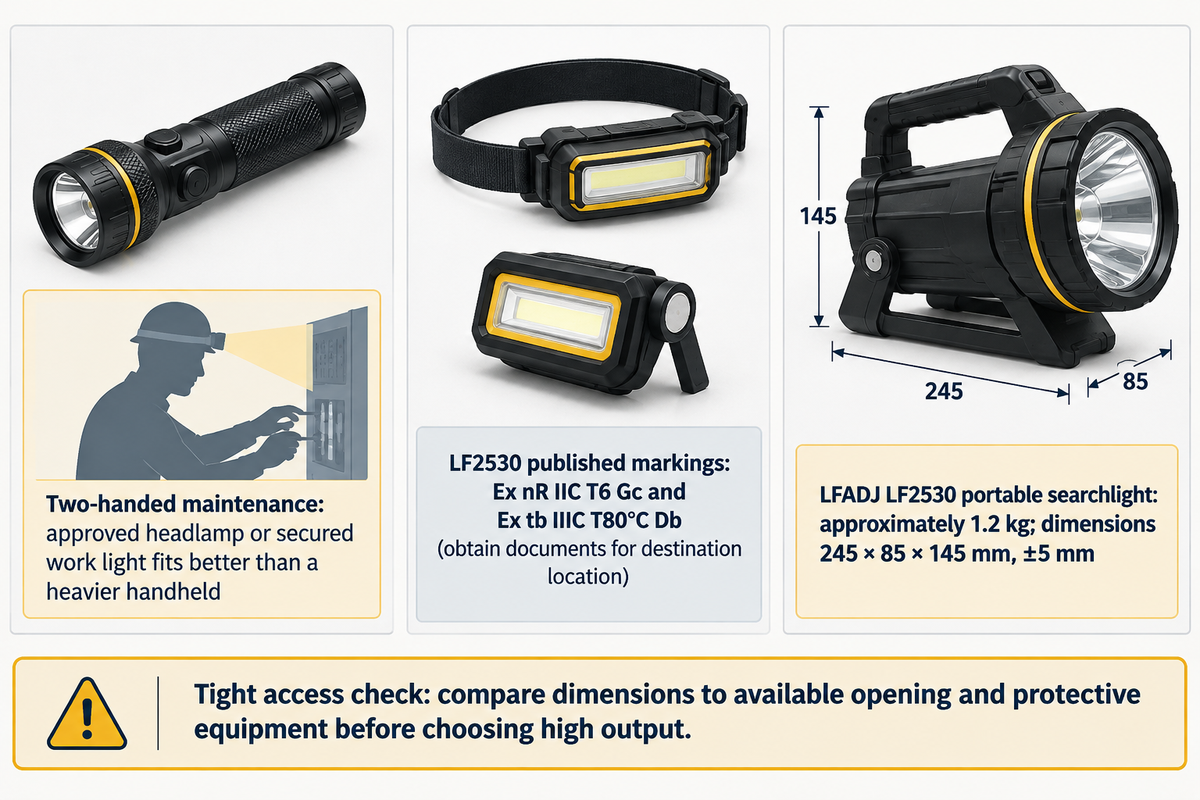
LFADJ lists the LF2530 portable searchlight at approximately 1.2 kg, with dimensions of 245 × 85 × 145 mm, ±5 mm. Its carrying format suits a different selection discussion from a pocket torch. Choose the form around reach, hand availability and access constraints, then match its specific approval scope.
The listing for the LF2530 provides Ex nR IIC T6 Gc and Ex tb IIIC T80°C Db. These are different protection methods from intrinsic safety. Treat it as a portable searchlight candidate; obtain the documents relevant to the country and location where it will be used and then specify it.
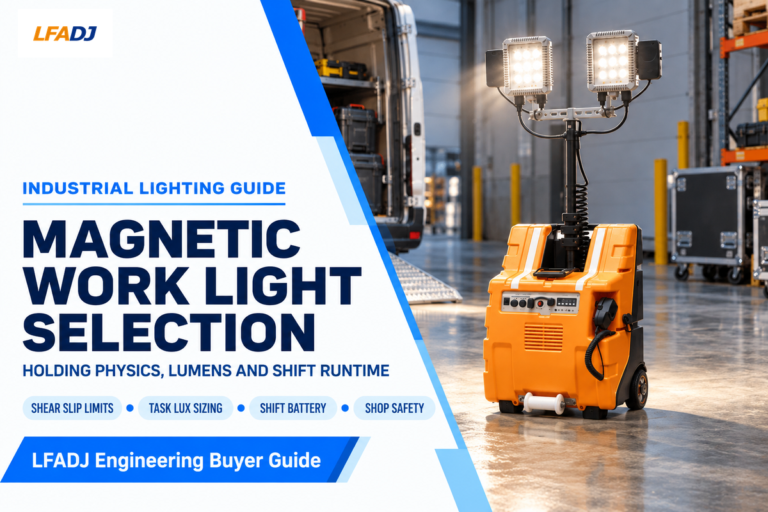
A technician working in hazardous locations may require two hands for maintenance. An approved headlamp or secured work light may fit better than a heavier handheld. An appropriate holding method also needs to fit the task. Our magnetic work light selection guide covers considerations of holding and positioning magnets. A convenient magnet alone doesn’t establish hazardous-location suitability. If access is tight, compare the light’s dimensions to the available opening and the operator’s protective equipment before choosing high output.
Build a Purchase Shortlist for Your Worksite
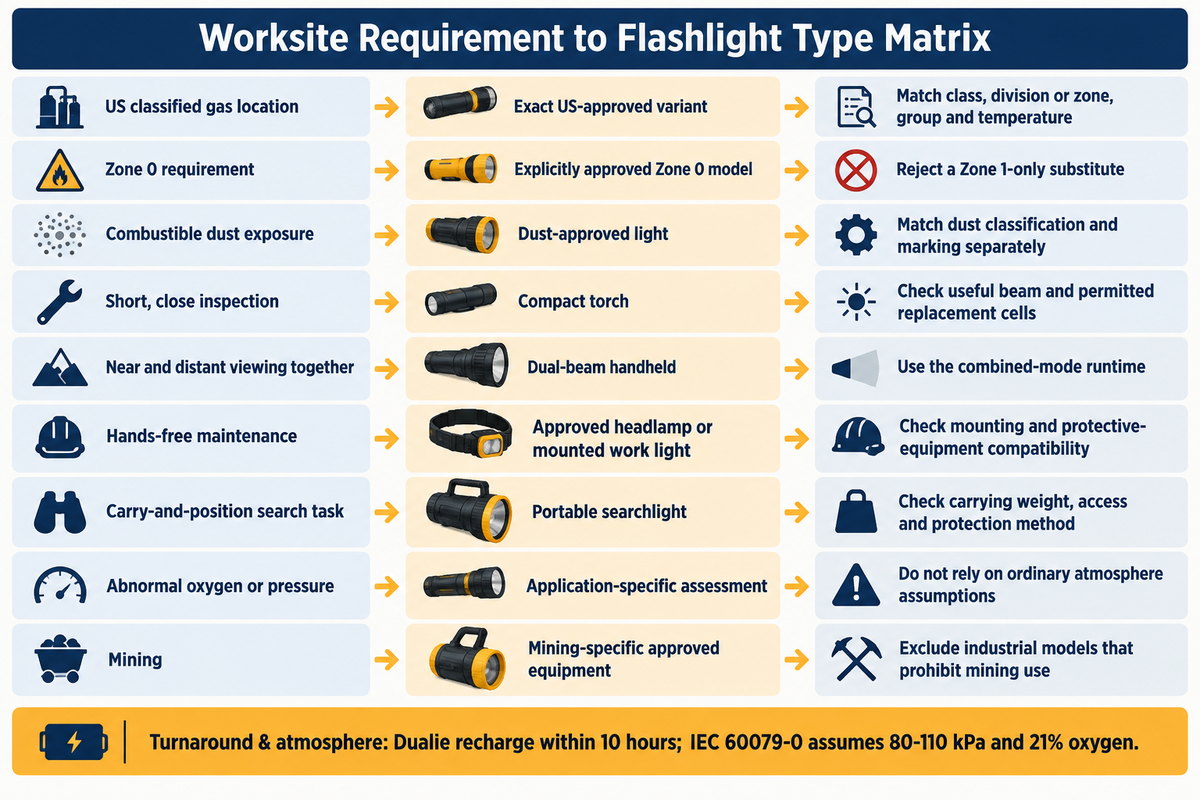
Use the Task-Marking-Mode Match below to eliminate unsuitable lighting solutions before requesting prices. Begin with the site’s classification and then consider the substances; choose a carrying format and an operating mode. In high-risk industrial environments, procurement can compare prices only after technical approval is granted and a plan for issuing lights is agreed.
| Requirement | Type to assess | Decision before ordering |
|---|---|---|
| US classified gas location | Exact US-approved variant | Match class, division or zone, group and temperature |
| Zone 0 requirement | Explicitly approved Zone 0 model | Reject a Zone 1-only substitute |
| Combustible dust exposure | Dust-approved light | Match dust classification and marking separately |
| Short, close inspection | Compact torch | Check useful beam and permitted replacement cells |
| Near and distant viewing together | Dual-beam handheld | Use the combined-mode runtime |
| Hands-free maintenance | Approved headlamp or mounted work light | Check mounting and protective-equipment compatibility |
| Carry-and-position search task | Portable searchlight | Check carrying weight, access and protection method |
| Abnormal oxygen or pressure | Application-specific assessment | Do not rely on ordinary atmosphere assumptions |
| Mining | Mining-specific approved equipment | Exclude industrial models that prohibit mining use |
The availability bottleneck: Streamlight states a recharge time within 10 hours for the Dualie Rechargeable. Compare this to the real time between issue periods, separately from runtime. A light returning from a shift may occupy a charger when the next team needs it; operations has to plan for charged units or an approved alternative.
For a confined space or storage tanks, lighting selection does not replace the site’s entry procedure. IEC 60079-0‘s general atmospheric assumptions include 80–110 kPa pressure and typically 21% oxygen by volume. An abnormal atmosphere needs specific assessment; an ordinary location marking is not blanket permission for oxygen-enriched use.
Industry Outlook: What Current Flashlight Designs Mean for Buyers
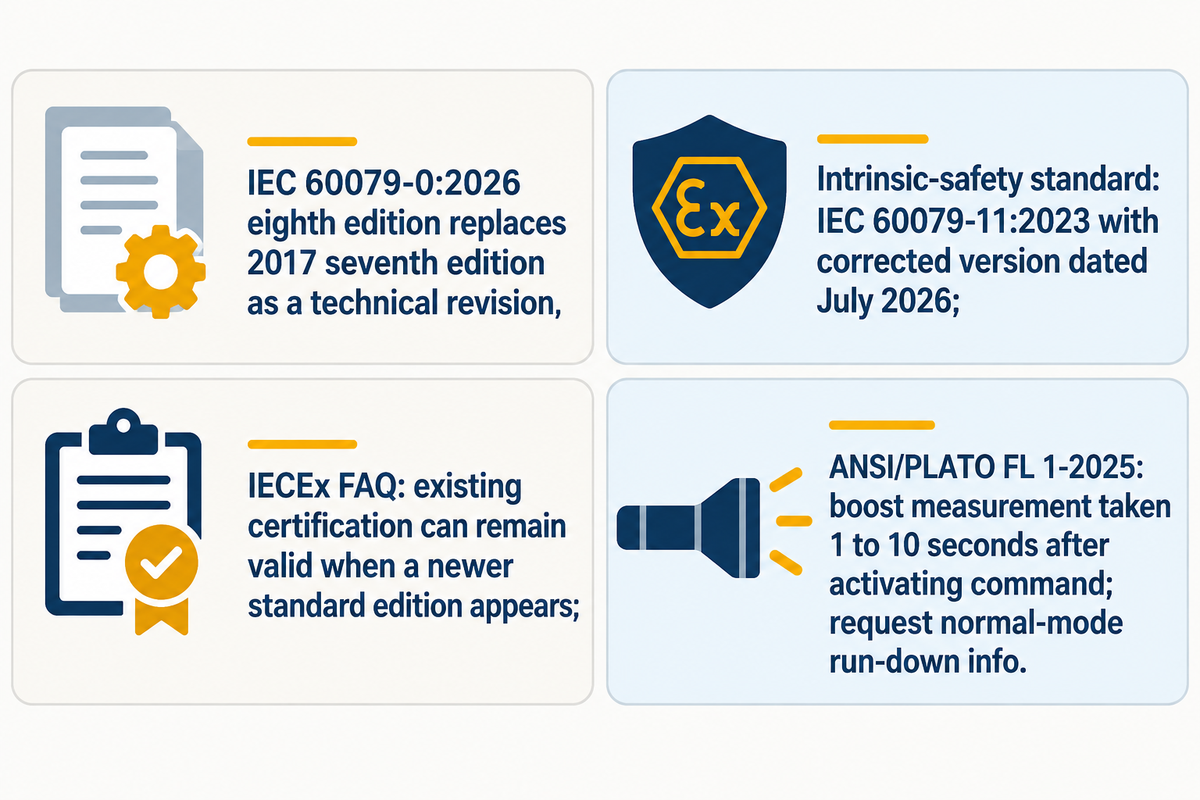
The 2026 revision of IEC 60079-0 makes document revision control a practical purchasing issue. Its eighth edition replaces the 2017 seventh edition as a technical revision. Buyers specifying certified lighting need to record the standard and edition on the product’s actual certificate, rather than writing “latest safety standards” on the purchase order.
The IEC 60079-0:2026 public catalogue entry describes general requirements. The intrinsic-safety standard remains IEC 60079-11:2023, with a corrected version dated July 2026. A corrected text and a new edition are different changes. Maintain the exact document identifier with the approved model and instructions to enable a future substitution to be assessed against the same basis.
Existing certification can remain valid when a newer standard edition appears. The distinction and the role of a controlled electronic certificate are explained in the IECEx frequently asked questions. The IEC explains that the eighth edition of its general equipment standard is a technical revision that cancels and replaces the 2017 edition. ATEX and IECEx serve different regulatory and certification functions. When a new order comes in, figure out which documents the destination accepts. Replacing one acronym with another in the specification doesn’t resolve that requirement.
Performance reporting is also changing. ANSI/PLATO FL 1-2025 describes short-duration elevated brightness and defines ordinary operating modes. It describes a boost measurement as being taken 1 to 10 seconds after the activating command. A headline bright-light figure measured in that window answers a different question from sustained output during maintenance. If a task requires reliable lighting for an extended period, ask for the normal-mode run-down information.
When placing a new order, provide the required marking and operating mode for the task on the quotation request. Indicate the battery models and charging accessories as part of the assembly. This keeps the decision useful for both the person approving the purchase and the person checking prices. Vendors may suggest alternatives, but must show how the device actually meets the same requirements.
Frequently Asked Questions
What are intrinsically safe flashlights?
Intrinsically safe flashlights limit electrical and thermal energy so that it can’t ignite the specified explosive atmosphere under their assessed conditions.
Their suitability will still be assessed upon verification of their exact approvals, battery configuration and operating limits. Refer to the model markings against the worksite classifications. A well-known brand name, LED emitter, or waterproof housing doesn’t determine suitability. The instructions for the light issued must be kept to ensure the replacement batteries and charging arrangements are in accordance with the assessed configuration.
Is ATEX the same as intrinsically safe?
No.
ATEX refers to the European regulatory framework concerning explosive atmospheres, while intrinsic safety is a particular protection technique. Equipment covered by ATEX can be protected by different techniques. A flashlight marking identifies the relevant category and technique; instead of considering ATEX and intrinsic safety as interchangeable purchasing labels, the full marking should be assessed and compared to the requirements of the location.
How long does an LED flashlight last?
Streamlight states that the Dualie Rechargeable has a run time of 10 hours in spot mode, 20 hours in flood mode and 7 hours with both beams operating.
Under PLATO’s ordinary-mode definition, runtime ends at 10% of initial output. The light can therefore become dimmer during that period. Select a mode that supplies the beam needed for the task and check its run-down information before planning a shift. LED component lifetime is a separate measurement from battery runtime.
Can a Zone 1 flashlight be used in Zone 0?
Select a flashlight approved for the specific Zone 0 application.
Fenix lists the WF30RE for Zone 1 and Zone 2 gas locations. Use those limits when choosing candidates for a worksite.
Can I use any AAA battery in an intrinsically safe torch?
No.
Follow the specific model’s permitted cell list. Size of the battery is only one part of the overall compatibility; an equally sized rechargeable cell isn’t automatically an approved replacement for an alkaline cell. Fenix prohibits replacing the WF05E’s batteries in an explosive atmosphere and specifies the use of alkaline AAA batteries. Order permitted replacements along with the light and ensure the instructions are provided to the person giving out the batteries.
What should I send when requesting a quotation?
Provide worksite classification, country of use, substances, ambient conditions, task, required mode, duration and quantity.
Request the exact model and approval documents, permitted battery configuration and charging equipment supplied.
LFADJ’s Portable-Lighting Perspective
LFADJ supplies industrial lighting, including the LF2530 portable searchlight discussed here. Our preference is to settle the equipment family prior to discussing a quotation. A pocket inspection torch and a carry and position searchlight impose different access and handling demands. Comparisons herein are based upon published specifications and manufacturers’ prices; they aren’t results of an LFADJ comparative field test.
Provide your classification and task requirements to discuss the LFADJ portable explosion-proof lighting range.
References & Sources
- Hazardous (classified) locations: 29 CFR 1910.307 OSHA.
- Electrical definitions: 29 CFR 1910.399 OSHA.
- Nationally Recognized Testing Laboratory Program OSHA.
- IEC 60079-0:2026, public scope and edition information IEC.
- IEC 60079-11:2023, public scope and corrected-version information IEC.
- Certification frequently asked questions IECEx.
- Directive 1999/92/EC EUR-Lex.
- ANSI/PLATO FL 1-2025: Getting the Testing Right PLATO.
- Koehler Bright Star flashlight recall, 2018 US Consumer Product Safety Commission.