Get in touch with LFADJ Company

LFADJ · Industrial project lighting
Rechargeable Portable Work Lights
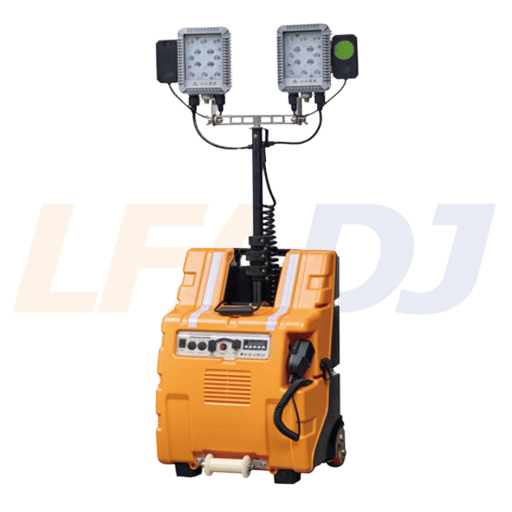
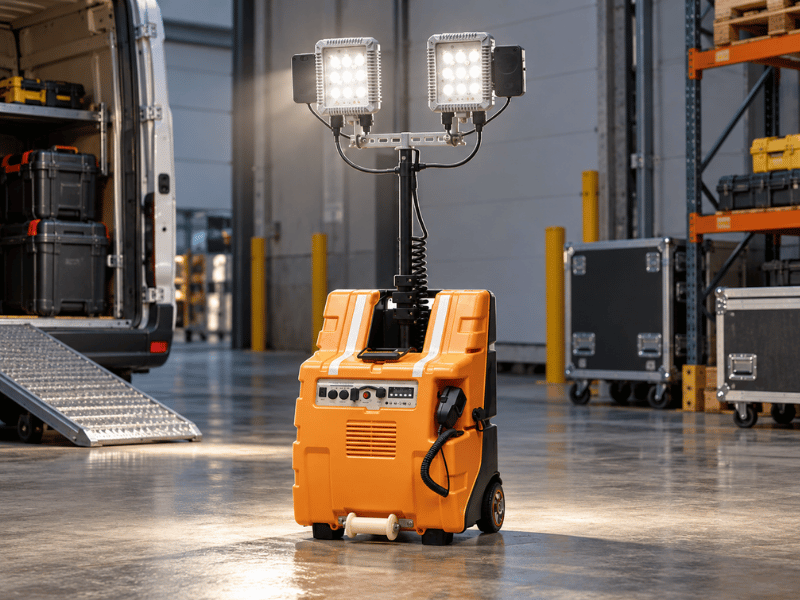
Our LF6128 is a portable work light rechargeable between shifts, combining two adjustable LED heads with a wheeled battery case. We supply it for temporary maintenance, inspection and emergency operations where crews need movable area lighting.
- Two 30 W LED heads with flood and spot adjustment
- 25.2 V, 22 Ah lithium battery
- Retractable lighting assembly and wheeled transport
Send your working area, shift hours and quantity. We will discuss the lighting configuration and supply requirements for your site.
2 × 30 W
LED head ratings
25.2 V · 22 Ah
Lithium battery
15.6 kg
Listed unit weight
IP65 / IP54
Lamp heads / case
365 × 330 × 620 mm
Retracted dimensions
Flood + spot
Adjustable light distribution
LF6128 Rechargeable Work Light Capabilities
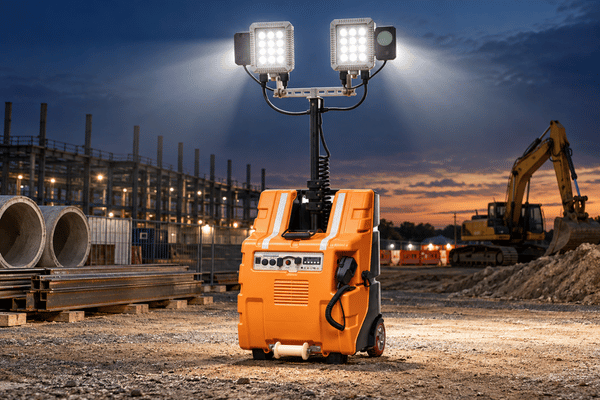
Place the lighting beside the job instead of routing a power cord to every temporary work position. Our LF6128 combines battery powered work light operation, an extendable assembly and directional LED heads in one transportable case.
Position the light
The adjustable heads support flood and spot lighting for a local work area or a more concentrated task. Aim from the working position so equipment and the operator do not block the light.
Move with the crew
The wheeled case suits repeated moves along a usable route. Plan lifting separately wherever steps, loose ground or vehicle loading interrupt that route.
Coordinate the operation
Red and yellow warning lights, audio amplification and recording playback support site communication. Choose these functions according to the operating procedure and include their use when checking battery duty.
Lighting and supporting functions
- An 8-megapixel camera and 32 GB storage are included in the listed model configuration.
- A battery indicator helps crews check status before departure.
- The USB output supports phone charging; include that extra demand in the operating plan.
Portable Setup and Job Site Applications
A cordless LED work light can remove the trailing supply cable during battery operation, but its location still determines whether the task is visible. Our 15.6 kg case format is designed around movable area lighting; specify the access route as carefully as the work area.
Equipment maintenance
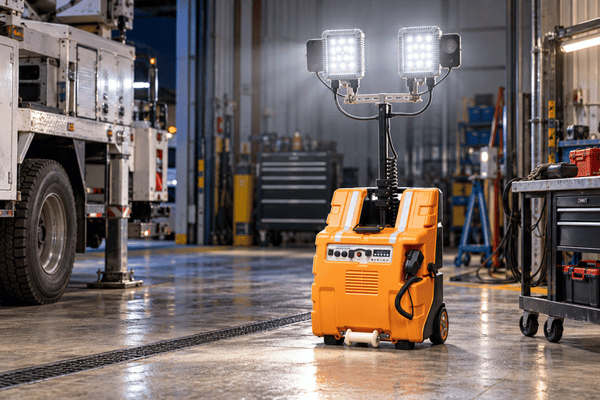
Place the heads to illuminate the repair surface without putting the operator’s hands in shadow. For a workshop or garage inspection, check the view behind guards and inside the machine before accepting the setup.
Temporary site work
For a construction site or utility maintenance job, identify stable placement and a clear route between work positions. Check the outdoor exposure of the complete deployed arrangement, including open connections.
Emergency operations
Use a movable area light where the response plan calls for temporary operational lighting. This work light is not a substitute for a specified emergency escape or hazardous-area lighting system.
Placement check before the shift
- Identify the task surface, viewing distance and the area requiring illumination.
- Check glare and shadows from the normal working position.
- Confirm stable placement, access and the route back to charging.
Measure illumination at the task, rather than accepting a wattage label as proof of coverage. CCOHS lighting guidance recommends workplace measurements and checking shadows; apply the requirements relevant to your own location and task.
Shift Coverage and Recharge Planning
Our LF6128 specification lists at least 8 hours of continuous operation and no more than 6 hours of charging. Agree the output setting, starting charge, temperature and auxiliary functions for your duty cycle before using those figures as a shift commitment.
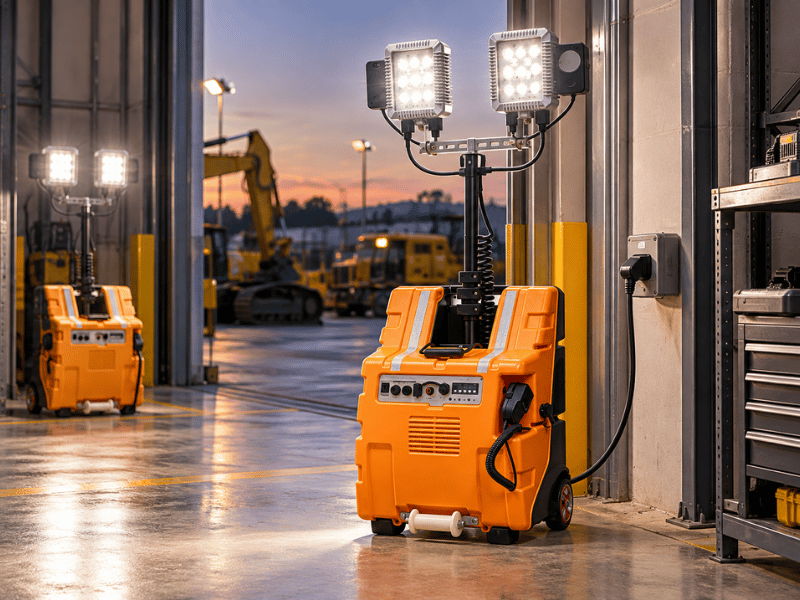
Plan the light and its next charging window as one job.
— LFADJ project planning note
Shift Coverage and Recharge Roster
The example below assumes a validated planning runtime of 8 hours, a 6-hour recharge and a 1-hour allowance for return and preparation. Unlike a runtime-only comparison, it includes recovery to expose the risk of a lighting gap; these are scheduling assumptions, not additional LF6128 performance guarantees.
| Operating pattern | Illustrative arrangement | Condition to check |
|---|---|---|
| 8-hour duty once each day | One unit has a 16-hour off-duty window | The 7-hour recovery allowance fits that window |
| 16 hours of uninterrupted duty | Two whole units cover consecutive 8-hour periods | Both start charged; the handover preserves task lighting |
| Continuous repeated duty | Two whole units alternate 8-hour periods | Each has 8 hours off duty for 7 hours of recovery |
The charging bottleneck: a spare unit only helps if a charged unit is ready where it is needed. Assign charging capacity, return time and responsibility; a late return can consume the apparent reserve because the next shift starts before recovery is complete.
Check the actual output mode
Longest runtime does not necessarily mean full brightness for the same period. Record the lighting setting and any camera, warning, audio or USB use together; use the same conditions for the acceptance run and subsequent shift planning.
- Set a usable-light threshold for the task rather than waiting for battery exhaustion.
- Allow for charging access and handover; the roster assumes whole-unit rotation.
- Arrange separate reserve lighting wherever a loss of light would interrupt safe work.
LF6128 Technical Specifications
Use these model values to determine the configuration for your quotation. Lamp-head ratings, battery capacity and retracted envelope answer different questions; none alone answer what area will receive appropriate light.
| Item | LF6128 value | Project check |
|---|---|---|
| Battery | 25.2 V, 22 Ah lithium | Confirm charging input and supplied charger |
| LED heads | 2 × 30 W | Validate task illumination and head positions |
| Continuous operation | At least 8 hours | Agree brightness and operating conditions |
| Charging time | No more than 6 hours | Confirm starting charge and charging conditions |
| Light distribution | Flood and spot adjustment | Check beam coverage at the working distance |
| Ingress protection | IP65 lamp heads; IP54 case | Review the complete operating configuration |
| Retracted size | 365 × 330 × 620 mm | Check vehicle and storage access |
| Unit weight | 15.6 kg | Plan wheeling, lifting and loading |
| Camera and storage | 8-megapixel camera; 32 GB storage | Agree the recording requirements separately |
| Additional functions | Warning lights, audio, USB output, battery indicator | Record the functions used during the runtime check |
Read the protection ratings by component
Our IP65 lamp heads and IP54 case carry different listed ratings. IEC 60529 classifies enclosure protection, so do not transfer a lamp-head rating to a charger, open connector or the whole installation.
- Confirm connector and cover positions for the intended use.
- Keep charging arrangements within the supplied equipment instructions.
- Specify exposure, temperature and cleaning conditions with the inquiry.
Project Pricing and Delivery
Request a quote for the complete operating arrangement, including any whole-unit reserve and charging equipment. We review your quantity and configuration together with your delivery destination, to ensure the supply scope matches your job.
Equivalent-Duty Lighting Quote Sheet
| Compare on the same basis | Record for each offer | Why it affects the purchase |
|---|---|---|
| Task and coverage | Working distance, target illumination and area | A lower-priced lamp may cover a different task |
| Usable runtime | Output mode and agreed operating conditions | Determines the reserve and rotation arrangement |
| Included equipment | Complete units, charger, accessories and packing | Prevents omitted items from distorting the comparison |
| Delivery scope | Destination, freight scope and required date | Separates product cost from delivery obligations |
| Support | Warranty terms, maintenance route and service scope | Makes the agreed after-sales provision clear |
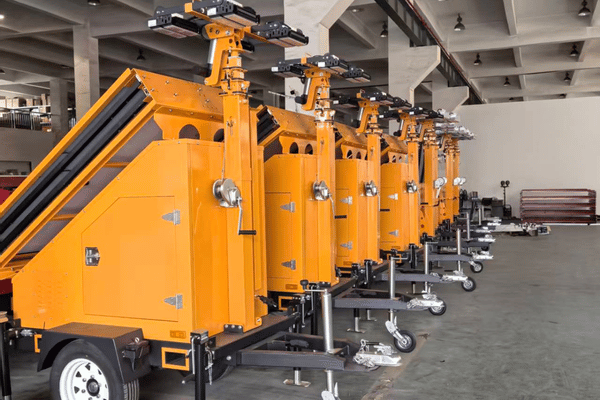
Compare the complete package: buying fewer lamps is not always the lower-cost operating choice if it leaves a shift without charged lighting. First establish an equivalent duty, then compare the quoted equipment and delivery totals.
Supply terms for your project
- State quantity, required delivery date and destination.
- List charging supply, plug requirements and any configuration changes.
- In the quotation and contract, agree upon quantity, payment, warranty, and delivery terms.
QUALITY & SUPPORT // ZHEJIANG LONGFA LIGHTING
Quality and Project Support
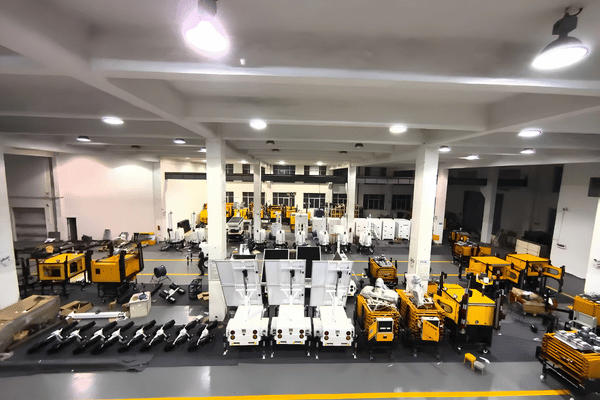
LFADJ is the industrial lighting brand of Zhejiang LONGFA Lighting Co., Ltd., established in Yueqing, Zhejiang, in 2013. We combine product development, manufacturing, trade and service across industrial, mobile and emergency lighting.
Model-specific technical communication
We discuss product selection and configuration against the operating environment. In the order, we agree on the model, supplied items, and acceptance conditions. This is to allow the receiving team to verify the configuration.
Support matched to the contract
We provide product-use consultation and after-sales problem handling. Maintenance obligations, response times, warranty and on-site support follow the agreement for your project.
Documents to match to the order
- Model specification and agreed configuration
- Applicable charging and operating instructions
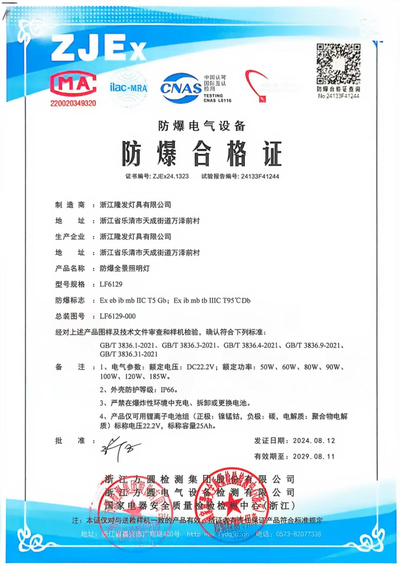
- Required model-specific test or compliance documents
- Acceptance criteria, delivery scope and service terms





Project Ordering and Deployment
A clear duty description connects the choice of lighting to delivery and acceptance. We work with your operating requirements to discuss configuration and supply. The checks below keep the purchasing and site teams aligned.
-
Describe the job:
task area, working distance, shift length, exposure and access route. -
Confirm the configuration:
heads, power arrangements, auxiliary functions and required documentation. -
Agree the supply:
quantity, packing, destination, required date and contractual support. -
Check the received equipment:
model identification, supplied components and visible condition. -
Validate the duty:
place the light, verify the task surface and run the agreed lighting mode, then assign the roster.
Keep handover practical
Record the work light’s charge state, work area and next charge slot. A durable case does not remove the need to inspect wheels, controls and connections after transport. Follow the operating instructions for maintenance.
- Return the unit to its assigned charging location.
- Report damage or abnormal operation before reuse.
- Keep the spare allocation separate from equipment that has already been committed to another use.
Rechargeable and Corded Lighting Options
Choose the power architecture around access to electricity and how often the jobsite moves. Our LF6128 combines a lithium battery with listed mains operation; confirm the required mains input and operating conditions when ordering.
| Arrangement | Useful fit | Trade-off to resolve |
|---|---|---|
| Rechargeable case light | Movable local area lighting without a trailing supply cable | Charging window, unit weight and reserve equipment |
| Compact tool-battery light | Crews already using a compatible battery platform | Battery availability, platform compatibility and suitable coverage |
| Corded flood light | A work area with an appropriate continuous supply | Cable routing, electrical protection and mobility |
Confirm what dual power actually includes
Battery operation, mains operation and charging while illuminated are separate functions. For example, Milwaukee's 2366-20 specifies an M18 battery or a 120 V extension cord; that architecture does not establish compatibility or charging behavior for another model.
- DeWalt, Milwaukee and Makita battery systems are not interchangeable by default.
- Our USB output is a device-charging feature, not a stated USB charging input.
- Compare a replacement for a halogen bulb or fixture based on usable light and placement, not based on input watts alone.
Alternative Lighting for Different Tasks
The LF6128 case format is the wrong choice for a pocket-sized handheld work light. Match the equipment shape to the task before comparing brightness or battery capacity.
Close inspection
A handheld flashlight, headlamp or slim task light can reach a confined workspace where an elevated area light cannot. For hands-free under-hood repair, check whether a magnetic base and a suitable metal mounting surface are required.
Elevated or broad coverage
A tripod or a larger mobile lighting system may suit a different mounting height or work area. Compare the deployed arrangement and measured illumination before treating portable LED lights as equivalent.
Hazardous locations
Specify the hazardous-area classification and the approved lighting model required for that location. A general rechargeable LED work light's ingress rating is not explosion-protection approval.
Rechargeable Portable Work Lights Planning Tools
Select an engineering calculator below to map shift rotation schedules, compare supplier quotes on an equivalent duty basis, or calculate LF6128 transport weight and volume.
Enter your validated runtime, recharge duration and handover allowance to calculate a whole-unit rotation schedule and identify potential lighting gaps.
Align working distance, usable runtime, included equipment and delivery scope to compare two quoted lighting package totals on the same operational basis.
Specify your required unit quantity to calculate total pre-packaging weight, retracted storage dimensions and charging supply requirements for transport planning.
Request a Project Lighting Quote
Let us know the task, how long the light must work, and how many units. LFADJ will discuss product selection, configuration and supply for your project.
- Task area and required lighting duty
- Shift and charging schedule
- Quantity, destination and required delivery date
Rechargeable Work Light FAQs
Can one rechargeable light cover a 12-hour night shift?
Do not assume it from a headline runtime figure. Our LF6128 lists at least 8 hours, so a 12-hour duty needs a verified operating plan, a different arrangement or charged reserve equipment.
- Validate the required output and auxiliary functions together.
- Use the roster to plan whole-unit handover and charging.
Is this a compact magnetic work light for vehicle repair?
The LF6128 is a wheeled case system rather than a pocket light with a magnetic base. Choose a smaller magnetic or handheld model where the job calls for mounting directly beneath a vehicle or inside a narrow enclosure.
Why should brightness and runtime be checked together?
A lumen figure measures output, while runtime depends on the mode of operation and test conditions. Streamlight's BearTrap 360 flood mode is 2,000 lumens for 2.5 hours on high and 575 lumens for 8.75 hours on low; these are separate combinations, not one performance claim.
- See the manufacturer's mode-by-mode figures.
- Ask for equivalent mode information for the product you are buying.
Does the wattage prove the work area meets an illumination requirement?
No; check light at the task surface against the applicable requirement. For example, OSHA 29 CFR 1926.56 lists 10 foot-candles for general construction plants and shops in the US; this is not a universal industrial-lighting requirement or a product approval.
- Read the applicable OSHA illumination table.
- Confirm the relevant local requirements and measure the proposed setup.
Can it be charged from USB or used with a tool battery?
The LF6128 specification lists USB output and a 25.2 V, 22 Ah lithium battery. Confirm the supplied charger and input requirements; do not assume USB input, an interchangeable tool battery or hot swapping.
What information is needed for an outdoor project quotation?
Send the task, working area, hours of operation, quantity, destination and environmental conditions, and let us know the charging situation and documentation required. Also send any information regarding recording or warning functions to check the quoted configuration against the intended use.