Get in touch with LFADJ Company

Updated November 2026 · By GW · Reviewed by the Zhejiang LONGFA Lighting Co., Ltd. technical team
Temporary lighting for construction must provide at least 5 foot-candles over indoor work areas and corridors. Matching each luminaire format starts with ceiling height, wet-location exposure, and branch-circuit power. Good jobsite illumination prevents trip accidents on stairs and slabs. Clear visibility also helps keep the electrical, framing, and concrete crews productive during their night shifts.
General contractors don’t typically solve worksite lighting with one product family across an entire construction project. Low corridors require linkable string lights. Tall warehouse shells require suspended bay fixtures, while unpowered zones require portable construction lights for crew safety and productivity. Below are code clauses, circuit load math, cord durability benchmarks, and rental vs. purchase numbers.
Quick Specs: Temporary Construction Lighting Baseline
| OSHA General Indoor Floor | 5 foot-candles (54 lux); 10 foot-candles in mechanical and electrical rooms |
| Wet or Conductive Locations | 12 V maximum, or 120 V protected by a ground-fault circuit interrupter |
| 20-Amp Branch Continuous Cap | 16 A / 1,920 VA (1,728 W at 0.90 power factor), or lower cord pass-through limit |
| 100-ft Integrated LED Stringer | 78 W to 150 W, 8,000 to 15,000 lumens at 5000K, IP65 outdoor rating |
| Emergency Exit Backup | 90 minutes minimum battery backup on UL 924 listed exit fixtures (Nora Lighting) |
How Temporary Construction Lighting Formats Fit Each Jobsite Zone
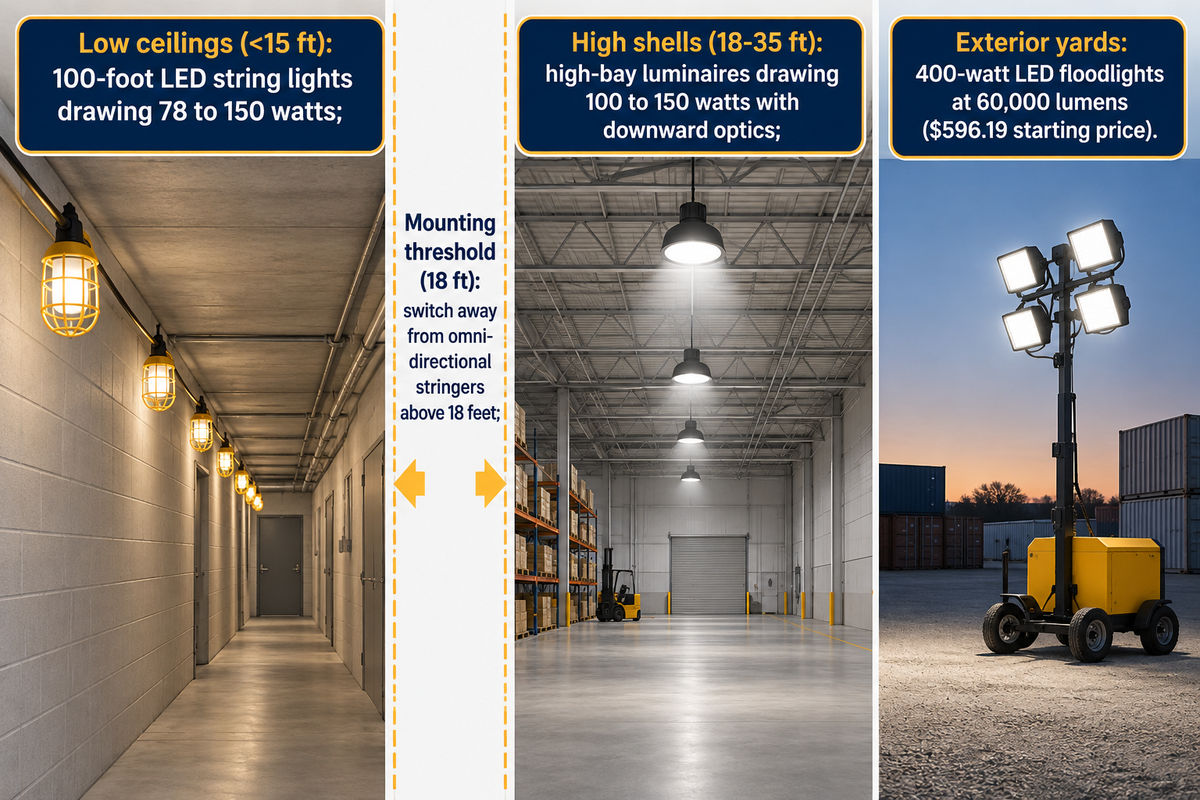
100-foot LED string lights drawing 78 to 150 watts fit ceilings less than 15 feet. High-bay luminaires drawing 100 to 150 watts cover 18 to 35-foot shells. Mobile masts and battery-operated stands provide lighting for unpowered spaces. Switch away from stringers above 18 feet because omni-directional modules waste upward light.
Ordering one temporary lighting solution for every floor results in blind spots or blocked walkways. Tripods block narrow hallways. Low-wattage temporary site lights hung from 28-foot bar joists miss the slab below. Ericson separates its commercial bay fixtures at the 18-foot mounting height threshold to match the changing lighting needs.
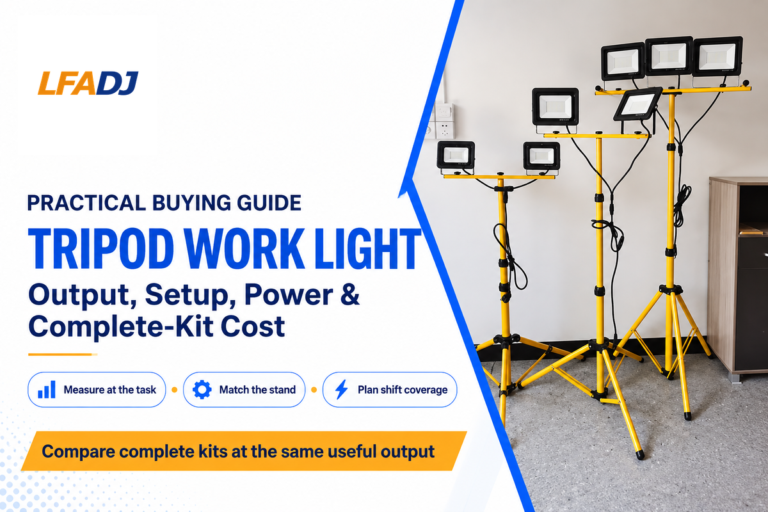
Use the 9-Zone Construction Lighting Format Matrix to align the work areas on your jobsite layout with the proper equipment class. For portable work lights, check out our portable LED work lights selection guide.
| Jobsite Zone | Ceiling or Mast Height | OSHA Floor | Primary Fixture Format | Key Field Rule |
|---|---|---|---|---|
| Interior corridor and stairs | 8–12 ft | 5 fc | 100-ft integrated LED string lights | Hang on tensioned messenger cable above head height |
| Open commercial framing floor | 12–18 ft | 5 fc | 360-degree 100–150 W LED baylight | Space units on 25–30 ft centers with locking hooks |
| High-bay warehouse shell | 18–35 ft | 5–10 fc | Directional 120–150 W UFO high-bay work light | Use downward optics and safety restraint cables |
| Mechanical and electrical rooms | 9–16 ft | 10 fc | 5000K CRI 80+ LED work light plus stringer | Keep high CRI on panel terminations for wire colors |
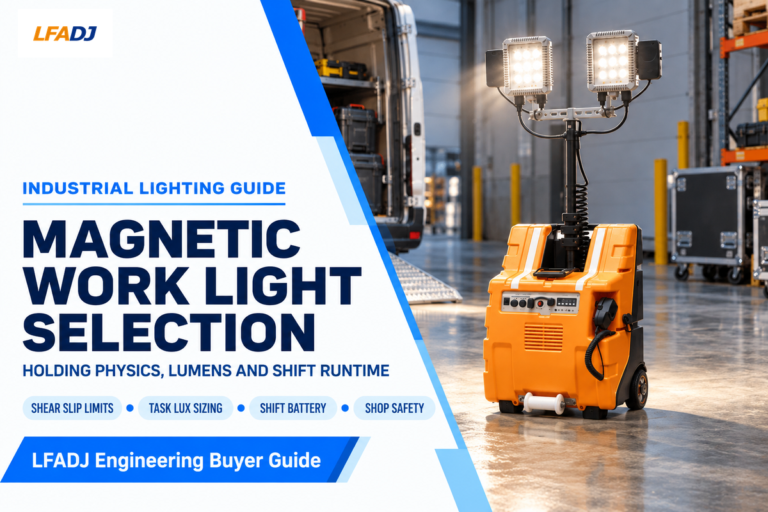
| Unpowered demolition or punch-list | Portable stand | 5–10 fc | Rechargeable dual-head battery case light | Rotate spare battery units across charge cycles |
| Wet basement or conductive steel | 6–14 ft | 5 fc | 12 V low-voltage system or GFCI-fed IP65 LED | Keep cord connections elevated off standing water |
| Exterior laydown and concrete pour | 15–30 ft mast | 3–5 fc | Wheeled mast or 200–400 W LED floodlight | Park engine generators outdoors away from air intakes |
| Road-adjacent night work zone | 15–25 ft flagger | 5–10 fc | Glare-controlled mast or diffused balloon light | Aim beams downward away from oncoming traffic lanes |
| Permit-required confined space | Tank or vault | 5–10 fc | Hazard-approved Class/Division or 12 V light | Never substitute ordinary IP65 weatherproof lights |
Many electricians on the construction subreddit say LED flexible rope lights are dim and unsuitable for active framing. Reserve rope strips strictly for dry stairwell handrails. Larger areas need LED fixtures. LED Lighting Supply lists 400-watt LED sports light floodlights at 60,000 lumens ($596.19 starting price) for exterior yards rather than indoor bays. They recommend them for use in outdoor yards and not bays.
OSHA 29 CFR 1926.56 Minimum Foot-Candle Rules by Construction Area
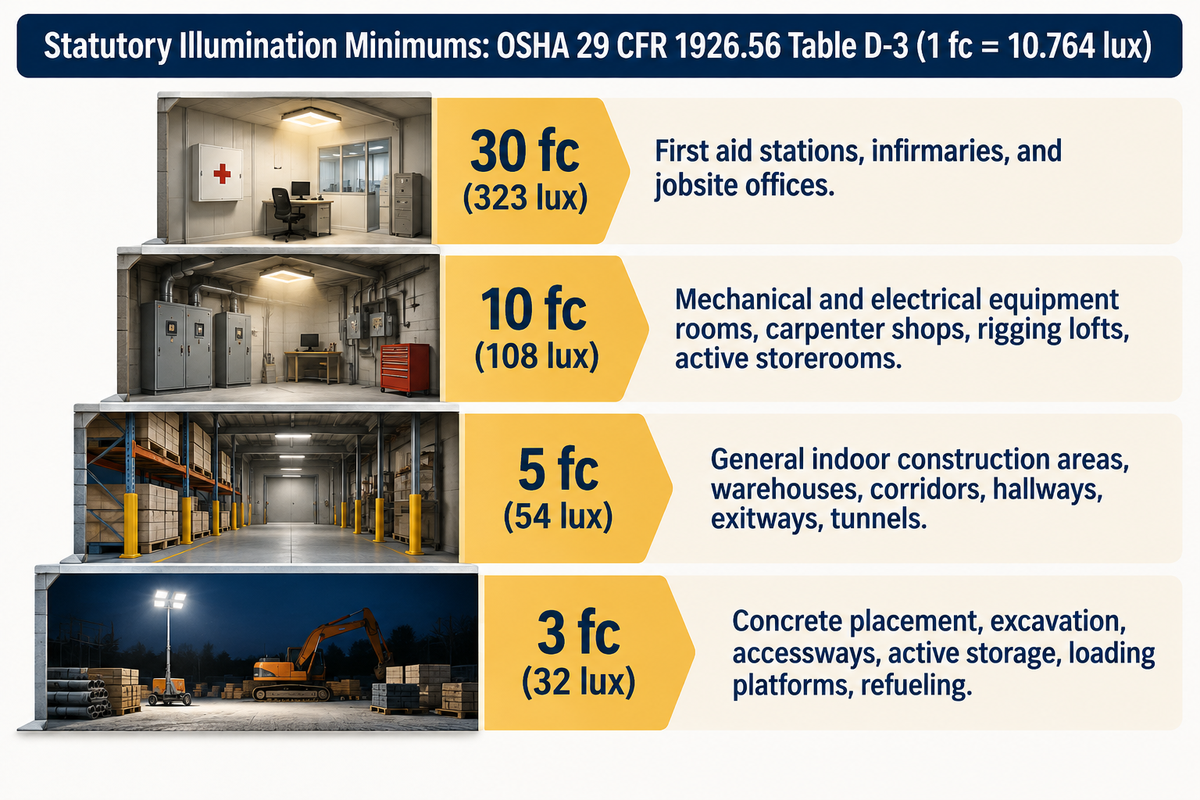
According to OSHA 29 CFR 1926.56 Table D-3, illumination has a minimum of four tiers: 3, 5, 10, and 30 foot candles. The indoor construction areas are at least 5 foot-candles and exit ways are at least 5 foot-candles. Mechanical shops step up to 108 lux (10 foot-candles), and site offices require 30 foot-candles.
| Minimum Foot-Candles | Metric Equivalent | Covered Construction Area or Operation |
|---|---|---|
| 3 fc | 32 lux | Concrete placement, excavation and waste areas, accessways, active storage, loading platforms, refueling, and field maintenance |
| 5 fc | 54 lux | General construction area lighting; indoor warehouses, corridors, hallways, and exitways; tunnels and shafts |
| 10 fc | 108 lux | General construction plant and shops, mechanical and electrical equipment rooms, carpenter shops, rigging lofts, active storerooms, indoor toilets, and active tunnel headings |
| 30 fc | 323 lux | First aid stations, infirmaries, and jobsite offices |
What Are the OSHA Construction Site Lighting Requirements for Walkways and Mechanical Rooms?
Indoor corridors, halls, and exit ways are at least 5 foot candles, and mechanical and electrical equipment rooms are at least 10 foot candles according to Table D-3. Exterior accessways, loading platforms, and active storage yards operate at the 3 foot-candle (32 lux) floor. Paragraph 1926.56(b) of the Construction Standard provides additional direction for unlisted tasks in ANSI A11.1-1965 (R1970).
There’s some wording overlap in Table D-3 that catches safety managers off guard. The 54-lux and 32-lux rows both mention general construction areas. Indoors, all enclosed building areas should meet the 5 foot-candle minimum. The 32-lux level should be reserved for earthwork, concrete pours, and access ways.
Code requirements set a lower limit for a ‘safety floor’ rather than striving for optimal visual acuity. Commercial lighting layout guides from LED Lighting Supply recommend 10 to 20 foot-candles in active equipment zones. Custom lighting plans add focused task lights where fine inspection requires 30 to 50 foot-candles. Measure illumination requirements at the actual work surface using a handheld light meter after dividers are constructed.
OSHA 1926.405 and NEC Article 590 Temporary Wiring, Guarding, and GFCI Rules
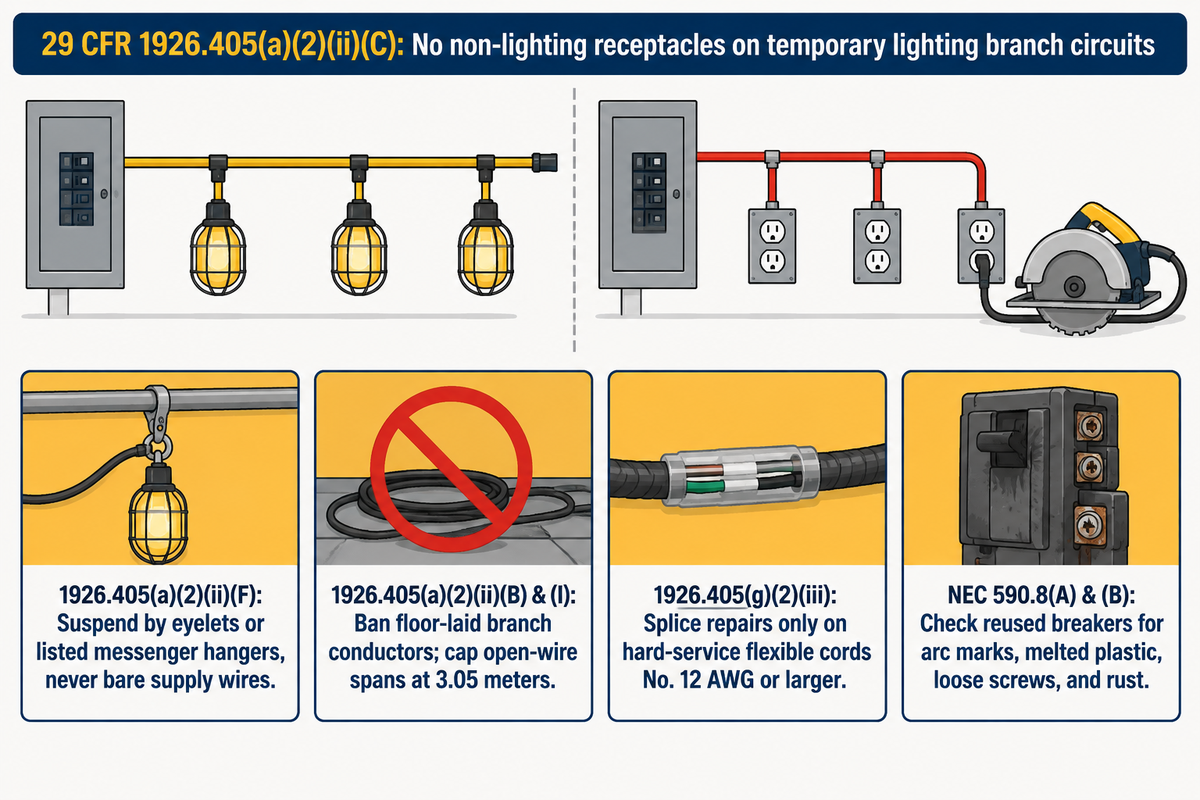
Portable electric lights in wet or conductive locations must run at 12 volts or less unless 120-volt units have GFCI protection under OSHA 29 CFR 1926.405(a)(2)(ii). Every lamp must be protected from physical breakage. Temporary lighting branch circuits must be separated from power tool branch circuits.
“Receptacles for uses other than temporary lighting shall not be installed on branch circuits which supply temporary lighting.”
Power tools on a lighting circuit can be hazardous. A faulty wet masonry saw on a combined tool-and-light circuit downstream from a circuit breaker leaves other workers on scaffolds in the dark. Electricians on the Mike Holt Code Forum consider circuits that supply power tools and lighting together to be one of the most common jobsite violations.
What Is the NEC Code for Temporary Lighting and When Must Temporary Wiring Be Removed?
According to NFPA 70 (NEC) 590, temporary power and lighting installations must be removed immediately upon completion of the project. Likewise, 1926.405(a)(2)(i) of OSHA’s standards enforces immediate removal of such lighting upon completion of the project. As per NEC 590.6(A)(1) (Electrical License Renewal), for temporary 125-volt, single-phase 15, 20, and 30-ampere receptacles, personnel GFCI protection is required.
Four physical rigging rules within 29 CFR 1926.405 and JADE Learning’s NEC 590 inspection guidance greatly reduce the number of walkdown citations issued on a job site.
- – Strain-relieved hanging loops: Paragraph 1926.405(a)(2)(ii)(F) requires suspension eyelets or listed messenger hangers, rather than branches that are suspended by bare supply wires.
- – Floor and pinch-point protection: Paragraph 1926.405(a)(2)(ii)(B) and (I) ban floor-laid branch conductors, cap open-wire spans at 3.05 meters, and require pinch guards on doorways.
- – Hard-usage cord jackets: Paragraph 1926.405(a)(2)(ii)(J) requires the usage of hard or extra hard service cords (S, SO, ST, SJ, SJO, or SJT) without field tape splices. Paragraph 1926.405(g)(2)(iii) permits splice repairs retaining outer sheath properties only on hard-service flexible cords No. 12 AWG or larger.
- Reused breaker checks: NEC 590.8(A) and (B) call for checking reused breakers for arc marks, melted plastic, loose screws, and rust.
Local jurisdictions adopt different NEC editions on staggered schedules. While NEC Article 590 places temporary GFCI rules in Section 590.6(A)(1), listed cord sets with GFCI protection are also permitted for temporary portable LED strings. Check which NEC your local electrical inspector enforces before mobilizing.
Power Planning and Circuit Load Math for Linkable Jobsite Lights
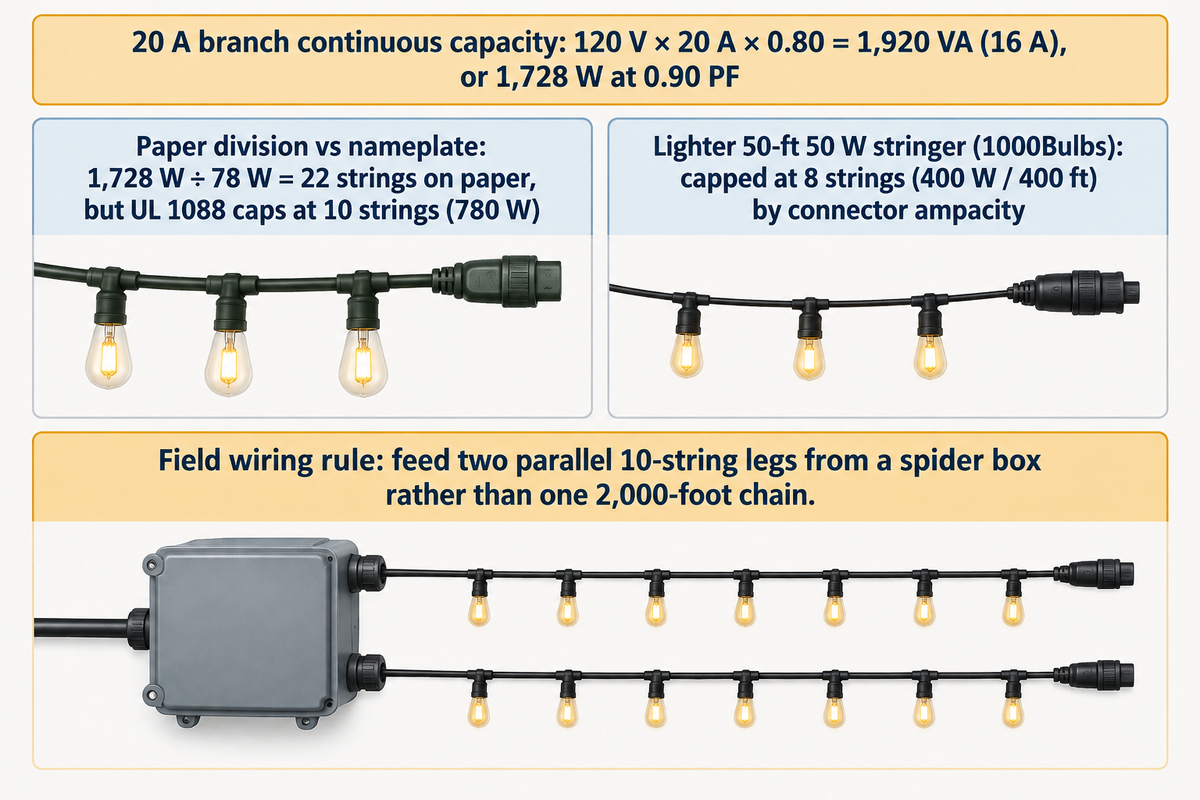
A 120 volt, 20 amp lighting circuit can support a continuous load of 16 amperes (1,920 volt-amperes) for shifts of 3 hours or more. Internal cord gauge and pass-through connectors still limit most linkable LED stringers to 400 to 780 watts. Always stop linking at the nameplate string count rather than at the breaker limit.
How Many LED String Work Lights Can You Daisy-Chain on One 20-Amp Circuit?
Connect up to 10 integrated 100-foot LED stringers on 14/3 cord, or up to 8 integrated 50-foot stringers on lighter cord. Southwire caps its 100-foot 14/3 SJTW LED stringer (model 7165SW, 78 watts, UL 1088 listed) at 10 strings. Meanwhile, 1000Bulbs caps a 50-foot 50-watt integrated stringer at 8 runs.
Apply the 16-Amp Continuous Daisy-Chain Cap to prevent melted female tail plugs and dim corridor ends. Assumed inputs: one dedicated 120 V, 20 A branch circuit runs a full shift (0.80 continuous factor) at 0.90 driver power factor with 78 W Southwire 7165SW stringers. Branch capacity equals 120 V × 20 A × 0.80 = 1,920 VA (16 A), or 1,728 W of real power. Dividing 1,728 W by 78 W gives 22 strings on paper, yet Southwire’s UL 1088 nameplate caps linking at 10 strings (780 W). That 10-string limit protects the first string’s 14 AWG pass-through wires and respects Duraline’s 3% branch voltage-drop guideline. To run 20 strings on one 20 A breaker, feed two parallel 10-string legs from a spider box rather than one 2,000-foot chain.
| Luminaire Configuration | Cord Gauge | Unit Wattage | Pass-Through Chain Cap | Governing Limit |
|---|---|---|---|---|
| 50-ft 5-lamp integrated LED stringer (1000Bulbs) | Integrated 50-foot cords | 50 W (6,000 lm) | 8 strings (400 W / 400 ft) | Molded connector & cord ampacity |
| 100-ft 10-head LED stringer (Southwire 7165SW) | 14/3 SJTW | 78 W (8,000 lm) | 10 strings (780 W / 1,000 ft) | UL 1088 pass-through & 3% voltage drop |
| 50-ft 5-head LED stringer (Southwire 50-ft variant) | 14/3 SJTW | 39 W (4,000 lm) | 20 strings (780 W / 1,000 ft) | Total 1,000-ft run resistance |
| 100-ft 10-socket cage stringer w/ 15W LED bulbs | 12/3 SJTW | 150 W | 11 strings (1,650 W) | 15 A NEMA 5-15 plug rating |
| 100-ft 10-socket cage stringer w/ 100W incandescent | 12/3 SJTW (7539SW) | 1,000 W | 1 string (1,000 W) | 1,875 W string max & 16 A continuous cap |
| 100W temporary LED high-bay (1000Bulbs PLT) | Integral whip | 100 W (12,000 lm) | 7 fixtures (700 W) | Onboard auxiliary outlet rating |
| 150W temporary LED baylight (Ericson 1004/1006) | 100–277 V feed | 150 W | 11 fixtures on 120 V 20 A | 1,728 W continuous real-power ceiling |
| 200W LED area floodlight (LED Lighting Supply) | 100–277 V whip | 200 W (28,000 lm) | 8 fixtures on 120 V 20 A | 1,728 W continuous real-power ceiling |
| 400W LED perimeter floodlight on 277 V feed | 277 V branch | 400 W (56,000 lm) | 9 fixtures on 277 V 20 A | 3,988 W continuous ceiling at 0.90 PF |
Voltage drop explains why wide input LED drivers and high energy efficiency matter on large construction sites. Duraline states that industry standards suggest 3 percent maximum branch circuit voltage drop and 5 percent total voltage drop. A multi-voltage 100–277 V LED temporary work light holds steady brightness 200 feet down the line where incandescent lamps dim. Keep every stringer leg on a dedicated lighting circuit under OSHA 29 CFR 1926.405(a)(2)(ii)(C).
LED Construction String Lights vs. Socket Stringers: 5000K Specs and Cord Durability
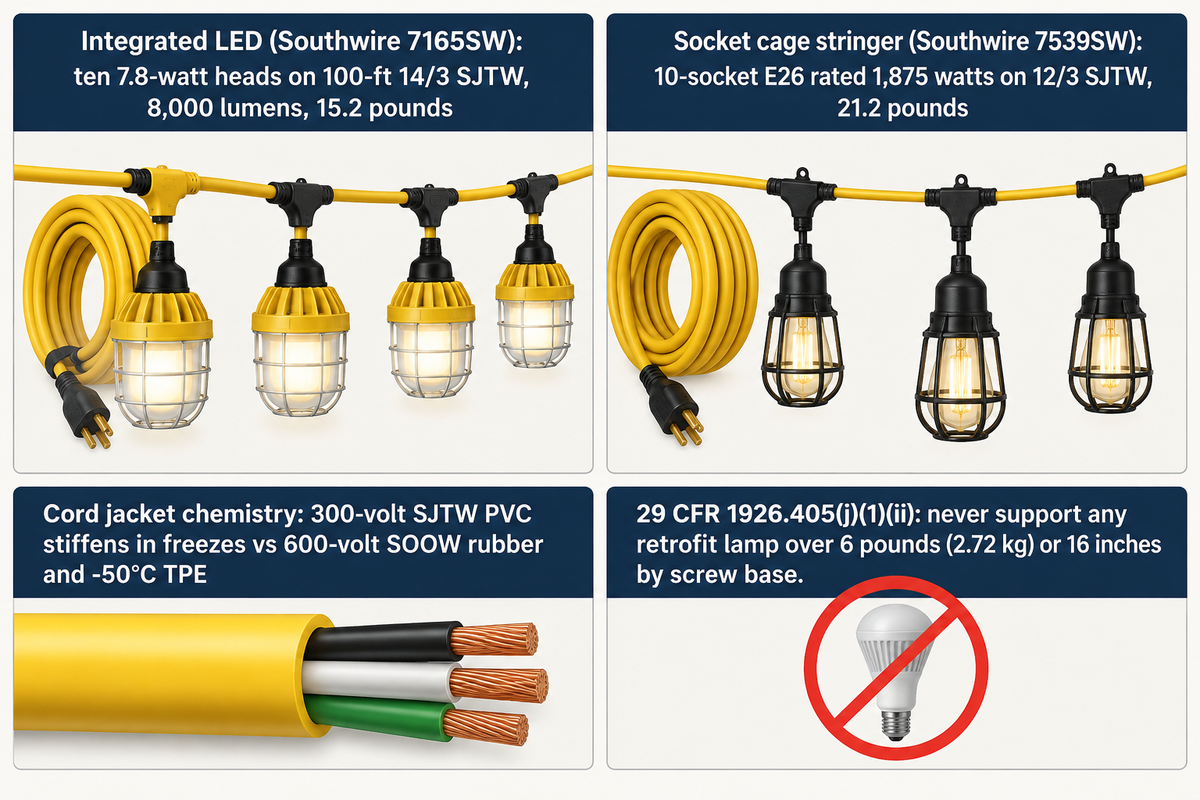
Commercial 100-foot integrated LED string lights draw 78 to 150 watts and deliver 8,000 to 15,000 lumens at 5000K. By contrast, 10-socket E26 cage stringers rated at 1,875 watts use heavier 12/3 cords. Choose sealed LED stringers for fast interior moves, or 14/3 SOOW rubber socket stringers when crews prefer swapping damaged bulbs.
Southwire’s model 7165SW illustrates integrated design with ten 7.8-watt heads on a 100-foot 14/3 SJTW cord. Each head projects downward at 700 lumens and upward at 100 lumens for a total of 8,000 lumens at 15.2 pounds. Southwire’s 7539SW metal-cage socket stringer weighs 21.2 pounds on 12/3 SJTW cable and requires separate screw-in lamps.
Winter and oil exposure survival rates depend on the chemical composition of the jacket of the cord. Thermoplastic PVC cords (SJTW, 300-volt junior hard service) used in interior framing and outdoor use, stiffen in sub-zero temperatures. The U.S. Patent US9557019B2 (inventor Casey James Mahr) and Duraline’s industrial stringer specs show why heavier jackets win in harsh zones. Thermoset 600-volt SOOW rubber and flexible (to −50°C) TPE resist oil, cuts and wear far longer than PVC.
For electrical rough-in, specify a 5000K color temperature with a Color Rendering Index (CRI) of 80 or higher. Clean, crisp, 5000K white light allows electricians to differentiate between red, orange, brown, and blue tracer wires. Electricians should also follow OSHA 1926.405(j)(1)(ii) by not supporting any retrofit lamp over 6 pounds (2.72 kg) or 16 inches by its Edison screw base. Review 29 CFR 1926.405(j)(1)(ii) for full lampholder weight limits.
Cordless Battery Work Lights and Wheeled Masts for Unpowered Zones
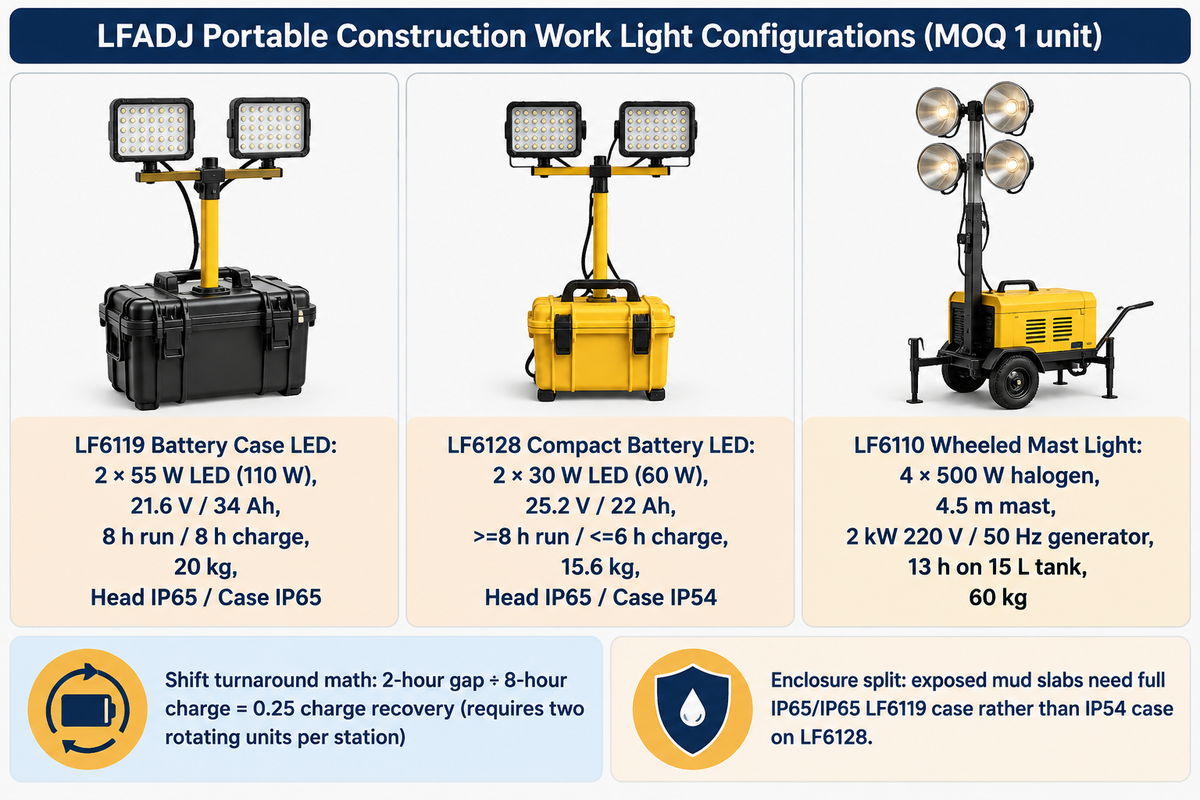
During unpowered shifts, the construction site is lit by battery-powered LEDs. Portable battery LED cases cover 6 to 8-hour construction shifts inside unpowered shells without generator exhaust, whereas wheeled 4.5-meter mast generators light wide exterior excavations. For wet floor mud, choose a unit with an IP65 rating on both the head and case. Keep a spare battery case for each unit and rotate it for each consecutive shift.
LFADJ publishes portable construction work-light configurations starting with LF6119 (2 × 55 W LED, 21.6 V / 34 Ah, 8 h run, 8 h charge, 20 kg, Head IP65 / Case IP65). Compact work-light LF6128 uses 2 × 30 W LED heads with a 25.2 V / 22 Ah pack (>=8 h run, <=6 h charge, 15.6 kg, Head IP65 / Case IP54). Wheeled work-light LF6110 mounts 4 halogen 500 W standard lamps on a 4.5 m mast with a 2 kW 220 V / 50 Hz generator (60 kg, MOQ 1 unit).
Jobsite buyers source portable units from four channels: hand-tool brands like Milwaukee Tool, electrical brands like Southwire, rental yards, and OEM suppliers like LFADJ. Cordless 18 V tool lights fit single-room repairs when crews already carry matching packs.
| Specification | LF6119 Battery Case LED | LF6128 Compact Battery LED | LF6110 Wheeled Mast Light |
|---|---|---|---|
| Standard lamp power | 2 × 55 W LED (110 W) | 2 × 30 W LED (60 W, spot/flood) | 4 × 500 W halogen (LED option by quote) |
| Power source | 21.6 V / 34 Ah battery | 25.2 V / 22 Ah battery | 220 V / 50 Hz; 2 kW gen (5 kW option) |
| Listed lighting / charging | 8 h lighting / 8 h charging | ≥8 h lighting / ≤6 h charging | 13 h full load on 15 L fuel tank |
| Unit weight | 20 kg (44.1 lb) | 15.6 kg (34.4 lb) | 60 kg (132.3 lb) wheeled base |
| Folded / raised dimensions | 645 × 350 × 210 mm; 1,860 mm (73.2 in) raised | 365 × 330 × 620 mm folded | 1,350 × 500 × 800 mm; 4.5 m (14.8 ft) mast |
| Enclosure & LFADJ warranty | Head IP65 / Case IP65 (−20 to 40°C) | Head IP65 / Case IP54 | One-year whole-unit warranty (LFADJ) |
Verify shift turnaround math and enclosure boundaries before ordering cordless units. Assumed inputs: a tunnel crew works two consecutive 8-hour shifts daily with a 2-hour gap, using LF6119 battery lights rated at 8 hours lighting and 8 hours charging. One unit finishes Shift 1 empty and recovers only one-quarter (2 ÷ 8 = 0.25) of its charge before Shift 2 begins. Continuous lighting across back-to-back shifts therefore requires two units per work station rotating on a charger. Note also that LF6128 pairs an IP65 head with an IP54 case, so exposed mud slabs need the full IP65/IP65 LF6119 case. For U.S. 120 V / 60 Hz jobsites, specify destination charger or generator voltage, plug type, and 29 CFR 1926.403 approval requirements in your quote. Verify work-surface lux on battery stands against 29 CFR 1926.56 Table D-3.
Mounting Heights, Messenger Wires, and Glare Control Indoors and Outdoors
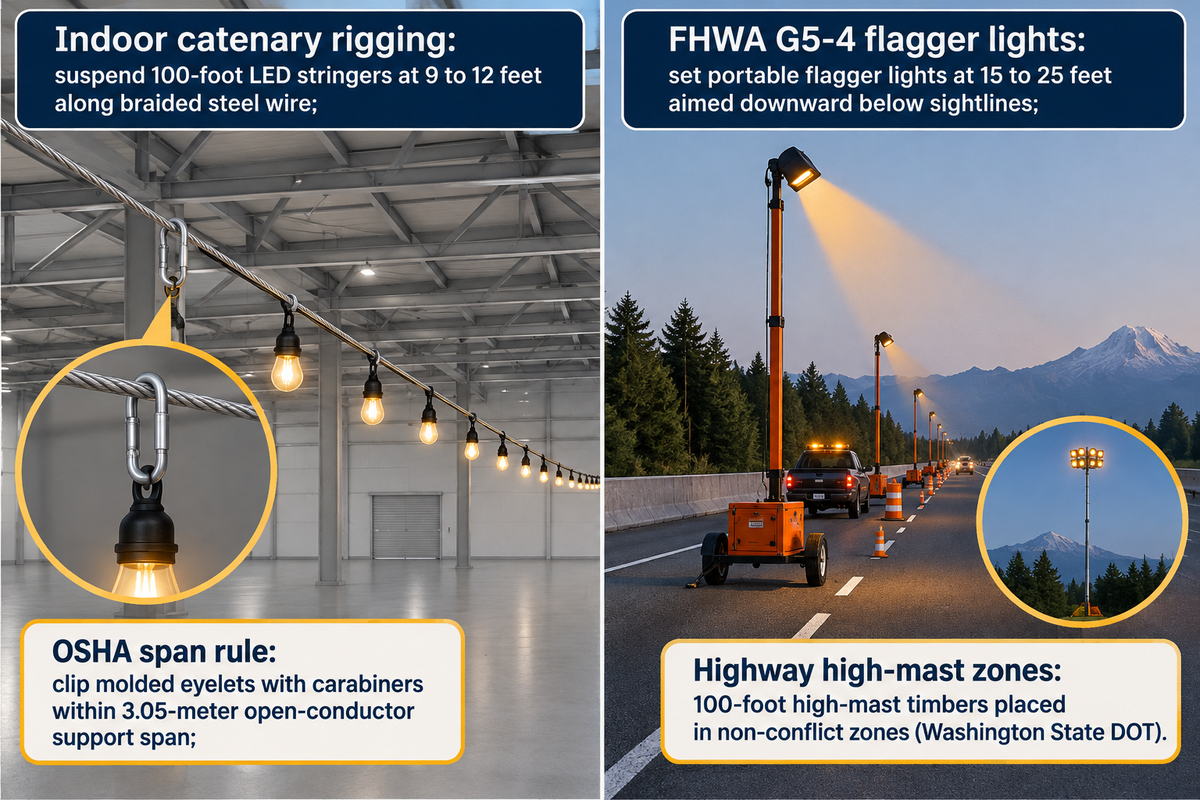
Suspend interior 100-foot LED stringers along overhead messenger wires at 9 to 12 feet. For outdoor placement, set portable flagger lights 15 to 25 feet in accordance with FHWA guidance to avoid blinding drivers. Aim every floodlight downward below horizontal sightlines before night work starts.
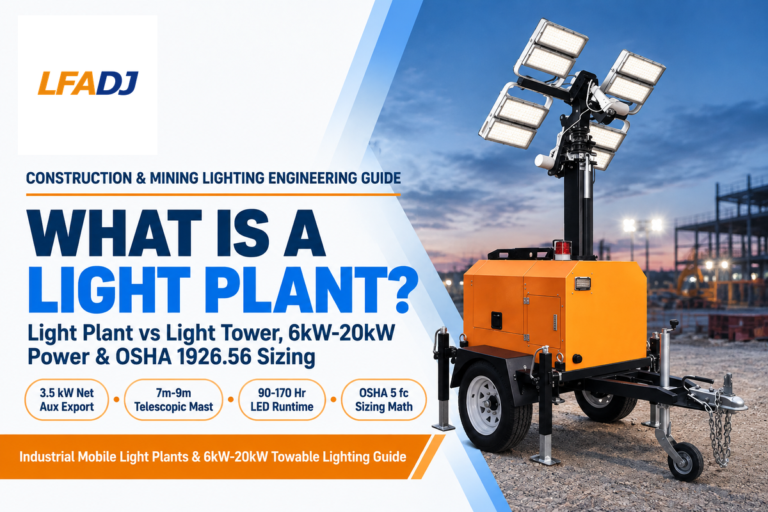
Washington State DOT, in accordance with FHWA Work Zone Best Practice G5-4, places 100-foot high-mast timbers in non-conflict zones of the highway. This same state also has a spec for portable 15 to 25-foot lights at flagging stations to control driver glare. For highway fleets, check our construction and road work light towers and mobile light towers coverage guide.
Indoors, cinching stringer cords directly around sharp steel bar joists invites insulation cuts and drywall entrapment. Run lighting supports overhead using a braided steel catenary wire first. Clip each module’s molded eyelet with a carabiner within OSHA’s 3.05-meter open-conductor support span. Check fixture suitability with the operator standing in actual task posture. Outdoors, never run engine mast generators inside a building or near an air intake, where CO will collect.
Emergency Egress Backup and Confined or Hazardous Location Boundaries
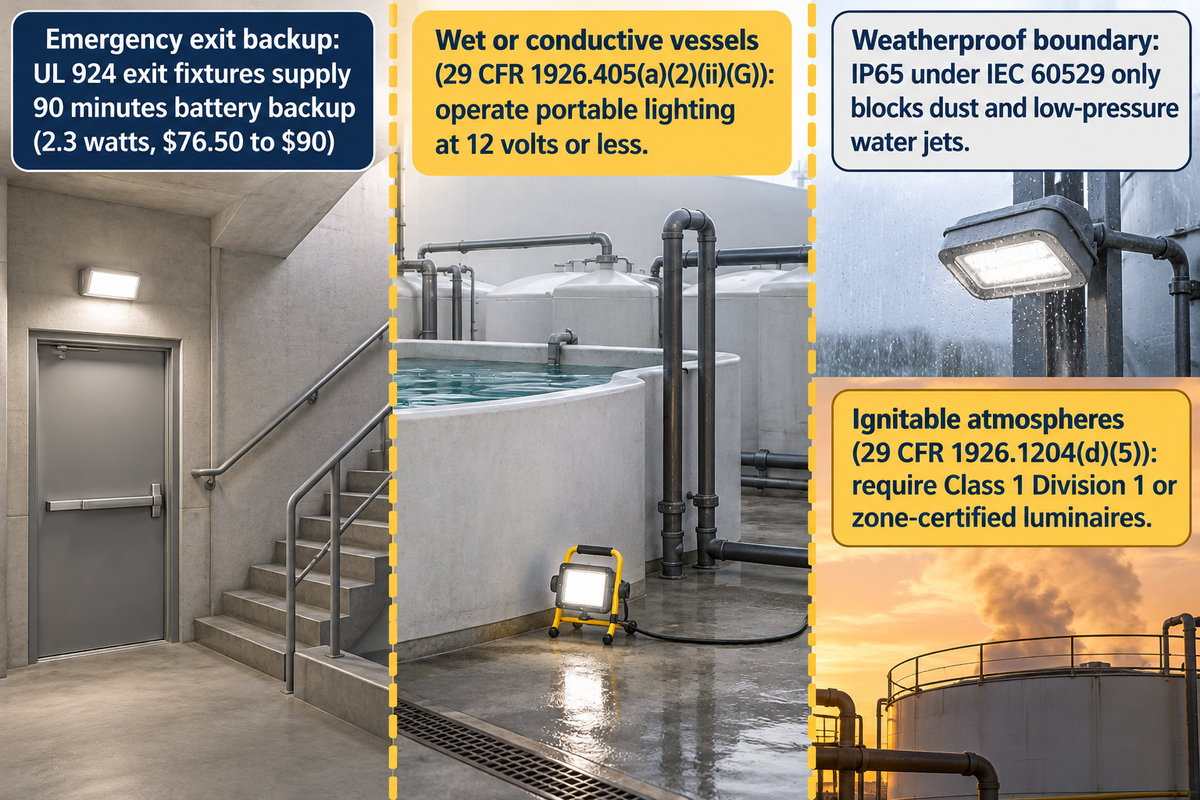
Windowless construction stairwells and exit corridors need 90-minute battery-backed emergency luminaires so crews evacuate safely if temporary power trips. Inside permit-required confined spaces with flammable vapors or combustible dust, OSHA 29 CFR 1926.1204(d)(5) requires lighting approved for that exact ignitable hazard.
“Portable electric lighting used in wet and/or other conductive locations, as for example, drums, tanks, and vessels, shall be operated at 12 volts or less.”
What Are the OSHA Requirements for Emergency Lighting on a Construction Site?
OSHA requires occupied exit routes and stairs to maintain Table D-3 corridor illumination under 1926.56, while commercial UL 924 exit fixtures (such as Nora Lighting’s NX-606-LED/G) supply 90 minutes of battery backup when AC power fails. Those 120/277 VAC aluminum LED exit signs draw 2.3 watts and list at $76.50 to $90 on Lighting Design, keeping stairwell exits visible during panel cutovers.
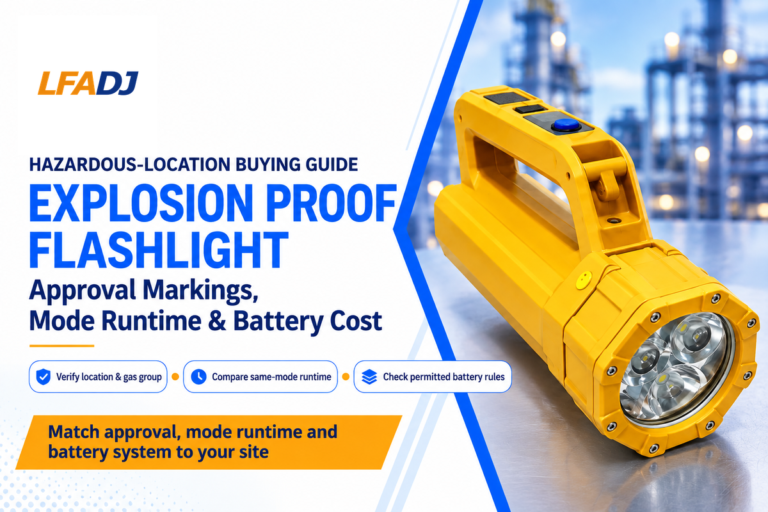
Do not confuse weather-resistant IP65 ingress protection with explosion-proof certification. An IP65 rating under IEC 60529 only blocks dust and low-pressure water jets. Tank coatings, fuel vaults, and solvent zones require Class 1 Division 1 or zone-certified luminaires under 1926.1204(d)(5)—detailed in our explosion-proof lighting ratings and zone rules.
Buy vs. Rent Cost Breakdown and Supplier Shortlist Criteria
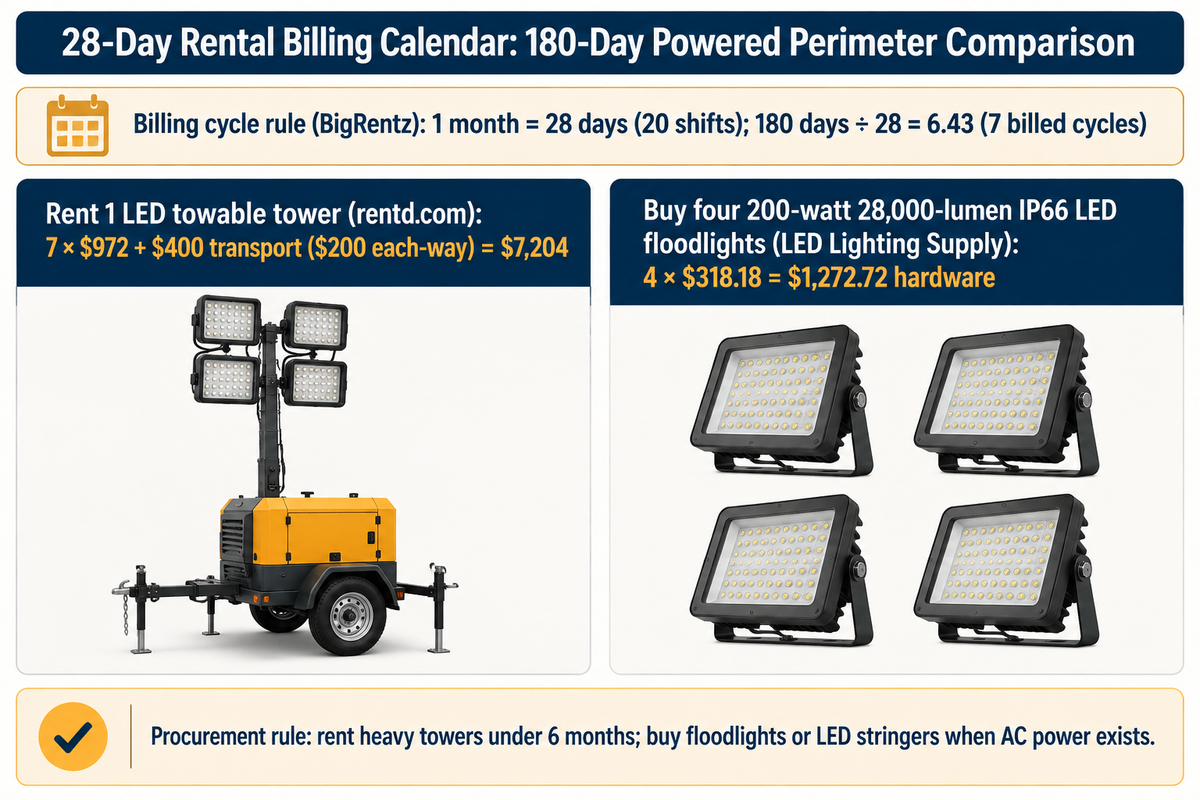
Towable construction light towers rent for $510 to $1,900 per month on rentd.com (July 2026), spanning $449 to $1,995 by power class. Commercial 200 to 300-watt LED floodlights start at $262.75 to $318.18 to buy on LED Lighting Supply. Rent heavy towers under 6 months, and buy indoor LED stringers for multi-phase work.
| Equipment Class | Published Purchase Benchmark | Published Rental Benchmark (28-Day Month) | Recommended Procurement Path |
|---|---|---|---|
| Metal-halide towable light tower | Quote by fleet spec | $449–$638/mo ($53–$67/day, rentd.com) | Rent only for short-term rural jobs tolerating generator fuel burn |
| LED towable light tower | Quote by mast & kW spec | $972–$1,383/mo ($114–$146/day, rentd.com) | Rent under 6 months or <12–14 days/mo; buy above 60% utilization (rentd.com) |
| Solar or hybrid towable tower | Quote by battery bank | $1,496–$1,995/mo ($176–$210/day, rentd.com) | Rent for noise-restricted municipal night roadwork |
| 200–300W IP65/IP66 LED area floodlight | $262.75–$318.18 starting (LED Lighting Supply) | Rarely rented standalone | Buy outright when crane, pole, or building AC power exists |
| 50–100 ft LED stringer (39–180W) | Distributor quote (Southwire / Ericson) | Portal quote by ZIP (United Rentals) | Buy for multi-month interior construction and redeploy across jobsites |
| 20W Class 1 Div 1 portable LED work light | $1,430.00 online list (LED Lighting Supply) | Portal quote (explosion-proof class) | Rent for a single tank turnaround; buy for recurring refinery work |
Watch the 28-day billing calendar when comparing multi-month quotes. Assumed inputs: a 180-day perimeter with 120/277 V pole power needs night lighting, and BigRentz bills 1 month every 28 days (20 shifts). One LED tower rents at $972 per cycle plus $200 each-way at the top of rentd.com’s $75–$200 transport band. Over 180 days, the yard bills 7 cycles (180 ÷ 28 = 6.43), totaling 7 × $972 + $400 = $7,204 before fuel or waivers. Buying four 200-watt 28,000-lumen IP66 LED floodlights ($318.18 each on LED Lighting Supply) for existing poles costs 4 × $318.18 = $1,272.72 in hardware. That hardware figure excludes electrician mounting labor, yet still saves thousands on powered perimeters.
When evaluating suppliers in our Industrial work light manufacturers comparison, copy this safety spec checklist into your RFQ to ensure equal safety requirements are considered when pricing your product.
RFQ checklist — copy these into your quote request:
| Parameter | Recommended range | Why it matters | How to verify |
|---|---|---|---|
| Safety listing | UL 1088 (stringers), UL / ETL / CSA, or Class 1 Div 1 | Satisfies OSHA 1926.403 NRTL approval walkdowns | Check exact model file number on datasheet |
| Cord jacket & gauge | 14/3 or 12/3 SJTW (300V) or SOOW (600V) | Keeps branch voltage drop within Duraline’s 3% target | Read outer sheath surface marking per 1926.405(g)(2) |
| Daisy-chain cap | 8–10 strings max (400–780 W pass-through) | Prevents tail-receptacle overheating on 20A circuits | Require nameplate maximum linked unit count |
| Optical output & CCT | 8,000–15,000 lm per 100 ft at 5000K, CRI ≥80 | Meets Table D-3 floors and keeps wire colors clear | Request photometric file or lumen/watt spec table |
| Enclosure IP split | IP65 head and IP65 case for outdoor mud/rain | Avoids water ingress into IP54 battery cases | Check separate head and base IP ratings in manual |
| Supply voltage & cycle | 120 V / 60 Hz or 100–277 V input; ≥8 h shift runtime | Matches U.S. spider boxes and shift charge windows | Specify destination plug, voltage, and reserve units |
Industry Outlook: Sealed LED Stringers and Hybrid Power on Modern Jobsites
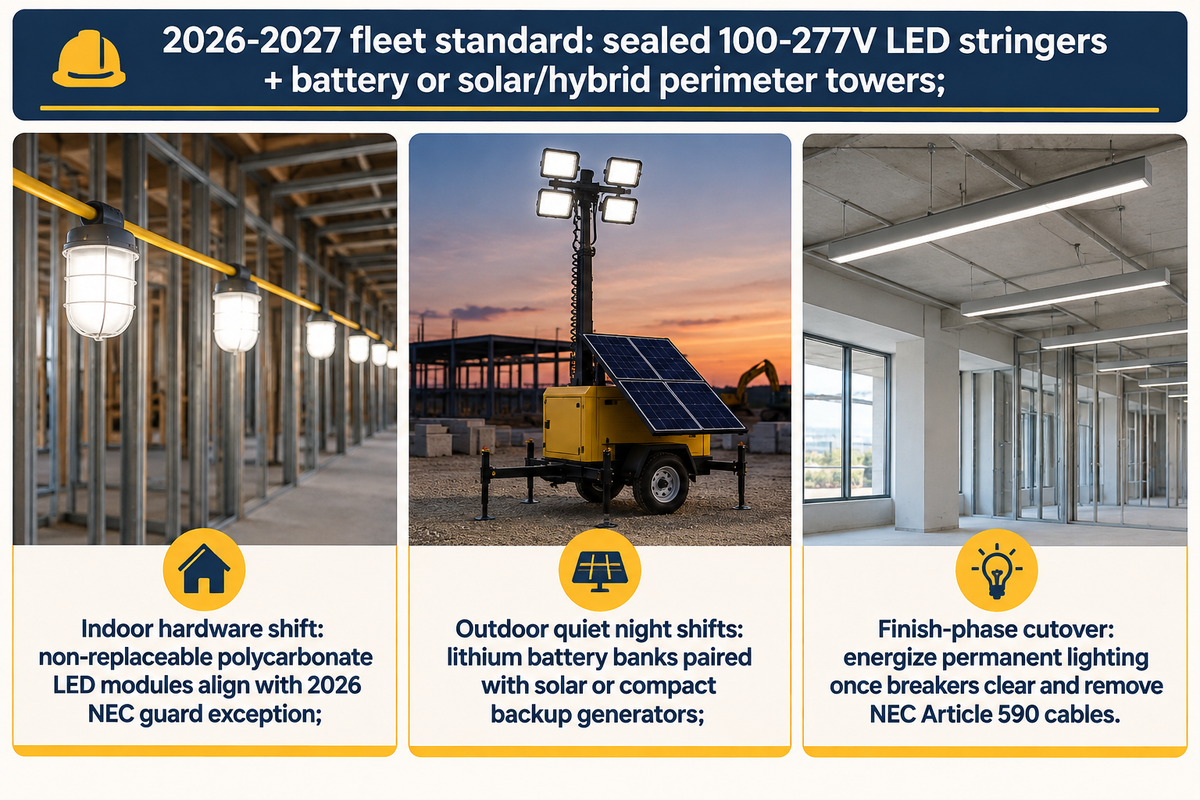
Criteria for supplier shortlists have been updated to incorporate recent urban night-noise limits, changes to 2026 NEC Article 590, and the use of multi-voltage LED drivers. Standardizing your fleet around sealed 100-277V LED stringers and battery or solar/hybrid perimeter towers cuts relamping labor and fuel-truck visits for 2026-2027 jobsites.
Two hardware changes modify how electrical estimators build a lighting plan for large-scale projects. Indoors, non-replaceable polycarbonate LED modules replace breakable glass bulbs and align with the 2026 NEC’s guard exception for listed integrated LED strings. Outdoors, pairing lithium battery banks with solar or compact backup generators—covered in our hybrid light towers for quiet night shifts—supports continuous lighting through overnight pours without diesel noise.
Separate permanent fixtures from temporary assets on the 2026 bids, and energize newly installed permanent lighting when inspectors clear permanent breakers. This reduces your temporary fixture count during interior finish work. Keep your dust wraps off the warm LED drivers and remove all NEC Article 590 temp lighting cables at closure.
Frequently Asked Questions
Can you hang temporary construction string lights by their electrical cords?
OSHA 29 CFR 1926.405(a)(2)(ii)(F) prohibits suspending temporary lights by their cords, unless the cord and lights are designed for that means of suspension.
Hang commercial stringers from their mounting eyelets or built-in carabiner loops. If you have a lot of space to cover, as in a wide corridor or high bay, use a steel messenger first, and then string the electrical cord.
Do temporary construction lights require GFCI protection under OSHA and the NEC?
Portable 120-volt temporary lights operated in wet or conductive locations require ground-fault circuit interrupter protection under OSHA 29 CFR 1926.405(a)(2)(ii)(G), unless the system runs at 12 volts or less.
Whenever temporary stringers or portable task stands plug into 125-volt, single-phase 15-, 20-, or 30-ampere spider-box outlets, NEC Article 590 also mandates personnel GFCI protection across the supply. Keep temporary lights on a dedicated branch circuit separate from power tool receptacles.
Can newly installed permanent building lights be used as temporary construction lighting?
Newly installed, permanent luminaires can provide construction site illumination when their permanent branch circuits, breakers, and grounding paths are approved.
Keep plastic paint or drywall dust wraps off energized LED driver housings. Check that floor illumination meets Table D-3 minimums, and strip out all remaining NEC Article 590 temporary cables at completion.
What color temperature works best for temporary construction site lighting?
Neutral daylight white at 5000K is standard.
Pairing 5000K LEDs with CRI 80+ helps in distinguishing wire colors.
How do you prevent glare and dark shadows when moving portable construction lights?
Raise portable floodlight heads above worker eye height. Shadows should be examined with operators standing in their real working posture.
Splitting output across two angled LED heads eliminates body and scaffold shadows that one low floor lamp can’t avoid. Outdoors, aim mast floodlights downward away from crane cabs and adjacent travel lanes.
Does an IP65 rating mean a temporary work light is approved for hazardous locations?
No, IP65 only rates water and dust sealing.
OSHA 1926.1204(d)(5) states that ignitable gas, vapor, or dust zones require certified hazardous-location luminaires.
What is the OSHA 30-minute rule for lightning during outdoor night construction?
Per OSHA outdoor lightning safety guidance, crews must leave elevated towers and cranes as well as open areas upon hearing thunder, and remain sheltered for a minimum of 30 minutes.
If safe, lower or secure mobile light masts before thunder arrives. Move workers into grounded buildings or hard-topped metal vehicles with rolled-up windows, and restart the 30-minute timer after every thunderclap.
How LFADJ Reviews Temporary Jobsite Lighting Specs
Zhejiang LONGFA Lighting Co., Ltd. (LFADJ) provides wheeled mast lights and rechargeable LED case work lights (models LF6110, LF6119, and LF6128) from 1-unit minimum orders. Our 29 CFR 1926.56 tables, 16-amp circuit math, and 2026 U.S. rental comparisons synthesize public federal rules and published supplier schedules. Project teams can align power ratings, IP ratings, and shift charge windows prior to ordering. Reviewed by the Zhejiang LONGFA Lighting Co., Ltd. Technical team.
References & Sources
- 29 CFR 1926.56, Illumination (Table D-3 Minimum Illumination Intensities) Electronic Code of Federal Regulations, U.S. Department of Labor
- 29 CFR 1926.405, Wiring Methods, Components, and Equipment for General Use Occupational Safety and Health Administration, U.S. Department of Labor
- Work Zone Best Practices Guidebook: G5-4 Nighttime Lighting Specification Federal Highway Administration, U.S. Department of Transportation
- 29 CFR 1926.1204, Permit-Required Confined Space Program Occupational Safety and Health Administration, U.S. Department of Labor
- Reducing Lightning Hazards When Working Outdoors (30-Minute Rule) Occupational Safety and Health Administration, U.S. Department of Labor