Get in touch with LFADJ Company

Last updated: November 2026
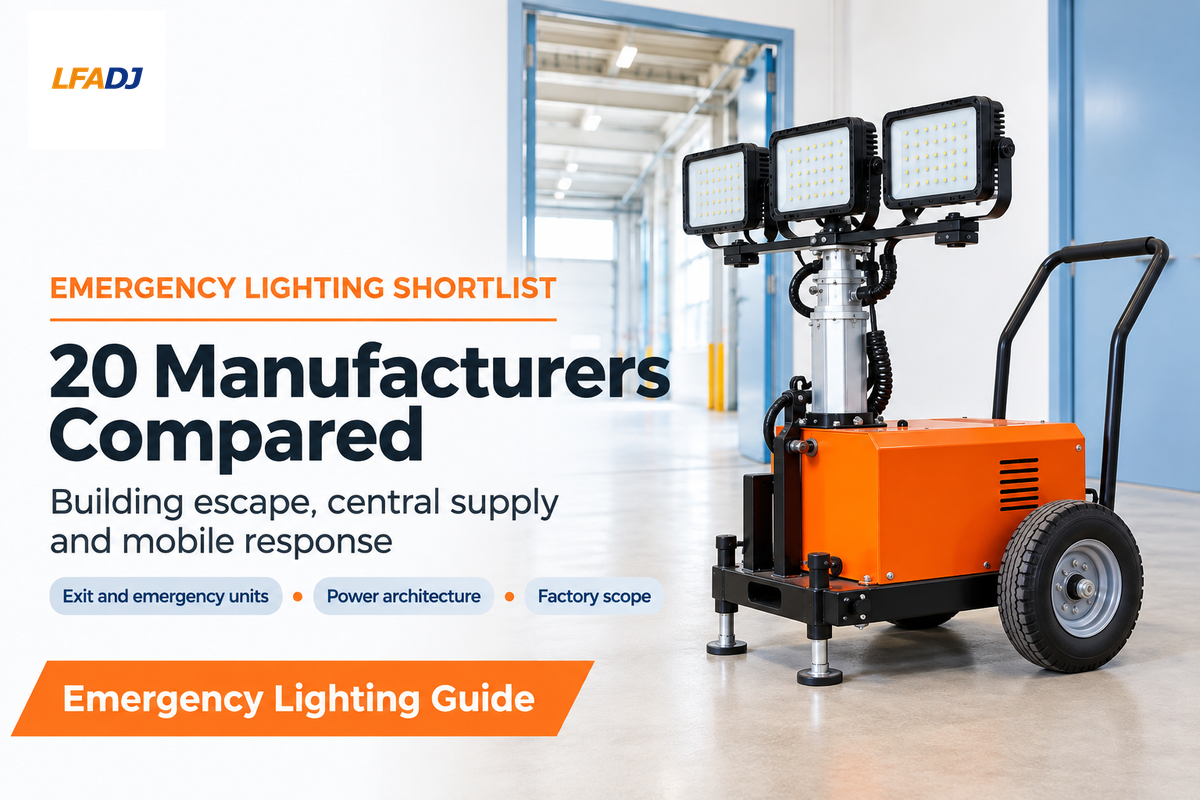
The best emergency lighting manufacturers include Eaton and ABB for managed building systems, Acuity for commercial exit and emergency units, R. STAHL for fixed hazardous-area lighting, and Streamlight for portable scene lighting. LFADJ supplies temporary industrial response equipment. These 20 manufacturers serve different jobs, so start with the application before comparing brands.
Quick picks
- Best for temporary industrial response lighting: LFADJ.
- Best for fixed hazardous-area emergency luminaires: R. STAHL and Hubbell’s Chalmit.
- Best for portable scene lighting: Streamlight; Pelican for its specifically rated hazardous-area models.
- Best for managed building systems: Eaton, ABB and Schneider Electric.
- Best for commercial exit signs and emergency units: Acuity, Dual-Lite and Evenlite.
- Best for dynamic escape-sign systems: Zumtobel and Beghelli.
Disclosure: This guide is published by LFADJ. We list ourselves first because this is our website, not because we claim to be the market leader. The other 19 manufacturers are grouped by what they’re best for, in no particular order within each group.
How We Selected These Emergency Lighting Manufacturers
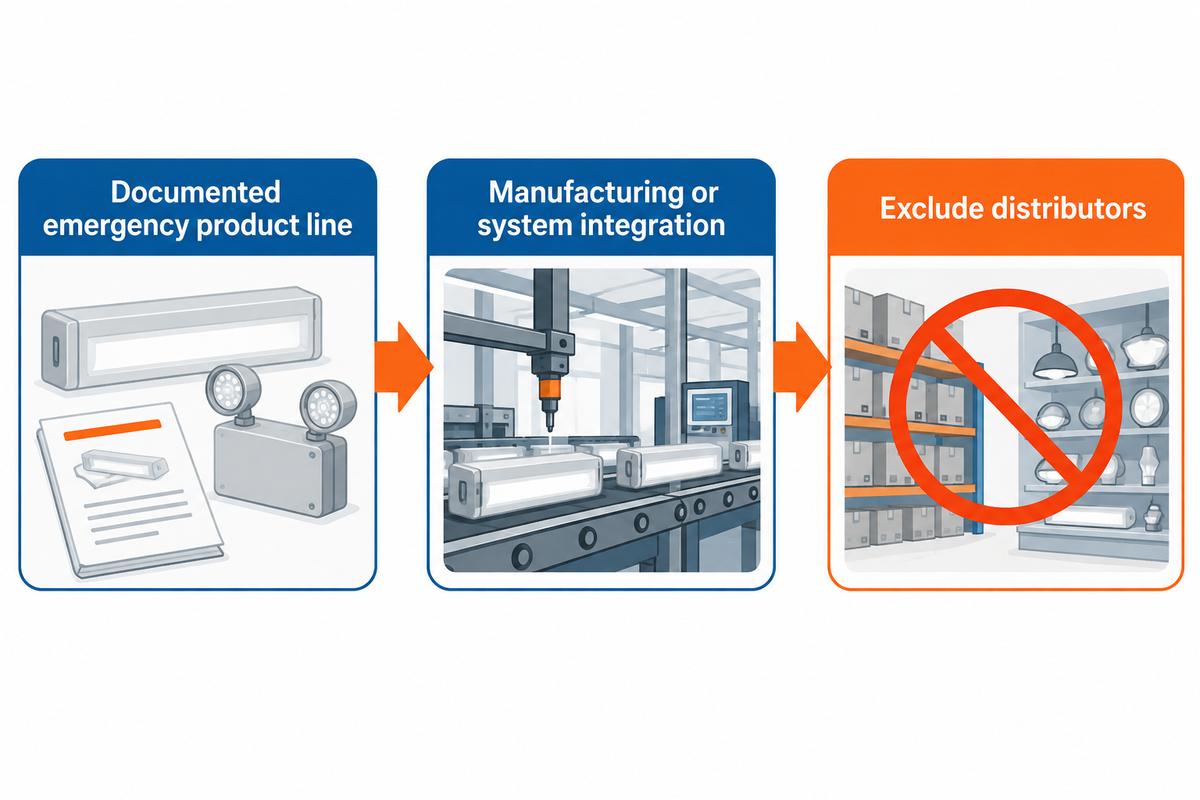
We analyzed companies with identifiable product lines and manufacturing or system integration capabilities in complete emergency luminaires, exit signs, lighting systems or industrial response equipment. We eliminated duplicate parent-company/brand entries; vehicle warning beacons; general lighting brands without a current emergency product line; and distributors presented as manufacturers. We also excluded trading companies, sourcing platforms, directories and component-only suppliers. Company information was checked against official websites and other publicly available sources in November 2026. The list includes companies worldwide, and each corporate group is included only once.
Products, capabilities and credentials below are attributed to the named manufacturers. “Best for” describes a buying fit; it isn’t a laboratory performance ranking. An extensive product catalogue alone wasn’t an entry criterion: each company needed a relevant complete product or system. Company origins and brand founding dates are identified separately from acquisitions. LFADJ appears first as the publisher, followed by application groups for commercial and industrial purchases.
Emergency Lighting Manufacturers: Comparison at a Glance
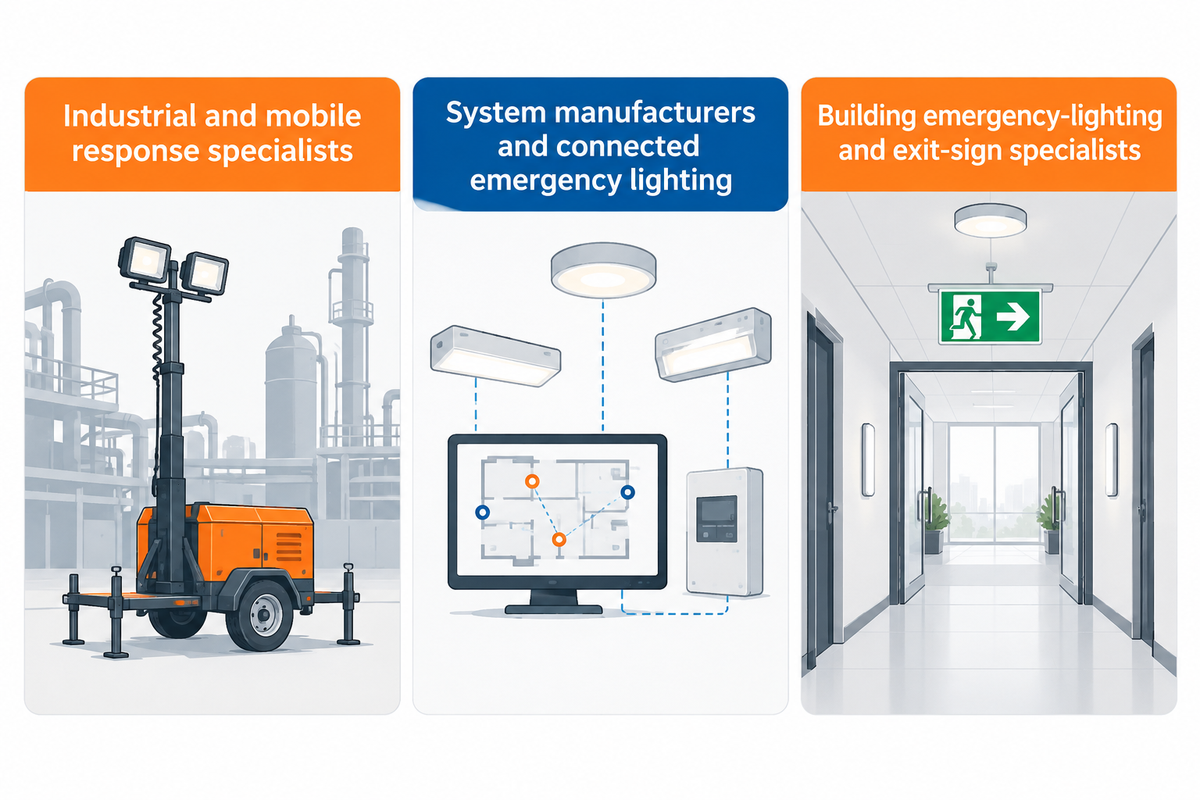
Choose the industrial group for classified plant areas or movable field work, the systems group for integrated building installations, and the building specialists for luminaires and signs. A manufacturer can span several groups. The grouping below focuses on documented product capabilities and purchasing constraints rather than general company size.
20-Maker Emergency Lighting Fit Map
The 20-Maker Emergency Lighting Fit Map matches complete-product manufacturers to application and power architecture, and provides a practical purchasing constraint for each.
| No. | Company Name | Headquarters | Founded Year | Best For | Brief Introduction | Main Products | Key Advantages | Potential Disadvantages | Official Website |
|---|---|---|---|---|---|---|---|---|---|
| 1 | LFADJ | Yueqing, China | 2013 | Temporary industrial response | Industrial lighting manufacturer supplying mobile equipment for field deployment. | LF6133 mast units, LF2970 mobile lights, all-terrain systems | Wheeled mast lighting with three independently aimed LED heads | Temporary field duty; separate from installed building egress | https://lfadjlight.com/ |
| 2 | R. STAHL | Waldenburg, Germany | 1876 | Classified industrial areas | Explosion-protection manufacturer with complete battery-backed emergency luminaires. | EXLUX emergency luminaires | Documented emergency-mode output and duration for specific models | Reviewed 272021 model excludes gas Zone 1 | https://r-stahl.com/ |
| 3 | Hubbell (Chalmit / Killark) | Shelton, USA | 1888 | Hazardous and marine facilities | Industrial group including Chalmit life-safety lighting products. | Solas, Protecta III, NexLED, HDL106NE | Dedicated industrial emergency and evacuation product families | Protecta options vary by hazard and emergency configuration | https://www.hubbell.com/ |
| 4 | Streamlight | Eagleville, USA | 1973 | Portable scene illumination | Portable lighting maker with rechargeable area-lighting equipment. | Portable Scene Light II, rechargeable work lights | Published output/runtime pairs and AC/DC operation | Highest-output battery mode is limited to two hours | https://www.streamlight.com/ |
| 5 | Pelican Products | Torrance, USA | 1976 | Portable hazardous-area response | Equipment manufacturer offering RALS remote-area lighting. | RALS systems, 9455 portable lights | 9455 carries specified hazardous-area ratings | 9455 repair work requires a certified Pelican centre | https://www.pelican.com/ |
| 6 | Eaton | Dublin, Ireland | 1911 | Central systems and industrial integration | Power-management group offering CEAG emergency lighting and monitoring. | Central batteries, self-contained luminaires, ExLin | ExLin monitoring can use existing supply conductors | Monitoring depends on compatible CEAG system equipment | https://www.eaton.com/ |
| 7 | ABB | Zurich, Switzerland | 1988 | Multisite testing and fault management | Group supplying Emergi-Lite luminaires, central power and monitoring. | Emergi-Lite, EMEX, Naveo Pro | Remote testing with floor-plan fault location | Canadian Provider series discontinued in September 2026 | https://new.abb.com/ |
| 8 | Signify | Eindhoven, Netherlands | 2016 | Connected exit and emergency units | Lighting group owning Cooper Lighting Solutions and Sure-Lites. | Sure-Lites signs, emergency units, remote heads | FirstLink app-based status and reporting | FirstLink requires enabled devices in the selected network | https://www.signify.com/ |
| 9 | Schneider Electric | Rueil-Malmaison, France | 1836 | Building supply-architecture choices | Electrical group with Exiway emergency lighting and control ranges. | Exiway signs, luminaires, DiCube, Power Control | Distinct self-contained and central-supply platforms | Different architectures require different compatible components | https://www.se.com/ |
| 10 | Legrand | Limoges, France | 1865 | Connected maintenance in France | Electrical manufacturer with BAES and centralized emergency products. | Safety luminaires, central-supply units, connected controllers | Fault reporting accompanied by replacement-parts lists | ERPconnecté availability is France-specific | https://www.legrand.com/ |
| 11 | Zumtobel Group | Dornbirn, Austria | 1950 | Dynamic evacuation indication | Lighting group combining emergency luminaires with control systems. | SMARTSIGN, SMARTescape, nBox, emergency luminaires | Signs can form part of dynamic route indication | Reviewed SMARTSIGN ELP configuration needs nBox central supply | https://www.zumtobel.com/ |
| 12 | Acuity Inc. | Atlanta, USA | 2001 | Commercial exit and combination units | Parent of Lithonia Lighting, including Quantum emergency products. | Exit signs, LQM, LHQM, emergency luminaires | STAR automatic testing and reporting options | Reviewed LQM is indoor damp-rated, 10–40°C | https://www.acuityinc.com/ |
| 13 | Dual-Lite (Current) | Greenville, USA | 1940 | Battery units with remote heads | Current brand with a history in complete emergency lighting. | LM units, SE signs, EVS, lighting inverters | LM remote-head support with selectable system capacities | SE special-text options differ from standard exit lettering | https://www.currentlighting.com/ |
| 14 | Beghelli (GEWISS) | Valsamoggia, Italy | 1982 | Fire-linked dynamic signs | Emergency lighting manufacturer within GEWISS since 2025. | Logica luminaires, signs, central systems, inverters | Logica 24 Dynamic responds to fire-alarm inputs | Dynamic operation needs compatible LG24 control and fire interface | https://www.beghelli.it/ |
| 15 | Teknoware | Lahti, Finland | 1972 | Supercapacitor emergency luminaires | Finnish manufacturer of emergency lighting and control systems. | Escap, exit signs, central systems, AaltoCtrl | Supercapacitor storage with LumiTest self-testing | Reviewed Escap operating range ends at +35°C | https://www.teknoware.com/ |
| 16 | Clevertronics | Melbourne, Australia | Not publicly disclosed | Large monitored luminaire networks | Emergency lighting specialist serving Australian, New Zealand and UK markets. | Exit signs, bulkheads, battens, Zoneworks | XT HIVE offers substantial per-controller capacity | Product ranges follow regional market requirements | https://clevertronics.com.au/ |
| 17 | Evenlite | Trevose, USA | 1993 | Commercial emergency unit selection | Specialist supplying complete exit, emergency and central-power products. | EVO, exit signs, combinations, inverters, remote heads | EVO offers high output and scheduled automatic tests | Cold-weather and NEMA 4X performance need specified options | https://www.evenlite.com/ |
| 18 | Daisalux | Vitoria, Spain | 1980 | Discreet recessed emergency lighting | Emergency lighting specialist with architectural luminaires and control products. | IZAR, exit signs, beacons, central batteries | Separate escape-route and open-area optics | IZAR needs suitable recessed mounting and a ceiling opening | https://www.daisalux.com/ |
| 19 | ETAP | Malle, Belgium | 1949 | Building emergency-lighting management | Luminaire manufacturer combining safety products with system management. | K2, safety signs, EBS, ESM | ESM automates tests and records faults digitally | G4 targets one building; ESMweb covers multiple buildings | https://www.etaplighting.com/ |
| 20 | RP-Technik (RP Group) | Rodgau, Germany | 1981 | European wireless monitoring | Manufacturer of complete emergency luminaires and power systems. | Exit luminaires, central power, Wireless Professional | Connected control centres support larger installations | Wireless Professional uses the European 868 MHz band | https://www.rp-group.com/ |
Industrial and Mobile Response Lighting Specialists
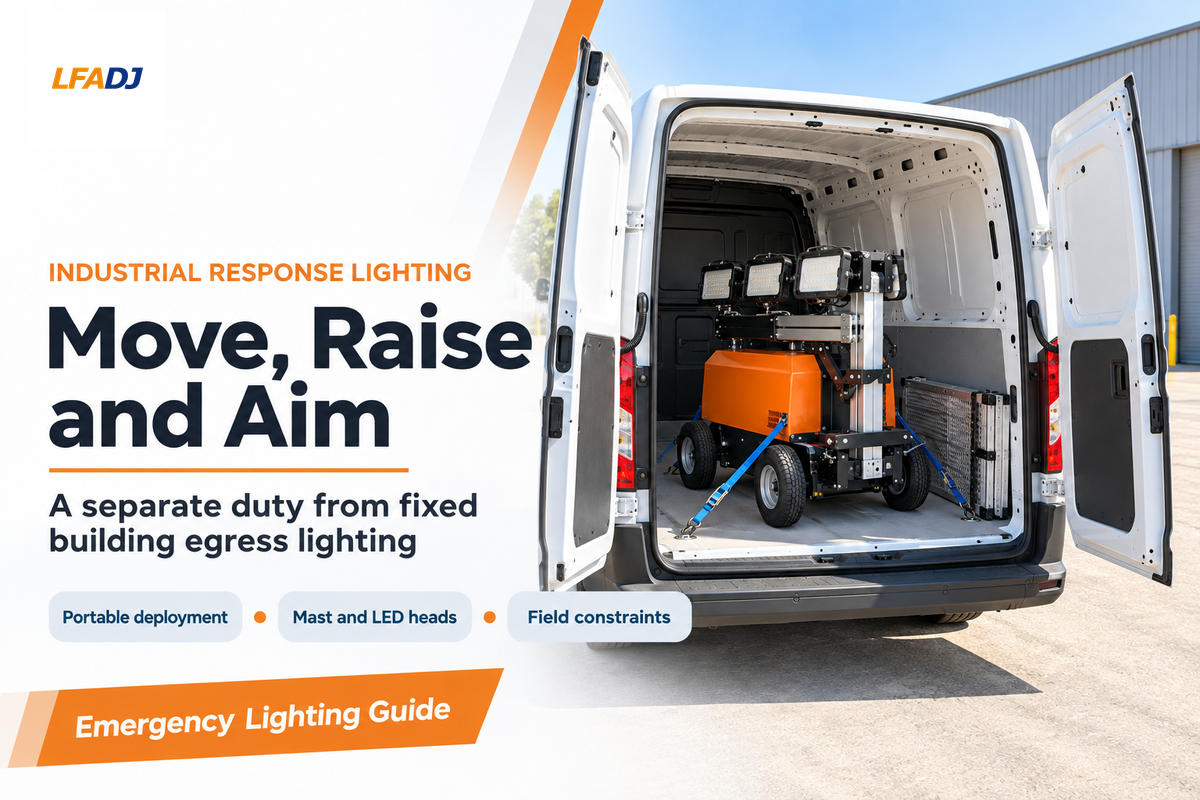
Industrial emergency lighting includes two different jobs: fixed luminaires for people leaving a facility, and movable lighting for crews working through an incident. R. STAHL and Chalmit offer fixed hazardous-area equipment. LFADJ, Streamlight and Pelican supply field-lighting products with different transport, power and environmental characteristics. A plant may purchase both types for separate tasks.
1. LFADJ: Best for Temporary Industrial Emergency-Response Lighting
Headquarters: Yueqing, Zhejiang, China · Founded: 2013 · Type: industrial lighting equipment manufacturer.
Official website: https://lfadjlight.com/
Main products: LF6133 mast lighting, LF2970 mobile lighting and all-terrain mobile response equipment.
Notable capability: Our LF6133 combines a 4.8 m mast with three 200 W LED lamps, according to our published product specifications.
Management systems: Displayed ISO 9001:2015, ISO 14001:2015 and ISO 45001:2018 certificates cover sales of lighting fixtures and accessories.
Our industrial emergency-lighting equipment suits temporary work positions where a crew needs to move, raise and aim the light source. The wheeled LF6133 provides a distinct deployment option alongside the larger LF2970 and self-propelled all-terrain equipment. This is field lighting rather than a replacement for the fixed building-egress luminaires and exit signs specified for a facility.
2. R. STAHL: Best for Fixed Emergency Lighting in Classified Industrial Areas
Headquarters: Waldenburg, Germany · Founded: 1876 · Type: explosion-protection equipment manufacturer.
Official website: https://r-stahl.com/
Main products: EXLUX complete emergency luminaires with integral batteries and automatic testing.
Published model data: According to R. STAHL’s data sheet, EXLUX 6409/4 model 272021 provides three hours at 20% emergency light output.
Product credentials: That model’s data sheet lists ATEX IBExU16ATEX1233 and IECEx IBE16.0047.
R. STAHL gives an industrial buyer a defined fixture configuration rather than a loose collection of lamps, batteries and drivers. Its paired emergency-output and duration figures are useful when comparing the battery-backed mode with normal lighting, because the two operating conditions are materially different. The reviewed 272021 model covers Zones 2, 21 and 22; its classification doesn’t extend to gas Zone 1.
3. Hubbell (Chalmit / Killark): Best for Hazardous-Area and Marine Emergency Lighting
Headquarters: Shelton, Connecticut, USA, for the group · Founded: 1888 · Type: industrial electrical manufacturer with Chalmit and Killark brands.
Official website: https://www.hubbell.com/
Main products: Chalmit Solas, Protecta III, NexLED and HDL106NE life-safety luminaires.
Notable work: Chalmit’s life-safety range includes complete emergency and evacuation lighting for industrial applications, according to its website.
The Chalmit range makes Hubbell a relevant shortlist entry for a facility that needs industrial lighting products alongside dedicated life-safety equipment. Product selection starts with the particular emergency arrangement, including whether the unit provides ordinary illumination as well as its emergency function. Protecta configurations differ by hazardous area, light source and emergency arrangement, so a family name alone doesn’t identify an interchangeable fixture. Dual-Lite is covered separately under Current, reflecting the later ownership split.
4. Streamlight: Best for Portable Scene Lighting with Defined Runtime Modes
Headquarters: Eagleville, Pennsylvania, USA · Founded: 1973 · Type: portable lighting manufacturer.
Official website: https://www.streamlight.com/
Main products: Portable Scene Light II and rechargeable work-area lights.
Published model data: Portable Scene Light II delivers 10,000 lumens for two hours at full output, or 2,300 lumens for eleven hours at the lower setting; AC/DC operation is also available.
Management system: Its official media kit identifies ISO 9001:2015 certification.
Streamlight’s explicit output/runtime pairs help a response team choose between a short, bright task and a longer working period. The portable scene light belongs in a deployment plan for crew illumination, alongside charging and power arrangements. Maximum battery output lasts two hours, so the eleven-hour figure must stay with the lower-output setting when comparing equipment or estimating the shift plan.
5. Pelican Products: Best for Portable Response Lighting with Specific Hazard Ratings
Headquarters: Torrance, California, USA · Founded: 1976 · Type: protective equipment and portable lighting manufacturer.
Official website: https://www.pelican.com/
Main products: Remote Area Lighting Systems, including the portable RALS 9455.
Published model data: The 9455 offers high and low modes, up to 1,600 lumens and a 125-degree beam.
Product credentials: The official 9455 page lists Class I Division 1, ATEX Zone 0 and IECEx ia ratings for that product.
Pelican’s 9455 gives buyers a named hazardous-area product within a broader portable-lighting family. Its wide beam and movable format address nearby response work rather than the permanent directional signs of a building escape route. A practical ownership constraint is the repair route: Pelican specifies that 9455 repairs be performed by a certified Pelican Products repair centre, which belongs in the fleet’s service plan.
System Manufacturers and Connected Emergency Lighting
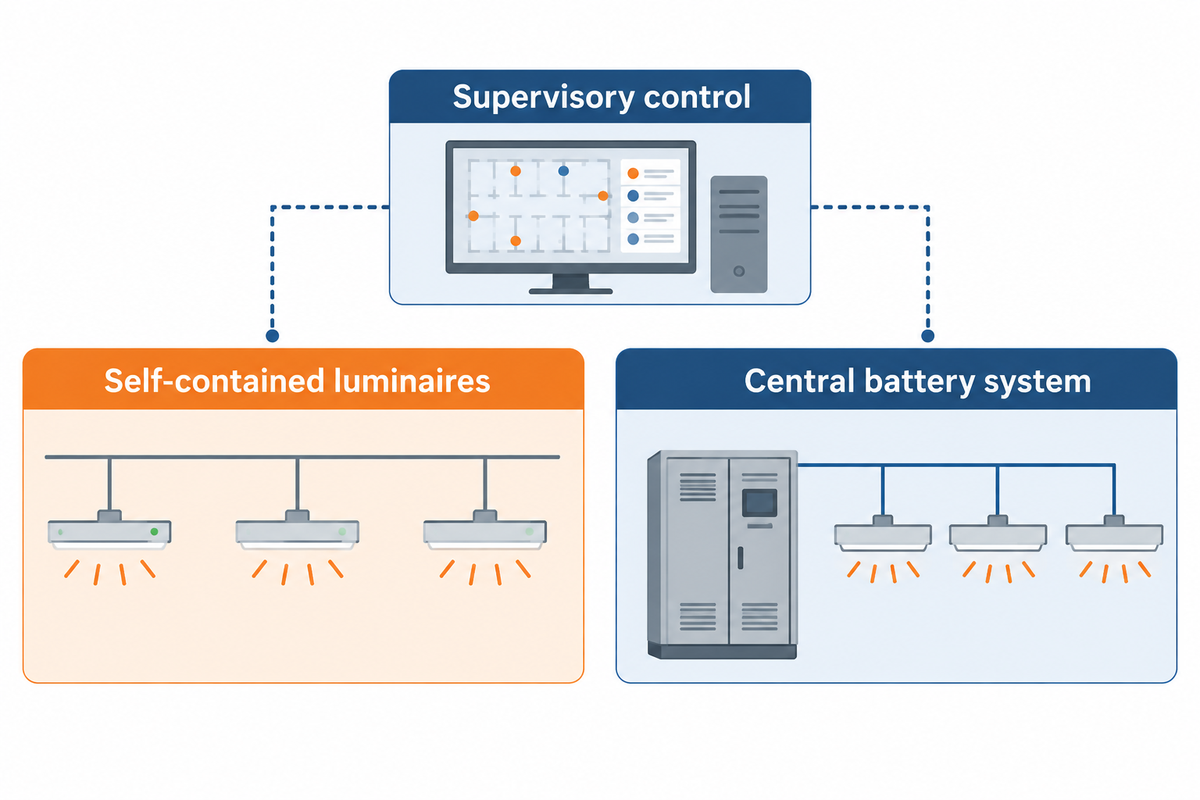
System manufacturers enable buyers to integrate emergency luminaires and other equipment. Centralized supervision does not necessarily mean that a central battery supplies every lamp. A useful comparison is in the complete arrangement: where energy is stored, how fixtures communicate, and how a maintenance crew identifies and repairs a failed unit.
6. Eaton: Best for Central Systems and Industrial Emergency-Lighting Integration
Headquarters: Dublin, Ireland · Founded: 1911 · Type: power-management and electrical equipment manufacturer.
Official website: https://www.eaton.com/
Main products: CEAG central battery systems, self-contained emergency luminaires and ExLin industrial emergency lighting.
Notable capability: The ExLin V-CG-S product page describes individual luminaire monitoring without an additional data cable.
Product credentials: The same page lists ATEX BVS 18 ATEX E 037 X and IECEx BVS 18.0028X.
Eaton is a useful candidate when emergency lighting must fit an existing industrial power and monitoring arrangement. The ExLin example links a complete luminaire to its supervisory system rather than treating the light and controls as unrelated purchases. That monitoring capability depends on compatible CEAG CG/Star/Star+ equipment, so the advantage is strongest where the corresponding system architecture forms part of the project.
7. ABB: Best for Multisite Testing and Floor-Plan Fault Management
Headquarters: Zurich, Switzerland · Founded: 1988 through the ASEA/BBC merger · Type: electrical equipment manufacturer.
Official website: https://new.abb.com/
Main products: Emergi-Lite emergency luminaires, EMEX central power equipment and Naveo Pro testing and monitoring.
Notable capability: ABB describes automated testing, remote multisite management and fault location on floor plans through Naveo Pro.
ABB’s combination of luminaires and monitoring is relevant to an estate where a facilities team manages more than one building. A fault displayed against a floor plan gives the team a location to work from, while the supply arrangement remains a separate choice between the relevant product families. For replacement purchasing, the Canadian Provider series ended in September 2026, making the current regional range the appropriate starting point for a new design.
8. Signify: Best for Connected Sure-Lites Exit and Emergency Units
Headquarters: Eindhoven, Netherlands · Founded: 2016 as an independently listed company; renamed Signify in 2018 · Type: lighting manufacturer.
Official website: https://www.signify.com/
Main products: Sure-Lites exit signs, emergency units and remote heads through Cooper Lighting Solutions.
Notable capability: FirstLink connects compatible emergency products with app-based status and reporting, according to the Sure-Lites website.
Signify completed its Cooper Lighting Solutions acquisition in 2020, so Sure-Lites belongs under this entry rather than under Eaton. The range is relevant when a buyer wants complete exit and emergency lighting units with a connected reporting option. FirstLink requires FirstLink-enabled products, which makes the exact device selection important to the network’s functionality. Standard units carrying the same brand name don’t automatically become connected devices.
9. Schneider Electric: Best for Comparing Self-Contained and Central-Supply Architectures
Headquarters: Rueil-Malmaison, France · Founded: 1836 · Type: electrical equipment and building systems manufacturer.
Official website: https://www.se.com/
Main products: Exiway emergency luminaires and exit signs, DiCube and Power Control central systems.
Notable capability: Schneider distinguishes DiCube for self-contained luminaires from Power Control for centralized emergency equipment.
Product credentials: Its regional Exiway Easyled page lists NF, AENOR and ENEC certifications for that range.
Schneider’s product structure is helpful when a building team is deciding where batteries and control equipment should sit. The two named platforms give the discussion a concrete equipment basis rather than a vague choice between “smart” and conventional lighting. DiCube and Power Control represent different supply architectures, so their components and luminaire selections can’t be treated as one interchangeable package.
10. Legrand: Best for Connected Emergency-Lighting Maintenance in France
Headquarters: Limoges, France · Founded: 1865 predecessor; electrical activity from 1919 · Type: electrical infrastructure manufacturer.
Official website: https://www.legrand.com/
Main products: BAES self-contained safety luminaires, central-supply emergency luminaires and connected controllers.
Notable capability: ERPconnecté reports emergency-lighting faults and produces replacement-parts lists; its published system description allows up to 63 units on one emergency-lighting bus.
Legrand’s connected offer is particularly relevant to a maintenance team that needs to turn a fault report into a parts order. Pairing the identified unit with replacement information can make the report more useful than a simple list of failed lights. ERPconnecté is listed as a service for France, so that particular connected-maintenance proposition is a regional purchase rather than a uniform feature of every Legrand emergency-lighting installation worldwide.
11. Zumtobel Group: Best for Dynamic Evacuation Indication
Headquarters: Dornbirn, Austria · Founded: 1950 · Type: lighting and lighting-control manufacturer.
Official website: https://www.zumtobel.com/
Main products: Emergency luminaires, SMARTSIGN escape signs, SMARTescape controls, central batteries and monitoring modules.
Notable capability: SMARTSIGN with SMARTescape provides dynamic evacuation indication, according to Zumtobel’s product information.
Product credentials: OVE ENEC licence 251-236 covers the specified SMARTSIGN 190 P .. ELP .. escape-sign luminaires.
Zumtobel fits projects where the direction displayed by a sign is part of a designed evacuation-control arrangement. Its system approach brings signs and controls into the same discussion instead of reducing the purchase to a pictogram and enclosure. The reviewed SMARTSIGN 190 ELP certificate specifies DC 48 V central supply with the Zumtobel nBox system, so that configuration belongs to a compatible installation rather than a standalone battery-sign purchase.
Building Emergency Lighting and Exit-Sign Specialists
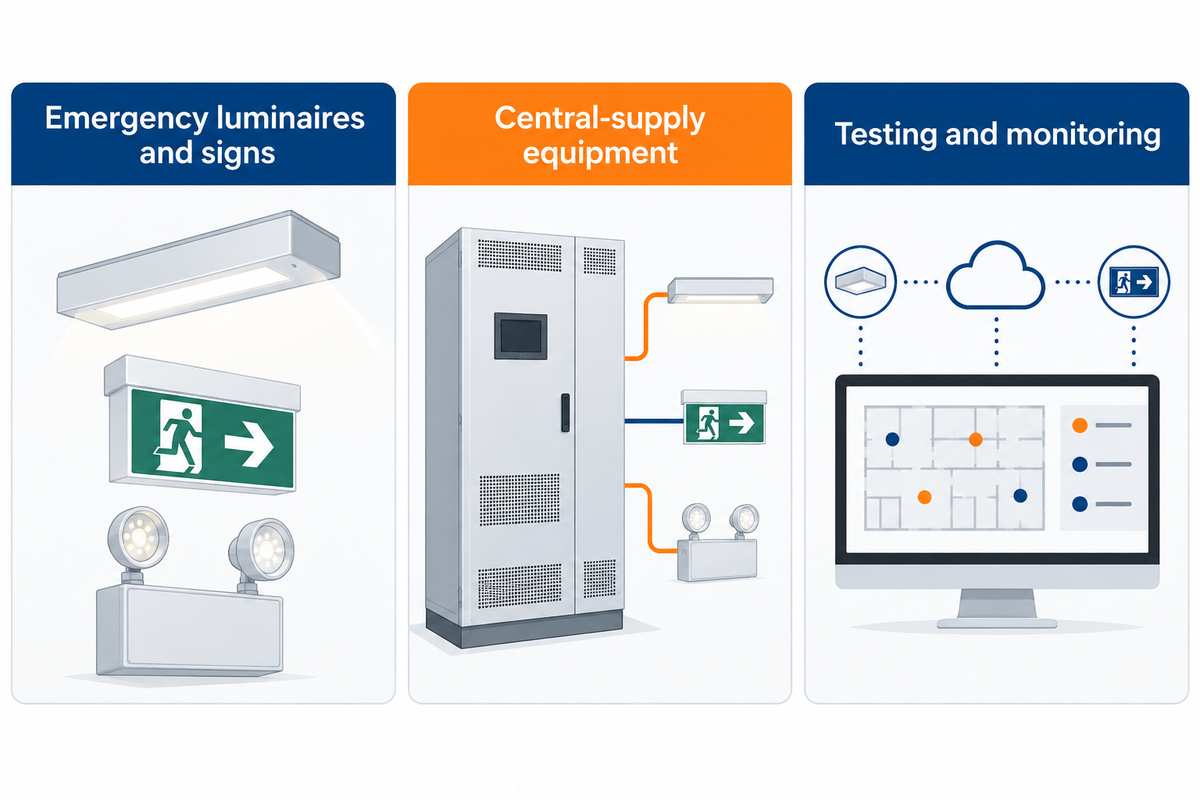
Building specialists offer complete units for escape routes, open areas and exit indication, often with several testing or power options. The strongest short list reflects the actual fixture type and maintenance arrangement. A recessed emergency light, an exit-sign combination unit and a central lighting inverter fulfill different requirements of the specification, even if the same company supplies all three.
12. Acuity Inc.: Best for Commercial Exit Signs and Combination Units
Headquarters: Atlanta, Georgia, USA · Founded: 2001 as an independent company · Type: lighting and technology manufacturer.
Official website: https://www.acuityinc.com/
Main products: Lithonia Lighting exit signs, emergency luminaires and Quantum LQM and LHQM products.
Notable capability: LQM and LHQM offer STAR automatic testing and reporting options.
Product credentials: The reviewed LQM specification lists UL indoor damp-location suitability and California Title 20.
Acuity Inc., formerly Acuity Brands, is the parent-company entry for Lithonia Lighting, avoiding a duplicate listing of the same corporate family. The Quantum products offer a concrete starting point for commercial buildings that need signs or combined exit and emergency functions, with optional automated checks. The reviewed LQM is rated for indoor damp locations at 10–40°C, so its stated application doesn’t cover outdoor freezing conditions.
13. Dual-Lite (Current): Best for Battery Units Serving Remote Heads
Published contact location: Greenville, South Carolina, USA · Founded: 1940, Dual-Lite brand · Type: emergency lighting manufacturer within Current.
Official website: https://www.currentlighting.com/
Main products: LM emergency units, SE exit signs, EVS standby lighting and central lighting inverters.
Notable capability: LM offers 6 or 12 VDC configurations, capacity up to 130 W and support for remote heads.
Product credentials: The EVS brochure lists UL 924 damp-location coverage.
Dual-Lite provides a useful comparison when a project combines a battery unit with separate remote lighting heads. Matching the voltage and connected load is part of choosing the LM configuration, rather than an assumption based on its maximum capacity. A separate sign-selection constraint concerns SE special-text options: those options don’t meet the standard UL 924 letter-size requirements and shouldn’t be confused with the standard exit legend.
14. Beghelli (GEWISS): Best for Fire-Linked Dynamic Escape Signs
Headquarters: Monteveglio, Valsamoggia, Bologna, Italy · Founded: 1982 · Type: emergency lighting manufacturer, part of GEWISS since 2025.
Official website: https://www.beghelli.it/
Main products: Logica emergency luminaires, exit signs, centralized systems and inverters.
Notable capability: Logica 24 Dynamic changes escape-sign scenarios in response to fire-alarm inputs, according to Beghelli’s system description.
Beghelli is relevant where emergency and exit lighting forms part of a coordinated building response. The dynamic-sign function provides a more specific reason to shortlist it than general claims about a broad lighting catalogue. A project using that function needs the compatible LG24 controls and fire-alarm interface, because the sign’s behaviour comes from the system relationship as well as the individual luminaire. Ordinary sign replacement and a dynamic evacuation installation therefore have different purchasing scopes.
15. Teknoware: Best for Supercapacitor-Based Emergency Luminaires
Headquarters: Lahti, Finland · Founded: 1972; emergency lighting production from 1974 · Type: lighting equipment manufacturer.
Official website: https://www.teknoware.com/
Main products: Self-contained and central-battery luminaires, exit signs, Escap products and AaltoCtrl monitoring.
Notable capability: Escap uses supercapacitors with LumiTest self-testing and optional AaltoCtrl wireless monitoring, according to Teknoware.
Teknoware offers a distinct storage-technology choice for buyers comparing self-contained emergency lighting solutions. Escap places supercapacitors in the product discussion rather than assuming that every self-contained light uses the same battery chemistry and replacement cycle. LumiTest and optional wireless supervision also distinguish local testing from network access. The reviewed Escap range has a published ambient-temperature envelope of −25°C to +35°C, making that upper limit a concrete constraint for a hot installation location.
16. Clevertronics: Best for Large Monitored Luminaire Networks
Headquarters: Melbourne, Australia · Founded: Not publicly disclosed · Type: emergency lighting manufacturer.
Official website: https://clevertronics.com.au/
Main products: Emergency luminaires, exit signs, bulkheads, battens and Zoneworks monitoring systems.
Notable capability: Zoneworks XT HIVE supports 1,000 luminaires per controller, according to its product information.
Conformity statement: The Australian website says its luminaires are tested to ASNZS 2293.3.
Clevertronics suits a shortlist built around managing many individual emergency fixtures through a dedicated platform. The controller capacity is useful for defining the initial system scope, while the named luminaire families keep the comparison tied to complete safety products. Regional product ranges focus on Australia, New Zealand and the UK, so the applicable regional catalogue belongs alongside the monitoring specification when selecting the actual units.
17. Evenlite: Best for Commercial Emergency Units with Defined Options
Headquarters: Trevose, Pennsylvania, USA · Founded: 1993 · Type: emergency lighting specialist.
Official website: https://www.evenlite.com/
Main products: Emergency units, exit signs, combinations, lighting inverters, transfer devices and remote heads.
Published model data: Evenlite describes EVO as delivering more than 1,565 lumens.
Product credentials: Its EVO information lists UL 924 and automatic monthly 30-second and annual 90-minute tests.
Evenlite gives buyers several complete-product routes, from a local emergency unit to supporting power equipment. EVO’s published output and automatic test functions make the discussion specific enough to compare a named fixture with alternatives, rather than assuming every emergency LED unit behaves alike. NEMA 4X protection and operation at −40°C require the corresponding options, so the standard unit and an option-equipped cold-weather unit represent different purchase configurations.
18. Daisalux: Best for Discreet Recessed Emergency Lighting
Headquarters: Vitoria, Spain · Founded: 1980 in its official business history · Type: emergency lighting manufacturer.
Official website: https://www.daisalux.com/
Main products: Emergency luminaires, exit signs, beacons, central batteries and control systems.
Notable capability: IZAR recessed luminaires offer optics for escape routes and open areas.
Management systems: The company website displays AENOR ISO 9001 and ISO 14001 marks.
Daisalux is a useful candidate when the emergency light fixture must fit a restrained architectural layout while serving a defined lighting task. Separate IZAR optics allow the discussion to focus on the shape of the illuminated area rather than appearance alone. IZAR requires a suitable ceiling cut-out and recessed installation, so a project with no usable ceiling recess may need a different mounting format from the manufacturer.
19. ETAP: Best for Managed Emergency Lighting within a Building
Headquarters: Malle, Belgium · Founded: 1949; first emergency luminaire produced in 1970 · Type: luminaire and lighting-system manufacturer.
Official website: https://www.etaplighting.com/
Main products: K2 emergency luminaires, safety signs, EBS central batteries and ESM management.
Notable capability: ETAP’s current ESM page describes G4 managing up to approximately 500 luminaires in one building, with wired and wireless networks.
ETAP combines complete lighting products with a management platform that performs function and duration tests and records results digitally. The ability to associate faults with a luminaire’s location and components makes ESM relevant to maintenance planning as well as initial installation. ESM G4 is the single-building option, while ETAP positions ESMweb for multiple buildings, so the estate’s scope determines which platform belongs in the quote.
20. RP-Technik (RP Group): Best for European Wireless Emergency-Lighting Monitoring
Headquarters: Rodgau, Germany · Founded: 1981 · Type: emergency lighting manufacturer within RP Group.
Official website: https://www.rp-group.com/
Main products: Emergency and exit luminaires, self-contained units, central power and Wireless Professional.
Notable capability: Wireless Professional supports 1,000 luminaires per control centre and up to 50,000 across connected centres, according to RP-Technik.
Management systems: Its website lists ISO 9001, ISO 14001 and ISO 45001.
RP-Technik is relevant when wireless testing and monitoring must scale beyond one small installation. The distinction between capacity per control centre and capacity across connected centres helps keep the equipment schedule realistic. Wireless Professional uses the European 868 MHz band and cites a 30 m indoor radio range, so its regional radio arrangement and building layout remain part of the system design.
How to Choose an Emergency Lighting Manufacturer
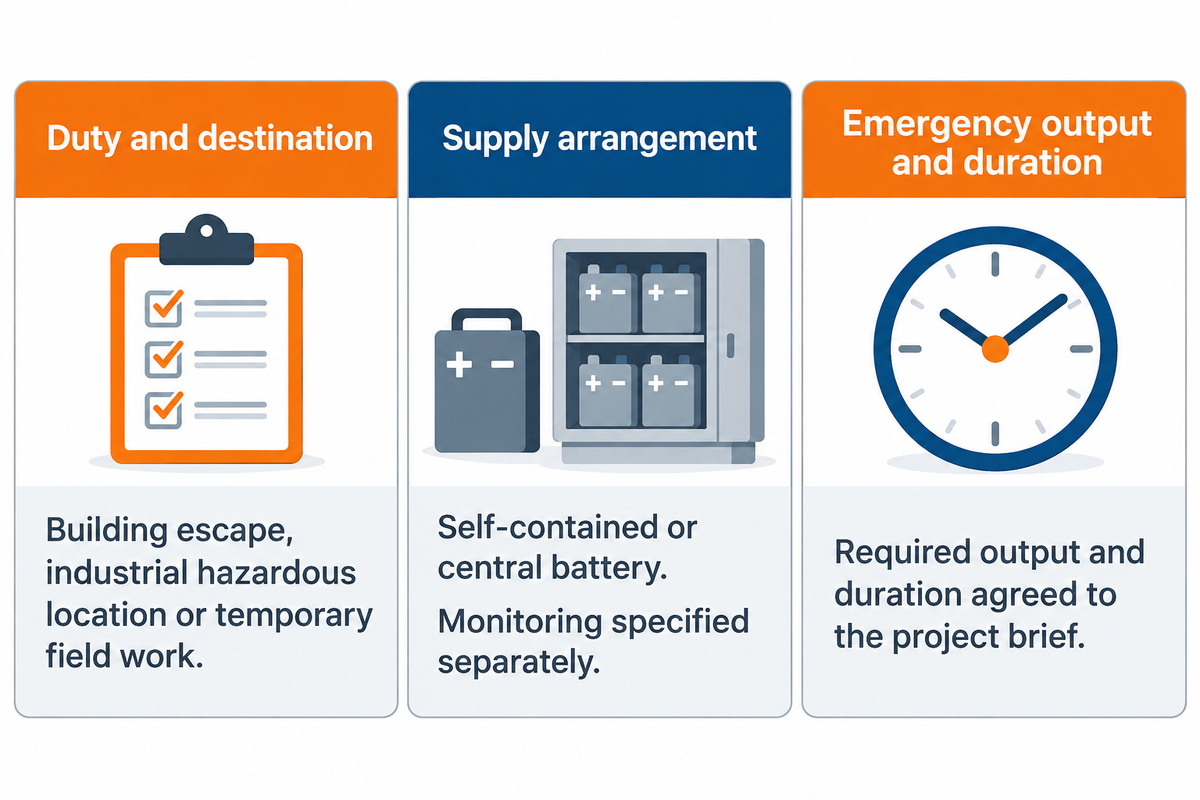
Build the short list around eight factors: Duty and destination, supply arrangement, emergency output and duration, photometric layout, certification and environmental consideration, service, order scope and deployment. Placing the equipment first and the brand second gives suppliers the same brief and makes differences in their quotes easier to identify.
Are Emergency Lighting and Exit Lighting Different?
Emergency lighting illuminates a space when normal power fails and exit lighting indicates the way out. An exit sign can be part of the emergency lighting system, but its directional message doesn’t replace the illumination needed along an escape route. During emergency situations, crews use portable lighting to illuminate the work area.
1. Define duty and destination. State if the purchase is for a building escape route, an industrial hazardous location or temporary field work. State the destination country and the project requirements. UL’s description of emergency lighting equipment provides a basis for distinguishing luminaires, exit indication and emergency power sources and control equipment; this is helpful in preparing a complete equipment schedule.
The National Fire Protection Association has published NFPA 101, the Life Safety Code. The National Fire Protection Association publishes NFPA 101, the Life Safety Code, covering both existing and new structures. Make sure that you identify the code edition that the project has adopted before using it as the basis of design. A life-safety code and a product listing serve different purposes in project documentation.
The team’s field light should be selected for that work area and its hazards. Further details on this selection may be found in our Hazardous-Location lighting Guide.
Self-Contained or Central Battery: Which Supply Architecture Fits?
Self-contained luminaires store backup energy at each luminaire, while a central battery system supplies emergency power to multiple luminaires. For a large commercial building designed with central emergency circuits and an accessible battery location, shortlist central-supply system manufacturers. For a phased retrofit retaining individual battery-backed luminaires, shortlist self-contained products with compatible monitoring. The size of the building alone doesn’t determine the architecture of the emergency power system.
2. Separate power from monitoring. Ask for a diagram showing the battery location, supply circuits, control network and monitoring interface. The DALI Alliance’s emergency-lighting explanation describes self-contained equipment with the battery inside or beside the luminaire, while digital commands support testing and reporting. DALI-2 Emergency certification concerns controlgear for that function; it isn’t a blanket approval of every assembled lighting installation.
Compare similar architectures across suppliers. A quote for self-contained lighting units plus a controller differs from a quote for a central inverter, batteries and compatible centrally supplied luminaires. An app screenshot alone does not establish how the emergency load receives power. The comparison should be done at the hardware level and the software level to determine what equipment is used to keep the emergency lights on and how it’s monitored.
When comparing the monitoring system, define for the maintenance team the remote capability that they’ll actually use: viewing faults, scheduling tests or exporting reports. For LED lighting, compare power consumed during normal operation to that consumed during emergency. An energy-efficient LED product still needs suitable backup power and the required emergency performance; a lower normal mode wattage is only one line in the comparison.
For innovative lighting functions such as dynamic signs, compare the control interface with the intended system. Advanced LED controls are evaluated for usefulness against a defined operating or maintenance need. Identify that need in the inquiry so the supplier can include the relevant controls and explain their function.
How many lumens do I need for LED emergency lights?
There isn’t a single lumen rating that selects LED emergency lights for every space. Emergency-mode photometry and rated duration should be taken from the luminaire and used in the lighting design. A luminaire with a high normal-mode lumen value may not provide adequate emergency illumination.
3. Keep output and duration together. Request the emergency output, runtime, ambient temperature and supply mode as one specification. Streamlight’s two clearly paired settings illustrate the purchasing issue: choosing maximum output changes the available battery runtime. For a fixed emergency fixture, the rated emergency output may also differ from its normal operating output. Comparing a normal-mode wattage with another unit’s emergency-mode lumens produces a misleading shortlist.
4. Match the optics and layout. Obtain the photometric file for the selected emergency configuration, mounting position and lens. A narrow escape-route optic and a broad open-area optic distribute the same source output differently. Daisalux’s IZAR options are a practical example of that distinction. Include obstructions, changes in level and the intended mounting arrangement in the design brief instead of relying on a headline spacing figure taken from another installation.
A commercial corridor renovation demonstrates that appearance isn’t the only consideration with choice. The selected recess depth must fit the ceiling, the optic must fit the route and the emergency power arrangement must fit the wiring. A visually similar replacement may alter any of those three conditions. To satisfy the project’s lighting designer, the manufacturer should provide the exact product information.
Certification and Environment: Match the Exact Model
5. Check the product, option and intended market. Match the certificate or listing to the quoted model, emergency configuration and installation conditions. Management-system certifications describe processes and don’t certify emergency lights. Our displayed management system certificates, for example, have a sales scope. Likewise, the rating of a named hazardous-area model doesn’t automatically apply to every portable light from its manufacturer.
Record the ambient-temperature range, ingress protection, hazardous-area classification where relevant, and any special mounting conditions. Indoor equipment is different from outdoor equipment. Cold-weather rating is dependent on options fitted on the unit. Use explosion-proof emergency-lighting requirements as the basis for an industrial inquiry, and have the model and installation assessed against the project specification.
For outdoor applications, include exposure and service access in the specification for durable lighting. Reliable illumination requires the complete assembly to suit its surroundings, including the battery and electronic parts inside the enclosure. List the safety standards and regulations, including the standards set in the approved project design, by edition and jurisdiction rather than accepting a generic promise in the quotation.
Battery Replacement, Testing and Product Support
6. Price the service route with the hardware. For the selected model, request the replacement battery/energy storage assembly, driver, lamp or LED module, test procedure and warranty-service route. A battery backup should be provided with a maintenance plan. A replaceable incandescent bulb, an integrated LED-based assembly and a legacy ballast-based fixture may require quite different repair parts even when serving the same location.
For conventional batteries, record the specified chemistry, including whether the product uses NiCd, often written as NiCad, or another type. Don’t substitute a pack just because its connector fits. Teknoware’s supercapacitor products show why storage technology must be identified explicitly. Include access equipment and maintenance services in the ownership estimate where fixtures sit high above commercial spaces or industrial work areas.
The DALI Alliance differentiates a short function test from a duration test of the full rated operating period. Automated reporting can help organize that work, but the purchase still needs an owner for faults, repairs and records. Ask whether the supplier’s product support includes commissioning, training, replacement parts and the aforementioned monitoring software. Assume not all connected systems are turnkey services.
Evaluate a supplier’s commitment to quality through warranty handling, parts availability and fault resolution. Project references can support assessment of customer satisfaction with that support, rather than with the appearance of the luminaire alone. References from comparable installations are helpful to the purchasing team to determine the service levels they need.
What Affects Price, Minimum Order and Delivery?
Price and delivery are driven by the actual unit, quantity, approvals, options, customization and installation scope. A stock branded light, a private-label order and an engineered central system are different purchases. LFADJ publishes a one-unit minimum for its field-lighting offer; that policy doesn’t establish a minimum for another manufacturer’s product or a custom production order.
7. Request the same supply scope. Send the same duty, destination, quantity and required configuration, whether the supplier offers a comprehensive range of lighting or a specialist product line. Ask for an itemized quote breaking down luminaires, batteries, controls, accessories, software, commissioning, freight and spare parts. For private labeling, include artwork and packaging and provide sample approval. A lower fixture price may reflect a smaller supply scope rather than a cheaper way to complete the same installation.
LFADJ’s published payment policy requires a 50% deposit and the balance before shipment. Delivery for a specific purchase should be stated in its quotation, with the configuration and destination attached. A quote that identifies an available stock unit is more useful than a general promise of fast delivery. Keep the approved model and option codes with the order so the delivered equipment can be checked against the agreed specification.
Transport and Deployment for Mobile Response Lighting
8. Plan the move as well as the light. For field equipment, consider vehicle payload and method of loading, equipment access width, surface conditions, clearances and the intended power source. Our LF6133 weighs 70 ± 5 kg and has a wheeled base; however, it still needs to be part of the equipment-handling plan. A portable lamp and a movable mast system can both travel to a job, but they make different demands on the crew and vehicle.
Specify whether the equipment will remain in a single work position or be moved repeatedly during a shift. Include arrangements to charge, fuel or provide power to the selected operating mode. For smaller equipment in classified areas, our portable explosion-proof lighting page addresses a different product route from a general-purpose mobile mast. A weather-resistant enclosure alone is not a hazardous-area approval.
Frequently Asked Questions
Which emergency lighting manufacturers are best for commercial buildings?
Acuity, Dual-Lite and Evenlite are useful starting points for commercial exit signs and emergency units; Eaton, ABB and Schneider Electric fit comparisons involving broader power and monitoring systems. For recessed architectural luminaires, consider Daisalux. Choose the shortlist by fixture type, local product range and supply architecture so that each quotation addresses the same building requirement rather than a different collection of equipment.
Who is the largest emergency lighting manufacturer in the world?
No single company can be identified here as the largest by comparable emergency-lighting revenue or market share. Eaton, ABB, Signify, Schneider Electric and Acuity operate substantial lighting or electrical businesses, but their total group revenues cover different activities. For procurement, the more useful comparison is the relevant product range, regional supply route, technical support and compatibility with the proposed installation.
What is the difference between an emergency lighting manufacturer and a supplier?
A manufacturer makes or integrates the complete lighting equipment, while a supplier may distribute products made by other companies. A company can perform both roles. During a purchase, determine the manufacturer that’s behind the model and the business that’s responsible for the commercial contract, warranty and replacement parts. This is true even if a familiar brand name is on the offer.
Which manufacturers make emergency lights for hazardous areas?
R. STAHL and Hubbell’s Chalmit offer fixed industrial emergency luminaires, while Pelican’s 9455 is a named portable option with hazardous-area ratings. Eaton’s ExLin range also provides an industrial system route. These examples serve different installation and deployment duties; the applicable classification belongs to the specific model and configuration described in its product documentation.
How much does emergency lighting cost?
Cost will vary based on options and installation scope. Also, because fixture, backup supply and quantity vary with the application, no common price range was established for comparative purposes. A stock exit sign, a private-label order and an engineered central system are distinct purchases. Compare itemized quotes for batteries and controls, commissioning, and freight to bring the figures to an equal basis for comparison.
Which manufacturers are best for portable emergency-response lighting?
Streamlight suits portable scene-lighting comparisons, while Pelican offers specifically rated hazardous-area models such as the 9455. LFADJ supplies movable mast and field-lighting equipment for larger temporary work positions. Select among them by deployment method, output, runtime and the work area’s classification. These products serve response crews; they don’t replace a building’s separately designed escape lighting.
Build a Shortlist Around the Job
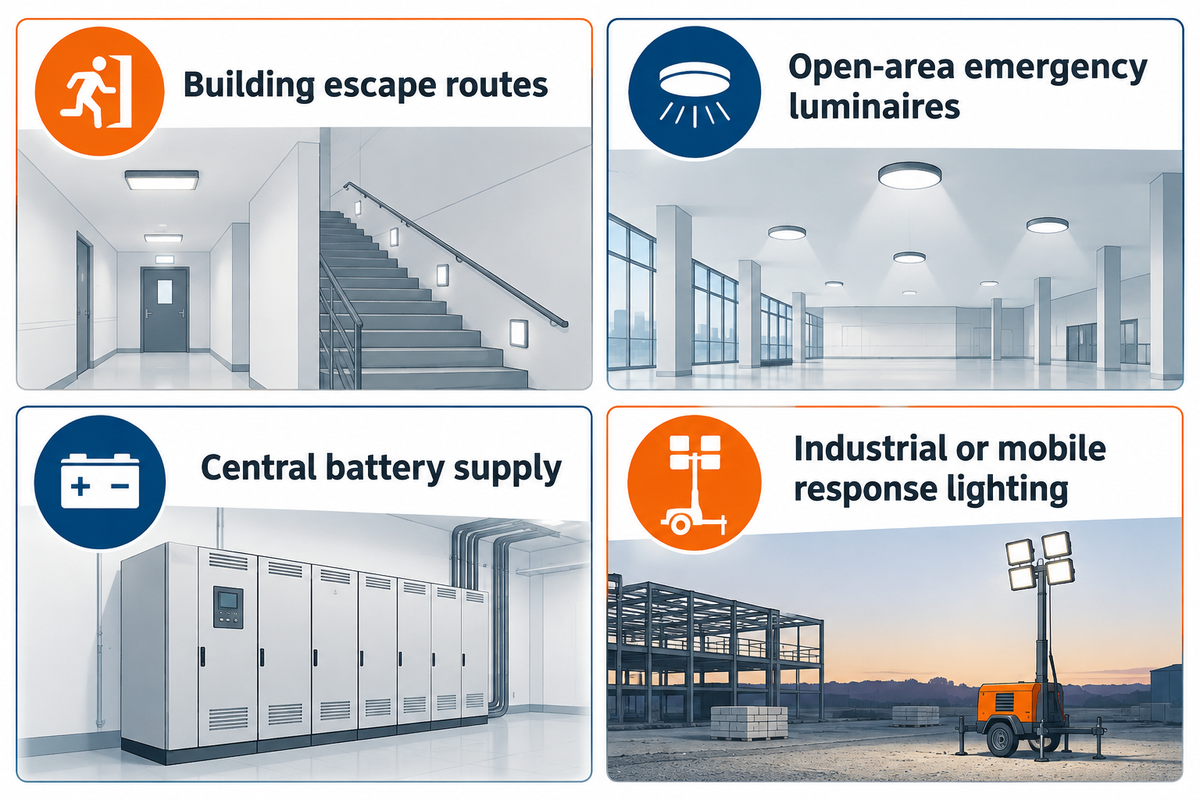
Start with the equipment category, then compare two or three manufacturers offering complete products of the same type. Include model, power architecture, environmental rating, and service scope with the price for each. This turns a list of brands into a purchase decision that an engineer, facilities manager and procurement team can discuss together.
For temporary industrial response equipment, explore LFADJ’s emergency-lighting systems and send the application, quantity, destination and deployment requirements through the page’s inquiry route. Our company introduction explains the business behind the LFADJ brand.
Related Articles
- Diesel light tower manufacturers compared
- Mobile light towers: equipment and applications
- Light, power and placement explained
- Portable LED work lights and selection factors
References & Sources
- UL Solutions: Emergency Lighting Testing and Certification equipment categories and the distinction between luminaires, signs, power and controls.
- DALI Alliance: DALI Emergency self-contained emergency controlgear, automated function tests and duration tests.
- National Fire Protection Association: NFPA 101, Life Safety Code document scope and access to current and prior editions.