Get in touch with LFADJ Company

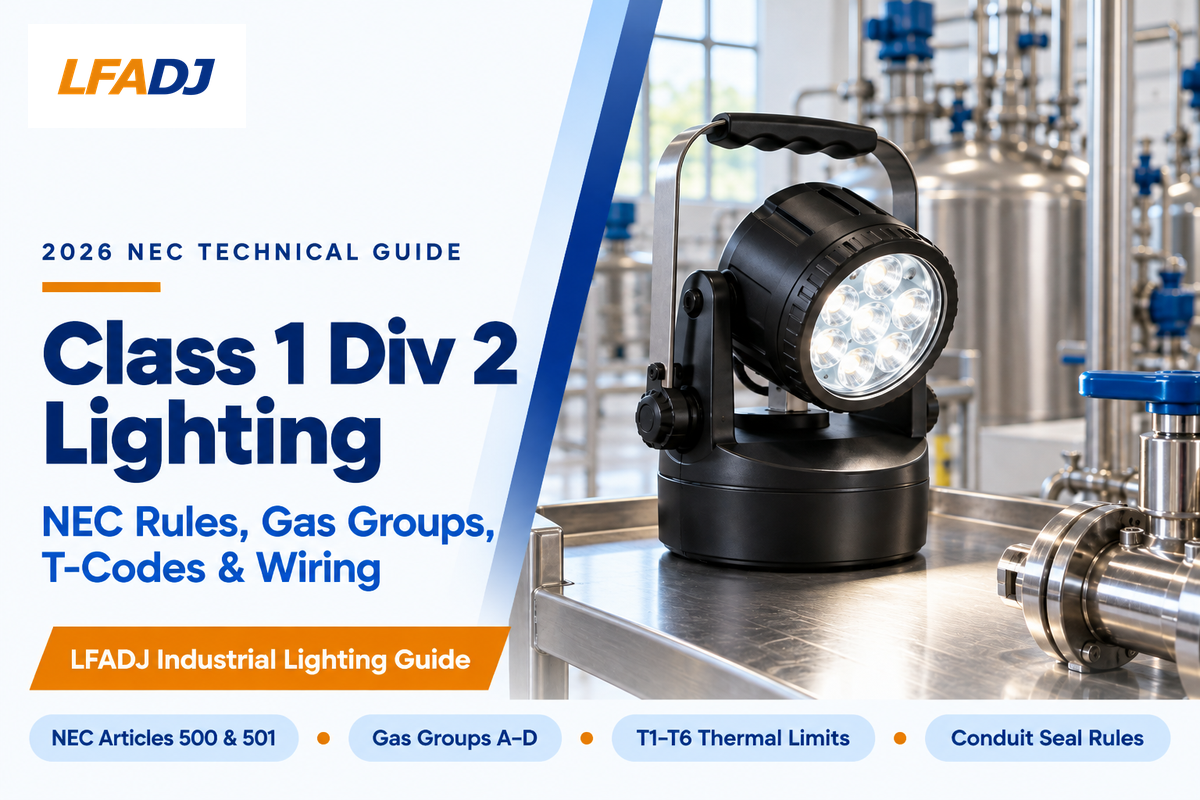
A Class 1 Div 2 (Class 1 Division 2) hazardous location covers locations where flammable gases or vapors may be present during abnormal events. Ordinarily, those gases are absent from air in quantities sufficient to cause an explosion; during normal shifts, they are not present in quantities to cause an explosion. The National Electrical Code (NFPA 70) and OSHA 29 CFR 1910.307 tie this rating to abnormal conditions such as leaks, equipment failure, or loss of ventilation.
Understanding Class 1 Division 2 rules governs electrical safety, NEC Article 501 wiring methods (RMC, IMC, or approved cables with boundary seals), and UL 844 lighting equipment selection in hazardous environments. Oil and gas refineries, chemical plants, paint booths, and fuel terminals apply these rules daily. Misidentifying enclosure, gas group, T-code, or certification mark results in inspection failures or ignition hazards. This guide maps NEC Articles 500, 501, and 505 to luminaire specs, conduit seals, US pricing, and NRTL checks.
What Is a Class 1 Div 2 Hazardous Location Under NEC Article 500?
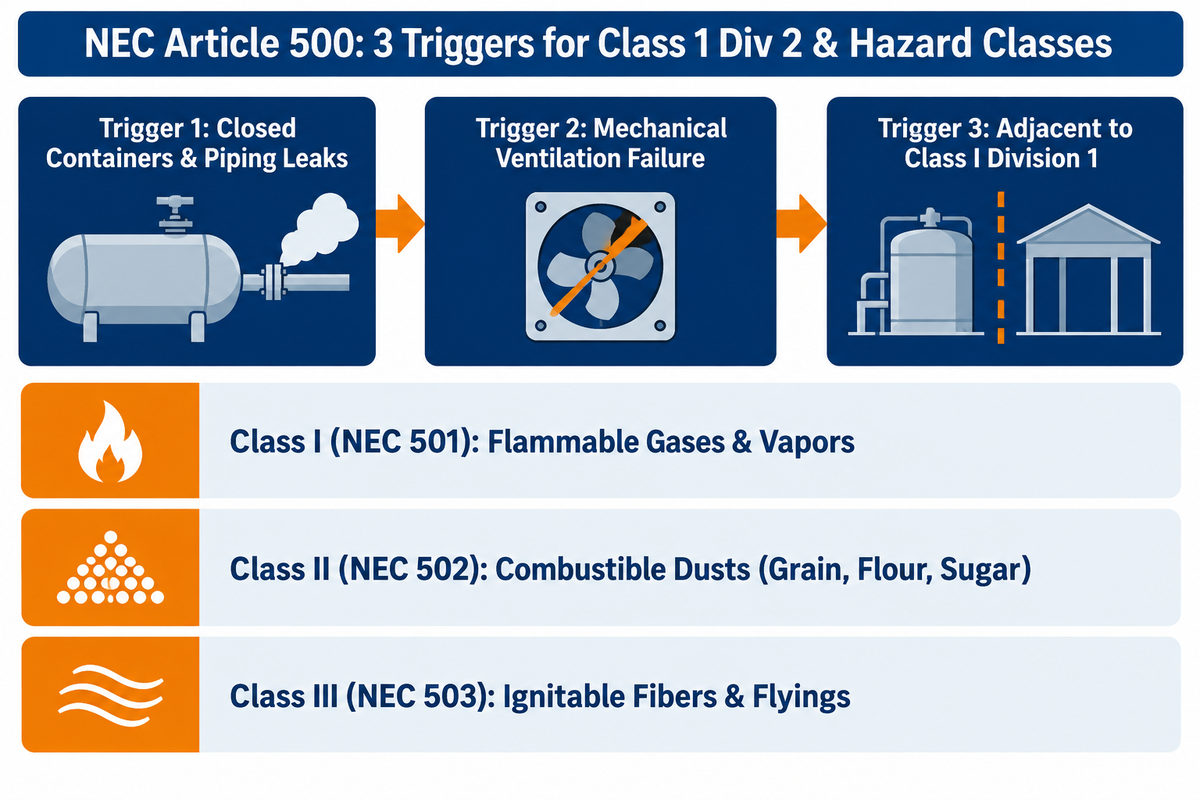
Under Article 500, the National Electrical Code classifies hazardous locations as Class I Division 2 when flammable gases or vapors stay confined or diluted during normal operating conditions. Ignitable mixtures occur only during abnormal situations. Under NEC Section 500.5(B)(2) and OSHA 29 CFR 1910.399 , engineers classify hazardous rooms, and a space is classified as Class I, Division 2 when any of three contingencies applies.
These three statutory Class I, Division 2 situations cover different containment and air flow conditions.
- Closed-system confinement pertains to volatile flammable liquids and gases that are confined to closed systems, and escape only through accidental rupture or equipment failure.
- Mechanical ventilation dependence pertains to positive mechanical ventilation, which normally blocks ignitable concentrations. A hazardous atmosphere forms only if airflow fails.
- Division 1 adjacency refers to a room located next to a Class I, Division 1 area. Vapors may occasionally migrate unless blocked by positive-pressure ventilation with failure safeguards.
While “29 CFR 1910.399” defines hazard classes and divisions, “29 CFR 1910.307(c)” prescribes equipment installations. Installations in classified locations must follow one of three legal pathways: intrinsically safe equipment, approved equipment, or demonstrated-safe equipment. Approval is never generic. OSHA 29 CFR 1910.307 requires approval matched to the specific hazardous location and the exact gas, vapor, dust, or fiber present.
| NEC Class | Hazardous Material Present | Material Groups | Typical Industrial Sites | Governing NEC Article |
|---|---|---|---|---|
| Class I | Flammable gases, flammable liquid-produced vapors, or combustible liquid-produced vapors | Groups A, B, C, D | Oil refineries, fuel storage, chemical plants, spray booths | Article 501 (Divisions) / Article 505 (Zones) |
| Class II | Combustible dusts (conductive metal, carbon, or organic dusts) | Groups E, F, G | Grain elevators, flour mills, coal handling, metal powder shops | Article 502 (Divisions) / Article 506 (Zones) |
| Class III | Easily ignitable fibers or combustible flyings (not normally suspended) | No letter groups | Textile mills, cotton gins, woodworking and sawmills | Article 503 (Divisions) / Article 506 (Zones) |
Accurate hazardous area classification ensures proper classification of different hazardous atmospheres before any lighting purchase begins. A fixture rated only for Class I locations doesn’t qualify for Class II locations or Class III locations. Combustible dust blankets insulate luminaire housings, and increase surface temperatures. For projects outside of North American code jurisdictions, it’s advised to compare hazardous location explosion-proof lighting systems to local classification frameworks as early as possible.
What Is Class I Div II and How Does It Differ From Class 2 Div 2?
Class I, Div II (or Class I Div 2) is a Roman-numeral shorthand for NEC Class I, Division 2 flammable gas and vapor areas, whereas Class 2 Div 2 (Class II, Division 2) covers combustible dust hazards. Typical Class II dusts include grain, flour, sugar, and plastic powders not normally suspended in air.
Both ratings use Division 2 for abnormal release events, which leads to frequent buying mistakes. Yet gas protection and dust protection address completely different failure modes. OSHA 1910.307 treats explosionproof apparatus (Class I gases) and dust-ignitionproof enclosures (Class II dusts) as separate protection methods. Where vapor and combustible dusts are present together in a classified area, select luminaires evaluated for both Class I and Class II.
Class 1 Div 1 vs. Class 1 Div 2: Hazard Probability, Equipment, and Cost
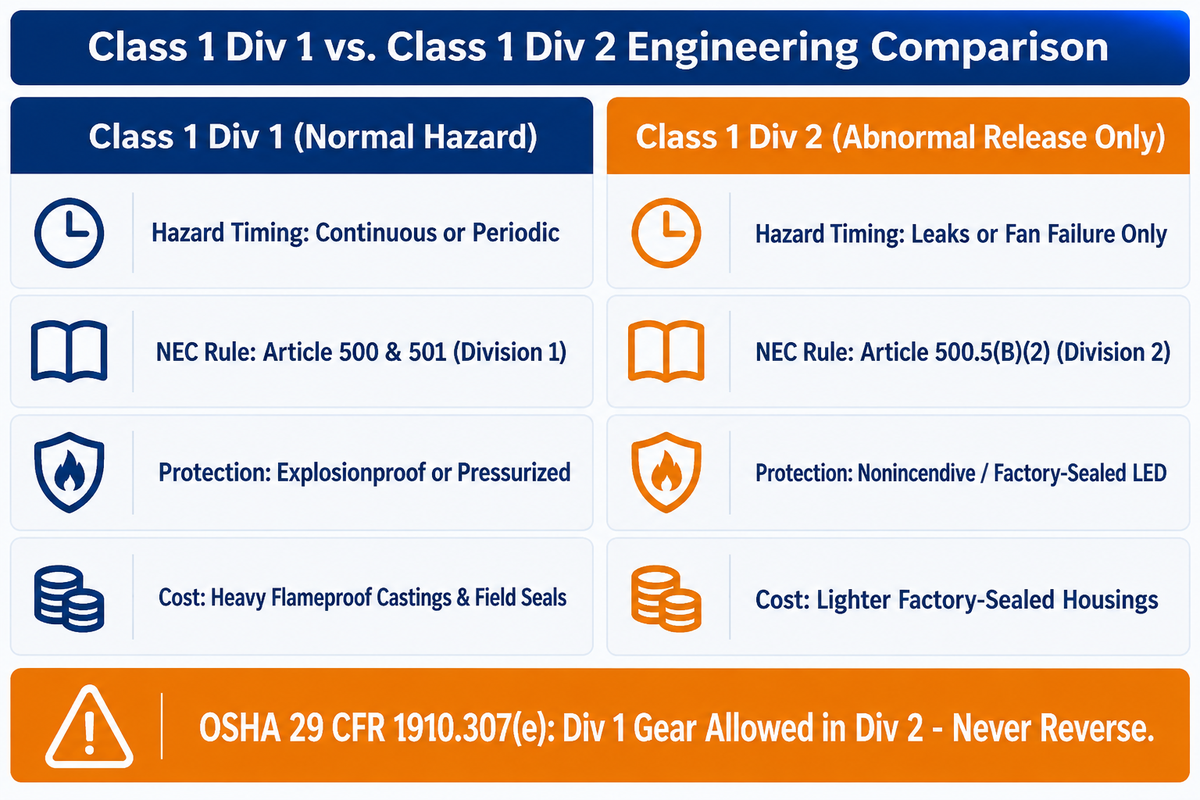
The real difference between Class 1 Division 1 and Class 1 Division 2 is the probability of hazardous substances being present for normal operation. In Division 1 locations, ignitable mixtures exist continuously, intermittently, or periodically during routine work or repair. In a Division 2 location (a division 2 hazardous area), ignitable mixtures appear only during abnormal failure or accidental release.
During the design, installation, and testing of electrical systems, classification into Class 1 Div 2 or 1 Div 1 dictates differences in enclosure engineering, wiring rules, and safety in hazardous locations products. Under OSHA 29 CFR 1910.307(e), Division 1 equipment may be installed in a Division 2 area of the same Class and gas group. Installation of Division 2 equipment in Division 1 vapor envelopes violates both OSHA and NEC codes.
| Comparison Dimension | Class I, Division 1 (Div 1) | Class I, Division 2 (Div 2) |
|---|---|---|
| Likelihood of Hazardous Atmosphere | Present continuously, intermittently, or periodically under normal operating conditions or routine repair | Absent during normal operations; present only during abnormal rupture, breakdown, or ventilation loss |
| Permitted Protection Techniques (NEC 500.7) | Explosionproof apparatus, intrinsically safe systems, or NFPA 496 Type X/Y purged and pressurized enclosures | Nonincendive circuits/equipment, hermetically sealed devices, NFPA 496 Type Z purge, oil-immersed, plus all Div 1 methods |
| Typical Luminaire Construction | Heavy copper-free cast aluminum flameproof housing with machined flamepaths designed to contain an internal explosion | Lighter sealed non-sparking LED housing with controlled surface temperatures and gasketed optics |
| Conduit & Wiring Flexibility (NEC 501.10) | Threaded RMC, threaded steel IMC, or Type MI / MC-HL cable; explosionproof fittings required at enclosures and specified seal points | RMC or IMC (threaded or listed threadless fittings), MC-HL, PLTC/ITC, enclosed gasketed busways, flexible fittings |
| Substitution Rule (OSHA 1910.307(e)) | Div 1 equipment may be used in Div 2 of the same class and gas group | Div 2 equipment is strictly prohibited inside any Class I, Division 1 area |
Specifying Division 1 fixtures for a Division 2 space can increase the lighting budget. Heavy flameproof housings increase the mounting load and raise the hardware cost. Non-factory sealed entries also increase the cost and labor due to the need for conduit seals. Review explosion-proof lighting principles and rating frameworks before sizing a mixed-division facility.
Does Class 1 Div 2 Require Explosion-Proof Equipment?
No, Class 1 Div 2 doesn’t require explosion-proof equipment for most lighting applications. Lowering the risk of explosion in Division 2 allows several lighter methods under NEC Section 500.7 and Article 501. Permitted options include nonincendive equipment, hermetically sealed parts, oil-immersed devices, and NFPA 496 Type Z purged enclosures alongside explosion-proof housings.
Where explosionproof protection is used in Division 1, the enclosure contains an internal explosion and prevents flame propagation into surrounding vapors. In Division 2, gaskets and sealed optics don’t always prevent hazardous gases from entering a housing during a leak. Instead, non-sparking circuits and controlled surface temperatures keep the luminaire from acting as an ignition source and reduce the risk of fire or explosion during normal operation. As Control Global’s hazardous-area engineering coverage notes, Division 2 supports far lighter, lower-cost nonincendive hardware than Division 1.
Is Class 1 Div 2 Equivalent to Zone 2 Under IEC and ATEX Rules?
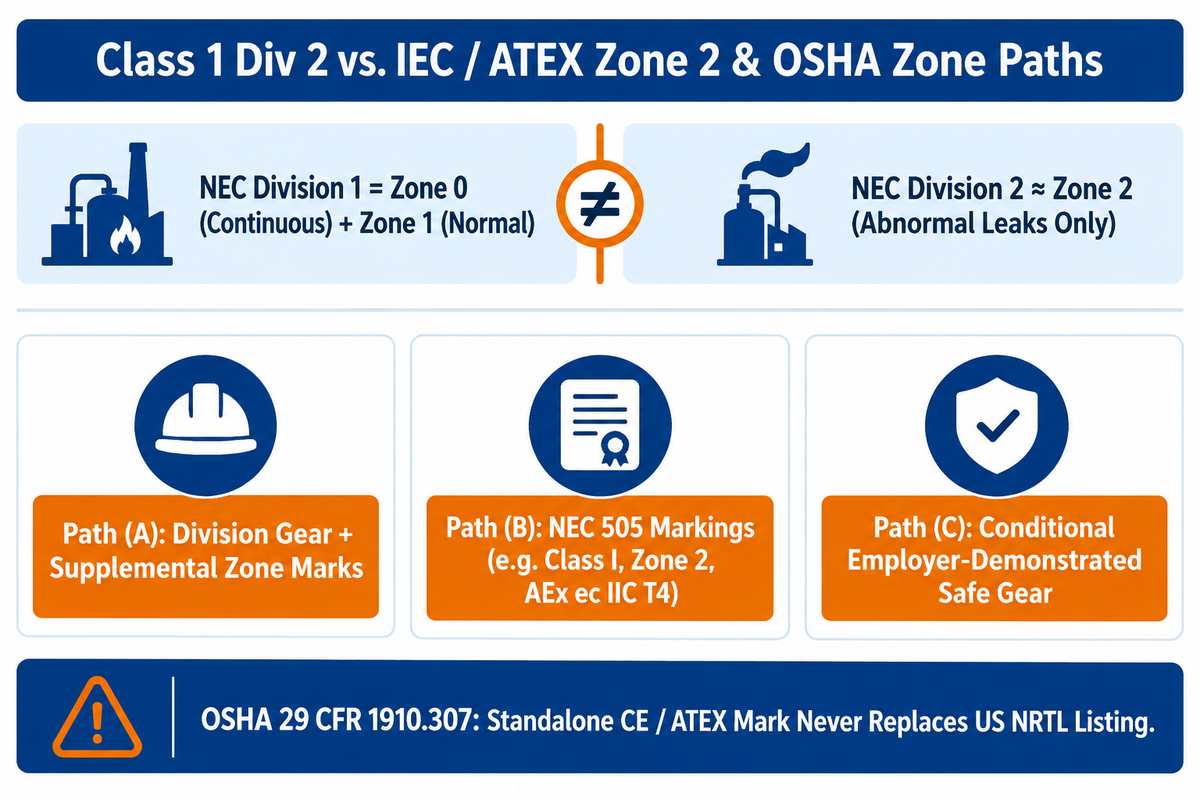
No, Class 1 Div 2 and Zone 2 share similar hazard likelihood, but they aren’t legally interchangeable for equipment certification. Both describe an abnormal-release hazardous area where flammable vapors remain unlikely during normal operation. However, each system follows a distinct legal framework, gas group boundaries and laboratory approvals.
In the United States, OSHA 29 CFR 1910.307 (g) allows an employer to use the Zone classification system (NEC Article 505) instead of Divisions (NEC Article 500/501). Within a single facility, Class I, Zone 2 areas may touch or border Class I, Division 2 areas, but they may not overlap. That boundary impacts global luminaire sourcing.
Three legal and technical boundaries separate North American Division 2 from IECEx and European ATEX Zone 2:
- Under 29 CFR 1910.307(g)(5)(ii)(A) through (C), US Zone equipment qualifies through three marking paths. Path (A) relies on Division-approved equipment and supplements it with Zone, gas-group, and temperature markings. Path (B) uses NEC 505 markings such as Class I, Zone 2, AEx ec IIC T4. Path (C) allows conditional employer-demonstrated safe gear where workers recognize the protection. Claiming every Zone fixture needs “AEx” oversimplifies the statute.
- Standalone European ATEX or CE marks don’t substitute for US NRTL approval under the OSHA NRTL Program. Under 29 CFR 1910.307(c), US sites accept intrinsically safe, NRTL-approved, or demonstrated-safe pathways. For approved commercial luminaires, OSHA requires a recognized lab mark (UL, CSA, Intertek ETL, or FM Approvals) tied to a US standard rather than a CE / ATEX mark replacing a certified Class I, Division 2 fixture.
- Gas-group flaws cause spec errors across systems. The NEC Division system uses four groups (A, B, C, D), while the IEC Zones use three (IIC, IIB, IIA). Thus, Group A and B of the NEC map to IEC Group IIC, and therefore, Group IIB Zone 2 equipment is not permitted to be used in a Group B hydrogen site.
| Parameter | NEC Class I, Division 2 | NEC Article 505 Class I, Zone 2 | EU ATEX / IECEx Zone 2 |
|---|---|---|---|
| Governing Standard | NFPA 70 Articles 500 & 501; UL 844 / UL 121201 | NFPA 70 Article 505; UL 60079-0 series | ATEX Directive 2014/34/EU; IEC 60079 series |
| Gas Group Mapping | Group A, Group B, Group C, Group D | IIC (A+B), IIB (C), IIA (D) | IIC (A+B), IIB (C), IIA (D) |
| Typical Nameplate String | Class I, Div 2, Groups A, B, C, D, T4 | Class I, Zone 2, AEx ec IIC T4 Gc (or Div supplemental marking) | Ex II 3G Ex ec IIC T4 Gc (CE under ATEX Category 3G; IECEx regional) |
| US OSHA Workplace Acceptance | Accepted with OSHA NRTL listing (UL, CSA, ETL, FM) | Accepted under 1910.307(g) with NRTL listing | Not accepted standalone without US NRTL evaluation |
As CSA Group’s North American certification guidance notes, match fixture markings to your stamped area classification drawing. Never rely on informal equivalence charts.
Class 1 Div 2 Gas Groups (A, B, C, D) and T-Code Temperature Ratings
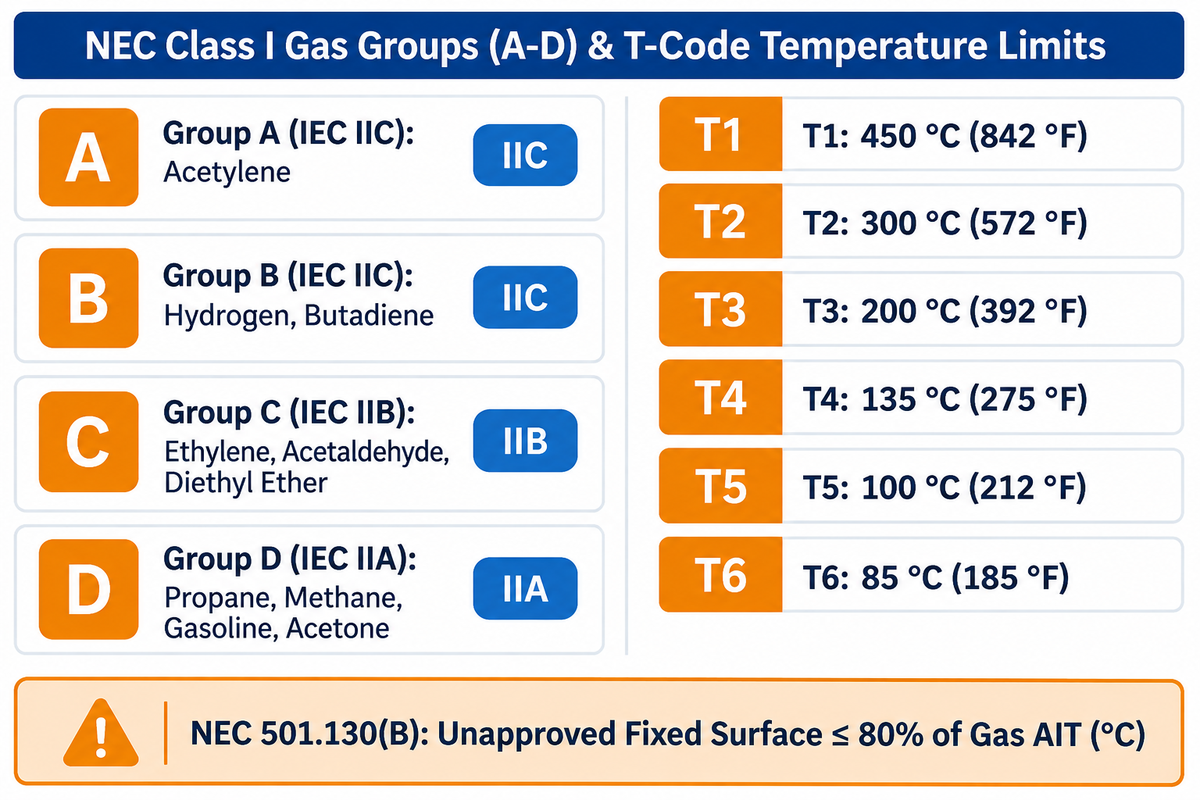
Every Class 1 Div 2 lighting spec must match two chemical limits: the gas group (Groups A, B, C, and D under NEC 500.6(A)) and the temperature code (T1 through T6 under NEC Table 500.8(D)(2), 450 °C down to 85 °C). Picking the wrong group or surface rating creates an ignition hazard even on gear rated for Class 1 Div 2.
Meeting both limits is one of the core safety measures in NEC Article 500. Section 500.6(A) sorts Class I flammable gases and vapors into four groups by Maximum Experimental Safe Gap (MESG) and Minimum Igniting Current (MIC) ratio. Group A carries the most stringent limitations. Group D is more common in general industry.
| NEC Group | Representative Gases & Vapors | IEC / NEC 505 Equivalent | Key Lighting Selection Note |
|---|---|---|---|
| Group A | Acetylene | Group IIC | Highest explosion pressure; verify explicit Group A listing |
| Group B | Hydrogen, butadiene, ethylene oxide, propylene oxide, acrolein | Group IIC (or IIB + H2) | Lighter than air; hydrogen tends to rise toward upper ceilings and unvented roof pockets |
| Group C | Ethylene, acetaldehyde, diethyl ether, cyclopropane | Group IIB | Lower ignition energy than Group D; Group D-only lights cannot be used |
| Group D | Propane, methane, natural gas, gasoline, acetone, ethanol, hexene | Group IIA | Widest industrial coverage across petroleum, fuel, and solvent plants |
Next comes surface temperature. Flammable vapors ignite on a hot housing even without a spark if surface heat exceeds the gas autoignition temperature (AIT). NEC Table 500.8(D)(2) sets six main T-codes (plus sub-codes like T3A and T4A) at a 40 °C (104 °F) baseline ambient. Under OSHA 29 CFR 1910.307(c)(2)(ii)(E), equipment rated above 40 °C (104 °F) needs dual markings. The markings need to indicate both the maximum ambient temperature and the operating temperature (or range) at that elevated ambient temperature.
| NEC T-Code | Max Surface Temp (°C) | Max Surface Temp (°F) | Typical LED Luminaire Relevance |
|---|---|---|---|
| T1 | 450 °C | 842 °F | Covers high-AIT gases like methane and propane (450 °C AIT) only |
| T2 | 300 °C | 572 °F | Legacy high-wattage HID range; too hot for low-AIT hydrocarbons |
| T3 | 200 °C | 392 °F | Common ceiling for high-output industrial luminaires |
| T3A | 180 °C | 356 °F | Intermediate sub-code below 80% AIT for 245 °C vapors like hexene |
| T3B | 165 °C | 329 °F | Intermediate sub-code for tighter solvent thermal ceilings |
| T3C | 160 °C | 320 °F | Cooler T3-class ceiling for low-AIT chemical vapor zones |
| T4 | 135 °C | 275 °F | Standard sweet spot for modern C1D2 LED high bays |
| T4A | 120 °C | 248 °F | Cool-running LED sub-code bridging T4 and T5 chemical areas |
| T5 | 100 °C | 212 °F | Cool-running LED linear and low-bay luminaires for strict chemical areas |
| T6 | 85 °C | 185 °F | Strictest T-code; required for carbon disulfide and ultra-low AIT vapors |
Worked Thermal Check: Listed T-Code Rule vs. NEC 501.130(B) 80% Autoignition Trigger
Assumed inputs (from NFPA 497 Chapter 4): A Class I, Division 2 Group D room handles hexene (CAS 592-41-6, AIT = 245 °C / 473 °F) and propane (CAS 74-98-6, AIT = 450 °C / 842 °F). Always design to the lowest AIT present (245 °C).
Path A, UL 844 Listed, T-Code Marked Luminaire (OSHA 1910.307(c)(2)(ii) & NEC 500.8(D)): A listed fixture’s marked maximum operating temperature must stay at or below 100% of the gas AIT (245 °C). A UL 844 T3 fixture (200 °C / 392 °F) or T4 fixture (135 °C / 275 °F) passes at standard ambient.
Path B, Unapproved Fixed Division 2 Luminaire Threshold (NEC 501.130(B), per Eaton Crouse-Hinds 2023 Code Digest): Unapproved fixed Division 2 luminaires face an 80% AIT ceiling: 0.80 × 245 °C = 196 °C (385 °F; °F = °C × 1.8 + 32). A 200 °C unapproved unit breaches 196 °C. It must either carry a hazardous-location listing (where a UL 844 T3 200 °C or T4 135 °C fixture passes under Path A) or use a cooler unit verified not to exceed 196 °C.
Elevated ambient check (55 °C ceiling): Above standard ambient limits, select a UL 844 luminaire dual-marked for 55 °C (or 60 °C) ambient. Verify its marked maximum operating temperature at that ambient stays at or below 245 °C.
What Is Class 1 Div 2 Group C and D?
Class 1 Div 2 Group C and D covers Division 2 areas with ethylene-family gases (Group C: ethylene, acetaldehyde, diethyl ether) and common hydrocarbons (Group D: propane, methane, gasoline, acetone). Most refinery, petrochemical, and paint-booth luminaires carry at least Group C and D markings.
However, Group C and D fixtures are never valid in Group B (hydrogen) or Group A (acetylene) spaces. Battery rooms, hydrogen reformers, and acetylene manifolds need explicit Group A or Group B nameplate ratings. Some UL 844 LED models carry multi-group markings covering Groups A, B, C, and D, though buyers must still verify every letter on the specific nameplate.
Where Does Class 1 Div 2 Apply? Boundaries, Ventilation, and Common Sites
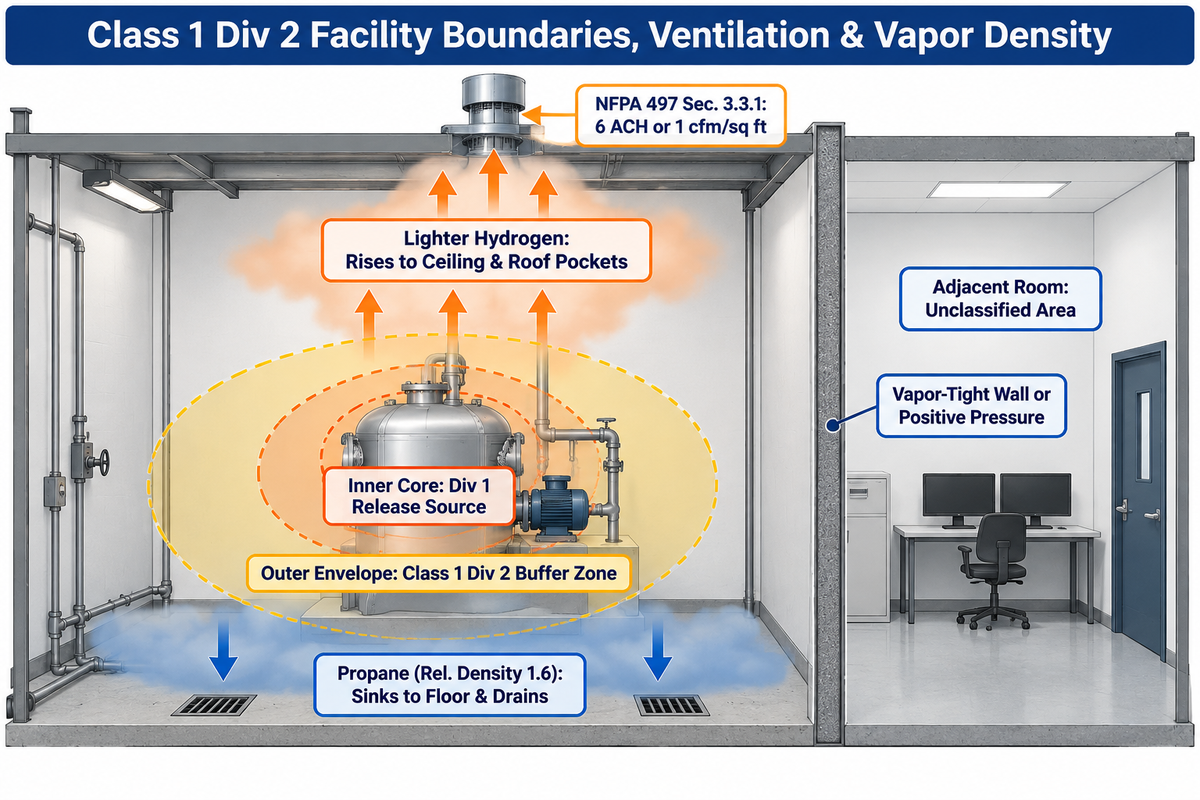
Class 1 Div 2 applies around closed flammable-liquid or gas equipment and in buffer zones next to Class 1 Div 1 sources. These zones can be found in refineries, chemical pump pads, fuel racks, paint rooms, biogas digesters, ethanol distilleries, aircraft hangars, battery rooms, etc. Industrial electrical systems in these areas rely on sealed piping and mechanical airflow to ensure safety.
A misconception is Class 1 Division 2 always extends a “15-foot radius” from every Division 1 source. According to NFPA 497 and API RP 500, four factors affect boundary envelopes: release rate, indoor confinement, ventilation rate, and vapor density.
- Adequate ventilation under NFPA 497 Section 3.3.1 delivers 6 air changes per hour (ACH) or 1 cfm per square foot (0.3 m³/min per m²).
- Ventilation failure still triggers Division 2 under 29 CFR 1910.399 because fan loss lets vapors build up without ventilation. Keeping an adjacent room unclassified requires vapor-tight separation or positive-pressure ventilation with failure safeguards.
- Vapor density affects where hazards accumulate. NFPA 497 lists propane at a vapor relative density of 1.6 (air = 1) and 2-hexanone at 3.5 . Heavy hydrocarbons will sink in drains, but hydrogen, being a gas, will rise to upper ceiling and roof areas.
| Facility / Zone | Typical Flammable Substance | Likely NEC Group | Vapor Dispersion Pattern |
|---|---|---|---|
| Refinery pump pads & valve manifolds | Gasoline, propane, light hydrocarbons | Group D | Heavier than air; pools near grade, sumps, and low trenches |
| Paint spray booths (outside spray interior) | Solvent vapors (xylene, toluene, acetone) | Group D | NEC Article 516 defines exact Div 1 interior vs. Div 2 perimeter envelopes |
| Wastewater digester & biogas rooms | Methane / biogas | Group D | Lighter than air; collects along ceiling bays and overhead luminaires |
| Hydrogen compressor & battery rooms | Hydrogen gas | Group B | Rapidly buoyant; requires high-elevation Group B ceiling fixtures |
| Distilleries & ethanol storage buildings | Ethanol vapor | Group D | Heavier than air; high ventilation failure sensitivity around stills |
As the Steel Tube Institute notes, AHJs usually don’t draw classification maps, and instead approve installed equipment. Chemical, process safety, electrical, and insurance engineers must stamp that drawing first.
What Lighting Is Allowed in Class 1 Div 2? NEC 501.130(B) and UL 844 Rules
In Class 1 Div 2, lighting equipment used in hazardous locations under NEC Section 501.130(B) includes NRTL-listed Division 2 (or Division 1) luminaires, commonly evaluated to UL 844 or CSA C22.2 No. 137. Fixed luminaires without hazardous-location listing may also qualify when they meet NEC 501.130(B)’s degrees-Celsius autoignition ceiling and physical guard conditions. Ordinary fixtures listed only to UL 1598 cover non-hazardous branch circuits up to 600 V nominal.
NEC 501.130(B) establishes four core installation controls for Division 2 lighting, alongside key thermal advantages in modern LEDs:
- Portable handlamps and work lights under NEC 501.130(B)(1) must be listed as a complete assembly for Class I, Division 1 or Division 2; see our guide on selecting hazardous-location inspection flashlights.
- Fixed luminaires under NEC 501.130(B)(2) need guards or safe mounting height against physical damage, and surface heat must satisfy either the listed T-code cap or the unapproved fixed-luminaire degrees-Celsius autoignition ceiling detailed above.
- Rigid conduit pendant stems longer than 12 inches (300 mm) under NEC 501.130(B)(3) require permanent lateral bracing within 12 inches of the lower end, or a Class I, Division 2 flexible fitting within 12 inches of the top support.
- In accordance with NEC 501.130(B)(4)-(5), switches, relays, and arcing starters must be contained in explosionproof enclosures unless hermetically sealed or nonincendive.
- Modern LED thermal efficiency improves safety margins: according to LEDVANCE industrial lighting data, C1D2 LEDs reach 130–200 lm/W versus 60–90 lm/W for metal halide, with L70 lifetimes of 50,000–100,000 hours. Third-party patents like US11828448 use integrated heat-dissipating LED modules to manage housing temperatures across ratings such as T4–T6; see our breakdown of explosion-proof LED luminaire thermal and optical engineering.
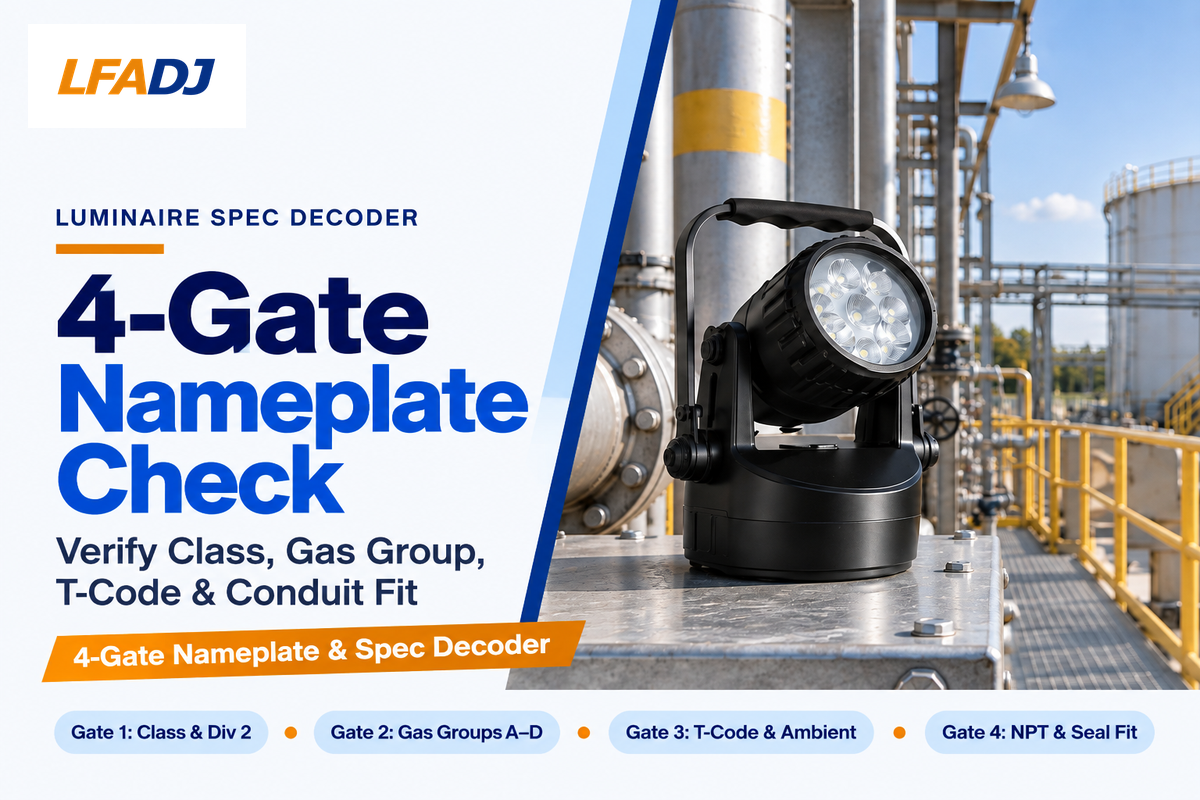
4-Gate Nameplate Framework: 4-Gate Class 1 Div 2 Luminaire Nameplate & Spec Decoder
Run every NRTL-listed candidate luminaire through these four gates before issuing a purchase order (unapproved fixed Div 2 luminaires follow NEC 501.130(B)’s separate thermal path):
- Gate 1, NRTL Mark + Standard Scope: For a listed Class I, Division 2 luminaire, confirm the certification mark, product listing, and hazardous-location marking cover the required gas group and installation conditions (UL 844 is one applicable standard). Reject fixtures showing only UL 1598, UL 8750, CE, or IP66.
- Gate 2 – Class, Division & Exact Gas Group: Check that the label states Class I, Division 2 (or Division 1). Confirm it shows all gas groups on your stamped drawing (Groups A, B, C or D).
- Gate 3 – T-Code at True Site Ambient: The T-code you’ve marked must remain at or below the site’s lowest gas AIT at your room’s maximum ambient temperature.
- Gate 4, Entry Thread, Seal & Environment Fit: Check NPT entry size (typically 3/4-inch NPT), factory-sealed status, and bracing on stems over 12 inches. Add wet (UL 1598), marine (UL 1598A), or paint-spray listings where needed.
| Fixture Type | Best Application | Common Mounting | Limitations / Non-Applicability |
|---|---|---|---|
| C1D2 High-Bay / Round LED | Process halls, refineries, warehouses (>20 ft / 6 m height) | 3/4-inch NPT pendant, yoke, trunnion, stanchion | High glare below 12 ft; verify ambient derating above 40 °C near ceilings |
| C1D2 Linear / Vapor-Tight LED | Catwalks, pipe racks, low-clearance bays, inspection aisles | Ceiling bracket, wall, cable, or pendant | Suitability in spray areas depends on stamped NEC Article 516 zone classification and paint-spray installation requirements, not standard C1D2 listing alone |
| C1D2 Paint-Spray Booth Linear LED | Finishing booths, solvent coating lines, spray prep rooms | Recessed behind listed glass or surface wall/ceiling mount | Must carry specific paint-spray area approval and follow NEC Article 516 zone rules |
| C1D2 Flood & Area Lights | Tank farms, loading racks, outdoor pump yards | Yoke, slip-fitter, pole stanchion | Salt-spray offshore or marine decks may require supplemental UL 1598A marine listing |
| C1D2 Low-Bay / Canopy LED | Fueling canopies, loading docks, compressor shelters | Surface ceiling box, pendant, recessed canopy frame | Confirm wet-location gasket integrity and ambient ceiling heat under metal roofs |
| C1D2 Bulkhead / Jelly Jar LED | Stairwells, valve pits, pump rooms, tight doorways | Wall 90-degree bracket, ceiling junction box, stanchion | Lower lumen output; requires wire guard where exposed to tool or cart impact |
| C1D2 Stanchion & Walkway LED | Refinery pipe bridges, perimeter walkways, elevated platforms | 25-degree or straight stanchion pole mount | Verify wind-load vibration rating and corrosion-resistant stainless hardware |
| C1D2 Emergency & Exit Lights | Egress routes, stairwells, control-room doors | Wall, ceiling, end-mount | Must carry both UL 844 and UL 924; battery pack limits max ambient temperature |
| C1D2 Portable & Temporary Work Lights | Turnarounds, tank cleaning, maintenance inspection | Tripod, hook, magnetic/cart, handheld | Must be listed as a complete assembly under NEC 501.130(B)(1); cords and plugs must match classification |
When specifying compliant hazardous area equipment with emergency backup, internal NiCad or LiFePO4 battery heat limits lower the maximum ambient temperature rating the luminaire can sustain. See our guide on hazardous-area emergency lighting lifecycle readiness to learn how planning maintenance early prevents failures during annual 90-minute discharge tests.
Can You Put Standard LED Replacement Bulbs in a Class 1 Div 2 Fixture?
No. Installing an unlisted commercial LED corn bulb inside a legacy HID fixture voids its UL 844 certification. Swapping a metal halide or high-pressure sodium lamp alters internal heat flow, driver heat, and ballast wiring. Those changes invalidate the original laboratory listing.
Legal retrofits require an NRTL-listed hazardous-location retrofit kit (such as UL 844 paired with UL 1598C) or an OEM-approved listed conversion assembly evaluated for that exact host luminaire family. As SpecGradeLED’s hazardous-location retrofit checklist and Current Lighting’s UL 844 guidance stress, verify the exact UL IFUL listing and relabeling steps before swapping any lamp.
Class 1 Div 2 Wiring Methods, Conduit Seal-Offs, and Enclosures
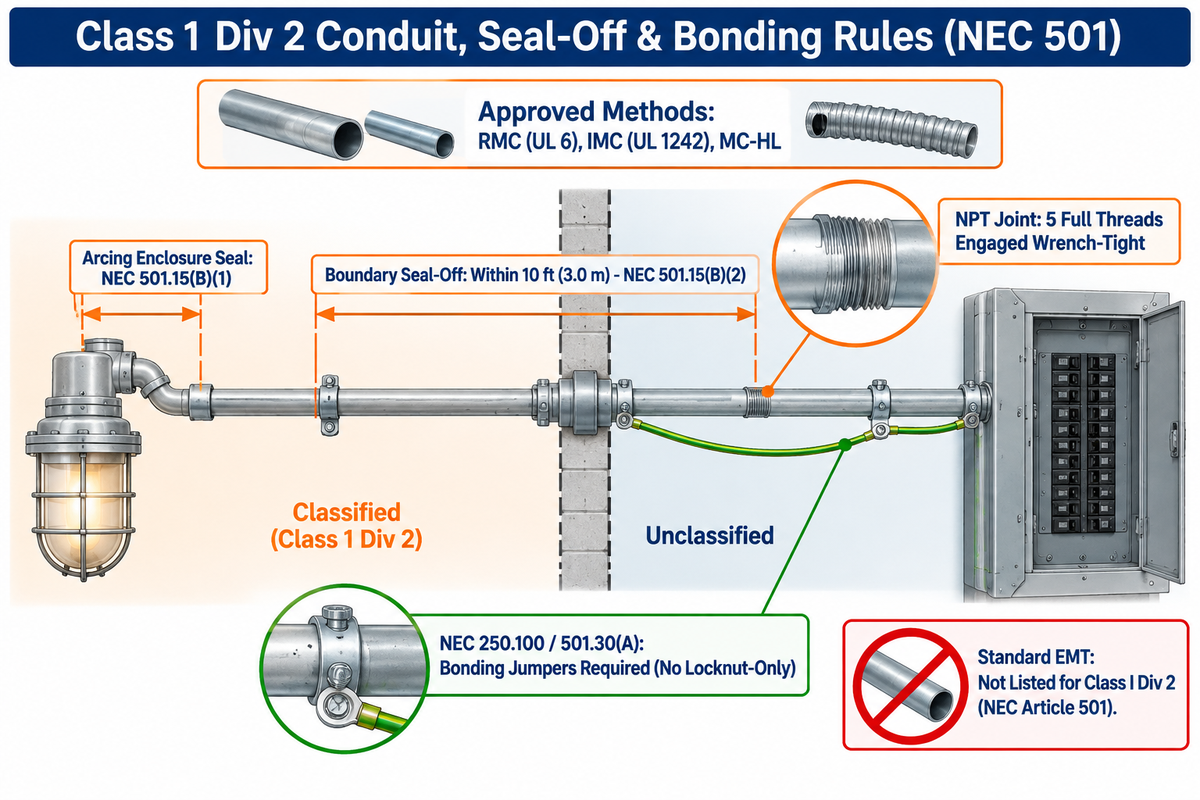
Under NEC Section 501.10(B) and NEC Section 501.15(B), Class 1 Div 2 lighting circuits commonly use rigid metal conduit (RMC), steel intermediate metal conduit (IMC), or approved cable methods such as MC-HL. Boundary seals must be installed within 10 ft (3.0 m) of a conduit crossing into an unclassified space, unless an exception to NEC 501.15(B)(2) applies. The Steel Tube Institute’s NEC Article 501–503 summary distinguishes Class I, Division 1 from Division 2: NEC 501.10(B) permits EMT in Class I, Division 2 when installed with suitable fittings.
Guidance provided by the Steel Tube Institute describes three field rules that are often missed:
- Class I, Division 2 permits threaded RMC, threaded steel IMC, or listed threadless hazardous-location fittings. Approved cable systems include MC-HL and PLTC/ITC per NEC 501.10(B). Threaded RMC couplings carry the UL “EC” stamp under UL 6 (or UL 1242 for IMC).
- Explosionproof NPT tapered conduit joints must engage 5 full threads wrench-tight. That threaded flamepath cools hot gases and contains ignition inside the conduit.
- Locknut-bushing and double-locknut connections don’t satisfy NEC 250.100 and 501.30(A) hazardous-location bonding requirements at terminations, where bonding jumpers or listed fittings may be used.
| Seal Scenario | NEC Clause | Required Distance & Rule | Field Lighting Impact |
|---|---|---|---|
| Enclosures required to be explosionproof (e.g., arcing light switches, starters) | NEC 501.15(B)(1) | Within 18 in. (450 mm) of the explosionproof enclosure | Applies to arcing control switches in Div 2; only threaded couplings or explosionproof fittings allowed between seal and enclosure |
| Factory-sealed C1D2 LED luminaires (non-arcing, nonincendive) | NEC 501.15(B)(1) | No 18-in. enclosure seal needed at the luminaire itself | Major labor saving compared to Div 1; still verify manufacturer installation instructions |
| Conduit leaving Class I Div 2 to unclassified area | NEC 501.15(B)(2) | Within 10 ft (3.0 m) on either side of the classified boundary (unless an NEC 501.15(B)(2) exception applies) | Prevents flammable gases from migrating through non-exempt conduit runs into unclassified electrical panels |
Threads on Mike Holt’s Electrical Forum highlight two opposite field errors on Division 2 lighting. Some crews pour needless 18-inch seals at factory-sealed UL 844 LED fixtures. Others skip required boundary seals where non-exempt homeruns exit into an unclassified MCC room.
Is a NEMA 4X or IP66 Enclosure Enough for a Class 1 Div 2 Area?
No. A NEMA 4X or IP66 rating alone never qualifies a luminaire or junction box for a Class 1 Div 2 location. NEMA 4X (NEMA 250) and IP66 (IEC 60529) assess levels of water-jet, dust and corrosion resistance. They do not assess ignition protection against explosive gas mixtures.
As NEMA Enclosures’ technical guidance explains, a NEMA 4X box works in Division 2 only if all internal electrical components are nonincendive, hermetically sealed, or Class I, Division 2 approved. Treat IP66 and NEMA 4X as weather seals added on top of certified ignition protection in hazardous locations. They never replace applicable hazardous-location certification.
Class 1 Div 2 vs. Div 1 Lighting Costs, Lead Times, and Total Budget
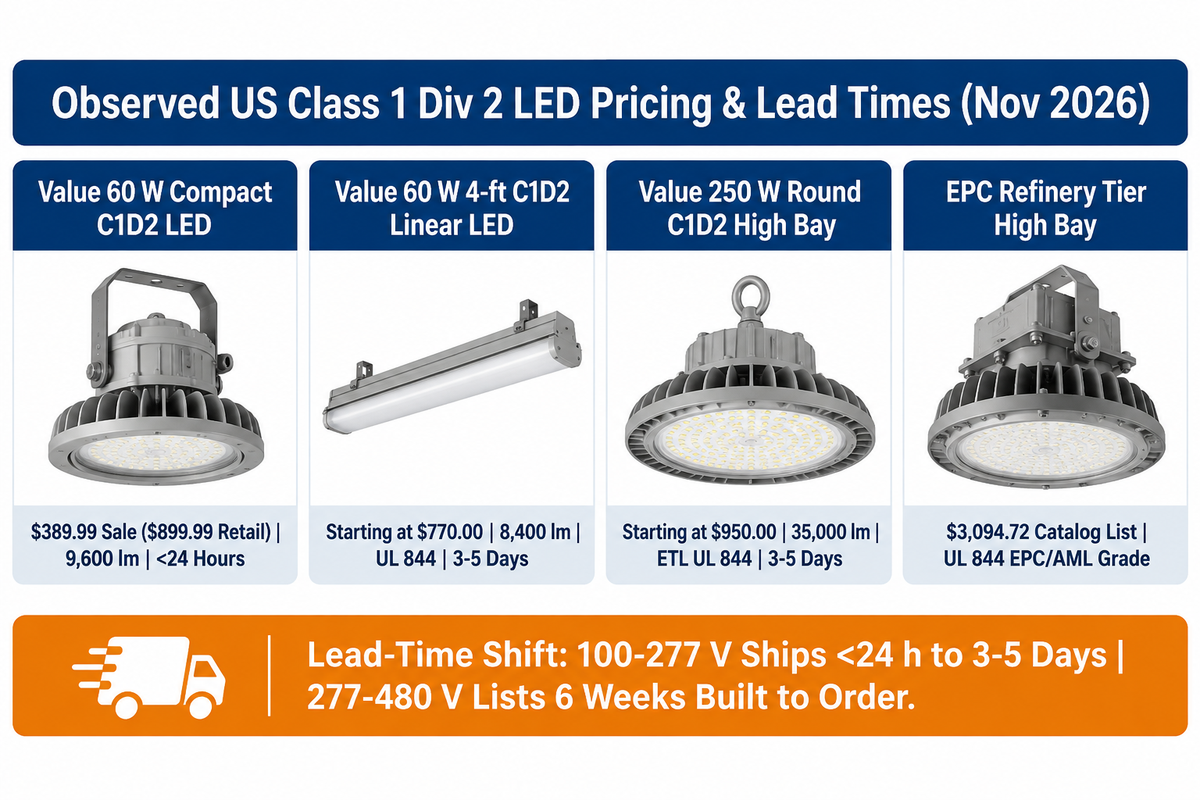
Published US distributor listings in November 2026 (including LED Lighting Supply and LED Light Expert) show wide price bands for Class 1 Div 2 LED luminaires (including UL 844 listed and distributor-rated fixtures): $389.99 to $950.00 at value distributors and $3,094.72 for EPC refinery-grade fixtures. Across the surveyed listings below, stocked 100–277 V units ship in under 24 hours to 3–5 days, while 277–480 V models list 6 weeks built to order.
Observed US distributor listings below cover Class 1 Div 2 luminaires only; paired same-spec Class 1 Div 1 quotes aren’t publicly listed at matching lumens and brand. When comparing equal lumen output, voltage, optics, mounting, and brand, Division 1 costs climb due to heavy flameproof castings and added field conduit seals versus lighter, factory-sealed Division 2 nonincendive housings.
| Fixture Category & Reference Listing | Key Verified Specs | Published US List Price | Published Stock / Lead Time |
|---|---|---|---|
| Value 60 W Compact C1D2 LED (LED Light Expert Caladan Series) | 9,600 lm, 5000K, Distributor-listed Class I Div 2 (verify exact NRTL file on datasheet), 5-Year warranty | $389.99 sale ($899.99 retail) | In stock; ships in <24 hours |
| Value 60 W 4-ft C1D2 Linear LED (LED Lighting Supply SKU MLLG-E-LED-EXPLH-60) | 8,400 lm, UL 844 C1D2 Groups A–D, IP66, IK08, UL 1598A, 15 lb | Starting at $770.00 | 100–277 V: 3–5 days (50 in stock) 277–480 V: 6 weeks built to order |
| Value 250 W Round C1D2 High Bay (LED Lighting Supply SKU MLLG-E-LED-EXPLB-250) | 35,000 lm, ETL UL 844 C1D2 Groups A–D, IP66, 10 kV surge, -40 °F to 140 °F | Starting at $950.00 | 100–277 V: 3–5 days (39 in stock) 277–480 V: 6 weeks built to order |
| EPC Refinery Tier High Bay (Elliott Electric Supply — Eaton Crouse-Hinds Champ Div 2) | Heavy industrial EPC/AML-grade UL 844 Class I Div 2 luminaire | $3,094.72 catalog list | Quote-dependent by exact catalog part number and quantity |
Total project costs far surpass fixture costs. Three budget multipliers usually surprising plant managers are:
- Conduit and seal-off labor can make up a significant share of field costs, even when factory-sealed C1D2 LEDs do not require luminaire-level seals.
- Moving from standard 100–277 V drivers to high-voltage 277–480 V drivers or adding UL 924 battery backup raises unit cost. In the surveyed distributor listings, 277–480 V units shift from stock dispatch to 6 weeks built to order.
- EPC Approved Manufacturer Lists (AMLs) at refineries and chemical complexes tend to require legacy EPC brands, driving project costs into the upper tier of wholesale catalog prices.
Major UL 844 Class 1 Div 2 Lighting Manufacturers and Certification Checks
North American plants source UL 844 Class 1 Div 2 LED luminaires from three supplier tiers. Full-ecosystem EPC giants include Eaton Crouse-Hinds, Emerson Appleton, and Hubbell Killark. Industrial LED specialists include Dialight, Acuity Holophane, Kenall, Nemalux, and RAB Lighting, while Larson Electronics focuses on portable and turnaround gear.
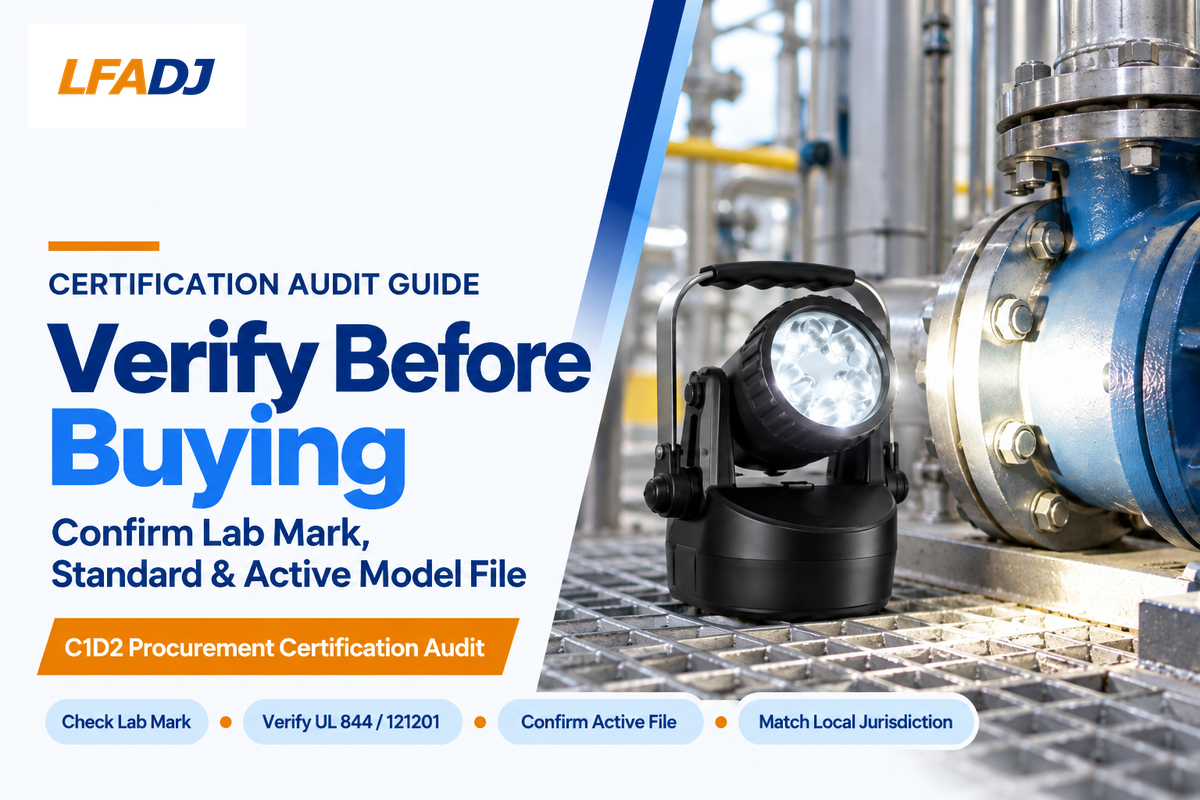
“UL 844” or “AEx” text printed in a PDF brochure never proves OSHA compliance on its own. While OSHA 29 CFR 1910.307(c) allows intrinsically safe, approved, or demonstrated-safe pathways, commercial hazardous-location luminaires normally rely on approval under the OSHA NRTL Program. For NRTL-listed electrical equipment in hazardous locations, check three items. Confirm a registered NRTL mark (UL, CSA, Intertek ETL, or FM Approvals), the applicable product standard (such as UL 844 or UL 121201), and active certification records covering the catalog model or series.
| Supplier Tier | Established Brands | Representative C1D2 Families | Best Fit |
|---|---|---|---|
| EPC Full-Ecosystem Manufacturers | Eaton Crouse-Hinds, Emerson Appleton, Hubbell Killark | Eaton Crouse-Hinds Champ Div 2 high-bay luminaire | Refineries, petrochemical plants, strict EPC AML sites needing matching fittings & seals |
| Industrial LED Specialists | Dialight, Acuity Holophane, Kenall, Nemalux, RAB Lighting | Class 1 Div 2 LED fixtures | High-efficiency LED retrofits, food/pharma washdown, paint booths, wastewater plants |
| Portable & Specialty Suppliers | Larson Electronics | Portable tripod/cart C1D2 work lights, string lights, explosionproof temporary lighting | Plant turnarounds, tank cleaning, temporary maintenance lighting |
Critical compliance boundary for global and overseas sourcing: Always verify regional certificate jurisdiction before issuing a purchase order. Overseas factories often hold Chinese domestic explosion-proof certificates (CNEX / CCC Ex) or regional IECEx/ATEX marks rather than US NRTL UL 844 listings. Zhejiang Longfa Lighting Co., Ltd. (LFADJ) supplies fixed, portable, and emergency hazardous location explosion-proof lighting systems (MOQ 1 unit, 50% deposit with balance before shipment). Those luminaires carry Chinese domestic explosion-proof certifications rather than US UL 844 or Class I, Division 2 NRTL listings. For US NEC-governed facilities relying on approved luminaires under OSHA 29 CFR 1910.307(c), buyers procure fixtures with active NRTL hazardous-location certification (unless qualifying under another statutory 1910.307(c) pathway). For broader regional supplier comparisons, review our directory of global explosion-proof lighting manufacturers by site requirement.
C1D2 Procurement Certification & Boundary Audit Checklist
| RFQ Input Item | Exact Specification to Provide | Verification Artifact Required |
|---|---|---|
| 1. Governing Code & Framework | NEC edition adopted by AHJ; Class/Division vs. Zone drawing | Stamped area classification drawing & jurisdiction note |
| 2. Gas Group & Lowest AIT | Exact Class I groups (A, B, C, or D) + lowest chemical AIT (°C/°F) | Luminaire nameplate photo showing matching Group & T-code |
| 3. Ambient & Environmental Exposure | Min/max ambient °C (flag if >40 °C), washdown, marine salt, paint spray | Dual ambient/T-code marking; IP66/UL 1598A for wet or marine sites; separate NEC Article 516 paint-spray approval where applicable |
| 4. NRTL Listing & File Number | UL 844 / CSA C22.2 No. 137 / UL 924 (if emergency) | Active UL Product iQ, CSA, ETL, or FM certificate covering catalog model or series |
| 5. Electrical, Mounting & Delivery | Voltage (100–277 V vs. 277–480 V), 3/4-inch NPT entry, stem length, ship date | Written ship date for exact part number, voltage, and quantity |
2026 NEC (NFPA 70) Updates and Integration Checklist for Class 1 Div 2 Projects
Edition lag is the most significant compliance risk for 2026 Class 1 Division 2 projects. Designing to the most recently published standard and local AHJ enforcing an older edition may occur. NFPA’s 2026 NEC overview states that NFPA 70 (2026) was released late 2025 with 3,933 Public Inputs (4,006 with the 2023 edition). It updated Section 90.3 so Chapters 5–8 can modify rules in Chapters 1–8 and relocated articles before a major 2029 restructuring. TRADECAIRN’s industry commentary mentions the extensive relocations of articles and cites the Independent Electrical Contractors for revised Section 110.16 arc-flash marking coordinated with NFPA 70E.
Alongside NFPA 70, NFPA 497 (2027 Edition) was issued April 16, 2026 and took effect May 6, 2026. Yet publication never equals immediate local law. For instance, Washington State Department of Labor & Industries replaces the 2023 NEC with the 2026 NEC on December 31, 2026. Cities like Chicago and New York keep local amendments. Meanwhile, LED upgrades keep growing: IMARC Group estimates global hazardous-location LED revenue rose from $531.56 million in 2025 to $579.06 million in 2026.
“Locations are classified as hazardous due to the materials handled, processed, or stored in those locations. Hazardous (classified) locations, if properly treated, are not necessarily any more dangerous to work in than other areas or locations.”
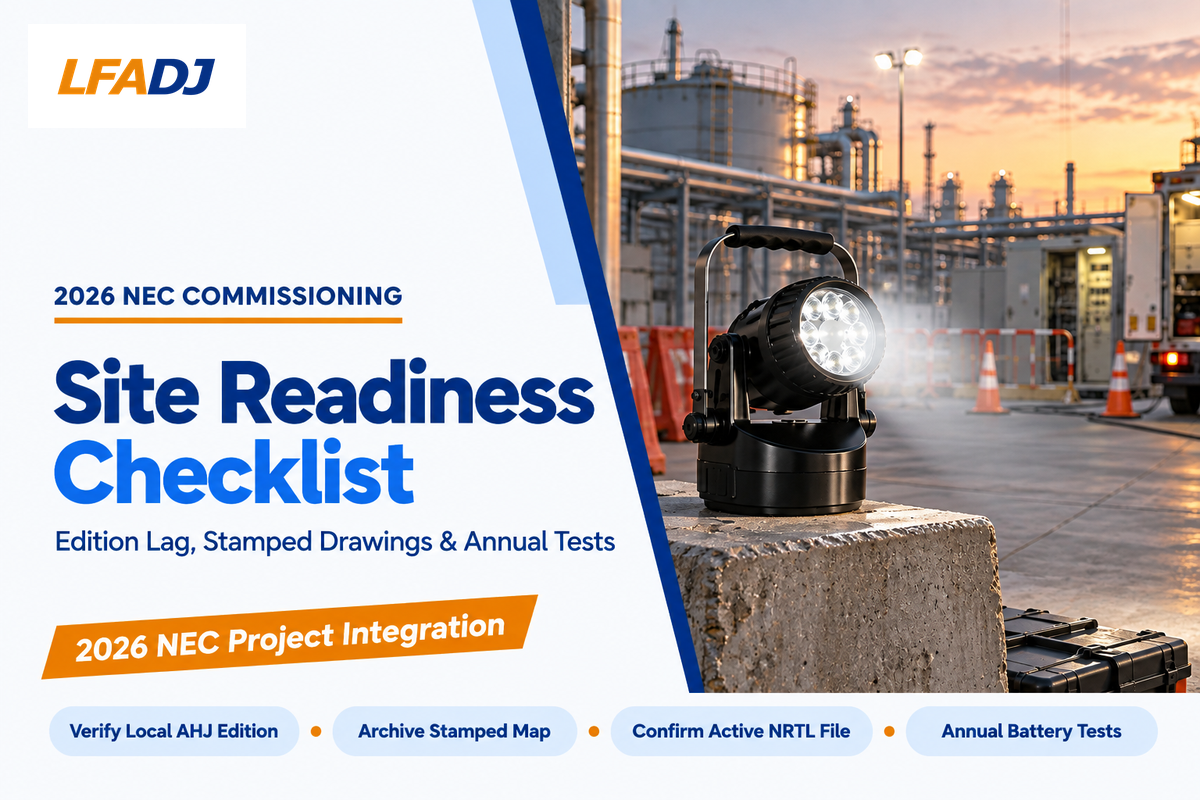
Documenting the enforced NEC edition, stamped drawings, and live NRTL files protects plant safety and compliance. One handover packet should be created before any Class 1 Div 2 lighting system is energized.
- Verify which NEC edition (2017, 2020, 2023, or 2026) your local AHJ enforces on the permit date and log local amendments.
- Archive stamped area classification drawings recording Class, Division, gas group, and ventilation failure assumptions.
- File active NRTL certificates and T-code logs matching every installed SKU, elevated-ambient marking, and emergency UL 924 coverage.
- Sign off raceway inspections to cover RMC/IMC fittings, 5-thread NPT engagement, bonding jumpers, pendant bracing, and boundary seals.
- Align lens cleaning, gasket checks, and annual battery tests, with emergency lighting industrial power testing and maintenance schedules.
Frequently Asked Questions About Class 1 Div 2
What is a Class 1 Div 2 rating in plain terms?
Class 1 Div 2 areas are areas where flammable gases are sealed during routine operations and may escape during leaks or fan loss. Equipment must suit the classified location, gas group, and temperature limit through an applicable protection method.
What gases are in Class 1 Div 2 Group D?
Class 1 Div 2 Group D covers the most common industrial hydrocarbon and solvent vapors, including propane, methane, natural gas, gasoline, acetone, ethanol, methanol, butane, and hexene. Group D luminaires are employed in petroleum refineries, fuel storage depots, distilleries and solvent paint rooms in North America. Group D-only luminaires can’t be installed where Group C ethylene, Group B hydrogen, or Group A acetylene is present. Always match every gas on the facility’s stamped classification sheet.
What is the difference between Zone 0, Zone 1, and Zone 2?
Zone 0 has explosive gas continuously or for long periods. Zone 1 has explosive gas likely during normal operation, while Zone 2 has explosive gas unlikely during normal work and present only briefly under abnormal leaks. Under NEC Article 505 and IEC 60079, Division 1 covers hazard likelihood broadly comparable to Zones 0 and 1, while Division 2 aligns conceptually with Zone 2. However, the Division and Zone systems use separate nameplate markings, gas-group structures, and approval rules that cannot be swapped informally.
Can you use EMT conduit in a Class 1 Div 2 area?
No. Under NEC Article 501, standard EMT is generally not an approved Class I, Division 1 or Division 2 raceway; use RMC, steel IMC, or listed cable systems.
How far does a Class 1 Div 2 boundary extend from a Class 1 Div 1 source?
Hazardous boundary dimensions depend on the dispersal scenario, and therefore can’t be taken from a single, universal radius. The boundaries are from the stamped NFPA 497 or API RP 500 drawings. Actual hazard envelopes shift with release pressure, release volume, and indoor confinement versus open outdoor airflow. Vapor relative density also matters: heavier hydrocarbons sink toward low sumps. Lighter hydrogen rises toward the upper ceiling. The difference is even more pronounced when releases occur in the presence of mechanical ventilation, which reshapes the Transition Zone of Division 2.
What is a Class 1 Div 1 area compared to Division 2?
A Class 1 Div 1 area has ignitable gas or vapor mixtures continuously, intermittently, or periodically during normal operations or maintenance. Division 2 covers only abnormal release areas.
Can an ATEX Zone 2 or Chinese Ex-certified light be installed in a US Class 1 Div 2 plant?
No, not on its own. Under OSHA 29 CFR 1910.307, standalone European ATEX/CE markings or Chinese domestic Ex certificates (CNEX / CCC Ex) don’t establish US compliance for commercial hazardous-location luminaires. US installations using approved fixtures require evaluation to recognized North American standards, such as UL 844 or the UL 60079-0 series, by an OSHA-recognized NRTL laboratory. The only exceptions are catalog SKUs carrying dual North American certification or installations qualifying under another statutory 1910.307(c) pathway.
For industrial sites operating under Chinese domestic or non-NEC project-specific explosion-proof lighting schemes, review the product designs and quotation data on our hazardous location explosion-proof lighting systems page.
Editorial Review & Transparency: Reviewed by Zhejiang Longfa Lighting Co., Ltd. technical team. Cited regulatory data pertains to NFPA, OSHA and Steel Tube Institute documents current as of November 2026.
References & Sources
- 29 CFR 1910.307, Hazardous (Classified) Locations Occupational Safety and Health Administration (U.S. Department of Labor)
- 29 CFR 1910.399, Definitions Applicable to Subpart S Occupational Safety and Health Administration (U.S. Department of Labor)
- Nationally Recognized Testing Laboratory (NRTL) Program FAQs Occupational Safety and Health Administration (U.S. Department of Labor)
- Understanding NFPA 70, National Electrical Code (NEC) National Fire Protection Association
- What Changed in the 2026 NEC? National Fire Protection Association
- NFPA 497 Standard Development (2027 Edition) National Fire Protection Association
- NFPA 497 First Draft, Section 3.3.1 Adequate Ventilation Definition National Fire Protection Association
- NFPA 497 Chapter 4 Chemical Data & Autoignition Tables National Fire Protection Association
- Understanding Hazardous Locations and the NEC Requirements for Conduit and Tubing Steel Tube Institute
- Definitions for Hazardous Locations in North America CSA Group
- Electrical Laws, Rules, and NEC Edition Adoption Schedule Washington State Department of Labor & Industries
- Process Automation Technologies in Hazardous Areas Control Global
- US11828448, Harsh and Hazardous Location LED Module and Luminaire Assembly United States Patent and Trademark Office (Google Patents)