Get in touch with LFADJ Company

What Is a Light Plant? Light Plant vs Light Tower, Power Options, and Jobsite Sizing Explained

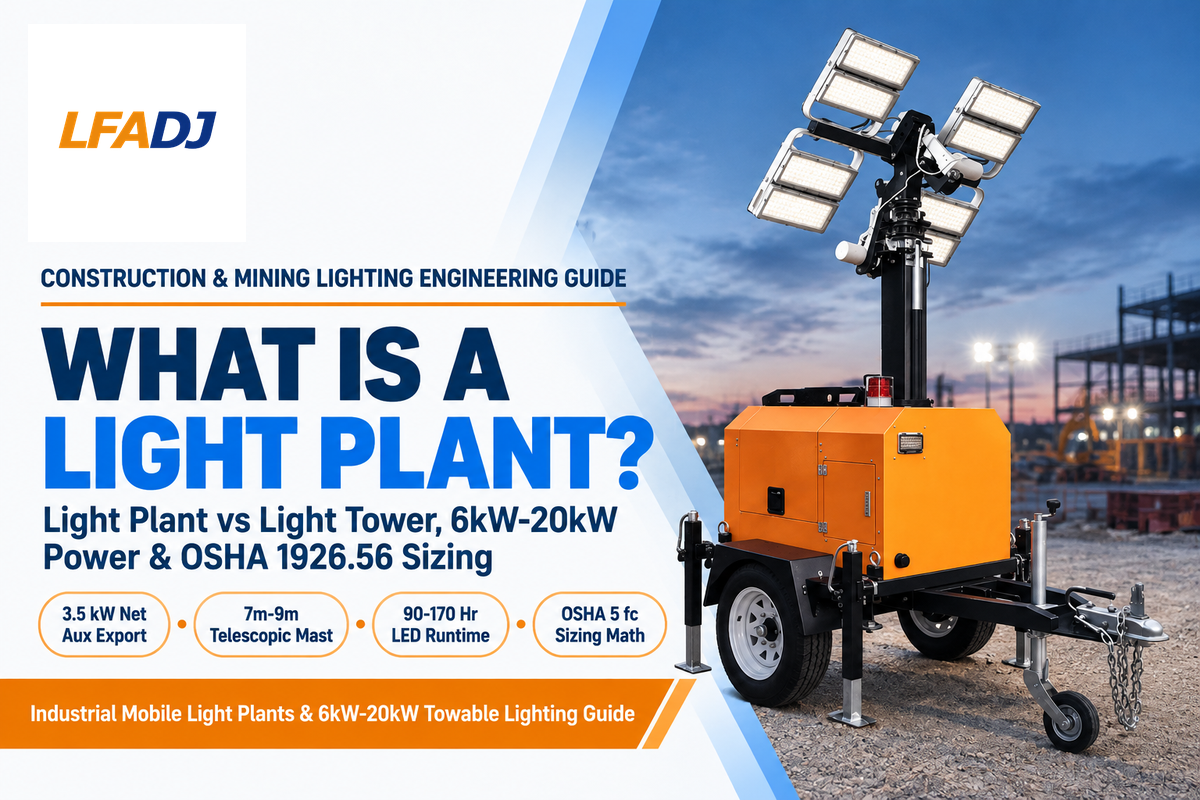
What’s a light plant? A light plant is a self-contained mobile utility station. It combines an onboard power generator or battery bank with a telescoping floodlight mast. Construction and mining crews use light plants to illuminate night shifts. It also exports 120V or 240V auxiliary electricity for jobsite tools. Most field operators refer to any portable power unit as a light plant. However, procurement specs reserve “light plant” for units with dedicated onboard power generation.
Key Engineering Takeaways for Light Plant Buyers (2026 Benchmarks)
- Terminology Boundary: Every diesel or solar-hybrid light plant is a mobile light tower. A plug-in or mast-only tower without an onboard generator isn’t a light plant.
- Net Export Power: A 6 kW diesel unit running four 400W LED fixtures draws 1.6 kW. It leaves 3.5 kW of continuous auxiliary power after a standard continuous derating margin. Legacy 4×1000W metal halide lamps draw 4.4 kW with ballast losses and leave only 0.7 kW.
- Wet-Stacking Floor: Diesel generators run cleanest near 70% to 80% of rated load. Sufficient load keeps exhaust temperatures above 260°C (500°F). Running 1.6 kW of LEDs on an unloaded 6 kW to 8 kW engine causes unburned fuel fouling. Add auxiliary loads or right-size the engine to prevent wet-stacking.
- OSHA 29 CFR 1926.56 Table D-3 requires 5 fc for general construction areas. One 156,000-200,000 lumen light source meets this requirement and limits general construction areas to 9,500 -12,160 sq ft (0.22-0.28 acres). OSHA 1926.56 Coverage Reality: Brochure claims of “5 to 7 acres” measure down to 0.5 foot-candles at the perimeter.
- Rent vs. Buy Crossover: Rental rates and purchase prices vary by power train specification, mast height, and regional freight distances. Generally, short-term jobs use rental fleets, while longer civil and mining jobs support purchase of a unit.
What Is a Light Plant and How Does It Differ from a Light Tower?
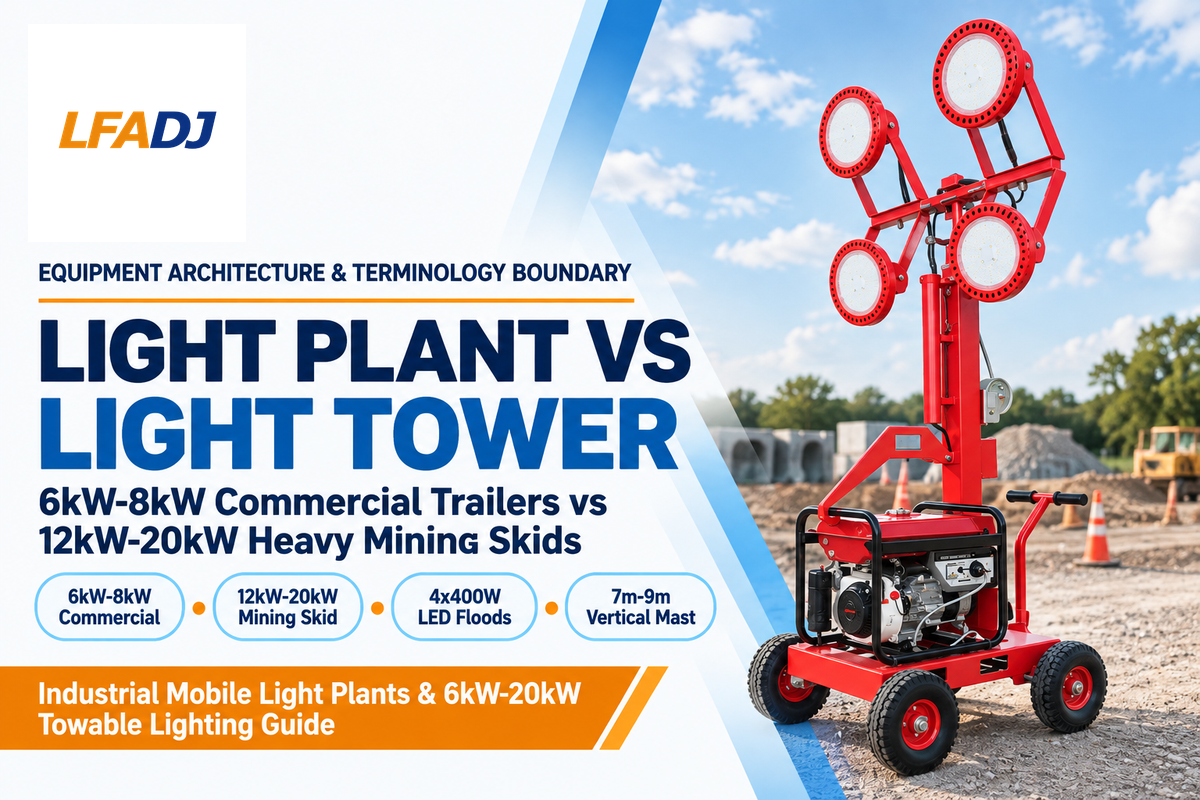
A light plant is a towable or skid-mounted machine, which includes an onboard power plant. It’s equipped with an engine-driven generator or solar-battery bank, a fuel tank, outlets, and a lighting mast. It’s a turnkey lighting solution for remote work zones without grid power. On the other hand, a standard light tower can describe any elevated mast fixture. That broader definition includes shore-powered tripod towers and stadium masts without a prime mover. For heavy civil projects, contractors use industrial mobile light towers and towable light plants in both diesel and solar configurations. These machines supply overhead illumination and field power simultaneously.
We looked at benchmarks for rental fleets from United Rentals’ portable light tower specifications. A typical commercial towable model pairs a 6 kW to 8 kW generator with a vertical mast. The mast extends 23 ft to 30 ft (7 m to 9 m) in the air. For heavy mining and oil light plants, the generator is scaled to 12 kW to 20 kW. The additional headroom powers submersible pumps, welding rectifiers and engine block heaters. Meanwhile, the overhead floodlights continue to operate at full output.
| Parameter | Commercial Diesel Light Plant | Standard Portable Light Tower | Heavy Mining Skid Light Plant |
|---|---|---|---|
| Primary Power Source | 6 kW to 8 kW liquid-cooled diesel genset | Diesel, solar battery powered, or 120V plug-in | 12 kW to 20 kW heavy-duty diesel genset |
| Net Auxiliary Power Export | 3.5 kW to 5.2 kW (with LED lamps on) | 0 kW (solar/plug-in) to 3.5 kW (diesel) | 8.0 kW to 15.0 kW continuous export |
| Typical Lamp Array | 4x350W to 4x400W LED (or 4x1000W metal halide) | 4x100W to 4x350W LED floodlights | 6x350W to 8x400W high-output LED |
| Mast Height | 7 m to 9 m (23 ft to 29.5 ft) | 4.5 m to 8.5 m (15 ft to 28 ft) | 9 m to 12 m (29.5 ft to 39 ft) hydraulic |
| Chassis Architecture | DOT single-axle towable trailer with outriggers | Compact trailer, hand cart, or folding tripod | Reinforced steel drag skid with fork pockets |
| Core Jobsite Role | Road construction, civil grading, and tool power | Municipal maintenance, special events, and paving | Open-pit haul roads, crushers, and arctic drilling |
Why Do Construction and Mining Crews Call a Light Tower a Light Plant?
Construction and mining superintendents call the machine a “light plant” for historical reasons. Early mobile floodlight rigs mounted a steel pipe mast directly onto a towable diesel power plant. Field technicians often compare military surplus MEP-802A generators with commercial Ingersoll-Rand and Doosan units. They point out that a 6 kW light tower is fundamentally an 1,800 RPM diesel generator set. Most commercial units couple a three-cylinder Kubota D905 or D1105 engine to a brushless pancake alternator. Crews can switch off the overhead lamps during daytime shifts. The full 6 kW output then remains available at the side receptacles. That dual identity as a lighting rig and a mobile power plant cemented the name on construction sites.
Disambiguating Industrial Mobile Light Plants from Indoor Plant Grow Lights
Search engines often mix heavy construction equipment with indoor horticultural grow lamps for the query “light plant.” An industrial light plant is an 800 kg to 1,380 kg towable machine. It’s built for outdoor work zones, disaster relief, and mining pits. It has nothing to do with residential botanical lighting for houseplants like Alocasia or Lithops. Suppose you’re writing a procurement specification or searching for light towers for sale. Pair the phrase with power ratings like 6kW, 8kW, or 20kW. You can also add chassis terms like towable or skid-mounted to filter out consumer grow-light results.
Portable Light Plant Anatomy: Mast Mechanisms, Towable Chassis, and Containment
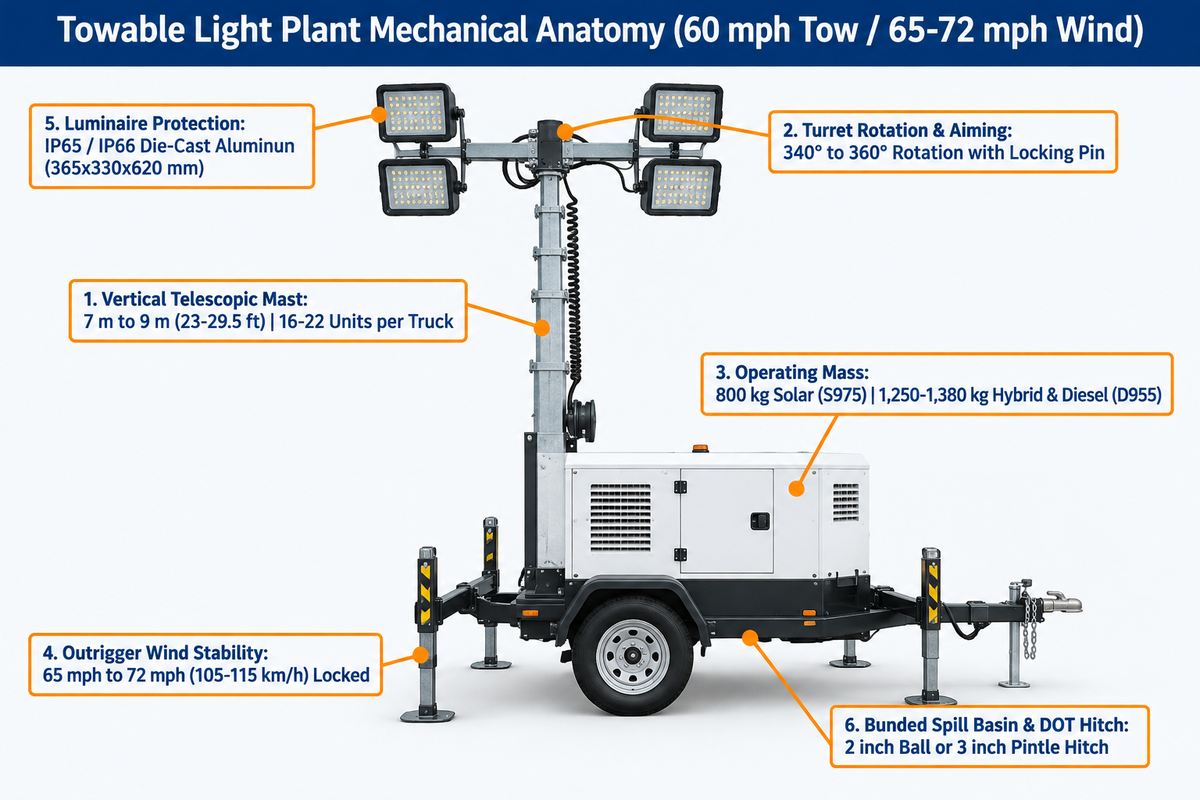
There are four main mechanical subsystems in every light plant. They’re the power enclosure, the telescoping mast, the flood light crossarm, and the towable trailer chassis. Each subsystem must withstand highway towing speeds of up to 60 mph (97 km/h). It also must endure continuous site vibration to assure long-term structural durability. Mechanical safety features like automatic mast brakes and outrigger interlocks, protect crews during setup. Engineers evaluating 9 m hydraulic telescopic lighting towers, study how the four subsystems interact with wind and thermal loads.
Quick Specs Card: Commercial Towable Light Plant Mechanical Benchmarks
- Telescopic Mast Height: 7 m to 9 m (23 ft to 29.5 ft) multi-section vertical or laydown mast (published LFADJ D955 specification).
- Mast Rotation & Aiming: Manual or electric turret rotation of 340° to 360° with locking pin.
- Operating Mass: 800 kg for solar units (LFADJ S975). Hybrid and diesel units weigh 1,250 kg to 1,380 kg (LFADJ Hybrid / D955).
- Wind Stability Rating: Typically 65 mph to 72 mph (105 km/h to 115 km/h) with four outriggers locked on level ground.
- Luminaire Ingress Protection: IP65 or IP66 weatherproof housing with die-cast aluminum heat sinks (365×330×620 mm on S975).
- Environmental Spill Basin: Bunded steel chassis holding the full onboard fluid volume plus a safety reserve margin.
Vertical Telescopic Masts vs Laydown Rotating Masts (7 m to 9 m)
For many decades, rental fleets have relied on horizontal laydown masts. Laydown towers allow for low bridge clearance. Horizontal designs occupy a long trailer footprint and require a lot of clear space behind the unit for raising. In the last ten to fifteen years, the trend has been toward vertical telescopic masts in rental fleets.
This design has been described in the USPTO Patent US8833985B2 for mobile light tower mast assemblies. Vertical, multi-section telescoping masts are housed in a vertical tower. The design routes the electrical cord through a protected internal channel. This shortens the towbar-to-bumper length, and permits manufacturers to load 16 to 22 compact light plants on a single 48- to 53-foot flatbed truck. Inside the mast, a dual-winch cable system or hydraulic cylinder raises the 7 m to 9 m sections in under 60 seconds. Operators should perform a pre-shift setup to inspect the coiled power cable and winch brake pawls. Our telescopic mast deployment and wind stability guide, details the inspection process.
“US8833985B2 discloses a mobile light tower with a multi-section telescoping mast, rotatable luminaire crossarm, and mechanical winch deployment mechanism for portable work-area lighting.”
DOT Trailer Hitches, Outrigger Footprint, and Bunded Fluid Containment Basins
A road ready towable light plant requires a Department of Transportation (DOT) compliant trailer frame. It has LED stop, turn, and tail lamps, safety chains, and a reversible 2 inch ball or 3 inch pintle hitch. On a jobsite, a 9 m mast serves as a tall lever arm in high winds. The Patent GB2491421B for mobile lighting tower stabilization describes outrigger deployment. Extending the telescopic outrigger legs increases the tipping polygon and allows the unit to stabilize against 65 mph wind gusts. Public agencies mandate a sealed fluid containment steel belly pan for sensitive sites in the vicinity of waterways. The belly pan captures fluids before they come in contact with the ground.
6kW to 20kW Auxiliary Power: Using a Light Plant as a Jobsite Generator
A diesel light plant functions as a two-in-one jobsite generator and lighting mast when sized properly. Standard commercial units carry a 6 kW or 8 kW brushless alternator. The panel is wired to 120V 20A GFCI duplex outlets and a 120/240V 30A twist-lock receptacle. Before using the generator to power external tools, the net exportable wattage must be calculated. The diesel engine must also be maintained at its minimum thermal load.
Usable Auxiliary Receptacle Power After Subtracting Floodlight Load
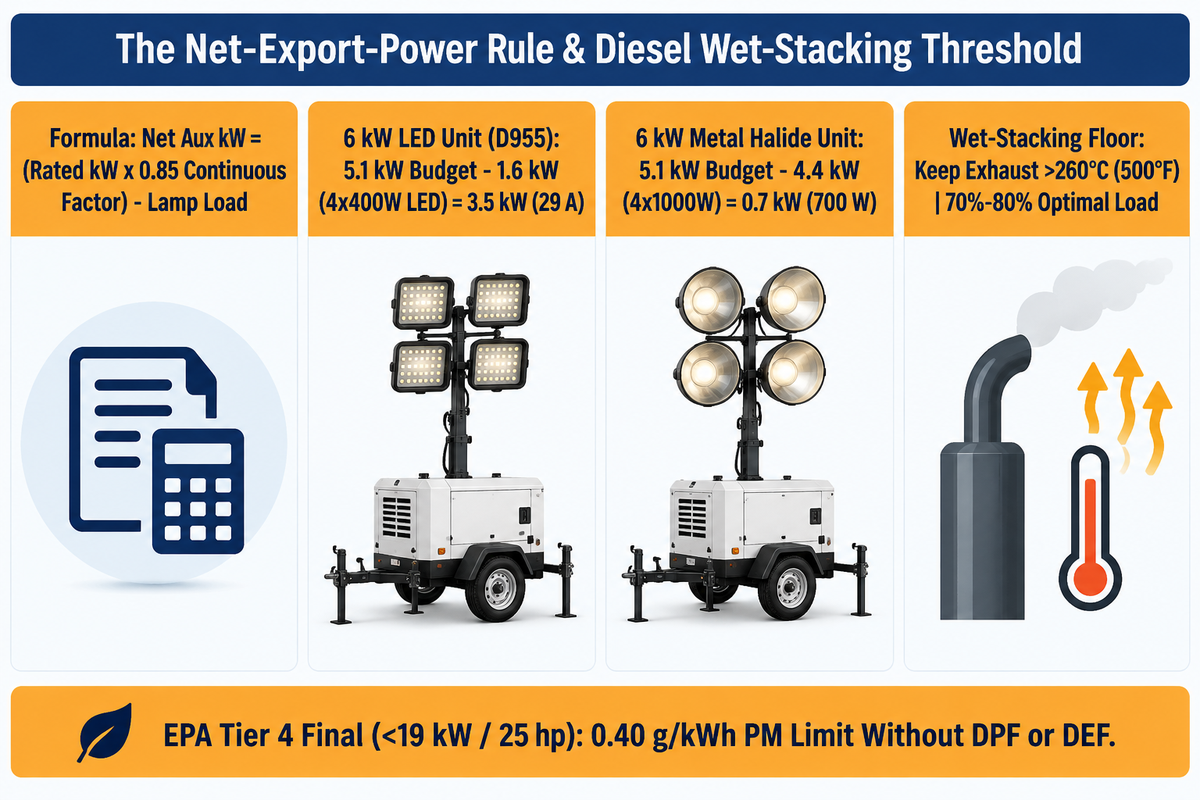
We use The Net-Export-Power Rule to calculate usable auxiliary electricity with all floodlights running. First, set a safe continuous duty budget for the alternator by multiplying the alternator’s prime kW rating by 0.85. This accounts for the electric tool surges during start up. Next, subtract the total wattage of the mast floodlights and their drivers or ballasts:
Net Usable Auxiliary Power (kW) = (Rated Generator kW x 0.85 Continuous Factor) – Total Lamp and Ballast Load (kW)
Consider a 6 kW (120V/60Hz) diesel unit like the LFADJ D955 4x400W LED diesel light plant. Applying the 0.85 continuous factor to the 6.0 kW alternator yields a 5.1 kW continuous power ceiling. The four 400W LED floodlights consume 1.6 kW total. Subtracting 1.6 kW from 5.1 kW leaves 3.5 kW of net usable auxiliary power (about 29 A at 120V AC). That 3.5 kW budget easily runs a 1.5 kW submersible dewatering pump plus tool chargers.
By contrast, an older 6kW light plant fitted with four 1,000W metal halide bulbs draws 4.0 kW at the lamps. It also loses roughly 0.4 kW in magnetic ballast heat (4.4 kW total). Subtracting 4.4 kW from the 5.1 kW continuous budget leaves only 0.7 kW (700 W) for auxiliary outlets. Starting a 15A circular saw or pump on that metal halide unit will trip the main breaker immediately.
Why Do Diesel Light Plants Suffer from Wet Stacking Under LED Loads?
Swapping 4.4 kW of metal halide lamps for 1.2 kW to 1.6 kW of LED fixtures frees up receptacle power. However, it introduces a major mechanical hazard on oversized diesel engines. We call this The Diesel Load Wet-Stacking Threshold. Generator load engineering data from PowerTech Generators’ wet-stacking prevention guide explains the cause. Diesel engines operate best near 70% to 80% of rated capacity. Running under light load prevents the cylinders from reaching normal combustion temperature.
This threshold is confirmed by CK Power’s diesel wet-stacking analysis and Axiom Equipment Group’s light tower load guidelines. Running a 6 kW to 8 kW diesel engine under a 1.2 kW to 1.6 kW LED-only load leaves the alternator lightly loaded. At that light load, combustion chamber temperatures stay below 260°C (500°F). Unburned diesel fuel condenses into dark, oily deposits inside the exhaust system. Those deposits ooze from the stack, glaze cylinder walls, and foul injector tips. In field reports, operators running 6 kW to 10 kW diesel light plants overnight with LEDs add a dummy load. They plug a 1.5 kW electric heater or water pump into the convenience outlet to push total alternator load into the optimal upper operating band.
Engineering Note (Preventing and Curing Low-Load Wet Stacking): <30% Load Wet Stacking): Never hit a severely wet-stacked diesel light plant with an immediate full-capacity shock load. PowerTech Generators warns that sudden full load can ignite exhaust carbon or damage fouled injectors. Instead, burn off mild deposits using a controlled, progressive resistive load bank over 2 to 3 hours. To prevent wet stacking on LED fleets, use one of three methods. First, connect 1.0 kW to 2.0 kW of continuous auxiliary site loads. Second, specify right-sized 2.5 kW to 3.5 kW diesel engines. Third, follow our diesel light tower fuel and engine maintenance guide to schedule periodic load-bank service.
Why do most North American diesel light plants stay below 19 kW (25 hp)? The answer lies in the U.S. eCFR Title 40 Part 1039 nonroad diesel emission standards and the EPA Tier 4 Final Rule for nonroad compression-ignition engines. Engines rated below 19 kW face a 0.40 g/kWh particulate matter (PM) limit. Small Kubota or Yanmar engines meet that limit without Diesel Exhaust Fluid (DEF) or selective catalytic reduction. Stepping above 19 kW triggers the stricter 19 kW to 56 kW tier (0.03 g/kWh PM). That higher tier requires active diesel particulate filter (DPF) regeneration systems that clog rapidly during low-load idling.
Diesel Light Plant vs Solar Light Plant vs Hybrid Light Tower: Powertrain Comparison
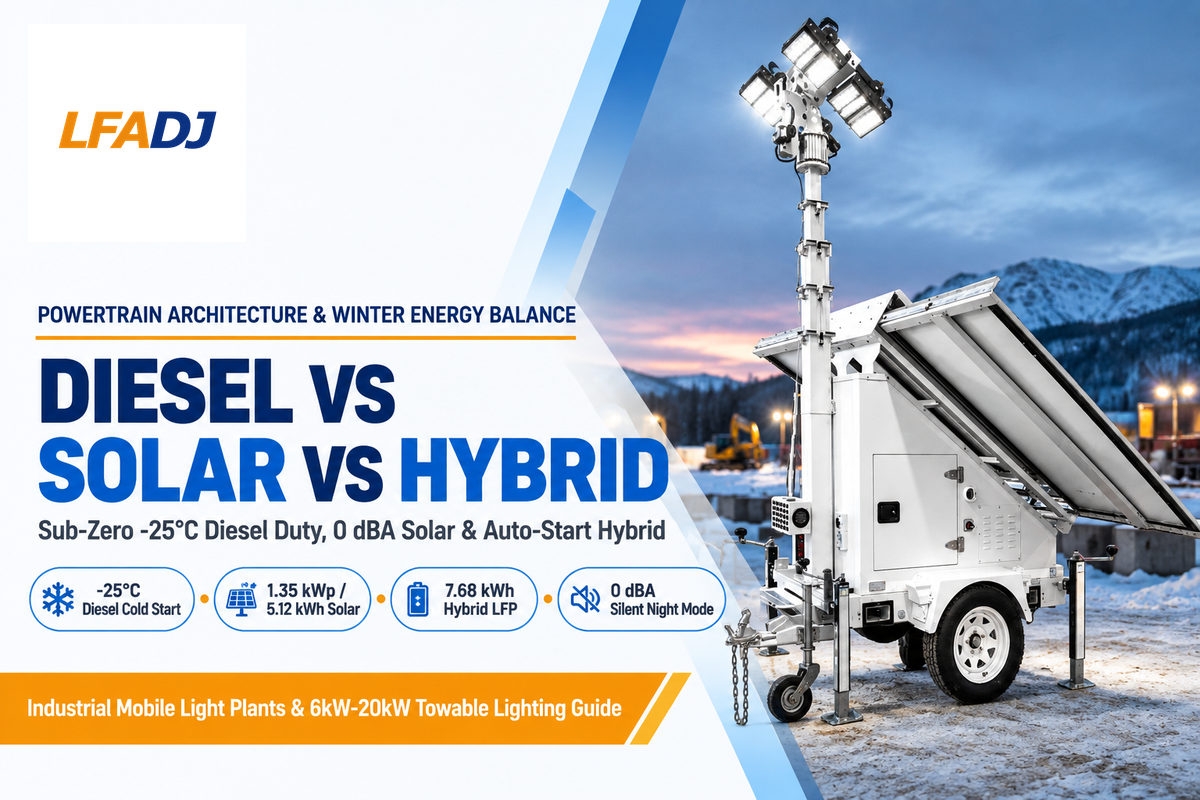
Matching local fuel logistics and limitations play a large role in determining the best power source for your application. The availability of winter sunlight also factors into the decision. Fleet buyers have a choice between three core powertrains. The first being Tier 4 Final diesel light plants. The second being pure solar battery powered units. You can compare how each architecture balances fuel burn and autonomy in our hybrid battery-diesel light tower architecture overview.
| Light Plant Type & Model Class | Powertrain Category & Tier | Lamp Array & Output | Energy Storage / Generator | Mast & Chassis Spec | Primary Jobsite Application |
|---|---|---|---|---|---|
| LFADJ D955 Hydraulic Diesel | Diesel Light Plant | 4x400W LED (1,600 W total) | Diesel genset; 3.5 kW net aux export | 7 m hydraulic mast; 340° rotation | Highway paving, civil grading, tool power |
| LFADJ D951 Manual-Winch Diesel | Diesel Light Plant | 4x400W LED floodlights | Diesel genset with AC receptacles | Manual winch telescopic mast | Long-term stationary site deployments |
| LFADJ D957 Pneumatic Diesel | Diesel Light Plant | 4x400W LED floodlights | Diesel genset with air-lift control | Pneumatic telescopic mast | Rapid-setup utility and municipal maintenance |
| LFADJ S975 Solar Trailer | Solar Light Plant (LiFePO4) | 4x100W LED (400 W, 5000K) | 1.35 kWp PV (3x450Wp); 5.12 kWh LFP | 7 m mast; 800 kg towable trailer | Sunbelt roadwork, residential noise curfews |
| LFADJ Hybrid Battery-Diesel | Hybrid Light Tower | 4x200W LED (800 W, 156,000 lm) | 7.68 kWh LFP (dual 25.6V 150Ah) + diesel | Telescopic mast; 1,250 to 1,380 kg | Year-round highway work, winter shifts |
| LFADJ High-Mast 4x1000W Project Unit | Heavy Diesel Light Plant | 4x1000W high-output LED array | High-capacity diesel generator package | 9 m manual telescopic mast | Large mining pits and port terminals |
| Commercial 6kW–8kW Fleet Tower | Tier 4 Final Diesel Class | 4x290W to 4x350W LED fixtures | 6 kW to 8 kW diesel; 30 to 52 gal tank | 23 ft to 30 ft vertical mast | General rental fleets and commercial sites |
| Heavy 20kW–21kW Super Light Plant | Tier 4 Final Heavy Diesel | 4x300W LED or 4x1000W metal halide | 20 kW to 21 kW diesel; 6 receptacles | 23 ft to 30 ft mast or steel skid | Oilfields, dewatering pumps, arctic camps |
| Compact 3.5kW Inverter Light Tower | Portable Gas / Diesel Class | 4x160W to 4x320W directional LED | 3,500 W generator; 2,000 W aux power | 18 ft vertical mast; 17 units/truck | Urban municipal repair and event staging |
| High-Output 10kW Electric-Lift Tower | Heavy Diesel Light Plant | 4x1000W LED floodlight array | 10.0 kW diesel genset; 27 gal fuel tank | 30 ft electric lifting vertical mast | Extreme desert and snowfield construction |
Advantages of Solar & Hybrid Light Plants
- Continuous zero noise (0 dBA) discharge of solar during night-time work satisfies municipal codes.
- It eliminates the need for daily diesel refueling and prevents low-load idling, which results in engine wet stacking.
- Eco-friendly operation produces zero carbon monoxide inside urban trenches, tunnels, or special events.
Limitations vs. Pure Diesel Light Plants
- Pure solar units can’t provide continuous 3.5 kW + AC power for heavy jobsite pumps or heaters.
- Northern winter cloud cover (<1.5 peak sun hours) results in a daily deficit of watt-hours.
- Standard LiFePO4 batteries block charging below 0°C (32°F) unless fitted with self-heating pads.
Tier 4 Final Diesel Light Plants for Continuous Sub-Zero and Multi-Shift Duty
Pure diesel light plants remain the top choice for 24-hour operations in sub-freezing climates. They’re also essential when crews need continuous AC receptacle power. On northern winter sites, liquid-cooled diesel engines use glow plugs and coolant block heaters. These components provide reliable cold-weather starting down to −25°C (−13°F). Operators can refuel a 100 L diesel tank in five minutes from a pickup slip tank. That quick stop restores another 90 to 120 hours of 4x400W LED output. Modern control panels also feature user-friendly digital gauges and auto-start timers that simplify winter operation.
When Should You Choose a Solar or Hybrid Light Plant Over Diesel in Winter?
If your night shifts are longer than 10 hours during the winter, choose the hybrid light plant over a pure solar unit. A hybrid is also needed if your solar irradiance drops below 2.5 peak sun hours. Winter hits pure solar towers from two directions at once: longer 14-hour nights increase the energy draw, and snow and low sun angles decrease daytime charging.
Both OpTraffic’s winter construction solar lighting guide and Lehui Power’s solar-hybrid nightly Wh sizing methodology highlight this seasonal trap. Let’s run the winter energy balance on a LFADJ S975 solar light plant with 1.35 kWp PV and 5.12 kWh LFP storage. Running four 100W LED fixtures (400W total) across a 14-hour December night consumes 5.60 kWh per night. An overcast northern winter day often delivers only 1.5 peak sun hours after charge controller conversion losses. Under those skies, the 1.35 kWp (3×450Wp) solar array harvests only 1.52 kWh per day (1.35 kWp × 1.5 hrs × 0.75). That leaves a 4.08 kWh daily energy deficit and depletes the battery bank on the second night. In addition, standard LiFePO4 battery management systems lock out charging below 0°C (32°F) unless battery heaters are installed.
By contrast, a 156,000-lumen hybrid mobile light tower model solves both winter problems. It pairs a 7.68 kWh (dual 25.6V 150Ah) battery bank and 4x200W LEDs with an auto-start backup generator. The tower runs silently on battery power for most of the shift. When battery state of charge reaches its low-voltage floor, the engine automatically starts at an efficient heavy charging load. After 2 to 3 hours of charging, the engine shuts off again.
What if a solar light tower shuts down after only two hours on a clear night? Field troubleshooting data from OpTraffic’s two-hour solar light tower shutdown diagnostic warns against replacing the battery bank first. Replacing batteries prematurely is the most expensive mistake owners make. A two-hour cutoff is rarely caused by bad lamps and isn’t always caused by dead battery cells. Instead, technicians should inspect the daytime charge path first. Check for corroded MC4 panel connectors, a tripped MPPT controller breaker, or shaded panels that blocked daytime charging.
LED vs Metal Halide Light Plants: Lumens, Glare Control, and Fuel Consumption
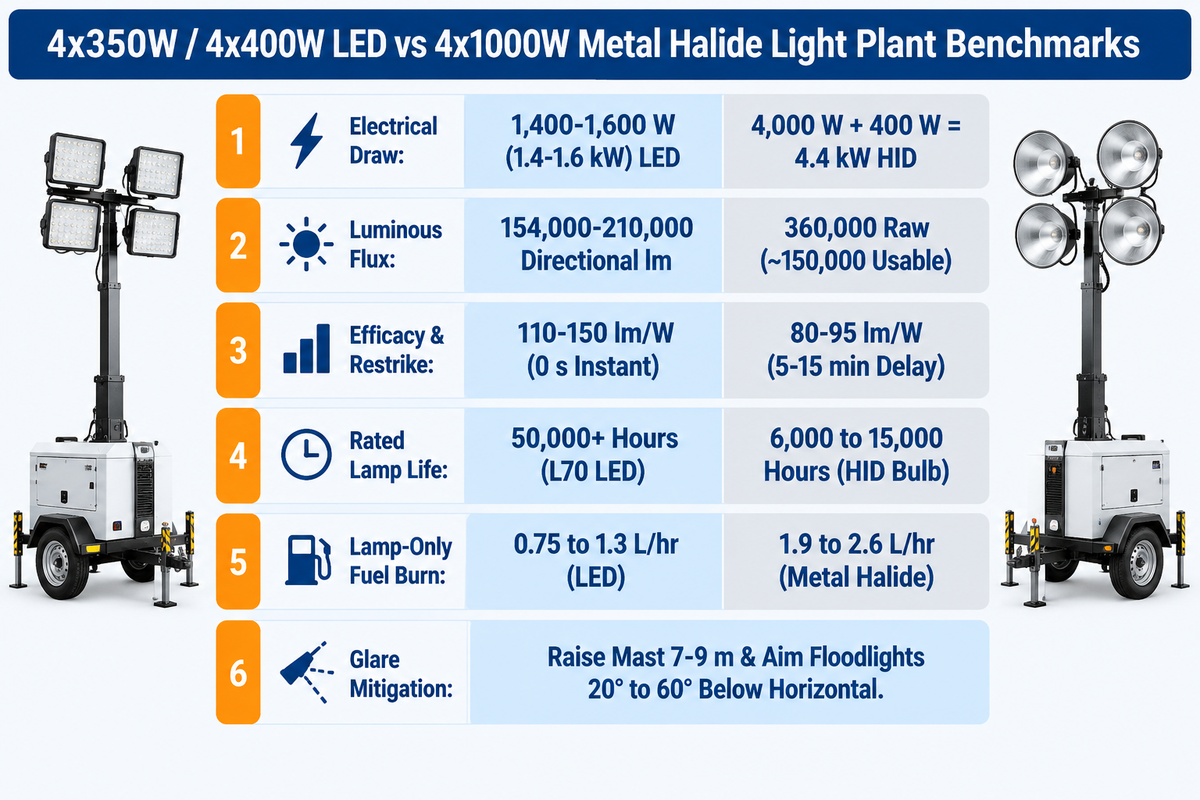
Solid-state LED luminaires have overtaken legacy 1,000W metal halide (HID) bulbs across new light plant production. High-output LED modules deliver equal or higher usable ground illuminance. At the same time, they cut lamp electrical draw from 4.4 kW down to 1.4 kW to 1.6 kW.
| Performance Metric | 4x350W / 4x400W LED Light Plant | 4x1000W Metal Halide Light Plant |
|---|---|---|
| Total Lamp & Driver/Ballast Draw | 1,400 W to 1,600 W (1.4 kW to 1.6 kW) | 4,000 W lamps + ~400 W ballast = 4.4 kW |
| Delivered Luminous Flux | 154,000 to 210,000 directional lumens | 360,000 raw spherical lumens (~150,000 usable on ground) |
| Luminous Efficacy | 110 to 150 lm/W (asymmetric optics) | 80 to 95 lm/W (isotropic bulb + reflector loss) |
| Cold Start & Hot Restrike Delay | 0 seconds (instant-on full brightness) | 3 to 5 min warm-up; 5 to 15 min hot restrike |
| Rated Lamp Service Life | 50,000+ hours (L70 lumen maintenance) | 6,000 to 15,000 hours (fragile glass arc tube) |
| Typical Fuel Burn (Lamp-Only) | 0.75 to 1.3 L/hr (0.20 to 0.35 gal/hr) | 1.9 to 2.6 L/hr (0.50 to 0.70 gal/hr) |
4x400W LED vs 4x1000W Metal Halide Photometric Output and Warm-Up Time
Four 1,000W metal halide lamps theoretically produce 360,000 to 440,000 raw lumens. In reality, a metal halide arc tube emits light in all directions (360°). Therefore, a considerable amount of light is trapped in the reflector bucket and there’s rapid lumen depreciation within the first 2,000 hours of use. As shown in LEDs Magazine’s outdoor solid-state luminaire efficacy analysis, high-output outdoor LED arrays, achieve 130 to 150 lm/W. Asymmetric lenses direct almost all of the photons down onto the work surface.
This is evident in published data in Allmand’s Night-Lite Pro II V-Series LED specifications. Four 350W LED fixtures (1,400W total) produce 154,000 usable lumens and run for 170 hours on a tank of fuel. A similar 4x400W LED array (1,600W total) produces 180,000 to 210,000 lumens with no warm-up time. Instant restrike protects crew productivity and prevents unscheduled downtime during night concrete pours or natural disaster rescues. Metal halide lamps take 5 to 15 minutes to cool down before the arc can be reignited. For fleet buyers, upgrading to LED fixtures is a sound capital investment that cuts fuel and maintenance costs.
Asymmetric Optics, Visor Aiming Angles, and Driver Glare Mitigation
Uncontrolled, high-intensity light presents a safety risk to site crews and passing highway traffic (including mine haul roads) and requires careful aiming. A study from the National Work Zone Safety Information Clearinghouse on driver visibility highlights this risk. Aiming floodlights too close to horizontal causes disability glare that blinds approaching motorists. This can be controlled by following DLC LUNA outdoor lighting technical requirements and CPWR Construction Solutions work zone lighting guidance:
- Raise the Mast to Full Height (7 m to 9 m): Elevating the crossarm to 23 ft to 30 ft increases the downward beam angle. It also shortens ground shadows behind excavators and pavers.
- Aim Floodlights 20° to 60° Below Horizontal: Never tilt floodlight heads above 60° from vertical nadir. Always point the beam away from oncoming traffic lanes.
- Use Balloon or Visor Optics in Flagger Zones: Fit the mast with anti-glare hood visors or a balloon light around flagger stations.
How Long Will a Light Plant Run on a Single Tank or Battery Charge?
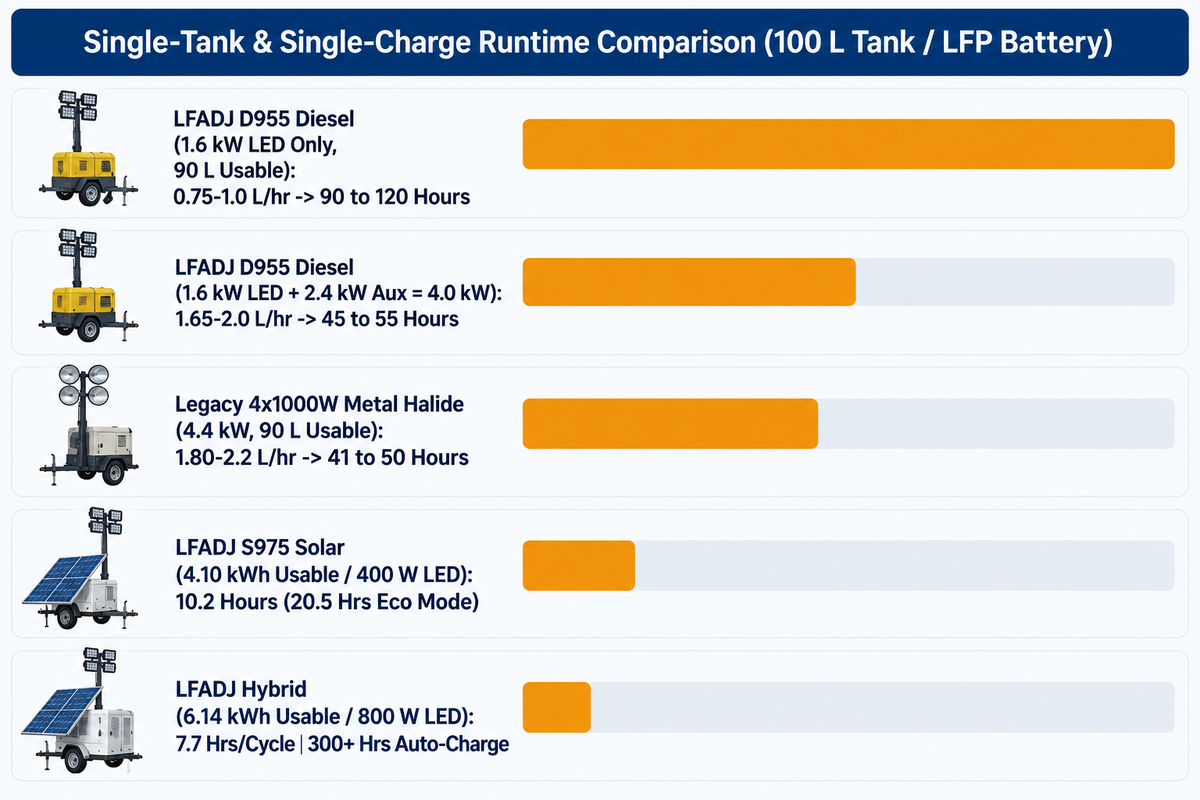
A new LED diesel light plant with a 100 L (26.4 gal) fuel tank can run on lamp-only duty for 90 to 170 hours. A legacy 4x1000W metal halide unit on a 100 L tank runs for about 45 to 50 hours . Both the 100L diesel lighting tower benchmark by Jackwin Safety and Equipment World’s roadbuilding light tower report provide data on this shift. LED retrofits and downsized engines have tripled refueling intervals to two or three weeks of night shifts.
Fuel Burn Rate Math and Tank Sizing Across Diesel, Hybrid, and Solar Units
Fuel pickup tubes are installed above the bottom sump of the tank to avoid drawing water and sediment. Operators should therefore take a bottom fuel reserve allowance when calculating diesel runtime (e.g. 60 L available after reserve at 2 L/h provides 30 hours). For battery-powered and solar units, use the manufacturer’s usable Depth of Discharge (DoD) for sizing shift autonomy:
- Diesel Usable Runtime (Hours) = Usable Fuel After Reserve (Liters) / Hourly Fuel Burn Rate (L/h)
- Battery Single-Charge Autonomy (Hours) = Usable Battery Storage (Wh) / Total LED Wattage (W)
| Light Plant Configuration | Tank / Battery Capacity | Electrical Load | Consumption Rate | Continuous Single-Tank / Charge Runtime |
|---|---|---|---|---|
| LFADJ D955 Diesel (LED Lamp-Only) | 100 L diesel (90 L usable) | 1.6 kW (4x400W LED) | 0.75 to 1.0 L/hr | 90 to 120 hours (9 to 12 ten-hour nights) |
| LFADJ D955 Diesel (LED + Aux Load) | 100 L diesel (90 L usable) | 4.0 kW (1.6 kW LED + 2.4 kW tools) | 1.65 to 2.0 L/hr | 45 to 55 hours (4.5 to 5.5 ten-hour nights) |
| Legacy Diesel (4x1000W Metal Halide) | 100 L diesel (90 L usable) | 4.4 kW (lamps + ballasts) | 1.80 to 2.2 L/hr | 41 to 50 hours (4 to 5 ten-hour nights) |
| LFADJ S975 Solar (No Sun Reserve) | 5.12 kWh LFP (4.10 kWh usable reserve) | 400 W (4x100W LED full output) | 0.40 kWh/hr | 10.2 hours (20.5 hrs in dimmed eco mode) |
| LFADJ Hybrid (Battery Cycle Only) | 7.68 kWh LFP (6.14 kWh usable reserve) | 800 W (4x200W LED full output) | 0.80 kWh/hr | 7.7 hours per battery cycle (300+ hrs with diesel auto-charge) |
| Rental Fleet Solar Tower (1.4–1.6 kW PV) | Deep-cycle solar battery bank | 4x160W to 4x200W LED fixtures | 0.64 to 0.80 kWh/hr | 35 to 40 hours per charge (published rental fleet spec) |
| Compact 3.5kW Inverter Light Tower | Single onboard fuel tank | 4x160W to 4x320W LED fixtures | Variable-speed inverter load | 80 hours on a single tank of fuel |
| Heavy 10.0kW 30ft Electric-Lift Tower | 27 gal (102 L) diesel tank | 4x1000W high-output LED array | Full 10.0 kW generator duty | 15 hours continuous full-output operation |
How Cold Weather and Auxiliary Tool Loads Derate Usable Runtime
Two jobsite variables shrink the single-tank or single-charge numbers shown in brochures. First, plugging a 2.4 kW submersible pump or heater into a 6 kW diesel light plant raises total demand to 4.0 kW. That extra load keeps the diesel engine healthy and prevents wet stacking. However, it increases fuel burn from ~0.85 L/hr to ~1.8 L/hr and cuts refueling intervals from 105 hours to 50 hours. Second, winter Blended No. 1 / No. 2 diesel fuel contains slightly less thermal energy than summer No. 2 diesel. Sub-freezing temperatures also reduce usable battery storage.
Jobsite Lighting Layout: Sizing a Light Plant for OSHA 1926.56 Foot-Candles
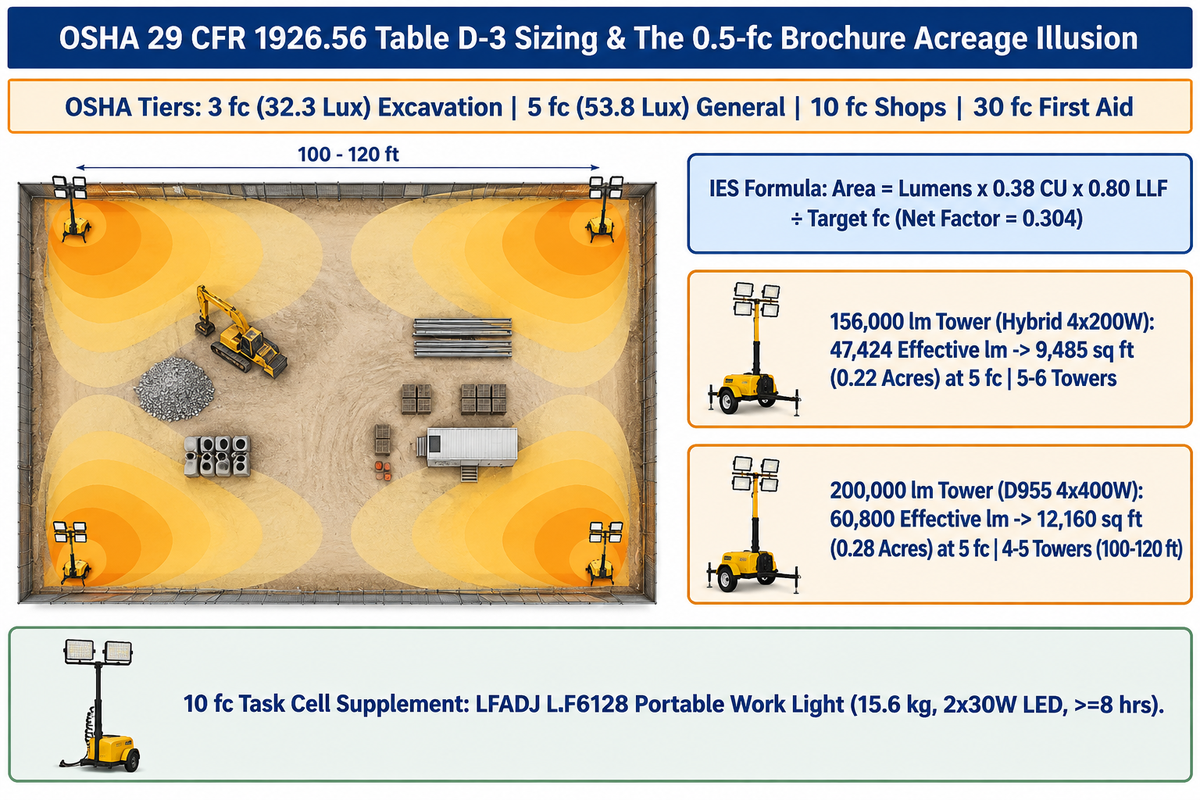
Safety engineers in the United States must size jobsite lighting around OSHA Standard 29 CFR 1926.56 (Illumination) Table D-3. Never rely on marketing acreage claims for night work. One foot-candle (fc) is about 10.764 lux and is equivalent to one lumen of light per square foot of surface area.
“29 CFR 1926.56(a) General. Construction areas, ramps, runways, corridors, offices, shops, and storage areas shall be lighted to the minimum intensities in Table D-3.”
OSHA 29 CFR 1926.56 Table D-3 Minimums (3 fc, 5 fc, 10 fc, and 30 fc Zones)
OSHA Table D-3 separates construction sites into four main tiers of illuminance based on task hazards:
- 3 Foot-Candles (32.3 Lux): Areas where concrete is placed, excavation and waste removal areas, access ways, active storage areas, loading platforms, refueling zones and field maintenance areas.
- 5 Foot-Candles (53.8 Lux): General construction area lighting, and indoor warehouses, corridors, hallways, and exit ways.
- 10 Foot-Candles (107.6 Lux): General construction plants and shops, and batch and screening plants, mechanical and electrical rooms, carpenter shops, and active storerooms.
- 30 Foot-Candles (322.9 Lux): First aid stations, infirmaries, field engineering offices.
How Many Square Feet Does a Single Light Plant Actually Cover at 5 Foot-Candles?
A single 154,000 to 200,000-lumen LED light plant covers 9,400 to 12,160 square feet (0.22 to 0.28 acres) at a maintained OSHA 5 foot-candle level. It doesn’t cover the 5 to 7 acres stated in rental brochures. We call this the 0.5-fc Brochure Acreage Illusion. If a catalog states that one tower light covers 6 acres (261,360 sq. ft.) that contour extends to 0.5 fc at the edge. Even with directional glass optics, where Equipment World notes a 320-watt LED covers 21,528 square feet and four 160-watt LED bulbs illuminate up to 32,292 square feet, brochure footprints include low-lux perimeter spill. That outer perimeter is ten times dimmer than OSHA’s general construction requirement of 5 fc.
Use the Illuminating Engineering Society (IES) Lumen Method to determine compliant square footage for any light plant:
Compliant Area (sq ft) = (Total Lamp Lumens × Coefficient of Utilization (CU) × Light Loss Factor (LLF)) ÷ Target Foot-Candles (fc)
Outdoor mast floodlights lose light to beam spill, atmospheric scattering, and oblique projection angles. Those factors yield a typical Coefficient of Utilization (CU) of 0.38. Lens dust and thermal depreciation give a Light Loss Factor (LLF) of 0.80 (combined net utilization factor = 0.304). Here’s how a 156,000-lumen tower (LFADJ Hybrid 4x200W) and a 200,000-lumen tower (LFADJ D955 4x400W) perform on a 50,000 sq ft (1.15-acre) site requiring 5 fc:
- 156,000 lumen tower: Multiply 156,000 lm by 0.38 CU and 0.80 LLF to get 47,424 effective lumens. Divided by 5 fc, one tower covers 9,485 sq ft (0.22 acres) at 5 fc (or 15,808 sq ft at 3 fc). Covering 50,000 sq ft at 5 fc requires 5 to 6 towers.
- 200,000 lumen tower: Multiply 200,000 lm by 0.38 CU and 0.80 LLF to get 60,800 effective lumens. Divided by 5 fc, one tower covers 12,160 sq ft (0.28 acres) at 5 fc (or 20,267 sq ft at 3 fc). Covering 50,000 sq ft at 5 fc requires 4 to 5 perimeter towers spaced 100 to 120 feet apart.
Heavy excavators, pipe trenches and mechanical rooms require 10 fc without boom shadows. Parked perimeter trailers can’t reach those confined work cells. Crews pair perimeter towable plants with compact 15.6 kg portable work lights. For example, the LFADJ LF6128 (2x30W LED heads, 25.2V 22Ah battery, IP65 lamp head, ≥8 hours runtime) sits directly beside the task.
Light Plant Rental vs Buying in 2026: Price Bands and Utilization Break-Even
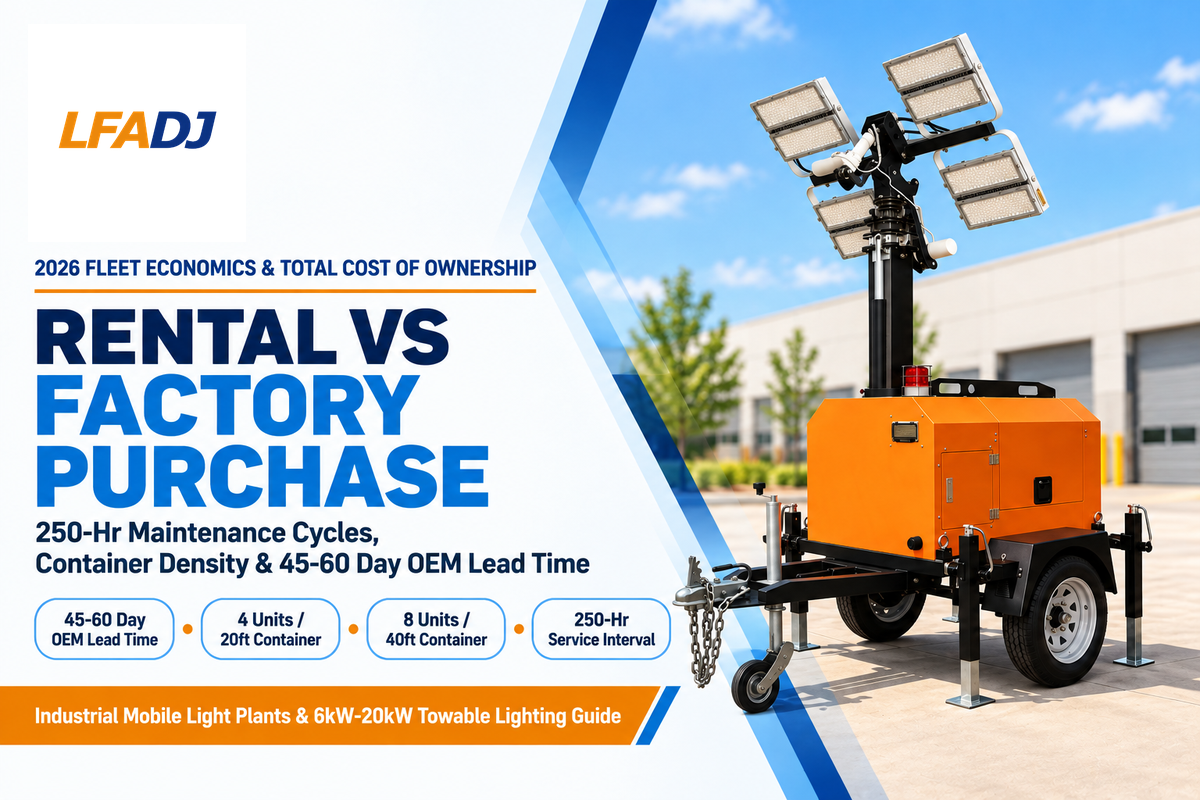
In 2026, whether to rent or buy a light plant will depend on the projected length of the project and how heavily the equipment will be utilized. We reviewed various procurement frameworks, available in Tide Power’s light tower rental vs. purchase analysis and OriginalPricing’s portable light tower cost guide. Rental rates and purchase prices depend on the brand of engine, kW of the generator, type of mast, and the quantity ordered (request for a quote to get site-specific prices. For factory-direct orders, LFADJ offers the D955 configuration with a delivery lead time of 45-60 days.)
| Powertrain Category | New Purchase Price Basis | Short-Term Rental Billing | Monthly Rental Billing | Typical Purchase Break-Even Basis |
|---|---|---|---|---|
| Diesel LED Light Plant (6kW–8kW) | Quoted by engine brand and mast configuration (request a quote) | Daily or weekly rate varies by branch | Monthly rate plus fuel and transport | Multi-month civil and roadwork contracts |
| Solar Light Plant (LFP Battery) | Quoted by solar array kWp and battery kWh (request a quote) | Daily or weekly zero-fuel billing | Monthly rate with zero diesel cost | Faster payback when replacing daily refueling labor |
| Hybrid Battery-Diesel Light Plant | Quoted by LiFePO4 pack and genset size (request a quote) | Daily or weekly hybrid fleet billing | Monthly rate with reduced fuel burn | Year-round multi-shift highway deployments |
| Used / Surplus Diesel Light Plant | Varies by engine hours and auction condition (request inspection) | N/A (owner-maintained) | N/A | Short utilization window (higher repair risk) |
2026 New Purchase Price Tiers vs Daily, Weekly, and Monthly Rental Rates
Regional rental rates vary by season. The haul distance also affects rates. Most national rental houses bill on a four-week cycle rather than a calendar month. Above the basic rental charge, additional fees are assessed for damage waivers and environment surcharges. For short projects like a weekend event or a 2-week paving job, renting is more convenient.
Calculating the Project Duration Crossover Including Maintenance and Resale
To determine your Total Cost of Ownership (TCO) crossover point, compare the net depreciation against the total of rental invoices. Remember to consider preventive maintenance costs, which are scheduled every 250 hours (engine oil change, replacement of fuel and air filters, quote these from your service dealer).
A highway contractor needs a 4x400W LED diesel light plant for a multi-phase road construction contract. While assessing two quotations, ensure the equipment scope, delivery freight, load-specific fuel consumption, and planned maintenance are accounted for under matching annual operating hours. Recurring monthly rental charges, round-trip, flatbed transportation, and damage waivers, quickly mount up for long-term contracts. Purchasing a new diesel LED light plant maintains resale equity upon completion of the contract and eliminates long-term rental charges. Direct OEM container orders, with a 45–60 days factory lead time and 4 units per 20 ft or 8 units per 40 ft container, lower per-unit landed cost and compress payback into a single construction season.
2026–2028 Fleet Outlook and Spec Verification Checklist for Light Plant Buyers
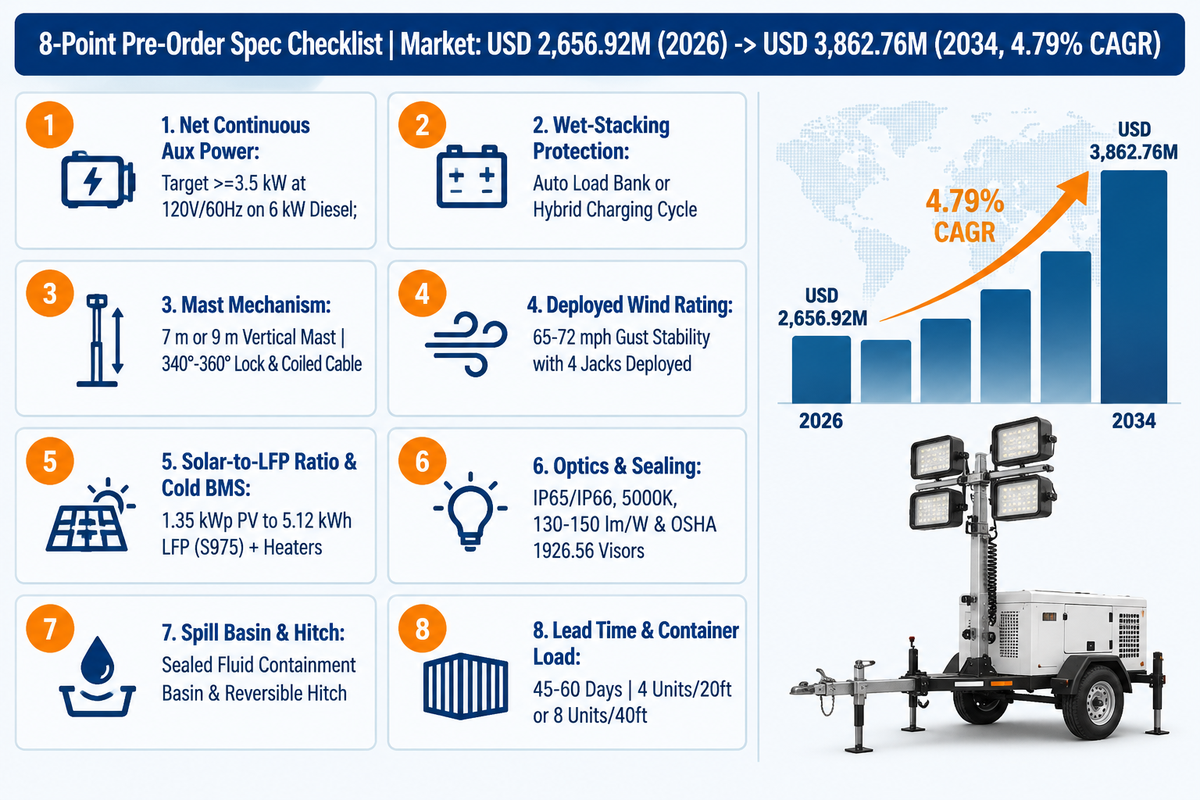
Global demand for mobile lighting equipment continues to expand steadily. According to Fortune Business Insights’ 2026 global light tower market report, the worldwide market reached USD 2,535.5 million in 2025. It’s projected to grow from USD 2,656.92 million in 2026 to USD 3,862.76 million by 2034 at a 4.79% CAGR. Contractor demand for “light plant” units has risen alongside this expansion as contractors replace metal halide trailers with LED, solar, and hybrid fleets.
How Fleet Electrification and Noise Ordinances Reshape 2026–2028 Light Plant Procurement
Three primary factors will influence replacement cycles of construction equipment fleets between 2026 and 2028. That rule accelerates adoption of silent solar (S975) and auto-cycling hybrid towers. Second, rental fleets are retiring 4x1000W metal halide towers to eliminate bulb breakage and cut nightly diesel fuel burn substantially. Third, a majority of the major OEMs, including Generac Mobile, Atlas Copco, Wacker Neuson, Allmand, Bobcat and Progress Solar Solutions, have introduced modular product platforms. Configurable diesel, solar and hybrid towable towers are also available from factory-direct OEM producers like LFADJ (Zhejiang LONGFA Lighting Co., Ltd.).
Pre-Order Factory Verification Checklist for OEM and Rental Fleet Buyers
Before placing a dealer purchase order or an OEM production run, you must verify the following eight engineering specifications in the datasheet:
- Net Continuous Auxiliary kW at 120V/60Hz: Check how many kilowatts remain available at the outlets with all floodlights running (target ≥3.5 kW on a 6 kW diesel unit).
- Low Load Wet-Stacking Protection: Confirm that an LED diesel unit employs an engine with automatic load bank or a hybrid charging cycle to prevent low-load carbon fouling.
- Mast Elevation & Rotation Mechanism: Specify a 7 m or 9 m hydraulic or dual-winch vertical mast, a 340° to 360° rotation lock, and internal coiled cable routing (as on the LFADJ D955).
- Deployed Wind Speed Rating & Outrigger Span: Verify the wind gust rating (65-72 mph) with all four jacks deployed.
- Solar PV-to-Battery Ratio & Cold-Weather BMS: Check the PV wattage vs. LiFePO4 capacity (such as 1.35 kWp PV to 5.12 kWh LFP on the LFADJ S975). Request self-heating battery pads for sub-zero charging.
- Luminaire Ingress Protection & Photometrics: Require IP65 or IP66 fixture sealing, 5000K color temperature, 130 to 150 lm/W efficacy, and individual tilt visors for OSHA 1926.56 glare control.
- Bunded Spill Containment & DOT Hitch: Confirm that the diesel and hybrid frames have a sealed fluid containment basin and a reversible pintle/ball coupler.
- Standard OEM Lead Times & Container Density: Account for standard OEM factory lead times (45-60 days on LFADJ D955 orders). Check how many vertical-mast units fit in a container (4 units fit in a 20 ft container, and 8 units fit in a 40 ft container) to reduce ocean freight costs.
Frequently Asked Questions
1. Is a light plant the same thing as a portable light tower?
In everyday construction, roadbuilding, and mining terminology, field crews use “light plant” and “portable light tower” interchangeably for a towable mast floodlight unit. Technically, however, a light plant always includes an onboard electrical power generation station. That station is a 6 kW to 20 kW diesel generator or a solar-hybrid LiFePO4 battery bank wired with 120V and 240V receptacles for jobsite tools. By contrast, the broader term “light tower” also covers shore-powered tripod masts, balloon lights, and stadium poles that rely entirely on external grid power and carry no prime mover.
2. Can a diesel light plant power jobsite tools while the floodlights are running?
Yes, provided you subtract the floodlight wattage and apply a standard continuous generator derating margin first. Take a 6 kW diesel light plant equipped with four 400W LED floodlights (1.6 kW lamp load, such as the LFADJ D955). Its safe 5.1 kW continuous budget leaves 3.5 kW (about 29 amps at 120V AC) of auxiliary receptacle power. That output runs submersible dewatering pumps, pipe heaters, or tool chargers while the lamps stay on.
3. Why do LED diesel light plants experience engine wet stacking, and how do you prevent it?
Wet stacking occurs when a diesel generator runs far below its optimal rated load band for extended shifts. Light loads keep exhaust temperatures below 260°C (500°F), so unburned fuel coats the injectors and exhaust stack. Four 400W LED floodlights (1.6 kW) load a 6 kW diesel engine to only a small fraction of capacity. Fleet operators prevent wet stacking by connecting auxiliary tool loads, specifying right-sized 2.5 to 3.5 kW engines, or using hybrid battery-diesel towers.
4. How much fuel does a diesel light plant burn per hour?
A 4x400W LED diesel light plant burns 0.75 to 1.3 liters per hour on lamp-only duty. Older 4x1000W metal halide towers burn 1.9 to 2.6 liters per hour.
5. Can a solar light plant work through northern winter night shifts?
Pure solar light plants often struggle during mid-winter shifts above 40° latitude. Long 14-hour nights increase energy draw while overcast skies drop solar irradiance below 1.5 peak sun hours per day. Running four 100W LED fixtures for 14 hours consumes 5.60 kWh per night. Meanwhile, a 1.35 kWp solar array (three 450Wp panels on the LFADJ S975) generates only 1.52 kWh on a 1.5-sun-hour winter day. That deficit depletes a 5.12 kWh LiFePO4 battery within two nights. Standard LiFePO4 battery management systems also block charging below 0°C (32°F) without self-heating pads. For sub-freezing winter or 24-hour work, contractors should select a hybrid battery-diesel light plant or a Tier 4 Final diesel unit.
6. What wind speed can a mobile light plant withstand with its mast fully extended?
Most commercial towable light plants can take 65-72 mph (105-115 km/h) winds on level ground. All four outriggers and tongue jacks need to be fully extended and locked. If forecasted winds are 45-50 mph, operators should lower the telescopic mast to the stowed position.
Specifying Diesel, Solar, or Hybrid Light Plants for Your Fleet?
Zhejiang LONGFA Lighting Co., Ltd. (LFADJ) manufactures towable diesel (D955), solar (S975), and hybrid mobile light plants plus IP65 portable work lights. For OEM specifications, photometric layouts, and container load schedules, please contact our engineering team.
Request a Factory Fleet Quote for LFADJ Mobile Light Towers & Explore More
References & Sources
- Occupational Safety and Health Administration (OSHA) – Standard 29 CFR 1926.56 Illumination & Table D-3 Minimum Illumination Intensities in Foot-Candles
- Electronic Code of Federal Regulations (eCFR) — Title 29 Part 1926 Subpart D §Electronic Code of Federal Regulations (eCFR) — Title 29 Part 1926 Subpart D §1926.56 Construction Illumination Standards 1926.56 Construction Illumination Standards
- Electronic Code of Federal Regulations (eCFR) – Title 40 Part 1039 Control of Emissions from New and In-Use Nonroad Compression-Ignition Engines
- U.S. Environmental Protection Agency (EPA) – Final Rule Control of Emissions of Air Pollutants from Nonroad Gasoline-powered Engines and Fuel (Tier 4 Final Rule, Updated April 2026)
- National Work Zone Safety Information Clearinghouse — Work-Zone Lighting’s Effect on Driver Visibility and Glare Control
- CPWR (The Center for Construction Research and Training) — Construction Solutions: Work-Zone Lighting
- United States Patent and Trademark Office (USPTO) — Patent US8833985B2: Mobile Light Tower with Multi-Section Telescoping Mast
- UK Intellectual Property Office / Google Patents — Patent GB2491421B: Mobile Lighting Tower Apparatus and Outrigger Stabilization
- LEDs Magazine — DLC LUNA Technical Requirements for Outdoor LED Lighting and Glare Control
- Equipment World — New Era of Light Towers: Extended LED Runtime and Hybrid Roadbuilding Systems
LFADJ · COMPANY & TECHNICAL CONTEXT
Practical lighting guidance for real project conditions
LFADJ shares product context, application notes, and selection checks to help project teams compare industrial lighting options with the right site details in view.
What LFADJ covers
LFADJ focuses on industrial lighting and tailored lighting solutions for teams planning, specifying, or operating demanding work environments.
- Product context: mobile lighting, light towers, explosion-proof lighting, emergency lighting, and related industrial lighting equipment.
- Project context: application conditions, target illumination, runtime, site constraints, and product configuration questions.
- Decision support: use the information here as a starting point, then confirm final specifications against the actual installation and local requirements.
Industrial lighting
Application guidance
Project enquiries
NEXT STEP
Have a site question?
Send the operating environment, lighting target, expected runtime, and any drawings or photos you have. The existing enquiry form is ready for a focused discussion.
Start an enquiry Or use the LFADJ contact page